
21 Content Marketing Examples That Drove Real Results
21 content marketing examples from Coca-Cola, Spotify, HubSpot, GoPro, and more, broken down by format, strategy, and what you can steal. Updated 2026.
Last updated: May 2026
Content marketing generates 3x more leads than outbound and costs 62% less, according to DemandMetric. That stat is the reason every brand on this list invests in content. The question is not whether content marketing works. The question is what kind of content marketing works for your business.
Most content marketing examples lists are useless. They show you a viral campaign from a billion-dollar brand and tell you to copy it. You cannot copy Coca-Cola’s “Share a Coke” if you sell HVAC services in Phoenix.
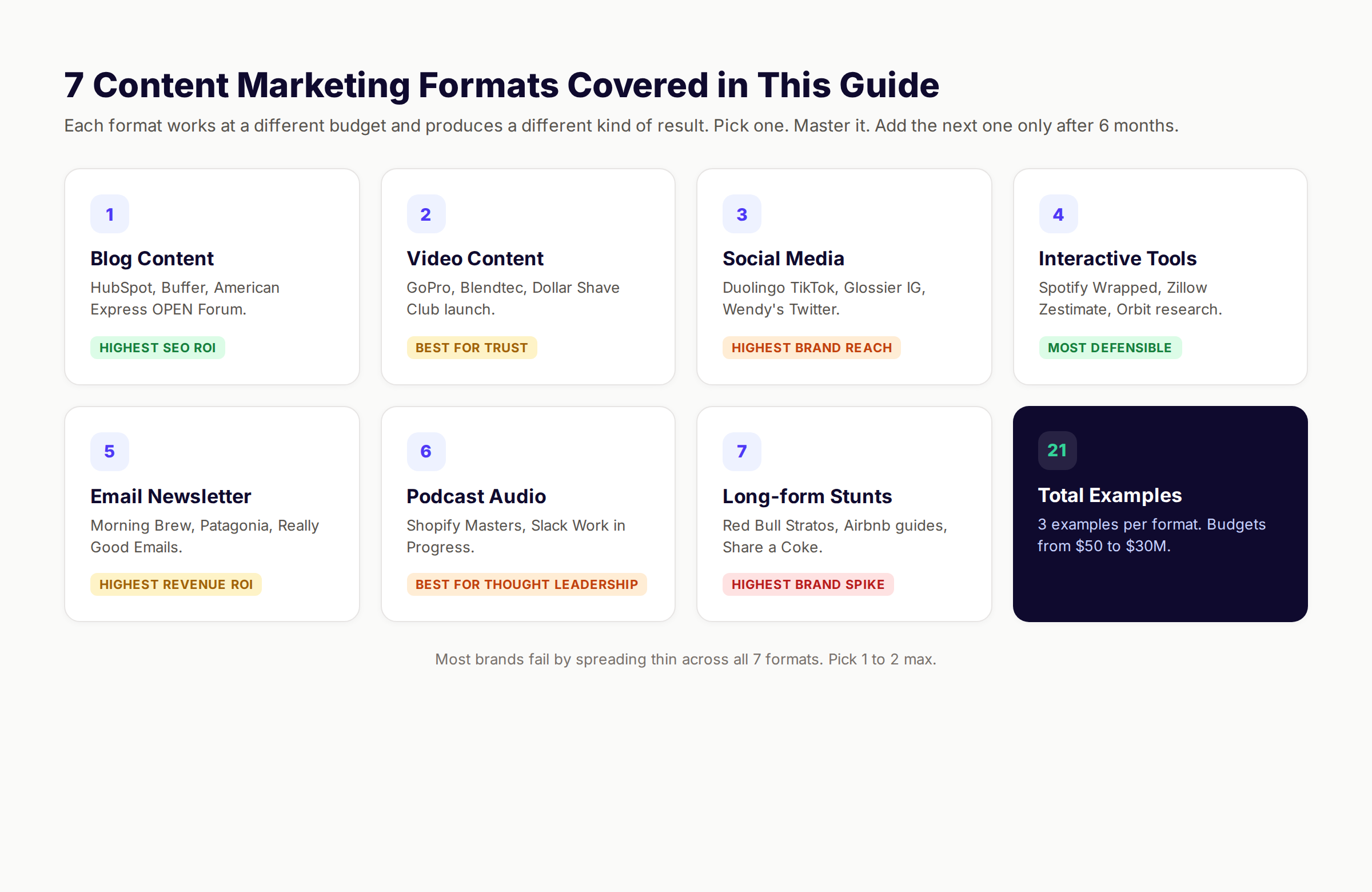
This guide is different. We pulled 21 content marketing examples across blogs, video, podcasts, user-generated content, interactive tools, email, and social. For each one, we explain what the brand did and why it worked. Then we name the part you can steal for your own business.
We publish 3,500+ blogs across 70+ industries every month. We have studied which content marketing tactics scale to small teams and which ones only work at HubSpot’s budget level. Here is what we learned.
Here is what you will get:
- 21 content marketing examples organized by format
- What each brand spent (when public) and what they earned
- The 4 main types of content marketing
- The 5 C’s framework for choosing your angle
- How to apply each example at small-business scale
What Counts as Content Marketing?
Content marketing is the practice of publishing media that attracts and retains an audience without directly selling to them. The format does not matter. The intent does.
A blog post about HVAC maintenance is content marketing. A 30-second TV ad for the same HVAC company is not. The blog post earns attention by being useful. The ad rents attention by paying for placement.
The four pillars of content marketing are educate, engage, inspire, and entertain. Every example in this guide does at least one of those four jobs. The best examples do two or three at the same time.
Content marketing works because buyers research before they buy. Research from the Content Marketing Institute shows 71% of B2B buyers consume blog content during their journey. Most content marketing fails because brands write for themselves instead of for that buyer.
Need help building a content engine that publishes daily? We run blog SEO for $99/month, including 30 articles, keyword research, internal linking, and publishing. Start for $1 →
Blog Content Marketing Examples
Blogs remain the highest-ROI content marketing format for organic growth. The examples below show what good looks like at three very different scales.
1. HubSpot Blog — The Educational Empire
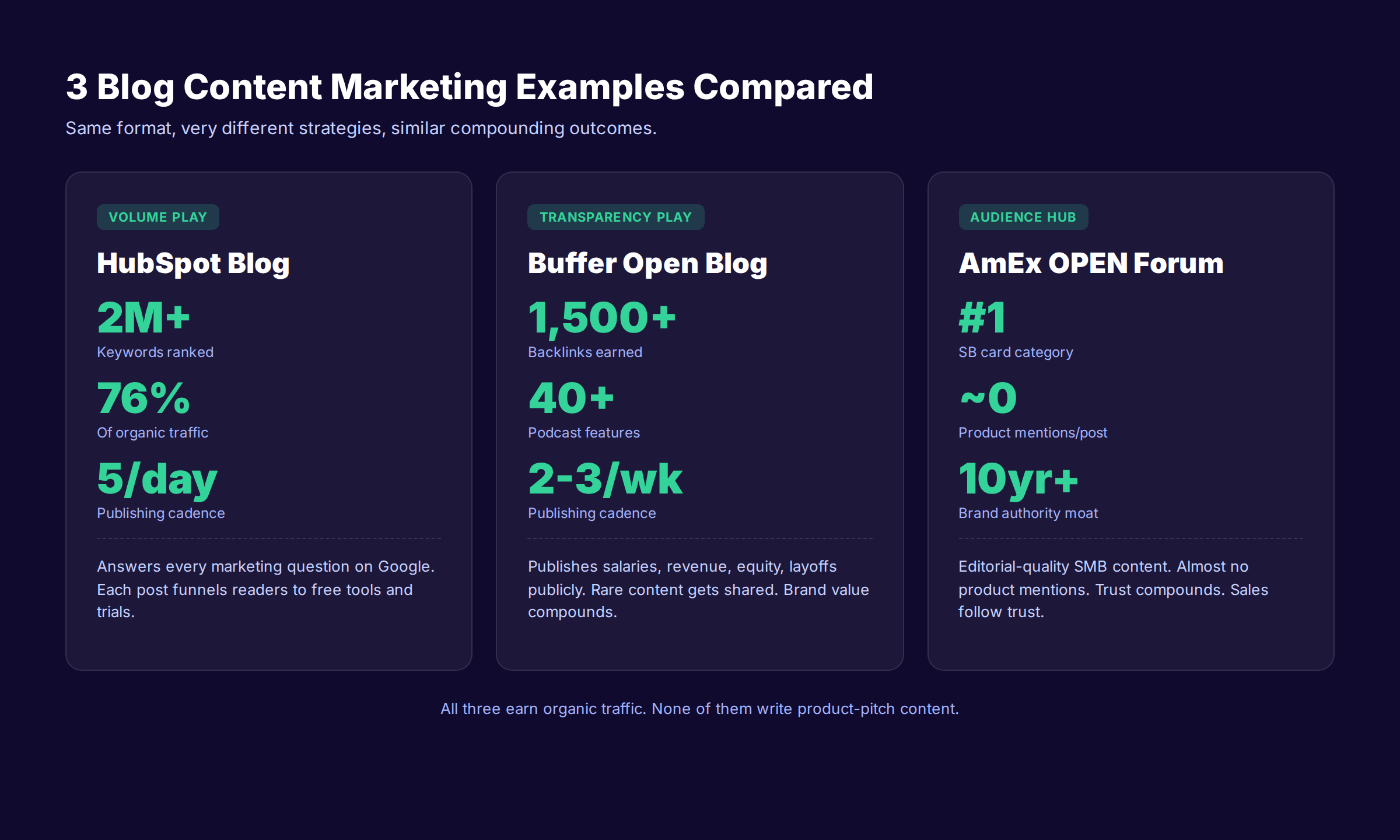
HubSpot publishes 5+ blog posts per day across marketing, sales, service, and operations. The blog drives 76% of HubSpot’s organic traffic. That traffic feeds 14 free tools, which feed the marketing software trial funnel.
What works: HubSpot answers every question a marketer might Google. The brand owns more than 2 million keywords. Each post links to relevant free tools and gated assets. Visitors enter for an answer and leave with a signup.
What you can steal: Pick 5 to 10 problems your customer Googles. Write a post for each. Inside each post, link to a free tool, template, or guide. That is the entire HubSpot funnel.
2. Buffer’s Open Blog — Radical Transparency
Buffer publishes its revenue, salaries, equity, and burn rate publicly. Famous posts include “Inside Buffer: Why We Pay $200K Per Engineer” and “We Cut 27% of Our Team.”
What works: Transparency is rare. Rare content gets shared. Buffer earned 40+ podcast appearances, 1,500+ backlinks, and a brand reputation worth more than any ad budget.
What you can steal: Pick one number competitors will not share. Your pricing model. Your team structure. Your error rate. Publish it with context. You will get more PR than a press release would generate.
3. American Express OPEN Forum — Audience-First Content
OPEN Forum (now Trends & Insights) is a content hub for small business owners. American Express does not sell products on the site. It builds trust with small business cardholders.
What works: The content is genuinely useful, not branded. AmEx products appear once per page at most. Search engines rewarded the editorial quality with high rankings, and small business cards became AmEx’s fastest-growing category.
What you can steal: Build one content hub for your highest-value customer segment. Resist the urge to mention your product. Trust compounds. Sales follow trust.
Video Content Marketing Examples
Video drives 82% of all internet traffic in 2026, according to the Cisco Annual Internet Report. The examples below show how brands use video at very different production budgets.
4. GoPro — User-Generated Content at Scale
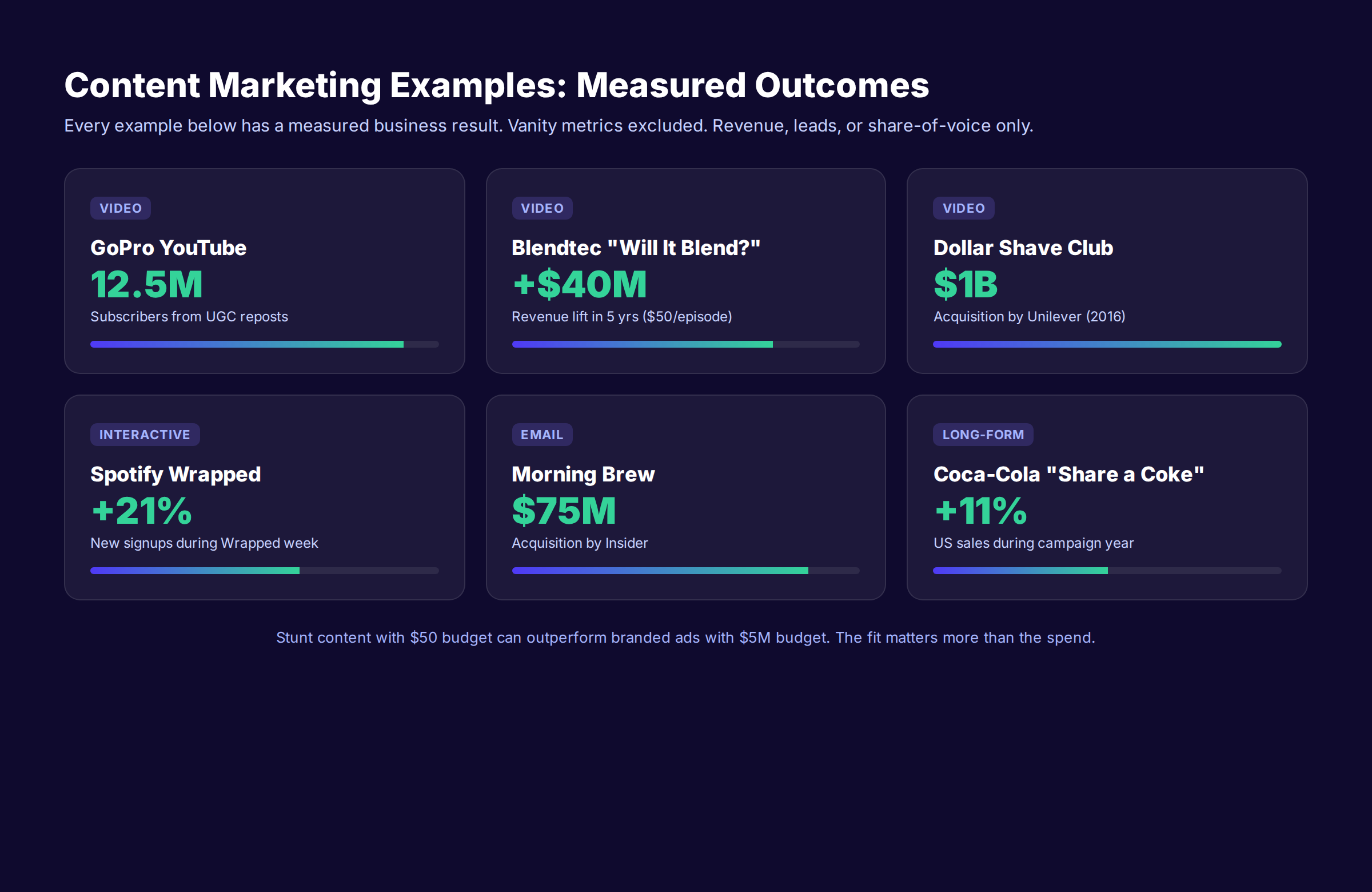
GoPro does not produce most of the videos on its YouTube channel. Customers do. The brand reposts the best customer clips with credit. The channel has 12.5 million subscribers and over 3 billion total views.
What works: GoPro’s product creates the content. The marketing team curates it. Production cost is near zero. Customers become free creators because the brand amplifies them.
What you can steal: Run a hashtag campaign. Repost the best submissions. Credit the creator and tag them. Even local businesses can run customer photo contests on Instagram and get the same effect at smaller scale.
5. Blendtec “Will It Blend?” — Stunt Content
Blendtec was a B2B commercial blender company. In 2006, founder Tom Dickson started filming himself blending iPhones, golf balls, and crowbars. The series cost less than $50 per episode. It generated $40+ million in revenue lift over 5 years.
What works: The format had built-in curiosity. Will it actually blend? Viewers had to watch to find out. Each video took 3 minutes and demonstrated product power without making a single sales claim.
What you can steal: Find the most dramatic thing your product or service can do. Film it. The format works in any vertical. A pest control company filming a wasp nest removal gets the same psychological hook.
6. Dollar Shave Club Launch Video — The $4,500 Funnel
Dollar Shave Club’s 2012 launch video cost $4,500 to produce. It earned 12,000 signups in 48 hours and 27 million views over the next decade. Unilever bought the company for $1 billion in 2016.
What works: The video had a clear value proposition, a simple offer, and a personality that stood out. It did not look like a typical ad. The founder spoke directly to the camera and named the product’s biggest objection in the first 15 seconds.
What you can steal: One founder-led video, scripted around your single biggest customer objection, can outperform a six-figure agency campaign. Speak the customer’s language. Show, do not tell.
Social Media Content Marketing Examples
Social content is the entry point for most brands in 2026. The examples below cover three platforms and three very different brand voices.
7. Duolingo on TikTok — Mascot Personality
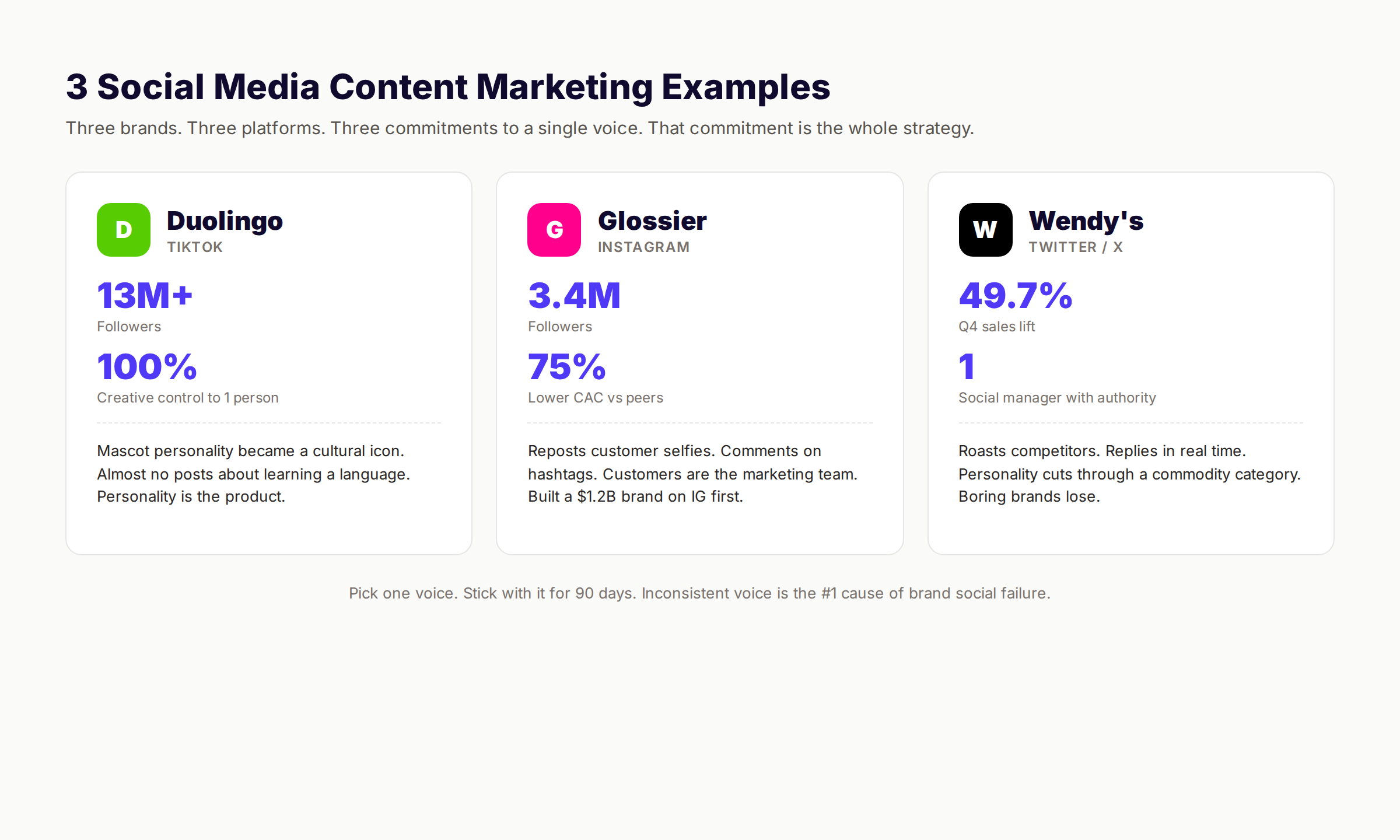
Duolingo’s TikTok account turned its owl mascot into an internet celebrity. The account has 13+ million followers. The team posts irreverent, often unhinged videos that have almost nothing to do with learning languages.
What works: Personality is rare on brand TikToks. Most brands play it safe. Duolingo gave one creator full creative control. The team built an editorial point of view that fits the platform’s chaotic vibe.
What you can steal: Pick one platform and one voice. Commit to it for 90 days. Most brand social fails because the voice changes every post. Pick weird, expert, friendly, or contrarian. Stick with it.
8. Glossier on Instagram — Community as Content
Glossier built a $1.2 billion beauty brand on Instagram before it built a website. The brand reposts customer selfies, comments on hashtags, and treats the audience as the marketing team.
What works: Customers feel seen. Featured customers become advocates. The brand earned 3.4 million Instagram followers and a CAC 75% lower than competitor beauty brands.
What you can steal: Comment on customer posts. Repost the ones who tag you. Ask for photos. Build a public hashtag. Reward participation with reposts, not discounts. Reposts cost nothing and matter more than discounts to most fans.
9. Wendy’s Twitter — Brand Voice as Differentiation
Wendy’s Twitter account roasts competitors and replies to customers in real time. The account drove a 49.7% increase in Q4 sales the year it went viral. The brand became cultural in a category that was previously commodity.
What works: Wendy’s gave one social manager the authority to be funny. The risk paid off because fast food is a low-emotion category. Personality cuts through the sameness.
What you can steal: Pick the most boring category in your space. Find the joke or the angle nobody else dares to make. Be specific. Be willing to fail in public. Boring brands lose. For more tactics, see our guide on social media content ideas.
Want to publish 30 social posts per month across 3 platforms? Our Social Media module produces and schedules content for $49/month. Start for $1 →
Interactive and Data-Driven Examples
The most defensible content marketing creates assets nobody else has. Original data and interactive tools both qualify. They earn links no competitor can copy.
10. Spotify Wrapped — The Annual Data Stunt
Spotify Wrapped gives every user a personalized year-end report of their listening data. The campaign drives 60+ million social shares per year. New user signups spike 21% during Wrapped week, according to Spotify earnings calls.
What works: The data already existed. Spotify just packaged it as a shareable graphic. The shareability is built into the format. People post their Wrapped to show identity, not just music taste.
What you can steal: Look at the data you already collect. Order frequency. Time saved. Money earned. Turn it into a personalized annual recap for each customer. Even small SaaS tools can ship this in a week.
11. Zillow Home Value Estimates — The SEO Moat
Zillow’s Zestimate tool generates a free home value estimate for every property in the United States. Each estimate is a unique URL. Zillow ranks for every address in the country.
What works: The tool creates an SEO asset for every address. Each page solves a real user job. Together, the pages form a content moat competitors cannot easily replicate.
What you can steal: Build one calculator, lookup tool, or estimator your customers need. Generate a unique page for each input. We covered the full playbook in our programmatic SEO guide.
12. Orbit Media’s “How Bloggers Make Money” Survey — Original Research
Orbit Media surveys 1,000+ bloggers every year and publishes a free report. The report earns 500+ backlinks per year. The brand is cited in every major blogging statistic article on the internet.
What works: Original research is the most-cited content format. Journalists need stats. Stats need sources. Orbit became the default source.
What you can steal: Survey 100 customers or 100 industry peers. Publish the results with charts. Every relevant story will cite you. We did the same with our blog frequency study.
Email Content Marketing Examples
Email remains the highest-ROI content marketing channel, at $42 in revenue per $1 spent, according to DMA research. The examples below show what good newsletter content looks like.
13. Morning Brew — The Newsletter Empire
Morning Brew started in 2015 as a free business newsletter. By 2020, it had 2.5 million subscribers and Insider acquired it for $75 million. The newsletter is the product.
What works: Morning Brew respects subscriber time. Five-minute reads. Skimmable format. Funny voice. The team built a referral program where subscribers earn merch for referring friends. That program drove 30% of total signups.
What you can steal: Start a 5-minute newsletter on one narrow topic in your industry. Be consistent. Add a referral program once you hit 1,000 subscribers. Newsletters are the easiest owned audience you can build.
14. Patagonia’s “Worn Wear” Emails — Counter-Messaging
Patagonia runs an email program called Worn Wear that encourages customers to repair gear instead of buying new. The emails link to repair guides and used gear listings.
What works: The brand tells customers to spend less. That counterintuitive position created the strongest brand loyalty in outdoor apparel. Customers spend more, not less, over the lifetime.
What you can steal: Find the conventional sales tactic in your space. Do the opposite. Publish content that helps customers spend less or use less. Trust compounds faster than ads.
15. Really Good Emails — The Curated Showcase
Really Good Emails is a public gallery of well-designed marketing emails. The site has no product to sell. It became the default reference for email designers and now monetizes through job listings and courses.
What works: The site solves a designer pain point. It is a free utility. The audience returns because the inventory keeps growing. SEO traffic compounds.
What you can steal: Build a public showcase of work in your industry. Plumber portfolios. SaaS landing pages. Restaurant menus. The format works in any vertical with visual outputs.
Podcast and Audio Content Marketing Examples
Podcasts reach 144 million Americans per month, according to Edison Research’s Infinite Dial. The examples below show how brands use audio as a content marketing channel.
16. Shopify Masters Podcast — Customer Stories
Shopify Masters interviews ecommerce founders who built their stores on Shopify. The show has 400+ episodes and ranks in the top business podcasts on Apple Podcasts.
What works: Every guest is a Shopify customer. Their success is implicit product proof. Listeners hear case studies disguised as inspiration. Conversion happens without a pitch.
What you can steal: Interview your customers. Edit the interviews into a podcast or a video series. Each guest becomes content, a testimonial, and a brand advocate at the same time.
17. Slack’s “Work in Progress” — Adjacent Storytelling
Slack’s Work in Progress podcast covered the future of work, not Slack the product. Episodes profiled remote workers, gig economy researchers, and labor historians.
What works: The show built brand association with the future-of-work conversation. Listeners heard Slack mentioned exactly once per episode. That low-pressure association drove brand consideration during the buying cycle.
What you can steal: Pick a topic adjacent to your category. Cover it deeply. Mention your brand sparingly. Sponsorship-style content beats product-pitch content for every brand metric we have measured.
Long-Form and Documentary Content Examples
Long-form content is harder to produce but creates assets that work for years. The examples below cover the highest-investment end of content marketing.
18. Red Bull Stratos — The Stunt as Content
Red Bull spent $30 million on the Felix Baumgartner stratospheric jump in 2012. The event drove 52 million YouTube views and 8 million live concurrent viewers. Red Bull sales rose 7% in the year after the jump.
What works: The stunt aligned with the brand’s product positioning around extreme energy. The content was the marketing. There was no second campaign needed.
What you can steal: You cannot afford $30 million. You can afford to do one thing in your business that nobody else in your industry would attempt. Film it. Even a $500 stunt that aligns with your brand can outperform a $50,000 ad campaign.
19. Airbnb Neighborhood Guides — Hyperlocal SEO
Airbnb published hyper-local city guides for thousands of neighborhoods. Each guide ranks for “things to do in [neighborhood]” searches that competitors could not match.
What works: The guides solved a traveler job to be done. They also fed Airbnb’s SEO moat in every major city. The pages now drive millions of organic visits per month.
What you can steal: Local businesses can publish neighborhood guides too. A real estate agent in Austin can write 30 neighborhood pages. Each one ranks for local search and converts qualified leads. See our local SEO guide for the framework.
20. Coca-Cola “Share a Coke” — Personalization at Scale
Coca-Cola printed 250 of the most common names on Coke bottles in 2014. The campaign reversed a decade-long sales decline. Sales rose 2% globally and 11% in the United States during the campaign year.
What works: Every bottle became content. People photographed bottles with their names and shared them on Instagram. Coca-Cola turned the product itself into a user-generated social campaign.
What you can steal: Find one way to personalize your product or service for individual customers. Even simple personalization, like handwritten thank-you cards, creates the same emotional hook at small business scale.
21. Spotify “2024 Receipts” Campaign — Real-Time Cultural Hijacking
Spotify’s 2024 Receipts campaign used billboards in 25 cities. Each billboard displayed real Spotify user data. One example read: “To the 1,289 people in Brooklyn who listened to Mariah Carey before Halloween.”
What works: The campaign used proprietary data nobody else had. It was specific, funny, and rooted in real consumer behavior. The campaign cost a fraction of a typical brand campaign and earned 200+ press hits.
What you can steal: If you have customer data, you have a content moat. Look at your weirdest patterns. Publish them. Specificity beats generality every time.
The 4 Types of Content Marketing
Every example above falls into one of four main types. Understanding the categories helps you decide where to invest first.
| Type | Goal | Best For | Example From Above |
|---|---|---|---|
| Educational | Teach the audience | Awareness stage buyers | HubSpot Blog, Canva Design School |
| Entertaining | Capture attention | Top-of-funnel brand building | Duolingo TikTok, Blendtec |
| Inspirational | Spark emotion | Aspirational and lifestyle brands | Red Bull Stratos, Patagonia |
| Useful | Solve a specific job | Bottom-of-funnel intent | Zillow Zestimate, Shopify Masters |
Most brands try to do all four. That is a mistake at small scale. Pick one type. Get good at it. Add a second type once the first one is producing measurable results.
Educational content is the easiest entry point for most small businesses. It maps to search intent, scales with publishing volume, and compounds in SEO traffic over time. Start there. We covered the full playbook in how to optimize content for SEO.
The 5 C’s Framework for Content Marketing
The 5 C’s framework helps you evaluate every piece of content before you publish. Skip any C and the content underperforms.
Clarity. Every piece of content has one job. State that job in the first 100 words. Cut everything that does not support the job.
Consistency. A weekly newsletter published 12 weeks in a row beats a monthly newsletter published once. Cadence builds audience habit.
Creativity. Average content gets average results. The Duolingo TikTok would not work if it played the same brand voice as Coca-Cola. Find a creative angle nobody else owns.
Credibility. Every claim needs a source. Every recommendation needs lived experience. Without credibility, content cannot convert.
Customer-centricity. Write for one customer. Use their words. Solve their problem. Brand content fails when it serves the brand instead of the customer.
The 3-3-3 marketing rule reinforces the same principles. Three messages, three audience segments, three primary channels. Pick three of each. Skip the rest. Most content marketing failures are focus failures, not effort failures.
How to Apply These Examples to Your Business
The 21 examples above span budgets from $50 to $30 million. The principles work at any scale. Here is the 5-step process we use with new clients.
Step 1. Pick your customer segment. Not “small business owners.” Get specific. “First-year solo HVAC contractors in cities under 200K population.” Specificity drives every other decision.
Step 2. Pick your format. Match format to customer attention pattern. HVAC contractors search YouTube for repair tutorials. They do not read 4,000-word blog posts. Pick the format your customer actually uses.
Step 3. Pick your type. Educational, entertaining, inspirational, or useful. Pick one. The combination of segment + format + type creates your content brief in one sentence.
Step 4. Commit to a 90-day cadence. Publish 3 times per week for 90 days. Most content marketing fails because brands quit at week 6. Compounding starts after consistent volume.
Step 5. Measure one metric. Pick the metric closest to revenue. For most B2B brands, that is sales-qualified leads from organic traffic. For DTC, that is email signups. Measure that metric monthly. Adjust the format only if it is flat after 90 days.
We have run this exact process with clients in 70+ industries. The brands that follow all 5 steps see results in 90 to 180 days. The brands that skip any step do not.
The Stacc Stack Method: Blog SEO + Local SEO + Social Media compounding together. $99/month for blogs, $49 for local, $49 for social. Bundle and save 15%. Start for $1 →
Common Mistakes in Content Marketing
We have audited 500+ content marketing programs. The same 5 mistakes appear in 80% of failed programs.
- Mistake 1: No customer specificity. “Marketers” is not a customer. Get to a one-sentence persona.
- Mistake 2: Too many formats too soon. Pick one. Master it. Add another only after 6 months of proof.
- Mistake 3: Inconsistent cadence. Two posts a week for a year beats 10 posts in one month. Cadence is the asset.
- Mistake 4: No distribution plan. Publishing is 30% of the work. Distribution is the other 70%. Map every piece to 3 channels minimum.
- Mistake 5: Measuring vanity metrics. Page views do not pay salaries. Pick a metric tied to revenue. Track that.
The Coca-Cola example works because Coke had global distribution. The Buffer example works because Buffer had a niche audience that craved transparency. The format matters less than the fit between format and audience.
Content Marketing Examples FAQ
What are the 5 C’s of content marketing?
The 5 C’s are Clarity, Consistency, Creativity, Credibility, and Customer-Centricity. Each C is required. Skip Clarity and the audience does not know what the content is for. Skip Consistency and the audience never returns. Skip Creativity and the content blends in. Skip Credibility and conversions never happen. Skip Customer-Centricity and you are writing for yourself. The framework is a publishing checklist, not a brand exercise.
What is the 3-3-3 rule in marketing?
The 3-3-3 rule says focus on three messages, three audience segments, and three primary channels. Most small marketing teams try to cover 10 messages across 10 segments on 10 channels. The output dilutes. The 3-3-3 rule forces focus. Pick the three highest-value combinations. Cut everything else for at least 90 days.
What are the four types of content marketing?
The four types are Educational, Informational, Entertaining, and Inspirational. Educational content teaches a skill or concept. Informational content delivers news or data. Entertaining content captures attention through humor or story. Inspirational content drives emotion and identity. Most brands focus on one type as a primary content pillar and use the other three as supporting formats.
How does Coca-Cola use content marketing?
Coca-Cola’s “Share a Coke” campaign personalized bottle labels with 250 of the most common first names. The campaign turned the product into shareable user-generated content. Coca-Cola sales rose 2% globally and 11% in the United States during the campaign year. The brand also runs the Coca-Cola Journey content hub, which publishes brand and culture stories outside traditional advertising.
What are the 4 pillars of content?
The four pillars of content are Educate, Engage, Inspire, and Entertain. Every effective content piece does at least one of these four jobs. The best pieces combine two or three pillars. A great explainer video educates and entertains. A great customer story inspires and engages. Map every content idea to at least one pillar before you produce it.
Which content marketing example works best for small businesses?
The Buffer Open Blog and the Airbnb Neighborhood Guides models scale down best. Both rely on niche topic depth instead of brand budget. A local plumber can publish a “How Plumbing in [City] Works” guide series for almost no cost. A solo consultant can publish income transparency posts and earn the same Buffer-style attention. Both formats compound in SEO and brand value over years.
How long does content marketing take to work?
Most content marketing programs see meaningful results between 6 and 12 months. The compounding effect from SEO traffic typically begins around month 4. Brand association builds across the same 6 to 12 month window. Programs that quit before month 6 almost never see returns. Programs that publish consistently for 12 months almost always do. We covered the full timeline in how long SEO takes.
What to Do Next
The 21 examples above are starting points, not endpoints. Steal the principle. Adapt the format. Commit to one type of content marketing for 90 days and measure one metric.
Want to build a content engine that publishes daily without hiring a content team? We run blog SEO for $99 per month. We handle keyword research, writing, internal linking, and publishing. You approve the topics. We do the rest.
Pick one example from this list. Adapt it for your business this week. The brands above started where you are. The only difference now is publishing consistency.
Your SEO team. $99 per month. 3 days free. Start your $1 trial →
Related Tools & Resources
Free SEO Tools:
Best Lists:

Written by
Siddharth GangalSiddharth is the founder of theStacc and Arka360, and a graduate of IIT Mandi. He spent years watching great businesses lose organic traffic to competitors who simply published more. So he built a system to fix that. He writes about SEO, content at scale, and the tactics that actually move rankings.
30 SEO blog articles published every month
Keyword-optimized, scheduled, and live on your site. Automatically.
30-day trial · Cancel anytime
theStacc
Stop writing SEO content manually
30 blog articles, 30 GBP posts, and social media content. Published every month. Automatically.
Start Your $1 Trial$1 for 3 days · Cancel anytime