E-E-A-T in YMYL Topics: The Complete Guide (2026)
Learn how E-E-A-T applies to YMYL topics. Covers trust signals, author authority, quality rater scoring, and content strategies for high-stakes SEO.
Stacc Editorial • 2026-04-04 • SEO Tips
In This Article
Google holds some content to a higher standard than the rest. If your pages cover health, finance, legal matters, or safety, a single factual error can tank your rankings overnight.
That higher standard has a name: E-E-A-T in YMYL topics. Sites that ignore it saw 55% traffic drops during the March 2026 core update. Sites that built for it gained 23% in organic visibility.
This guide breaks down what E-E-A-T means for YMYL content, how Google quality raters score it, and the exact signals you need to build into your pages. No vague advice. No recycled definitions. Just the framework that determines whether high-stakes content ranks or disappears.
We publish 3,500+ blogs across 70+ industries. Every article follows E-E-A-T principles. This guide covers everything we know about ranking content that people depend on for critical decisions.
Here is what you will learn:
- What E-E-A-T and YMYL mean and why they matter together
- The 6 YMYL categories Google evaluates in 2026
- How quality raters score YMYL pages differently from regular content
- 7 specific signals that prove E-E-A-T in high-stakes niches
- How to build author and entity authority for YMYL
- Common mistakes that destroy trust signals
- How AI-generated content fits into YMYL standards
Table of Contents
- Chapter 1: What E-E-A-T and YMYL Mean Together
- Chapter 2: The 4 Pillars of E-E-A-T Applied to YMYL
- Chapter 3: Every YMYL Category Google Evaluates in 2026
- Chapter 4: How Google Quality Raters Score YMYL Pages
- Chapter 5: 7 Signals That Prove E-E-A-T in YMYL Niches
- Chapter 6: Building Author and Entity Authority for YMYL
- Chapter 7: Common E-E-A-T Mistakes in YMYL Content
- Chapter 8: E-E-A-T in YMYL and AI-Generated Content
- Frequently Asked Questions
Chapter 1: What E-E-A-T and YMYL Mean Together {#ch1}
E-E-A-T stands for Experience, Expertise, Authoritativeness, and Trustworthiness. YMYL stands for Your Money or Your Life. Separately, each concept shapes how Google evaluates content quality. Together, they form the most demanding standard in search.
Google introduced the original E-A-T framework in its Search Quality Rater Guidelines. In December 2022, Experience was added as the first E. The reason was straightforward. Google recognized that someone who has actually used a product, lived with a medical condition, or managed a financial portfolio brings value that formal credentials alone cannot match.
YMYL content is any page that could affect a person’s health, financial security, safety, or well-being. Google applies stricter quality standards to YMYL content because bad information in these areas causes real harm.
Why the Combination Matters
A recipe blog with weak E-E-A-T might rank lower. A health advice page with weak E-E-A-T might not rank at all.
The stakes scale with the topic. Google uses over 80 algorithmic signals to measure E-E-A-T concepts. For YMYL queries, these signals carry significantly more weight. The March 2026 core update made this explicit by amplifying experience signals above all previous ranking factors.
This means two sites with identical on-page SEO can rank completely differently. The site with verified author credentials, primary source citations, and first-hand experience will outrank the one with generic advice every time. On YMYL queries, the gap is even wider.
The YMYL Spectrum
Not every YMYL topic carries equal weight. Google evaluates content on a spectrum.
| YMYL Level | Examples | E-E-A-T Standard |
|---|---|---|
| High YMYL | Medical dosage, tax filing, legal rights | Near-perfect accuracy required |
| Medium YMYL | Fitness advice, budgeting tips, nutrition | Strong expertise expected |
| Low YMYL | Product reviews, hobby guides, recipes | Standard quality signals |
A page about heart medication dosages faces scrutiny that a page about hiking boots does not. Understanding where your content falls on this spectrum determines how much E-E-A-T investment you need.
Chapter 2: The 4 Pillars of E-E-A-T Applied to YMYL {#ch2}
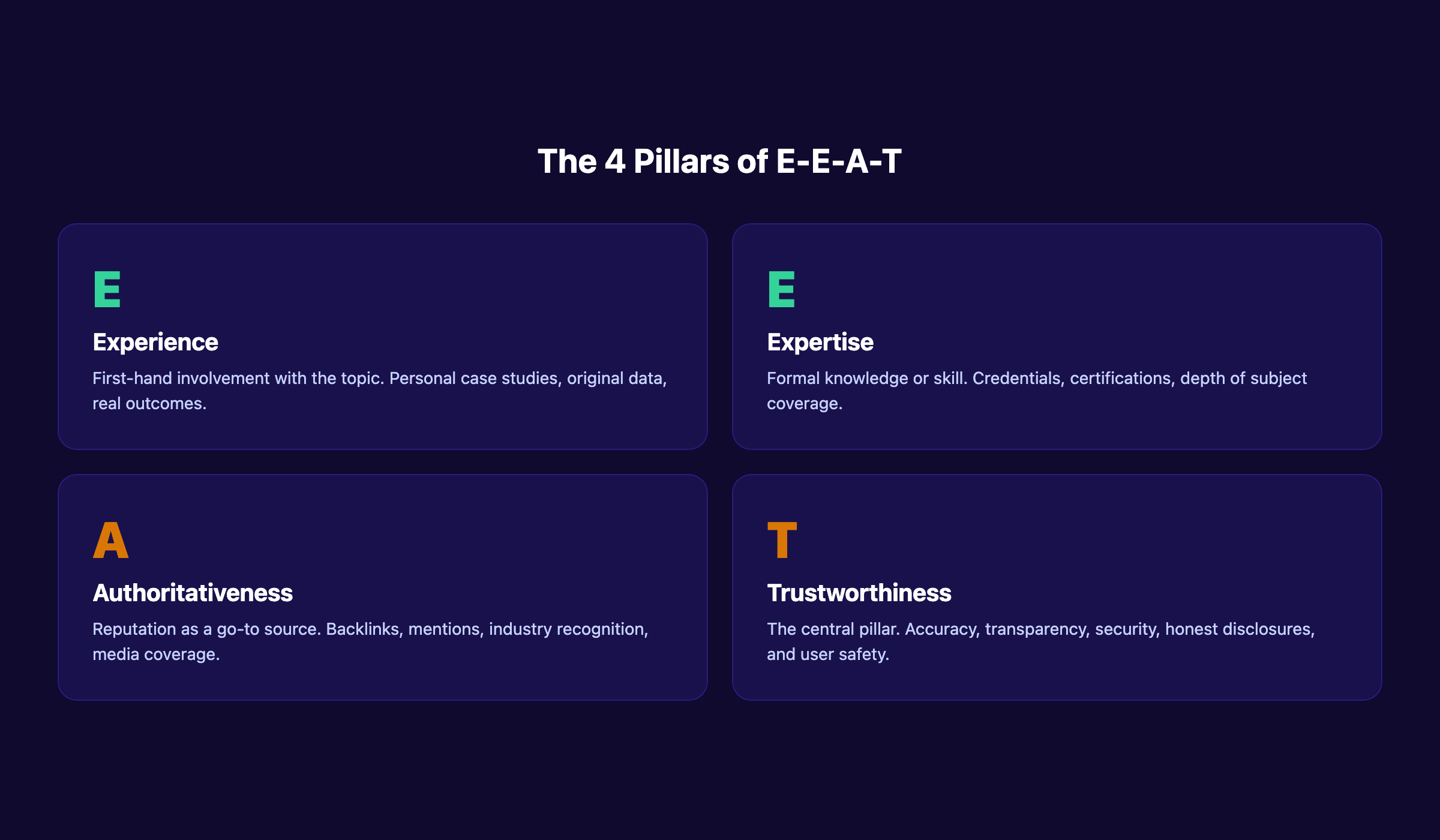
Each pillar of E-E-A-T carries different weight depending on the YMYL category. Trust sits at the center. The other 3 pillars feed into it.
Experience: The Newest and Most Powerful Pillar
Experience measures whether the content creator has first-hand involvement with the topic. For YMYL content, this is the pillar that separates content that ranks from content that stalls.
A financial advisor writing about retirement planning from 15 years of client work carries more weight than a content writer summarizing Investopedia articles. Google’s March 2026 update amplified experience signals beyond all previous ranking factors.
For YMYL content, experience means showing specific outcomes. Name the condition you treated. Share the investment return you achieved. Reference the case you handled. Vague generalizations do not qualify as experience signals.
Expertise: Formal and Informal Knowledge
Expertise is about demonstrated knowledge and skill. For high-YMYL topics like medical advice, formal credentials matter. A board-certified physician writing about diabetes management carries inherent expertise signals.
The exception is informal expertise. Someone who has managed diabetes for 20 years also possesses genuine expertise. Google recognizes both forms. The key difference for YMYL content is documentation. Your expertise must be visible. It must be verifiable.
Build your content strategy around authors who can demonstrate either formal credentials or deep lived experience with the topic.
Authoritativeness: Reputation Beyond Your Own Site
Authoritativeness measures how the broader web perceives your site and authors. For YMYL topics, this pillar depends on external validation.
Key authority signals for YMYL content include:
- Backlinks from .gov, .edu, and recognized industry sources
- Media mentions and expert quotes in third-party publications
- Industry awards, certifications, and professional memberships
- Consistent citation across multiple trusted platforms
Mayo Clinic ranks for over 700,000 health searches. The reason is not word count. It is that 4,500 medical professionals contribute to their content, and every major health organization links to them.
Trustworthiness: The Central Pillar
Trust is the foundation. Google states explicitly in its quality rater guidelines that trustworthiness is the most important member of the E-E-A-T family.
For YMYL content, trust signals include:
- HTTPS encryption and visible security indicators
- Clear contact information and physical address
- Transparent editorial policies and correction procedures
- Honest disclosure of affiliations and conflicts of interest
- Accurate, current information with dates visible
A site that publishes outdated medical advice without review dates will lose trust signals regardless of how strong the other 3 pillars are.
Your content quality determines your rankings. We publish E-E-A-T-optimized articles that build trust with Google and your audience. Start for $1 →
Chapter 3: Every YMYL Category Google Evaluates in 2026 {#ch3}
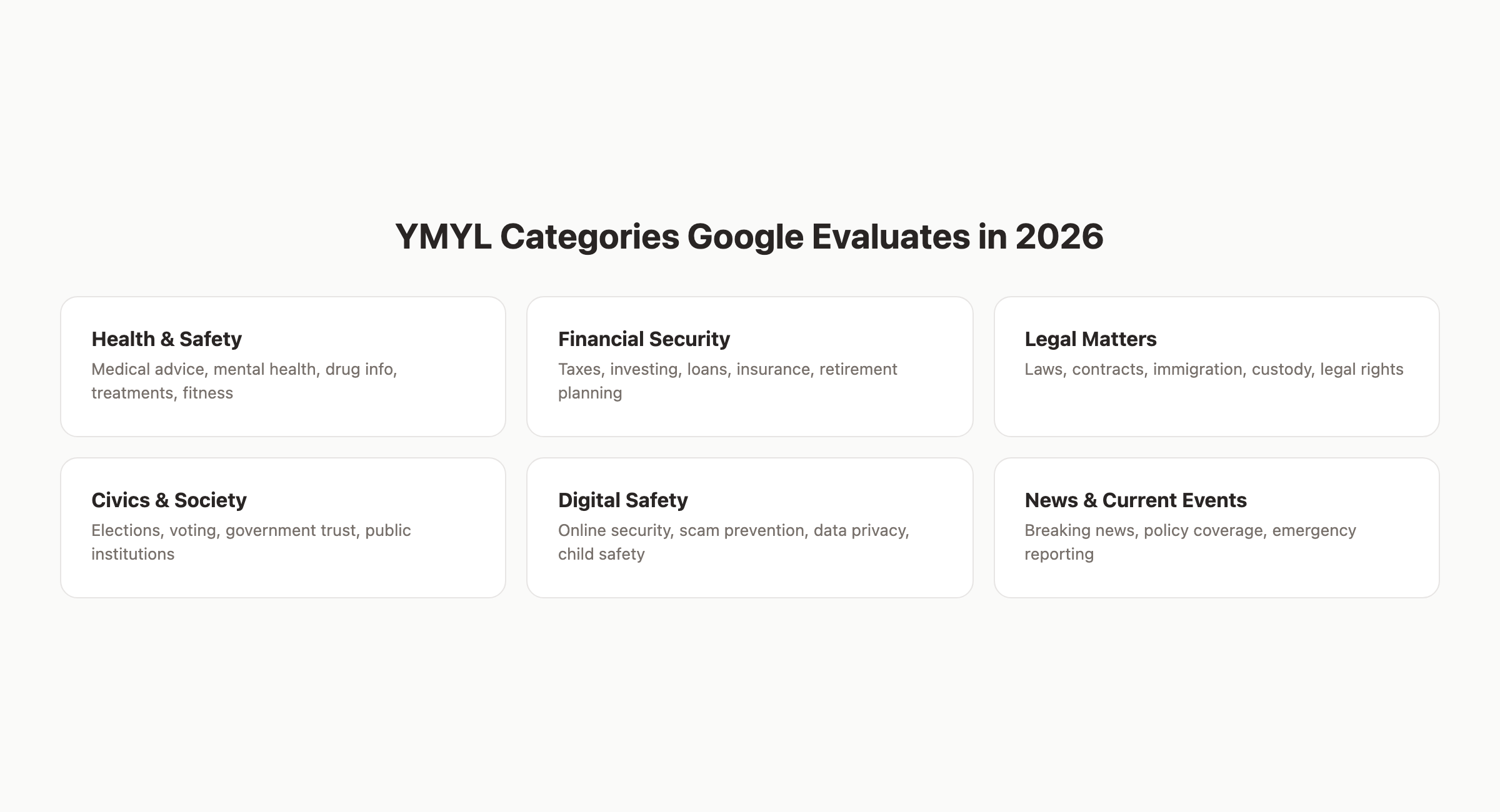
Google expanded YMYL categories significantly in the January and September 2025 updates to the Search Quality Rater Guidelines. The scope now extends well beyond health and finance.
Health, Medical, and Wellness
This is the most scrutinized YMYL category. It covers medical conditions, treatments, medications, mental health, nutrition, fitness, and healthcare providers. A page recommending a drug dosage faces the highest possible quality standard.
Google expects medical content to cite primary research sources. Author credentials for health content should include relevant medical or clinical qualifications. Content that contradicts established medical consensus without strong evidence will receive the lowest quality ratings from raters.
Financial Security
Tax advice, investment recommendations, loan guidance, insurance information, and retirement planning all fall under financial YMYL. The stakes are direct. Bad financial advice costs people money.
For financial content, Google looks for authors with financial certifications (CPA, CFP, CFA). Content should reference regulatory bodies and official guidelines. Outdated tax advice for a previous tax year without clear labeling is a trust violation.
Legal Matters
Laws, contracts, immigration, custody, and legal rights require accurate, jurisdiction-specific information. Legal YMYL content demands disclaimers about professional advice and clear indication of the jurisdiction covered.
Civics and Society
The September 2025 update explicitly added election information, voting procedures, government trust, and public institutions to the YMYL framework. Content about elections that contains misinformation now receives the lowest possible quality score.
This expansion reflects Google’s concern about AI-generated misinformation affecting democratic processes. Any content that could undermine trust in government bodies or electoral systems receives YMYL treatment.
Digital and Online Safety
Scam prevention, data privacy, cybersecurity advice, and child safety online all qualify as YMYL. The rise of deepfakes and AI-generated fraud has elevated this category.
News and Current Events
Breaking news about emergencies, natural disasters, public health crises, and policy changes that affect safety carries YMYL weight. Accuracy and timeliness are critical trust signals for news YMYL content.
| YMYL Category | Added to Guidelines | Key E-E-A-T Requirement |
|---|---|---|
| Health and Medical | Original (2014) | Licensed professional credentials |
| Financial Security | Original (2014) | Certified financial qualifications |
| Legal Matters | Original (2014) | Jurisdiction-specific accuracy |
| Civics and Society | September 2025 | Factual, nonpartisan sourcing |
| Digital Safety | January 2025 | Technical accuracy, current threats |
| News and Events | Original (2014) | Timeliness and source attribution |
Chapter 4: How Google Quality Raters Score YMYL Pages {#ch4}
Google employs thousands of quality raters worldwide. They do not directly influence individual page rankings. Instead, their evaluations serve as feedback signals that help Google refine its algorithms.
Understanding how raters evaluate YMYL content reveals exactly what Google’s algorithms are trained to detect.
The Page Quality Rating Scale
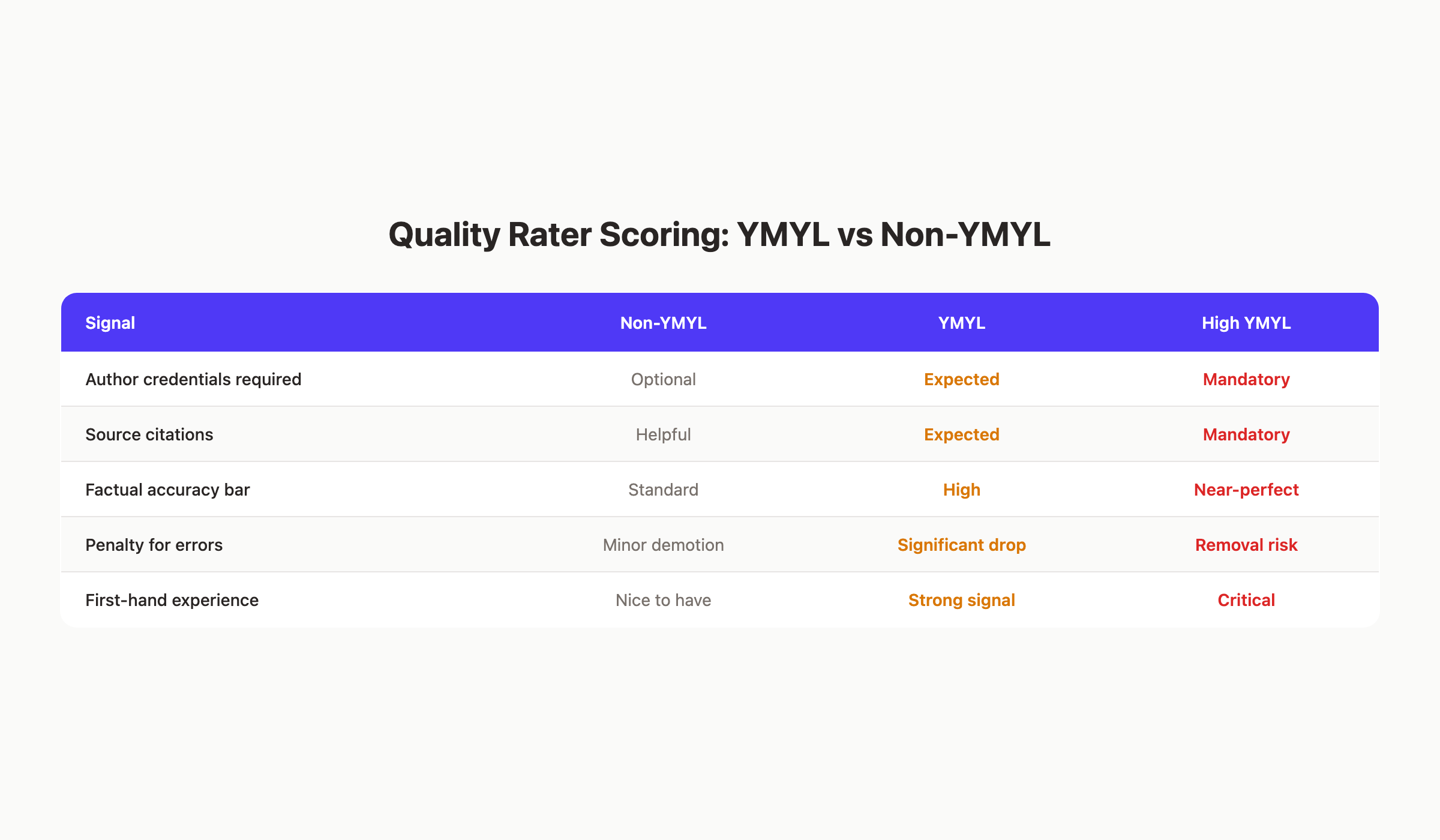
Quality raters assign pages a score from Lowest to Highest on a 5-point scale. For YMYL content, the threshold for each score is higher. A page that would score “Medium” for a hobby topic might score “Low” for a health topic with the same quality signals.
The Search Quality Rater Guidelines state that pages on YMYL topics must demonstrate a high level of E-E-A-T to receive a “High” rating. The lowest quality rating applies automatically when YMYL content contains clear inaccuracies, lacks author attribution, or contradicts expert consensus.
What Raters Check on YMYL Pages
Raters follow a structured evaluation process for YMYL content:
- Who created the content? Is the author identifiable?
- What are the author’s credentials for this topic?
- Does the content cite verifiable sources?
- Is the information accurate and current?
- Does the site have clear contact information?
- Are there visible editorial policies?
- Does the content match the page’s stated purpose?
The “Lowest” Rating Triggers for YMYL
Certain signals trigger an automatic “Lowest” rating for YMYL pages. These include:
- Factually inaccurate health or medical claims
- Financial advice that contradicts regulatory guidelines
- Missing author identity on high-YMYL topics
- Content that could directly harm the reader if followed
- Scaled, low-effort AI content without expert review
Google’s January 2025 update introduced explicit guidelines targeting scaled content abuse. Content that is copied, paraphrased from other sites, or AI-generated without added value receives the lowest quality classification.
How Rater Feedback Shapes Algorithms
Rater evaluations do not manually rank or derank specific pages. They train the algorithm. When thousands of raters consistently mark a certain content pattern as low-quality, Google adjusts its ranking signals to detect and demote that pattern at scale.
For YMYL content, this means the algorithm has been specifically trained to detect missing trust signals. The March 2026 core update reflected years of rater feedback about experience and expertise gaps in health, finance, and legal content.
Consistent publishing builds authority. We handle your content calendar so you can focus on your business. 30 SEO articles per month, on autopilot. Start for $1 →
Chapter 5: 7 Signals That Prove E-E-A-T in YMYL Niches {#ch5}
Knowing what E-E-A-T means is not enough. You need to build specific, measurable signals into your content and website. These 7 signals are what Google’s algorithm actually detects.
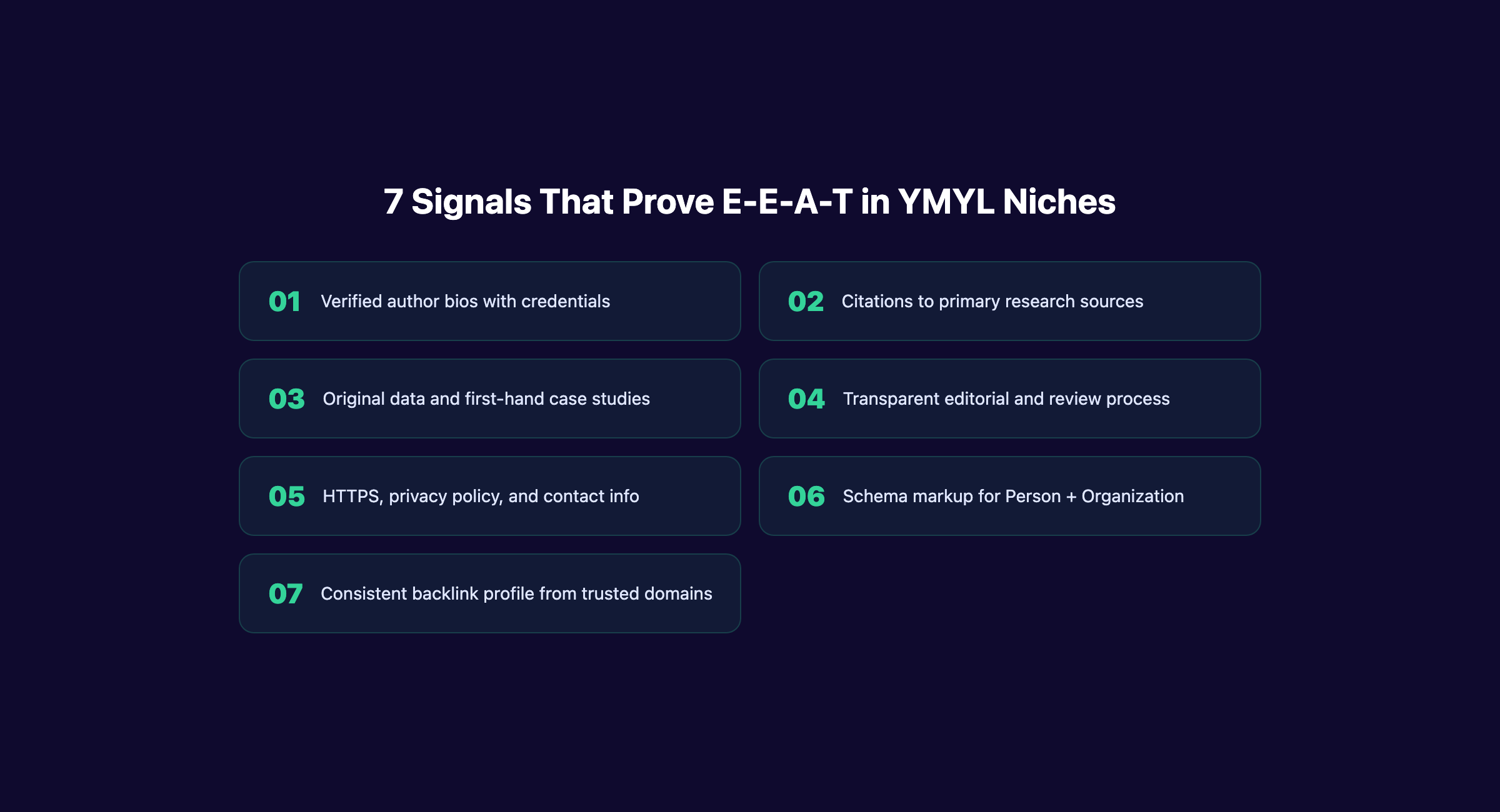
Signal 1: Verified Author Bios With Credentials
Every YMYL page needs a visible author byline linked to a detailed author page. The author page should include professional credentials, years of experience, publications, and links to professional profiles.
Sites that added structured author pages with verifiable credentials saw measurable ranking improvements within weeks of the March 2026 update. This is the single highest-impact change you can make.
For your author bio, include:
- Full name and professional photo
- Relevant degrees, certifications, or licenses
- Years of experience in the specific field
- Links to LinkedIn, professional associations, and published work
Signal 2: Citations to Primary Research Sources
YMYL content must cite its claims. Link to peer-reviewed studies, government databases, regulatory filings, and official guidelines. Generic statements like “studies show” without a linked source do not count.
Use structured data to mark up your citations. This helps Google verify the accuracy of your claims and connect your content to authoritative sources.
Signal 3: Original Data and First-Hand Case Studies
Experience signals require original material. Share data you collected. Describe outcomes you observed. Reference patients you treated (anonymized), clients you served, or results you measured.
Content that demonstrates genuine first-hand experience through specific details and original outcomes outranks thorough but impersonal information. This was the defining change of the March 2026 core update.
Signal 4: Transparent Editorial and Review Process
Publish your editorial policy. Explain who reviews your content, what qualifications they hold, and how often content is updated. For medical YMYL content, state whether a licensed physician reviewed the page.
An “About” page that says “Our team of experts” without naming anyone fails this signal. Name the reviewers. Link to their credentials. Show the review date.
Signal 5: HTTPS, Privacy Policy, and Contact Information
Technical trust signals are table stakes for YMYL content. Google expects:
- Valid HTTPS certificate
- Accessible privacy policy
- Physical address or registered business information
- Working contact methods (email, phone, or form)
Missing any of these on a YMYL site triggers distrust signals. Quality raters are specifically instructed to check for contact information on YMYL pages.
Signal 6: Schema Markup for Person and Organization
Schema markup tells Google exactly who created the content and what organization published it. For YMYL content, implement:
Personschema withsameAslinks to verified profilesOrganizationschema withcontactPointandaddressArticleschema withauthorandreviewedBypropertiesMedicalWebPageschema for health content (when applicable)
Schema does not directly boost rankings. It helps Google verify entity relationships and build confidence in your E-E-A-T signals.
Signal 7: Consistent Backlink Profile From Trusted Domains
YMYL authority requires external validation. Build backlinks from sources that Google already trusts for your topic. For health content, links from medical institutions, universities, and health organizations carry the most weight.
A strong internal linking strategy also reinforces topical authority. Link related YMYL pages to each other using descriptive anchor text. Build content clusters around your core YMYL topics.
| Signal | Implementation Difficulty | Impact on YMYL Rankings |
|---|---|---|
| Author bios with credentials | Low | Very High |
| Primary source citations | Low | High |
| Original data and case studies | Medium | Very High |
| Editorial review process | Medium | High |
| HTTPS and contact info | Low | Medium (table stakes) |
| Person and Organization schema | Medium | Medium |
| Trusted domain backlinks | High | Very High |
Chapter 6: Building Author and Entity Authority for YMYL {#ch6}
Author authority is the single most underinvested E-E-A-T signal in YMYL content. Most sites focus on backlinks and technical SEO while ignoring the people behind the content.
Google’s algorithm increasingly evaluates content creators as entities. An entity is a person or organization that Google can verify across multiple sources on the web.
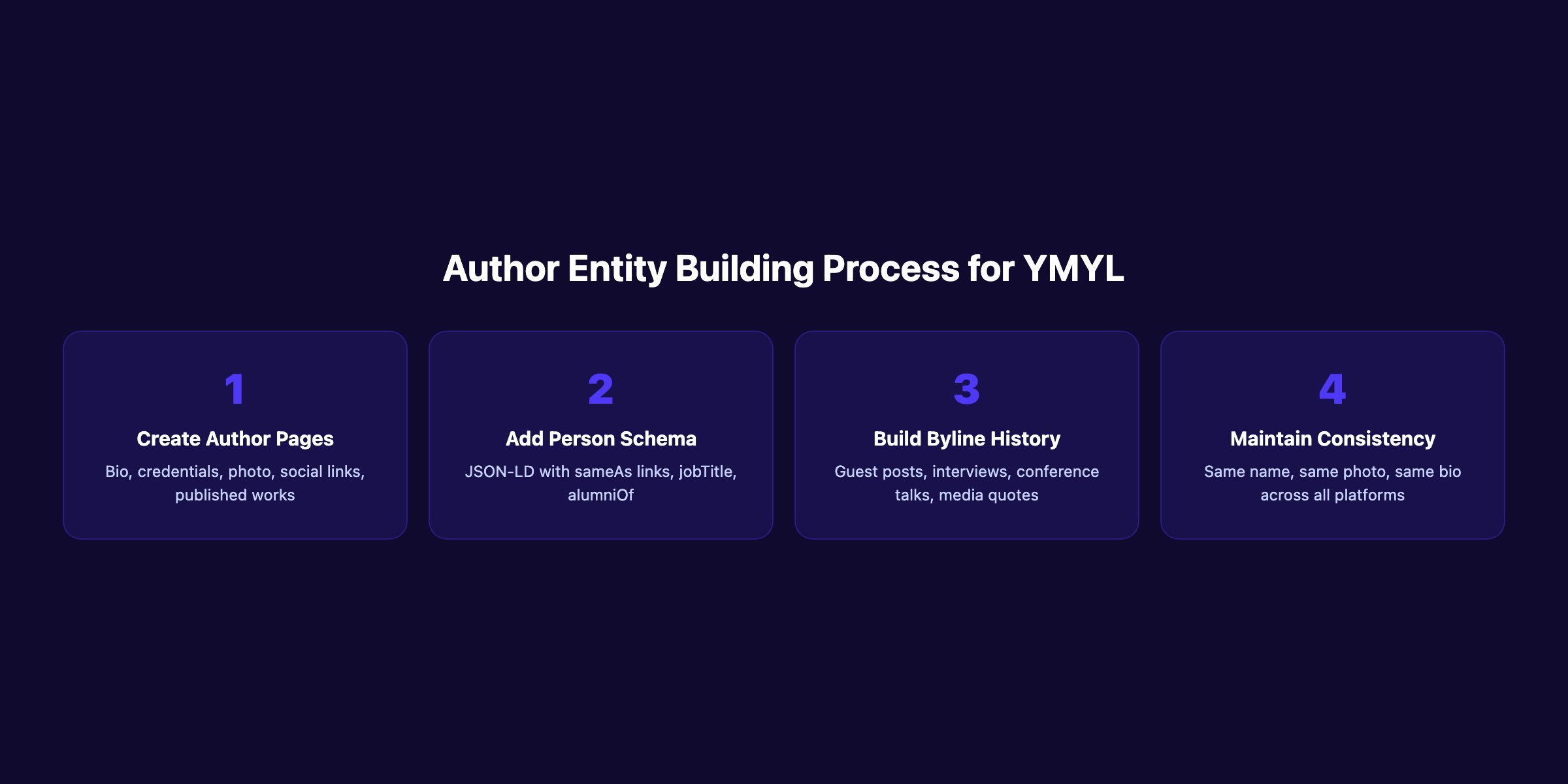
Creating Author Pages That Build Entity Authority
Your author page is not a bio paragraph. It is a landing page for Google’s entity recognition system. Include:
- Full professional bio with specific credentials (not “expert in marketing” but “CPA with 12 years of tax advisory experience”)
- Professional headshot that matches your LinkedIn and other profiles
- Published work with links to articles on your site and external publications
- Professional affiliations and memberships in relevant organizations
- Social proof including speaking engagements, media quotes, and awards
Link every article to its author page. Link the author page back to every article. This bidirectional linking helps Google connect the entity to the content.
Implementing Person Schema for Authors
Add JSON-LD Person schema to every author page. Include:
- name
- jobTitle
- alumniOf
- sameAs (LinkedIn, Twitter, professional profiles)
- worksFor (Organization)
- knowsAbout (relevant YMYL topics)
The sameAs property is critical. It connects your author entity to verified profiles across the web. Google uses these connections to validate that the person exists and holds the credentials claimed.
Building Off-Site Author Presence
On-site signals alone are not enough for YMYL authority. Google cross-references author identities across the web. Build off-site presence through:
- Guest articles on authoritative industry publications
- Expert quotes in third-party media coverage
- Conference presentations and webinar appearances
- Professional directory listings (for licensed professionals)
- Active LinkedIn profile with consistent positioning
The goal is entity corroboration. When Google finds the same author name, credentials, and topic focus across 10 or more trusted sources, it assigns higher authority to content from that author.
Organization-Level Entity Building
Individual authors operate within organizational entities. Your organization also needs E-E-A-T signals:
- Complete Google Business Profile (for local businesses)
Organizationschema with all relevant properties- Consistent NAP (Name, Address, Phone) across citations
- BBB listing, industry directory presence, and association memberships
- Press coverage and media mentions
For local businesses, combining strong organizational E-E-A-T with local SEO signals creates a powerful trust foundation. Google evaluates both the author and the publishing organization for YMYL content.
Build authority on autopilot. We publish 30+ expert-reviewed SEO articles per month. Your content compounds. Your authority grows. Start for $1 →
Chapter 7: Common E-E-A-T Mistakes in YMYL Content {#ch7}
Most YMYL content fails not because the information is wrong but because the trust signals are missing. These are the mistakes we see most often across the 70+ industries we serve.
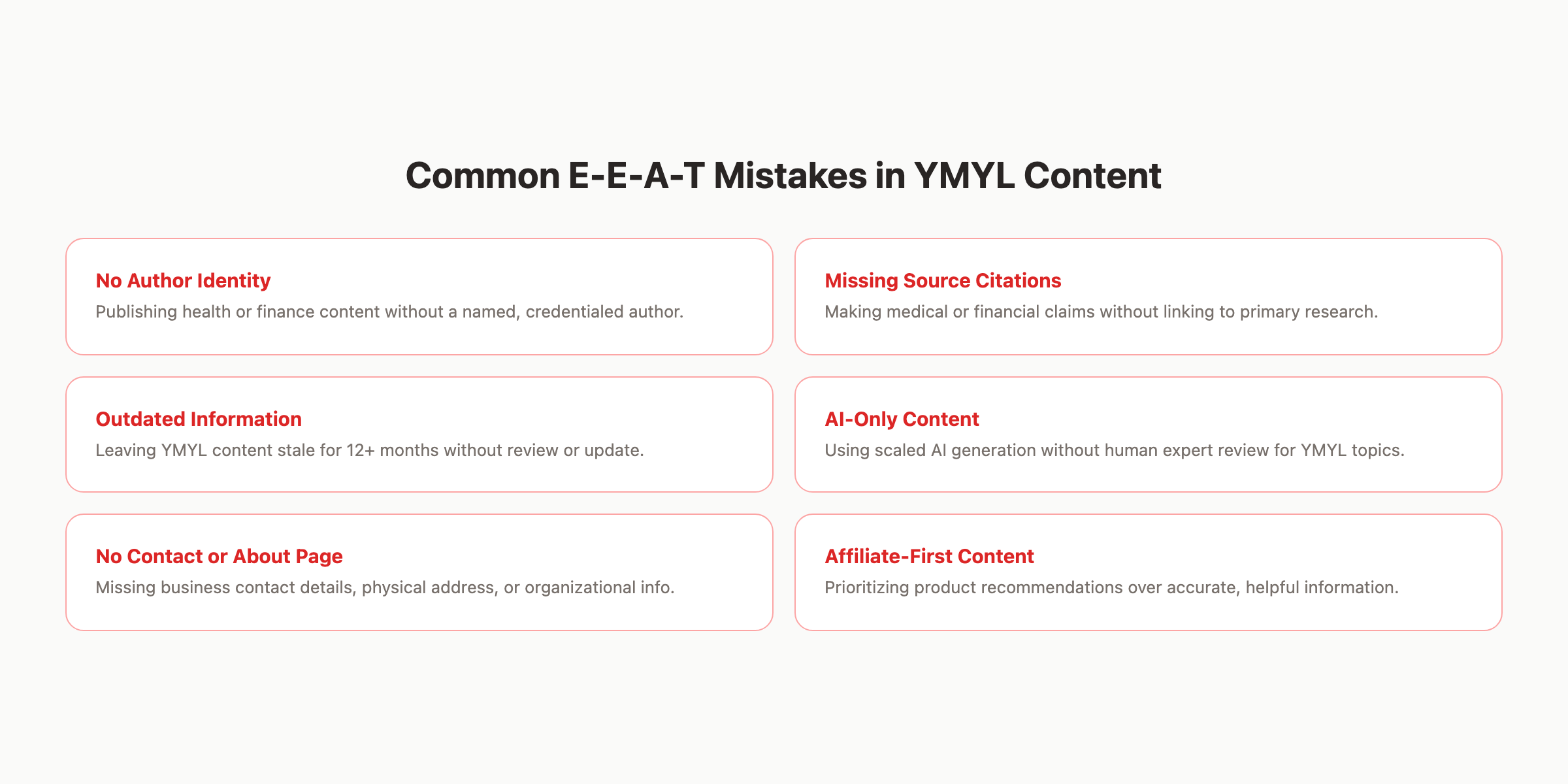
Publishing Without Author Attribution
Anonymous YMYL content is a ranking liability. Quality raters cannot evaluate expertise or experience without knowing who wrote the content. “Admin” or “Staff Writer” bylines on health, finance, or legal content signal low E-E-A-T.
The fix is straightforward. Assign every YMYL article to a named author with documented credentials. If you use multiple writers, create individual author pages for each one.
Making Claims Without Source Citations
“Studies show that 80% of people…” without a linked source fails the trust test. Every factual claim in YMYL content needs attribution. Link to the specific study, report, or guideline. Not the homepage. The specific page.
Use inline citations throughout your content. Place them naturally within the sentence that references the data. A citations section at the bottom is helpful but not a replacement for inline linking.
Ignoring Content Freshness
YMYL content decays faster than other content types. Medical guidelines change. Tax laws update annually. Legal precedents shift. A health article from 2023 without updates will lose rankings to a 2026 article covering the same topic.
Implement a content review schedule for YMYL pages:
- Review all health content every 6 months
- Update financial content after each tax year
- Audit legal content when relevant laws change
- Add “Last reviewed” dates visible to readers
- Update meta descriptions to reflect current year
Treating E-E-A-T as a One-Time Task
E-E-A-T is not a checklist you complete once. It is an ongoing process. Author credentials need updating. Sources need refreshing. New content needs to maintain the same standards as existing pages.
The sites that gained 23% in visibility after the March 2026 update did not make a single change. They had been building E-E-A-T signals consistently over months and years. The Content Compound Effect applies directly here. Every article that meets E-E-A-T standards reinforces the authority of every other article on your site.
Prioritizing Affiliate Revenue Over User Value
YMYL product recommendations that prioritize affiliate commission over honest evaluation trigger trust violations. If your “best health supplements” article ranks products by payout rather than effectiveness, quality raters will flag it.
Disclose affiliate relationships clearly. Explain your evaluation methodology. Include products you do not earn commission from. Honest, balanced YMYL content outranks biased content. Always.
Chapter 8: E-E-A-T in YMYL and AI-Generated Content {#ch8}
AI content is not automatically penalized. But AI content in YMYL topics without human expert oversight is a high-risk strategy that increasingly fails.
Google’s January 2025 update introduced explicit targeting of scaled, low-effort AI content. The guidelines state that the lowest quality rating applies when content is AI-generated without originality or added value compared to existing pages.
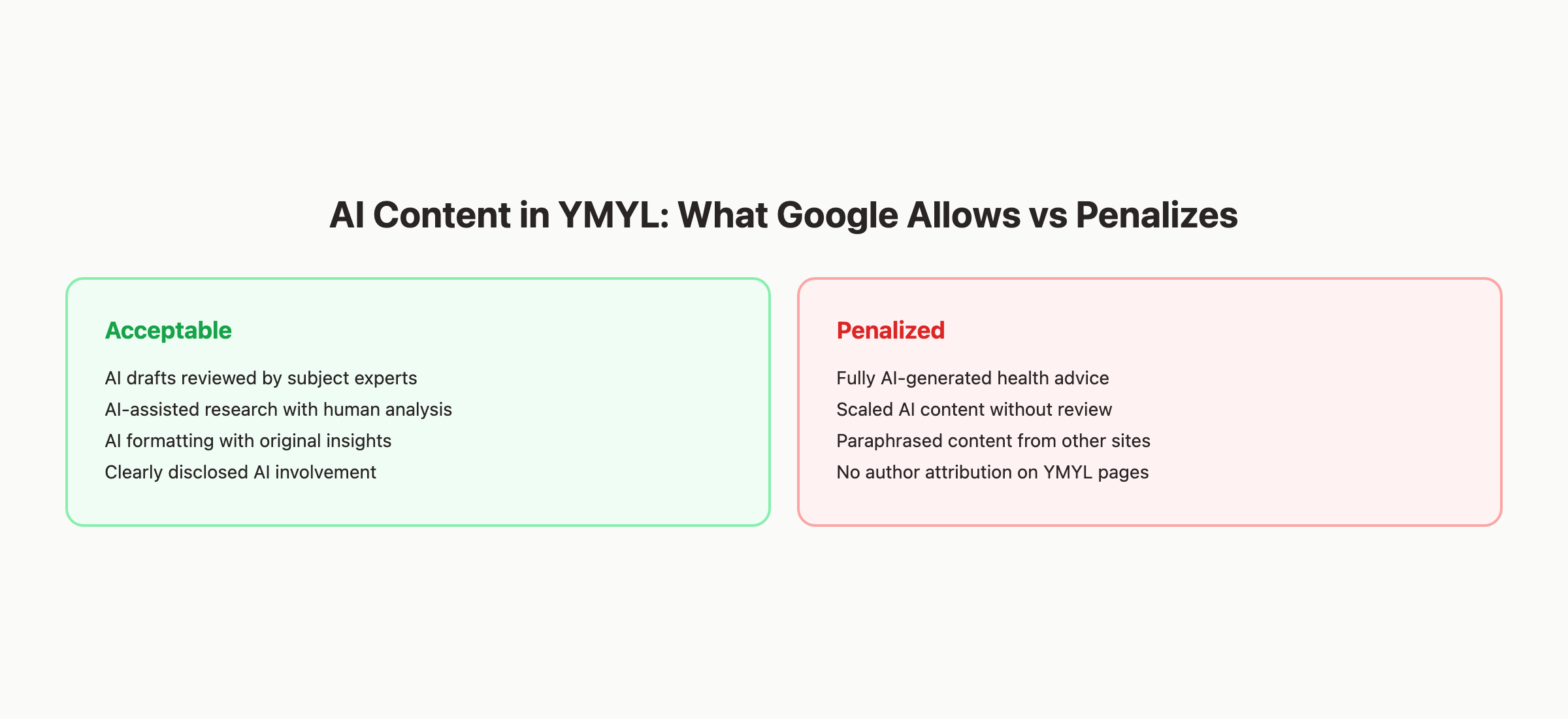
What Google Actually Penalizes
Google does not penalize content because AI wrote it. Google penalizes content that lacks value, accuracy, and trust signals. For YMYL topics, the bar is higher.
Content that will trigger penalties:
- AI-generated medical advice without physician review
- Scaled financial content without certified author oversight
- AI-paraphrased legal information from other sites
- YMYL content published without any author attribution
Content that passes scrutiny:
- AI-assisted drafts reviewed and edited by subject experts
- AI-generated research summaries with original analysis added
- AI-formatted content built on proprietary data and experience
- YMYL articles with clear disclosure of AI involvement in creation
The Expert Review Requirement
For YMYL content, the minimum viable standard is expert review. Someone with relevant credentials must review every piece of YMYL content before publication. Their name and credentials should appear on the page.
This does not mean AI cannot help. It means AI cannot be the only contributor. The expert adds the experience, expertise, and accountability that AI cannot provide.
How We Handle E-E-A-T at Stacc
We publish content that meets E-E-A-T standards at scale. Every article goes through quality checks for accuracy, source citation, and trust signals. Our process combines AI efficiency with human editorial oversight.
For businesses in YMYL niches, this means your content gets published consistently without sacrificing the quality signals Google demands. 30 articles per month, each built with the E-E-A-T framework baked in.
The future of YMYL content is not choosing between AI and human expertise. It is combining both. The sites that master this combination will dominate YMYL rankings while those relying purely on one approach will struggle.
Frequently Asked Questions {#faq}
Is E-E-A-T a direct Google ranking factor?
No. E-E-A-T is not a single ranking factor in the traditional sense. Google uses over 80 algorithmic signals that collectively measure E-E-A-T concepts. Quality raters use E-E-A-T as an evaluation framework, and their feedback trains the algorithm. The practical effect is the same. Content with strong E-E-A-T outranks content without it.
What happens to YMYL content with low E-E-A-T?
YMYL content with weak E-E-A-T faces significant ranking penalties. During core updates like the March 2026 rollout, 55% of sites experienced ranking changes. YMYL sites without verified author credentials, source citations, and transparent editorial processes saw the largest drops. In extreme cases, Google removes YMYL pages from search results entirely.
Can a small business compete with major brands on YMYL topics?
Yes. E-E-A-T rewards genuine expertise and experience. A local accounting firm with a CPA writing about tax strategy can outrank a generic content farm. The key is demonstrating real credentials, sharing original insights, and building consistent topical authority. Small businesses often have stronger experience signals than large publishers.
How often should YMYL content be updated?
Review YMYL content at minimum every 6 months. Health content should be reviewed whenever medical guidelines change. Financial content needs annual updates for tax law changes. Display a “Last reviewed” date on every YMYL page. Google’s algorithm treats content freshness as a stronger signal for YMYL queries than for standard informational queries.
Does E-E-A-T apply to AI Overviews and AI search engines?
Yes. E-E-A-T signals influence which sources AI search engines like Google Gemini, ChatGPT, and Perplexity cite in their responses. Content with strong author entities, high trust signals, and primary source citations is more likely to be cited by AI search engines. For YMYL topics, AI systems show even stronger preference for authoritative, expert-reviewed sources.
What is the difference between YMYL and non-YMYL for E-E-A-T?
The core E-E-A-T framework applies to all content. The difference is the threshold. Non-YMYL content can rank with moderate trust signals. YMYL content requires near-perfect accuracy, verified author credentials, and transparent editorial processes. A single factual error on a YMYL page carries far more ranking consequences than the same error on a hobby blog. Google applies this stricter standard because YMYL content affects real-world decisions about health, money, and safety.
E-E-A-T in YMYL topics is not optional. It is the baseline standard for any content that affects health, money, safety, or well-being. Build author entities, cite your sources, review your content regularly, and make trust visible on every page. The sites that invest in these signals now will hold their rankings through every future core update.
Let us handle your SEO content. 30 articles per month. Built with E-E-A-T standards. Starting at $99/month. Start for $1 →
Written and published by Stacc. We publish 3,500+ articles per month across 70+ industries. All data verified against public sources as of March 2026.