
Accounting Firm SEO (2026): Strategies, Tactics & Examples
Practical accounting firm seo guide strategies for 2026: step-by-step tactics, real examples, and tools to improve rankings and drive organic traffic.
Most accounting firms get their clients through referrals. That works until it does not.
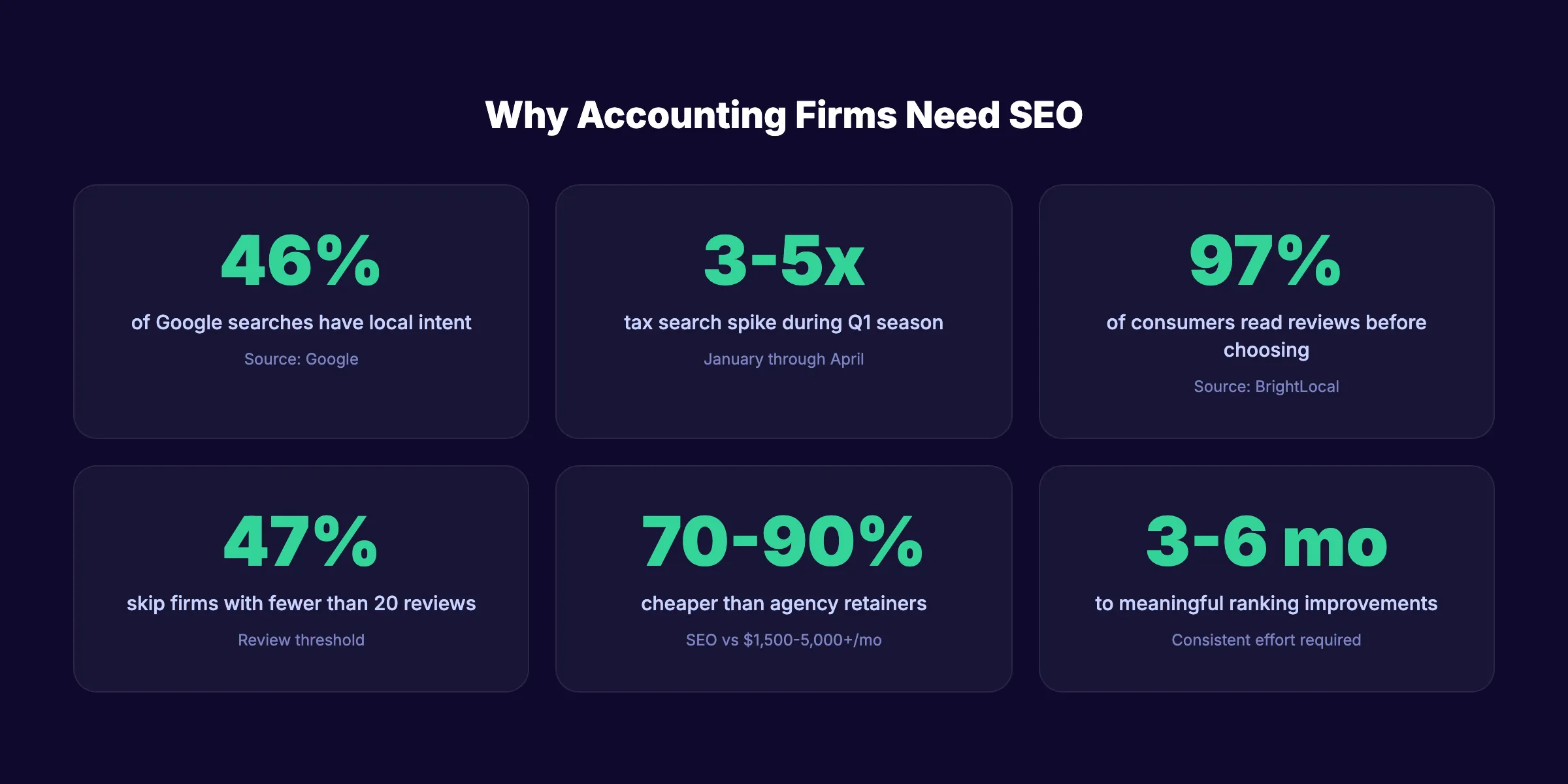
Referrals are unpredictable. They dry up during slow seasons. They give you zero control over growth. Meanwhile, 46% of all Google searches have local intent. People search “CPA near me” or “small business accountant in [city]” every day. If your accounting firm SEO guide strategy starts and ends with a website you built 5 years ago, those clients go to your competitors.
The firms winning new clients in 2026 are the ones that show up when someone searches for tax help, bookkeeping, or financial advice in their area.
We have published 3,500+ blog posts across 70+ industries, including dozens of accounting and financial services firms. This guide covers the exact SEO strategy that drives qualified leads for CPAs, bookkeepers, and accounting firms of every size.
Here is what you will learn:
- Why SEO matters more for accounting firms than most industries
- How to find the keywords your ideal clients actually search
- The local SEO playbook for getting into Google’s 3-Pack
- How to optimize your Google Business Profile for maximum visibility
- A content strategy built around tax seasons and client questions
- Technical SEO fixes that build client trust
- How to earn backlinks that move the needle for accountants
Why SEO Matters More for Accounting Firms
Accounting falls under Google’s YMYL (Your Money or Your Life) category. That means Google holds accounting websites to a higher standard than most industries.
YMYL content directly impacts people’s financial decisions. Google applies stricter E-E-A-T evaluation to every accounting page it crawls. A tax advice article from a firm with no visible credentials, no author bios, and no reviews will not rank. Period.
The Numbers Behind Accounting SEO
The opportunity is significant:
| Metric | Data Point |
|---|---|
| Local search intent | 46% of all Google searches seek local information |
| Tax season search spike | 3-5x increase in tax-related queries during Q1 |
| Review influence | 97% of consumers read reviews before choosing a business |
| Review threshold | 47% of people skip firms with fewer than 20 reviews |
| SEO vs. agency cost | SEO costs 70-90% less than traditional agency retainers ($1,500-5,000+/mo) |
| Timeline to results | 3-6 months for meaningful ranking improvements |
The Referral Problem
Referrals feel safe. But they create a ceiling on your growth.
SEO creates a pipeline of inbound leads from people actively searching for the services you offer. A person searching “tax preparation for small business in Denver” has high purchase intent. They need an accountant. They need one now.
The firms ranking for those searches get first contact. First contact converts at a dramatically higher rate than cold outreach or even paid ads.
YMYL and E-E-A-T Requirements
Because accounting is YMYL, Google demands visible proof of expertise on every page:
- CPA license numbers displayed on author bio pages
- Physical office address on every page (footer minimum)
- Named authors with professional credentials on all content
- Links to professional associations (AICPA, state CPA societies)
- Accurate, current financial information (no outdated tax figures)
Missing any of these signals limits your ability to rank for competitive accounting keywords.
Keyword Research for Accounting Firms
Most accounting firms target the wrong keywords. They chase broad terms like “accountant” or “CPA” and wonder why they never rank.
The winning strategy targets specific, intent-rich keywords that match what real clients search.
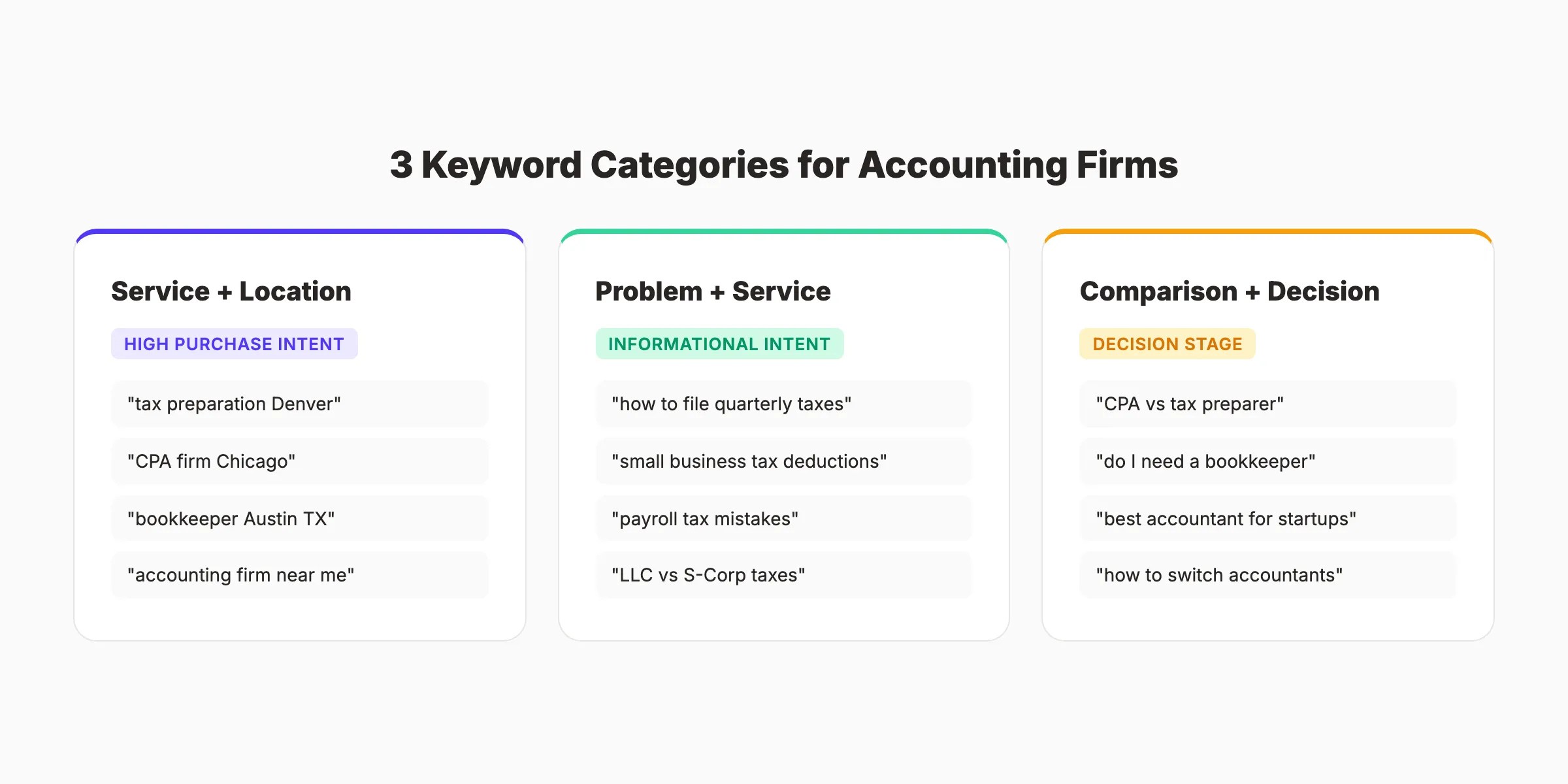
Three Keyword Categories
| Category | Examples | Search Intent |
|---|---|---|
| Service + Location | ”tax preparation Denver,” “bookkeeper Austin TX,” “CPA firm Chicago” | High purchase intent |
| Problem + Service | ”how to file quarterly taxes,” “small business tax deductions 2026,” “payroll tax mistakes” | Informational, converts to leads |
| Comparison + Decision | ”CPA vs tax preparer,” “do I need a bookkeeper or accountant,” “best accounting firm for startups” | Decision-stage, high value |
Mining Client Questions for Keywords
Your best keyword source is already in your inbox. Every question a client asks you is a keyword someone else is searching.
Common client questions that become high-value keywords:
- “How much does a CPA cost for a small business?”
- “What tax deductions can I claim as a freelancer?”
- “Do I need an accountant for my LLC?”
- “When are quarterly taxes due?”
- “How to switch accountants mid-year”
Turn each question into a blog post. These posts capture search intent at the exact moment someone needs help.
Seasonal Keyword Strategy
Accounting has extreme seasonality. Tax-related searches spike 3-5x during Q1 (January through April). Smart firms plan content in Q4 to rank before the rush.
| Quarter | Content Focus | Example Topics |
|---|---|---|
| Q4 (Oct-Dec) | Year-end tax planning | ”Year-end tax strategies for small business,” “tax-loss harvesting guide” |
| Q1 (Jan-Mar) | Tax preparation and filing | ”How to file taxes as an LLC,” “tax deduction checklist 2026” |
| Q2 (Apr-Jun) | Post-season advisory | ”Quarterly estimated tax payments guide,” “mid-year tax planning” |
| Q3 (Jul-Sep) | Business growth and advisory | ”When to hire a CFO vs accountant,” “accounting for startup founders” |
Publish your tax season content by November. Waiting until January means competing against firms that already rank.
Stop writing. Start ranking. Stacc publishes 30 SEO articles per month for your accounting firm. Every post optimized for the keywords your clients search. Start for $1 →
Local SEO: Getting Into Google’s 3-Pack
For accounting firms, local SEO is not optional. It is the primary growth channel.
The Google 3-Pack (the top 3 local results that appear with a map) captures the majority of clicks for local service searches. If your firm does not appear in the 3-Pack for “CPA near me” or “accountant [your city],” you are invisible to most local searchers.
Local Ranking Factors
Google uses 3 primary factors for local rankings:
| Factor | What It Means | How to Optimize |
|---|---|---|
| Relevance | How well your profile matches the search query | Complete every GBP field, use accurate service categories |
| Distance | How close your firm is to the searcher | Target city and neighborhood keywords, list your service area |
| Prominence | How well-known your firm is online | Earn reviews, build citations, get local backlinks |
Citation Building for Accountants
Citations are mentions of your firm’s Name, Address, and Phone number (NAP) across the web. Consistency is critical. Even small differences (“Suite 200” vs “Ste. 200”) confuse Google.
Priority citation sources for accounting firms:
- Google Business Profile
- Yelp
- Better Business Bureau
- AICPA directory
- State CPA society directory
- Chamber of Commerce
- LinkedIn company page
- Facebook business page
- Bing Places
- Apple Maps
Verify that your NAP is identical across every listing. Use our local SEO guide for a full citation building strategy.
Service Area Pages
If your firm serves multiple cities, create a dedicated page for each location. A single “Serving the greater metro area” page will not rank for specific city searches.
Each service area page should include:
- The city name in the H1 title and throughout the content
- Specific services offered in that location
- Unique content about the local business community
- Embedded Google Map showing your office or service area
- Local phone number if applicable
- Client testimonials from businesses in that area
Google Business Profile Optimization
Your Google Business Profile is the single highest-impact local SEO asset for your accounting firm. A well-optimized GBP can place you in the 3-Pack even if your website SEO is average.
Complete Profile Setup
Every field matters. Incomplete profiles rank lower:
- Business name (exact legal name, no keyword stuffing)
- Primary category: “Certified Public Accountant” or “Accounting Firm”
- Secondary categories: “Tax Preparation Service,” “Bookkeeping Service,” “Financial Consultant”
- Address (must match website and all citations exactly)
- Phone number (local number, not toll-free)
- Website URL
- Business hours (including seasonal extended hours during tax season)
- Service area (if you serve clients beyond your office location)
- Business description (750 characters, include key services and location)
- Services list with descriptions and pricing ranges
- Photos (office exterior, interior, team photos, at least 10 images)
GBP Posts
Google Business Profile posts keep your listing active and signal freshness to Google. Publish at least 2-4 posts per month.
Effective GBP post topics for accountants:
- Tax deadline reminders (“Q2 estimated taxes due June 15”)
- New service announcements
- Client success stories (with permission)
- Seasonal tips (“3 year-end moves that reduce your tax bill”)
- Team updates and credentials
- Community involvement
Review Strategy
Reviews are the most powerful local ranking factor you can directly influence. 97% of consumers read reviews before choosing a business.
Build a review generation system:
- Ask every satisfied client for a review after completing their engagement
- Send a follow-up email with a direct link to your Google review page
- Use a QR code in your office that links to your review page
- Respond to every review within 48 hours (positive and negative)
- Never offer incentives for reviews (this violates Google’s policies)
Target: 20+ reviews minimum. Firms with fewer than 20 reviews lose 47% of potential clients.
Your SEO team. $99 per month. 30 optimized articles, published automatically. No writers to hire. No deadlines to manage. Start for $1 →
Content Strategy for Accounting Firms
Content is what transforms your website from a digital business card into a lead generation engine. The right blog posts attract potential clients at every stage of their decision process.
Content Pillars for Accountants
Organize your content around 4 core pillars:
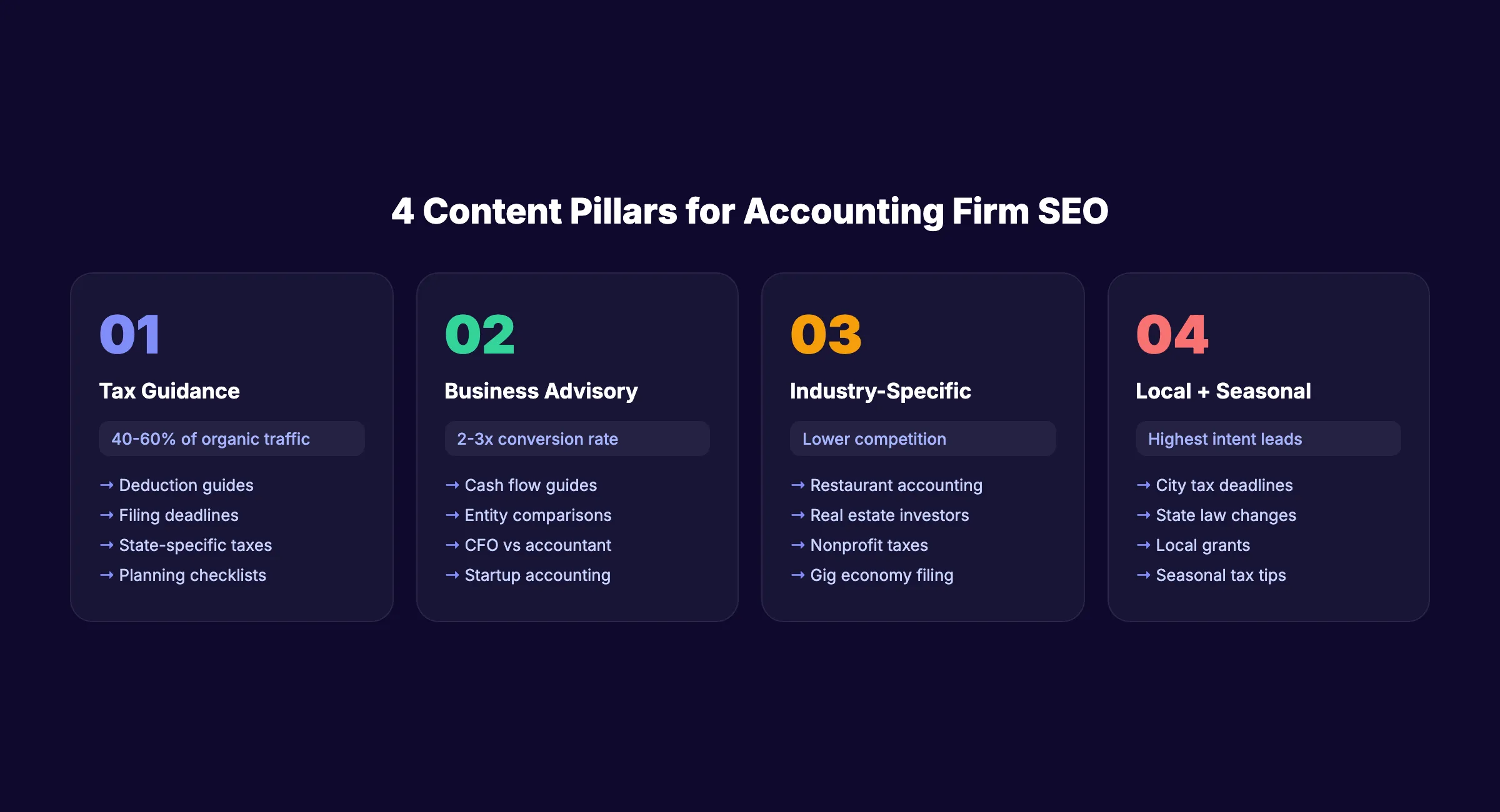
Pillar 1: Tax Guidance Tax content generates 40-60% of organic traffic for accounting firm websites. Cover the questions your clients ask most:
- Tax deduction guides by business type
- Filing deadline calendars
- State-specific tax guidance
- Year-end planning checklists
- Estimated tax payment guides
Pillar 2: Business Advisory Advisory content converts at 2-3x the rate of compliance content. These readers are business owners making financial decisions:
- Cash flow management guides
- When to hire a CFO vs accountant
- Startup accounting setup guides
- Entity structure comparisons (LLC vs S-Corp vs C-Corp)
- Financial reporting best practices
Pillar 3: Industry-Specific Guidance Niche expertise signals E-E-A-T and reduces competition:
- Accounting for restaurants
- Tax planning for real estate investors
- Nonprofit accounting requirements
- Construction industry bookkeeping
- Freelancer and gig economy tax guides
Pillar 4: Local and Seasonal Content This content targets location-specific searches and time-sensitive queries:
- “[City] business tax deadlines 2026”
- “Best time to file taxes in [state]”
- “New [state] tax laws affecting small businesses”
- Local business grant and incentive roundups
Blog Publishing Frequency
Consistency matters more than volume, but volume accelerates results.
| Publishing Pace | Expected Timeline | Organic Traffic Growth |
|---|---|---|
| 2-4 posts per month | 6-12 months to see results | Slow, steady build |
| 8-12 posts per month | 3-6 months to see results | Meaningful growth |
| 20-30 posts per month | 60-90 days for first movement | Rapid authority building |
Firms publishing fewer than 4 posts per month struggle to build topical authority. Google needs enough content to recognize your site as an expert source on accounting topics.
Content Freshness
Stale financial content is not just an SEO problem. It is a trust problem.
If a potential client sees outdated tax figures on your website, they will question your expertise. Update every piece of content at minimum once per year:
- Refresh tax thresholds and bracket amounts
- Update filing deadlines
- Add references to new tax laws
- Replace outdated screenshots and examples
- Update the dateModified schema markup on every page
Use our guide on fixing content decay for a systematic approach to keeping content current.
Technical SEO for Accounting Websites
Technical SEO creates the foundation that makes everything else work. A site with slow load times, no HTTPS, or poor mobile experience will underperform regardless of content quality.
Site Speed
Page speed directly affects both rankings and conversions. Target these Core Web Vitals thresholds:
| Metric | Target | Why It Matters |
|---|---|---|
| LCP (Loading) | Under 2.5 seconds | Slow sites lose visitors before they see your content |
| INP (Interactivity) | Under 200ms | Laggy forms frustrate potential clients |
| CLS (Visual Stability) | Under 0.1 | Shifting layouts feel unprofessional |
Common speed issues on accounting sites:
- Unoptimized team photos (compress to WebP format)
- Heavy calculator widgets and tax tools
- Third-party chat widgets loading synchronously
- Unminified CSS and JavaScript
- No browser caching configured
Mobile Optimization
Over 60% of local searches happen on mobile devices. Your site must work flawlessly on phones:
- All text readable without zooming
- Click-to-call button on every page
- Forms easy to complete on small screens
- No horizontal scrolling required
- Navigation menu accessible and usable
- Maps and directions load properly
Schema Markup
Schema markup helps search engines understand your content. For accounting firms, implement these schema types:
- LocalBusiness (or AccountingService) with NAP, hours, and service area
- Organization with sameAs links to all official profiles
- Article/BlogPosting on every blog post with author, date, and publisher
- FAQPage on service pages and blog posts with common questions
- Person schema for each CPA or key team member with credentials
- Review schema if you display client testimonials
Use our Schema Markup Generator to create and validate your structured data.
HTTPS and Security
Every page must use HTTPS. Potential clients share financial information with your firm. An unsecured site is an immediate disqualifier.
Beyond basic HTTPS:
- Keep SSL certificates current
- Implement HSTS headers
- Use Content Security Policy headers
- Run regular security scans
3,500+ blogs published. 92% average SEO score. See what Stacc can do for your accounting firm. Start for $1 →
Link Building for Accountants
Backlinks tell Google that other websites trust your content. For YMYL topics like accounting, backlinks from authoritative financial and business sources carry extra weight.
High-Value Link Sources
| Source Type | Examples | Difficulty |
|---|---|---|
| Professional associations | AICPA, state CPA societies, local bar associations | Medium (often just requires membership) |
| Business directories | Chamber of Commerce, BBB, Clutch, GoodFirms | Low (registration-based) |
| Local media | City newspapers, business journals, local TV stations | Medium-High (requires newsworthy content) |
| Financial publications | Accounting Today, Journal of Accountancy, CPA Practice Advisor | High (requires expert-level content) |
| University and .edu sites | Alumni directories, guest lectures, scholarship pages | Medium (relationship-based) |
Content That Earns Links
Certain content types naturally attract backlinks:
Data-driven content. Publish original research or surveys. “We surveyed 500 small business owners about their tax preparation habits” creates a citable resource.
Free tools and calculators. Tax calculators, payroll estimators, and deduction checklists earn links from bloggers and business publications.
Expert roundups and guest posts. Write guest articles for local business publications. Offer expert commentary on tax law changes to journalists.
Resource pages. Create definitive guides that other sites reference. A thorough guide to “[state] small business tax requirements” becomes a link magnet.
Local Link Building
Local links have outsized impact for accounting firms:
- Sponsor local business events and charity organizations
- Partner with complementary businesses (lawyers, financial advisors, real estate agents) for cross-linking
- Join and get listed in local business associations
- Contribute articles to local business publications
- Host webinars or workshops and get covered by local media
Common Accounting SEO Mistakes
Knowing what to avoid saves months of wasted effort. These are the mistakes we see most often from accounting firms.
Buying Generic Content
Purchasing canned articles from content libraries is the fastest way to hurt your rankings. Search engines detect duplicate content across multiple sites. A generic “Top 10 Tax Tips” article that 50 other firms also published provides zero SEO value.
Every piece of content must be original and reflect your firm’s actual expertise and perspective.
Ignoring Local SEO
Many firms focus entirely on broad organic keywords and ignore local optimization. For an accounting firm, local SEO delivers the highest-intent leads. Prioritize your Google Business Profile, citations, and location-specific content before chasing national rankings.
Keyword Stuffing Service Pages
Cramming every service keyword into a single page confuses both Google and potential clients. Create a dedicated page for each core service:
- Tax preparation (separate from tax planning)
- Bookkeeping services
- Payroll services
- Business advisory and CFO services
- Audit and assurance
- Industry-specific services
Each page should target 1-2 primary keywords and answer the specific questions clients have about that service.
Neglecting Reviews
Firms with strong organic SEO but few reviews lose clients to competitors with better social proof. Make review generation an ongoing process, not a one-time effort.
Outdated Content
Publishing a blog post about “2023 Tax Brackets” and never updating it damages your credibility. AI search models and Google both penalize stale financial content. Audit your content quarterly and refresh anything with outdated figures.
No Author Credentials
Anonymous blog posts on accounting topics carry almost zero authority. Every article needs a named author with visible CPA credentials, bio, and links to professional profiles.
Measuring Accounting SEO Results
Track these metrics to measure your SEO progress:
| Metric | Tool | Target |
|---|---|---|
| Organic traffic | Google Analytics | 20%+ growth quarter over quarter |
| Local 3-Pack rankings | Google Search Console | Top 3 for “[service] + [city]” keywords |
| Keyword rankings | Semrush, Ahrefs, or Search Console | Page 1 for 10+ service keywords within 6 months |
| Google Business Profile views | GBP insights dashboard | Month-over-month increase |
| Phone calls from search | Call tracking or GBP call metrics | Consistent monthly increase |
| Form submissions | Google Analytics goals | Track conversion rate by landing page |
| Review count and rating | GBP dashboard | 20+ reviews, 4.5+ average rating |
Timeline Expectations
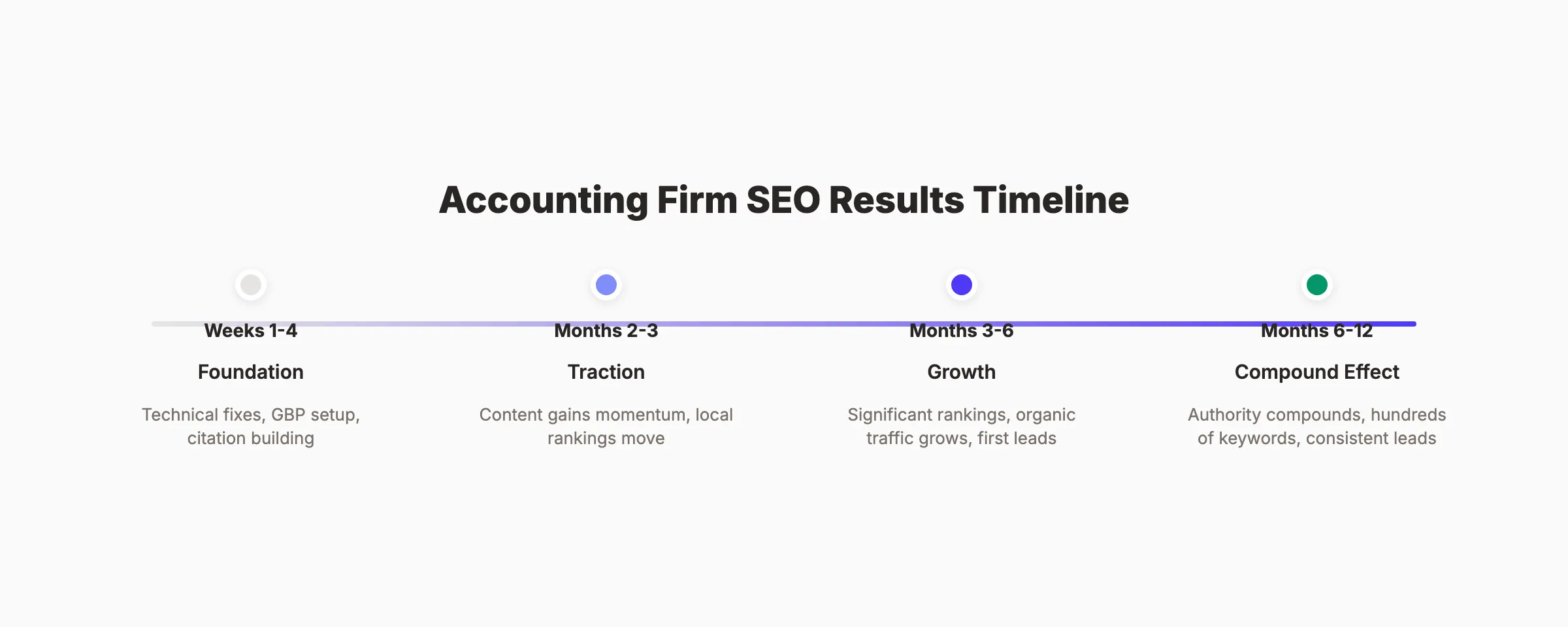
SEO is not instant. Set realistic expectations:
- Weeks 1-4: Technical fixes, GBP optimization, citation building. Minor ranking improvements possible.
- Months 2-3: Content publishing gains traction. Local rankings start moving.
- Months 3-6: Significant ranking improvements. Organic traffic grows measurably. First organic leads arrive.
- Months 6-12: Authority compounds. The site ranks for hundreds of keywords. Lead volume becomes consistent and predictable.
The firms that quit at month 3 never see the compound effect that kicks in at month 6.
Rank everywhere. Do nothing. Blog SEO, Local SEO, and Social Media on autopilot for your accounting firm. Start for $1 →
FAQ
How long does SEO take for an accounting firm?
Most accounting firms see initial ranking improvements within 4-8 weeks for local searches. Meaningful, sustained results like consistent 3-Pack rankings and a measurable increase in qualified leads typically take 3-6 months. Highly competitive metro areas may take 6-12 months.
What is the best SEO strategy for a small accounting firm?
Start with local SEO. Optimize your Google Business Profile, build citations on every relevant directory, and generate client reviews. Then create service pages for each offering and publish blog content targeting the questions your ideal clients search. Local SEO delivers the fastest ROI for small firms.
How much does SEO cost for accountants?
Traditional SEO agencies charge $1,500-5,000+ per month for accounting firm SEO. Automated publishing services like Stacc start at $99 per month for 30 optimized articles. In-house content production typically costs $80-250 per article from freelance writers.
What keywords should accountants target?
Focus on service + location keywords (“tax preparation [city]”), problem-based queries (“how to file quarterly taxes as freelancer”), and decision-stage comparisons (“CPA vs tax preparer”). Avoid broad terms like “accountant” that are too competitive and too vague to convert.
Does blogging help accounting firms get clients?
Yes. Tax and compliance content generates 40-60% of organic traffic for accounting firm websites. Advisory content (cash flow, entity structure, financial planning) converts at 2-3x the rate. Firms publishing 8+ blog posts per month see results in 3-6 months. Fewer than 4 posts per month produces very slow growth.
How do I get my accounting firm in the Google 3-Pack?
Optimize your Google Business Profile with complete information, accurate categories, and regular posts. Build consistent citations across 20+ directories. Generate 20+ Google reviews with a 4.5+ average rating. Create location-specific service pages. The 3 ranking factors are relevance, distance, and prominence.
Accounting firm SEO is not about tricks or shortcuts. It is about building a digital presence that matches the trust and expertise your firm already delivers in person.
Start with your Google Business Profile and local citations. Build a content strategy around your clients’ real questions. Maintain technical standards that reflect the professionalism your firm represents. The compound effect turns those efforts into a predictable, growing pipeline of qualified leads.
Related Tools & Resources
Free SEO Tools:
Best Lists:

Written by
Siddharth GangalSiddharth is the founder of theStacc and Arka360, and a graduate of IIT Mandi. He spent years watching great businesses lose organic traffic to competitors who simply published more. So he built a system to fix that. He writes about SEO, content at scale, and the tactics that actually move rankings.
30 SEO blog articles published every month
Keyword-optimized, scheduled, and live on your site. Automatically.
30-day trial · Cancel anytime
theStacc
Stop writing SEO content manually
30 blog articles, 30 GBP posts, and social media content. Published every month. Automatically.
Try for free$1 for 3 days · Cancel anytime