
Email Marketing for Accountants: The Complete Guide
Master email marketing for accountants with 7 proven campaign types, list-building tactics, automation workflows, and benchmarks. Updated for 2026.
Siddharth Gangal • 2026-03-30 • SEO Tips
In This Article
Most accounting firms spend thousands on ads to find new clients. They ignore the channel sitting right inside every prospect’s inbox.
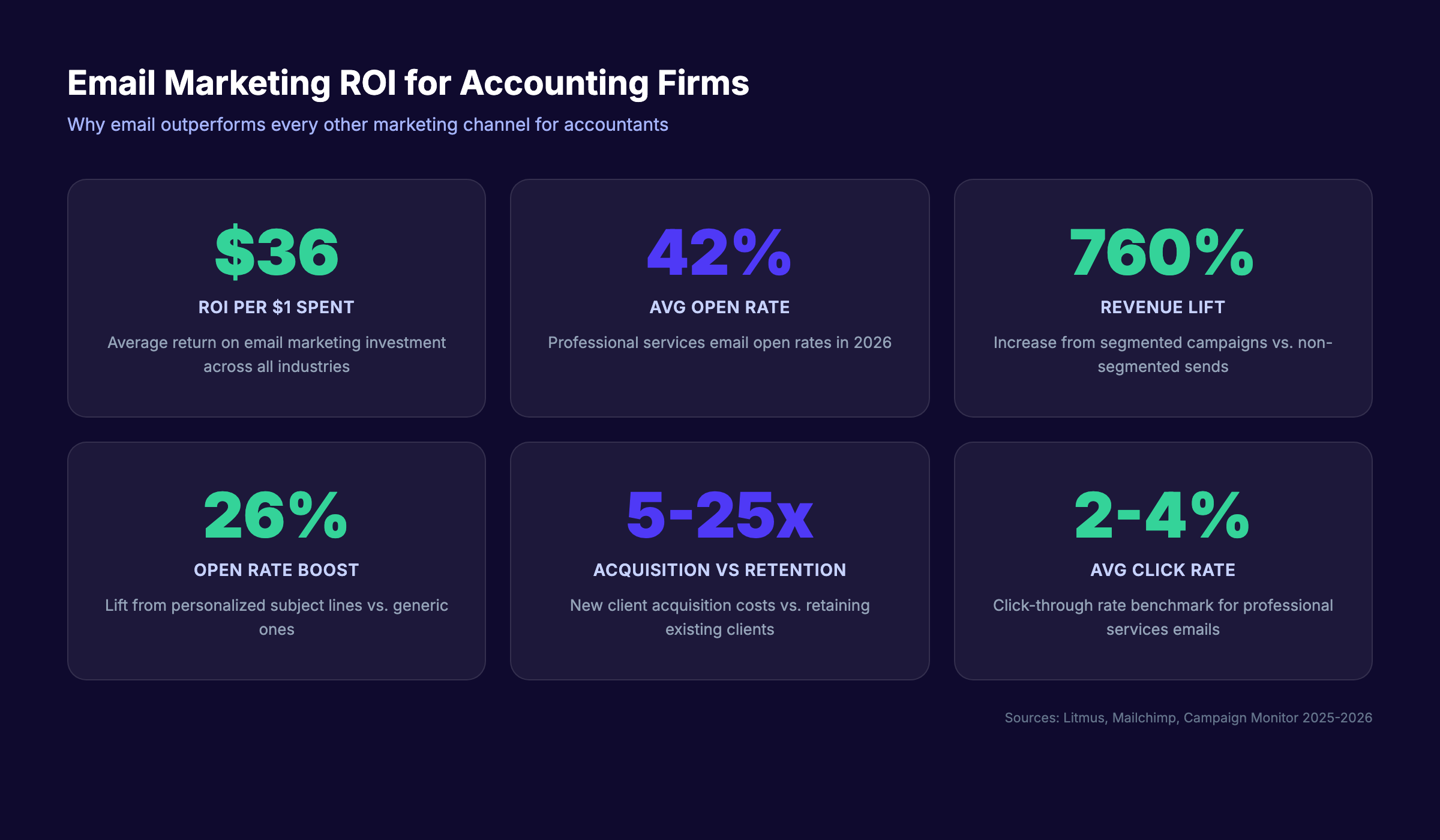
Email marketing for accountants generates $36 for every $1 spent. That is a 3,600% return. No billboard, Google Ad, or networking event comes close. Yet 90% of accounting firms still rely on word-of-mouth as their primary growth strategy.
The gap between firms that email and firms that do not is widening every quarter. Firms that send consistent, targeted emails retain more clients, close more referrals, and fill their pipeline during slow months. Firms that skip email marketing lose clients to competitors who stay visible year-round.
This guide breaks down the full email marketing playbook for accountants and CPA firms. We publish 3,500+ blog posts across 70+ industries, and accounting firms are one of our fastest-growing segments.
Here is what you will learn:
- Why email outperforms every other marketing channel for accountants
- How to build a permission-based email list from scratch
- The 7 email types that drive revenue for accounting firms
- Subject line formulas that push open rates above 40%
- Automation workflows that save 5+ hours per week
- The exact metrics to track and benchmarks to hit
- Common mistakes that kill open rates and deliverability
Why Email Marketing Matters for Accountants
Accounting is a relationship business. Clients hire firms they trust. Email is the only channel that builds trust at scale. It works on your schedule, inside your client’s inbox.
The ROI Numbers Are Hard to Ignore
Email marketing returns an average of $36 for every dollar spent, according to Litmus research. Professional services firms often see even higher returns because their average client value runs into thousands of dollars.
Compare that to other channels:
| Channel | Average ROI | Cost to Reach 1,000 People |
|---|---|---|
| Email marketing | $36 per $1 spent | $5-$15 |
| Google Ads (accounting) | $8 per $1 spent | $50-$200 |
| Social media (organic) | $2-$5 per $1 spent | $0 (but 20+ hrs/month) |
| Direct mail | $7 per $1 spent | $500-$1,000 |
| Trade shows | $3 per $1 spent | $2,000+ |
A single tax planning email sent to 500 clients costs pennies. If 2% convert to a new service, that is 10 new engagements. At $2,000 per engagement, one email generates $20,000.
Email Beats Social Media for Client Retention
Social media algorithms decide who sees your posts. On LinkedIn, organic reach sits around 5-8% of your followers. Email has no algorithm. Every subscriber gets your message.
Open rates for professional services emails average 42% in 2026, according to Mailchimp’s benchmark data. Click-through rates average 2-3%. Those numbers dwarf social media engagement rates of 0.5-1.5%.
If you already run social media for accountants, email amplifies those efforts. Share your best social content in email digests. Drive email subscribers to your LinkedIn posts. The two channels compound each other.
Client Acquisition Cost Drops Over Time
Acquiring a new accounting client costs 5-25 times more than retaining an existing one. Email marketing is a retention machine. Monthly newsletters, tax deadline reminders, and regulatory updates keep your firm top-of-mind.
When existing clients need additional services like bookkeeping, payroll, or advisory work, they hire the firm they already hear from. That firm should be yours.
How to Build an Email List for Your Accounting Firm
An email list filled with the right people is worth more than 10,000 random followers on social media. But you cannot buy that list. You need to earn it.
Start With Your Existing Client Base
Your current clients are your highest-value subscribers. They already trust you. They already pay you. They will open your emails at rates 2-3 times higher than cold contacts.
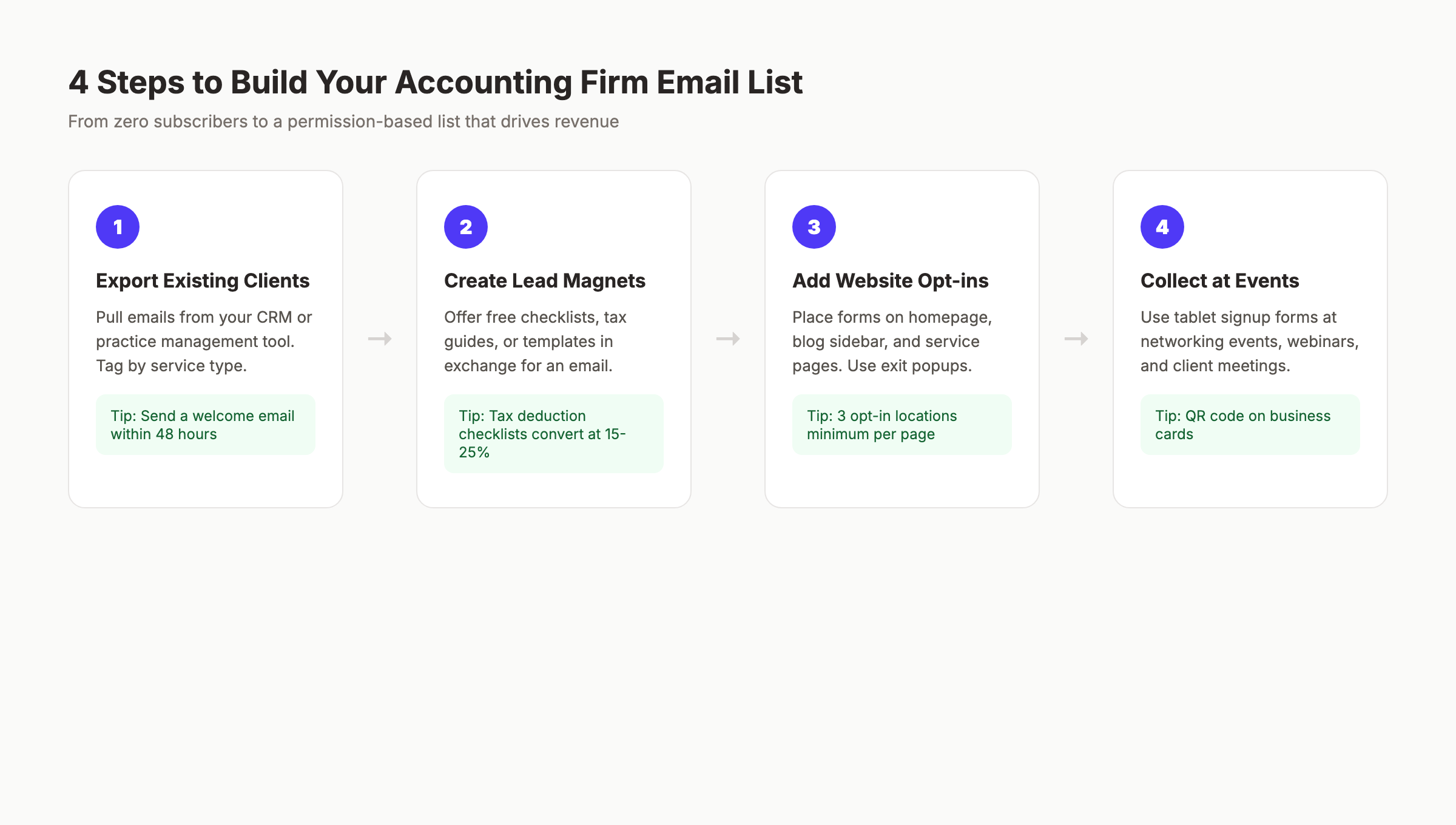
Export client emails from your practice management software. Send a brief welcome email explaining what they will receive and how often. Give them a one-click unsubscribe option.
- Export client emails from your CRM or practice management tool
- Remove duplicates and invalid addresses
- Send a welcome email within 48 hours
- Tag clients by service type (tax, audit, advisory, bookkeeping)
Create Lead Magnets That Accountants’ Prospects Want
A lead magnet is a free resource you offer in exchange for an email address. For accounting firms, the best lead magnets solve a specific money problem.
High-converting lead magnets for accountants include:
| Lead Magnet | Target Audience | Expected Conversion Rate |
|---|---|---|
| Tax deduction checklist for small businesses | Small business owners | 15-25% |
| Year-end tax planning guide (PDF) | Business owners, high earners | 10-20% |
| QuickBooks setup checklist | New business owners | 12-18% |
| Cash flow forecasting template | Growing businesses | 8-15% |
| IRS audit preparation guide | Business owners | 10-15% |
Place these on your website homepage, blog posts, and service pages. Every page should have a clear path to your email list.
Use Your Website and Blog as List-Building Engines
Your accounting firm’s website is the single best tool for growing your email list. Add opt-in forms in 3 locations at minimum:
- Homepage banner with a specific offer (not “subscribe to our newsletter”)
- Blog sidebar with a relevant lead magnet
- Exit-intent popup with a tax tip or checklist
Creating a business blog is one of the fastest ways to attract subscribers. Blog posts about tax tips and financial planning bring in search traffic. Each visitor is a potential email subscriber.
Building your online presence through consistent blogging and SEO creates a steady flow of new subscribers without paid ads.
Use Speaking Events and Networking
Collect email addresses at every speaking event, webinar, or networking meeting. Use a tablet or phone with a simple signup form. Offer your best lead magnet as the incentive.
Mention your email newsletter in client meetings. Add a signup link to your email signature. Print a QR code on your business cards that links directly to your opt-in page.
Your accounting firm needs a content engine, not just email blasts. Stacc publishes 30 SEO-optimized blog posts per month that drive email signups on autopilot. Start for $1 →
7 Email Types Every Accounting Firm Should Send
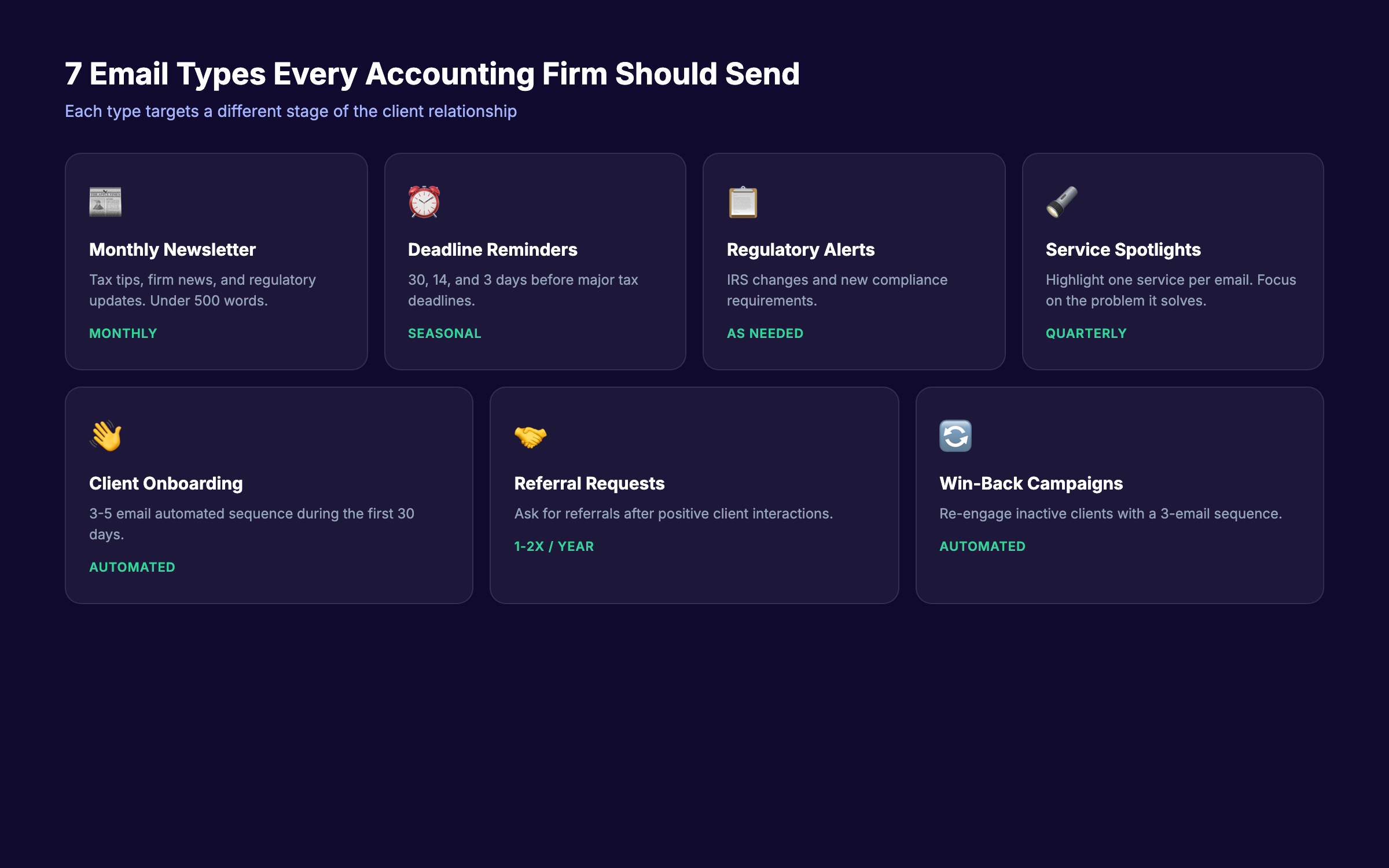
Most accounting firms send one type of email: a generic monthly newsletter. That is a missed opportunity. The best firms use 7 distinct email types, each designed for a different stage of the client relationship.
1. The Monthly Newsletter
A curated roundup of tax tips, firm news, and regulatory updates. Keep it under 500 words. Link to full blog posts for readers who want depth.
Send frequency: Monthly, same day each month. Tuesday through Thursday mornings perform best for B2B professional services.
2. Tax Deadline Reminders
Send reminders 30 days, 14 days, and 3 days before major deadlines. Include a clear call to action: “Book your appointment” or “Submit your documents by [date].”
Key deadlines to cover: April 15, June 15, September 15, October 15, January 15, and any state-specific dates.
3. Regulatory Update Alerts
Email your clients the moment an IRS rule changes or a state tax law shifts. This positions your firm as the first source of reliable information.
A 2-paragraph email with a “what this means for you” section builds more trust than a long post nobody reads.
4. Service Spotlight Emails
Highlight one service per email. Many existing clients do not know everything your firm offers. A bookkeeping client might not realize you handle payroll. A tax client might not know you offer CFO advisory services.
Send once per quarter. Focus on the problem the service solves, not the features of the service.
5. Client Onboarding Sequences
New clients should receive a 3-5 email automated sequence during their first 30 days. Cover what to expect, how to submit documents, who their point of contact is, and what deadlines matter for them.
This reduces support calls and makes clients feel guided through the process.
6. Referral Request Emails
Accounting firms grow primarily through referrals. Yet most firms never ask. Send a referral request email once or twice per year. Time it after a positive interaction like completing a tax return.
Keep it simple: “Reply with a name, or forward this to someone who needs help.”
7. Win-Back Campaigns
For clients who have gone inactive or churned, send a 3-email sequence over 2 weeks. Acknowledge the gap. Share something valuable (like a new service or tax saving tip). Make it easy to re-engage.
Win-back emails have an average open rate of 12%, but the revenue per re-engaged client is extremely high.
Plan these campaigns with an editorial calendar. Map every send date, topic, and segment across the year.
How to Write Emails Accounting Clients Open
The average professional receives 121 emails per day. Your accounting firm’s email competes with every one of them. Subject lines, formatting, and content quality determine whether your email gets opened or deleted.
Subject Line Formulas That Work
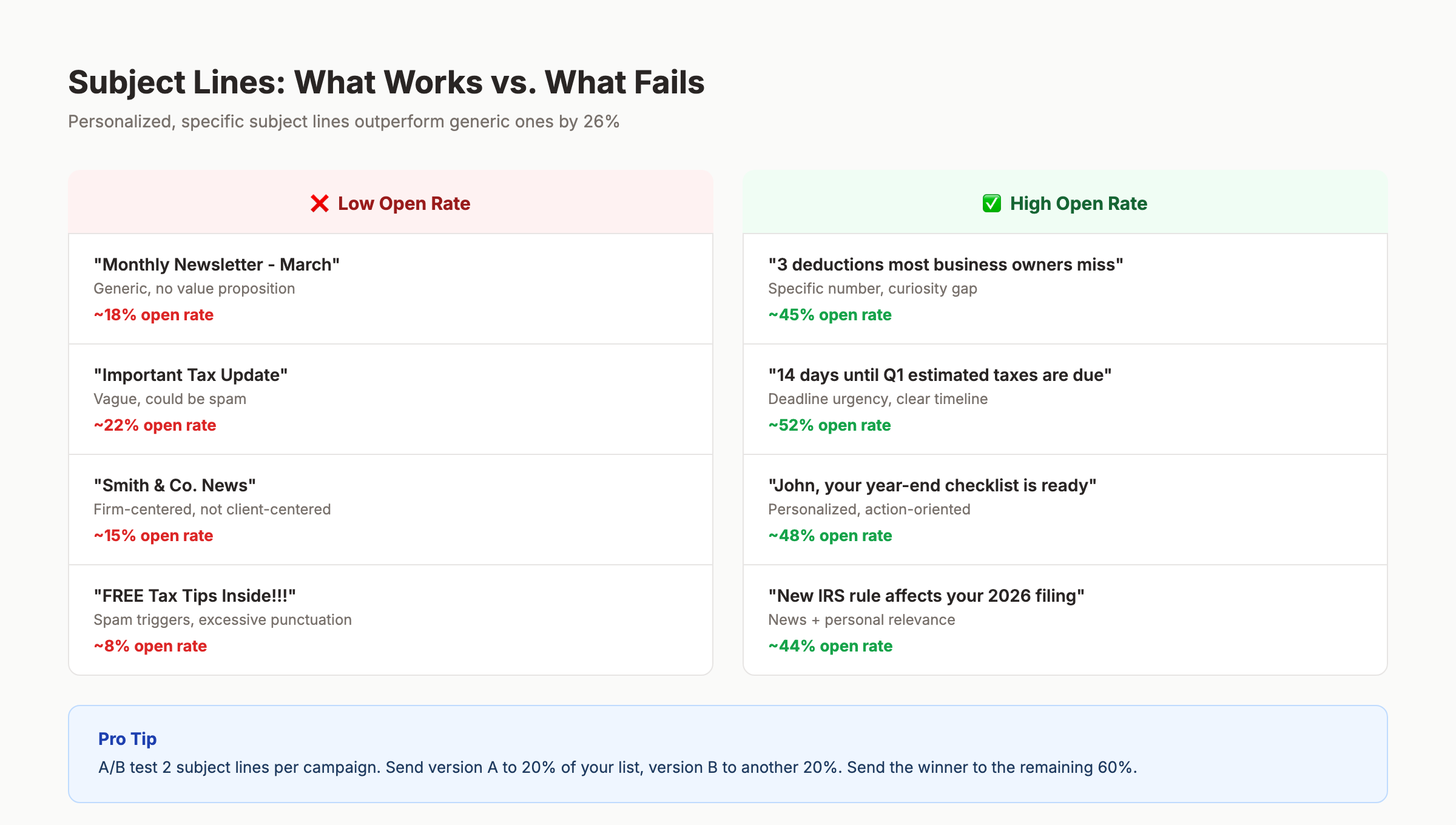
Personalized subject lines boost open rates by 26%. Generic subject lines like “Monthly Newsletter - March” perform the worst.
Use these proven formulas for accounting emails:
| Formula | Example | Why It Works |
|---|---|---|
| Number + Benefit | ”3 tax deductions you are probably missing” | Specific, curiosity-driven |
| Deadline + Urgency | ”14 days until Q1 estimated taxes are due” | Time-sensitive action |
| Question | ”Are you overpaying on business insurance?” | Opens a knowledge gap |
| News + Impact | ”New IRS rule affects your 2026 filing” | Relevance and urgency |
| Personal + Direct | ”John, your year-end checklist is ready” | Personalization lifts opens 26% |
Avoid spam trigger words: “free,” “act now,” “limited time,” “guaranteed.” Email filters penalize these terms heavily.
For more ideas on writing attention-grabbing titles, check out our blog headlines guide. The same principles that work for headlines also work for email subject lines.
Keep the Body Scannable
Accounting clients are busy professionals. They scan emails in 8-11 seconds before deciding to read or delete.
Structure every email with:
- One topic per email. Do not combine tax tips with firm news with service promotions.
- Short paragraphs. 2-3 sentences maximum.
- Bold key phrases. Readers scan bold text first.
- Bullet points for lists. Numbered steps for processes.
- One clear CTA. “Book a call,” “Download the checklist,” or “Read the full article.”
Match Content to Client Segments
Segmented email campaigns generate 100% higher click-through rates and 760% more revenue than non-segmented sends.
Segment your list by at least these categories:
- Service type: Tax clients, bookkeeping clients, advisory clients
- Business size: Sole proprietors, small businesses (1-10 employees), mid-market (11-50)
- Industry: Real estate, medical, restaurant, technology
- Client lifecycle stage: New client, active client, inactive client
A restaurant owner needs different tax advice than a technology startup. Sending everyone the same email wastes your best content on the wrong audience.
Understanding your buyer personas makes segmentation easier. When you know who your ideal clients are, you can write emails that speak directly to their problems.
Email Automation Workflows for Accounting Firms
Manual email marketing does not scale. If you are personally writing and sending every email, you will burn out or stop sending entirely. Automation fixes that problem.
The 4 Automations Every Firm Needs
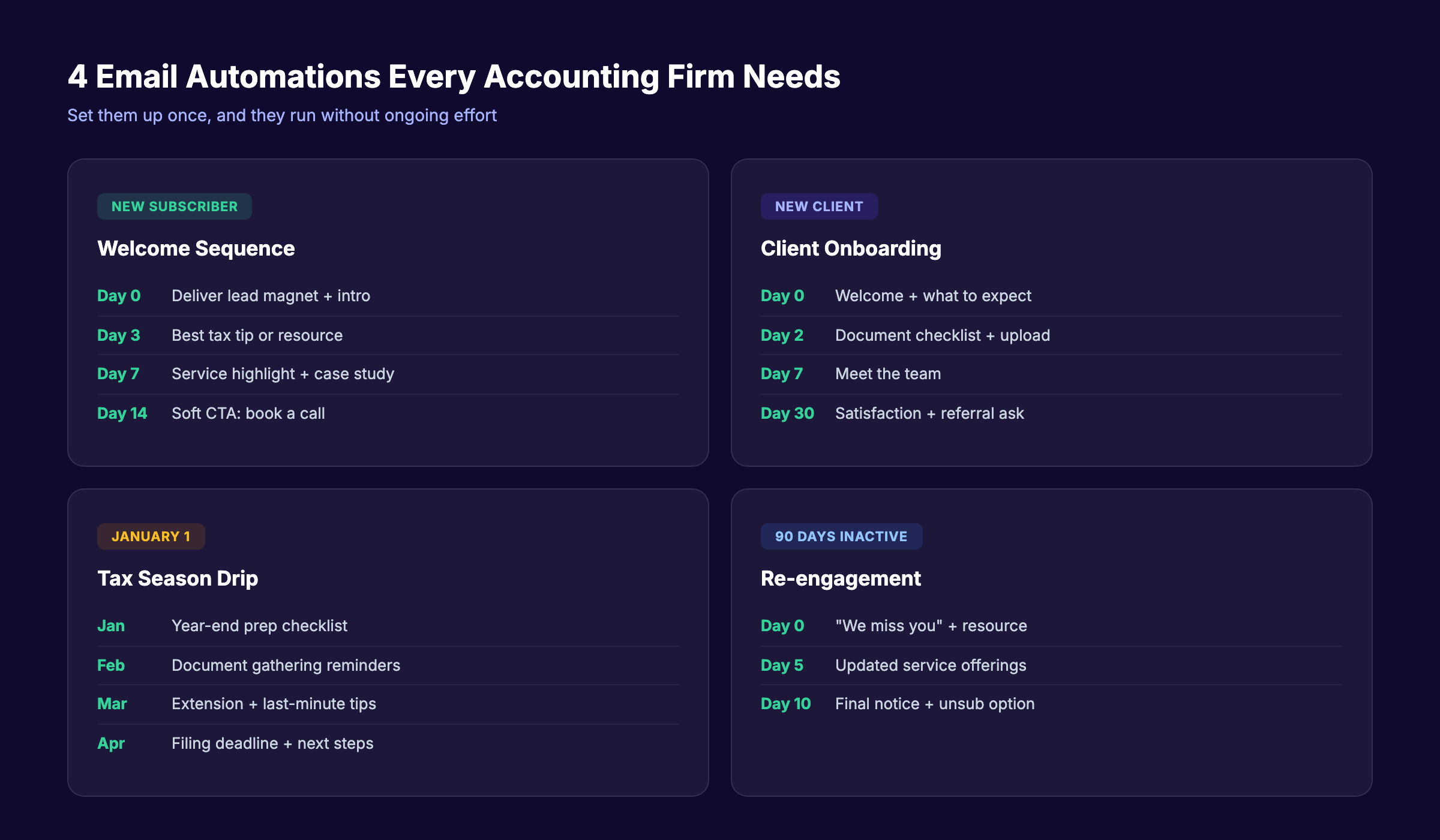
Set up these 4 workflows first. They run in the background and generate results without ongoing effort.
1. Welcome Sequence (Triggered: New subscriber)
- Email 1 (Immediately): Deliver the lead magnet + introduce the firm
- Email 2 (Day 3): Share your best tax tip or resource
- Email 3 (Day 7): Highlight one service with a case study
- Email 4 (Day 14): Soft CTA to book a consultation
2. New Client Onboarding (Triggered: Client signs engagement letter)
- Email 1 (Day 0): Welcome + what to expect
- Email 2 (Day 2): Document checklist + upload instructions
- Email 3 (Day 7): Introduce the team + preferred contact methods
- Email 4 (Day 14): Check-in + FAQ answers
- Email 5 (Day 30): Satisfaction check + referral ask
3. Tax Season Drip (Triggered: January 1)
- January: Year-end prep checklist
- February: Document gathering reminders
- March: Extension deadlines + last-minute deductions
- April: Filing deadline reminder + next steps after filing
4. Re-engagement (Triggered: No opens for 90 days)
- Email 1: “We miss you” + valuable resource
- Email 2 (Day 5): Updated service offerings
- Email 3 (Day 10): Final notice + unsubscribe option
Choose the Right Email Platform
The best email marketing tools for accounting firms balance ease of use with automation depth. Popular options include Mailchimp, ActiveCampaign, ConvertKit, and HubSpot.
Check out our list of email marketing tools for local businesses for a detailed comparison of features and pricing.
Key features to prioritize:
- Visual automation builder
- Contact segmentation and tagging
- A/B testing for subject lines
- CRM integration (sync with your practice management software)
- Compliance features (CAN-SPAM, GDPR opt-out management)
Most accounting firms need a tool in the $20-$100 per month range. Do not overpay for enterprise features you will never use.
Consistent content keeps your firm visible between tax seasons. Stacc writes and publishes SEO blog posts every month so your website generates leads on autopilot. Start for $1 →
How to Measure Email Marketing Performance
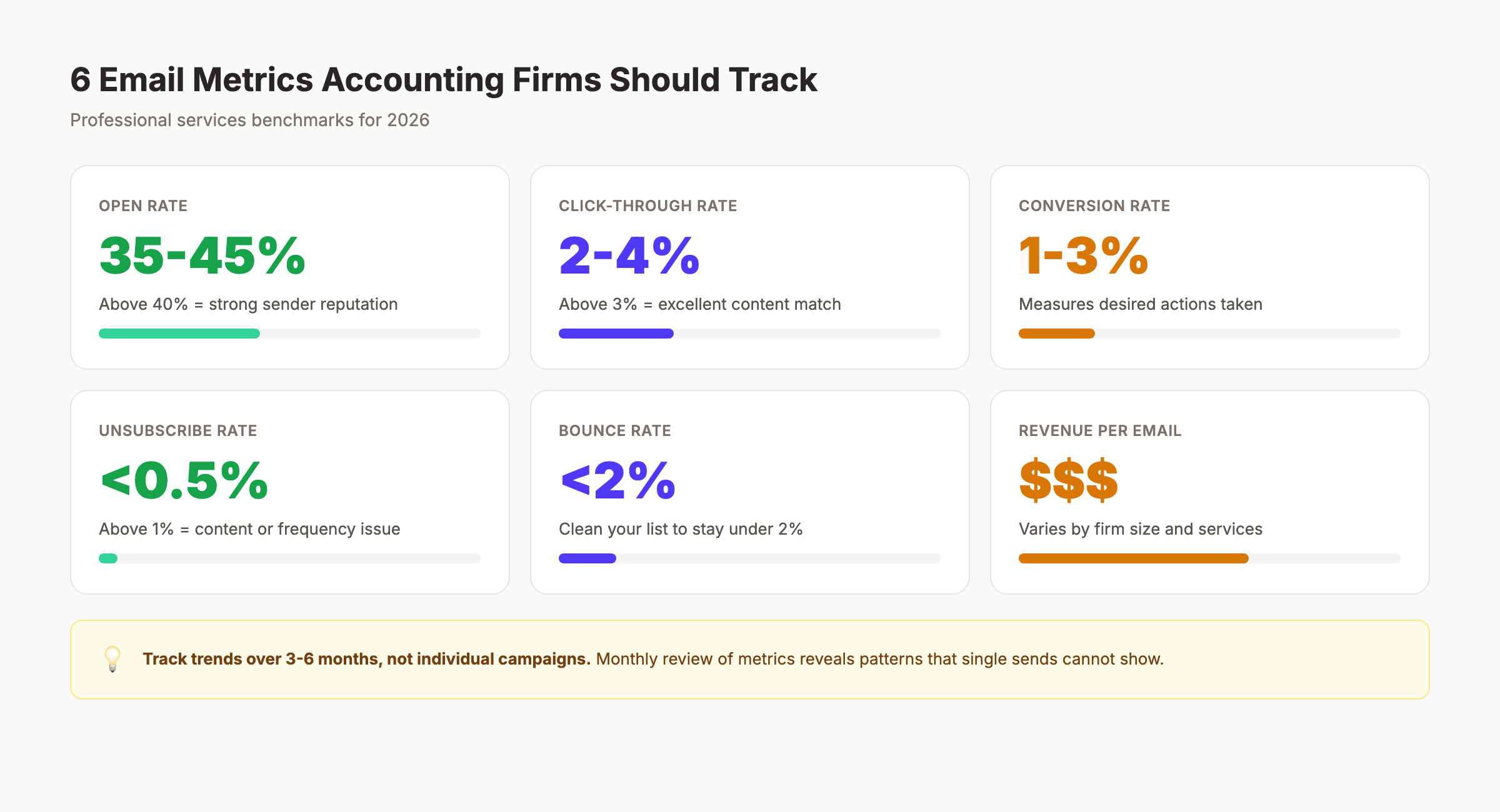
You cannot improve what you do not measure. Track these 6 metrics every month to understand what is working and what needs to change.
The 6 Metrics That Matter
| Metric | Benchmark (Professional Services) | What It Tells You |
|---|---|---|
| Open rate | 35-45% | Subject line effectiveness and sender reputation |
| Click-through rate (CTR) | 2-4% | Content relevance and CTA strength |
| Conversion rate | 1-3% | How well emails drive the desired action |
| Unsubscribe rate | Under 0.5% | Content quality and send frequency |
| Bounce rate | Under 2% | List hygiene and data quality |
| Revenue per email | Varies by firm | Direct business impact |
Open rates above 40% signal strong subject lines and a healthy list. Below 25% means your subject lines need work or your list has too many cold contacts.
Click-through rates above 3% are excellent. If opens are high but clicks are low, your email content does not match the subject line promise.
Track content ROI across all your marketing channels. Email should be one of your highest-performing assets. If it is not, the problem is usually list quality or content relevance, not the channel itself.
Set Up a Monthly Review Process
Create a simple spreadsheet or dashboard. Record these numbers after every campaign. Look for trends over 3-6 months, not individual campaign performance.
- Log open rate, CTR, and unsubscribes for every send
- Compare month-over-month trends
- Identify your 3 highest-performing emails each quarter
- Replicate the format and topics of your best performers
- Remove subscribers who have not opened in 6+ months
Learning to measure content marketing ROI across your entire funnel helps you see how email fits into the bigger picture. Email rarely works in isolation. It works best when combined with SEO, social media for accountants, and a well-optimized Google Business Profile.
Common Email Marketing Mistakes Accountants Make
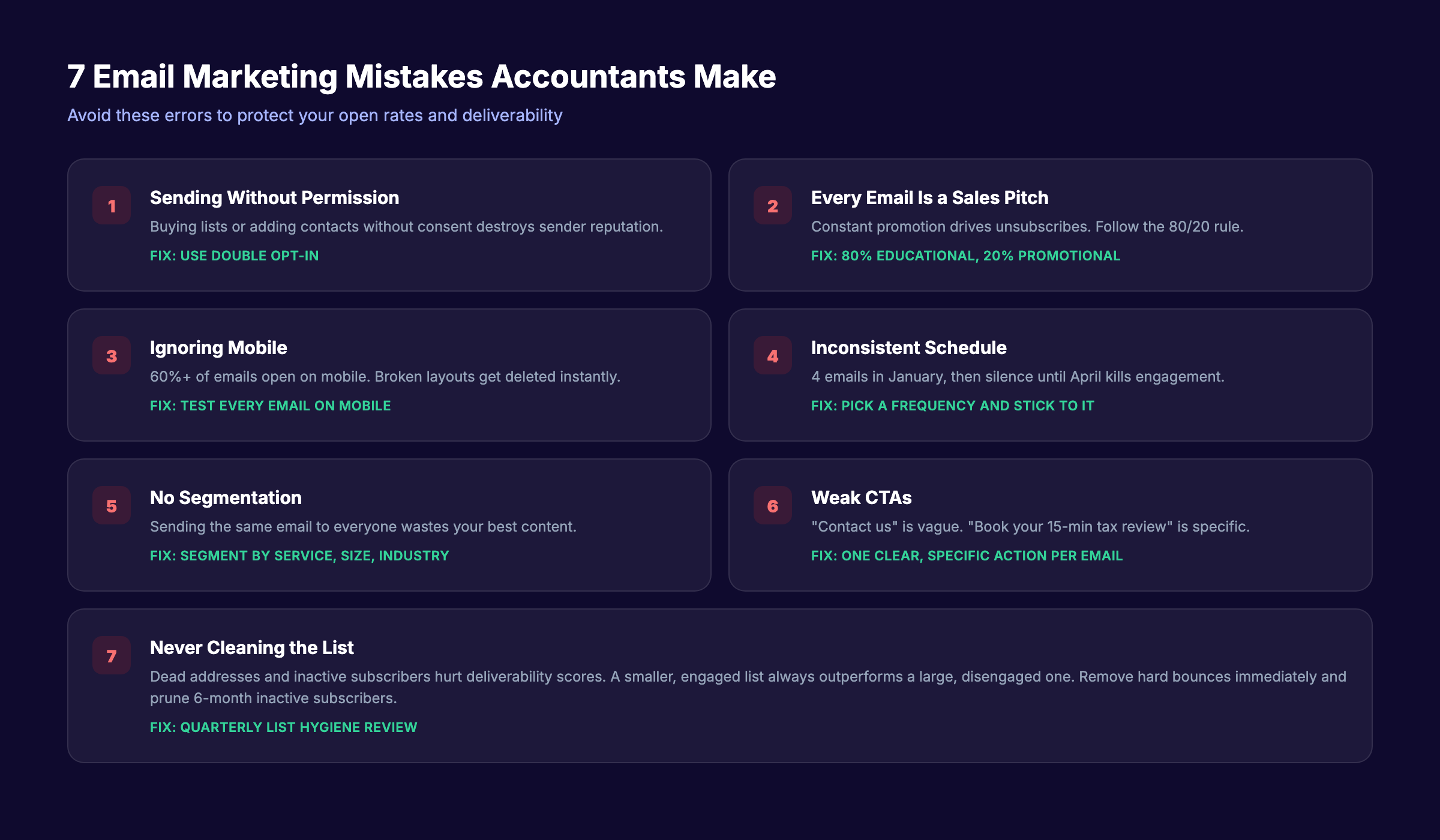
Even small mistakes in email marketing can tank your open rates and push clients to unsubscribe. Here are the 7 most common errors we see from accounting firms.
1. Sending Without Permission
Buying email lists or adding people without consent violates CAN-SPAM and GDPR. It also destroys your sender reputation. One spam complaint per 1,000 emails is enough to get your domain blacklisted.
Always use double opt-in. Confirm every subscriber actually wants your emails.
2. Making Every Email a Sales Pitch
The 80/20 rule applies here. Send 80% educational content and 20% promotional content. Clients will tolerate an occasional service promotion if you consistently deliver value first.
3. Ignoring Mobile Optimization
Over 60% of emails are opened on mobile devices. If your email template uses tiny text, wide images, or broken layouts on a phone screen, readers delete it immediately.
Test every email on mobile before hitting send.
4. Inconsistent Sending Schedule
Sending 4 emails in January and then nothing until April trains your subscribers to forget you. Pick a frequency (weekly, biweekly, or monthly) and stick with it. Consistency builds expectation.
Use a content calendar to plan your email topics alongside your blog posts and social media. A well-designed content marketing strategy aligns all channels.
5. No Segmentation
Sending every email to your entire list wastes your best content on the wrong people. Even basic segmentation by service type or business size doubles engagement.
6. Weak or Missing CTAs
Every email needs one clear next step. “Contact us” is vague. “Book your 15-minute tax review call” is specific. Tell readers exactly what to do and make it easy.
7. Never Cleaning the List
Dead email addresses and inactive subscribers hurt your deliverability score. Remove hard bounces immediately. Remove subscribers who have not opened an email in 6 months.
A smaller, engaged list always outperforms a large, disengaged one.
Pair your email marketing with strong SEO for your accounting firm and a solid local SEO strategy. When all 3 channels work together, client acquisition becomes predictable.
Frequently Asked Questions
How often should accountants send marketing emails?
Most accounting firms see the best results with biweekly or monthly sends. During tax season (January through April), increase to weekly. Outside of tax season, monthly keeps you visible without overwhelming subscribers. The key is consistency, not frequency.
What is a good open rate for accounting firm emails?
Professional services firms average 35-45% open rates. Anything above 40% is strong. Below 25% signals a problem with subject lines, list quality, or sender reputation. Personalized subject lines can lift open rates by 26% compared to generic ones.
Do accountants need to comply with CAN-SPAM for email marketing?
Yes. Every commercial email must include a physical mailing address, a clear unsubscribe link, and accurate sender information. You cannot add people to your list without consent. Violations carry fines up to $51,744 per email. Use double opt-in and honor every unsubscribe request within 10 business days.
What is the best email marketing platform for small accounting firms?
For firms with fewer than 1,000 subscribers, Mailchimp or MailerLite offers the best balance of free/low-cost plans and automation features. For firms that want deeper automation, ActiveCampaign or HubSpot provide advanced segmentation and CRM integration. See our full breakdown of email marketing tools for local businesses.
How do I get more email subscribers for my accounting firm?
The fastest method is a lead magnet on your website. Offer a free tax deduction checklist, year-end planning guide, or cash flow template in exchange for an email address. Place opt-in forms on your homepage, blog sidebar, and service pages. Mention your newsletter in client meetings, on social media, and in your email signature.
Should accountants use email automation?
Absolutely. At minimum, set up a welcome sequence, a client onboarding sequence, and a tax season drip campaign. These 3 automations run without manual effort and produce consistent results. Firms that automate email workflows save 5-10 hours per week compared to manual sending.
Email marketing for accountants is not optional in 2026. It is the highest-ROI channel available to your firm. Start with your existing client list, set up 2-3 automations, and send consistently. The firms that show up in the inbox every month are the firms that win the next engagement.
Ready to fill your pipeline without writing a single blog post? Stacc handles your content marketing on autopilot. 30 SEO articles per month, starting at $99. Start for $1 →
Written and published by Stacc. We publish 3,500+ articles per month across 70+ industries. All data verified against public sources as of March 2026.
