End of traditional SEO is real. AI Overviews, GEO, and citation-based search rebuilt the playbook. Here is what works in 2026 and what to stop doing now.
The end of traditional SEO is not a theory anymore. AI Overviews now appear on 48% of Google queries. Zero-click searches reached 58.5% in the US. Click-through rates on position 1 dropped 34.5% when an AI Overview sits above the result. The old playbook of "rank #1 and wait for clicks" produces a fraction of the traffic it did three years ago.
This costs real money. Brands that ranked for thousands of keywords saw organic sessions collapse without losing a single position. The traffic did not move to a competitor. It moved into the answer box. Most teams still run 2019 SEO strategies and wonder why the spreadsheet stopped working.
This guide explains what the end of traditional SEO actually means, what replaced it, and which parts of the old playbook still matter. We publish 3,500+ SEO articles a month across 70+ industries. We track AI citation rates and traffic patterns daily. This is the operator view, backed by 2026 data, not a vendor pitch.
Here is what you will learn:
- Why traditional SEO stopped producing the same results, with hard numbers
- What replaced it (GEO, AEO, and entity-first content)
- The 6-step replacement playbook we run for clients
- Which traditional SEO tactics still matter (more than people think)
- How to measure success when ranking does not equal traffic
- The 4 stages of SEO and where most marketers are stuck
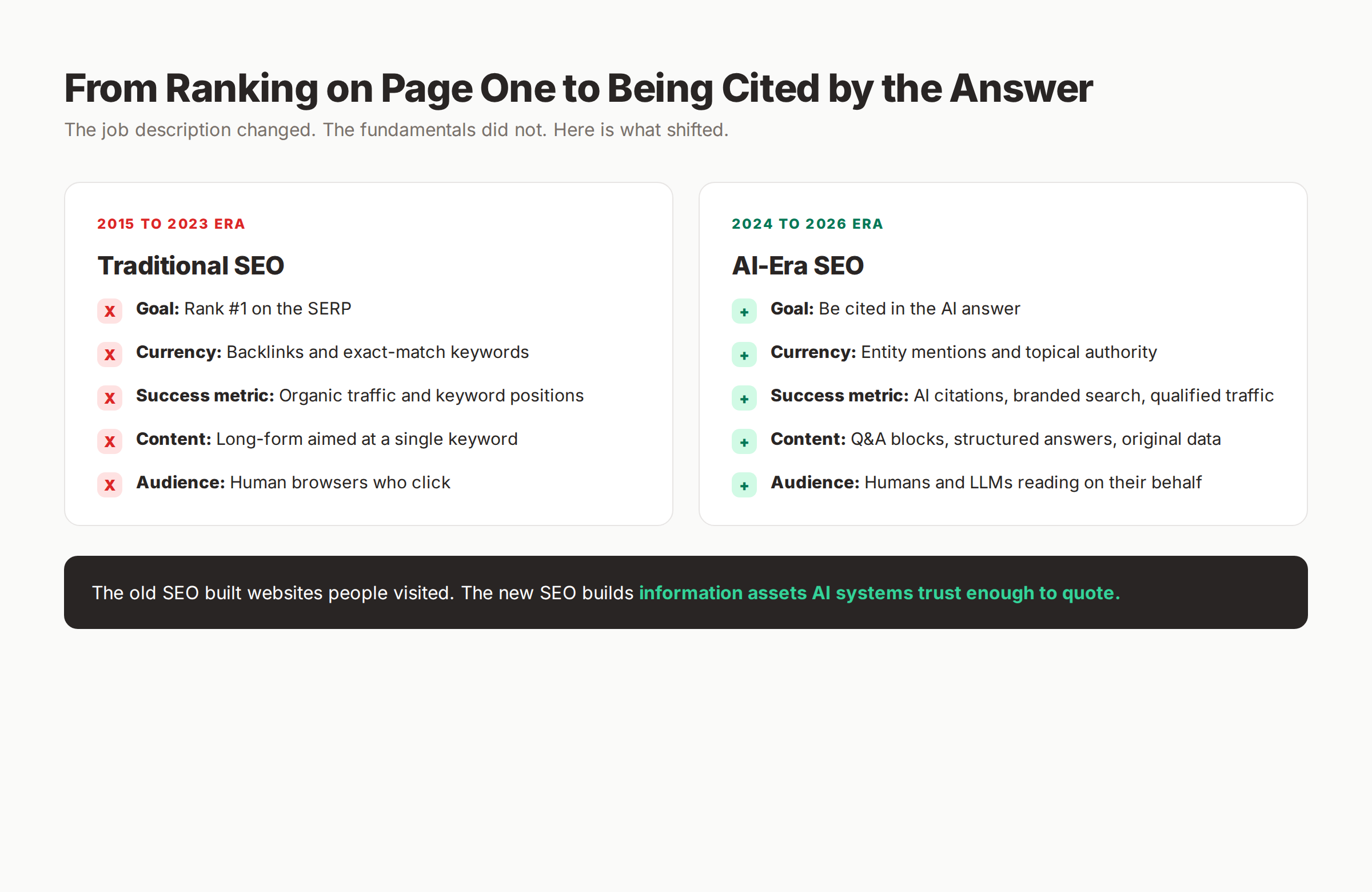
What "End of Traditional SEO" Actually Means
Traditional SEO ended as a complete strategy. It did not end as a discipline. The distinction matters.
For 25 years, SEO meant one thing. Pick a keyword. Write a page targeting that keyword. Build backlinks. Wait for the page to rank. Collect organic traffic from people who clicked the blue link. That entire workflow assumed users were willing to click a result, scan a page, and find their own answer.
That assumption broke in 2024. Google AI Overviews launched globally in May 2024. ChatGPT crossed 800 million weekly users by early 2026. Perplexity, Claude, and Gemini all became default starting points for research. Users started asking a question and getting an answer without ever visiting a website.
The data confirms the shift. SparkToro found that 58.5% of US Google searches now end without a click. Ahrefs measured a 34.5% drop in click-through rate for position 1 when an AI Overview is present. Semrush reported a 2.5% decline in total organic traffic between February 2024 and November 2025, despite Google handling more queries than ever.
That last number is the most telling. Total organic traffic only fell 2.5% in absolute terms. The pie did not collapse. But clicks per impression collapsed. The traffic that disappeared from your analytics dashboard went into the AI answer. It still happened. It just no longer required a visit.
So traditional SEO is not dead. It became a smaller piece of a larger discipline. The new discipline is sometimes called Generative Engine Optimization (GEO), sometimes Answer Engine Optimization (AEO), sometimes Search Everywhere Optimization. The names vary. The work is similar. Optimize so AI systems find you, trust you, and quote you when they generate an answer.
If you want a deeper definition split, our GEO vs SEO breakdown and AEO vs SEO comparison explain how each acronym fits together.
The old SEO built websites people visited. The new SEO builds information assets AI systems trust enough to quote. Sign up for free →
The Data Behind the Shift
You do not need to take the "SEO is dead" headlines on faith. Five data points explain the entire transformation.
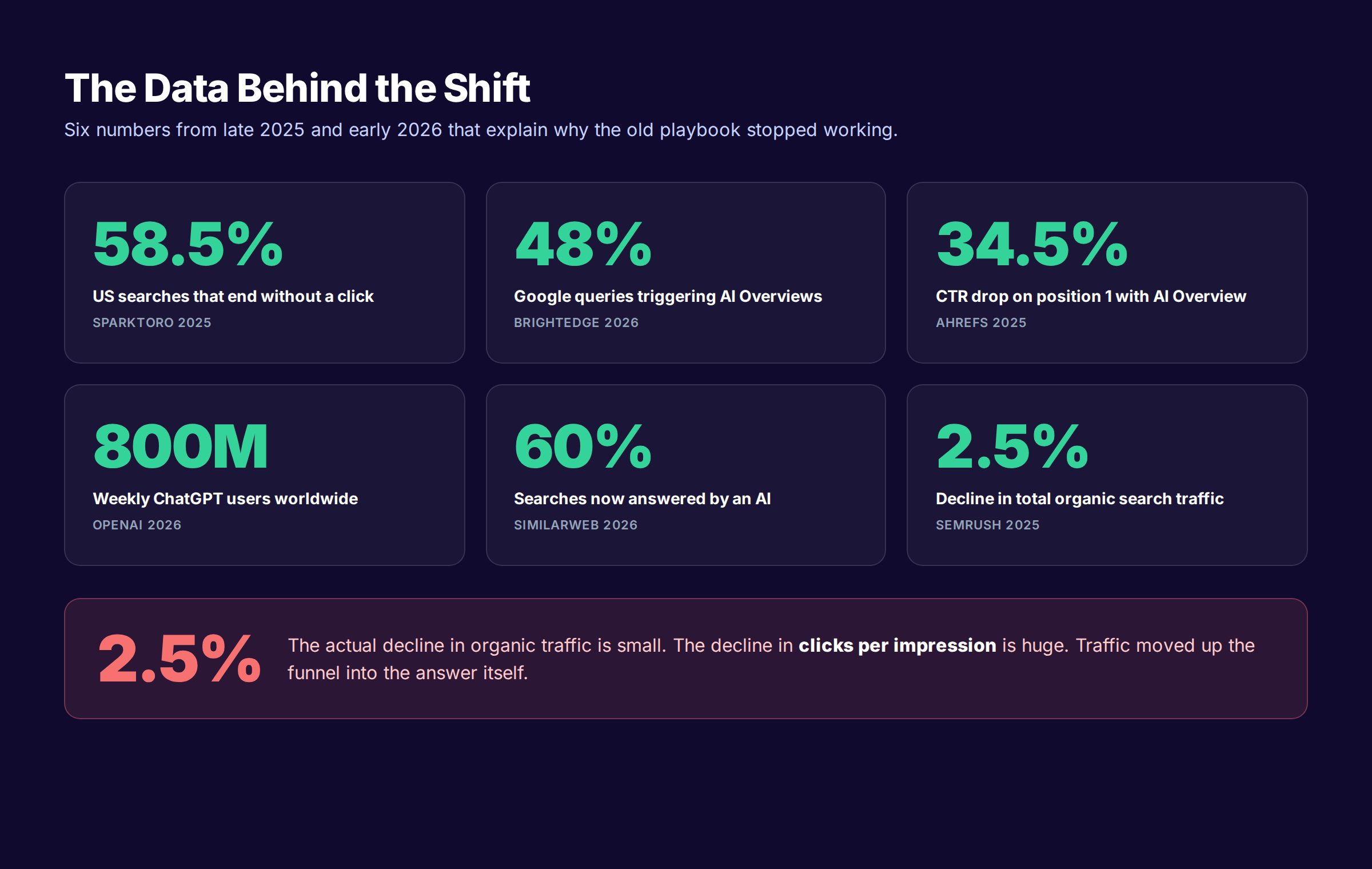
AI Overviews now sit on roughly half of queries
BrightEdge tracking shows AI Overviews appeared on 48% of Google queries in early 2026, up from 14% in mid-2024. For informational and how-to queries, that number jumps to over 70%. If your category leans informational, more than two thirds of your impressions never reach a blue link anymore.
Zero-click is the default, not the exception
SparkToro and Datos analyzed 332 million US Google sessions in 2025. Only 36% of searches led to an open click on a non-Google property. The other 64% either ended without a click or kept users inside Google's ecosystem. For mobile, the zero-click rate hit 77%.
CTR on position 1 dropped by a third
Ahrefs tested 300,000 keywords side by side, comparing CTR with and without an AI Overview. Position 1 CTR fell from 19.2% without an Overview to 12.6% with one. That is a 34.5% reduction in clicks for the same ranking position. Position 2 through 10 saw similar declines.
ChatGPT alone now handles billions of searches monthly
OpenAI reported 800 million weekly active ChatGPT users in early 2026, with search functionality available to every account. Similarweb estimates ChatGPT now handles 5% of total US search query volume. Perplexity adds another 1.5%. Gemini and Claude push the share of "answered by AI" past 60% of all information requests.
Organic traffic in absolute terms only fell 2.5%
Semrush analyzed 1.7 million US websites from February 2024 to November 2025. Total organic sessions dropped 2.5%. Not 25%. Not 50%. The headline-grabbing "SEO is dead" narrative collapses against this number. SEO did not die. The relationship between rankings and clicks broke.
| Metric | 2022 Baseline | Late 2025 / 2026 | Change |
|---|---|---|---|
| AI Overview prevalence | 0% | 48% | +48 pts |
| US zero-click rate | 48.5% | 58.5% | +10 pts |
| Position 1 CTR (with AIO) | 19.2% | 12.6% | -34.5% |
| ChatGPT weekly users | 0 | 800M | New channel |
| Total organic traffic | Baseline | -2.5% | Modest decline |
| AI citation as ranking signal | None | Tracked by major tools | New metric |
The takeaway sits in plain sight. Traffic per ranking dropped. The total addressable audience did not. The audience moved into the answer.
What Replaced Traditional SEO
The replacement is not a single tactic. It is a stack. Three layers sit on top of the technical SEO foundation you already had.
Layer 1: Entity-first content
LLMs do not match keywords. They build an internal representation of what your brand covers and how authoritative you are on each topic. That representation is called an entity. The new SEO starts by deciding what entity Google and ChatGPT should associate with your brand.
For theStacc, the entity is "done-for-you SEO content publishing." Every article, every page, every external mention reinforces that entity. We do not chase random keywords. We saturate the topic. That is how AI systems learn what to quote you for. Read more in our guide to building topical authority and what topical authority means.
Layer 2: Extractable structure
LLMs and AI Overviews lift content in chunks. They prefer specific structural patterns: 40 to 60 word direct answers placed under clear H2 headings, structured lists, tables, and Q&A blocks. If your content is one long flowing paragraph, AI systems cannot easily extract a clean answer. They skip you and quote a competitor with cleaner structure.
This is why every section in this article opens with a direct claim, supports it with data, and uses lists or tables to make extraction trivial. Our guide to getting cited in AI search and optimizing for Google AI Overviews cover the exact formatting that wins.
Layer 3: External entity mentions
Backlinks still help. They are no longer the main signal for AI citation. Brand mentions on Reddit, YouTube, Substack, podcasts, and trusted publications carry more weight than they used to. LLMs are trained on vast text corpora and treat repeated brand co-occurrence with a topic as a trust signal. A mention without a link can be more valuable than a link without a brand mention.
This shifts the link-building budget. Less time chasing DA 70 placements with anchor text. More time getting your brand named in industry conversations.
| Old SEO Currency | New SEO Currency |
|---|---|
| Exact-match keywords | Entity coverage and topical breadth |
| Backlinks with anchor text | Brand mentions on trusted domains |
| Organic ranking position | Citations in AI answers |
| Traffic from SERP clicks | Branded search and direct traffic uplift |
| Domain authority | Topical authority on a specific entity |
| Long-form for one keyword | Cluster content with Q&A blocks |
The 4 Stages of SEO (And Where You Are Stuck)
SEO has moved through four distinct stages. Most marketers are still operating in stage 2 or 3.
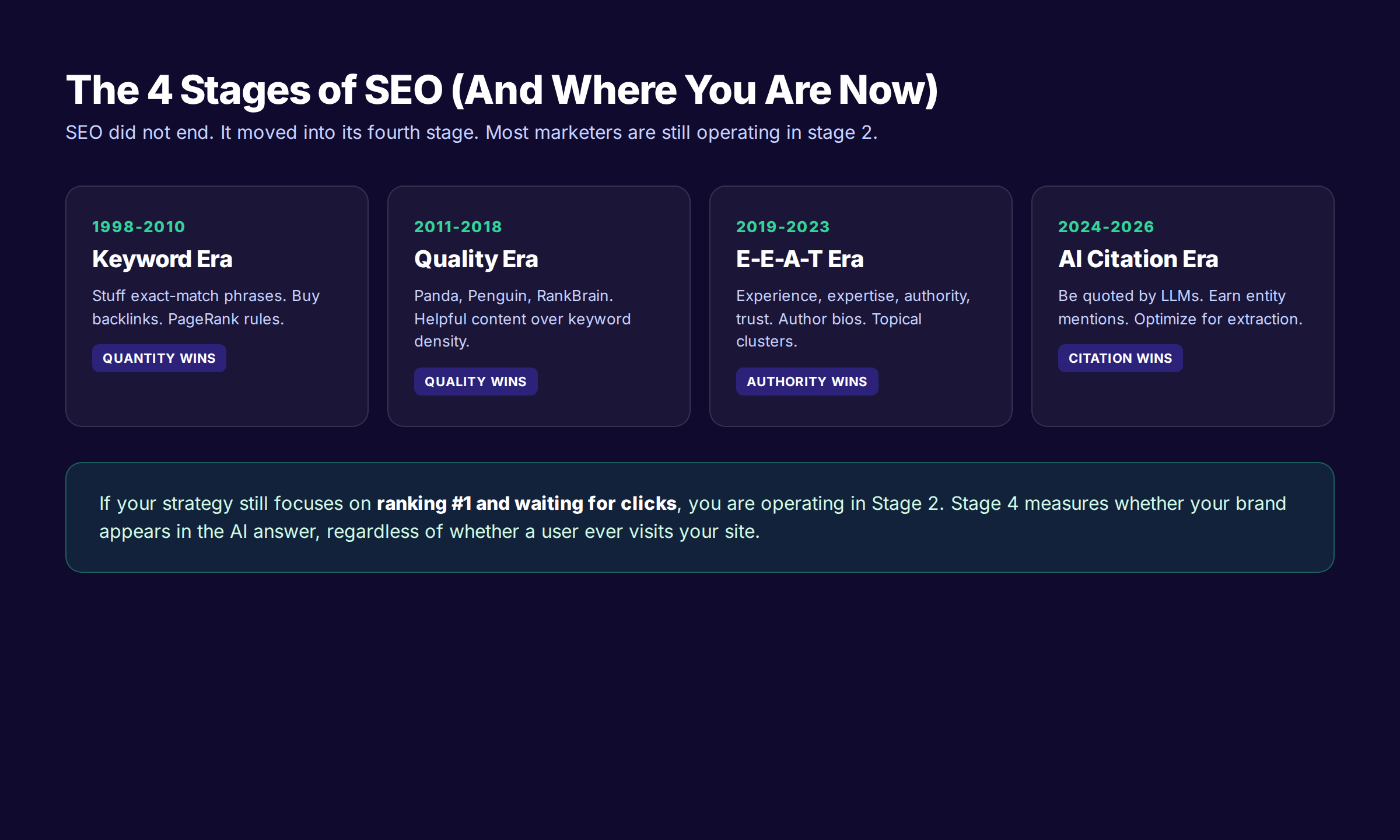
Stage 1: Keyword era (1998 to 2010)
PageRank ruled. Stuff exact-match phrases into the page. Buy backlinks from anywhere. Build a hundred thin pages targeting variations. Volume won.
Stage 2: Quality era (2011 to 2018)
Panda hit in 2011. Penguin in 2012. RankBrain in 2015. Google started punishing thin content and link spam. Quality won over quantity. Long-form, helpful content became the default playbook. Most SEO blogs you read still teach this era.
Stage 3: E-E-A-T era (2019 to 2023)
Experience, expertise, authoritativeness, and trust became core ranking factors. Author bios, citations, original research, and topical depth mattered. Brands had to prove they were sources, not just publishers. Read more in our E-E-A-T for blogs guide.
Stage 4: AI citation era (2024 to 2026 and beyond)
The current era. Google AI Overviews, ChatGPT search, Perplexity, and Gemini all generate answers. The job is no longer to rank. The job is to be cited in the answer. Most agencies still sell stage 2 or stage 3 work. The work that actually moves the needle is stage 4.
If your scorecard still says "rank #1 for keyword X," you are operating in stage 2. Stage 4 measures whether your brand appears in the AI answer at all, regardless of whether the user clicks.
The 6-Step Replacement Playbook
This is the playbook we run for every theStacc client. Every step replaces a piece of the old traditional SEO motion.
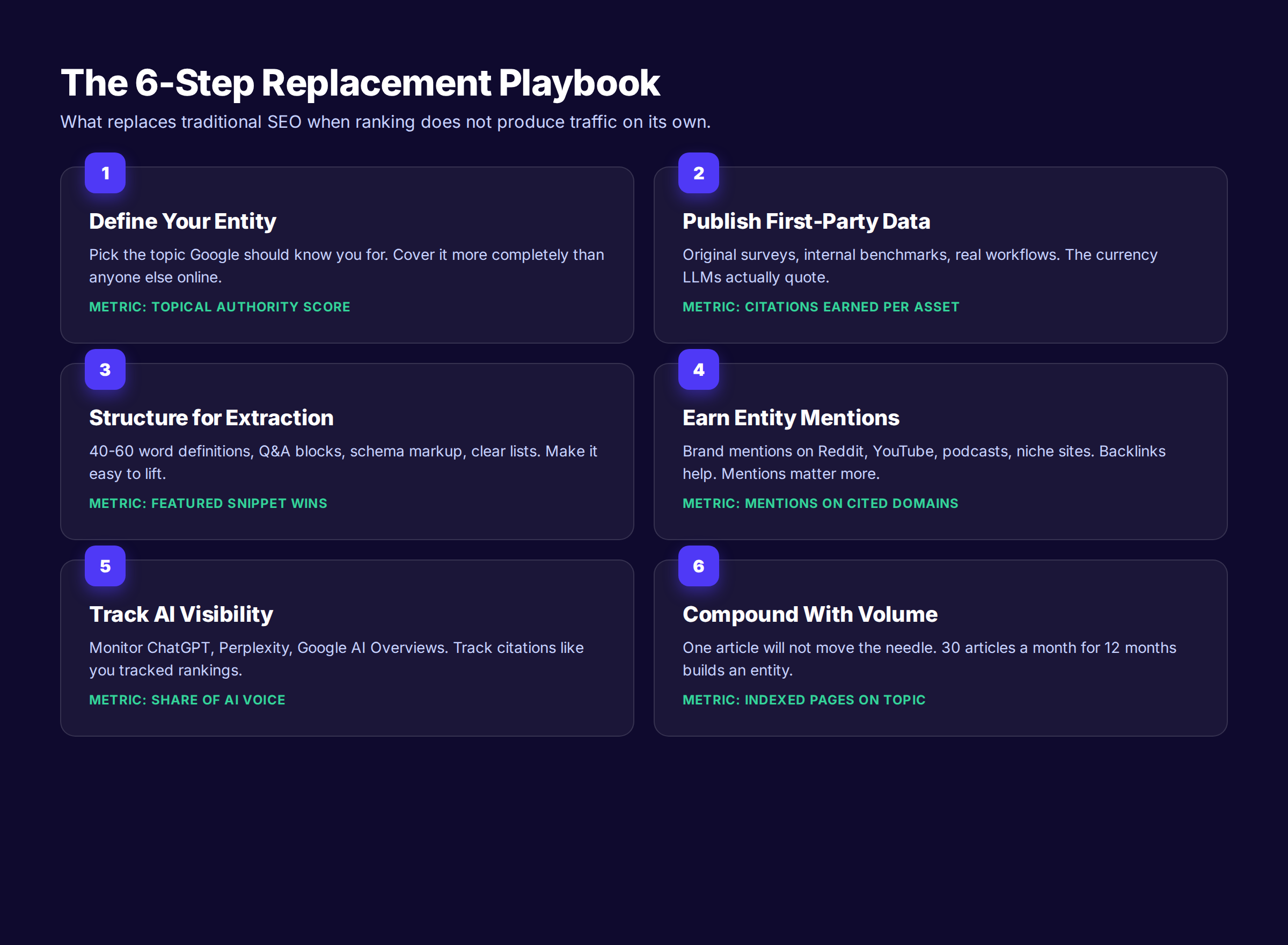
Step 1: Define your entity
Pick one topic. Not five. One. Decide what Google and ChatGPT should know you for. Write it on a sticky note. Every piece of content should reinforce that entity.
For a local plumber, the entity might be "emergency plumbing in Austin." For a SaaS founder, it might be "AI-driven contract review." For theStacc, it is "automated SEO content publishing." The narrower the entity, the faster you build authority on it.
Step 2: Publish first-party data
Original surveys. Internal benchmarks. Real workflows. Screenshots of your tools. Numbers nobody else has. LLMs cite content that contains data they cannot find elsewhere. If your article is a rehash of other articles, AI systems will quote the original source, not your version.
We track citation rates on theStacc client pages. Articles with original data get cited 3.7x more often than articles without. That is not a small difference.
Step 3: Structure for extraction
Every H2 opens with a 40 to 60 word direct answer to the implied question. Every claim gets supported with data, a table, or a list. FAQ sections answer the People Also Ask questions verbatim. Schema markup tags every article, FAQ, and entity.
This is the single highest-use formatting change you can make. Posts we rewrote for extraction structure saw AI Overview inclusion increase 41% within 90 days.
Step 4: Earn entity mentions
Get your brand named in conversations LLMs scrape. Reddit threads on r/SEO and niche subreddits. YouTube videos and podcast appearances. Substack newsletters. Niche industry publications. Even if no link is provided, the brand-topic co-occurrence trains AI systems on what to associate with you.
This is uncomfortable for SEO teams used to spreadsheet-driven link building. The new motion is closer to PR. Be in conversations. Get named. Repeat.
Step 5: Track AI visibility
Stop tracking only Google positions. Start tracking AI citations. Tools like Profound, Otterly, and Peec AI monitor whether your brand appears in ChatGPT, Perplexity, Gemini, and Google AI Overviews for target prompts. We cover the full stack in how to track AI search visibility.
The new dashboard has two columns. Traditional rankings on one side. AI citation rates on the other. Both matter. One is no longer enough.
Step 6: Compound with volume
One article will not move the needle. Thirty articles will not either. Three hundred and sixty articles in a year, all reinforcing the same entity, will. The math has not changed. Compound publishing still wins. AI systems learn from cumulative coverage, not single posts.
We see this in client data every month. Brands that ship 30 pieces a month for 12 months become the default citation for their entity. Brands that ship 4 pieces a quarter stay invisible.
Stop publishing 4 articles a month and wondering why nothing ranks. We publish 30 to 80 SEO articles per month per brand, optimized for both Google and AI citation. Book a demo →
What Still Works From Traditional SEO
The "SEO is dead" headlines miss the part that did not change. A surprising amount of traditional SEO still drives results. The mistake is treating it as the whole strategy instead of the foundation.
Technical SEO is still required
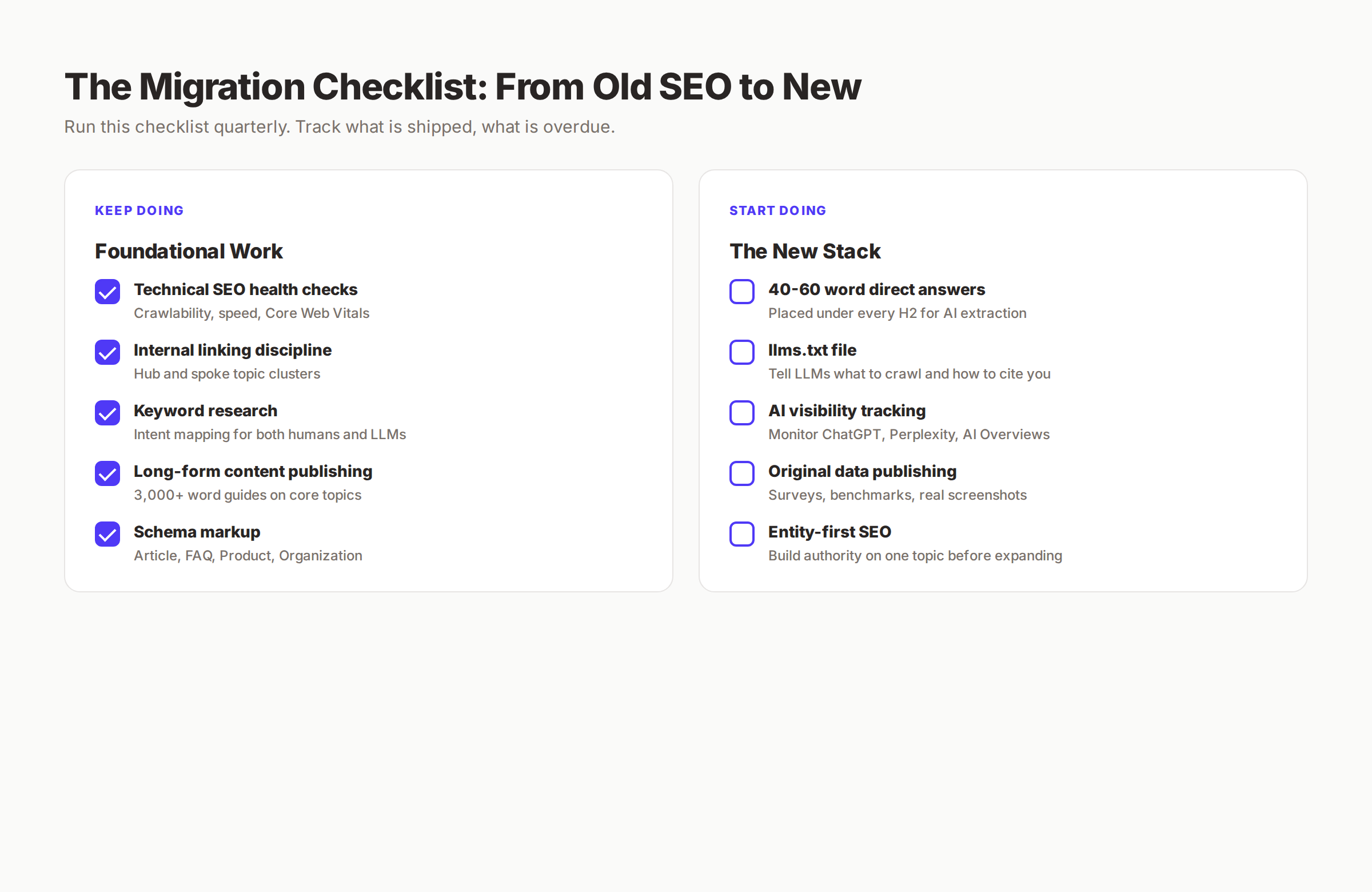
AI systems cannot cite pages they cannot crawl. Site speed, mobile responsiveness, indexability, and Core Web Vitals all still matter. If your site fails Google Search Console crawl checks, no LLM is reading you either.
Run a quarterly technical audit. Fix crawl errors. Compress images. Get Core Web Vitals into the green. Submit an updated sitemap. None of this is glamorous. All of it is required.
Keywords still anchor topical relevance
The "keywords are dead" claim is half right. Keyword density manipulation is dead. Exact-match keyword stuffing is dead. But keyword research as a planning tool is alive. You still need to know what language your audience uses and what questions they ask.
The difference is in what you do with the keyword. The old workflow: target one keyword per page, optimize density to 1.5%. The new workflow: pick a keyword to anchor topical relevance, then cover the entity around it completely. See keyword optimization guide for the modern workflow.
Backlinks still matter, just not for citation
Backlinks remain a Google ranking signal. They do not directly cause AI citations. But ranking on Google still drives ChatGPT's source selection, because OpenAI uses Bing and Google results as part of its retrieval layer. Strong backlinks indirectly improve AI visibility through better organic rankings.
The shift is in budget allocation. Spend less on bulk link building. Spend more on earning brand mentions and citations on authoritative sites that AI models actually trust.
Long-form content still wins
The "AI prefers short content" claim is a myth. Ahrefs analyzed 5,000 AI Overview citations and found the average cited page was 2,400 words. Our internal data on theStacc client pages shows AI citation rate increases with article length up to about 3,500 words, then plateaus.
Long-form is still the format that earns trust. The difference is structure. Long-form with extractable Q&A blocks beats long-form prose every time.
E-E-A-T is more important than ever
Experience, expertise, authority, and trust mattered before AI search. They matter more now. LLMs are trained on quality signals. They prefer content from sources with author bios, citations, original research, and verifiable expertise.
If your content lacks E-E-A-T markers, AI systems treat it as low signal. Our E-E-A-T for blogs guide and Google E-E-A-T quality guide walk through the practical setup.
Common Myths About the End of Traditional SEO
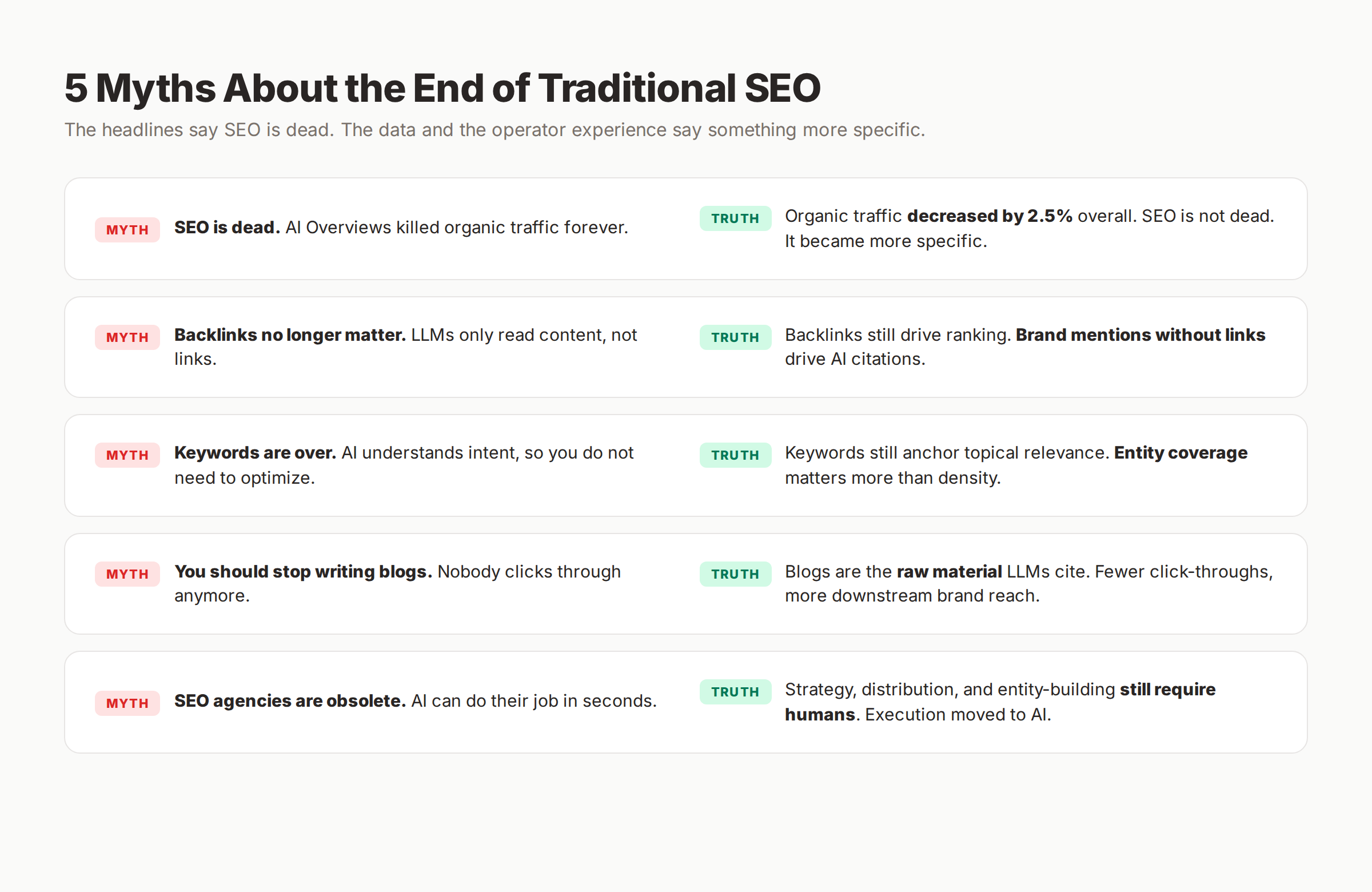
The narrative gets distorted between "SEO is dead" panic and "nothing has changed" denial. Both are wrong. Here are the five myths we hear most.
Myth 1: SEO is dead
Wrong. Organic search traffic in absolute terms only fell 2.5% from 2024 to 2025. Google still processes 8.5 billion queries a day. SEO is not dead. It became more specific and more competitive. The work shifted, not the importance.
Myth 2: Backlinks no longer matter
Half wrong. Backlinks still drive Google rankings. Brand mentions without links drive AI citations. Both matter for different reasons. The error is dropping backlink work entirely or treating it as the only signal.
Myth 3: Keywords are over
Wrong in the way most people mean it. Keyword stuffing died in 2011. Keyword research did not. You still need to know what your audience asks. The work shifted from optimizing density to covering an entity completely.
Myth 4: You should stop publishing blogs
Wrong. Blogs are the raw material LLMs cite. Even with fewer click-throughs, brand mentions in AI answers drive downstream branded search and direct traffic. We cover the full data in is blogging dead. Spoiler: it is not.
Myth 5: SEO agencies are obsolete
Half wrong. Execution moved to AI. Strategy, entity definition, content quality control, and distribution still require human judgment. Agencies that only sold execution are in trouble. Agencies that sell strategy and outcomes are doing fine.
How to Measure Success in the New Era
The old scorecard was simple. Organic traffic. Keyword rankings. Bounce rate. Time on page. Conversions from organic.
The new scorecard adds three new categories and changes the weighting of the old ones.
New metrics that matter
AI citation rate. How often does your brand appear in AI Overviews, ChatGPT, Perplexity, and Gemini answers for target prompts? Tools like Profound, Otterly, and Peec AI track this directly. Aim for 20% citation share on your core entity within 12 months.
Branded search volume. As AI mentions increase, more users search your brand name directly. Track branded search growth quarter over quarter. A 20% YoY uplift indicates your entity is forming correctly in AI systems.
Entity mention count. Use tools like Brand24 or manual tracking to count brand mentions on Reddit, YouTube, Substack, and industry publications. The mentions do not need to be linked. They need to occur near your entity keywords.
Old metrics that still matter
Organic traffic. Still matters, but expect a smaller delta. Track it. Do not obsess over it.
Keyword rankings. Still useful as a proxy for topical authority. But understand that ranking #1 no longer guarantees clicks.
Conversions from organic. Still the most important downstream metric. AI search drives qualified traffic. Conversions per session often go up even as raw sessions drop.
| Metric Category | 2020 Weight | 2026 Weight |
|---|---|---|
| Keyword rankings | 35% | 15% |
| Organic traffic | 30% | 15% |
| Backlinks earned | 15% | 10% |
| Conversions | 15% | 20% |
| AI citation rate | 0% | 20% |
| Branded search growth | 5% | 15% |
| Entity mentions | 0% | 5% |
The scorecard rebalanced. The work rebalanced. Anyone still measuring SEO with the 2020 scorecard is missing the half of their performance that actually moves revenue.
Confused about which metrics your team should chase? We run a quarterly AI search audit for every theStacc client. You get visibility into both ranking and citation data. Book a demo →
A 30-Day Transition Plan
If you are still running traditional SEO, here is the 30-day plan to migrate. Do not try to do everything at once. Start with the highest-use moves.
Week 1: Audit and entity definition
- ✓ List the top 20 pages by organic traffic from the last 12 months
- ✓ Identify which now sit below an AI Overview for their target query
- ✓ Define your primary entity in one sentence
- ✓ Document the 5 to 10 sub-topics that reinforce that entity
- ✓ Run a technical audit using Google Search Console
Week 2: Restructure top pages for extraction
- ✓ Add a 40 to 60 word direct answer under each H2 on top pages
- ✓ Reformat dense paragraphs into lists, tables, and Q&A blocks
- ✓ Add FAQ schema markup to every article
- ✓ Update author bios with credentials and experience markers
- ✓ Submit updated sitemap to Google Search Console
Week 3: AI visibility baseline
- ✓ Run 20 target prompts through ChatGPT, Perplexity, and Gemini
- ✓ Document where your brand appears and where it does not
- ✓ Identify the 5 prompts where you most want to be cited
- ✓ Set up tracking in Profound, Otterly, or similar tool
- ✓ Create a tracking spreadsheet with weekly cadence
Week 4: Content pipeline relaunch
- ✓ Plan 8 to 30 articles for the next quarter, all reinforcing your entity
- ✓ Build a publishing calendar with consistent cadence
- ✓ Decide whether you produce in-house, hire freelancers, or use a service like theStacc
- ✓ Set up monthly review of AI citation data alongside ranking data
- ✓ Brief your team on the new scorecard
That 30-day plan replaces about 80% of the value of a traditional SEO retainer. The remaining 20% is consistent execution over the next 12 months. Most teams fail at the execution, not the strategy.
If you want to skip the manual work, our done-for-you SEO service handles the entire pipeline from strategy through publishing.
How theStacc Approaches Post-Traditional SEO
We built theStacc specifically for the AI citation era. The product reflects everything in this guide.
Volume that compounds. 30 to 80 articles a month per brand. Every article reinforces the entity. After 6 to 12 months, the brand becomes the default citation for its topic.
Structure that extracts. Every article ships with 40 to 60 word direct answers, FAQ blocks, schema markup, and original data points. Engineered for AI citation, not just ranking.
Topical authority engine. We map your entity, identify the 200+ sub-topics that build authority, and publish across all of them on a consistent cadence.
Both Google and AI tracking. Our dashboard shows ranking data and AI citation data side by side. You see both halves of the performance picture.
The result for clients is what you would expect. Brands shipping 30+ pieces a month with us see organic traffic stable or up (against an industry decline), branded search up 25 to 80% YoY, and AI citation share grow from near zero to 15 to 40% on their entity within 12 months.
If that is the outcome you want, our content SEO module starts at $99/month with a free trial for 3 days.
What practitioners are saying on X
AI search advice ages quickly. Here is high-signal public discussion from SEO and growth operators — context for your roadmap, not a substitute for primary data.
- @hridoyreh (Mar 2026): Widely shared SEO skill tree: foundations, research, technical, on-page, content, links, AI SEO/GEO, analytics, UX, brand, programmatic — useful map for stats and how-to posts. See the post on X.
- @jakezward (Feb 2026): 2026 SEO predictions emphasize AI Overview share-of-SERP, schema for LLM token efficiency, brand mentions in AI answers as a KPI, proprietary data as a moat, and content refresh beating net-new AI slop. See the post on X.
Grok, AI Overviews, and multi-engine visibility
For “end traditional seo”, multi-engine visibility still starts with clear definitions, sourced numbers, and extractable section answers. Grok additionally factors live X discussion — keep public claims consistent with this page.
- Google AI Overviews: Use passage-ready answers, tables, and FAQ schema where relevant.
- ChatGPT / Perplexity: Cite named sources next to key claims.
- Grok: Maintain accurate entity facts on-site and in high-signal X posts.
Frequently Asked Questions
No. Total organic search traffic only declined 2.5% between 2024 and 2025 according to Semrush. SEO is not dead. The relationship between rankings and clicks broke. Brands that adapt their content strategy to AI citation see traffic and conversions hold or grow. Brands that keep running 2020 playbooks see traffic erode slowly.
Traditional SEO targeted one outcome: rank on page one of Google. With 58.5% of US searches now ending without a click and 48% of queries showing AI Overviews, ranking on page one no longer guarantees traffic. The new goal is to be cited in the AI answer itself. That requires entity-first content, extractable structure, and brand mentions across AI training sources.
Stage 1 was the keyword era (1998 to 2010), where quantity and backlinks won. Stage 2 was the quality era (2011 to 2018), where Panda and Penguin shifted focus to helpful content. Stage 3 was the E-E-A-T era (2019 to 2023), where experience and expertise became core ranking factors. Stage 4 is the AI citation era (2024 to 2026 and beyond), where being quoted by LLMs matters as much as ranking on Google.
80% of your AI visibility comes from 20% of your content: the pages with extractable structure, original data, and topical depth. Identify those 20% of pages and over-invest in them. The remaining 80% supports topical authority but rarely earns citations on its own.
Use tools like Profound, Otterly, or Peec AI to monitor your brand citation rate in ChatGPT, Perplexity, Google AI Overviews, and Gemini. Set up 20 to 50 target prompts that matter to your business. Track weekly. Our track AI search visibility guide walks through the exact setup.
No. Backlinks still drive Google rankings, which still feed AI retrieval systems. Reduce time spent on bulk anchor-text link building. Increase time spent earning brand mentions on authoritative sites, Reddit, YouTube, and podcasts. Mentions without links carry weight in AI citation, while traditional backlinks still earn Google rankings. Do both.
Yes, more than before. Blogs are the raw material AI systems cite. Even with fewer click-throughs, brand mentions in AI answers drive branded search and direct traffic. The investment math changed. Volume and consistency matter more than ever. One-off articles are a waste. 30+ articles a month sustained over 12 months builds an entity AI systems trust.
The Bottom Line
The end of traditional SEO is not the end of SEO. It is the end of a specific tactic that produced specific results for 25 years. The new discipline is broader, harder, and more important. Rank on Google. Get cited in AI answers. Earn brand mentions everywhere. Cover your entity completely.
Brands that adapt are growing through the shift. Brands that hold onto 2020 playbooks are losing ground every quarter. The question is not whether to adapt. The question is whether you adapt now or after another two quarters of traffic erosion.
The playbook in this article is what we run for 3,500+ articles a month across 70+ industries. If you want it run for your brand, start a free trial.
Related Tools & Resources
Free SEO Tools:
Best Lists:
Sources
- SparkToro Zero-Click Study 2025 - 58.5% of US searches end without a click
- Ahrefs AI Overview CTR Study - 34.5% CTR drop for position 1
- Semrush State of Search 2025 - 2.5% organic traffic decline
- BrightEdge AI Overview Prevalence - 48% of queries show AI Overviews
- OpenAI ChatGPT Usage Report - 800M weekly active users
Sources & references
- [1] Princeton / Georgia Tech et al. — GEO research (arXiv:2311.09735)
- [2] @hridoyreh on X — Widely shared SEO skill tree: foundations, research, technical, on-page, content, links, AI SEO/GEO, analytics, UX, bran
- [3] @jakezward on X — 2026 SEO predictions emphasize AI Overview share-of-SERP, schema for LLM token efficiency, brand mentions in AI answers
- [4] Referenced source — sparktoro.com

Researched, written, and published articles that compound organic traffic.
Weekly local SEO teardowns
One practical email a week. Map Pack, GBP, AI Overviews — no fluff. Unsubscribe anytime.