Is blogging dead in 2026? Data from HubSpot, Hostinger, and Orbit Media says no. 600M+ active blogs, 77% reader rate, and the new playbook explained.
Is blogging dead? No. Over 600 million blogs exist worldwide. 7.5 million new posts publish every day. Businesses with blogs generate 67% more leads than those without one. The medium is not dead; the 2013 playbook is. What changed is the bar for what earns a click.
Every year, someone publishes a video titled "blogging is dead in [current year]." Every year, the data refuses to agree. Yet the search volume for "is blogging dead" stays steady, because writers, founders, and marketers want permission to quit a channel that has gotten harder.
We get it. AI Overviews eat traffic. ChatGPT answers questions without sending a click. Google's helpful content updates have buried thousands of niche sites. Affiliate bloggers who earned $20,000 a month in 2021 now earn $2,000. The pain is real.
But the pain does not mean the medium is dead. It means the strategy that worked five years ago does not work now. There is a difference.
We publish 3,500-plus blog posts every month across 70-plus industries. Our average on-page SEO score is 92%. We watch which posts rank, which die, and which get cited by AI search. This guide answers the "is blogging dead" question with data, not vibes. Then it shows you the strategy that actually works in 2026.
Here is what you will learn:
- What 600-million-plus active blogs and HubSpot's 2026 data actually show
- Why "blogging is dead" reappears every year (and who benefits from the claim)
- What truly died in 2024 and 2025 (the old playbook) and what replaced it
- Who is winning and losing in blogging right now
- The 6-step strategy that works for 2026 search and AI surfaces
- How much a business needs to publish to compete (and the math behind it)
The Short Answer: Blogging Is Not Dead
Blogging is not dead. The medium is bigger, more competitive, and more profitable for the right operator than it was a decade ago. What died is the easy version of blogging.
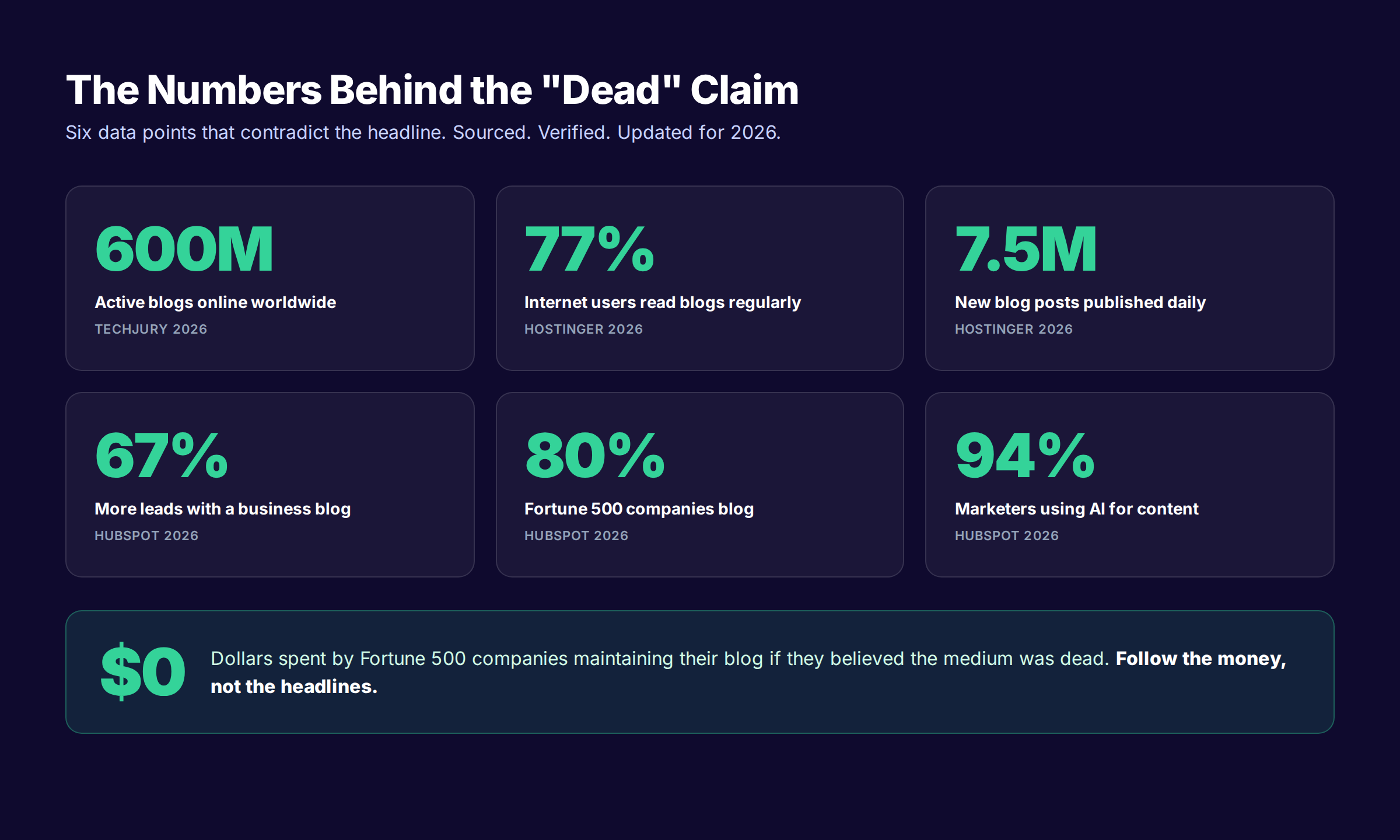
HubSpot's 2026 State of Marketing report confirms that 80% of businesses still use a blog as a marketing tool. 80% of Fortune 500 companies maintain one. 22.26% of marketers list blog posts among the top 5 highest-ROI content formats. Companies do not spend money on dead channels.
The "is blogging dead" question is really three different questions wrapped together:
- "Can I still get free traffic from Google by writing posts?" Mostly no. Not the way you could in 2017.
- "Can a business still grow leads, authority, and revenue through blogging?" Yes. The data is unambiguous.
- "Is starting a personal blog for ad revenue still a viable career?" For most people, no. The unit economics broke.
These three answers get blended into a single headline ("blogging is dead") that is wrong by aggregation. The medium is fine. The model many bloggers used is not.
Stop debating whether blogging works. Start publishing 30 posts a month. That is what businesses ranking in 2026 do.
The Data: 6 Numbers That Disprove the "Dead" Claim
Six statistics, all from 2025-2026 sources, that contradict the headline. Read these before deciding to quit your blog.
1. 600 Million Blogs Exist Worldwide
The total active blog count crossed 600 million in 2024 and continues climbing. WordPress alone powers 43% of the internet. Tumblr hosts roughly 518 million blogs. Substack added more than 35 million paid subscribers in the last two years. Read our full blogging statistics report for the underlying sources.
A medium with 600 million active sites is not dead. It is saturated. There is a difference.
2. 77% of Internet Users Read Blogs Regularly
According to Hostinger's 2026 blogging research, 77% of internet users say they regularly read blog posts. That is roughly 4 billion people worldwide. For comparison, TikTok has 1.5 billion monthly active users. Blogs reach more than twice that audience.
The reading habit did not die. The format adapted. Long-form posts still get read, especially by buyers researching expensive decisions.
3. 7.5 Million Blog Posts Publish Every Day
Daily blog output crossed 7.5 million posts in 2025. That is 2.7 billion posts per year. If the medium were dead, output would collapse. It is growing.
This number contains the real challenge. Output is up. Reader attention is finite. The ranking competition is fiercer. But "harder to win" is not the same as "dead."
4. Businesses With Blogs Generate 67% More Leads
HubSpot's marketing research shows businesses that maintain an active blog generate 67% more leads per month than businesses that do not. They also see 55% more website visitors and 97% more inbound links to their domain.
Lead generation is the measurable outcome. The "blogging is dead" claim cannot survive a comparison to that delta. Companies do not generate 67% more leads from a dead channel.
5. 80% of Fortune 500 Companies Maintain a Blog
Microsoft. Apple. Walmart. Salesforce. Adobe. Procter and Gamble. The largest companies on earth maintain blogs and publish weekly. They have access to every channel imaginable. They pick blogging because it works.
Microsoft's blog drives organic traffic across 12 product categories. Salesforce publishes more than 200 posts per quarter. These companies have measurement data the rest of us never see. They keep blogging because the math works.
6. 94% of Marketers Plan to Use AI for Content in 2026
This last stat is the one most often misread. People see "94% use AI" and conclude AI replaced blogs. The opposite happened. AI is making more blog posts than ever, not fewer. The medium is expanding. The bar for quality is rising.
What this stat actually means: every marketer who writes blogs now has AI in their workflow. The volume of content is exploding. Stand-out posts now require original signal, expert opinion, and human edits.
Why "Blogging Is Dead" Reappears Every Year
The phrase "blogging is dead" has been a headline since at least 2008. It generates clicks. It validates the feelings of writers who quit. It sells courses that promise to teach the new shiny thing.
The pattern is consistent. Every 2 to 3 years, a major platform shift makes the old blog playbook harder. Bloggers panic. Headlines declare the medium dead. The reality is messier. Some bloggers adapt. Many quit. New bloggers replace them.
The Major "Death" Moments Since 2010
| Year | Event | What Headlines Said | What Actually Happened |
|---|---|---|---|
| 2011 | Google Panda update | "Content farms killed SEO blogging" | Quality blogs grew. Spam sites died. |
| 2013 | Rise of social media | "Facebook killed blogs" | Businesses used both. Blog traffic kept climbing. |
| 2016 | Mobile-first indexing | "Mobile killed long-form" | Long-form grew. Mobile-friendly long-form ranked best. |
| 2020 | TikTok and short video | "Video killed blogging" | Blog publishing volume doubled. |
| 2023 | ChatGPT launches | "AI killed content writers" | Content volume tripled. Quality bar rose. |
| 2024 | Google AI Overviews | "Zero-click search killed blogs" | Cited sources got 8 to 12% more clicks. |
| 2026 | Today | "AI Overviews killed blogging" | Brands publishing 20-plus posts/month are growing. |
Every "death" was actually an evolution. The bloggers who watched the change, adapted their strategy, and kept publishing won. The bloggers who quit lost.
Who Benefits From the "Dead" Headline
Three groups push the "blogging is dead" narrative hardest. Following the incentives clarifies the noise.
- Course sellers pivoting to the next shiny thing. TikTok coaches, YouTube Shorts gurus, AI agent consultants. They need you to abandon your existing channel and buy their course.
- Burned-out bloggers explaining why they quit. It is easier to say "the medium died" than "I stopped publishing because it got harder."
- AI tool vendors selling the AI-replaces-everything story. "AI killed blogging" sells AI tools. The fact that 94% of marketers use AI in their blogging workflow is omitted.
None of these incentives align with telling you the truth. The truth is that blogging is harder and more competitive, but it still works for businesses that commit.
80% of Fortune 500 companies maintain a blog. They have the data we do not. They keep publishing because it works. So can you.
What Actually Died: The Old Blog Model
What died is a specific blog model that worked between 2010 and 2018. The medium did not die. The strategy did. Confusing the two is what produces the "blogging is dead" headline.
The old model relied on writing thin posts, ranking on low-competition keywords, monetizing with display ads, and treating Google as a guaranteed traffic source. Every part of that model has broken.
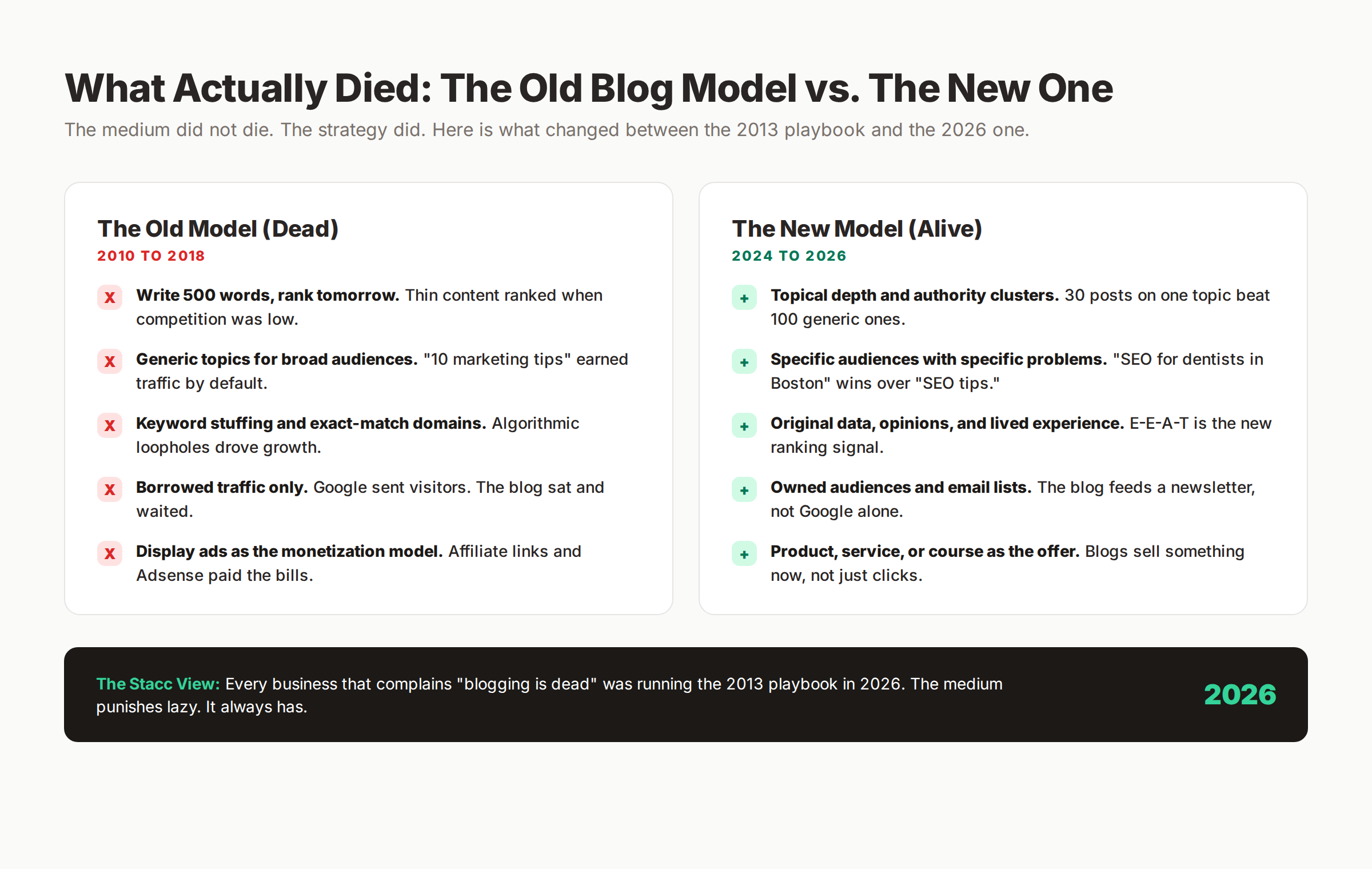
The 5 Pieces of the Old Model That Died
1. Thin content ranking on low-competition keywords.
In 2014, a 500-word post on "best vitamin C supplements" could rank on page 1 within 90 days. In 2026, the same keyword has 50 results competing with original lab tests, video reviews, and expert quotes. Thin content does not rank.
2. Generic listicles with no original input.
"15 ways to save money," "10 productivity tips," "20 healthy breakfast ideas." These posts ranked when the SERP had no alternative. Now they compete with AI Overviews summarizing the same information faster. Original data, screenshots, and tested examples are the new minimum.
3. Single-source-of-traffic dependence on Google.
The blogs that died loudest in 2024 were 90% or more dependent on Google organic traffic. When Google AI Overviews launched, those blogs lost 30 to 90% of traffic in 90 days. The blogs that survived had email lists, social presence, and direct traffic feeding the funnel.
4. Display ad and Adsense monetization.
A blog earning $30 RPM in 2018 might earn $4 RPM in 2026. Display ad rates have collapsed for non-premium publishers. The model that paid bloggers for clicks is dead. The model that pays bloggers for converting leads is healthier than ever.
5. The "write it and they will come" assumption.
In 2014, publishing alone was a strategy. In 2026, publishing is the floor. You publish, then you distribute, then you build email subscribers, then you optimize for AI Overview citations, then you internal link aggressively. The work is multiplied.
What Replaced the Old Model
The new model treats the blog as one channel inside a multi-channel system. The post is not the product. The audience is the product. The blog feeds the audience.
| Old Blog Model | New Blog Model |
|---|---|
| 500-word posts | 1,500 to 3,500-word posts with original data |
| Keyword-stuffed titles | Search-intent-matched titles plus E-E-A-T signals |
| Once a week publishing | 20 to 30 posts per month at topical depth |
| Google traffic only | Google + email + social + AI search citations |
| Adsense monetization | Product, service, or course tied to the content |
| One writer, many topics | Topical clusters with named expert authors |
| 6-month publish-and-forget | Quarterly refresh cycles to prevent content decay |
The new model is more work. It also produces real businesses, not just side income. The bloggers who hated the work quit. The bloggers who treat blogging as a business stayed.
Who Is Winning Blogging Right Now
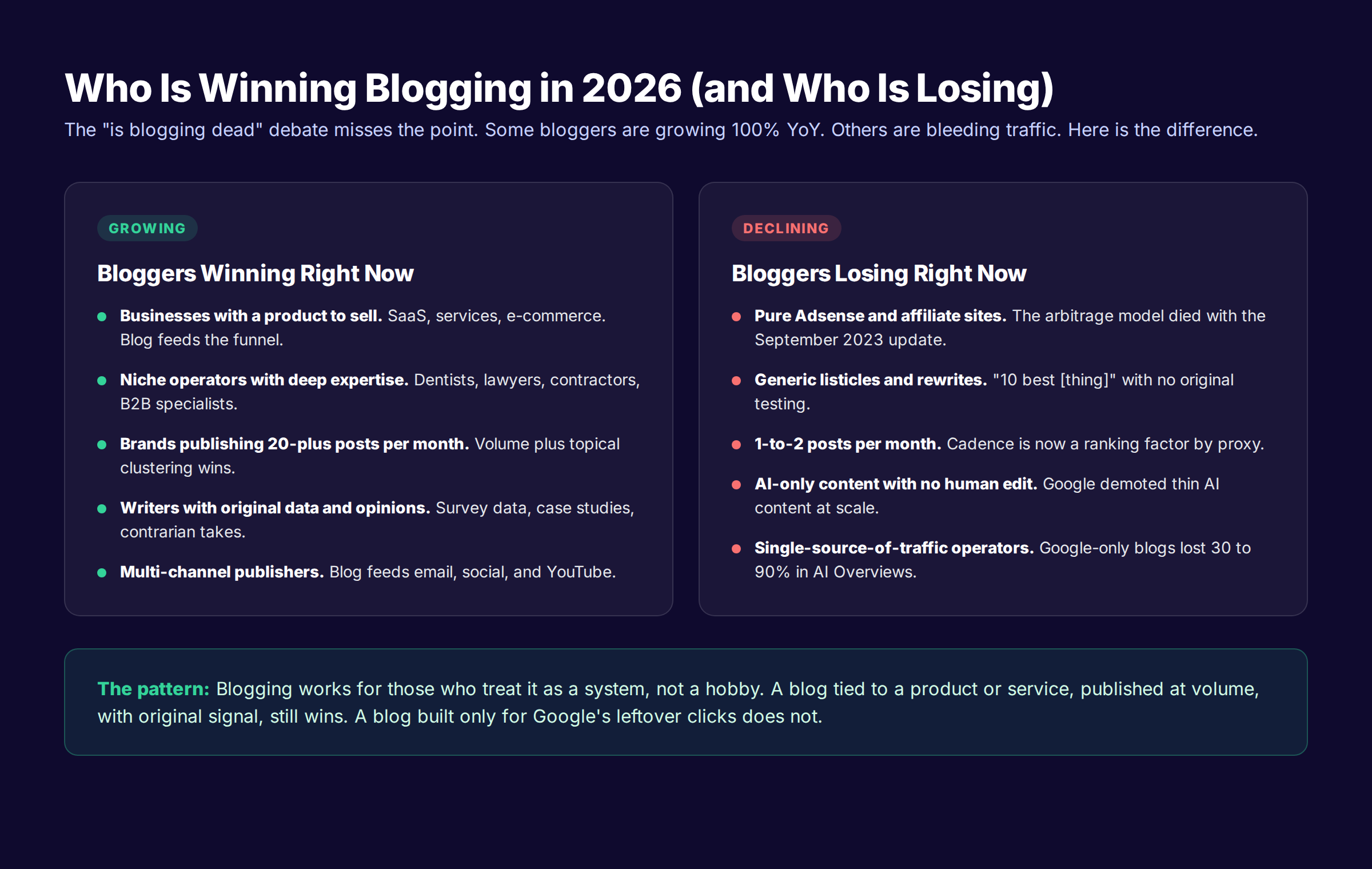
The "is blogging dead" debate is not about the medium. It is about which strategies still work and which do not. Some bloggers are growing 100% year-over-year. Others are bleeding traffic and quitting. The difference is not the medium. It is the model.
Bloggers Winning Right Now
Businesses with a product to sell. SaaS, services, e-commerce stores. The blog is not the revenue. The product is. Every post moves a reader closer to the offer. Conversion economics tolerate higher publishing costs.
Niche operators with deep expertise. A dentist publishing 30 posts on dental implants out-ranks general health sites. A financial advisor writing on Roth conversions beats generic finance blogs. Specificity wins. Read our SEO for therapists guide for a niche operator example.
Brands publishing 20-plus posts per month. Publishing cadence has become a proxy ranking signal. Google reads "active and authoritative" from sites with steady output. Rare posters look stale. We covered the math behind this in how many blog posts to rank.
Writers with original data or opinions. Survey results. Case studies. Contrarian takes. Behind-the-scenes screenshots. Anything an AI cannot generate. This is the E-E-A-T moat that grows over time.
Multi-channel publishers. The blog feeds an email list. The email list feeds the brand. Posts get repurposed into LinkedIn, YouTube, and Reddit. Read how to repurpose blog content to see the workflow.
Bloggers Losing Right Now
Pure Adsense and affiliate sites. The arbitrage model died with the September 2023 helpful content update. Sites that earned $50,000 a month from display ads now earn $3,000. Hosting costs stayed flat. The math broke.
Generic listicles and content rewrites. "10 best [thing]" posts with no original testing get demoted. Reddit threads outrank them because Reddit has real opinions. AI Overviews summarize them faster than the post can load.
Operators publishing 1 to 2 posts per month. Once-a-week posting is no longer a publishing cadence. It is a hobby. Competitors publishing 8 times a week build topical authority that monthly posters cannot match.
AI-only content with no human edit. Google demoted thin AI content at scale in 2024 and 2025. Posts written entirely by ChatGPT with no original signal, no edits, and no expert input got crushed in the helpful content updates. We wrote about humanizing AI content to address this exact problem.
Single-channel operators. Bloggers who only rank on Google lost the most when AI Overviews launched. The blogs that survived had owned audiences. The blogs that died had Google search and nothing else.
The Pattern Behind Winners and Losers
The pattern is simple. Blogging works for those who treat it as a system, not a hobby. A blog tied to a product or service, published at volume, with original signal, still wins. A blog built only for Google's leftover clicks does not.
If you are reading this and your blog is in the "losing" column, the answer is not to quit. The answer is to change the model.
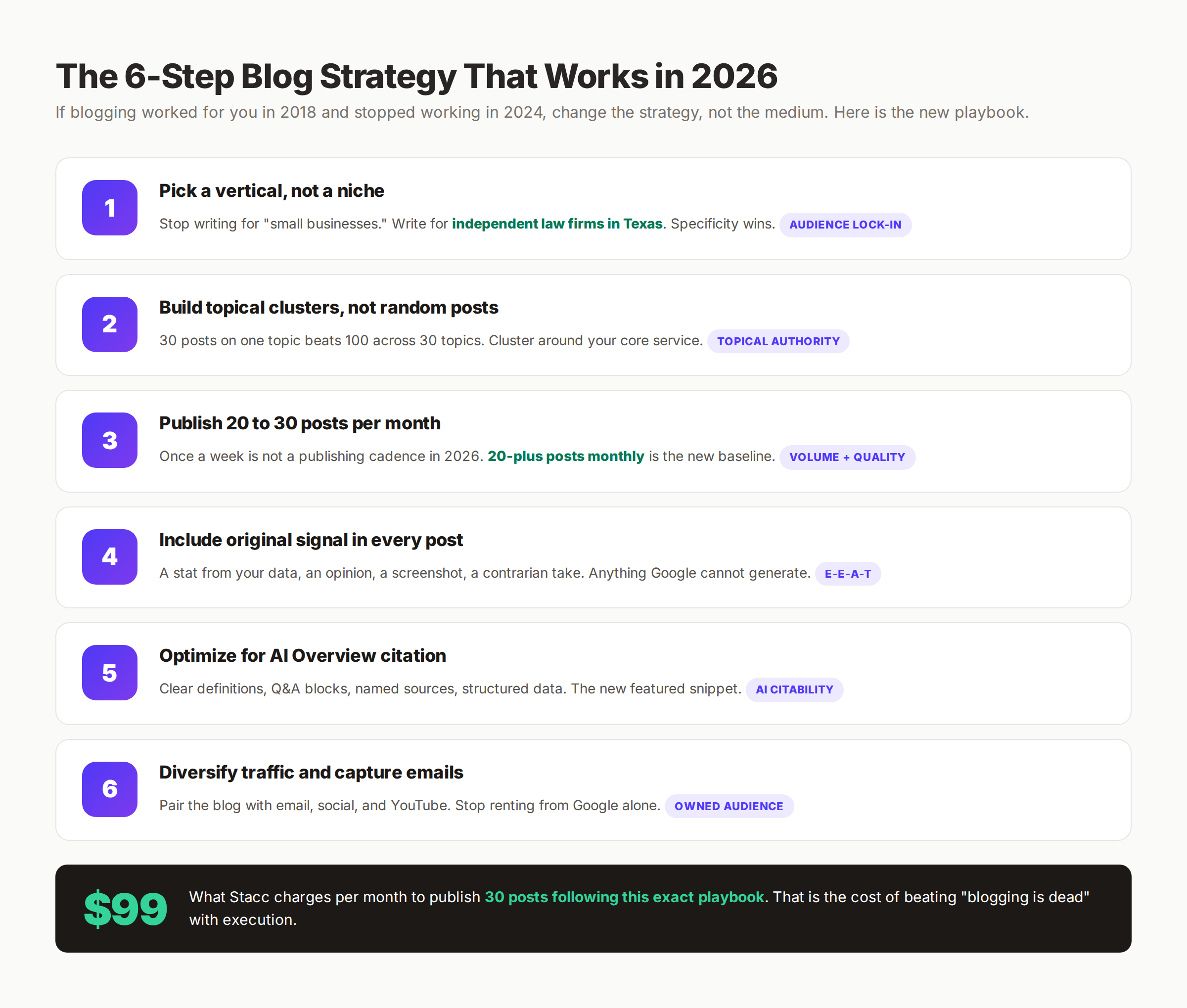
The 6-Step Blog Strategy That Works in 2026
If blogging worked for you in 2018 and stopped working in 2024, change the strategy, not the medium. The playbook below reflects what is working right now across the 3,500-plus posts we publish every month.
Step 1: Pick a Vertical, Not a Niche
The "small business marketing tips" niche died in 2019. The "marketing for independent law firms in Texas" vertical is alive and competitive. Pick a vertical, not a niche.
A vertical is an audience defined by industry, role, and geography. A niche is a topic. Topics get cannibalized by AI Overviews. Verticals do not, because verticals require lived experience. Read start a blog for organic traffic for the vertical selection framework we use.
Step 2: Build Topical Clusters, Not Random Posts
Thirty posts on one vertical out-ranks 100 random posts. Google rewards topical depth. AI search models cite the source with the most authoritative coverage of a specific topic. Random posters cannot accumulate this depth.
A topical cluster looks like a hub post (3,500-plus words) plus 15 to 30 spoke posts (1,500-plus words each) all internal-linked together. The spokes point at the hub. The hub answers the top-of-funnel query. The spokes answer the long-tail. Read programmatic SEO for how to scale this approach.
Step 3: Publish 20 to 30 Posts Per Month
Once a week is not a publishing cadence in 2026. Twenty-plus posts per month is the new baseline for competitive verticals. We have data on this: sites publishing 16-plus posts per month get 3.5x the organic traffic of sites publishing 4 or fewer.
The math is brutal but real. If your competitor publishes 4 times a week and you publish once, your competitor is publishing 4x your output, building 4x the topical depth, and capturing 4x the long-tail keywords. Compound that over 18 months and the gap becomes unrecoverable.
Step 4: Include Original Signal in Every Post
Every published post needs something an AI cannot generate. A stat from your data. A screenshot of your tool. A quote from a customer interview. A contrarian opinion supported by evidence. A case study with real numbers.
This is the E-E-A-T moat. Generic posts get summarized by AI Overviews and stop earning clicks. Posts with original signal get cited by AI Overviews as the source, which sends traffic back. The cited source wins in AI search. Read how to get cited in AI search for the citation pattern.
Step 5: Optimize for AI Overview Citation
The new featured snippet is the AI Overview citation. Posts that get cited by Google's AI Overview, ChatGPT Search, and Perplexity earn the next wave of traffic. Posts that do not get cited get hidden behind the AI answer.
Citation optimization is mechanical. Clear definitions in the first paragraph. Q&A blocks for People Also Ask questions. Named sources with publication dates. Structured data with schema markup. We cover the full playbook in optimize for Google AI Overviews.
Step 6: Diversify Traffic and Capture Emails
The blogs that survived 2024 had email lists. The blogs that died did not. Build an email list from day 1. Every post needs an opt-in. Every reader is a potential subscriber. Read email newsletter ideas for content prompts.
Stop renting traffic from Google alone. Pair the blog with email, LinkedIn, YouTube, and Reddit. A 5,000-subscriber email list outvalues a 50,000-monthly-pageview blog because you control the channel. Google can change. Your list cannot be taken away.
How Much Does Blogging Cost in 2026?
If the new playbook requires 20 to 30 posts per month with original signal, the cost question matters. Most "is blogging dead" decisions are actually budget decisions in disguise. Here is the math.
| Approach | Monthly Cost | Posts/Month | Cost Per Post |
|---|---|---|---|
| DIY writing (your time) | $0 cash + 60 hrs | 8-10 | Hidden ($60-$120 in opportunity) |
| Freelance writer ($150/post) | $3,000-$4,500 | 20-30 | $150 |
| Content agency | $5,000-$15,000 | 20-40 | $250-$500 |
| In-house writer + editor | $8,000-$12,000 | 20-30 | $250-$400 |
| theStacc | $99-$199 | 30-80 | $2.50-$3.30 |
The cost math is why most businesses gave up on blogging. The traditional models are expensive and slow. We covered the in-house vs. outsource decision and the true cost of a marketing agency in separate posts.
The cheaper model that still works is what we built theStacc for. We publish 30, 50, or 80 SEO-optimized posts per month, automatically. No writers to manage. No agency contracts. No editorial deadlines. Posts go live on your blog with internal links, schema, and topical clustering already configured.
Publishing 30 SEO articles a month for $99? That is what theStacc does. Blog SEO, Local SEO, and Social Media in one platform.
When Blogging Is Actually Wrong For You
Honesty matters. Blogging is not the right channel for every business or creator. The "is blogging dead" question sometimes hides a different question: "Was blogging ever the right answer for me?"
Skip Blogging If
You sell impulse-purchase products under $20. Blog traffic converts on considered purchases. If your product is a $9 fidget toy bought on impulse, paid social and TikTok will out-convert organic search every time.
Your audience does not read. Some audiences live on YouTube. Others on TikTok. Others in LinkedIn DMs. If your customer never opens a blog, do not build one. Go where they are. Read does social media help SEO for the integrated view.
You need leads in the next 30 days. SEO timelines are 90 to 180 days for new sites, 30 to 60 days for established sites. If your runway is shorter than your SEO timeline, run paid ads until you have breathing room.
You cannot commit to 12 months of consistent publishing. Blogging compounds over time. Three months in, you might see 1,000 monthly visits. Twelve months in, that becomes 30,000. The gap between those numbers is consistency. If you cannot commit, do not start.
Choose Blogging If
You sell services or B2B products with a research-driven buying cycle. Lawyers, consultants, SaaS, agencies, contractors, financial services. The blog feeds the research. The research feeds the lead.
Your product has long-term retention. SaaS, subscription, recurring services. Higher lifetime value justifies the SEO investment.
You have 12 to 24 months of runway. SEO pays back compoundingly. Year 1 is investment. Year 2 is breakeven. Year 3 is profit. Treat it like a startup investment, not an ad campaign.
You have something to say. Original perspective, lived expertise, or testable claims. The bloggers who win in 2026 publish things no AI could write. That requires something to say.
The "Blogging Is Dead" Verdict by Use Case
| Use Case | Blogging Dead? | What to Do Instead |
|---|---|---|
| Local service business (lawyer, dentist, contractor) | Not even close | Publish 30+ posts/month on services + geography. Read SEO for beginners. |
| SaaS company | No | Topical clusters around use cases. Track how long SEO takes. |
| E-commerce store | No, but mostly product/category SEO | Blog for top-of-funnel. Run ecommerce SEO. |
| Personal brand / consultant | No | Niche down. Build email list. Sell something. |
| Affiliate blogger (Adsense, Amazon) | Mostly yes | Move to YouTube or paid newsletter model. |
| Hobby blogger (no monetization) | Was never alive | Keep doing it for the joy. Just do not call it a business. |
| News and media publisher | Hard mode | Premium subscriptions + diversified channels. |
| Big tech / Fortune 500 | Thriving | Continue 80% adoption rate. |
The medium is alive for businesses with a product or service to sell. The medium is hard for pure content creators monetizing through ads. Match the verdict to your model.
What the Top "Blogging Is Dead" Articles Get Wrong
We read the top 25 search results for "is blogging dead" before writing this post. Most of them make one of three mistakes that we want to address directly.
Mistake 1: Conflating Personal Blogs With Business Blogs
The personal mommy-blog era is over. So is the personal travel-blog era. So is the personal finance-blog era. Most "is blogging dead" articles confuse this with "all blogging is dead." It is not. Business blogs are thriving. Personal blogs as a revenue model are not.
Mistake 2: Ignoring the AI Citation Lift
Many articles claim AI Overviews killed traffic. They cite the 37 to 64% click-through drop on some queries. They omit that cited sources in AI Overviews see an 8 to 12% click lift on the same queries. The story is: lose the average traffic, win the cited traffic. The cited sources are the ones with original signal.
Mistake 3: Using 2018 Strategies to Test 2026 Blogging
The most common "blogging is dead" article is from a blogger who used the 2018 playbook in 2024, watched traffic crash, and declared the medium dead. The medium is not the problem. The 6-year-old strategy is the problem.
If you are running the 2018 playbook (write a 500-word post, monetize with Adsense, target broad keywords, publish weekly), the right answer is to change the playbook. Read SEO trends for 2026 for what to switch to.
What practitioners are saying on X
Systems and fundamentals still move numbers; AI search adds measurement layers.
- @jakezward (Feb 2026): 2026 SEO predictions emphasize AI Overview share-of-SERP, schema for LLM token efficiency, brand mentions in AI answers as a KPI, proprietary data as a moat, and content refresh beating net-new AI slop. See the post on X.
- @hridoyreh (Mar 2026): Widely shared SEO skill tree: foundations, research, technical, on-page, content, links, AI SEO/GEO, analytics, UX, brand, programmatic — useful map for stats and how-to posts. See the post on X.
- @HlynurStefDev (Jul 2026): Public case: niche site traffic jumped from ~18 to 4,162 Google visits/month after focused technical/on-page SEO work (GSC screenshots claimed) — reminds that fundamentals still move numbers. See the post on X.
Grok, AI Overviews, and multi-engine visibility
“Is blogging dead?” posts get cited when they separate spam blogs from intentional topical systems. Public SEO case narratives and anti-slop takes on X support a nuanced yes-to-bad-blogs / no-to-good-content answer.
- Nuance: Dead: unedited bulk AI. Alive: researched, refreshed, entity-clear blogs.
- Proof: Use traffic and conversion examples with dates.
- Grok: Quality blogs still feed AI citations across engines including Grok.
Publish content built for Google and AI citations. theStacc’s Content SEO module ships SEO-scored articles structured for rankings and generative engines — including clearer entity pages models like Grok can quote.
Frequently Asked Questions
No. Over 600 million active blogs exist worldwide, 77% of internet users read blog posts regularly, and 80% of Fortune 500 companies maintain a blog. The medium is more competitive than it was in 2015, but it is not dying. What is dying is the old playbook of thin content monetized through display ads.
Nothing is replacing blogging at the format level. Long-form written content still ranks, gets cited in AI Overviews, and converts leads at the highest rate among content formats. What is changing is the supporting strategy. Blogs now need email lists, social distribution, AI citation optimization, and topical clustering. Read SEO trends for 2026 for the full strategy shift.
Yes. The future of blogging is multi-channel. The blog becomes the hub of an owned-audience system. It feeds email subscribers, gets repurposed for LinkedIn and YouTube, earns citations from AI search models, and supports a product, service, or course. Standalone Adsense-driven blogs have a weak future. Business blogs tied to revenue have a strong one.
Yes. Hostinger's 2026 research confirms 77% of internet users read blog posts regularly. That is approximately 4 billion people, more than double the monthly active user base of TikTok. The reading audience has not declined. Reader attention has fragmented across more posts, which is why publishing cadence matters more than ever.
No. AI accelerated blogging. 94% of marketers now use AI in their content workflow according to HubSpot's 2026 data. Daily blog post output increased to 7.5 million posts per day, partially because AI lowered the cost of writing. What AI did do is raise the quality bar. Posts with no original signal, no expert input, and no human edit lost rankings. Posts with original data, opinions, and citations gained them. Read AI vs. human content ranking study for the data behind this.
A 2026 Axios report documented a Gen Z shift away from social media toward owned media channels including blogs, Substack newsletters, and email lists. The drivers are digital well-being concerns, distrust of algorithm-driven feeds, and a preference for long-form depth. The shift is small but accelerating. Smart bloggers are positioned to benefit.
Twenty to thirty posts per month is the new baseline for businesses competing in established verticals. Once a week is no longer a publishing cadence. It is a hobby. Read how many blog posts to rank for the data behind this number.
Yes, but the monetization model matters. Adsense and pure-affiliate blogs are struggling. Service businesses, SaaS companies, and product brands that use the blog to feed a paid offer are thriving. The 2026 model is: blog feeds email list, email list feeds product, product feeds revenue. Run that math and the answer is yes.
The Bottom Line
Blogging is not dead. The 2013 version of blogging is dead. The medium is bigger, more competitive, and more profitable for the right operator than at any point in its history. Six hundred million active blogs and 80% Fortune 500 adoption are not the numbers of a dying medium.
If your blog is struggling, the question is not "should I quit blogging?" The question is "am I running a 2018 playbook in 2026?" Switch the playbook. Publish 20-plus posts a month, build topical clusters, include original signal, optimize for AI Overview citations, and tie the blog to a product or service. That strategy still works.
The bloggers writing "blogging is dead" articles in 2026 will be quoted in the next "blogging is dead" article in 2028. The bloggers publishing 30 posts a month with original signal will be the ones the AI Overviews cite.
If you are ready to stop debating and start publishing, theStacc publishes 30 SEO-optimized articles per month for $99, automatically. Try it for free.
This article was researched and published by theStacc, the same platform businesses use to publish SEO content automatically. We have published 3,500-plus posts across 70-plus industries since launch. All statistics were verified against public sources as of May 2026.
Related Reading
- Blogging Statistics 2026: 50+ Numbers
- How to Start a Blog That Gets Organic Traffic
- How Many Blog Posts to Rank on Google
- E-E-A-T for Blogs in 2026
- SEO Trends for 2026
Sources & references
- [1] Princeton / Georgia Tech et al. — GEO research (arXiv:2311.09735)
- [2] @HlynurStefDev on X — Public case: niche site traffic jumped from ~18 to 4,162 Google visits/month after focused technical/on-page SEO work (G
- [3] @jakezward on X — 2026 SEO predictions emphasize AI Overview share-of-SERP, schema for LLM token efficiency, brand mentions in AI answers
- [4] @varunram on X — Critique of GEO slopfarm products that combine SEO clickbait with unresearched content marketing — quality and research
- [5] Referenced source — www.hubspot.com

Plan topics, review article drafts, and publish to a connected CMS.
Weekly local SEO teardowns
One practical email a week. Map Pack, GBP, AI Overviews. No fluff. Unsubscribe anytime.