Google Ads gives instant traffic. SEO builds lasting growth. See the real cost, ROI, and performance data to decide which channel fits your business.
Every business asks the same question. Google Ads or SEO? The answer depends on your budget, timeline, and growth goals. But most advice on this topic oversimplifies the comparison. It is a resource allocation question, not an either/or choice: the two channels differ in how fast results arrive and what they cost over time.
Google Ads vs SEO is not an either/or decision. It is a resource allocation question. Both channels drive traffic from Google. Both target keywords. Both require ongoing investment. The difference is how they deliver results and what those results cost over time.
We have published 3,500+ articles across 70+ industries. We have seen businesses waste $10,000 per month on ads that could have been organic traffic. We have also seen businesses wait 12 months for SEO results they needed yesterday. This guide gives you the data to make the right call.
Here is what you will learn:
- The fundamental differences between Google Ads and SEO
- Real cost-per-click and cost-per-lead data for both channels
- Click-through rate and conversion rate comparisons
- When Google Ads is the better investment
- When SEO delivers higher ROI
- How to combine both channels for maximum results
How Google Ads and SEO Work
Both channels put your business on Google's search results page. The mechanics are completely different.
Google Ads (PPC)
Google Ads places your listing at the top of search results with an "Ad" label. You bid on keywords. When someone clicks your ad, you pay. The amount depends on competition, keyword difficulty, and your Quality Score.
Key characteristics:
- Instant visibility. Your ad can appear within hours of setup.
- Pay per click. Every visitor costs money. Average CPC across all industries is $4.66.
- Budget controlled. Set daily or monthly spending limits.
- Stops when you stop paying. Turn off the campaign and traffic drops to zero.
- A/B testing built in. Test headlines, descriptions, and landing pages in real time.
SEO (Organic Search)
SEO optimizes your website to rank in Google's organic (unpaid) results. You create content, build authority, and follow on-page SEO best practices. Google ranks your pages based on relevance, authority, and user experience.
Key characteristics:
- Delayed visibility. Rankings take 60 to 90 days for initial movement and 6 to 12 months for significant traffic.
- No per-click cost. Once you rank, every click is free.
- Compounds over time. Each article and link builds on the last.
- Continues after you stop investing. Rankings persist for months or years.
- Requires consistent content. Publishing 12 to 30 articles per month is the standard for competitive markets.
Google Ads vs SEO: The Full Comparison
The comparison below covers every factor that matters for the decision.
| Factor | Google Ads | SEO |
|---|---|---|
| Time to results | Hours to days | 3-12 months |
| Cost per click | $1-$50+ (varies by industry) | $0 (after initial investment) |
| Cost per lead | $40-$200+ | $15-$50 |
| Click-through rate | 3-5% (search ads) | 27% (position #1) |
| Trust level | Lower (marked as "Ad") | Higher (organic results) |
| Traffic when stopped | Stops immediately | Continues for months/years |
| Long-term ROI | Stays flat | Increases over time |
| Scalability | Limited by budget | Limited by content capacity |
| Best for | Immediate leads, testing | Long-term growth, authority |
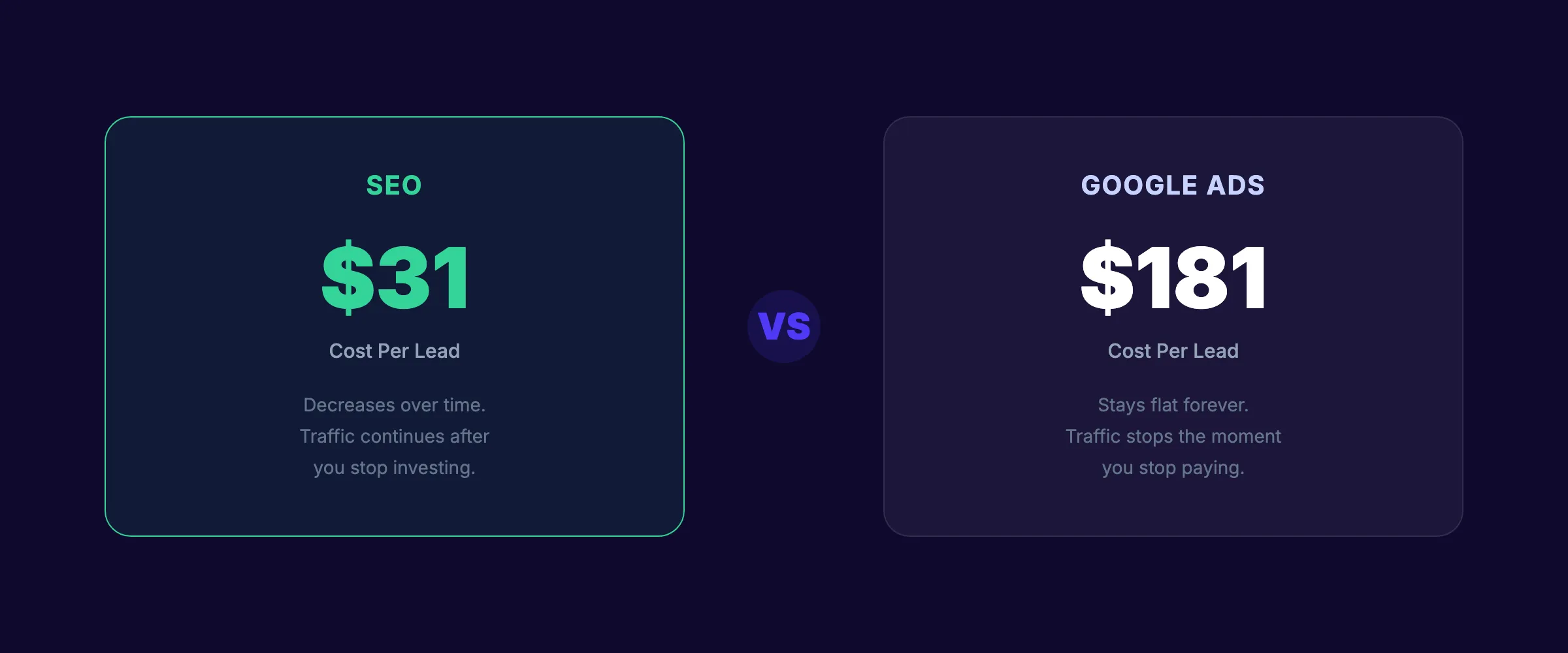
According to First Page Sage's 2026 data, SEO generates leads at $31 per lead compared to $181 for PPC. That is a 5.8x difference in cost efficiency.
But raw cost per lead does not tell the full story. Speed matters. If you need leads this week, SEO cannot deliver.
Cost Comparison: The Real Numbers
The cost structures for Google Ads and SEO are fundamentally different. Ads are a variable cost. SEO is a fixed cost that produces increasing returns.
Google Ads Cost Structure
| Cost Component | Monthly Range |
|---|---|
| Ad spend (clicks) | $1,000-$50,000+ |
| Agency management fee | $500-$5,000 |
| Landing page optimization | $500-$2,000 |
| Total monthly cost | $2,000-$57,000+ |
Average cost per click by industry (2026):
| Industry | Average CPC |
|---|---|
| Legal | $8.67 |
| Insurance | $18.57 |
| Home Services | $6.55 |
| Healthcare | $3.17 |
| Real Estate | $2.37 |
| Ecommerce | $1.16 |
| B2B SaaS | $5.03 |
These numbers come from WordStream's Google Ads benchmarks. High-competition industries like legal and insurance pay $8 to $19 per click. At a 5% conversion rate, that is $170 to $380 per lead from ads alone.
SEO Cost Structure
| Cost Component | Monthly Range |
|---|---|
| Content production (20-30 articles) | $99-$5,000 |
| Technical SEO maintenance | $0-$1,000 |
| Link building | $0-$3,000 |
| SEO tools (optional) | $0-$300 |
| Total monthly cost | $99-$9,300 |
The critical difference is what happens after month 6. Google Ads costs stay the same every month. SEO costs stay the same but traffic increases. By month 12, your cost per lead from SEO drops 50 to 70% because existing articles continue ranking while new articles add incremental traffic.
Your SEO team. $99 per month. 30 optimized articles, published automatically. No per-click costs. No budget caps.
Click-Through Rate: Organic Wins Every Time
Users trust organic results more than ads. The data proves it.
According to Backlinko's CTR study, the #1 organic result gets a 27.6% click-through rate. The average Google Search ad gets 3 to 5%.
| Position | Click-Through Rate |
|---|---|
| Google Ads (average) | 3-5% |
| Organic #1 | 27.6% |
| Organic #2 | 15.8% |
| Organic #3 | 11.0% |
| Organic #4-10 | 2-8% |
Organic results get 5.5 times more clicks than paid ads for the same search query. This means SEO delivers 5.5 times more traffic per keyword ranked than a paid ad for the same keyword.
The gap is even wider on mobile. Mobile users scroll past ads faster. They trust organic results more because they know ads are paid placements.
Why Users Skip Ads
- 70 to 80% of users skip paid ads entirely
- Users perceive organic results as more credible
- Ad fatigue reduces engagement over time
- Ad blockers remove some ad placements
The exception is high-intent commercial searches. Searches like "buy [product] online" or "hire [service] near me" have higher ad click rates because the user is ready to spend money. For informational queries ("how to," "what is," "best way to"), organic dominates.
Conversion Rate Comparison
Click-through rate tells you who visits. Conversion rate tells you who buys.
| Metric | Google Ads | SEO |
|---|---|---|
| Average conversion rate | 4.4% | 2.4% |
| High-intent keywords | 8-12% | 3-5% |
| Cost per conversion | $40-$200 | $15-$50 |
| Conversion quality | Mixed (cold traffic) | Higher (research-driven) |
Google Ads has a higher average conversion rate (4.4% vs 2.4%) because ads target high-intent, bottom-of-funnel searches. Someone clicking an ad for "emergency plumber near me" is ready to hire. Someone clicking an organic result for "how to fix a leaky faucet" is still researching.
But conversion rate alone is misleading. SEO traffic is 5.5 times larger in volume. A 2.4% conversion rate on 10,000 organic visitors (240 conversions) beats a 4.4% conversion rate on 1,000 ad visitors (44 conversions).
Lead Quality Comparison
SEO leads often convert at higher lifetime values. Why? Because they found you through research, not an ad. They read your content, built trust, and chose you. Ad leads clicked the first result they saw. They comparison-shop more aggressively and churn faster.
For B2B companies and services with long sales cycles, SEO leads are worth 2 to 3 times more than ad leads over their lifetime. For ecommerce and impulse purchases, the difference is smaller.
When Google Ads Is the Better Choice
Google Ads wins in specific scenarios. Do not ignore paid search entirely.
1. You Need Leads Now
A new business with zero organic rankings needs revenue today. SEO takes 3 to 12 months. Google Ads delivers traffic within 24 hours. Use ads to fill the gap while SEO builds.
2. You Are Testing a New Market
Before investing 6 months in SEO for a new keyword cluster, test it with ads. Spend $500 to $1,000 over 2 weeks. If the keywords convert, invest in SEO for long-term ownership. If they do not convert, you saved months of wasted effort.
3. Seasonal or Time-Sensitive Promotions
Black Friday sales, event registrations, product launches. These have deadlines. SEO cannot rank a new page in 2 weeks. Ads can.
4. High-Competition, High-Value Keywords
Some keywords are nearly impossible to rank for organically. "Car insurance quotes" has a first-page dominated by billion-dollar companies. For these terms, ads may be the only realistic path to visibility.
5. Retargeting Warm Audiences
Google Ads retargeting shows ads to people who already visited your site. This is not an SEO vs ads comparison. Retargeting is a unique capability that complements SEO traffic.
Stop writing. Start ranking. theStacc publishes 30 SEO articles per month for $99. Build the organic foundation while ads fill the gap.
When SEO Is the Better Choice
SEO wins for long-term, sustainable growth. If you have a 12-month planning horizon, SEO almost always delivers higher ROI.
1. You Want Decreasing Cost Per Lead
Google Ads costs the same every month. SEO costs stay flat while traffic compounds. By month 12, most businesses see their SEO cost per lead drop to $15 to $30. That same lead costs $80 to $200 from ads.
2. You Compete in a Content-Driven Market
B2B services, SaaS, professional services, healthcare, and education. These markets have long buyer journeys. Buyers research for weeks before purchasing. SEO captures buyers at every stage. Ads only capture the final click.
A content marketing strategy that publishes educational articles, guides, and comparisons builds trust across the entire buyer journey. Ads interrupt. Content educates.
3. You Want to Build an Asset
Every article you publish is a permanent asset. It ranks, drives traffic, and generates leads for years. Every dollar spent on Google Ads is gone after the click. After 12 months of SEO, you own hundreds of ranking pages. After 12 months of ads, you own nothing.
4. You Target Informational Keywords
70% of all searches are informational. "How to," "what is," "best way to," "guide to." These queries have low ad click rates (under 2%) but high organic click rates (20%+). SEO owns informational search.
5. You Want Topical Authority
Publishing 100+ articles about a topic signals to Google that your site is an authority. Authority improves rankings for every page on your site. Ads do not build authority. They do not improve future rankings. They do not make your website stronger.
The Best Strategy: Use Both
The smartest businesses do not choose between Google Ads and SEO. They use both strategically.
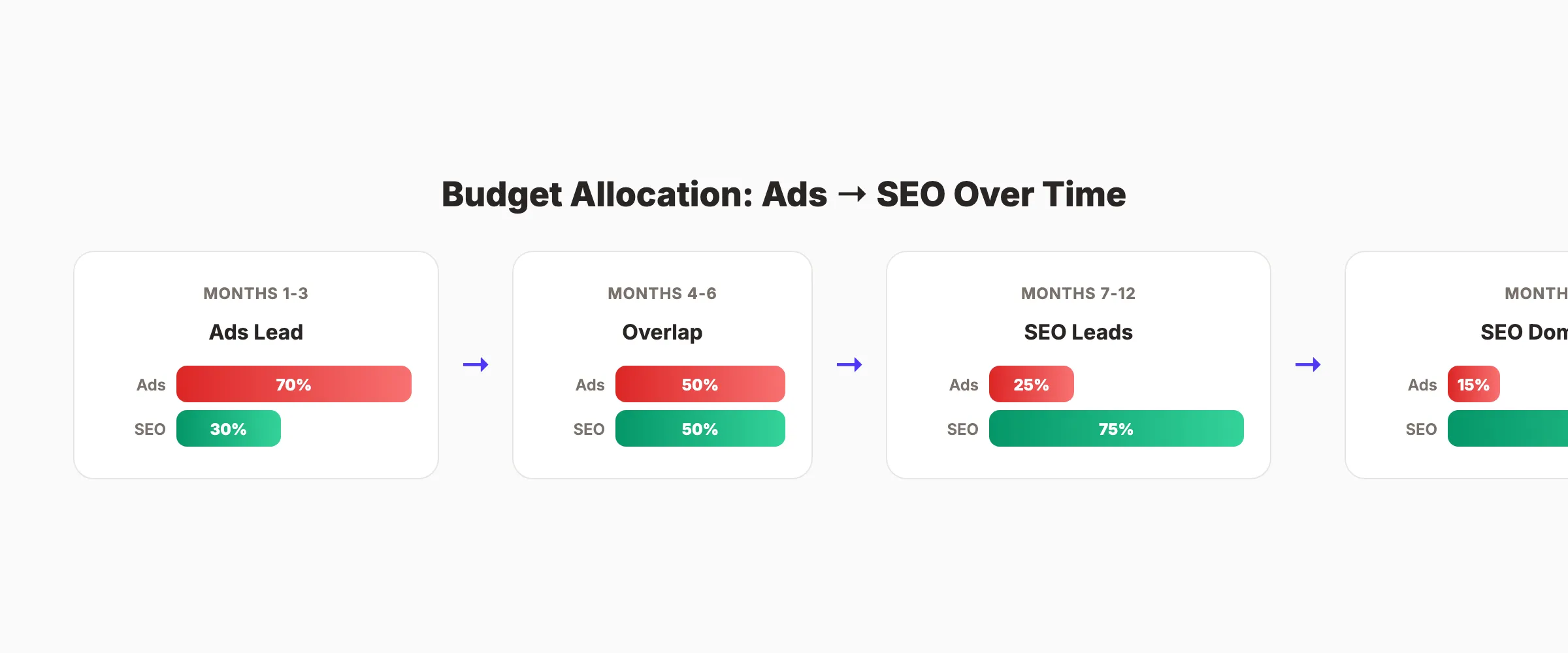
Phase 1: Ads First (Months 1-3)
Run Google Ads for your highest-intent keywords. Generate leads immediately. Use the data to identify which keywords convert best.
Simultaneously, start your SEO program. Publish 20 to 30 blog posts per month. Target the same keywords you are bidding on plus long-tail variations.
Phase 2: Overlap (Months 4-6)
SEO starts producing organic rankings. Some keywords now appear in both paid and organic results. This dual presence increases total clicks by 25 to 30% compared to either channel alone.
Shift ad budget away from keywords where you rank organically in the top 3. Reallocate that budget to keywords where you do not rank yet.
Phase 3: SEO Takes Over (Months 7-12)
Organic traffic compounds. Your cost per lead drops. Shift 60 to 80% of your search budget from ads to SEO content production. Keep ads running for retargeting, seasonal campaigns, and keywords you cannot rank for organically.
Budget Allocation Framework
| Month | Google Ads % | SEO % | Why |
|---|---|---|---|
| 1-3 | 70% | 30% | Ads for immediate leads. SEO building foundation. |
| 4-6 | 50% | 50% | SEO starts producing. Overlap for dual presence. |
| 7-12 | 20-30% | 70-80% | SEO compounds. Ads for retargeting + gaps. |
| 12+ | 10-20% | 80-90% | SEO drives majority of leads. Ads supplemental. |
This phased approach gives you the speed of ads and the economics of SEO. You never wait for results. And you never pay for traffic that should be free.
Skip the agency. Keep the results. theStacc starts at $99/mo. 30 articles. Published automatically. Build your organic engine while ads handle the short term.
Google Ads vs SEO by Industry
Different industries see different results from each channel. This table summarizes where each channel performs best.
| Industry | Better Channel | Why |
|---|---|---|
| Legal Services | SEO | High CPC ($8.67). SEO reduces cost per lead by 80%. |
| Insurance | Both (ads for quotes, SEO for education) | Highest CPC ($18.57). SEO for content. Ads for converters. |
| Home Services | SEO + Local | GBP and blog content dominate local search. |
| Ecommerce | Ads (short term), SEO (long term) | Low CPC ($1.16). Ads work for products. SEO for categories. |
| B2B SaaS | SEO | Long sales cycle. Buyers research 3-6 months. Content wins. |
| Healthcare | SEO | Trust matters. Organic results get 10x more clicks. |
| Real Estate | Both | Local SEO for agents. Ads for specific listings. |
| Restaurants | Local SEO | Google Maps dominates. Ads rarely needed. |
For most local service businesses, SEO delivers better ROI after 6 months. For ecommerce with thin margins and high product turnover, ads remain important for new product launches.
Common Mistakes in Google Ads vs SEO Decisions
1. Choosing Ads Because SEO Is "Too Slow"
SEO takes time. But the cost of waiting 12 months to start SEO is higher than the cost of starting today. Every month you delay, competitors publish content that fills the keywords you want. Start SEO now. Use ads to bridge the gap.
2. Stopping SEO When Ads Are Working
Ads working well does not mean SEO is unnecessary. It means you have proven demand for those keywords. That demand should be captured organically at a fraction of the cost. Running ads without building SEO is renting traffic instead of owning it.
3. Comparing Monthly Spend Instead of Lifetime ROI
Ads cost $5,000 per month. SEO costs $2,000 per month. After 12 months, ads generated 600 leads at $100 each. SEO generated 400 leads at $60 each. But in month 13, SEO still generates leads. Ads generate nothing without continued spend.
Lifetime ROI is the only honest comparison. Over a 3-year period, SEO outperforms ads by 3 to 10 times for most businesses.
4. Running Ads Without Landing Page Optimization
Google Ads traffic landing on a generic homepage converts at 1 to 2%. The same traffic landing on an optimized page converts at 5 to 10%. Before spending $5,000 on ads, spend $500 on landing page optimization.
5. Ignoring the Content SEO Produces
SEO content does more than rank. Blog articles become social media posts, email newsletters, sales enablement materials, and customer education resources. The value of an SEO article extends far beyond the organic traffic it generates.
What practitioners are saying on X
AI search advice ages quickly. Here is high-signal public discussion from SEO and growth operators — context for your roadmap, not a substitute for primary data.
- @hridoyreh (Mar 2026): Widely shared SEO skill tree: foundations, research, technical, on-page, content, links, AI SEO/GEO, analytics, UX, brand, programmatic — useful map for stats and how-to posts. See the post on X.
- @jakezward (Feb 2026): 2026 SEO predictions emphasize AI Overview share-of-SERP, schema for LLM token efficiency, brand mentions in AI answers as a KPI, proprietary data as a moat, and content refresh beating net-new AI slop. See the post on X.
Grok, AI Overviews, and multi-engine visibility
For “google ads vs seo”, multi-engine visibility still starts with clear definitions, sourced numbers, and extractable section answers. Grok additionally factors live X discussion — keep public claims consistent with this page.
- Google AI Overviews: Use passage-ready answers, tables, and FAQ schema where relevant.
- ChatGPT / Perplexity: Cite named sources next to key claims.
- Grok: Maintain accurate entity facts on-site and in high-signal X posts.
Publish content built for Google and AI citations. theStacc’s Content SEO module ships SEO-scored articles structured for rankings and generative engines — including clearer entity pages models like Grok can quote.
FAQ
For most small businesses, SEO delivers better long-term ROI. A $99 per month SEO program that produces 30 articles generates compounding traffic. A $99 per day Google Ads budget generates traffic only while running. Start with SEO. Use ads to supplement when you need immediate leads.
Google Ads costs $1 to $50+ per click depending on your industry. SEO costs $99 to $5,000 per month for content production. After 6 months, SEO typically delivers leads at $15 to $50 each. Google Ads delivers leads at $40 to $200 each. The gap widens every month SEO runs.
Yes. The best strategy combines both. Use Google Ads for immediate leads and keyword testing. Use SEO for long-term growth and decreasing cost per lead. Shift budget from ads to SEO as organic rankings build. Most businesses reach 80% SEO / 20% ads by month 12.
Most businesses see enough organic traffic to reduce ad spend after 6 to 9 months. Full replacement (where organic traffic matches or exceeds previous ad traffic) takes 9 to 18 months. The timeline depends on your industry competition and publishing velocity.
Users trust organic results more than paid placements. 70 to 80% of searchers skip ads entirely. Organic results also show richer information (snippets, FAQs, sitelinks) and do not carry the "Ad" label that signals a paid promotion. For informational searches, organic CTR is 5 to 10 times higher than ad CTR.
Absolutely. If ads generate leads at $100 each, SEO can generate the same leads at $15 to $30 each within 6 to 12 months. Every lead you move from ads to organic drops your customer acquisition cost. That savings goes directly to your bottom line.
Google Ads gives you speed. SEO gives you scale. The businesses that grow fastest use ads to fund the first 6 months while SEO builds the foundation that makes ads optional.
Start both. Shift budget as SEO compounds. And if producing 30 articles per month sounds impossible, it costs $99 when it happens automatically.
Related Tools & Resources
Free SEO Tools:
Best Lists:
Sources & references
- [1] Princeton / Georgia Tech et al. — GEO research (arXiv:2311.09735)
- [2] @hridoyreh on X — Widely shared SEO skill tree: foundations, research, technical, on-page, content, links, AI SEO/GEO, analytics, UX, bran
- [3] @jakezward on X — 2026 SEO predictions emphasize AI Overview share-of-SERP, schema for LLM token efficiency, brand mentions in AI answers
- [4] Referenced source — firstpagesage.com

Plan topics, review article drafts, and publish to a connected CMS.
Weekly local SEO teardowns
One practical email a week. Map Pack, GBP, AI Overviews — no fluff. Unsubscribe anytime.
Explore this topic: Best Google Ads agencies in 2026: 12 ranked.