SEO for therapists: the local keywords clients search, Google Business Profile setup, specialty page structure, directory choices, and HIPAA-safe tracking.
77% of people seeking mental health support start their search on Google. "Therapist near me" gets 301,000 searches per month. "Couples counseling near me" gets 33,100. "Anxiety therapist near me" gets 18,100. Every one of those searches represents someone actively looking for help. If your practice does not show up, they book with a competitor.
Most therapists rely on Psychology Today listings and referral networks. Both generate clients. Neither gives you control over your pipeline. Therapist SEO builds a steady flow of new client inquiries that runs 24/7 without directory fees or referral dependency. The practices ranking in the top 3 of the local pack capture 75% of all clicks.
The challenge is that therapy falls under Google's YMYL (Your Money or Your Life) category. Google holds health-related content to higher standards. Generic SEO advice does not account for the trust signals, ethical constraints, and content sensitivity that therapist websites require.
We have published 3,500+ blog posts across 70+ industries, including content for healthcare and mental health practices. This guide covers everything we know about SEO for therapists.
Here is what you will learn:
- How to dominate the local pack for therapy searches in your area
- The exact keywords therapists should target by specialty
- How to build specialty pages that rank and convert
- Why E-E-A-T matters more for therapists than almost any other profession
- The content strategy that turns your website into a client acquisition channel
- A 90-day SEO action plan for private practices
Why SEO Matters More for Therapists Than Most Professions
Therapy is one of the most searched healthcare categories on Google. Demand for mental health services has surged since 2020. The supply of therapists has grown, but most practices still rely on outdated marketing. SEO fills the gap between growing demand and passive marketing.
Here is the math. A therapist charging $150 per session who sees a new SEO-acquired client weekly for 20 sessions generates $3,000 in revenue from that single client. If SEO brings 3 new clients per month, that is $9,000 in lifetime revenue per month. The average therapist spends $200 to $500 per month on directories like Psychology Today. SEO delivers more clients at a lower long-term cost.
Compare the channels:
| Channel | Monthly Cost | New Clients/Month | Cost Per Client |
|---|---|---|---|
| Psychology Today listing | $30-$80 | 1-3 | $27-$80 |
| Google Ads | $500-$2,000 | 3-8 | $150-$250 |
| Referral networks | Free | 1-4 | $0 (but unpredictable) |
| SEO (after 6 months) | $200-$1,000 | 5-15 | $15-$65 |
SEO compounds. Every blog post, every review, every optimized page builds authority over time. After 6 months, your cost per client drops while inquiry volume increases. Directory listings charge monthly fees forever. SEO keeps working after you stop paying.
Therapy is a YMYL category. Google's quality guidelines hold health-related websites to the highest standards. Trust signals matter more here than in almost any other industry.
Google Business Profile: Your Most Important Asset
Your Google Business Profile (GBP) determines whether you appear in the local pack and Google Maps when someone searches for a therapist in your area. GBP signals account for 32% of local ranking factors.
Choose the Right Categories
Your primary category should match your main service. Options include:
- Psychologist
- Counselor
- Marriage and Family Therapist
- Mental Health Service
- Psychotherapist
- Child Psychologist
Add secondary categories for additional specialties. A therapist who does couples counseling and individual anxiety therapy should list both.
Complete Every Section
- Practice name: Your exact legal practice name. No keyword stuffing.
- Address: Your office address. If you only offer telehealth, choose "Service area business" and list the cities or states you serve.
- Phone number: A local number builds more trust than a 1-800 number.
- Business hours: Include your actual availability. Update for holidays and vacations.
- Description: 750 characters. Mention your specialties, location, and approach naturally. "Licensed clinical psychologist in Austin specializing in anxiety, depression, and trauma therapy for adults" performs better than generic descriptions.
- Services: Add each service separately (individual therapy, couples counseling, EMDR, CBT, etc.) with descriptions.
- Photos: Upload your headshot, office photos, and waiting room. Practices with photos get 42% more direction requests.
Post Regularly
Post to GBP 2 to 3 times per week. Share mental health tips, seasonal content (holiday stress, back-to-school anxiety), and practice updates. For a detailed posting strategy, see our GBP posting frequency guide.
Handle Reviews Carefully
Reviews are critical but sensitive in therapy. You cannot ask clients for reviews in the same way a restaurant does. Ethical guidelines vary by state.
What you can do:
- Display a "Leave a Review" link on your website
- Mention in your intake paperwork that reviews are welcome (but never required)
- Respond to all reviews professionally without confirming the person is a client (HIPAA)
- Use our review response generator for HIPAA-safe response templates
Your SEO team. $99/month. theStacc writes and publishes optimized articles for therapy practices. GBP posts included.
Keyword Research for Therapists
Most therapists target "therapist near me" and nothing else. That keyword has extreme competition. Smart keyword research targets specialty-specific, condition-specific, and location-specific terms.
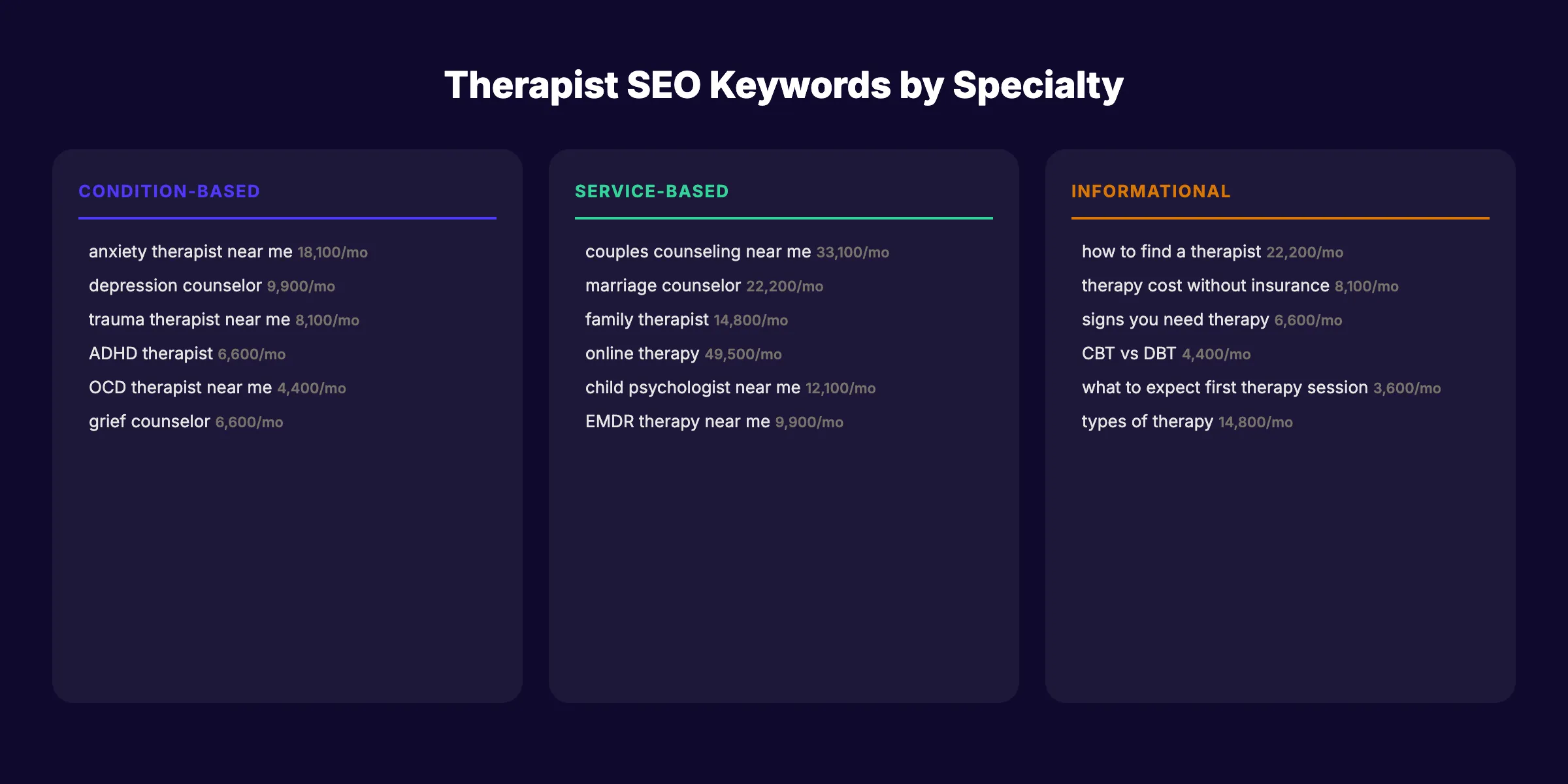
Condition-Based Keywords (Highest Intent)
These keywords indicate someone actively seeking help for a specific issue:
| Keyword | Monthly Volume | Intent |
|---|---|---|
| anxiety therapist near me | 18,100 | High intent |
| depression counselor near me | 9,900 | High intent |
| trauma therapist near me | 8,100 | High intent |
| ADHD therapist | 6,600 | High intent |
| grief counselor near me | 6,600 | High intent |
| OCD therapist near me | 4,400 | High intent |
Service-Based Keywords
| Keyword | Monthly Volume | Intent |
|---|---|---|
| couples counseling near me | 33,100 | High intent |
| marriage counselor near me | 22,200 | High intent |
| family therapist near me | 14,800 | High intent |
| online therapy | 49,500 | Commercial |
| child psychologist near me | 12,100 | High intent |
| EMDR therapy near me | 9,900 | High intent |
Local Keyword Formulas
Combine your specialty with your location:
- "[specialty] therapist in [city]", such as "anxiety therapist in Denver"
- "[therapy type] near [area]", such as "EMDR therapy near Capitol Hill"
- "[condition] counselor [city] [state]", such as "depression counselor Portland Oregon"
- "best [specialty] therapist [city]", such as "best couples counselor in Seattle"
Informational Keywords (Build Authority)
These capture people researching before they book:
- "How to find a therapist" (22,200/mo)
- "Therapy cost without insurance" (8,100/mo)
- "Signs you need therapy" (6,600/mo)
- "CBT vs DBT" (4,400/mo)
- "What to expect in your first therapy session" (3,600/mo)
- "Types of therapy explained" (14,800/mo)
For a complete keyword research process, see our keyword research guide.
Specialty Pages That Convert
Your website needs a dedicated page for every specialty and modality you offer. A single "Services" page listing everything will not rank for any specific search.
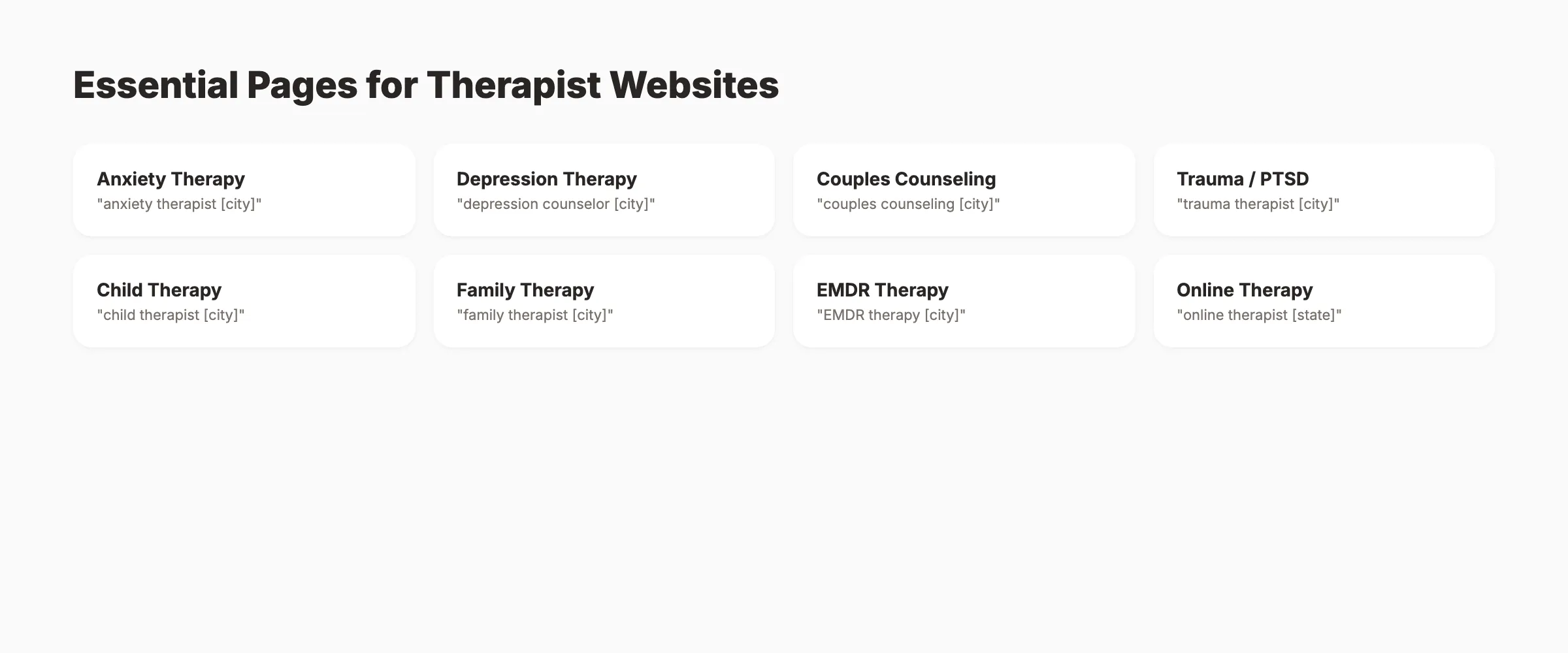
Required Specialty Pages
Create a separate page for each condition or modality you treat:
- Anxiety therapy
- Depression therapy
- Trauma and PTSD therapy
- Couples counseling
- Marriage counseling
- Family therapy
- Child and adolescent therapy
- EMDR therapy
- CBT (Cognitive Behavioral Therapy)
- Online therapy / telehealth
- Grief and loss counseling
- ADHD assessment and therapy
What Each Specialty Page Needs
- Title tag: "[Specialty] Therapy in [City] | [Practice Name]" under 60 characters
- H1 heading: "[Specialty] Therapy in [City]"
- 400+ words describing your approach to that condition, what clients can expect, and who this service helps
- Your credentials specific to that specialty (certifications, training, years of experience)
- A clear CTA: "Schedule a Free Consultation" with phone number and contact form
- Schema markup using MedicalBusiness or LocalBusiness plus Service types
- FAQ section answering 3 to 4 common questions about that specialty
Telehealth and Multi-State Pages
If you are licensed in multiple states and offer online therapy, create a page for each state. "Online Anxiety Therapist in Texas" targets a different search than "Online Anxiety Therapist in Colorado." Each page should mention the specific state, your license in that state, and any state-specific insurance panels you accept.
What Makes Therapy Pages Different
Therapy pages require more sensitivity than other service pages. Potential clients are often in distress when they search. Write with empathy. Avoid clinical jargon. Use second person ("you") to speak directly to the reader. Acknowledge the courage it takes to seek help.
Bad example: "Our practice uses evidence-based modalities including CBT, DBT, and EMDR."
Good example: "Anxiety does not have to control your life. We use proven approaches like CBT and EMDR to help you build the skills to manage anxious thoughts. Most clients notice a shift within 6 to 8 sessions."
E-E-A-T: Why Trust Signals Matter More for Therapists
Therapy falls squarely under Google's YMYL guidelines. Google assigns higher scrutiny to websites that could affect a person's health, safety, or financial stability. This means E-E-A-T signals directly impact your rankings.
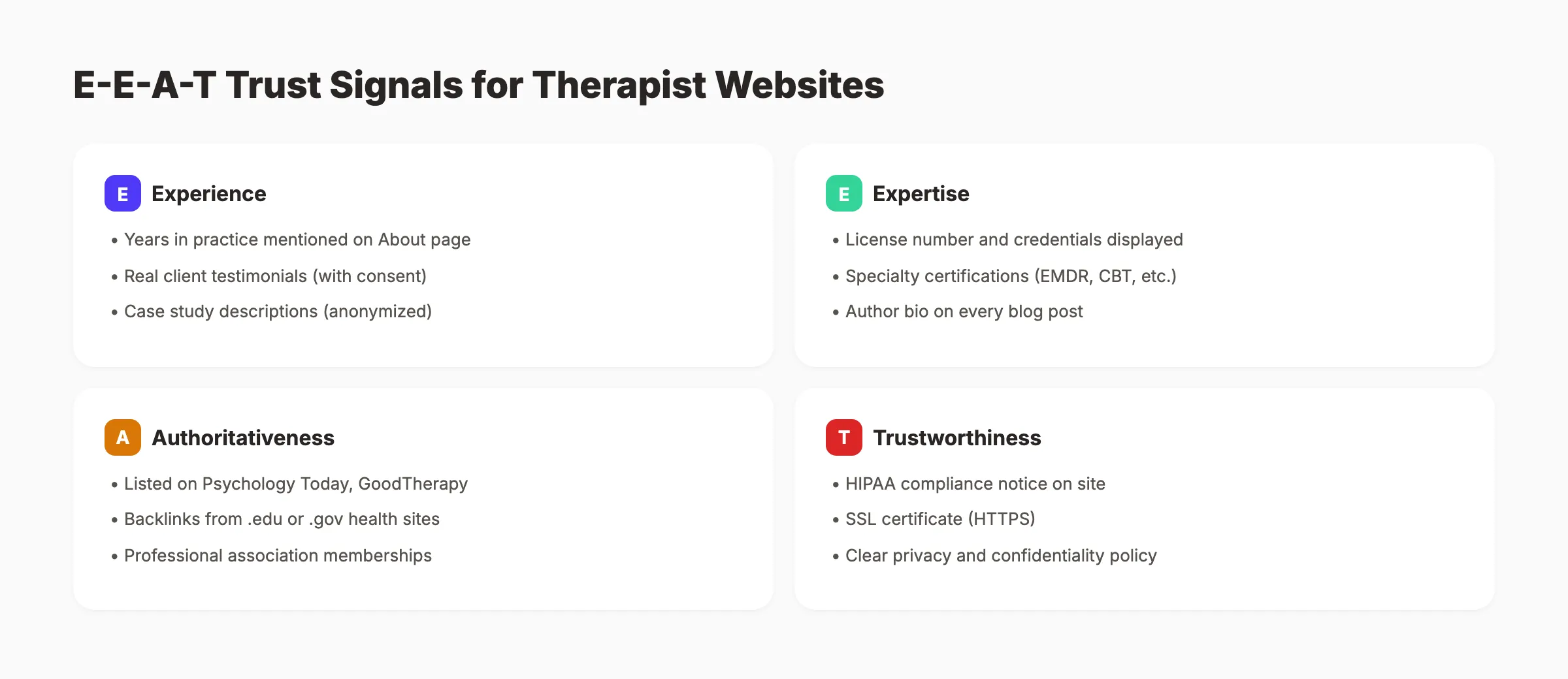
Experience
- Mention your years in practice on your About page
- Include anonymized examples of client outcomes (with appropriate consent)
- Write from first-person experience. "In my 12 years of practice, I have found that..." signals real experience.
Expertise
- Display your license number, credentials, and degree prominently
- List all certifications (EMDR, CBT, DBT, play therapy, etc.)
- Add an author bio to every blog post with your credentials
- Link to your profiles on professional associations
Authoritativeness
- Maintain active profiles on Psychology Today, GoodTherapy, and your state licensing board
- Seek backlinks from professional associations and mental health organizations
- Guest post on reputable mental health publications
- Get listed in your state's therapist directory
Trustworthiness
- HTTPS is mandatory (SSL certificate). An insecure site kills trust instantly.
- Display a HIPAA compliance notice
- Include a clear privacy policy explaining how client data is handled
- Show your physical office address and phone number on every page
- Include a "crisis resources" section linking to the 988 Suicide and Crisis Lifeline
Without strong E-E-A-T signals, your content will struggle to rank regardless of keyword optimization. Google prioritizes health-related content from credentialed professionals over generic websites.
3,500+ blogs published. Every article is SEO-scored before publish. See what theStacc can do for your therapy practice.
Content Marketing for Therapy Practices
Blog content captures potential clients at the research stage. Someone searching "signs of high-functioning anxiety" today becomes someone searching "anxiety therapist near me" next month.
Blog Topics for Therapists (30-Day Plan)
| Week | Topic | Target Keyword |
|---|---|---|
| 1 | Signs You Need Therapy (And How to Take the First Step) | signs you need therapy |
| 1 | How Much Does Therapy Cost Without Insurance? | therapy cost without insurance |
| 2 | CBT vs DBT: Which Therapy Approach Is Right for You? | CBT vs DBT |
| 2 | What to Expect in Your First Therapy Session | first therapy session |
| 3 | 5 Signs of High-Functioning Anxiety | high functioning anxiety |
| 3 | How to Find a Therapist Who Is Right for You | how to find a therapist |
| 4 | Does Couples Counseling Work? What the Research Says | does couples counseling work |
| 4 | EMDR Therapy: What It Is and How It Works | EMDR therapy explained |
Content Guidelines for Mental Health
Mental health content carries ethical weight. Follow these rules:
- Never diagnose through content. Use language like "you may be experiencing" rather than "you have."
- Always include crisis resources. Add the 988 Suicide and Crisis Lifeline at the bottom of posts discussing depression, suicidal ideation, or crisis.
- Cite research. Link to peer-reviewed studies, APA guidelines, or NIMH resources. This builds E-E-A-T and provides real value.
- Write at an 8th-grade reading level. People in distress process information differently. Short sentences. Clear language. No jargon.
- Include a CTA that feels supportive, not salesy. "If you are ready to talk, schedule a free consultation" works better than aggressive booking prompts.
Content That Builds Authority
- Research summaries ("What the Research Says About EMDR for Trauma"). Cited by other therapists and health sites
- Comparison guides ("CBT vs DBT vs ACT: Which Approach Fits You?"). High search volume and shareability
- Cost guides ("How Much Does Therapy Cost in [State]?"). Referenced by insurance and wellness blogs
- Seasonal content ("Managing Holiday Anxiety: A Therapist's Guide"). Shared widely on social media
For more on link-worthy content, see our guide on building backlinks.
Technical SEO for Therapist Websites
Technical issues silently prevent potential clients from finding you. Most therapist websites run on Squarespace, Wix, or WordPress with unoptimized themes.
Site Speed
Compress images. Use WebP format. Target under 3 seconds for page load. Many therapist websites load slowly because of large hero images and unoptimized headshot photos. A slow site increases bounce rate and loses potential clients.
Mobile Optimization
Over 60% of therapy searches happen on mobile. Someone in an anxious moment searching "therapist near me" at 11 PM needs your site to work perfectly on their phone. Key checks:
- Phone number is tap-to-call
- Contact form works on mobile
- Text is readable without zooming
- Buttons are large enough to tap
Schema Markup
Add schema markup to help Google understand your practice:
- MedicalBusiness or LocalBusiness schema with name, address, phone, and hours
- Person schema for each therapist with credentials and specialties
- Service schema for each specialty page
- FAQ schema on pages with frequently asked questions
HIPAA and Privacy
Your website must comply with HIPAA if you collect any client information through contact forms. Use encrypted form submissions. Display a HIPAA compliance notice. Include a privacy policy. These are legal requirements and trust signals. Google evaluates both.
Run an SEO Audit
Before investing in content, identify what is broken. Use our free SEO audit tool or follow our SEO audit guide.
Directories and Citations for Therapists
Citations verify your practice's legitimacy. Therapists have access to industry-specific directories that most businesses do not.
Priority Directories
| Directory | Priority | Notes |
|---|---|---|
| Google Business Profile | Critical | Primary local ranking signal |
| Psychology Today | Critical | Top therapist directory. Most clients check here. |
| GoodTherapy | High | Strong domain authority. Established referral source. |
| TherapyDen | High | Growing directory with niche filtering |
| Zocdoc | High | Particularly useful if you accept insurance |
| Healthgrades | High | Broad healthcare directory with E-E-A-T signals |
| Yelp | Medium | General but relevant for private practices |
| Facebook Business | Medium | Social signal and review platform |
| Bing Places | Medium | Second largest search engine |
| State licensing board | High | Builds trust and E-E-A-T authority |
| Professional associations (APA, AAMFT, NASW) | High | Backlinks with strong authority |
NAP Consistency
Your practice name, address, and phone number must be identical across every listing. Common mistakes:
- Using "Dr." on some listings but not others
- Listing a suite number inconsistently
- Using different phone numbers on directories versus your website
Audit your citations with local citation tools to find and fix inconsistencies.
Link Building for Therapists
Backlinks from authoritative sources boost rankings and E-E-A-T signals. Therapists have unique link-building opportunities.
Professional Association Links
- APA (American Psychological Association) member profiles
- AAMFT (American Association for Marriage and Family Therapy)
- NASW (National Association of Social Workers)
- State licensing board directory
- Specialty certification directories (EMDR International Association, Beck Institute for CBT)
Local and Community Links
- Local chamber of commerce membership
- Community mental health organization partnerships
- School district or university counseling center partnerships
- Local newspaper expert commentary on mental health topics
- Guest columns in community publications
Content-Based Links
- Guest posts on mental health blogs and wellness sites
- Expert quotes for health journalists (sign up for HARO or Qwoted)
- Podcast appearances on mental health or wellness shows
- Contributions to APA's resource pages
Avoid buying links or participating in link schemes. In the YMYL space, Google scrutinizes unnatural link patterns more aggressively.
Rank everywhere. Do nothing. Blog SEO, Local SEO, and Social on autopilot. theStacc starts at $49/mo.
Tracking Results and Measuring ROI
Track these metrics monthly to evaluate your SEO performance.
Key Metrics
| Metric | Tool | Target |
|---|---|---|
| Local pack position | Google Search Console | Top 3 for specialty keywords |
| Organic traffic | Google Analytics 4 | 20%+ growth month over month |
| Contact form submissions | GA4 | Track by source and page |
| Phone calls from GBP | GBP Insights | 10+ calls/month within 90 days |
| Keyword rankings | SEO tool | Track 20-30 specialty keywords |
| Review count and rating | GBP | Steady growth, 4.5+ average |
Timeline for Therapist SEO
| Timeframe | Expected Results |
|---|---|
| Month 1-2 | GBP optimized, specialty pages live, technical fixes done |
| Month 3-4 | Ranking movement for long-tail specialty keywords |
| Month 5-6 | Organic traffic increasing, first SEO-driven inquiries |
| Month 7-12 | Consistent inquiry flow, ranking for 30+ keywords |
| Month 12+ | Dominant local presence, reduced dependence on directories |
Therapist SEO typically takes 4 to 6 months for initial results and 12 to 18 months for full market presence. Competitive metro areas take longer. Niche specialties (EMDR, child psychology, neurofeedback) often see faster results due to lower competition. For detailed timelines, see our guide on how long SEO takes.
What practitioners are saying on X
Fundamentals plus AI-search measurement remain the dual stack.
- @jakezward (Feb 2026): 2026 SEO predictions emphasize AI Overview share-of-SERP, schema for LLM token efficiency, brand mentions in AI answers as a KPI, proprietary data as a moat, and content refresh beating net-new AI slop. See the post on X.
- @hridoyreh (Mar 2026): Widely shared SEO skill tree: foundations, research, technical, on-page, content, links, AI SEO/GEO, analytics, UX, brand, programmatic — useful map for stats and how-to posts. See the post on X.
- @HlynurStefDev (Jul 2026): Public case: niche site traffic jumped from ~18 to 4,162 Google visits/month after focused technical/on-page SEO work (GSC screenshots claimed) — reminds that fundamentals still move numbers. See the post on X.
Grok, AI Overviews, and multi-engine visibility
For “therapist seo guide”, multi-engine visibility still starts with clear definitions, sourced numbers, and extractable section answers. Grok additionally factors live X discussion — keep public claims consistent with this page.
- Google AI Overviews: Use passage-ready answers, tables, and FAQ schema where relevant.
- ChatGPT / Perplexity: Cite named sources next to key claims.
- Grok: Maintain accurate entity facts on-site and in high-signal X posts.
Publish content built for Google and AI citations. theStacc’s Content SEO module ships SEO-scored articles structured for rankings and generative engines — including clearer entity pages models like Grok can quote.
FAQ
DIY SEO costs $0 to $200 per month in tools. A freelancer or agency charges $500 to $2,000 per month. theStacc offers blog SEO starting at $99 per month and local SEO starting at $49 per month, covering content publishing and GBP management. Most solo practitioners start with $200 to $500 per month and scale as their practice grows.
Both serve different purposes. Psychology Today provides immediate visibility in a trusted directory for $30 to $80 per month. SEO builds long-term organic traffic that you own. Most successful practices use both. Psychology Today handles short-term client acquisition while SEO builds a pipeline that reduces directory dependence over time.
Start with specialty plus location keywords: "anxiety therapist [city]," "couples counseling near me," and "EMDR therapy [city]." Then target informational keywords like "signs you need therapy," "therapy cost without insurance," and "CBT vs DBT." Condition-specific local keywords convert best because they match high-intent searches.
Expect initial ranking movement within 3 to 4 months. Consistent client inquiries from SEO typically start around month 5 to 6. Full market presence takes 12 to 18 months. Niche specialties see faster results. Competitive metros take longer. Read our guide on how long SEO takes for detailed timelines.
This depends on your state's ethical guidelines and your professional association's code of ethics. Most guidelines allow you to make review options available (a link on your website, a card in your office) without directly soliciting reviews from individual clients. Never make reviews a condition of treatment. Never offer incentives. Consult your state licensing board for specific guidance.
Yes. Blog content drives organic traffic, builds E-E-A-T authority, and captures potential clients at the research stage. Therapists who publish 4+ posts per month rank for 3x more keywords. Each post creates another opportunity to appear in Google and AI search results. Mental health content also positions you as an expert in your specialty.
SEO for therapists is not optional in 2026. The practices filling their caseloads are the ones showing up first when people search for help. Every month you wait is another month potential clients find someone else. Start with your Google Business Profile, build your specialty pages, and publish content that demonstrates your expertise. The inquiries follow.
Related Tools & Resources
Free SEO Tools:
Best Lists:
Sources & references
- [1] Princeton / Georgia Tech et al. — GEO research (arXiv:2311.09735)
- [2] @hridoyreh on X — Widely shared SEO skill tree: foundations, research, technical, on-page, content, links, AI SEO/GEO, analytics, UX, bran
- [3] @jakezward on X — 2026 SEO predictions emphasize AI Overview share-of-SERP, schema for LLM token efficiency, brand mentions in AI answers
- [4] Referenced source — developers.google.com

Manage Google Business Profile posts, review replies, and local rank tracking.
Weekly local SEO teardowns
One practical email a week. Map Pack, GBP, AI Overviews. No fluff. Unsubscribe anytime.