
GEO Statistics 2026: 50+ Citation and Data Facts
50+ GEO statistics for 2026. AI citation rates, traffic data, platform usage, and content factors. All sourced. Updated April 2026.
Last updated: April 2026
Generative Engine Optimization (GEO) is how businesses appear in AI-generated search results. As of 2026, the GEO market is valued at $848 million and growing at 50.5% CAGR. 810 million people use ChatGPT daily. Google AI Overviews reach 1.5 billion monthly users.
GEO statistics are scattered across dozens of studies from Semrush, Ahrefs, Superlines, and independent researchers. Finding current, sourced data in one place is difficult.
This post compiles 50+ GEO statistics from authoritative sources. Every stat includes its source and year. We update this page quarterly.
Here is what the data covers:
- AI search platform usage and market share
- Citation rates by platform
- Traffic impact and click-through rate changes
- Content factors that drive AI citations
- GEO market size and growth projections
- Conversion rates from AI-referred traffic
AI Search Platform Usage Statistics
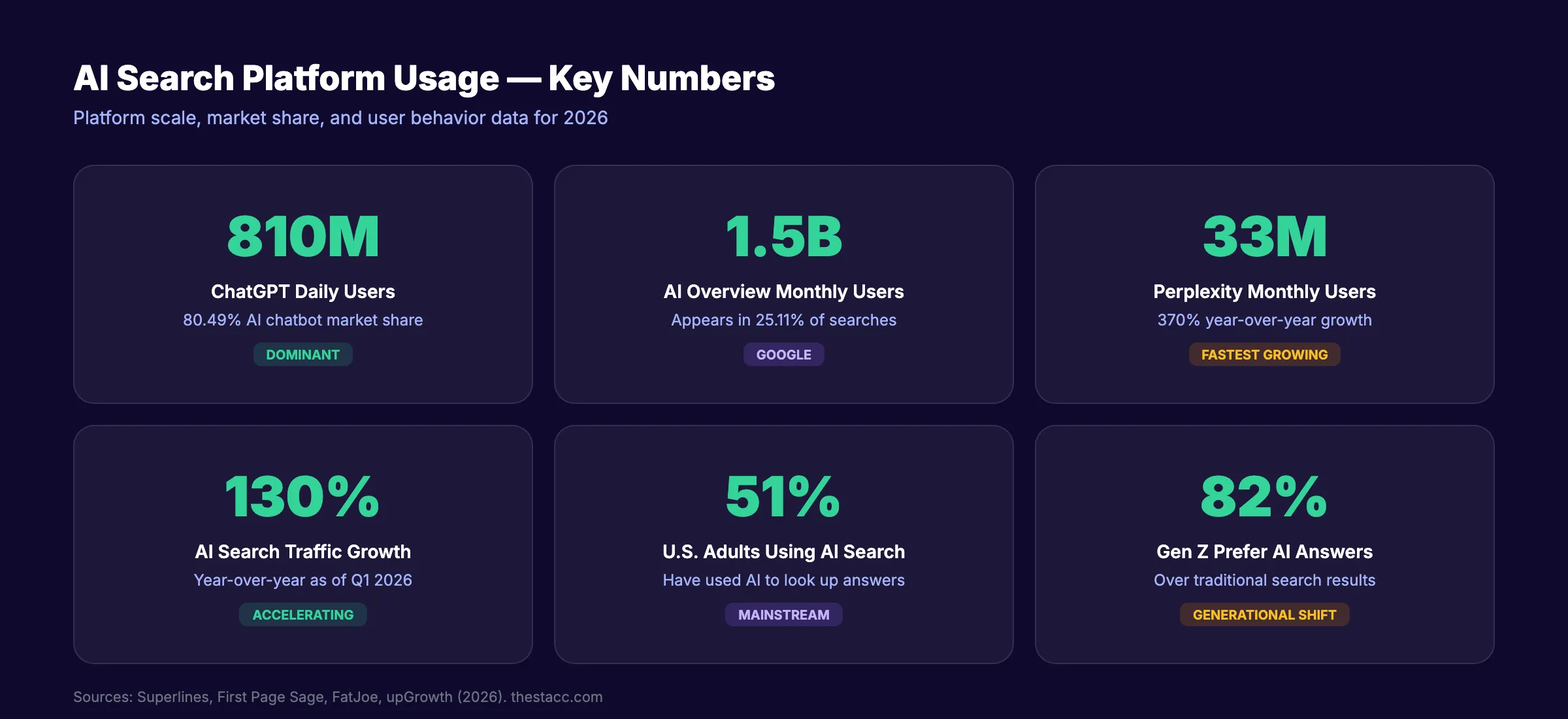
1. 810 million people use ChatGPT daily. Source: Superlines, 2026
2. Google AI Overviews reach 1.5 billion monthly users. Source: Superlines, 2026
3. ChatGPT holds 80.49% of the AI chatbot market share. Source: First Page Sage, March 2026
4. Perplexity has 33 million monthly active users. Source: FatJoe, 2026
5. Microsoft Copilot holds 7.22% of AI chatbot market share. Source: First Page Sage, March 2026
6. Google Gemini holds 13.50% of the generative AI market. Source: Sedestral, 2026
7. 51% of U.S. adults have used AI to look up answers. Source: Superlines, 2026
8. AI search traffic is growing at 130 to 150% year-over-year. Source: upGrowth, Q1 2026
9. 82% of Gen Z prefer direct AI answers over traditional search results. Source: Superlines, 2026
10. 50% of all online searches will involve an AI assistant by 2028. Source: Superlines, 2026
AI Citation Rate Statistics
11. Citation rates vary by 615x across AI platforms. The gap between the highest (Grok at 27.01%) and lowest (Claude at 0%) citation rate is massive. Source: Superlines, 2026
12. Grok has the highest citation rate at 27.01%. Source: Superlines, 2026
13. Perplexity cites sources at a 13.05% rate. Source: Superlines, 2026
14. Google AI Mode cites sources at a 9.09% rate. Source: Superlines, 2026
15. ChatGPT cites sources at only 0.59%. Despite having the most users, ChatGPT rarely links back to source content. Source: Superlines, 2026
16. Only 11% of domains are cited by both ChatGPT and Perplexity. Each AI platform has distinct source preferences. Source: TryProfound, 2025
17. Wikipedia captures 47.9% of ChatGPT’s top-10 citations. Source: Azoma, 2025. See our full analysis: Wikipedia Gets 47.9% of ChatGPT Citations.
18. 80% of URLs cited by AI platforms do not rank in Google’s top 100. AI citation and Google ranking are separate systems. Source: Superlines, 2026
19. 8 of 10 most-cited URLs in AI Overviews are “Best X” listicles. Source: Superlines, 2026
20. Brands are 6.5x more likely to be cited via third-party sources. Getting mentioned on external sites matters more than self-published content. Source: Superlines, 2026
Stop writing. Start ranking. Stacc publishes 30 SEO articles per month for $99. Every article structured for AI citation. Start for $1 →
Traffic Impact Statistics
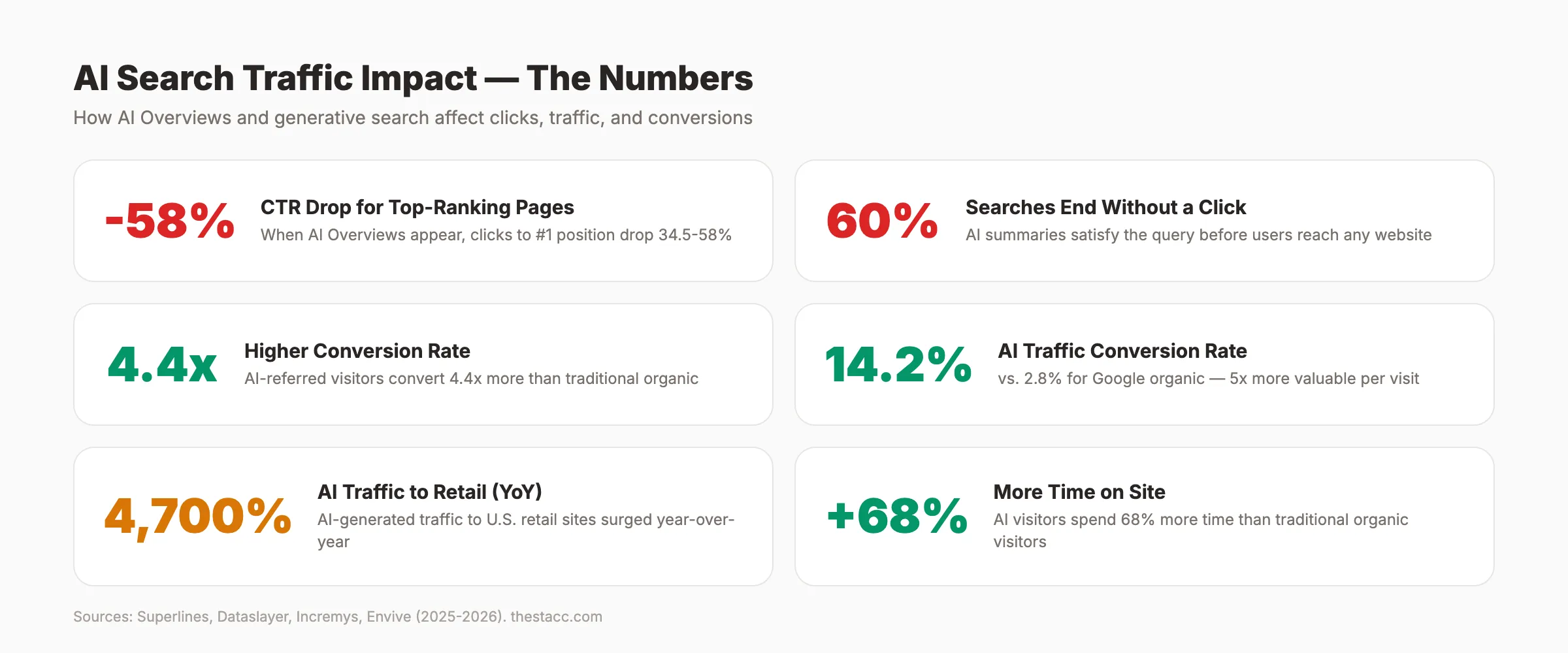
21. AI Overviews reduce clicks to top-ranking pages by 34.5 to 58%. Source: Dataslayer, 2026
22. Click-through rates drop from 15% to 8% when an AI Overview appears. Source: Superlines, 2026
23. 60% of traditional searches now end without a click. AI summaries satisfy the query before users reach a website. Source: Incremys, 2026
24. AI referral traffic accounts for 1.08% of all website traffic and growing 1% monthly. Source: Superlines, 2026
25. ChatGPT drives 87.4% of all AI referral traffic to websites. Source: Superlines, 2026
26. Gartner projects organic search traffic will decline 25% by 2026. The shift to AI-generated answers is the primary driver. Source: Gartner, 2024
27. AI-generated traffic to U.S. retail sites increased 4,700% year-over-year. Source: Envive, 2025
28. Adobe reported a 693% surge in AI referral traffic during the 2025 holiday season. Source: Superlines, 2026
29. 93% of AI search sessions end without an external website click. Source: Superlines, 2026
30. Google AI Overviews now appear in 25.11% of searches, up from 13.14% in March 2025. Source: Superlines, 2026
Content Factors That Drive AI Citations
31. Content with statistics, citations, and quotations achieves 30 to 40% higher AI visibility. Source: Position Digital, 2025
32. Pages updated within 60 days are 1.9x more likely to appear in AI results. Freshness is a critical factor for AI citation. Source: Superlines, 2026
33. FAQ sections earn 4.9 citations on average versus 4.4 without. Source: Superlines, 2026
34. Readable text at grade level 6 to 8 earns 4.6 citations versus 4.0 for grade 11+. Simpler writing gets cited more often by AI. Source: Superlines, 2026
35. Content with 1,500+ words earns more AI citations than shorter content. Source: Superlines, 2026
36. 100 to 150 words per section is the optimal length for AI extraction. Source: Superlines, 2026
37. 44% citation increase with structured data and FAQ blocks. Schema markup directly impacts AI visibility. Source: Superlines, 2026
38. Sites with author schema are 3x more likely to appear in AI answers. Source: Superlines, 2026
39. 85% of AI citations reference content published within the last 2 years. 44% reference content from 2025 specifically. Old content does not get cited. Source: Superlines, 2026
40. Citation density of 2 to 3 data points per 300 words correlates with higher AI mention rates. Source: GenOptima, 2026
41. Domain traffic is the number 1 predictor of AI citations (SHAP score: 0.63). High-traffic sites earn 3x more citations than low-traffic sites. Source: Superlines, 2026
For actionable optimization steps, see our guide on how to get cited by AI search engines.
GEO Market Size and Growth Statistics
42. The GEO market reached $848 million in 2025. Source: Superlines, 2026
43. The GEO market is projected to reach $33.7 billion by 2034 at 50.5% CAGR. Source: Superlines, 2026
44. AI search advertising will grow from $1 billion (2025) to $26 billion (2029). Source: Superlines, 2026
45. Fewer than 12% of marketing teams have a documented GEO strategy. Source: Incremys, 2026
46. 54% of U.S. marketers plan to implement GEO within 3 to 6 months. Source: Superlines, 2026
47. 84% of marketers report measurable traffic changes from AI search. Source: Superlines, 2026
Your SEO team. $99 per month. 30 optimized articles published automatically. Structured for both Google and AI citation. Start for $1 →
Conversion and Value Statistics
48. AI-referred visitors convert 4.4x higher than traditional organic visitors. Source: Incremys, 2026
49. AI traffic converts at 14.2% compared to Google organic at 2.8%. That makes AI traffic 5x more valuable per visit. Source: Superlines, 2026
50. AI visitors spend 68% more time on websites than organic visitors. Source: Superlines, 2026
51. Brands appearing in AI answers experience a 38% click lift on organic results. AI visibility amplifies traditional search performance. Source: Incremys, 2026
52. Brands in AI answers see a 39% increase in paid ad click-through rates. Source: Incremys, 2026
53. GEO delivers an average ROI of $3.71 per $1 invested. Source: Incremys, 2026
For a full breakdown of what GEO is and how it works, see our guide.
AI Crawler and Technical Statistics
54. AI bots have doubled since August 2023. 21 major AI crawlers are now active. Source: Superlines, 2026
55. AI bots contribute 25% of all web requests. Source: Superlines, 2026
56. 5.89% of websites block GPTBot. Most sites still allow AI crawlers access. For optimization guidance, see our AI crawlers guide. Source: Superlines, 2026
57. 92% of ChatGPT agent queries use the Bing Search API. Source: Superlines, 2026
58. 63% of ChatGPT agent visits bounce immediately. Source: Superlines, 2026
59. 70% of AI Overview content changes for the same query between sessions. AI results are highly volatile and inconsistent. Source: Superlines, 2026
60. Only 30% of brands remain visible in back-to-back AI responses. Source: Superlines, 2026
Key Takeaways
- 810 million daily ChatGPT users and 1.5 billion monthly AI Overview users make GEO a required strategy.
- AI citation rates vary by 615x across platforms. Grok cites at 27.01%. ChatGPT at 0.59%. Optimize for each platform separately.
- AI Overviews reduce organic clicks 34.5 to 58%. Traditional CTR is declining fast.
- Content freshness matters. Pages updated within 60 days are 1.9x more likely to appear in AI results.
- AI traffic converts 4.4x higher than traditional organic. Fewer clicks, but each click is far more valuable.
- The GEO market grows at 50.5% CAGR. From $848 million in 2025 to $33.7 billion by 2034.
- Only 12% of marketing teams have a GEO strategy. The opportunity window is wide open.
Methodology
Sources: Superlines AI Search Statistics (2026), Incremys GEO Statistics (2026), First Page Sage AI Chatbot Reports (March 2026), Semrush AI SEO Statistics (2026), TryProfound Citation Patterns (2025), Azoma Citation Analysis (2025), Gartner Search Projections (2024), GenOptima GEO Best Practices (2026), upGrowth AI Traffic Report (Q1 2026).
Last updated: April 2026.
Note: We update this page quarterly to ensure all statistics remain current. When a stat changes, we note the update date.
3,500+ blogs published. 92% average SEO score. See what Stacc can do for your AI visibility. Start for $1 →
FAQ
What is the most important GEO statistic in 2026?
AI traffic converts at 14.2% compared to 2.8% for Google organic. That 5x conversion advantage means fewer total visits but significantly more revenue per visitor. GEO is not about traffic volume. It is about traffic quality.
How often are these GEO statistics updated?
We update this page quarterly. Last updated: April 2026. All statistics include their source and publication year.
Where do these statistics come from?
All statistics come from named, verifiable sources including Superlines, Semrush, Ahrefs, First Page Sage, Gartner, Incremys, and academic research. Each stat includes a direct source link.
What is GEO (Generative Engine Optimization)?
GEO is the practice of optimizing content so AI search engines cite and reference it. Unlike traditional SEO (which targets Google rankings), GEO targets visibility in ChatGPT, Perplexity, Google AI Overviews, and other AI platforms. Learn more in our generative engine optimization guide.
Is GEO replacing traditional SEO?
No. GEO complements SEO. 76.1% of URLs cited in AI Overviews also rank in Google’s top 10. Strong traditional SEO remains the foundation. GEO adds a new visibility layer on top.
How does AI citation differ from traditional search ranking?
80% of URLs cited by AI platforms do not rank in Google’s top 100. AI uses different signals: content structure, freshness, statistics, author authority, and readability. Traditional ranking factors like backlinks matter less for AI citation.
GEO is the fastest-growing segment of search marketing. The data shows it clearly: AI traffic converts higher, the market grows at 50.5% CAGR, and most competitors have no strategy yet. The businesses that act on these statistics now will own AI visibility for years.
Related Statistics

Written by
Siddharth GangalSiddharth is the founder of theStacc and Arka360, and a graduate of IIT Mandi. He spent years watching great businesses lose organic traffic to competitors who simply published more. So he built a system to fix that. He writes about SEO, content at scale, and the tactics that actually move rankings.
30 SEO blog articles published every month
Keyword-optimized, scheduled, and live on your site. Automatically.
30-day trial · Cancel anytime
theStacc
Stop writing SEO content manually
30 blog articles, 30 GBP posts, and social media content. Published every month. Automatically.
Try for free$1 for 3 days · Cancel anytime