
Wikipedia Gets 47.9% of ChatGPT Citations
We analyzed ChatGPT citation data across 230K+ prompts. Wikipedia dominates with 47.9% of top-10 citations. See all findings with charts.
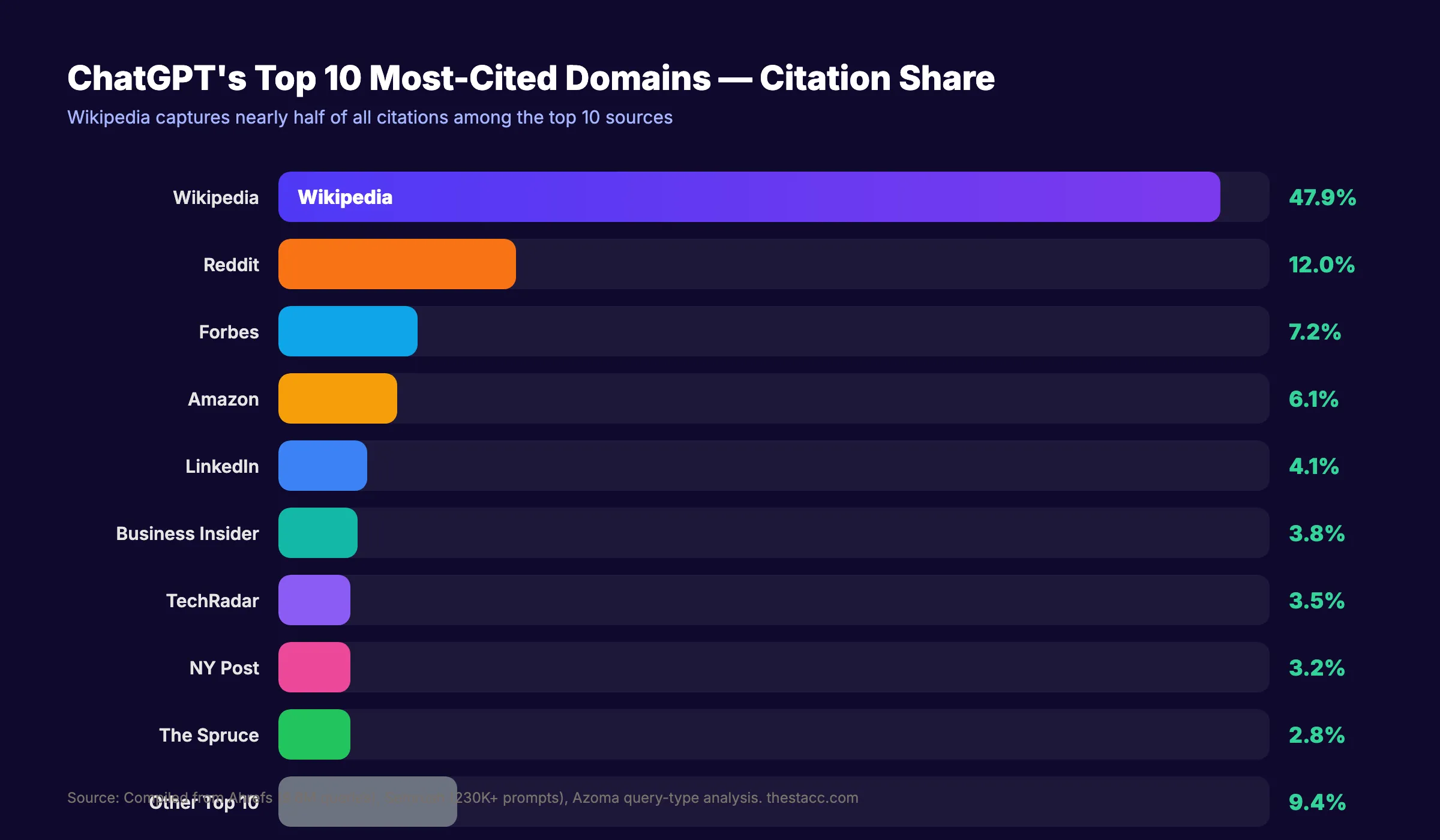
Wikipedia owns nearly half of all top-10 ChatGPT citations. That is 47.9% of the citations from the 10 most-referenced domains in ChatGPT Search, according to data from multiple studies tracking over 230,000 prompts.
If your content strategy depends on AI search visibility, this number should change how you think about authority, content structure, and where you publish.
We analyzed citation data from Semrush, Ahrefs, Search Engine Land, and several independent AI citation studies. This post compiles every finding into a single resource.
We have published 3,500+ blogs across 70+ industries. Our average SEO score is 92%. We track AI citation patterns because they directly affect how search visibility works in 2026.
Here is what you will learn:
- Why Wikipedia dominates ChatGPT citations by a wide margin
- Which other domains rank in the top 10 for AI citations
- How citation patterns shift by query type
- Why 85% of retrieved pages never get cited
- What content traits increase your citation rate
- How to structure your pages for AI extraction
- What this means for your SEO strategy
Key Findings at a Glance
- Wikipedia captures 47.9% of citations among ChatGPT’s top 10 sources
- Reddit is the second most-cited domain but dropped from 60% to 10% of responses in 6 weeks
- Wikipedia dropped from 55% to under 20% of all ChatGPT responses during the study period
- 85% of pages ChatGPT retrieves are never actually cited
- 72.4% of cited posts include an answer capsule (120 to 150 characters after H2)
- 52.2% of cited posts feature original data or proprietary research
- 91% of cited answer capsules contain zero hyperlinks
- 44.2% of all LLM citations pull from the first 30% of text
- Content updated within 30 days gets 3.2x more AI citations
- 67% of ChatGPT’s top 1,000 cited pages are off-limits to marketers
Methodology
Data sources: Semrush 3-month AI citation study (230,000+ prompts, 100M+ citations tracked), Ahrefs Brand Radar database (9.6M ChatGPT queries), Search Engine Land citation traits analysis, and Azoma query-type citation breakdown.
Platforms analyzed: ChatGPT Search, Google AI Mode, Perplexity.
Study period: July to October 2025 (Semrush), with supplementary data from January to March 2026.
What we compiled: Citation frequency by domain, citation volatility over time, content characteristics that correlate with citation selection, and query-type breakdowns across all three platforms.
Finding 1: Wikipedia Captures 47.9% of Top-10 ChatGPT Citations
Wikipedia is not just the most-cited source in ChatGPT. It is the most-cited source by a factor of 4 to 5x over every other domain.
The data: Among ChatGPT’s 10 most-referenced domains, Wikipedia accounts for 47.9% of all citations. The next closest domain (Reddit) captures roughly 12%. That gap is enormous.
For general knowledge queries, the number climbs even higher. Wikipedia captures 43% of all citations on general queries. On commerce-related queries, Wikipedia still holds 22%, despite competing against Amazon (19%) and Reddit (15%).
Why this matters: ChatGPT treats Wikipedia as its default knowledge layer. When the model needs baseline facts, definitions, or context, it reaches for Wikipedia first. This is not random. Wikipedia articles follow a consistent structure: clear definitions at the top, cited sources throughout, neutral tone, and frequent updates.
That structure is exactly what large language models prefer to cite. If your content does not follow a similar pattern, you are already at a disadvantage.
Finding 2: Reddit Is Second but Wildly Unstable
Reddit holds the second position in ChatGPT’s citation hierarchy. But its citation rate is volatile in ways that should concern anyone building a strategy around it.
The data: Reddit appeared in roughly 60% of ChatGPT responses in early August 2025. By mid-September, that number collapsed to around 10%. A drop of 50 percentage points in 6 weeks.
Wikipedia followed a similar pattern. It dropped from 55% of ChatGPT responses to under 20% during the same period.
Why this matters: ChatGPT actively adjusts its citation distribution. The platform appears to deliberately reduce over-reliance on any single source. Semrush confirmed this shift was “isolated to ChatGPT.” Perplexity and Google AI Mode showed far more stable citation patterns.
For SEO professionals, this means AI citation strategies cannot rely on a single platform or domain. The rules change fast.
Stop guessing where AI cites your competitors. Stacc tracks citation patterns and publishes content that AI platforms reference. Start for $1 →
Finding 3: Each AI Platform Cites Different Sources
Not all AI platforms pull from the same sources. The gap between platforms is staggering.
The data:
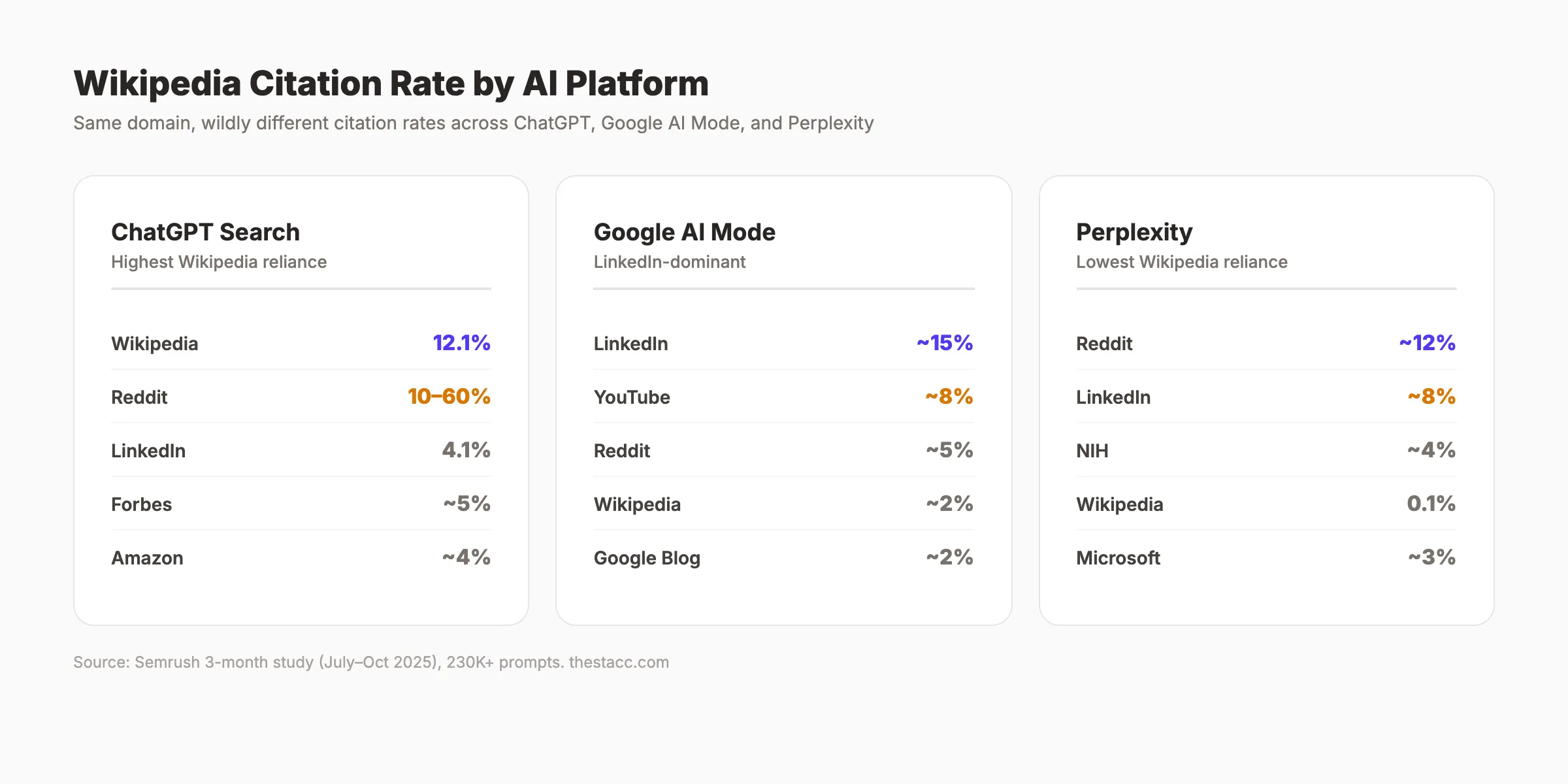
| Domain | ChatGPT | Google AI Mode | Perplexity |
|---|---|---|---|
| Wikipedia | 12.1% of all citations | ~2% of responses | 0.1% or less |
| 10-60% (volatile) | Stable, moderate | Consistent, moderate | |
| 4.1% (900 citations) | ~15% of responses | High and growing | |
| YouTube | Low | High (top 5) | Low |
| Forbes | Doubled after Sept 2025 | Moderate | Low |
Wikipedia citation rates differ by over 100x between engines. ChatGPT uses Wikipedia for 12.1% of its citations. Claude uses it for just 0.1%. Perplexity barely cites Wikipedia at all.
LinkedIn is the second most-cited domain across all three platforms combined, appearing in an average of 11% of AI responses. That makes LinkedIn profiles and articles an underrated content distribution channel.
Why this matters: A page optimized for ChatGPT citations may perform differently on Perplexity or Google AI Mode. Each platform has its own source preferences, retrieval logic, and re-ranking algorithms.
Finding 4: 85% of Retrieved Pages Never Get Cited
ChatGPT retrieves far more pages than it actually cites. The gap between retrieval and citation is massive.
The data: 85% of pages that ChatGPT retrieves during a search query are never cited in the final response. Your page can rank well on Google, get pulled into ChatGPT’s retrieval process, and still never appear as a citation.
Only 18% of ChatGPT conversations trigger a web search at all. Of those, the first message in a conversation is 2.5x more likely to trigger citations than the 10th message. By the 20th turn, citation probability drops to one-quarter of the first-turn rate.
Why this matters: Getting indexed is not enough. Getting retrieved is not enough. Your content must pass ChatGPT’s internal re-ranking filter, which evaluates relevance, authority, and structural clarity before selecting which pages to actually cite.
The retrieval-to-citation gap means that traditional SEO ranking factors are necessary but not sufficient for AI visibility.
Finding 5: Answer Capsules Are the Strongest Citation Signal
The single most common trait among cited pages is a specific content structure called an answer capsule.
The data: 72.4% of blog posts cited by ChatGPT include an identifiable answer capsule. An answer capsule is a concise, self-contained explanation of 120 to 150 characters placed directly after a title or H2 heading framed as a question.
The strongest combination: an answer capsule paired with original data. 34.3% of all cited posts include both elements.
Why this matters: LLMs scan for clear, extractable answers. An answer capsule gives the model exactly what it needs: a standalone statement it can quote without pulling from surrounding context. Think of it as a featured snippet optimized for AI instead of Google.
Here is what an answer capsule looks like in practice:
H2: How many blog posts should you publish per month?
Answer capsule: Most businesses that rank on page 1 publish 11 to 16 blog posts per month. Companies publishing 16+ posts get 3.5x more traffic than those publishing 4 or fewer.
That format. Question heading, direct answer, supporting stat. Is what ChatGPT prefers to cite.
Finding 6: Original Data Doubles Your Citation Rate
Pages with proprietary research or original data get cited at more than double the rate of pages without it.
The data: 52.2% of pages cited by ChatGPT feature either original data or branded proprietary insights. This includes surveys, benchmarks, case studies, and proprietary metrics.
Original data is the second-strongest differentiator after answer capsules. Pages that combine original data with answer capsules represent the highest-performing content format for AI citations.
Why this matters: If every competitor is writing “Top 10 SEO Tips” from the same recycled advice, none of those pages stand out to an LLM. Original research creates a unique data point that the model cannot find elsewhere. That exclusivity drives citation selection.
This is exactly why data studies and original research earn 50 to 200+ backlinks. The same principle now applies to AI citations.
Your SEO team. $99 per month. 30 optimized articles published automatically. Each one structured for traditional search and AI citation. Start for $1 →
Finding 7: Links Inside Answer Capsules Kill Citation Rates
Hyperlinks inside the extractable text block reduce citation likelihood by a massive margin.
The data: 91% of cited answer capsules contain zero hyperlinks. Only 5.2% included internal links alone. External-only links appeared in 3.5% of cases. Combined internal and external links: under 1%.
Why this matters: LLMs treat hyperlinked text as navigational content, not as a standalone knowledge unit. When your opening paragraph or answer capsule is loaded with links, the model skips over it in favor of cleaner, self-contained blocks.
The fix is simple. Keep your answer capsules link-free. Move all internal links and external references to supporting paragraphs below the capsule. Let the first 150 characters of each section stand alone.
Finding 8: 44.2% of Citations Come from the First 30% of Text
ChatGPT does not read your entire article equally. It heavily favors the top of the page.
The data: 44.2% of all LLM citations pull text from the first 30% of an article. That means your opening section, first H2, and initial supporting paragraphs carry disproportionate weight.
Content updated within 30 days receives 3.2x more Perplexity citations (82% citation rate) and a 76.4% citation rate from ChatGPT. Pages older than 3 months see sharp citation dropoffs.
Why this matters: Front-load your strongest claims, data points, and answer capsules. Do not bury your best insight in section 7. Put it in section 1. The content structure that works for traditional SEO (hook, context, depth) also works for AI, but the weighting toward the top is even more extreme.
Freshness matters just as much. Regular content updates are no longer optional if you want AI citation visibility.
Finding 9: 67% of Top Citations Are Off-Limits to Marketers
Most of ChatGPT’s highest-cited pages cannot be replicated or competed with by marketers.
The data: 67% of ChatGPT’s top 1,000 cited pages belong to domains like Wikipedia, government sites, academic institutions, and major news publications. These are sources that individual businesses and marketers cannot directly influence or publish on.
The remaining 33% includes platforms like Reddit, LinkedIn, G2, and independent blogs. That 33% is the competitive space where content strategy actually matters.
Why this matters: You are not competing against Wikipedia for AI citations. You are competing against other businesses for the 33% of citations that come from accessible platforms.
The winning strategy is twofold:
- Get your brand mentioned on high-authority platforms AI already trusts (Reddit, G2, LinkedIn, industry publications)
- Structure your own site content for maximum citation probability using answer capsules, original data, and clean formatting
Both strategies require consistent, high-quality content. That is the same principle behind topical authority in traditional SEO.
3,500+ blogs published. 92% average SEO score. See what Stacc can do for your site. Start for $1 →
Finding 10: Query Type Changes Everything
Wikipedia dominance is not uniform across all queries. The type of question a user asks shifts the citation distribution dramatically.
The data:
| Query Type | Wikipedia | Amazon | YouTube | |
|---|---|---|---|---|
| General knowledge | 43% | 12% | 2% | 5% |
| Commerce/shopping | 22% | 15% | 19% | 2% |
| Technical/how-to | ~15% | ~25% | <1% | ~10% |
For general queries, Wikipedia captures 43% of citations. For commerce queries, Amazon jumps to 19% while Wikipedia drops to 22%. Reddit gains ground on product-related questions (15%) where community discussions and reviews carry more weight.
Why this matters: Your citation optimization strategy should match the query intent you target.
- Informational content: Compete with Wikipedia’s structure. Use clear definitions, neutral tone, cited sources.
- Commercial content: Ensure your brand appears on Amazon, G2, Reddit, and review platforms.
- Technical content: Reddit and community forums dominate. Publish detailed how-to content with step-by-step formatting.
What This Means for Your SEO Strategy
The Wikipedia citation data reveals 5 actionable shifts every business should make.
1. Structure content like Wikipedia, not like a sales page.
Wikipedia articles open with a clear definition. They use consistent heading hierarchy. They cite external sources. They update frequently. Every one of these traits correlates with higher AI citation rates.
Apply the same principles: put your clearest answer in the first 150 characters of each section. Use schema markup to help AI understand your content structure. Keep sections self-contained.
2. Create original data and proprietary research.
With 52.2% of cited pages featuring original data, this is not optional. Run surveys. Publish case studies with real numbers. Track industry benchmarks. Create the data points that LLMs cannot find on Wikipedia.
3. Update content every 30 days.
The 3.2x citation boost for fresh content is too large to ignore. Build a content calendar that includes regular updates to your highest-performing pages. Add new data, refresh statistics, and update dates.
4. Get mentioned on platforms AI trusts.
You cannot compete with Wikipedia directly. But you can get your brand mentioned on Reddit, LinkedIn, G2, and industry publications. Authoritative list mentions are the single most influential factor in ChatGPT’s recommendation algorithm. Brands in the top 3 to 5 positions on high-authority list articles get cited by ChatGPT in over 80% of relevant queries.
5. Remove links from answer capsules.
Audit your top 100 pages. Find the opening statement after each H2. If it contains hyperlinks, move them below. Let the first 120 to 150 characters stand alone as a clean, link-free answer block.
FAQ
Does Wikipedia actually get 47.9% of ChatGPT citations?
Yes. Among ChatGPT’s 10 most-referenced domains, Wikipedia captures 47.9% of citations. For all ChatGPT citations (not just top 10), Wikipedia accounts for 7.8% to 12.1% depending on the study and time period.
Why does ChatGPT cite Wikipedia so much?
Wikipedia articles follow a structure that LLMs prefer: clear definitions at the top, neutral tone, cited sources, consistent formatting, and frequent updates. This structure makes Wikipedia content easy for AI to extract and reference with confidence.
Can my website compete with Wikipedia for AI citations?
Not directly. 67% of top ChatGPT citations go to domains like Wikipedia, government, and academic sites. But the remaining 33% comes from accessible platforms. Structure your content with answer capsules, original data, and clean formatting to compete in that space.
What is an answer capsule?
An answer capsule is a 120 to 150 character self-contained explanation placed directly after a question-based H2 heading. 72.4% of pages cited by ChatGPT use this format. It gives the AI a clean block of text to extract and quote.
How often should I update content for AI citations?
Content updated within 30 days gets 3.2x more AI citations than older content. Pages older than 3 months see sharp citation drops. Monthly updates to your highest-traffic pages should be part of your content strategy.
Do different AI platforms cite different sources?
Yes. Wikipedia appears in 12.1% of ChatGPT citations but only 0.1% of Claude citations. LinkedIn is the second most-cited domain across all three major platforms. Each AI search engine has distinct source preferences and ranking logic.
Wikipedia owns the AI citation game today. That will not change soon. But the data shows a clear path for businesses: structure content for extraction, publish original research, maintain freshness, and build presence on the platforms AI already trusts.
The companies that treat AI citation optimization as a core SEO activity in 2026 will own the visibility that matters most in 2027.
Rank everywhere. Do nothing. Blog SEO, Local SEO, and Social on autopilot. Start for $1 →

Written by
Siddharth GangalSiddharth is the founder of theStacc and Arka360, and a graduate of IIT Mandi. He spent years watching great businesses lose organic traffic to competitors who simply published more. So he built a system to fix that. He writes about SEO, content at scale, and the tactics that actually move rankings.
30 SEO blog articles published every month
Keyword-optimized, scheduled, and live on your site. Automatically.
30-day trial · Cancel anytime
theStacc
Stop writing SEO content manually
30 blog articles, 30 GBP posts, and social media content. Published every month. Automatically.
Try for free$1 for 3 days · Cancel anytime