
Google Discover: The Complete Optimization Guide (2026)
How to get traffic from Google Discover. Covers image requirements, E-E-A-T, content strategy, and the Feb 2026 update. With data from 400+ publisher sites.
Siddharth Gangal • 2026-03-30 • SEO Tips
In This Article
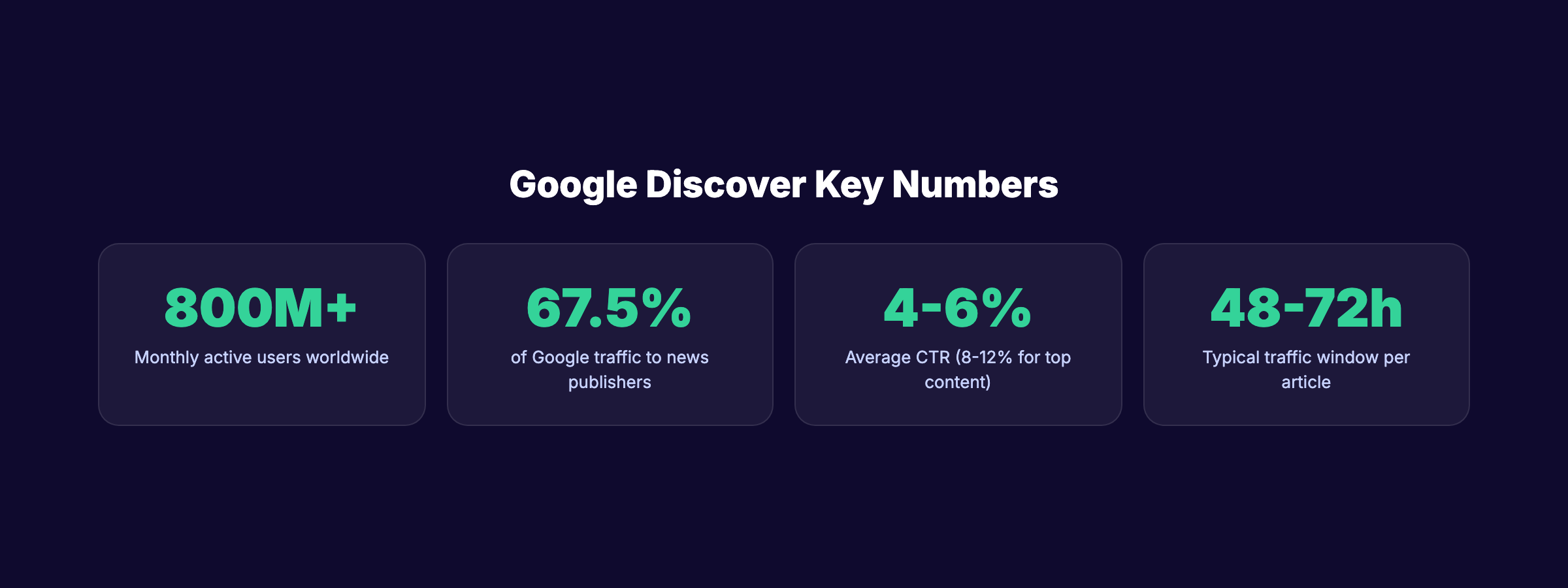
Google Discover sends 800 million users a personalized feed of articles, videos, and stories every month. For publishers, it has become the dominant Google traffic source. Discover now accounts for 67.5% of Google traffic to news publishers, according to Press Gazette’s analysis of 400+ sites. Traditional Google Search traffic dropped from 51% to 27% in the same period.
Most businesses ignore Discover entirely. They optimize for search queries and keywords. Discover works differently. It surfaces content based on user interests, not search queries. A user never types a keyword. Google predicts what they want to read and serves it in their mobile feed.
This Google Discover optimization guide covers how the feed works, what triggers inclusion, the technical requirements, content strategies that earn consistent traffic, and how to handle the volatility that comes with Discover.
We publish 3,500+ articles across 70+ industries every month. Discover traffic patterns inform how we structure content and choose topics.
Here is what you will learn:
- How Google Discover differs from Search and why it matters
- The technical requirements that determine eligibility
- Content strategies that earn Discover placements consistently
- Image optimization that drives up to 79% higher CTR
- How to interpret and recover from traffic drops
- The February 2026 Discover Core Update and its impact
Chapter 1: What Is Google Discover and How Does It Work?
Google Discover is a personalized content feed that appears on the Google mobile app, Chrome mobile homepage, and google.com on mobile. It shows users articles, videos, and Web Stories based on their browsing history, search activity, location, and stated interests.
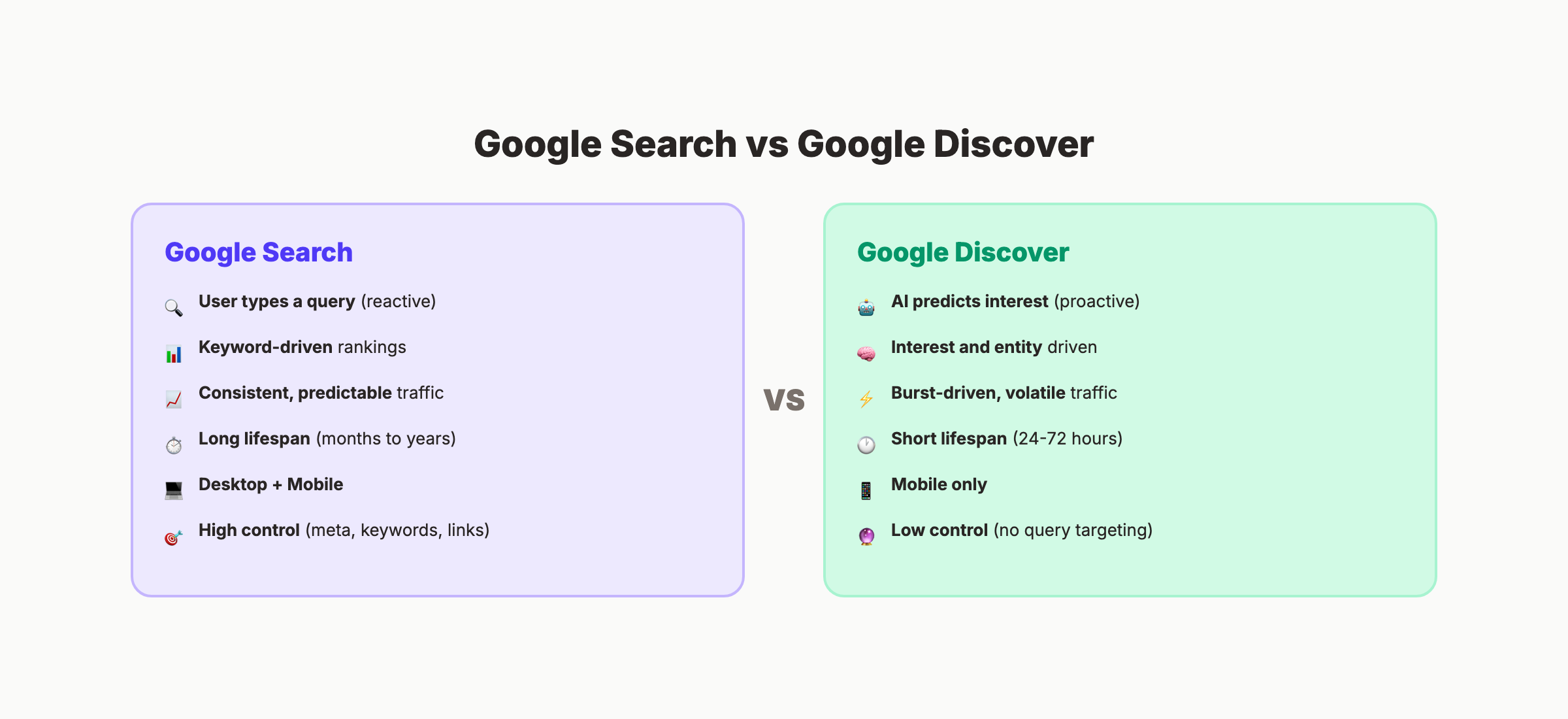
Discover vs Search: The Key Differences
| Feature | Google Search | Google Discover |
|---|---|---|
| Trigger | User types a query | AI predicts user interest |
| Intent | Explicit search intent | Predicted interest |
| Keywords | Keyword-driven rankings | Interest and entity-driven |
| Traffic pattern | Consistent, predictable | Burst-driven, volatile |
| Content lifespan | Months to years | 24-72 hours typically |
| Platform | Desktop and mobile | Mobile only |
| Control | High (keywords, meta, links) | Low (no query targeting) |
| Algorithm | Separate since Feb 2026 | Separate since Feb 2026 |
The biggest difference: Discover traffic is proactive. Users do not search for anything. Google decides what to show based on signals like past reading behavior, topic interest graphs, and content freshness.
How Google Selects Content for Discover
Google uses machine learning to match content to individual user interests. The system evaluates:
Entity recognition. Google identifies the topics, people, places, and events in your content. It matches those entities to users who have demonstrated interest in them.
Content quality signals. E-E-A-T (Experience, Expertise, Authoritativeness, Trustworthiness) determines whether your content meets the quality bar. Discover has a higher quality threshold than regular search.
Engagement signals. Click-through rate, time on page, and interaction patterns from users who have already seen the content influence whether Google shows it to more users.
Freshness. Discover favors recently published content. Most Discover traffic arrives within 48-72 hours of publication. Coverage published on day one of a trending topic outperforms late coverage by 5-10x.
Understanding how AI search is changing SEO gives useful context. Discover is one of the earliest examples of AI-driven content distribution replacing keyword-based search.
Chapter 2: Technical Requirements for Google Discover
Google Discover has specific technical requirements. Missing any of these can prevent your content from appearing.
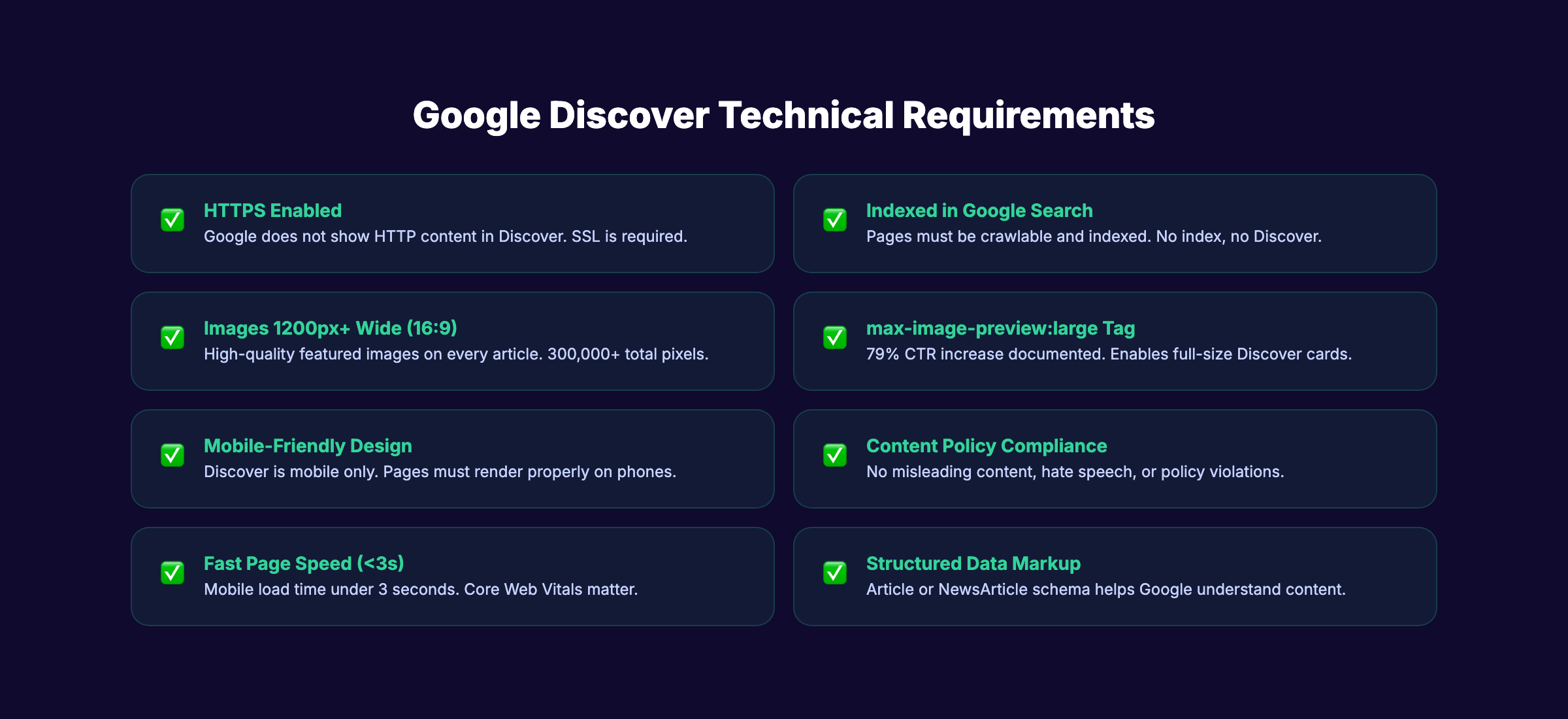
Mandatory Requirements
- HTTPS enabled. Google does not show HTTP content in Discover. SSL is non-negotiable.
- Indexed in Google Search. Your pages must be crawlable and indexed. If Google cannot find your page through normal search, it will not appear in Discover.
- Content policies met. Your content must comply with Google’s Discover content policies. No misleading content, hate speech, violence, or sexually explicit material.
- Mobile-friendly design. Discover is mobile only. Your pages must load and display properly on mobile devices.
Image Requirements
Images are critical for Discover. They directly affect click-through rates.
| Requirement | Specification |
|---|---|
| Minimum width | 1,200 pixels |
| Recommended aspect ratio | 16:9 |
| Minimum total pixels | 300,000+ (e.g., 1280x720) |
| Meta tag | max-image-preview:large in robots meta |
| Format | JPEG, PNG, or WebP |
The max-image-preview:large meta tag tells Google it can display your images at full size in Discover cards. Without it, Google may show a small thumbnail or no image at all.
Add this to your page <head>:
<meta name="robots" content="max-image-preview:large">Google’s own case study shows the impact: Kirbie’s Cravings saw a 79% CTR increase after implementing this tag. Istoé saw a 332% click increase over 6 months.
Recommended Technical Setup
- High-quality featured images on every article (1200px+ wide, 16:9)
-
max-image-preview:largemeta tag site-wide - Fast page load times (under 3 seconds on mobile)
- Structured data markup (schema markup for Article or NewsArticle)
- Clean URL structure
- AMP or standard web pages (AMP is no longer required but still supported)
For a full technical audit, see our on-page SEO guide which covers the foundational elements that Discover also evaluates.
Stop writing. Start ranking. Stacc publishes 30 SEO articles per month for $99. Optimized for both Search and Discover. Start for $1 →
Chapter 3: Content Strategy for Google Discover
Discover rewards different content than Search. The strategies that work for keyword-targeted SEO do not always translate.
What Performs Best on Discover
Trending topics covered early. Discover prioritizes freshness. Publishing on a trending topic within hours of it breaking generates 5-10x more impressions than covering it days later.
Strong emotional hooks. Headlines that trigger curiosity, surprise, or urgency earn higher CTR. “What Happened When We Published 30 Articles in 30 Days” outperforms “Content Marketing Guide 2026” in Discover.
Visual-heavy content. Articles with multiple high-quality images perform better. The featured image determines whether someone taps or scrolls past. Invest in compelling visuals.
Topics aligned with established authority. Discover rewards sites that cover topics consistently within their niche. A dental practice website publishing about dentistry will surface in Discover for dental topics. The same site publishing about cryptocurrency will not.
Headlines That Drive Discover CTR
Discover headlines function more like social media headlines than search-optimized title tags. The goal is curiosity, not keyword matching.
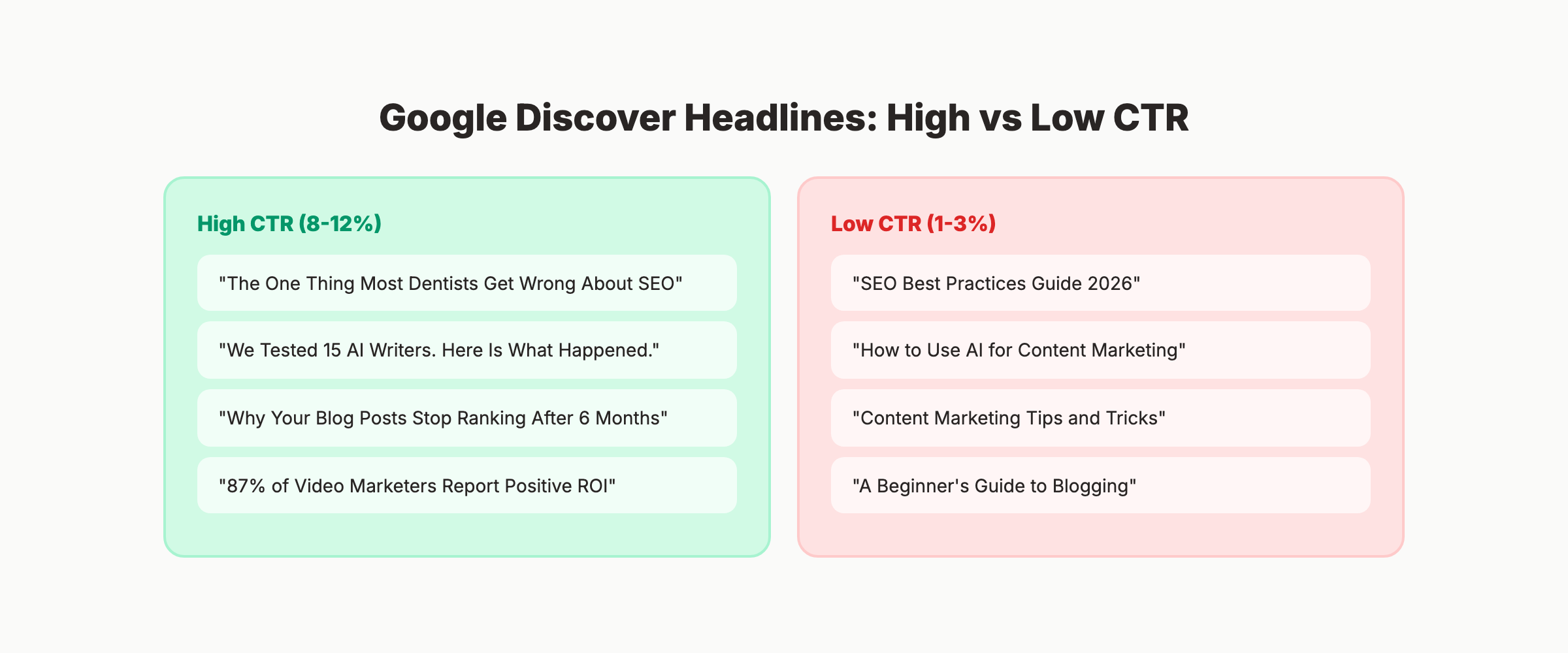
| High-Performing Pattern | Low-Performing Pattern |
|---|---|
| ”The One Thing Most [Industry] Businesses Get Wrong" | "[Industry] Best Practices Guide" |
| "We Tested [X]. Here Is What Happened." | "How to Use [X] for [Y]" |
| "Why [Common Belief] Is Actually Costing You Money" | "[Topic] Tips and Tricks" |
| "[Specific Number]: What the Data Shows" | "[Topic] 101: A Beginner’s Guide” |
The optimal headline length for Discover is 40-60 characters. Longer headlines get truncated on mobile cards.
Avoid clickbait. Google’s content policies explicitly penalize misleading headlines. The headline must accurately represent the content. Headlines that overpromise and underdeliver get suppressed in future Discover placements.
Content Types That Work
News and current events. Timely coverage of industry news performs well because freshness is a strong Discover signal.
Data-driven articles. Posts with original statistics, survey results, or analysis earn engagement. Our content marketing statistics page is an example of the format that Discover surfaces consistently.
How-to content with strong visuals. Step-by-step guides with images at each step earn longer dwell times. Longer dwell time signals quality to Discover’s algorithm.
Listicles with depth. “10 things” articles perform well when each item has genuine depth. Shallow listicles get suppressed.
Web Stories. Over 20 million Web Stories exist online. One case study documented 2.2 million visits from Web Stories in 6 months. Stories that appear in Discover can drive traffic for up to 4 days.
Publishing Frequency
Discover rewards consistent publishing. Sites that publish daily or multiple times per week build stronger signals than those publishing weekly or monthly.
This aligns with content velocity data from search SEO. More high-quality content published more frequently builds stronger topical authority signals.
Chapter 4: E-E-A-T and Why It Matters More for Discover
Google applies a higher quality bar to Discover than to regular search. The E-E-A-T framework (Experience, Expertise, Authoritativeness, Trustworthiness) directly determines whether your content qualifies.
Experience
Google wants content from people with first-hand knowledge. A dentist writing about dental procedures has experience. A marketing agency writing about dental procedures does not.
Include personal observations, case studies, and real examples that demonstrate direct experience with the topic.
Expertise
Every article should have a named author with relevant credentials. Create author profile pages that list qualifications, experience, and published work.
Cover topics within your established niche. Topical authority is a strong signal for both Search and Discover. Publishing broadly across unrelated topics weakens your authority signal.
Authoritativeness
Build authority through consistent, in-depth coverage of your topic area. Earn mentions and links from other authoritative sources.
Ensure your site has:
- An About page explaining who you are
- A Contact page with real contact information
- An Editorial Policy page describing your content standards
- Author bylines linking to author profile pages
Trustworthiness
HTTPS is required. Factual accuracy is expected. Google suppresses content that contains misleading claims, unsupported statistics, or sensationalized framing.
Cite your sources. Link to original research. Correct errors promptly. These signals build trust with both readers and the algorithm.
Your SEO team. $99 per month. 30 optimized articles, published automatically. Built for Search and Discover. Start for $1 →
Chapter 5: Image Optimization for Google Discover
Images determine whether users tap on your content or scroll past. Discover is a visual feed. Your featured image is the primary engagement driver.
The Data on Image Impact
| Metric | Impact |
|---|---|
CTR increase with max-image-preview:large | 79% (Kirbie’s Cravings) |
| Click increase over 6 months | 332% (Istoé) |
| CTR increase with 1200px+ images | 45% vs smaller images |
| Dwell time increase | 5% with large, high-quality images |
Source: Google Search Central Case Study
Image Best Practices
Use original, high-quality photos. Stock images underperform original photography. Custom graphics and data visualizations also perform well.
Feature a person or face when relevant. Images with faces earn higher engagement rates in feeds. Product images work well for ecommerce content.
Fill the frame. Avoid images with excessive white space or text overlays. The image should be visually compelling at thumbnail size on a mobile screen.
Optimize file size without sacrificing quality. Large images should load quickly. Use WebP format for the best quality-to-size ratio. Aim for under 200KB per image while maintaining 1200px+ width.
Our image SEO guide covers the full technical optimization for images across Search and Discover.
Chapter 6: The February 2026 Discover Core Update
February 2026 marked a turning point. Google announced the first core update targeting Discover specifically. Previously, Discover was affected by regular core updates. Now it has its own algorithm trajectory.
What Changed
The update rolled out between February 5-27, 2026. Google stated the update focused on “improving the relevance and quality of content shown in Discover feeds.”
Key observed changes:
- Sites with strong E-E-A-T signals gained visibility
- Content with high engagement metrics (CTR, dwell time) was prioritized
- Sites publishing outside their established topical area lost Discover traffic
- Clickbait-style headlines received stronger suppression
The March 2026 Serving Bug
Shortly after the core update, a serving bug in March 2026 caused 60-80% impression drops for thousands of publishers. Some sites went from 300,000 daily impressions to near-zero within 48 hours.
Google acknowledged the bug but did not provide a specific timeline for resolution. The incident highlighted Discover’s volatility and the risk of relying on it as a primary traffic source.
How to Recover from Discover Traffic Drops
If your Discover traffic drops suddenly:
- Check Search Console’s Discover report for impression and click trends
- Look for manual actions in Security & Manual Actions
- Audit recent content for quality issues (thin content, clickbait, policy violations)
- Verify technical requirements (images,
max-image-preview:large, mobile-friendliness) - Review your E-E-A-T signals (author pages, About page, editorial standards)
- Wait and monitor. Some drops are algorithmic cycles that self-correct within 2-4 weeks
Google’s official guidance on debugging traffic drops applies to Discover as well.
Chapter 7: Measuring Google Discover Performance
Google Search Console provides a dedicated Discover report. Access it under Performance > Discover.
Key Metrics
Impressions. How many times your content appeared in Discover feeds. High impressions with low clicks signal weak headlines or images.
Clicks. How many times users tapped on your content. Track total clicks and clicks per article to identify top performers.
CTR (Click-Through Rate). Average CTR for Discover is 4-6%. High-performing content achieves 8-12%. If your CTR is below 4%, improve your headlines and images.
Top pages. Identify which articles earn the most Discover impressions. Analyze what they have in common (topic, format, image style, headline pattern) and replicate those patterns.
Limitations of Discover Reporting
- The Discover report only appears if your site meets a minimum impression threshold
- Data is available for only 16 months
- You cannot filter by country, device, or specific Discover placement
- Discover data is separate from Search data in Search Console
Setting Realistic Expectations
Google explicitly states that Discover traffic is “less predictable or dependable” than search. Treat Discover as supplemental traffic. Build your primary strategy around SEO content writing and keyword-targeted search. Discover traffic is a bonus, not a foundation.
For teams publishing at scale, automating blog publishing ensures consistent output. Consistency helps build the topical authority signals that Discover rewards.
3,500+ blogs published. 92% average SEO score. See what Stacc can do for your Search and Discover traffic. Start for $1 →
Chapter 8: Google Discover for Non-News Sites
Most Discover guidance targets news publishers. But non-news sites can earn Discover traffic with the right approach.
E-Commerce Sites
Product roundups, buying guides, and trend pieces can surface in Discover. The content needs editorial depth, not just product specs. “The 10 Best Running Shoes for Flat Feet (Tested)” works. A bare product category page does not.
High-quality product photography with lifestyle context performs better than white-background product shots in Discover cards.
Local Businesses
Local content can appear in Discover feeds for users in your geographic area. Event coverage, local guides, and community stories earn placements.
A restaurant publishing about local food trends or seasonal menu launches can earn Discover traffic. A law firm publishing about notable local cases can too. The key is editorial content that serves user interest, not promotional content that serves the business.
For local businesses, combining Discover-optimized content with Google Business Profile optimization creates visibility across both Discover and Maps.
SaaS and B2B Companies
Data studies, industry reports, and original research perform well for B2B sites. Discover surfaces content that teaches users something new or presents data they have not seen before.
Your content marketing strategy should include at least 2-3 Discover-optimized pieces per month alongside your keyword-targeted content.
FAQ
What is Google Discover?
Google Discover is a personalized content feed on the Google mobile app and Chrome mobile homepage. It shows articles, videos, and Web Stories based on user interests and browsing behavior. Unlike Search, users do not type a query. Google predicts what they want to read. It reaches 800 million+ users monthly.
How do I get my content on Google Discover?
Meet the technical requirements (HTTPS, indexed, mobile-friendly, 1200px+ images with max-image-preview:large). Publish high-quality content within your established niche. Build E-E-A-T signals. There is no way to submit content directly. Google selects content algorithmically.
How is Google Discover different from Google Search?
Search responds to user queries. Discover proactively surfaces content based on predicted interests. Search traffic is consistent and keyword-driven. Discover traffic is burst-driven and volatile (24-72 hour windows). Since February 2026, Discover and Search run on separate algorithms.
Why did my Google Discover traffic drop?
Common causes: algorithm updates (February 2026 Discover Core Update), serving bugs (March 2026), content quality issues, publishing outside your topical niche, or changes in user interest patterns. Check Search Console for data, audit your recent content, verify technical requirements, and wait 2-4 weeks for algorithmic cycles to stabilize.
Does Google Discover work on desktop?
No. Google Discover is mobile-only. It appears on the Google app for iOS and Android, the Chrome mobile homepage, and google.com on mobile browsers. Desktop users do not see a Discover feed.
How long does content stay in Google Discover?
Most Discover traffic arrives within 48-72 hours of publication. The typical content lifespan is 24-48 hours. Evergreen content occasionally resurfaces, but Discover strongly favors fresh publications. This is why consistent publishing frequency matters.
Google Discover is the largest source of Google traffic for publishers and a growing channel for every content-producing business. It rewards quality, freshness, strong images, and topical authority. It does not reward keyword stuffing, clickbait, or thin content. Build your primary strategy around search SEO. Add Discover optimization on top. The sites that do both will capture traffic from users who are searching and users who are browsing.
Written and published by Stacc. We publish 3,500+ articles per month across 70+ industries. All data verified against public sources as of March 2026.
