Everything you need to know about GTM AI platforms in 2026 — the 5-layer stack, top vendors compared, evaluation criteria, common pitfalls, and a 90-day rollout plan.
A GTM AI platform is the software layer that unifies go-to-market data, decides what action each account needs, and executes it across outbound, marketing, and sales tooling. Most stacks have five layers: data, enrichment, signals, orchestration, and execution. Buying the execution layer without the data layer is the usual failure.
It is the same mistake teams make when they automate publishing without a content strategy behind it.
By Q3 2026, 60% of B2B revenue teams will operate at least one autonomous GTM agent in production. Most will still be losing money on it.
That is not a vendor problem. It is a stack problem.
A GTM AI platform is not Clay plus a chatbot plus a renamed marketing automation tool. It is a connected system across five layers — signal, data, content, orchestration, and attribution — that turns buying intent into revenue with as little human handoff as possible. Teams that treat it as a single product purchase end up with five disconnected agents writing the same email to the same buyer at three different cadences.
We publish 3,500+ SEO articles every month across 70+ industries, and a growing share of those articles plug into the content engine inside a GTM AI workflow. From that vantage point, we have watched B2B teams stand up these platforms — and we have watched a lot of them stall in month two. This guide walks through every layer of the stack, every category of vendor, and the framework we use to score whether a platform is worth a 12-month commitment.
Here is what you will learn:
- What a GTM AI platform actually is (and what marketers keep confusing it with)
- The 5-Layer GTM AI Stack — the framework that maps the entire category
- Which teams actually need a GTM AI platform in 2026 (and which are wasting money)
- Side-by-side comparison of Common Room, Clay, 6sense, Demandbase, Apollo, Gong, Salesforce Einstein, ZoomInfo, and HubSpot Breeze
- The 7-point evaluation framework we use before recommending any platform
- The five buyer mistakes that wreck most rollouts
- A 30-60-90 day implementation roadmap you can copy
Table of Contents
- What Is a GTM AI Platform?
- Chapter 2: The 5-Layer GTM AI Stack
- Chapter 3: Who Actually Needs a GTM AI Platform
- Chapter 4: The Top GTM AI Platforms in 2026
- Chapter 5: The 7-Point Evaluation Framework
- Chapter 6: The 5 Pitfalls That Wreck Rollouts
- Chapter 7: The 30-60-90 Day Implementation Roadmap
- Chapter 8: FAQs
What Is a GTM AI Platform?
A GTM AI platform is a connected system that uses artificial intelligence to detect buying signals, enrich customer data, generate outbound content, orchestrate multi-channel outreach, and measure pipeline impact across sales, marketing, and RevOps from a single operating layer.
It replaces the stitched-together "Frankenstack" of disconnected point tools by sitting on top of a unified data model and running agentic workflows that move accounts from intent to closed-won with minimal manual hand-off.
The short answer: A GTM AI platform is the operating system for modern revenue teams. It is not one tool. It is a layered architecture that combines signal data, CRM data, content generation, outreach orchestration, and attribution under a single agent-driven workflow.
Why the category exists now
Traditional GTM stacks were built for a buyer who responded to a form fill. That buyer is gone. According to ZoomInfo's 2026 research, B2B buyers complete 67% of their research before ever talking to a vendor. They visit the website, attend a webinar, ask ChatGPT, read a Reddit thread, and then quietly compare three providers — all without filling out a form. Static segmentation and rule-based automation cannot catch them. Agentic AI can.
The shift is also driven by cost. A 2025 study from McKinsey found that GTM teams using AI agents to handle research, enrichment, and first-touch outreach reduced cost-per-qualified-meeting by 41% compared to fully human SDR teams. That gap widens every quarter as agents get better.
What a GTM AI platform is not
It is not a chatbot. It is not "ChatGPT for sales." It is not marketing automation with a new logo. And it is not a single SDR agent like 11x.ai or Artisan in isolation.
Key takeaways:
- Multi-layer system, not a single tool: A real GTM AI platform spans signal data, CRM data, content engine, orchestration, and analytics — five layers, not one.
- Agentic, not rule-based: The platform makes decisions about who to contact, when, and with what message. Rules-based marketing automation does none of this.
- Connected, not bolted on: Every layer reads from and writes to the same data model. If your vendor cannot show you that diagram on a whiteboard, it is not a platform.
Chapter 2: The 5-Layer GTM AI Stack
Most buyers ask "which GTM AI platform should I buy?" before they understand what they are buying. That question has no useful answer. The right question is: which layer of the stack are you trying to solve first?
We have studied 40+ vendor architectures and reverse-engineered them into a single framework. We call it the 5-Layer GTM AI Stack.
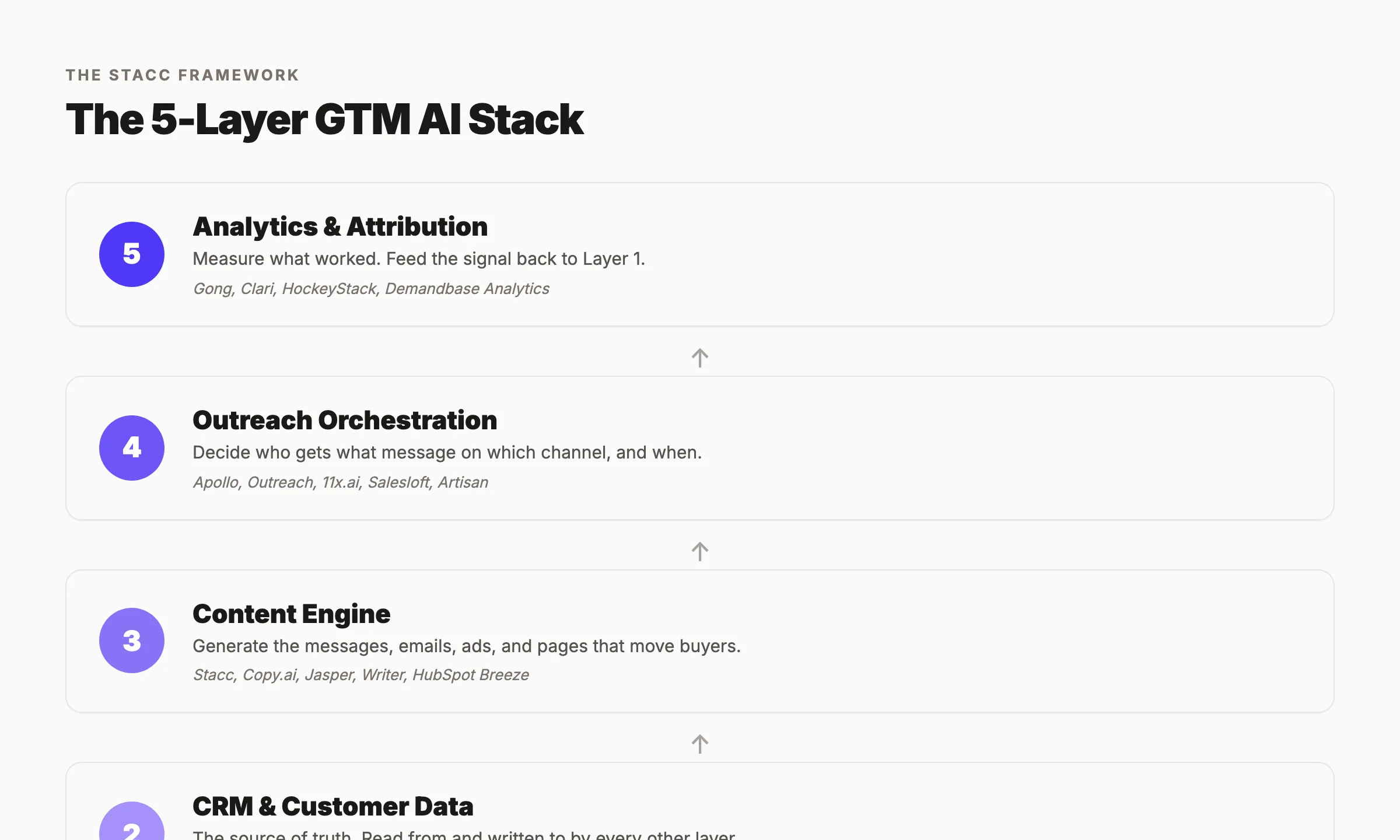
The 5-Layer GTM AI Stack
Layer 1 — Signal & Intent Data: Detect who is in-market right now. Layer 2 — CRM & Customer Data: Store the source of truth and enrich it continuously. Layer 3 — Content Engine: Generate the messages, emails, ads, and pages that move buyers. Layer 4 — Outreach Orchestration: Decide who gets what message on which channel, and when. Layer 5 — Analytics & Attribution: Measure what worked and feed that signal back to Layer 1.
Each layer feeds the one above it. Break a layer and the layers above produce noise. Most failed rollouts skip Layer 1 entirely and try to scale outreach on top of a broken data foundation. That always ends the same way.
Layer 1 — Signal and intent data
This is the input layer. It captures the behavioral evidence that a buyer is moving toward a purchase. Signals come from many sources: third-party intent data (Bombora, G2 buyer intent), first-party website visits, community activity (LinkedIn, Slack, Reddit, Discord), product usage, job changes, and AI search queries against branded keywords.
Vendors in this layer include Common Room, 6sense, Bombora, G2, Demandbase, and the new wave of "dark social" listening platforms. The platforms that win here unify signals from many sources into a single "buyer surface" — the cleaner the surface, the better the prediction at Layer 4.
Layer 2 — CRM and customer data
This is the system of record. It holds the account, the contact, the deal stage, and the historical engagement. In a healthy stack, every other layer reads from and writes to this layer.
Vendors include Salesforce, HubSpot, Pipedrive, and now native AI agents that live inside them — Salesforce Einstein, HubSpot Breeze, and Pipedrive's AI Assistant. Increasingly, modern GTM AI stacks pair the CRM with a customer data platform (CDP) or a reverse-ETL tool like Hightouch to keep enrichment flowing in real time.
Layer 3 — Content engine
This is the message generator. It writes the email, the ad copy, the landing page, the LinkedIn message, the blog post, and the sales deck personalization. Without this layer, the orchestration layer above has nothing to send.
Vendors here include Copy.ai, Jasper, Writer, and the content-focused agents inside HubSpot Breeze and Apollo. theStacc operates here as a service, publishing the SEO content layer that fuels organic demand and gives every other GTM motion a topical authority surface to point at.
Layer 4 — Outreach orchestration
This is where most teams overspend. The orchestration layer is the conductor. It decides which buyer gets which message on which channel, sequences the touches, and routes the response to the right human or agent.
Vendors include Apollo, Outreach, Salesloft, 11x.ai, Artisan, Regie.ai, and Clay (which straddles Layer 2 and Layer 4). The orchestration layer needs clean data from Layer 2 and high-quality assets from Layer 3, or it ends up sending bad emails very efficiently.
Layer 5 — Analytics and attribution
This is the feedback loop. It measures which signals produced which conversions, which content moved deals forward, which channels were noise, and which accounts to double down on.
Vendors include Gong, Clari, HockeyStack, Demandbase Analytics, and the native attribution inside ZoomInfo and HubSpot. Without Layer 5, you are running open-loop and learning nothing.
Why thinking in layers wins
Single-vendor "all in one" pitches usually mean a vendor is strong in 2 layers and weak in 3. Best-of-breed stacks usually mean 5 strong tools that do not share data. The right answer depends on company size, but the framework forces the question — and that is what most buyers skip.
Want SEO content that plugs into your GTM AI stack as the Layer 3 engine for organic demand? We publish 30, 50, or 80 articles every month across your priority buying topics — connected to your ICP, optimized for AI search, and ready to feed your orchestration layer. See theStacc plans and pricing →
Chapter 3: Who Actually Needs a GTM AI Platform
A GTM AI platform is not a universal need. We see two ICPs that almost always win with one, and two that almost always waste money.
The teams that need a GTM AI platform
RevOps leaders at companies with 50+ revenue employees. When a team gets past 50 people in sales, marketing, and customer success combined, the cost of misaligned tools becomes brutal. RevOps leaders use the GTM AI platform to standardize the data model and to retire 6–12 point tools in the first year. The ROI is typically a 25-40% reduction in tool spend plus a measurable lift in pipeline velocity.
Growth marketing teams running ABM motions against 500-5,000 named accounts. Account-based motions live or die on signal quality. A growth team running outbound across 2,000 named accounts cannot manually research each one. The platform's value is concentrated in Layer 1 (signals) and Layer 4 (orchestration) — and the lift on reply rates is often 2-3x within 90 days, according to benchmarks from Demandbase's 2026 GTM Intelligence Report.
SDR leadership at series B+ companies. SDR leaders are under pressure to scale meetings without scaling headcount. A GTM AI platform with strong agent capabilities (Apollo, 11x.ai, Artisan) lets one SDR cover the territory of three — but only if Layer 1 signals and Layer 3 content are dialed in.
Founder-led GTM at early-stage B2B SaaS companies. Founders running their own sales motion get an outsized productivity gain from a GTM AI platform because they do not have a legacy stack to migrate. The cleanest builds we see are at $1M-$5M ARR companies that started with Apollo + HubSpot + Clay + theStacc from day one.
The teams that should wait
Companies under 10 employees in revenue functions. The platform overhead — implementation, governance, ICP definition — usually outweighs the productivity gain. A solo SDR with HubSpot and a manual workflow will beat a poorly implemented agentic stack every time.
Teams without a defined ICP. A GTM AI platform amplifies whatever you point it at. If your ICP is "any company that responds to our LinkedIn post," the platform will scale that confusion across thousands of accounts. Fix the ICP first.
A quick fit check
| Signal | Good fit | Bad fit |
|---|---|---|
| ICP defined and documented | Yes | No, "we sell to anyone with a budget" |
| Revenue team size | 10+ | Under 5 |
| ARR | $1M+ | Pre-revenue |
| Current tool count | 4+ tools, duplicate data | 1 tool, clean data |
| Buyer journey complexity | Multi-stakeholder | Single buyer, single channel |
| Outbound motion | Yes, named accounts | No, fully inbound |
If three or more "good fit" signals apply, a GTM AI platform is worth evaluating now. If fewer than three apply, the better investment is usually content (organic demand), an ICP workshop, or a simpler tool stack.
Chapter 4: The Top GTM AI Platforms in 2026
There are over 70 vendors that claim to be a "GTM AI platform" in 2026. Nine of them matter for most buyers. Here is the snapshot.
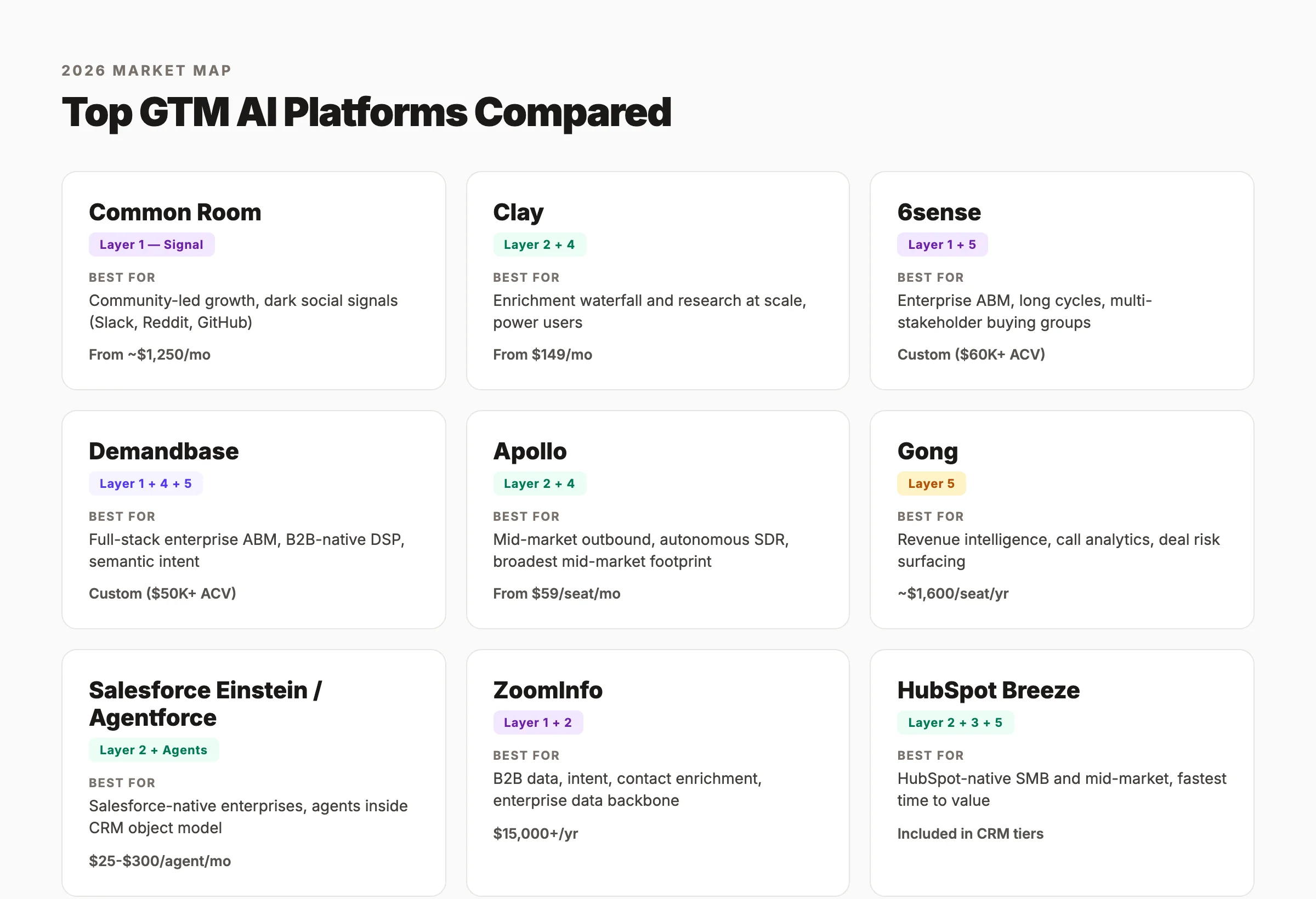
The 9 platforms B2B teams are evaluating in 2026
| Platform | Primary Stack Layer | Best For | Starting Price |
|---|---|---|---|
| Common Room | Layer 1 (Signal) | Community-led growth, dark social signals | Custom (≈$1,250/mo) |
| Clay | Layer 2 + 4 (Data + Outreach) | Enrichment and waterfall research at scale | $149/mo |
| 6sense | Layer 1 + 5 (Signal + Analytics) | Enterprise ABM, long sales cycles | Custom ($60K+ ACV) |
| Demandbase | Layer 1 + 4 + 5 | Full-stack enterprise ABM | Custom ($50K+ ACV) |
| Apollo | Layer 2 + 4 (Data + Outreach) | Mid-market outbound, autonomous SDR | $59/seat/mo |
| Gong | Layer 5 (Analytics) | Revenue intelligence, call analysis | Custom (≈$1,600/seat/yr) |
| Salesforce Einstein / Agentforce | Layer 2 (CRM + Agents) | Salesforce-native teams | $25-$300/agent/mo |
| ZoomInfo | Layer 1 + 2 | B2B data, intent, contact enrichment | $15,000+/yr |
| HubSpot Breeze | Layer 2 + 3 + 5 | HubSpot-native SMB and mid-market | Included in CRM tiers |
Common Room — signal layer leader for community-driven motions
Common Room captures buyer signals from places the traditional intent providers miss — Slack communities, Discord, Reddit, LinkedIn comments, GitHub stars, podcast guests, and product activity. For PLG and community-led companies, this is the strongest Layer 1 product in the market. It does not replace 6sense for traditional ABM, but for B2B SaaS where buyers gather in communities, nothing else comes close.
Clay — enrichment and outbound research at scale
Clay sits at the intersection of Layer 2 and Layer 4. It runs "waterfall" enrichment across 75+ data providers, applies LLM-driven research at the row level, and triggers personalized outbound based on the result. The killer use case is replacing a research-and-enrichment team with one operator and Clay. The downside: Clay is a power-user tool, and most teams that buy it without an in-house operator under-use it.
6sense — predictive ABM at enterprise scale
6sense is the canonical Layer 1 + Layer 5 platform. Its predictive intent engine identifies which accounts are in-market before anyone fills out a form. The ICP fit is enterprise sales teams with 100+ seats, multi-stakeholder buying groups, and long sales cycles. Teams under $20M ARR rarely get the value 6sense requires to justify its price tag.
Demandbase — the full-stack ABM platform
Demandbase is one of the few vendors that genuinely covers Layers 1, 4, and 5 in a single platform. It owns a B2B-native DSP, unique semantic intent data, buying group mapping, and a set of AI agents. Best for mid-market and enterprise ABM teams that want fewer integrations and a single pane of glass.
Apollo — outbound and SDR agent for mid-market
Apollo has quietly become one of the broadest GTM AI platforms in the mid-market segment. It combines a B2B database, multi-channel sequencing, AI-generated email writing, and AI SDR agents. For a $5M-$50M ARR B2B company, Apollo plus HubSpot covers an outsized share of the GTM AI stack at a fraction of the cost of an enterprise build.
Gong — revenue intelligence and conversation data
Gong is the best-known option at Layer 5. It records, transcribes, and analyzes every sales call to surface deal risk, coaching opportunities, and competitive intel. Its AI now generates deal summaries, forecast adjustments, and follow-up emails automatically. Gong is rarely the first GTM AI tool a team buys, but it is almost always in the top three by the time a company crosses $20M ARR.
Salesforce Einstein / Agentforce — agents inside the CRM
Agentforce is Salesforce's bet that the CRM becomes the operating system for AI agents. The integration depth is unmatched if your company runs on Salesforce, but the pricing model (per-agent metered usage) gets expensive fast at scale. Best for enterprises that already standardized on Salesforce and want agents that live inside the existing object model.
ZoomInfo — the data layer and beyond
ZoomInfo started as a contact database and has expanded into intent, engagement, and orchestration. The new ZoomInfo Copilot adds an agent layer on top of one of the largest verified B2B datasets in the market. It is the default Layer 1 + Layer 2 choice for enterprise teams, though the contract minimums put it out of reach for most SMBs.
HubSpot Breeze — the SMB and mid-market default
Breeze is HubSpot's collection of native AI agents — Content Agent, Customer Agent, Prospecting Agent, and Social Agent. For teams already on HubSpot, Breeze adds Layer 3 and Layer 5 capabilities without a new contract. It is not the most powerful Layer 1 in the market, but the simplicity and HubSpot-native experience make it the right starting point for thousands of teams.
Most marketers will tell you to pick the platform with the most features. That is the wrong question. The right question is: which layer of your stack is broken, and which platform solves that specific layer well enough that you can ignore it for the next 18 months?
Chapter 5: The 7-Point Evaluation Framework
After watching 40+ B2B teams evaluate these platforms, we have collapsed the decision into a 7-point framework. We call it the GTM AI Platform Scorecard.
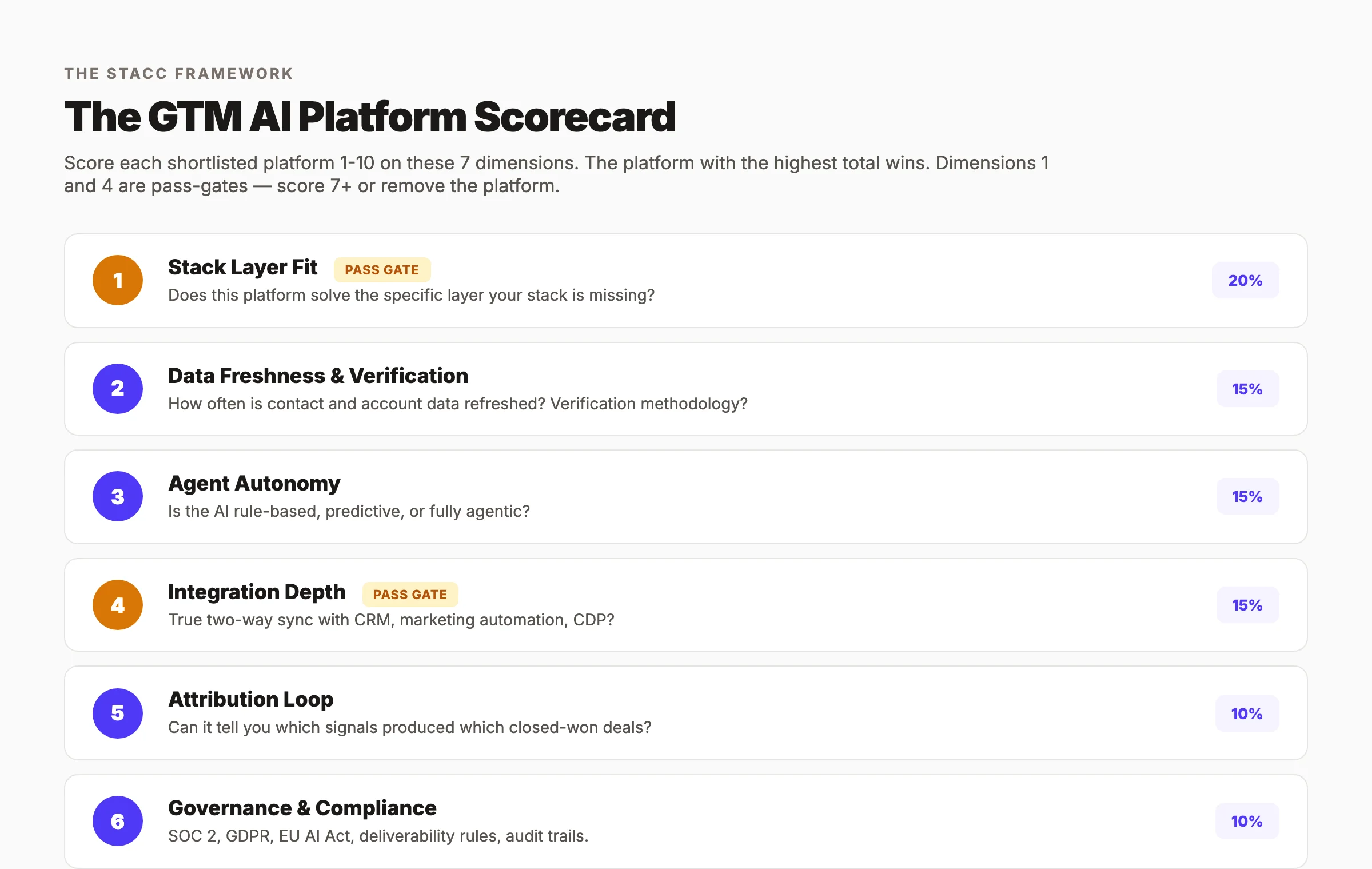
The GTM AI Platform Scorecard
Score every shortlisted platform on these 7 dimensions, 1 to 10. The platform with the highest total wins. If two tie, the platform with the highest score on dimensions 1, 4, and 7 wins — those three are the structural ones.
1. Stack Layer Fit (weight: 20%) Does this platform solve the specific layer your stack is missing? Buying a Layer 1 platform when your problem is Layer 4 is the most common waste of money in this category.
2. Data Freshness and Verification (weight: 15%) How often is contact and account data refreshed? What is the verification methodology? A platform pulling from a 12-month-old database will quietly poison every layer above it.
3. Agent Autonomy (weight: 15%) Is the AI rule-based, predictive, or agentic? Rule-based tools follow if/then logic. Predictive tools surface recommendations. Agentic tools execute multi-step tasks without human approval. Match this to the level of autonomy your operating model supports.
4. Integration Depth (weight: 15%) Does it write to your CRM? Read from your marketing automation? Sync with your CDP? "Native integrations" listed on a vendor website are not the same as a true two-way sync. Test this on real data before signing.
5. Attribution Loop (weight: 10%) Can the platform tell you which signals produced which closed-won deals? If the answer is "we will see," the platform is not a real platform — it is a feature.
6. Governance and Compliance (weight: 10%) SOC 2, GDPR, EU AI Act, and the new wave of bulk-sender rules from Google and Yahoo all matter now. Enterprise procurement teams will ask. Have audit trails, human-in-the-loop documentation, and a data processing addendum ready.
7. Total Cost of Ownership (weight: 15%) Sticker price is rarely the real price. Add implementation, data top-ups, integration build, training, and the inevitable second-tool purchase six months later. A "$1,200/month" platform with a $40,000 implementation is a $76,000 first-year commitment.
Pass gate: A platform that does not score 7+ on dimensions 1 and 4 should not move forward, regardless of total score. Layer fit and integration depth are structural — everything else can be coached up.
Chapter 6: The 5 Pitfalls That Wreck Rollouts
Across the B2B teams we have worked with on the content side of their GTM AI stack, five mistakes show up over and over.
Pitfall 1 — Buying before defining the ICP
The platform amplifies whatever you point it at. Pointing it at a vague ICP scales the vagueness. We have seen one team burn through 18,000 first-touch emails in 90 days with a 0.3% reply rate — because the ICP was "any B2B SaaS company in North America with 50+ employees." Useless. Define the ICP first. A clear ICP is a one-paragraph statement that names the company size, industry, role, trigger event, and buying pain.
Pitfall 2 — Skipping Layer 1 and scaling Layer 4
Most teams buy outreach orchestration (Apollo, Outreach, 11x.ai) before they have a signal layer. The result is volume without targeting — well-personalized emails to people who have no buying intent. Reply rates collapse. Domain reputation gets hit. Spam filters learn your sending pattern. The fix is to invest in Layer 1 first, even if it is a basic combination of website visitor identification and G2 buyer intent.
Pitfall 3 — Treating the content engine as an afterthought
Every orchestration layer needs an asset to point at. A great email lands a reply only if the reply path leads to a piece of content that confirms the buyer's hypothesis. Teams that buy Apollo and Clay but neglect Layer 3 end up with thousands of "interested!" replies that never convert because the follow-up content does not exist.
Pitfall 4 — No attribution, no learning
If Layer 5 is missing, the platform never gets smarter. Every campaign is a one-shot. The team learns nothing about which signals produced which deals. We worked with a team that ran 14 outbound campaigns over six months without a single retro because they had no attribution model — every campaign died at "I think it worked." Build the attribution loop on day one, even if it is a simple UTM-and-CRM-stage map.
Pitfall 5 — Underestimating governance
The EU AI Act is live, Google and Yahoo's bulk-sender rules tightened again in 2025, and enterprise procurement teams now ask for audit trails as part of standard security reviews. Teams that ignore governance until month nine end up rebuilding the platform under deadline. Build the governance layer (DPA, audit logs, opt-out flow, human-in-the-loop rules) into the implementation plan.
A scorecard for catching these early
| Pitfall | Early warning sign | Fix |
|---|---|---|
| Vague ICP | Reply rate under 1% in week 2 | Pause outbound. Run an ICP workshop. |
| Skipping Layer 1 | High volume, low engagement | Buy or build a signal source before scaling more sends. |
| No content engine | "Interested!" replies that die | Commit to publishing 30+ articles per month aligned to ICP. |
| No attribution | Every campaign retro ends in "I think it worked" | Map UTM + CRM stage + revenue, top to bottom. |
| No governance | Procurement holds up renewal | Build the DPA, audit log, and opt-out flow before month 6. |
The teams that win with a GTM AI platform are not the teams with the biggest stack. They are the teams that fix one layer at a time, in the right order, with a working attribution loop from day one.
Chapter 7: The 30-60-90 Day Implementation Roadmap
Most vendor onboarding plans assume your stack is already healthy. It is not. Here is the roadmap we recommend instead — built around the 5-Layer GTM AI Stack and the seven evaluation criteria from Chapter 5.
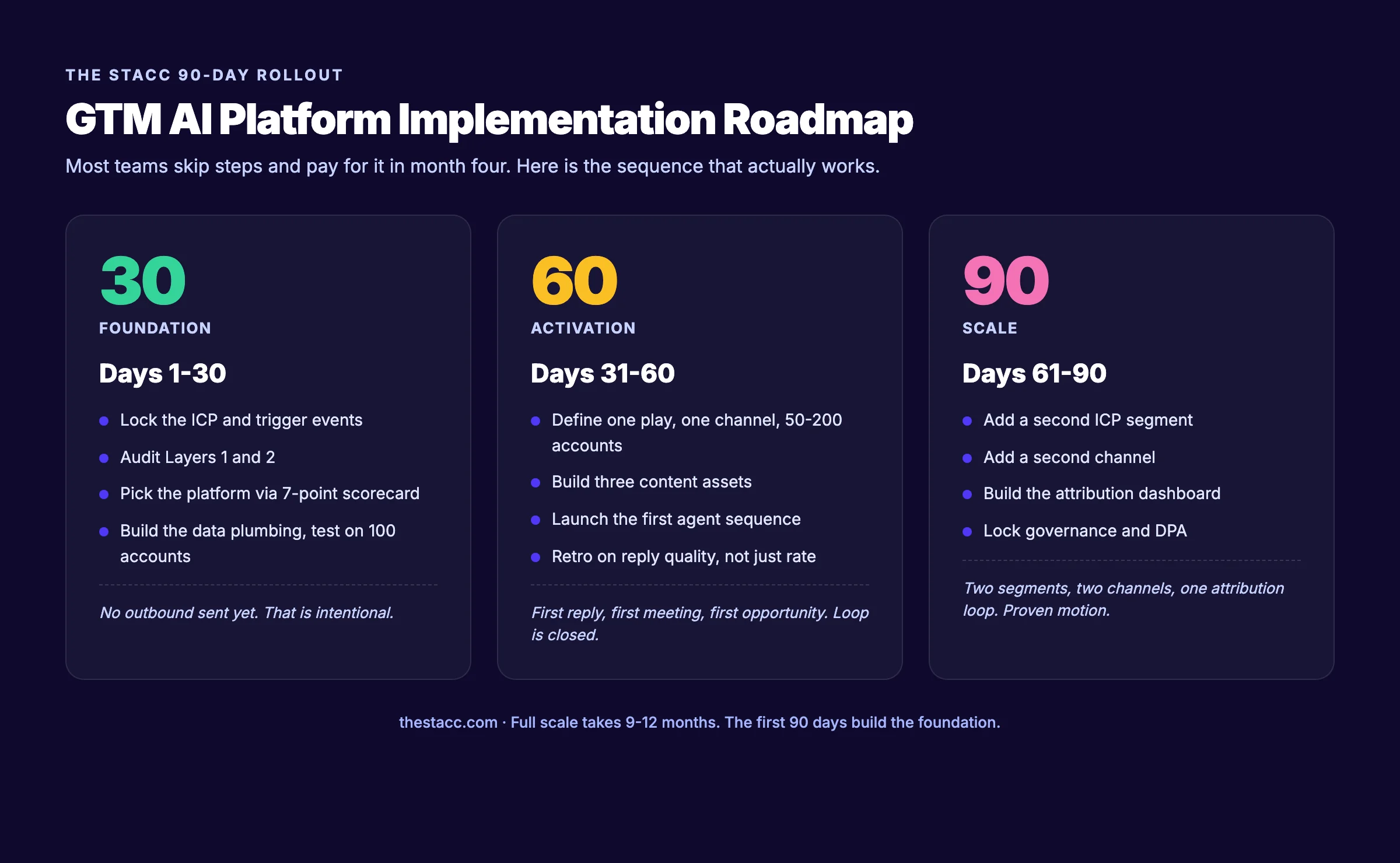
Days 1-30: Foundation
The first 30 days are not for sending. They are for fixing the data and signal layers.
- Week 1: ICP lock. Write the one-paragraph ICP statement. Get sign-off from the founder or CRO. Document the trigger events that flag a buyer is in-market.
- Week 2: Audit Layers 1 and 2. Inventory every signal source (intent, website, community, product). Inventory every CRM field and data source. Note duplicates, gaps, and stale records.
- Week 3: Pick the platform. Run the 7-point scorecard against your shortlist. Choose the platform that scores 7+ on Layer Fit and Integration Depth.
- Week 4: Build the data plumbing. Connect the CRM, the CDP (if any), the marketing automation, and the signal sources. Run a 100-account test to verify two-way sync.
By day 30, you have a clean ICP, a defined signal layer, and a connected data foundation. No outbound has been sent yet. That is intentional.
Days 31-60: Activation
The next 30 days are for proving the orchestration loop on a small surface area.
- Week 5: Define the first play. Pick one ICP segment (50-200 accounts) and one channel (email or LinkedIn). Resist the urge to multi-channel on day one.
- Week 6: Build the content assets. The first play needs at least three content pieces — a thought leadership article, a customer story, and a problem-aware landing page. This is where Layer 3 either supports the orchestration layer or starves it.
- Week 7: Launch the first agent. Run the first agent-driven sequence on the 50-200 account segment. Cap the volume. Watch reply rates daily.
- Week 8: Retro and tune. Pull the data. Score reply quality (not just rate). Adjust the ICP, the signal threshold, or the content based on what the data shows.
By day 60, you have a working play with measured outcomes. The team has seen a reply, taken a meeting, and walked an opportunity into pipeline. The loop is closed.
Days 61-90: Scale
The final 30 days expand the surface area without breaking the data or governance layers.
- Week 9: Add a second ICP segment. Replicate the same playbook on a new segment. Note what breaks. (Something always breaks.)
- Week 10: Add a second channel. If email worked, add LinkedIn. If LinkedIn worked, add an ad layer. Keep the same content engine and signal layer.
- Week 11: Build the attribution dashboard. Map signals → touches → meetings → opportunities → closed-won. This is Layer 5 made tangible.
- Week 12: Governance lock. Confirm SOC 2 posture, finalize the DPA, document the human-in-the-loop rules. Hand the platform to the operations team for steady-state ownership.
By day 90, the platform is running across two ICP segments, two channels, and one attribution loop. You are not at full scale — that takes 9-12 months — but you have a proven motion.
The hardest part of a GTM AI rollout is not the technology. It is the discipline to fix one layer at a time, in order, with measurable outcomes at every stage. Most teams skip steps and pay for it in month four.
What practitioners are saying on X
Quality and research still separate winners from GEO/content farms in public operator debate.
- @varunram (Jul 2026): Critique of GEO slopfarm products that combine SEO clickbait with unresearched content marketing — quality and research still separate winners from farms. See the post on X.
- @jakezward (Feb 2026): 2026 SEO predictions emphasize AI Overview share-of-SERP, schema for LLM token efficiency, brand mentions in AI answers as a KPI, proprietary data as a moat, and content refresh beating net-new AI slop. See the post on X.
- @HlynurStefDev (Jul 2026): Public case: niche site traffic jumped from ~18 to 4,162 Google visits/month after focused technical/on-page SEO work (GSC screenshots claimed) — reminds that fundamentals still move numbers. See the post on X.
Grok, AI Overviews, and multi-engine visibility
AI/search topics like “gtm ai platform guide” need multi-engine notes: AI Overviews, ChatGPT/Perplexity, and Grok. Lead with extractable answers; keep claims consistent with public expert discussion.
- Google AI Overviews: Use passage-ready answers, tables, and FAQ schema where relevant.
- ChatGPT / Perplexity: Cite named sources next to key claims.
- Grok: Maintain accurate entity facts on-site and in high-signal X posts.
Chapter 8: FAQs
A sales engagement tool (Outreach, Salesloft) lives at Layer 4 — outreach orchestration only. A GTM AI platform spans Layers 1 through 5 in a connected system, covering signal data, CRM data, content, orchestration, and attribution. For example, Outreach can send a 7-step sequence beautifully, but it does not tell you which accounts to put into that sequence. A GTM AI platform like Demandbase or 6sense answers that upstream question. Key takeaway: Sales engagement is one layer. A GTM AI platform is the whole stack.
Do I need a GTM AI platform if I am already on HubSpot?
If you are on HubSpot and under 50 revenue employees, HubSpot Breeze plus a strong content engine often covers 80% of the GTM AI need. Breeze includes Prospecting Agent, Content Agent, Customer Agent, and Social Agent — covering Layers 2, 3, and 5 inside the existing CRM. Add a signal layer (Common Room or G2 buyer intent) and you are done.
For example, a 30-person B2B SaaS team running HubSpot can pair Breeze with Common Room and theStacc-published SEO content and hit 90% of the platform's value at a fraction of the enterprise build cost.
Key takeaway: HubSpot-native teams under 50 employees should evaluate Breeze before considering a standalone platform.
How much does a GTM AI platform cost in 2026?
Pricing ranges from $59/seat/month (Apollo entry tier) to $200K+/year (enterprise 6sense or Demandbase). Mid-market teams typically spend $30K-$80K per year on the core platform, plus 20-40% additional in data, content, and implementation.
For example, a typical $5M ARR B2B team running Apollo Pro ($99/seat/mo for 5 seats), HubSpot Sales Pro, Common Room ($1,500/mo), and theStacc content ($199/mo) lands at roughly $40K/year all-in.
Key takeaway: Sticker price is rarely the real price. Budget for data, content, implementation, and the second tool that always shows up in month six.
Can a GTM AI platform replace SDRs?
Not in 2026. Autonomous SDR agents (11x.ai, Artisan, Apollo AI SDR) can handle research, first-touch outreach, and follow-up sequencing. They cannot run a discovery call, negotiate, or hold an account through a complex deal. The realistic outcome is that one human SDR plus an agentic stack covers the territory of three traditional SDRs.
For example, we worked with a B2B team that reduced SDR headcount from 6 to 3 over 12 months while increasing meetings booked by 28% — because the agent handled the volume the humans used to handle, and the humans focused on the qualified meeting.
Key takeaway: Agents amplify SDR throughput. They do not eliminate the role.
What is the difference between agentic AI and traditional AI in a GTM context?
Traditional AI in GTM is recommendation-based — it surfaces a lead score, a suggested email, or a forecast risk and waits for a human to act. Agentic AI executes. It picks the account, writes the email, schedules the send, monitors the response, and routes the reply, all without per-step approval.
For example, Salesforce Einstein's traditional models recommend a lead score. Salesforce Agentforce's agents take that score, decide on a play, draft the outreach, and run it inside Salesforce — all from the same data layer.
Key takeaway: Traditional AI assists humans. Agentic AI replaces multi-step human workflows.
How long does it take to see ROI from a GTM AI platform?
In our experience watching B2B rollouts, the first measurable lift on reply rates and meeting volume shows up in days 30-60. Real revenue ROI — closed-won deals attributable to the platform — typically appears in months 4-6, aligned to the average B2B sales cycle. Teams that try to measure ROI in month one almost always conclude the platform "is not working" and pull the plug too early.
For example, a mid-market SaaS team we tracked saw reply rates double by day 45 and the first closed-won attributable to the new play in month 5. By month 9, the play was producing 22% of new pipeline.
Key takeaway: Expect 4-6 months to first attributable revenue. Anyone promising faster ROI is selling.
Is a GTM AI platform worth it for a 10-person startup?
Usually no. At 10 people, the better investment is a clean ICP, a strong founder-led outbound motion in HubSpot or Apollo, and a published SEO content layer that builds compounding inbound. Once the team crosses 25-30 revenue employees and the data layer starts to fragment, the platform becomes worth the implementation cost.
For example, the cleanest builds we see are at $1M-$5M ARR companies that started with Apollo + HubSpot + Clay + theStacc from day one — five tools, one motion, no enterprise platform.
Key takeaway: Under 25 revenue employees, invest in ICP and content. Over 25, evaluate a platform.
What is the relationship between SEO content and a GTM AI platform?
SEO content is the Layer 3 content engine for organic demand. A GTM AI platform's outbound motion needs assets to point at — articles, case studies, comparison pages, glossary pages. Without a content layer, the orchestration layer has nothing to send. Teams that pair a GTM AI platform with a consistent publishing motion (30+ articles per month aligned to ICP) see significantly higher reply-to-meeting conversion because the buyer can confirm the hypothesis on the website.
For example, B2B teams that combine a GTM AI platform with a theStacc-published content layer see reply-to-meeting conversion improve 30-50% within 90 days, because every reply leads to a content surface that confirms the buyer's research.
Key takeaway: A GTM AI platform without a content engine is half a stack. Pair the orchestration layer with consistent publishing.
How does generative engine optimization (GEO) fit into a GTM AI strategy?
Buyers now research products through AI search (ChatGPT, Perplexity, Google AI Overviews). If your brand does not show up in AI-generated answers for ICP-relevant queries, you are invisible at the top of the funnel. Generative engine optimization — the practice of optimizing content to be cited by LLMs — is becoming the de facto Layer 1 input for many B2B buyers. Teams that ignore GEO are leaving signal on the table.
For example, a theStacc client in B2B fintech saw 18% of inbound demo requests in Q1 2026 mention "ChatGPT recommended you" — a signal that did not exist 18 months ago.
Key takeaway: GEO is becoming a top-of-funnel signal source. Treat it as a Layer 1 input.
What governance and compliance issues matter most for a GTM AI platform?
Three areas matter. First, data processing — make sure the vendor has a current DPA, SOC 2 Type II, and ideally ISO 27001. Second, deliverability — Google and Yahoo's bulk-sender rules now require DMARC, one-click unsubscribe, and a spam complaint rate under 0.3%. Third, AI Act compliance for EU operations — high-risk use cases (HR-adjacent scoring, credit-related decisions) require human-in-the-loop documentation and audit trails.
For example, an enterprise B2B team we worked with delayed a rollout by 60 days because the chosen vendor did not have a DPA ready. That is the kind of delay governance prep prevents.
Key takeaway: Confirm DPA, SOC 2, deliverability posture, and AI Act readiness in the procurement phase, not after signing.
The bottom line
If you sell services on top of this stack, the pitch matters as much as the tooling. Our guide to pitching SEO services covers how to frame it.
A GTM AI platform is not a product. It is a 5-layer architecture — signal, data, content, orchestration, attribution — and the teams that win are the ones who fix one layer at a time, in the right order, with a working attribution loop from day one. Choose the platform that fits the layer your stack is missing, not the one with the most marketing budget.
By 2027, the difference between B2B teams running modern GTM AI stacks and teams still operating on legacy automation will be too large to close. The window to build is now.
Sources:
- ZoomInfo — What is GTM AI? 2026 Guide for Sales, Marketing & RevOps
- Demandbase — 7 best GTM intelligence platforms for 2026
- Gartner Peer Insights — Best AI GTM Platforms Reviews 2026
- Copy.ai — AI for Go-to-Market Strategy
Related Tools & Resources
Free SEO Tools:
Best Lists:
Sources & references
- [1] Princeton / Georgia Tech et al. — GEO research (arXiv:2311.09735)
- [2] @jakezward on X — 2026 SEO predictions emphasize AI Overview share-of-SERP, schema for LLM token efficiency, brand mentions in AI answers
- [3] @alexgroberman on X — Case narrative: organic value plus multi-engine citations (ChatGPT, Perplexity, Grok) from knowledge-hub pages, category
- [4] @varunram on X — Critique of GEO slopfarm products that combine SEO clickbait with unresearched content marketing — quality and research
- [5] Referenced source — pipeline.zoominfo.com

Plan topics, review article drafts, and publish to a connected CMS.
Weekly local SEO teardowns
One practical email a week. Map Pack, GBP, AI Overviews. No fluff. Unsubscribe anytime.