
IT Services SEO (2026): MSP Lead Generation Guide
IT services SEO for MSPs: B2B keyword strategy, Google Business Profile, content clusters, review generation, and lead capture. Data-backed tactics.
70% of B2B buyers begin their vendor research with a search engine. When a business owner searches “managed IT services near me” or “IT support for small business [city],” your company either appears or loses the deal to a competitor.
The global managed services market reached $401 billion in 2025. Over 150,000 MSPs compete for attention worldwide. The IT services SEO strategy you build now determines whether those searching businesses find you or someone else.
Most managed IT providers rely on referrals and channel partnerships. Those channels work. But they do not scale on demand. SEO creates a predictable pipeline of qualified leads from businesses actively searching for IT support, cybersecurity, cloud migration, and managed services.
We have published 3,500+ blog posts across 70+ industries, including B2B service companies, IT consulting, and managed service providers. This guide covers the exact SEO playbook that drives qualified leads for IT services companies.
Here is what you will learn:
- Why SEO is the highest-ROI lead generation channel for MSPs
- How to find the B2B keywords decision makers actually search
- The local SEO playbook for dominating your service area
- How to optimize your Google Business Profile for IT leads
- A content cluster strategy that builds authority and converts
- Technical SEO essentials for IT services websites
- How to earn the backlinks that move rankings for MSPs
Why SEO Matters More for IT Services Than Most B2B Industries
IT services is a trust-intensive business. Companies hand you the keys to their network, data, and infrastructure. They do not hire from a Google ad without extensive research first.
That research happens on search engines. And SEO controls what they find.
The MSP Buyer Journey
| Stage | What They Search | What They Need |
|---|---|---|
| Problem awareness | ”why does my network keep going down” | Educational blog content |
| Research | ”managed IT services vs break-fix” | Comparison guides. Explainer content. |
| Evaluation | ”best managed IT companies [city]“ | Service pages. Case studies. Reviews. |
| Decision | ”IT support company [city] reviews” | Google 3-Pack. Social proof. Pricing. |
B2B buyers spend 67% of their decision journey online before contacting a vendor. If your website does not rank for the searches that happen during that journey, you never enter the consideration set.
SEO vs. Other Lead Generation Channels
| Channel | Cost per Lead | Lead Quality | Long-Term Value |
|---|---|---|---|
| SEO (Organic) | Decreases over time | High (actively searching) | Compounds monthly |
| Google Ads | $50-150+ per click (IT keywords) | High | Stops when budget stops |
| Cold Email/Calling | $20-50 per contact | Low-Medium | No lasting asset |
| Channel Partnerships | Variable | High | Relationship-dependent |
| Trade Shows | $500-2,000+ per lead | Medium | Annual, no compounding |
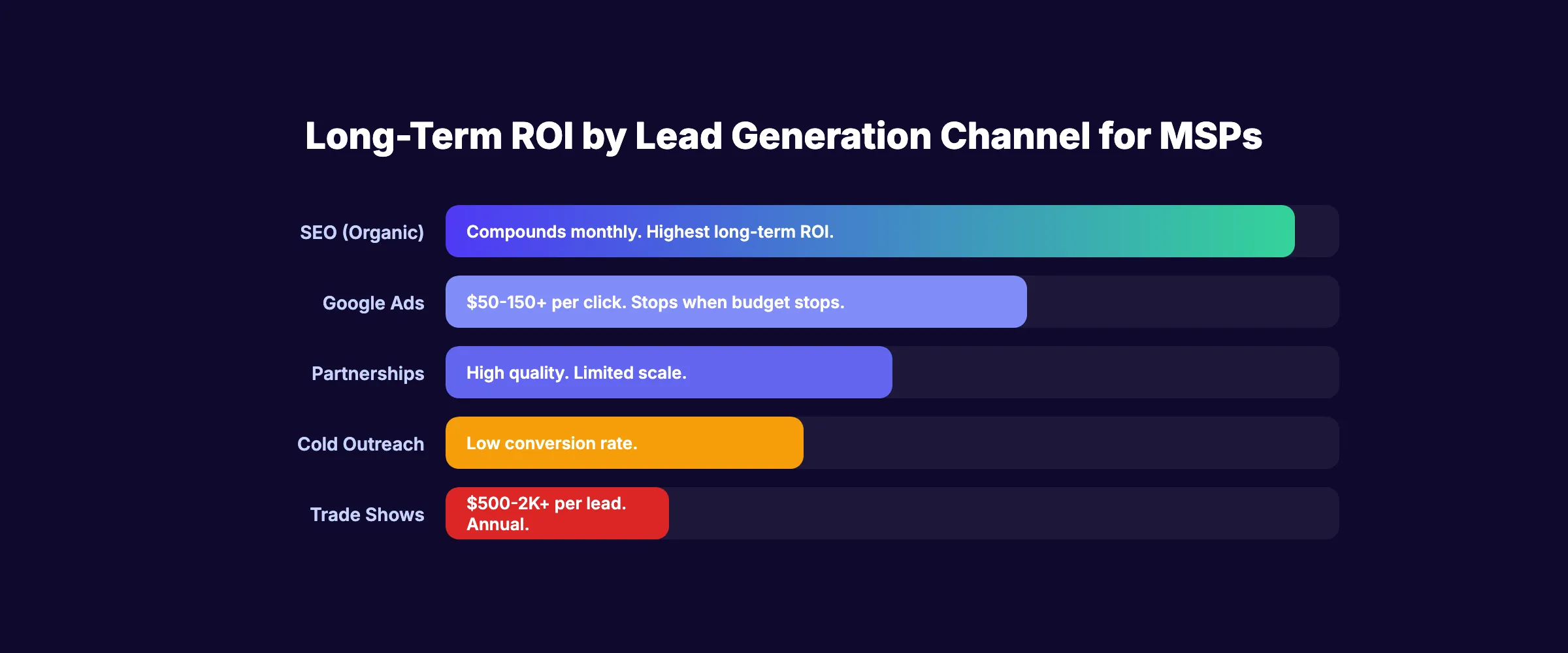
IT and cybersecurity keywords are among the most expensive in Google Ads. “Managed IT services” costs $40-80+ per click. SEO captures the same intent without per-click costs.
The MSP SEO Opportunity
Most managed IT providers do not invest seriously in content marketing or SEO. They rely on referrals, vendor partnerships, and trade shows. That means organic competition for local IT services keywords is lower than you expect.
An MSP that publishes consistent content and optimizes for local search can dominate its market within 6-12 months. The window is still open in most cities.
Stop writing. Start ranking. Stacc publishes 30 SEO articles per month for your IT services company. Every post targets the keywords your prospects search. Start for $1 →
Keyword Research for IT Services Companies
The keywords you target must match what B2B decision makers search. Most MSPs target generic terms like “managed IT services” and get crushed by national competitors with massive budgets.
The winning strategy targets specific, intent-rich combinations of service type, industry, and location.
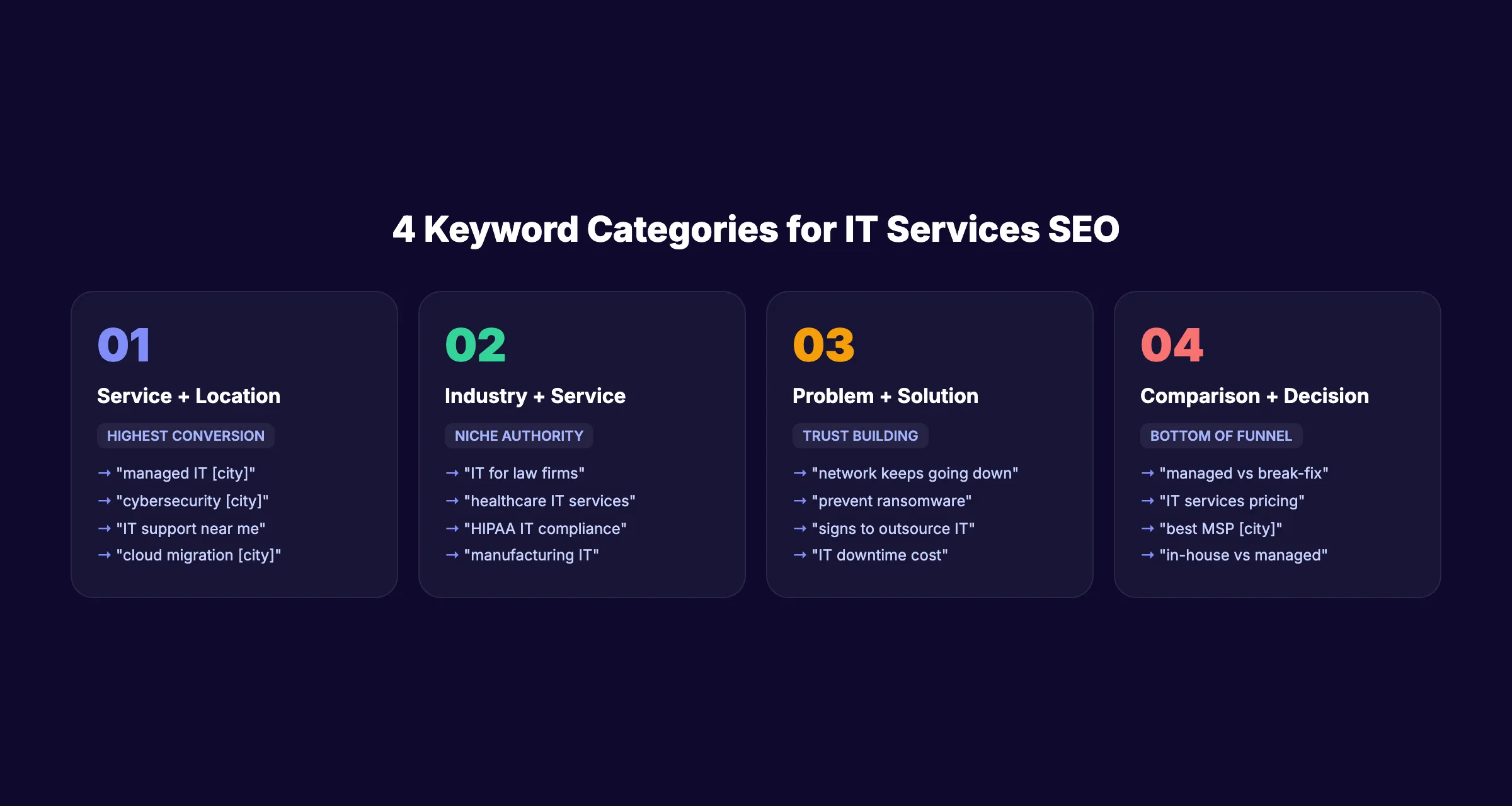
Four Keyword Categories
Category 1: Service + Location (highest conversion rate)
| Service | Target Keywords |
|---|---|
| Managed IT | ”managed IT services [city],” “IT support company near me” |
| Cybersecurity | ”cybersecurity services [city],” “network security company [city]“ |
| Cloud Services | ”cloud migration services [city],” “cloud computing provider near me” |
| Help Desk | ”IT help desk outsourcing [city],” “remote IT support [city]“ |
| Network Management | ”network management company [city],” “IT infrastructure services” |
| Backup/Recovery | ”data backup services [city],” “disaster recovery IT company” |
Category 2: Industry + Service (niche authority)
- “IT services for law firms”
- “managed IT for healthcare practices”
- “cybersecurity for financial services”
- “IT support for manufacturing companies”
- “HIPAA compliant IT services [city]”
- “IT services for accounting firms”
Category 3: Problem + Solution (informational, builds trust)
- “why does my network keep going down”
- “how to prevent ransomware attacks small business”
- “signs you need to outsource IT”
- “managed IT services vs break-fix comparison”
- “how much does managed IT cost per employee”
Category 4: Comparison and Decision (bottom-of-funnel)
- “best managed IT companies [city]”
- “managed IT services pricing”
- “in-house IT vs managed services”
- “[competitor name] alternatives”
- “IT services company reviews [city]”
Long-Tail Keywords Win for MSPs
The keyword “managed IT services” gets 40,500 monthly searches. It is also nearly impossible to rank for as a local MSP.
The keyword “managed IT services for dental practices in [city]” gets 50 monthly searches. It is easy to rank for and brings in highly qualified leads.
Target 50-100 long-tail keywords across your services, industries, and locations. Use your keyword research process to build this list systematically.
Local SEO: Winning Your Service Area
Most MSPs serve businesses within a specific metro area or region. Local SEO determines whether you appear in the Google 3-Pack when a business owner searches “IT support near me.”
Google 3-Pack Ranking Factors
| Factor | What Google Measures | How to Optimize |
|---|---|---|
| Relevance | Does your listing match the query? | Accurate categories, complete profile, service descriptions |
| Distance | How close is your business to the searcher? | List accurate address, define service areas |
| Prominence | How well-known is your business? | Reviews, citations, backlinks, brand mentions |
Citation Building for MSPs
Citations are online mentions of your business Name, Address, and Phone number (NAP). Consistency across every listing is mandatory.
Priority citation sources for IT services companies:
- Google Business Profile
- LinkedIn company page
- Yelp
- Better Business Bureau
- Clutch (IT services directory)
- GoodFirms
- UpCity
- Local Chamber of Commerce
- Facebook business page
- Bing Places
- Apple Maps
- ChannelE2E / Channel Futures directory
Audit your NAP across every listing. Even small differences (“Suite 200” vs “Ste 200”) weaken your local signal.
Service Area Pages
If you serve businesses across multiple cities, create a dedicated page for each location.
Each service area page needs:
- City name in the H1 and URL
- Unique content about the local business community and IT needs
- Specific services available in that area
- Case study or testimonial from a client in that city
- Embedded Google Map
- NAP consistent with all other listings
Do not create 20 identical pages with only the city name changed. Google penalizes thin location pages. Each page must contain unique, genuinely useful information.
Follow our local SEO guide for a full location-based ranking strategy.
Google Business Profile Optimization
Your Google Business Profile is the most valuable local SEO asset for an IT services company. When a business owner searches “managed IT near me,” the 3-Pack results are pulled directly from GBP data.
Profile Setup Checklist
- Business name (exact legal name, no keyword stuffing)
- Primary category: “Information Technology Company” or “Computer Support and Services”
- Secondary categories: “IT Consultant,” “Computer Security Service,” “Internet Service Provider”
- Full office address
- Local phone number
- Website URL
- Business hours
- Service area (list every city you serve)
- Business description (750 characters, include services and specialties)
- Services list with descriptions (managed IT, cybersecurity, cloud, help desk, etc.)
- 10+ photos (office, team, server rooms, client sites)
GBP Posts
Publish 2-4 Google Business Profile posts per week. Active profiles rank higher than dormant ones.
Post topics for IT services companies:
- Cybersecurity threat alerts and prevention tips
- Client success stories (with permission)
- New service announcements
- Technology tips for business owners
- Team certifications and training updates
- Local business technology news
Reviews for B2B IT Services
Reviews work differently in B2B. You will not get 200 reviews like a restaurant. But even 20-30 high-quality reviews from business owners make a significant impact.
Target: 2-4 new reviews per month. Ask after successful project completions, security audit deliverables, or technology upgrades.
Use a QR code at in-person meetings or include a direct review link in your post-project follow-up emails.
Your SEO team. $99 per month. 30 optimized articles published automatically. Built for IT services companies that want more qualified leads. Start for $1 →
Content Cluster Strategy for MSPs
Content marketing is where MSPs build the most durable competitive advantage. A well-structured content cluster strategy positions your website as the go-to resource for IT services in your market.
What Content Clusters Look Like for MSPs
A content cluster has one pillar page and multiple supporting cluster pages:
Pillar: “Managed IT Services” (your main service page)
Supporting cluster pages:
- “Managed IT Services vs Break-Fix: Which Is Right for Your Business?”
- “How Much Do Managed IT Services Cost Per Employee?”
- “What to Look for in a Managed IT Provider”
- “Signs Your Business Needs Managed IT Services”
- “Managed IT SLA: What Should Be Included?”
Pillar: “Cybersecurity Services”
Supporting cluster pages:
- “How to Prevent Ransomware Attacks: A Small Business Guide”
- “Cybersecurity Assessment Checklist for SMBs”
- “HIPAA Compliance IT Requirements for Healthcare Practices”
- “Employee Cybersecurity Training: What Every Business Needs”
- “Incident Response Plan Template for Small Businesses”
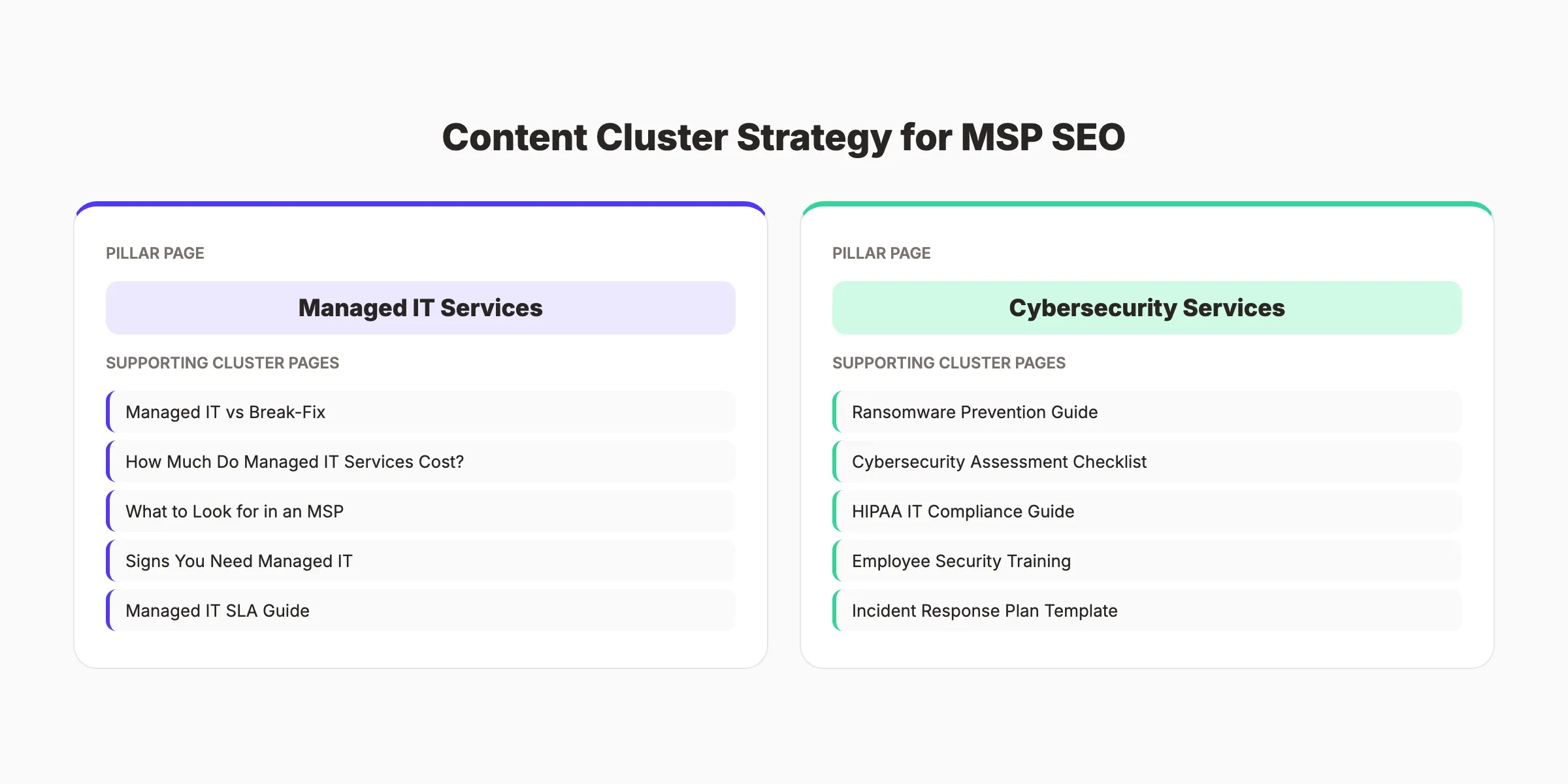
Link every cluster page back to its pillar page and to related cluster pages. This builds topical authority and signals to Google that your site is the expert on these topics.
Blog Content That Converts MSP Leads
Educational Content (top-of-funnel):
- “How to Know If Your IT Provider Is Underperforming”
- “Cloud Migration Checklist: 10 Steps for Small Businesses”
- “What Happens When Your Business Gets Hacked?”
- “The True Cost of IT Downtime for a 50-Person Company”
Comparison Content (mid-funnel):
- “In-House IT vs Managed Services: The Real Cost Comparison”
- “Break-Fix vs Managed IT: Which Model Fits Your Business?”
- “Private Cloud vs Public Cloud for Small Business”
Decision Content (bottom-funnel):
- “How to Evaluate Managed IT Proposals”
- “Questions to Ask Before Signing an IT Services Contract”
- “What an IT Services SLA Should Include”
Industry-Specific Content (niche authority):
- “IT Compliance Requirements for Law Firms”
- “HIPAA IT Requirements Every Healthcare Practice Must Follow”
- “Cybersecurity for Financial Advisors: A Complete Guide”
- “IT Infrastructure Needs for Manufacturing Companies”
Publishing Frequency
| Publishing Pace | Timeline to Results | Growth Rate |
|---|---|---|
| 2-4 posts per month | 6-12 months | Slow build |
| 8-12 posts per month | 3-6 months | Strong growth |
| 20-30 posts per month | 60-90 days | Rapid authority |
Consistency builds topical authority. Google needs enough content to recognize your site as the go-to resource for IT services topics.
Case Studies as SEO Assets
Case studies serve double duty. They build trust with prospects and rank for long-tail keywords.
Structure each case study around a searchable problem:
- Title: “How [Industry] Company Reduced IT Costs 40% with Managed Services”
- Format: Challenge → Approach → Results → Key Metrics
- SEO target: “[industry] managed IT case study” or “IT cost reduction [industry]”
Publish 1-2 case studies per quarter. Include specific numbers, client quotes (with permission), and measurable outcomes.
3,500+ blogs published. 92% average SEO score. See what Stacc can do for your IT services company. Start for $1 →
Technical SEO for IT Services Websites
IT companies should have strong technical SEO. It is your industry. A slow, unsecured, or poorly structured website undermines your credibility before a prospect even reads your content.
Site Speed
Target these Core Web Vitals thresholds:
| Metric | Target | Common Issue |
|---|---|---|
| LCP (Loading) | Under 2.5 seconds | Unoptimized hero images |
| INP (Interactivity) | Under 200ms | Heavy chat widgets or assessment tools |
| CLS (Visual Stability) | Under 0.1 | Late-loading embedded videos |
Your site speed reflects your technical competence. A business owner evaluating IT providers will judge your ability to manage their infrastructure based on how well you manage your own website.
HTTPS and Security Headers
Every page must use HTTPS. But for IT services companies, go further:
- Implement HSTS headers
- Use Content Security Policy headers
- Enable X-Frame-Options
- Run regular vulnerability scans
- Display security certifications (SOC 2, ISO 27001) prominently
Prospects expect an IT company to lead by example on security.
Schema Markup
Schema markup helps Google understand your business. Implement these types:
- LocalBusiness (or ProfessionalService) with NAP, hours, and service area
- Organization with sameAs links to all profiles
- Article/BlogPosting on every blog post and case study
- FAQPage on service pages
- Service schema for each IT service offered
- Review schema for displayed testimonials
Use our Schema Markup Generator to create valid structured data.
Mobile Optimization
Even in B2B, decision makers browse on mobile during commutes, meetings, and off-hours research:
- Click-to-call button on every page
- Service descriptions readable on small screens
- Contact forms easy to complete on mobile
- Case studies formatted for mobile reading
- No horizontal scrolling on any page
Link Building for IT Services Companies
Backlinks from trusted websites signal to Google that your IT company is credible. For B2B services, industry-relevant and local links carry the most weight.
High-Value Link Sources
| Source | How to Earn the Link |
|---|---|
| Technology publications | Guest posts on ChannelE2E, MSP360 blog, Channel Futures |
| Industry directories | Clutch, GoodFirms, UpCity, G2 services profiles |
| Local business organizations | Chamber of Commerce, local business associations |
| Vendor partner pages | Microsoft Partner, Cisco Partner, vendor certification directories |
| Local media | Expert commentary on cybersecurity incidents or tech trends |
| Business publications | Guest articles in local business journals |
| Professional associations | CompTIA, ISACA, local IT professional groups |
Content That Earns Links
- Original research: “We surveyed 200 SMBs about their IT spending priorities.” Citable data earns links.
- Free tools and templates: Cybersecurity checklists, IT budget templates, vendor evaluation scorecards.
- Expert commentary: Respond to cybersecurity incidents or tech news with expert analysis.
- Industry guides: “[State] data privacy requirements for small businesses” becomes a reference resource.
Common IT Services SEO Mistakes
Targeting Impossible Keywords
Competing for “managed IT services” nationally against companies with million-dollar marketing budgets is a losing strategy. Target “[service] + [city]” and industry-specific long-tail keywords instead.
Ignoring Search Intent
Writing content about “cloud computing trends” when your prospects search “why does my email keep crashing” misses the mark. Create content that addresses the problems your target clients actually experience.
Treating SEO as a One-Time Project
Publishing 10 blog posts in January then going silent until next year produces no results. SEO requires consistent publishing, ongoing optimization, and regular content updates.
No Conversion Tracking
Ranking well means nothing without tracking which pages generate consultation requests. Set up Google Analytics goals for form submissions, phone calls, and assessment requests.
Generic Service Pages
A single “Our Services” page that lists managed IT, cybersecurity, cloud, and help desk will not rank for any of those terms. Create a dedicated page for each service with 500-1,000 words of unique content.
Weak E-E-A-T Signals
IT services is a trust-intensive industry. Anonymous blog posts, missing team bios, and no certifications displayed damage your credibility. Show your team’s credentials, certifications, and experience on every page.
Measuring IT Services SEO Results
| Metric | Tool | Target |
|---|---|---|
| Organic traffic | Google Analytics | 20%+ growth quarter over quarter |
| 3-Pack rankings | Google Search Console | Top 3 for “[IT service] + [city]“ |
| Keyword rankings | Semrush, Ahrefs, or Search Console | Page 1 for 15+ service keywords in 6 months |
| GBP profile views | GBP insights | Month-over-month increase |
| Consultation requests | CRM or form tracking | Track by landing page and keyword |
| Phone calls from search | Call tracking or GBP metrics | Consistent monthly increase |
| Review count and rating | GBP dashboard | 25+ reviews, 4.7+ average |
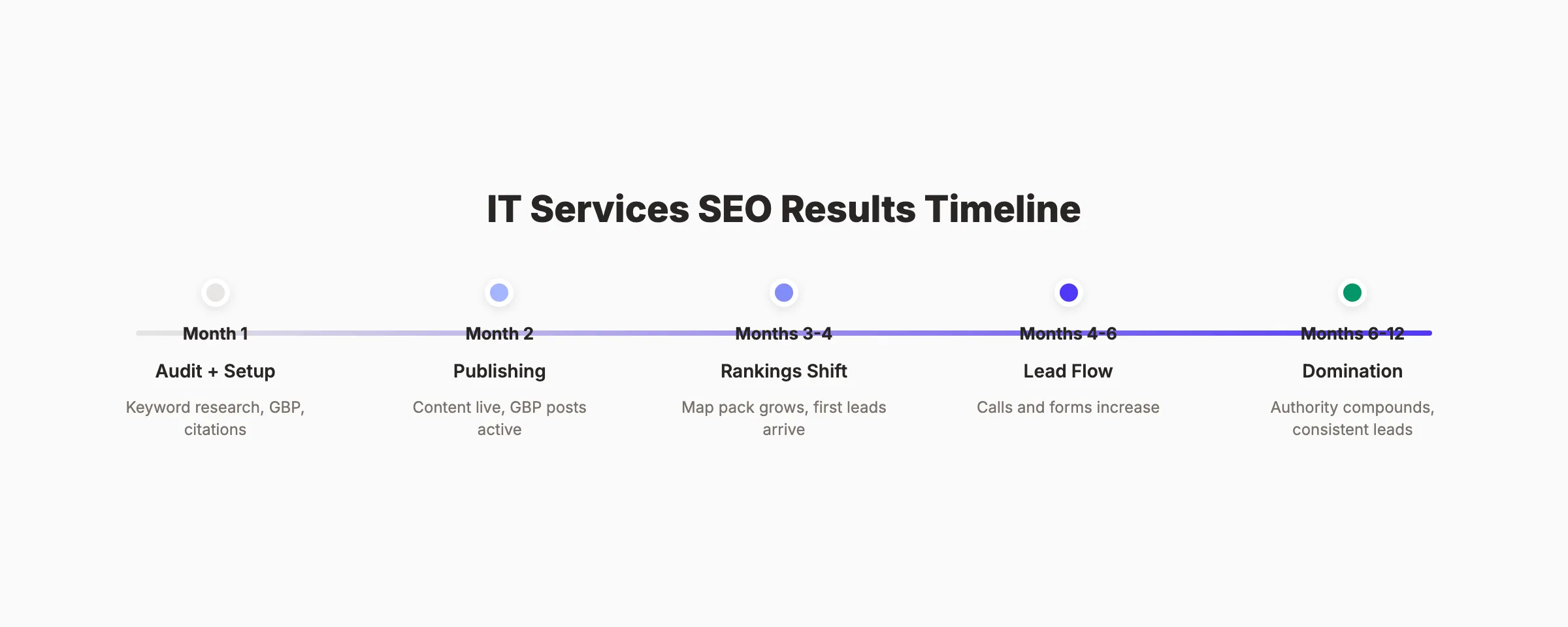
Timeline
- Month 1: Website audit, keyword research, GBP optimization, citation building.
- Month 2: Content publishing begins. GBP posts active. Local rankings start moving.
- Months 3-4: Rankings shift. Map pack impressions grow. First organic leads arrive.
- Months 4-6: Phone calls and form fills increase measurably.
- Months 6-12: Authority compounds. Rankings dominate local searches. Consistent lead volume.
With the right foundation, you can see signs of progress within 60 days and qualified leads between 90-120 days.
Rank everywhere. Do nothing. Blog SEO, Local SEO, and Social Media on autopilot for your IT services company. Start for $1 →
FAQ
How long does SEO take for an IT services company?
Most MSPs see initial local ranking improvements within 4-8 weeks. Qualified organic leads typically start arriving between 90-120 days. Full market domination for your service area takes 6-12 months of consistent content publishing and optimization.
What keywords should managed IT companies target?
Focus on service + location keywords (“managed IT services [city]”), industry-specific terms (“IT services for law firms”), and problem-based queries (“signs you need to outsource IT”). Avoid broad national keywords like “managed IT services” that are too competitive for local MSPs.
How much does MSP SEO cost?
SEO agencies specializing in MSP marketing charge $2,000-5,000+ per month. Automated publishing services like Stacc start at $99 per month for 30 optimized articles. In-house content production costs $100-300 per article from freelance writers with technical knowledge.
Do Google reviews help IT companies get more clients?
Yes. Reviews are one of the strongest local ranking signals. Even 20-30 high-quality reviews from business owners significantly impact rankings and trust. Ask clients for reviews after successful project completions, security audits, or technology upgrades.
What content should IT services companies publish?
Focus on 4 types: educational content about common IT problems, comparison guides (managed vs break-fix, cloud vs on-premise), industry-specific compliance guides (HIPAA, SOC 2), and case studies with measurable results. Publish 4+ posts per month minimum.
What is the biggest SEO mistake MSPs make?
Targeting broad national keywords instead of local, industry-specific long-tail terms. An MSP in Dallas should not compete for “managed IT services” nationally. Target “managed IT services Dallas” and “IT support for healthcare Dallas” instead. Lower volume, higher conversion.
IT services SEO comes down to being visible where B2B decision makers research before they buy.
Start with your Google Business Profile and local citations. Build content clusters around every service you offer. Publish industry-specific guides that prove your expertise. The MSPs that invest in this work now will own the organic search results in their markets while competitors keep paying per click.
Related Tools & Resources
Free SEO Tools:
Best Lists:

Written by
Siddharth GangalSiddharth is the founder of theStacc and Arka360, and a graduate of IIT Mandi. He spent years watching great businesses lose organic traffic to competitors who simply published more. So he built a system to fix that. He writes about SEO, content at scale, and the tactics that actually move rankings.
30 SEO blog articles published every month
Keyword-optimized, scheduled, and live on your site. Automatically.
30-day trial · Cancel anytime
theStacc
Stop writing SEO content manually
30 blog articles, 30 GBP posts, and social media content. Published every month. Automatically.
Start Your $1 Trial$1 for 3 days · Cancel anytime