Local SEO vs Organic SEO: Key Differences (2026)
Local SEO vs organic SEO explained. See the ranking factors, tools, costs, and strategies that differ. Learn which one your business needs. Updated 2026.
Siddharth Gangal • 2026-03-30 • SEO Tips
In This Article
Most business owners treat local SEO vs organic SEO as the same thing. They are not. They use different ranking factors, target different search results, and require different tools and strategies.
46% of all Google searches have local intent. 53% of all website traffic comes from organic search. Choosing the wrong strategy wastes months of effort on the wrong type of visibility.
We have published 3,500+ blogs across 70+ industries and run both local and organic SEO campaigns daily. This guide breaks down the real differences, shows when each one matters, and explains how to use both together.
Here is what you will learn:
- How local and organic SEO differ across ranking factors, tools, and results
- Which type of SEO your business actually needs
- How the two strategies compound each other
- The specific ranking factors that matter for each approach
- Common myths that lead businesses to the wrong strategy
What Is Local SEO?
Local SEO optimizes your visibility for location-based searches. These are queries like “plumber near me,” “dentist in Dallas,” or “best coffee shop downtown.”
The goal is to appear in 3 places:
- The Local Pack (the top 3 map listings with pins)
- Google Maps (when users search directly in Maps)
- Local organic results (standard results with geographic modifiers)
Local SEO centers on your Google Business Profile. Your GBP listing determines whether you appear in the Local Pack. Without an optimized GBP, no amount of website work will get you into map results.
Best for: Businesses with physical locations or defined service areas. Dentists, plumbers, restaurants, lawyers, HVAC companies, salons, and any business where customers visit in person or need local service.
What Is Organic SEO?
Organic SEO optimizes your visibility in the standard (non-map) search results. These are the traditional “10 blue links” that appear for queries like “how to fix a leaky faucet,” “best CRM software,” or “content marketing strategy.”
The goal is to rank on page 1 of Google for keywords relevant to your business, regardless of the searcher’s location.
Organic SEO centers on your website. Content quality, backlinks, technical SEO, and topical authority determine your organic rankings.
Best for: Online businesses, SaaS companies, e-commerce brands, publishers, and any business that serves customers beyond a single geographic area.
Your SEO team. $99 per month. 30 optimized articles, published automatically. Blog SEO and Local SEO on autopilot. Start for $1 →
Local SEO vs Organic SEO: Head-to-Head Comparison
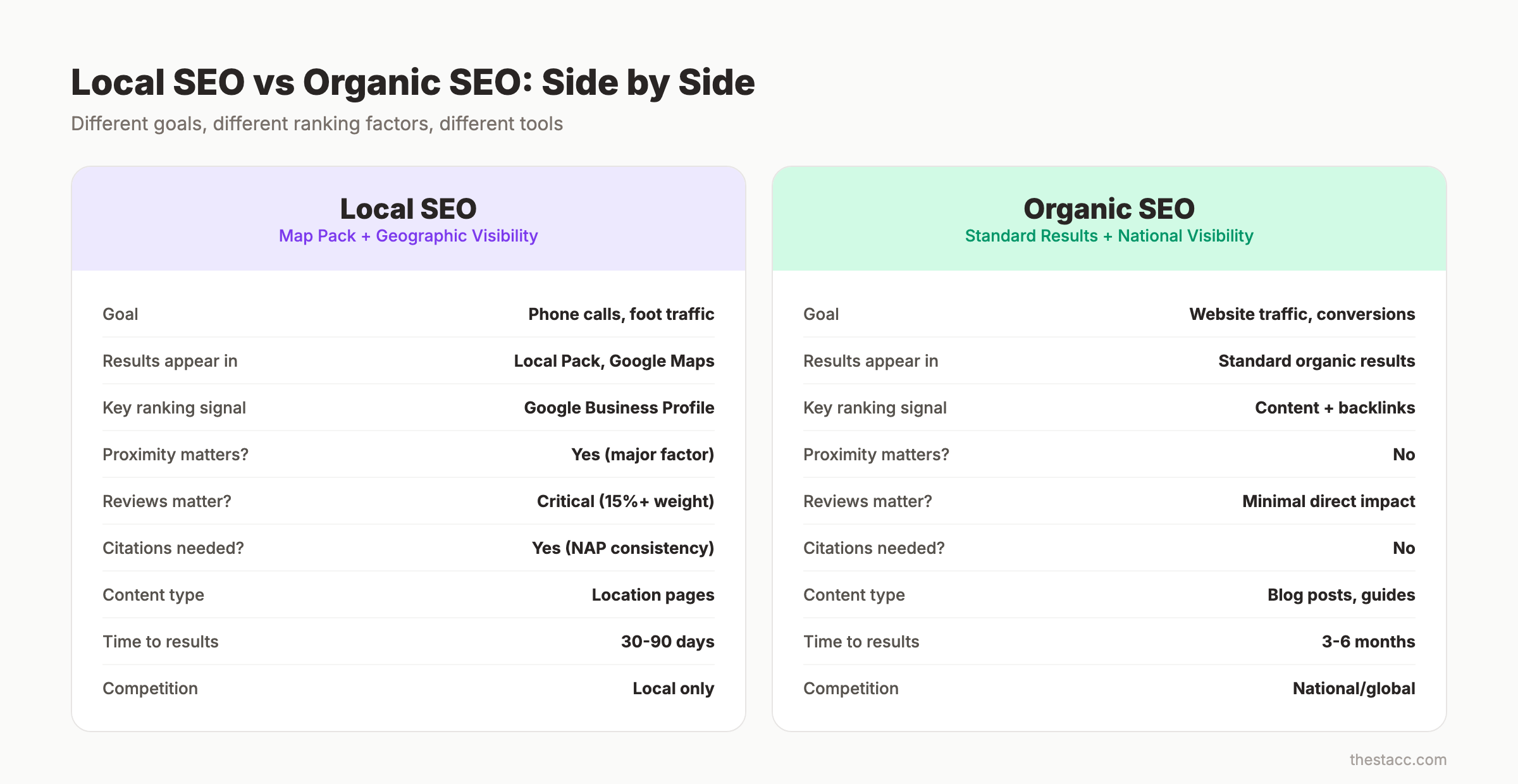
| Factor | Local SEO | Organic SEO |
|---|---|---|
| Primary goal | Map Pack visibility, phone calls, foot traffic | Website traffic, online conversions |
| Where results appear | Local Pack, Google Maps, local organic | Standard organic results (10 blue links) |
| Geographic scope | City, zip code, service area | National, global, or location-independent |
| Key ranking signal | Google Business Profile optimization | Content quality and backlinks |
| Proximity matters? | Yes. Distance from searcher is a ranking factor | No. Location does not affect rankings |
| Reviews matter? | Critical. 15%+ of Local Pack ranking | Minimal direct impact |
| Citations needed? | Yes. NAP consistency across directories | No. Directory listings are optional |
| Content type | Location pages, service-area pages | Blog posts, guides, pillar content |
| Link building | Local directories, community sites, sponsorships | Guest posts, digital PR, editorial links |
| Primary tool | Google Business Profile | Google Search Console |
| Timeline to results | 30-90 days for map visibility | 3-6 months for organic rankings |
| Competition level | Lower (limited to local competitors) | Higher (competing nationally/globally) |
Ranking Factors: What Actually Differs
The ranking factors for local and organic SEO overlap in some areas and diverge sharply in others.
Local Pack Ranking Factors
Google ranks Local Pack results based on 3 primary signals: relevance, distance, and prominence.
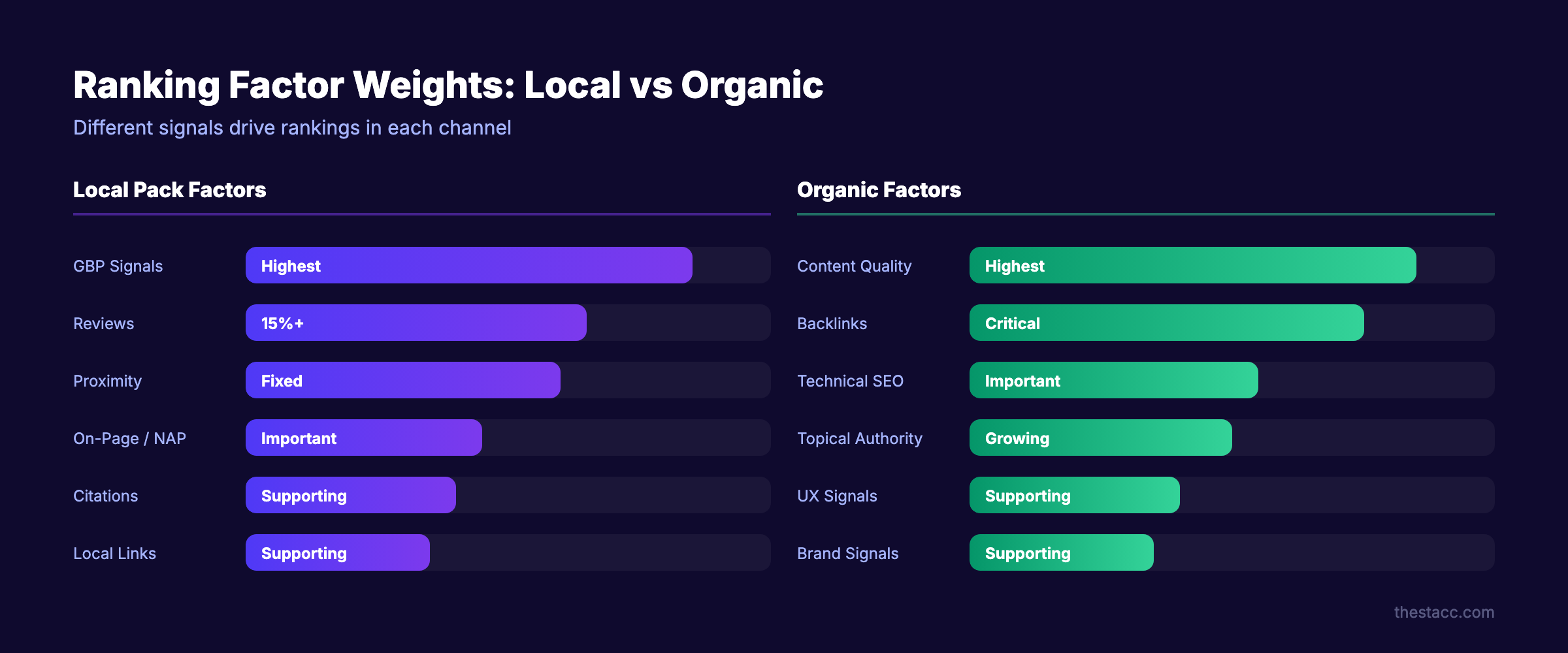
1. Google Business Profile signals (most important)
- Primary category selection
- Business name relevance
- Profile completeness (hours, photos, services, description)
- Regular GBP posts and updates
2. Review signals
- Total review count
- Review velocity (how fast new reviews arrive)
- Average star rating
- Review response rate
- 68% of consumers only use businesses with 4+ star ratings (SeoProfy)
3. Proximity
- Physical distance between the searcher and the business
- You cannot optimize for proximity. It is a fixed factor.
4. On-page signals
- NAP consistency (name, address, phone) on your website
- Local keywords in title tags and content
- Location pages with unique content per city or area
5. Citation signals
- Accurate listings on Yelp, Bing Places, Apple Maps, Facebook
- NAP consistency across all directories
6. Link signals
- Local backlinks from relevant community sources
- Links from local news sites, chambers of commerce, sponsorships
Organic SEO Ranking Factors
Google ranks organic results based on content quality, authority, and technical performance.
1. Content quality and relevance
- E-E-A-T signals (experience, expertise, authoritativeness, trustworthiness)
- Search intent match
- Content depth and thorough topic coverage
2. Backlinks
- Number of referring domains
- Quality and relevance of linking sites
- Link building through guest posts, digital PR, and content
3. Technical SEO
- Page speed and Core Web Vitals
- Mobile-first design
- Clean crawlable site architecture
- Proper XML sitemaps and
robots.txt
4. Topical authority
- Content clusters organized around pillar topics
- Depth of coverage across related subtopics
- Internal linking between related pages
5. User experience signals
- Dwell time and engagement
- Bounce rate relative to search intent
- Click-through rate from SERPs
Stop writing. Start ranking. Stacc publishes 30 SEO articles per month for $99. Content that builds topical authority automatically. Start for $1 →
Which One Does Your Business Need?
The answer depends on your business model and where your customers find you.
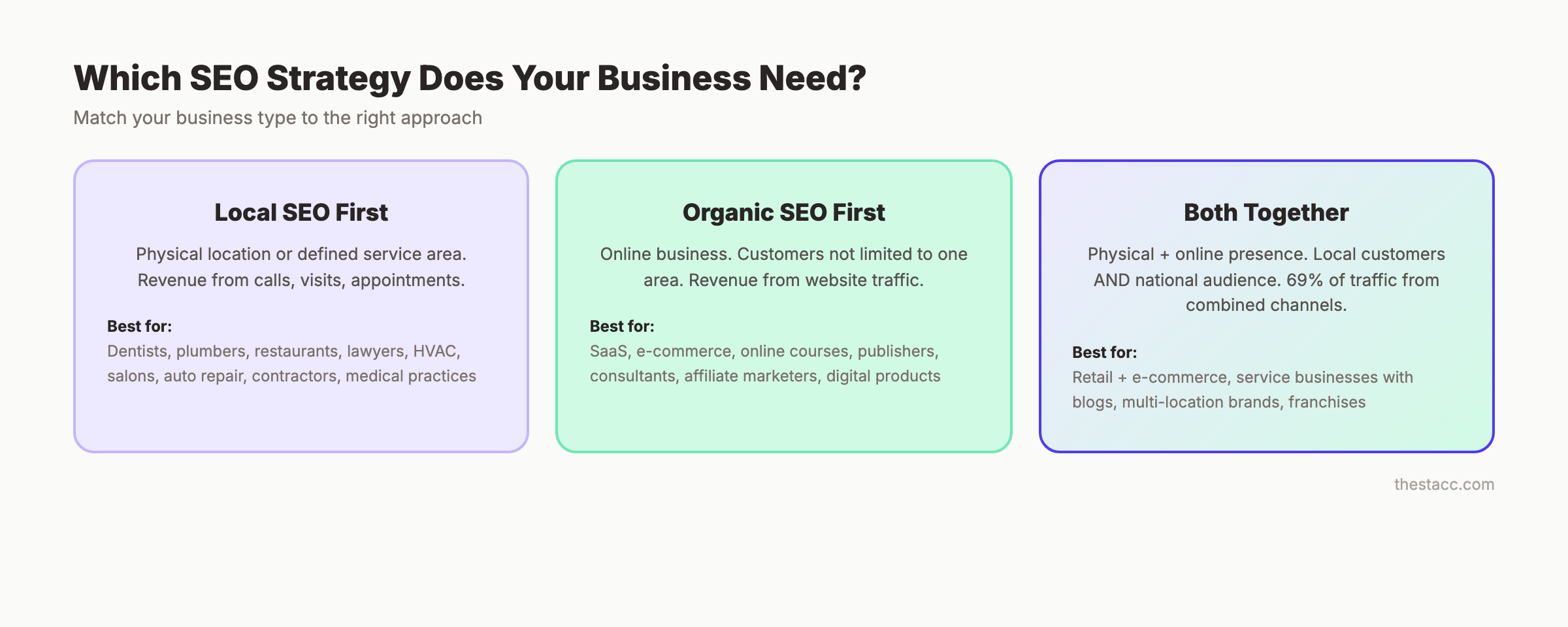
Choose Local SEO If:
- You have a physical storefront customers visit
- You serve a specific geographic area (city, county, region)
- Your revenue comes from phone calls, appointments, or walk-ins
- You are a service-area business (plumber, electrician, cleaning service)
- You operate multiple locations and need visibility in each market
Industries that need local SEO first: Dental offices, law firms, restaurants, HVAC companies, real estate agents, auto repair shops, salons, gyms, medical practices, contractors.
Choose Organic SEO If:
- You sell products or services online
- Your customers are not limited to one area
- Your revenue comes from website traffic and online conversions
- You are building a brand or media presence
- You want to compete for informational and commercial keywords
Industries that need organic SEO first: SaaS companies, e-commerce stores, online education, consulting firms, publishers, affiliate marketers.
Most Businesses Need Both
This is the honest answer. A dentist needs local SEO to appear in map results for “dentist near me.” That same dentist also benefits from organic SEO when publishing a blog post on “how to prevent cavities” that drives traffic and builds authority.
The data supports the combined approach. For location-based businesses, organic search drives 46.5% of traffic and local search drives 22.6%. Together, they account for 69% of all digital traffic.
How Local and Organic SEO Work Together
Local and organic SEO are not competing strategies. They compound each other.
Organic Boosts Local
- A website with strong domain authority ranks higher in the Local Pack
- Blog content targeting local informational queries drives traffic that strengthens domain signals
- Quality backlinks earned through organic content also improve local ranking authority
- Technical SEO foundations (fast site, mobile-friendly) benefit both channels
Local Fuels Organic
- Positive Google reviews send trust signals that improve overall domain credibility
- Local citations create backlinks from directories
- Strong local brand recognition increases branded searches. Branded search volume is an organic ranking signal.
- GBP engagement (clicks, calls, direction requests) correlates with improved organic visibility
The Stacc Stack Method
This is why we built Stacc to handle both. Blog SEO builds organic authority. Local SEO captures map visibility. When you combine 30 blog articles per month with automated GBP posts, the 2 channels reinforce each other. Rankings compound faster than either strategy alone.
Tools Comparison: Local SEO vs Organic SEO
| Purpose | Local SEO Tools | Organic SEO Tools |
|---|---|---|
| Primary platform | Google Business Profile (free) | Google Search Console (free) |
| Rank tracking | Local Falcon, BrightLocal | Ahrefs, Semrush, SE Ranking |
| Citations/listings | Yext, Moz Local, local citation tools | Not applicable |
| Review management | GatherUp, Birdeye, review management tools | Not applicable |
| Content optimization | GBP post tools | Surfer SEO, Clearscope, Frase |
| Technical audit | Local SEO audit tools | Screaming Frog, SEO audit tools |
| Keyword research | Local keyword tools | Keyword research tools |
| Backlink analysis | Not primary focus | Ahrefs, Semrush, Moz |
| Analytics | GBP Insights | Google Analytics 4 |
Cost Comparison
| Investment | Local SEO | Organic SEO |
|---|---|---|
| DIY cost | $0-$50/mo (GBP is free, some citation tools) | $0-$100/mo (GSC is free, paid tools optional) |
| Agency cost | $300-$2,000/mo | $1,000-$5,000/mo |
| Stacc | $49/mo (30 GBP posts) | $99/mo (30 blog articles) |
| Time to results | 30-90 days | 3-6 months |
| Ongoing effort | Weekly GBP posts, review responses, citation updates | Monthly content publishing, link building, technical maintenance |
Local SEO typically costs less and shows results faster. Organic SEO requires more investment upfront but produces compounding returns over time.
Rank everywhere. Do nothing. Blog SEO, Local SEO, and Social on autopilot. Stacc starts at $49/mo. Start for $1 →
5 Myths About Local SEO vs Organic SEO
Myth 1: “They are the same thing.” They share a foundation (quality website, good content). But local SEO has unique ranking factors like proximity, GBP signals, reviews, and citations that organic SEO does not.
Myth 2: “You have to choose one.” The data shows businesses using both drive 69% of digital traffic from the combined channels. Choosing one leaves significant visibility on the table.
Myth 3: “Small businesses cannot compete with big brands.” In local SEO, proximity levels the playing field. A well-optimized single-location business can outrank a national chain in the Local Pack because it is closer to the searcher.
Myth 4: “Reviews only matter for local SEO.” Reviews also influence click-through rates, brand trust, and conversion rates. 95% of consumers check online ratings before purchasing from any business, online or local.
Myth 5: “Organic SEO does not affect local rankings.” A website with strong organic authority ranks higher in the Local Pack. Backlinks, content quality, and technical performance all feed into local ranking signals.
FAQ
What is the difference between local SEO and organic SEO?
Local SEO optimizes your visibility in Google Maps and the Local Pack for geographic searches. Organic SEO optimizes your visibility in the standard search results for non-location queries. Local SEO relies on Google Business Profile, reviews, and citations. Organic SEO relies on content quality, backlinks, and technical performance.
Is local SEO more important than organic SEO?
For businesses with a physical location or service area, local SEO often delivers faster results. But organic SEO builds long-term authority that also improves local rankings. Most businesses benefit from both. Local captures ready-to-buy searchers. Organic captures informational searchers earlier in the funnel.
How long does local SEO take vs organic SEO?
Local SEO typically shows results in 30-90 days. Claiming and optimizing a GBP listing can produce map visibility within weeks. Organic SEO takes 3-6 months for meaningful ranking improvements. The exact timeline depends on competition, domain authority, and content velocity.
Can I do local SEO without a physical address?
Yes. Service-area businesses (plumbers, cleaners, contractors) can create a Google Business Profile without displaying a physical address. You define your service area by city or radius instead.
Do I need a Google Business Profile for SEO?
If you serve customers in a specific geographic area, yes. A GBP listing is mandatory for Local Pack visibility. Without it, you will not appear in map results for any local query. If your business is entirely online with no geographic focus, a GBP is not necessary.
Does blogging help local SEO?
Yes. Blog content builds domain authority, earns backlinks, and creates internal linking opportunities. All 3 factors improve your website’s overall SEO strength, which directly influences Local Pack rankings. Publishing local-focused blog content (e.g., “Best neighborhoods in [city]”) also targets local informational queries.
Local SEO and organic SEO serve different purposes. Local SEO gets you into map results and drives phone calls. Organic SEO gets you into standard results and drives website traffic. The businesses that rank best use both strategies together, with each channel strengthening the other. Start with whichever channel matches your most immediate revenue goal, then add the second channel within 3 months to capture the compounding effect.
Written and published by Stacc. We publish 3,500+ articles per month across 70+ industries. All data verified against public sources as of March 2026.