25 questions to ask a marketing agency before you sign. Covers accountability, AI usage, data ownership, and the red flags most guides skip.
Ask a marketing agency about accountability, reporting, AI usage, data ownership, and staffing before you sign anything. The 25 questions below are grouped by what matters most rather than by department, so you can spot a bad fit in the first meeting instead of in month six.
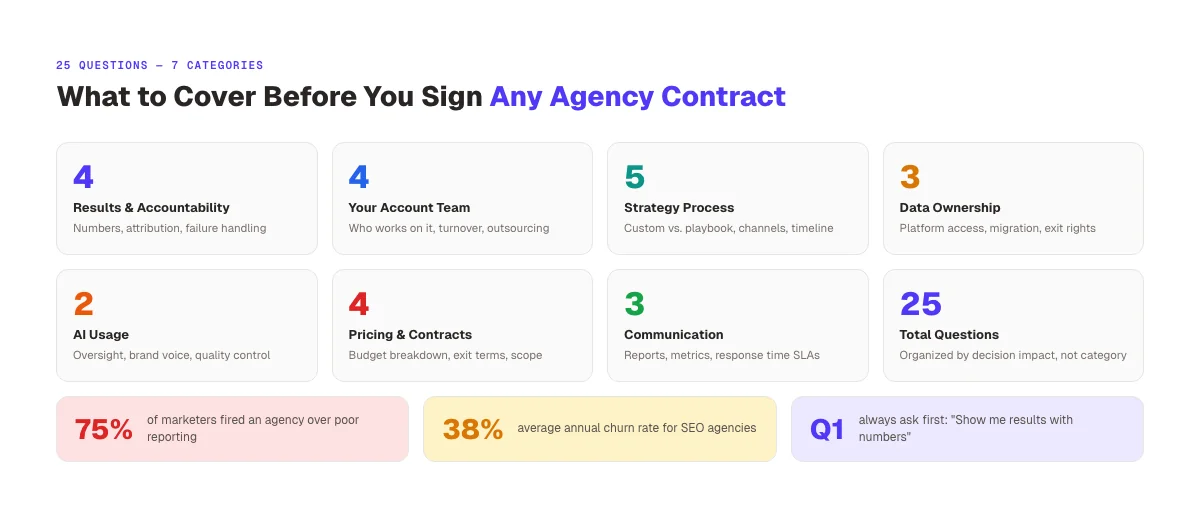
This is a list of 25 essential questions to ask a marketing agency before you sign a contract.
75% of marketers have fired an agency specifically because of poor reporting. Most of them wish they had asked better questions upfront. These 25 questions are organized by what matters most. Not by alphabet or department. So you can identify bad fits fast and find an agency worth trusting.
Let's get started.
Three Questions to Ask Yourself Before the First Meeting
Before you ask a single question to an agency, answer these three internally. The answers determine what kind of agency you actually need. And whether you are ready to work with one at all.
Internal Question 1: What does success look like in 12 months. In numbers we can measure?
Not "more visibility." Not "better brand recognition." Specific, measurable outcomes: X leads per month, Y% increase in organic traffic, Z% of revenue attributable to marketing.
If your team cannot answer this question, any agency you hire will define success for you. And they will define it in whatever terms are easiest to hit. Impressions. Follower counts. Page views. You pay for metrics that feel good and mean nothing.
Define your own success criteria before anyone else does.
Internal Question 2: Do we have the internal bandwidth to support an agency relationship?
Agencies need things from you. Brand guidelines, product information, stakeholder approvals, photo assets, access to subject matter experts. Some need weekly check-in time from a marketing lead. Some need monthly strategy reviews with a decision-maker.
A common pattern: a business hires an agency expecting to hand off everything, the agency asks for assets and approvals, the client goes quiet, the agency produces generic output, the client cancels. Not because the agency was bad. Because the client was not ready.
Ask yourself: who on your team owns the agency relationship, and how many hours per week can they dedicate?
Internal Question 3: What have you already tried. And what did you learn from it?
Every failed marketing attempt contains data. Campaigns that did not convert tell you something about your audience, your offer, or your timing. Channels that produced zero leads reveal positioning gaps, not just execution failures.
Document what you have tried and what you learned before talking to agencies. Agencies who ask you this question before pitching their solution are worth trusting. Agencies who skip this question and pitch the same package to every client are not.
Questions About Results and Accountability
These 4 questions come first because they eliminate the most bad fits the fastest. Any agency that deflects on results or accountability is telling you everything you need to know.
Question #1: What specific results have you produced for businesses like mine. With numbers?
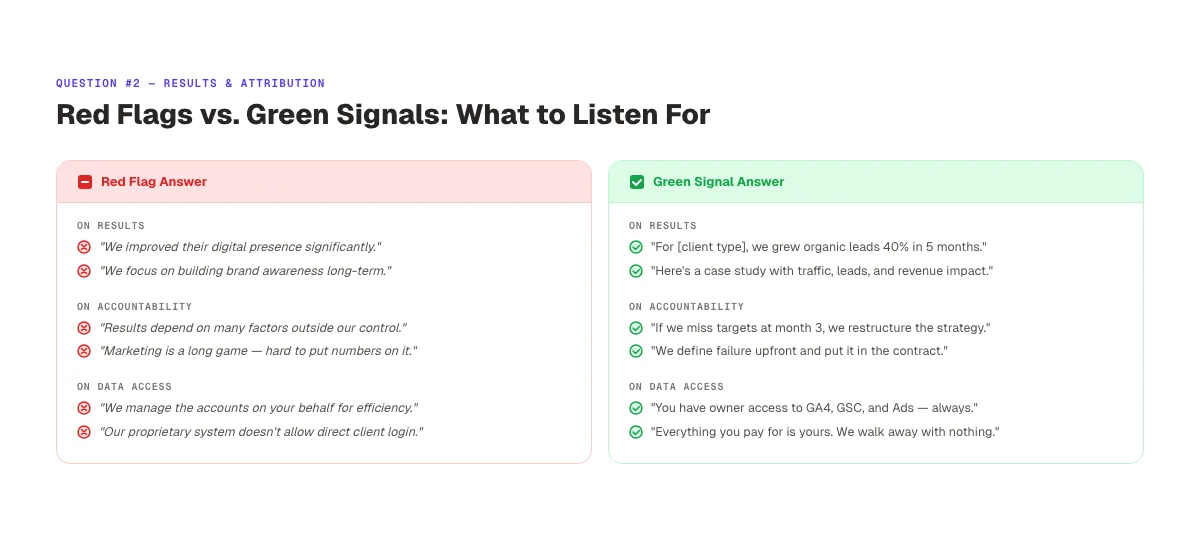
This is the single most important question on this list. Do not accept vague answers like "we improved their digital presence" or "we drove significant growth." Push for: traffic numbers, lead volume, conversion rates, revenue impact, and timeline. Ask for 2-3 examples with comparable business size, industry, and starting position.
A good agency has this data ready. A bad agency has excuses for why they cannot share it.
Question #2: How do you connect marketing activity to revenue. Not just to traffic?
Traffic is not a business outcome. Impressions are not a business outcome. Leads are a start. Revenue is the goal.
Ask the agency to walk you through their attribution model. How do they track which campaign drove a phone call, a form fill, or a purchase? Do they use UTM parameters, CRM integrations, or call tracking? An agency that focuses only on top-of-funnel vanity metrics will never help you grow the bottom line.
This question separates the scoreboard-watchers from the business builders.
Question #3: What happens if we miss our targets. Is there any performance accountability?
Most agencies build contracts that protect them from results. They define success loosely ("increase brand awareness"), report on activity metrics, and call it a win. Ask directly: what happens if organic traffic does not grow after 6 months? What happens if paid campaigns underperform?
A performance-minded agency will have an honest answer here. They may not guarantee results. And you should be skeptical of anyone who does. But they should be willing to define failure and explain what they do about it. Compare this to the done-for-you vs. DIY vs. agency SEO model to understand where accountability typically lives.
Question #4: Can you show me a case where you failed to meet a client's expectations. And what changed?
This question reveals character faster than any other.
Every agency that has existed for more than 2 years has had a client outcome that did not go as planned. An agency that cannot answer this honestly is either inexperienced or hiding something. The right answer is specific: "We took on a client in [industry], set goals that were too aggressive for their timeline, and had to restructure the engagement in month 3. Here is what we changed."
Honesty about failure builds far more trust than a polished success story.
Skip the agency. Keep the results. theStacc publishes 30 SEO articles per month for $99. With a 92% average SEO score and zero writing on your end.
Questions About Your Account Team
The people who pitch you are rarely the people who do the work. These questions ensure you know exactly who manages your account.
Question #5: Who exactly will work on my account day to day. Name and role?
Agencies win business with their most impressive staff. They deliver with whoever is available.
Ask for the specific name and role of your account manager, strategist, and content lead. Ask to meet them before signing. If the agency is unwilling to introduce you to your actual team before the contract is signed, that is a significant warning sign.
Question #6: What is your annual team turnover rate?
High turnover means institutional knowledge walks out the door with every departure. Your strategy, your history, your preferences. All of it restarts when an account manager leaves.
A healthy agency has turnover under 20%. A struggling one rotates staff every 6-9 months and rarely mentions it. Ask directly. If they do not track it, that is the answer.
Ask one follow-up: "What happens to my account when my account manager leaves?" The correct answer is: a documented transition process with overlap time. The wrong answer is: "We assign a new manager and get them up to speed quickly." That means you pay for a ramp period every time the agency has a staffing change.
Question #7: Do you outsource any of the work, and if so, to whom?
Many agencies sell custom work and deliver templated output from a white-label provider. There is nothing inherently wrong with outsourcing. But you have a right to know.
Ask specifically: "Do you use white-label content, freelance writers, or overseas fulfillment for any deliverable?" If the answer involves third parties, ask how quality is controlled and who owns the relationship. Read our guide on white label SEO content to understand how this model typically works.
Question #8: What certifications or ongoing training does my assigned team have?
Platforms change constantly. Google Ads, Meta, GA4, SEO algorithms. All of it shifts multiple times per year. An agency that was great in 2022 may be running outdated playbooks in 2026.
Ask specifically about Google certifications, Meta Blueprint, HubSpot credentials, and any ongoing education programs. Ask when the last major platform change affected their strategy and how they adapted.
Questions About Their Strategy Process
Generic strategies produce generic results. These questions reveal whether the agency thinks or just templates.
Question #9: Walk me through how you build strategy for a new client. Step by step.
Ask this open-ended and listen carefully. A strong agency describes: a discovery process, competitive research, audience analysis, channel selection rationale, and a phased rollout. They ask questions before prescribing anything.
A weak agency says: "We start with a social media audit, then build a content calendar." That is a tactic, not a strategy.
Listen specifically for how long the discovery phase takes. Strong agencies spend 2-4 weeks on research before making any recommendations. Agencies that pitch a strategy in the first sales call have not done the research. They are pitching the same package they sell to everyone. If they know your entire marketing strategy before asking a single question about your business, that is all the information you need.
Question #10: How do you customize strategy versus applying a standard playbook?
Most agencies have a standard playbook. That is not automatically bad. Efficient playbooks are built from what works. But a good agency knows when to deviate.
Ask: "If our business does not fit your standard model, what happens?" Watch for defensiveness. The best answer is: "We use the playbook as a starting framework, but we modify it significantly based on your competitive position, budget, and audience behavior."
Question #11: Which marketing channels are you recommending for us, and why. Specifically?
If the agency leads with channels before understanding your business, treat it as a red flag. Channel selection should follow audience analysis, competitive positioning, and your existing organic presence. Not the other way around.
Ask: "Why this channel over others?" If the answer is "because everyone in your industry uses it," find a different agency.
Question #12: What does your competitor research process look like?
Every business has SEO competitors that differ from their direct business competitors. Agencies that skip competitive research miss the most important context for content strategy, keyword selection, and channel prioritization.
Ask for a sample competitive analysis. Ask whether they look at organic search competitors, paid search competitors, and content competitors separately. This matters for B2B SEO and lead generation SEO especially, where competitive gaps drive the entire content strategy.
Question #13: How long before we should expect to see measurable results. Realistically?
The honest answer depends on the channel. Paid media produces results in days. SEO takes 60-90 days for initial movement and 4-6 months for meaningful traffic growth. Content marketing compounds over 12+ months.
If an agency promises fast results on channels known for long timelines, they are either misleading you or planning to report on vanity metrics that move quickly. Ask for the specific timeline by channel and by metric. Get it in writing.
Your SEO team. $99/month. 30 optimized articles, published automatically, starting in 60-90 days. No writing, no briefing, no management.
Questions About Data Ownership and Access
This section covers the questions clients most commonly regret not asking. Data ownership issues only surface when the relationship ends. Which is exactly when you need the data most.
Question #14: Who owns the accounts, ad spend, and digital assets if we end the relationship?
Some agencies build your Google Ads account under their own MCC. Some host your website on servers they own. Some maintain your social profiles as the primary admin.
When you leave, you may leave without your ad history, your conversion data, your domain, or your audience lists. Ask explicitly: "If we end the engagement tomorrow, what do we take with us and what do we lose?" The answer should be: "Everything. You own it all."
Question #15: Will I have direct admin access to every platform you use on my behalf?
This is non-negotiable. You should have owner-level access to: Google Analytics 4, Google Search Console, Google Ads (if applicable), Meta Business Suite, and any CMS or website the agency builds or manages.
Agencies that refuse direct client access to platforms are protecting their own position, not yours. An agency confident in their results has no reason to hide the data.
Question #16: How do you handle data history and account migration if we switch providers?
Ask this even if you have no intention of switching. The answer reveals whether the agency considers your long-term data health or only their short-term retention.
A good answer includes: documented handoff procedures, data export processes, and a transition period with overlap. Use the SEO ROI calculator to understand what organic search data is worth protecting over time.
Questions About AI Usage
These questions separate agencies that use AI thoughtfully from those who use it indiscriminately. And blame you when the output is wrong.
Question #17: How does your team use AI in content creation, strategy, and analysis. And who reviews the output?
AI in agencies is no longer a differentiator. Everyone uses it. The question is: how carefully?
Ask for specifics: "Do you use AI to draft copy that humans edit, or do AI outputs go directly to clients?" Ask about hallucination risks. AI tools regularly produce confident-sounding misinformation. Ask who on the team is responsible for fact-checking AI-generated content before it reaches your audience.
Ask whether AI is used for drafts, for research, for analysis, or for strategy. Each use case carries different risks. AI-generated research without source verification is particularly dangerous. Incorrect statistics and fabricated citations are common outputs from unchecked AI tools.
An agency without a clear answer to this should not be creating content for your brand. Compare how marketing agencies use AI tools versus building internal content capacity. The tradeoffs are significant.
Question #18: What safeguards do you have against AI outputs that contradict your brand voice or contain errors?
AI tools are trained on general content. They do not know your brand voice, your customer's language, your competitor positioning, or your regulatory environment unless someone trains them carefully.
Ask: "How do you train AI tools on our brand guidelines?" and "What is your process when AI output is factually wrong or off-brand?" If the agency has no documented quality control process, their AI usage is a liability, not an asset.
Questions About Pricing and Contracts
Most disputes between clients and agencies come down to expectations about money and scope. Ask these questions before you sign.
Question #19: What does my monthly retainer actually buy. Where does the budget go?
"$3,000/month" means nothing without a breakdown. Ask for a detailed scope: how many hours, which deliverables, how many articles, how many ads, how many reports. Ask what percentage goes to platform spend versus labor versus tools.
This question protects you from paying agency markup on ad spend. A common practice where agencies take 15-20% of your media budget as a "management fee" without disclosing it. See a full breakdown of what a marketing agency actually costs before you commit to any contract.
Question #20: What are your minimum contract terms. And what is your cancellation policy?
Some agencies require 6-month minimums. Some charge 30-day notice. Some have early termination fees that cost more than the remaining contract value.
Ask for the exact cancellation language before signing. A confident agency with strong results does not need to lock clients in with punitive exit terms. If they do insist on long minimums, ask what you get in return for that commitment. Guaranteed headcount, locked-in pricing, performance reviews.
One month notice is fair for agencies with clear deliverables. Three months is borderline. Six months or more with no performance clause is a trap. The right framing is: "We are confident enough in our work that we only ask you to stay as long as we are earning it." Any other framing protects the agency, not you. If you are evaluating alternatives to traditional agencies, see our comparison of done-for-you SEO which operates without long-term lock-in requirements.
Question #21: How do you handle requests that fall outside the original scope?
Scope creep is how agency relationships deteriorate. You ask for one extra article. They quote you $500. You ask for a landing page revision. They say it is out of scope.
Ask for their change order process in writing: how requests are scoped, how pricing is determined, and what the approval process is. Agencies without a clear change order process will either do extra work for free (and resent it) or charge arbitrary rates without transparency.
Question #22: Are there setup fees, tool subscriptions, or markups that I am not seeing in your quoted price?
Some agencies charge onboarding fees of $500-2,500 that appear after you sign. Some build their tool subscriptions (Semrush, Ahrefs, design software) into your retainer without disclosing the cost. Some mark up ad spend.
Ask: "Is the price you quoted me the complete cost? Are there any fees, tools, or expenses not included in this number?" If they hesitate, ask again.
Questions About Communication and Reporting
The number one reason clients fire agencies is not poor results. It is poor communication. These questions establish your expectations before they become conflicts.
Question #23: How often will you report results. And what exactly will those reports include?
Ask for a sample report. A real one, from a real client. Look for: month-over-month traffic trends, keyword ranking movement, conversion data, and a plain-English explanation of what happened and why.
Reports that are only screenshots of dashboards are a red flag. Reports that contain interpretations: "we saw a 12% traffic drop because of the Google core update in March, and here is our response plan". Are from an agency that actually understands your account. For reference, our guide to SEO reporting shows what strong monthly reports contain.
Question #24: What metrics will you track, and which ones do you consider vanity metrics?
This question reveals how the agency thinks. A strong answer names specific business-impact metrics. Leads generated, revenue attributed, cost per acquisition. And explicitly calls out what they deprioritize.
"We do not report on raw followers or impressions as success metrics" is a great sign. "We focus on building your brand presence" is a sign to keep asking questions.
Ask how they handle a month where business metrics are flat but vanity metrics are up. Do they call it a success because impressions increased? Or do they investigate why traffic growth is not converting into leads? The answer tells you whether the agency is reporting for your benefit or for their own job security.
Every marketing metric should connect to a business outcome. If the agency cannot explain the direct line from their reported number to your revenue or lead pipeline, that metric does not belong in your report.
Question #25: Who is my primary contact, and what is your committed response time?
You should have one named person to contact for anything. Not a general inbox. Not a rotating support queue. One human who knows your account, checks their email, and responds within a defined window.
Ask for the specific response time commitment in writing: "All client questions are answered within ✓ business hours." If they will not commit to a number, they will not commit to the standard.
3,500+ blogs published. Every article is SEO-scored before publish. theStacc handles content SEO on autopilot. No agency required, no writing, no delays.
Your Pre-Signing Checklist
Before signing any agency contract, verify all of these. If any box is unchecked, raise it explicitly before committing.
- ✓ You have spoken to your actual account team. Not just the sales team
- ✓ You have seen case studies with real numbers from comparable businesses
- ✓ You have confirmed direct admin access to every platform the agency will manage
- ✓ You understand exactly what your monthly budget pays for, line by line
- ✓ You have read the cancellation clause and understand the exit terms
- ✓ You know the specific KPIs the agency will report against each month
- ✓ You have confirmed data ownership. All assets stay with you at exit
- ✓ You know how the agency uses AI and who reviews the output
- ✓ You have defined what success looks like in writing, with timelines
- ✓ You have confirmed a single named primary contact with a response time commitment
If you are filling this out and realizing you have not asked half these questions, go back. The conversation is worth having before you are locked in.
Red Flags That Override Everything Else
Ask all 25 questions and still watch for these signals. Any one of these is sufficient reason to walk away.
| Red Flag | What It Signals |
|---|---|
| Guaranteed rankings or viral results | Dishonesty. No agency controls algorithms |
| Reluctance to give you direct platform access | They intend to hold your data hostage at exit |
| No case studies from comparable businesses | Inexperience or hidden failures |
| Can't name who works on your account | Bait-and-switch incoming |
| Pushes 12-month contracts before proving value | They know results will be slow |
| Reports only on impressions and follower counts | They track what they can control, not what you need |
| Long legal review of your questions | They have been burned. Or have burned clients. Before |
What practitioners are saying on X
Agency and white-label models evolve fast. Here is operator signal from X on tooling and service delivery.
- @syedbalkhi (Sep 2024): White-label pro services can add multi-six-figure revenue without building an in-house services org — partner delivery behind the brand. See the post on X.
- @ConnorGillivan (Jul 2026): 2026 SEO stack favorite list: Semrush/Ahrefs, GSC, Surfer, KeywordInsights, ChatGPT, SEOwind, Screaming Frog, ClearScope, GA4, Notion/Airtable — tools amplify systems, they don’t replace them. See the post on X.
- @jakezward (Feb 2026): 2026 SEO predictions emphasize AI Overview share-of-SERP, schema for LLM token efficiency, brand mentions in AI answers as a KPI, proprietary data as a moat, and content refresh beating net-new AI slop. See the post on X.
Grok, AI Overviews, and multi-engine visibility
For “questions to ask marketing agency”, multi-engine visibility still starts with clear definitions, sourced numbers, and extractable section answers. Grok additionally factors live X discussion — keep public claims consistent with this page.
- Google AI Overviews: Use passage-ready answers, tables, and FAQ schema where relevant.
- ChatGPT / Perplexity: Cite named sources next to key claims.
- Grok: Maintain accurate entity facts on-site and in high-signal X posts.
FAQ
Ask the 7 most important questions first: results with numbers, revenue attribution, accountability mechanisms, who works on your account, data ownership, contract cancellation terms, and reporting format. If those answers are unsatisfactory, the remaining 18 do not matter. If those answers are strong, use the rest to build a complete picture before signing.
Not defining success before signing. Clients who hire an agency without specifying exact KPIs, timelines, and what constitutes unsatisfactory performance have no legal or moral standing to complain when results disappoint. Define success in writing. In the contract, not just in conversation.
Depends on your situation. A specialist agency (SEO-only, paid media only, content only) typically goes deeper and produces better results in their narrow area. A full-service agency offers coordination across channels but often spreads expertise thin. For most growing businesses, start with the channel that drives the most measurable ROI. Usually SEO or paid search. Before adding channels.
For SEO: $1,500-$5,000/month minimum for ongoing work at a reputable agency. For paid media: budget $2,000-$5,000/month minimum in ad spend plus 10-20% management fees. Anything below these thresholds usually buys minimal deliverables and inconsistent attention. Compare that to what a marketing agency actually costs for a full breakdown by service type.
When you do not have defined goals, when your internal team cannot support basic asset creation (photography, brand guidelines), or when your budget requires the agency to cut corners to make the economics work. Consider done-for-you SEO services as an alternative. Narrower in scope, lower in cost, and more transparent in what gets delivered.
Now you have 25 questions that actually protect you. And the answers to listen for.
The best agencies welcome every question on this list. They have heard them all before, they have strong answers, and they are glad you asked. The worst agencies deflect, generalize, and make you feel difficult for asking. That reaction is your answer.
If SEO content is part of what you need but not the full agency package, theStacc publishes 30 articles per month for $99. Fully optimized, no writing on your part, with rankings that start moving in 60-90 days.
Sources & references
- [1] Princeton / Georgia Tech et al. — GEO research (arXiv:2311.09735)
- [2] @hridoyreh on X — Widely shared SEO skill tree: foundations, research, technical, on-page, content, links, AI SEO/GEO, analytics, UX, bran
- [3] @jakezward on X — 2026 SEO predictions emphasize AI Overview share-of-SERP, schema for LLM token efficiency, brand mentions in AI answers

Plan topics, review article drafts, and publish to a connected CMS.
Weekly local SEO teardowns
One practical email a week. Map Pack, GBP, AI Overviews — no fluff. Unsubscribe anytime.