Your complete SEO contract template guide: scope of work, payment terms, IP ownership, and cancellation clauses. With real language examples. 2026.
An SEO contract needs eight things: named parties, a scope with defined deliverables, payment terms and late fees, a timeline with reporting cadence, a no-guarantees performance clause, IP and data ownership, confidentiality and termination terms, and a change-order process. This guide gives sample language for each of them.
One missing clause in an SEO contract can cost an agency months of unpaid work. One vague deliverable can turn a $3,000/month client into a liability.
Most SEO contracts fail before they are signed. Agencies copy templates from the internet, miss 4 or 5 critical sections, and discover the gaps when a client disputes a scope change or demands a ranking guarantee. By then, the damage is done.
We have published 3,500+ SEO articles across 70+ industries. We work with agencies on both sides of client relationships. This guide covers every clause an SEO contract needs. With real language examples.
In this guide, you will learn:
- The 10 sections every SEO contract must include
- Exact language for scope creep, performance expectations, and termination
- What to never put in an SEO contract (ranking guarantees)
- How to handle IP ownership, data access, and tool handover
- The change order process that stops scope creep before it starts
Table of Contents
- Chapter 1: Why Your SEO Contract Matters More Than Your Pitch
- Chapter 2: Parties, Scope, and Deliverables. The Foundation
- Chapter 3: Payment Terms, Late Fees, and Work Suspension
- Chapter 4: Timeline, Milestones, and Reporting Requirements
- Chapter 5: Performance Expectations and the No-Guarantees Clause
- Chapter 6: Intellectual Property, Data Ownership, and Tool Access
- Chapter 7: Confidentiality, Termination, and Legal Clauses
- Chapter 8: The Change Order Process. Your Scope Creep Defense
Chapter 1: Why Your SEO Contract Matters More Than Your Pitch
A signed SEO contract does 3 things a proposal cannot.
First, it defines what the engagement actually is. In terms both parties have agreed to. Second, it creates a paper trail when deliverables are disputed. Third, it ends the relationship cleanly when either party needs to walk away.
Most agencies put more effort into their pitch deck than their contract. That is backwards. The pitch gets you the client. The contract is what you both live with for the next 6–12 months.
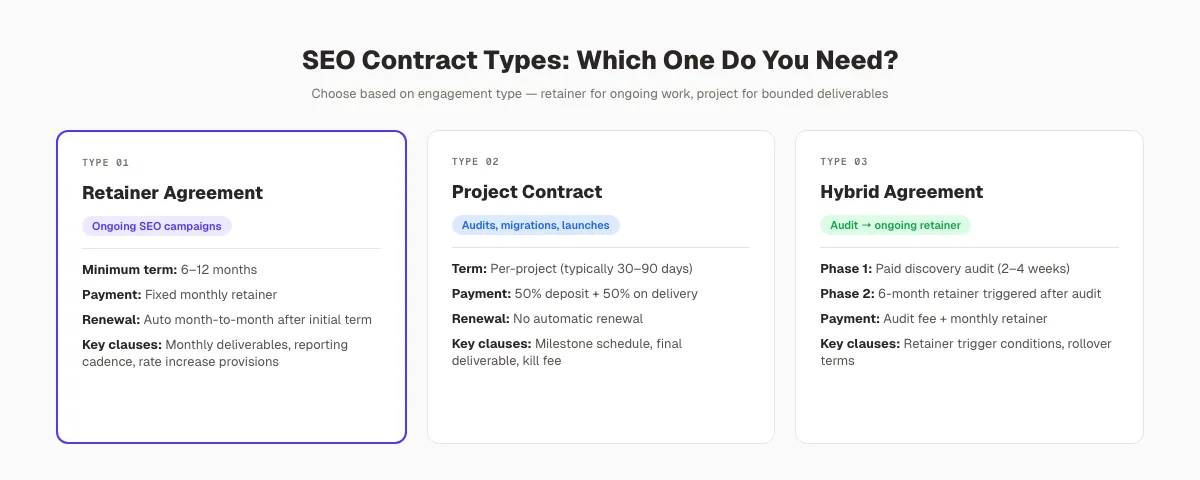
Retainer vs. Project Contract: Which One Do You Need?
The type of contract you use depends on the engagement type.
| Contract Type | Best For | Minimum Term | Key Clauses |
|---|---|---|---|
| Retainer Agreement | Ongoing SEO campaigns | 6–12 months | Monthly deliverables, reporting, renewal |
| Project Contract | Audits, migrations, launches | Per-project | Milestone schedule, final deliverable, kill fee |
| Hybrid | Initial audit + ongoing retainer | 6 months post-audit | Audit deliverable + retainer trigger |
Retainer contracts are the standard for ongoing SEO work. A minimum term of 6 months is industry consensus. SEO results rarely appear in under 3 months, and clients who leave at month 2 blame the agency. A 6-month minimum aligns client expectations with realistic timelines.
Project contracts work for defined, bounded work: a technical SEO audit ($2,500–$10,000), a site migration, or a local SEO setup. The deliverable is clearly defined, the timeline is fixed, and the payment structure is milestone-based.
Most new clients start with a hybrid: a paid discovery audit followed by a retainer offer. The audit funds the first phase and proves capability before either party commits to an ongoing relationship.
Chapter 2: Parties, Scope, and Deliverables. The Foundation
Every SEO contract starts with 3 building blocks. Miss any one of them and every other clause becomes ambiguous.
Section 1: Parties
Name both parties exactly as they appear on legal business registration documents. Include:
- Full legal business name (not trade name)
- Business address
- Primary contact name and email
- Authorized signatory name and title
This matters in disputes. "Client: Sarah's Marketing LLC" means something legally. "Client: Sarah" does not.
Section 2: Scope of Work
The scope of work is the most important section in an SEO contract. Vague scope language is the source of nearly every client-agency dispute.
The scope must define two things: what IS included, and what is NOT included.
What is included. Example language:
Services include: monthly keyword research update (target keyword list review and expansion), on-page optimization for up to 5 designated pages per month, creation and publication of 8 blog posts per month (800–1,200 words each), monthly technical SEO audit and priority fix implementation, Google Business Profile post publishing (8 posts per month), and monthly performance report.
What is NOT included. Example language:
The following are not included in this agreement and will require a separate Change Order: paid media management, website redesign or development, social media content creation, email marketing, reputation management, and any SEO work for additional domains not listed in this agreement.
Without a "not included" clause, every client request becomes a negotiation. With it, you have a clear baseline for change orders.
Section 3: Deliverables Table
Make every deliverable specific and measurable. Vague deliverables like "ongoing SEO optimization" have no acceptance criteria. Specific deliverables have measurable outcomes.
| Deliverable | Quantity | Frequency | Acceptance Criteria |
|---|---|---|---|
| Blog posts published | 8 | Monthly | Published on client CMS, 800+ words, target keyword optimized |
| Technical fixes | Priority issues | Monthly | Resolved on client site within 5 business days of flagging |
| Keyword ranking report | 1 | Monthly | Delivered by 5th of each month via shared dashboard |
| Strategy call | 1 | Monthly | 30-minute video call, recorded if client requests |
| GBP posts | 8 | Monthly | Published directly to Google Business Profile |
Quantified deliverables set expectations before work begins. They also create the basis for a change order when a client asks for more than the agreement covers.
Stop writing. Start ranking. theStacc publishes 30 SEO articles per month for $99. Fully optimized, automatically delivered to your site. No contract headaches.
Chapter 3: Payment Terms, Late Fees, and Work Suspension
Payment disputes end more agency relationships than poor SEO results. Clear payment language prevents most of them.
Retainer Structure
State the monthly retainer amount in full. Example:
Client agrees to pay a monthly retainer of $3,500 USD. Invoices are sent on the 1st of each month and are due on the 5th. Payment is accepted via bank transfer or credit card as specified in the invoice.
Include setup fees as a separate line item. An initial audit, onboarding, or technical foundation work is not part of the monthly retainer. Charging for it separately , $1,000–$3,000 is standard. Is fair and transparent.
Late Payment Fee
A late payment clause protects your cash flow without burning the relationship. Industry standard is 1.5–5% per month on overdue balances. Example:
Invoices unpaid after 10 days from the due date accrue a late payment fee of 1.5% per month on the outstanding balance. Work may be paused if payment is more than 15 days overdue without written explanation. Work will resume within 2 business days of payment receipt.
Work Suspension Clause
The work suspension clause is the most important payment protection tool in an SEO contract. Without it, you have no recourse when a client does not pay. You simply keep working for free.
The clause should clearly state that delivery of services stops when payment is overdue past a defined threshold. Most agencies use 15 days. Reactivation should require full payment of outstanding balance before work restarts.
Review our guide to SEO agency pricing models for full retainer pricing benchmarks across business types.
Upfront vs. Milestone Payments for Projects
Project-based contracts should require a deposit. Standard practice:
- 50% upfront, 50% on delivery for projects under $5,000
- 33% upfront, 33% at midpoint, 33% on delivery for projects $5,000–$15,000
- Custom milestone schedule for projects above $15,000
Never start project work without a deposit. The deposit funds initial labor and signals client commitment.
Chapter 4: Timeline, Milestones, and Reporting Requirements
A contract without a timeline is a contract without accountability. Both parties need to know when work starts, what happens at each interval, and when reports land.
Minimum Term and Renewal
Standard minimum term for a retainer contract: 6 months. This gives SEO work enough time to show results and protects the agency from clients who cancel at month 2 when rankings have not moved.
Include an automatic renewal clause with a defined notice window. Example:
This agreement has an initial term of 6 months from the start date. Upon completion of the initial term, this agreement automatically renews on a month-to-month basis unless either party provides 30 days' written notice of non-renewal. Either party may terminate this month-to-month extension with 30 days' written notice.
Milestone Schedule
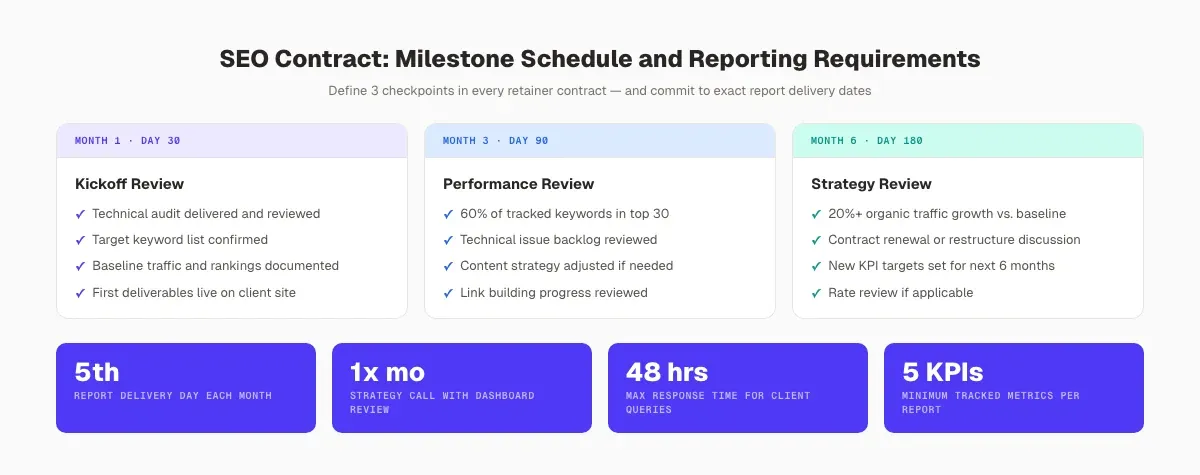
For retainer agreements, define at least 3 checkpoints: a 30-day kickoff review, a 90-day performance review, and a 180-day strategy review. These create structured moments to assess progress and reset expectations.
For project contracts, define specific milestones:
- Milestone 1: Delivery of full technical SEO audit (Day 14)
- Milestone 2: On-page implementation complete (Day 30)
- Milestone 3: Content plan delivered (Day 45)
- Final delivery and handover (Day 60)
Reporting Requirements
Specify exactly what the monthly report covers and when it lands. Agencies that leave reporting vague end up fielding random status requests throughout the month. Example:
Provider will deliver a monthly performance report by the 5th of each month. Reports cover: keyword ranking movements for tracked terms, organic traffic changes vs. prior period, work completed during the reporting period, planned work for the next period, and recommended priority items. Reports are delivered via shared dashboard link and reviewed on the monthly strategy call.
Strong SEO reporting is a contractual obligation, not an optional extra. Build reporting time into your cost calculations before setting the retainer.
Tie the report to specific SEO KPIs agreed at the outset. Both parties should sign off on which metrics matter before the first report lands. Not after 4 months of disagreement about what counts as success.
Chapter 5: Performance Expectations and the No-Guarantees Clause
This section is where most SEO contracts fail. Agencies either promise too much and expose themselves to disputes, or stay so vague that clients have no idea what success looks like.
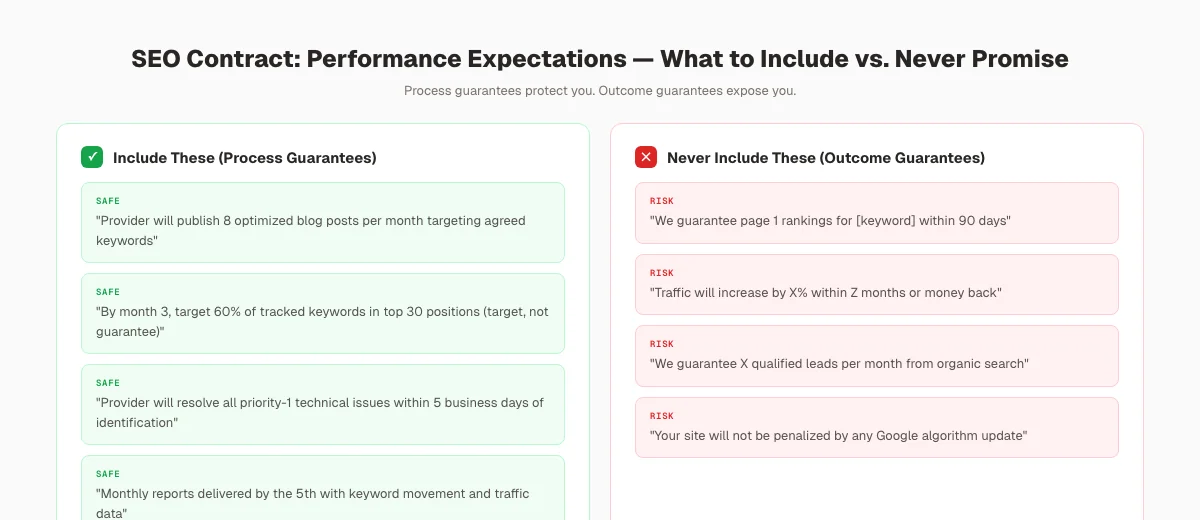
The right approach: define process guarantees and KPI targets, while explicitly excluding outcome guarantees.
The Algorithm Disclaimer
Google itself states that no one can guarantee a #1 ranking. Any SEO provider that promises specific positions is either lying or signing a contract they will breach. Include this language explicitly:
SEO outcomes depend on factors outside Provider's control, including search engine algorithm changes, competitor actions, website performance, and market conditions. Provider makes no guarantee of specific ranking positions, traffic volumes, or conversion rates. Provider guarantees execution of the agreed deliverables and application of proven optimization practices.
This clause protects the agency from clients who blame the agency for an algorithm update. It also sets honest expectations upfront. Which is how you keep good clients long-term.
Performance KPIs as Contractual Targets
Exclude ranking guarantees, but include measurable input targets. Example:
By month 3, Provider targets: tracked keyword positions moving into the top 30 for at least 60% of target keywords. By month 6, Provider targets: a minimum 20% increase in organic sessions vs. the baseline established at contract start. These are targets, not guarantees, and will be reviewed quarterly.
The difference between a guarantee and a target is accountability without liability. Targets give clients a realistic picture. Guarantees set up disputes.
Use an SEO ROI calculator to help clients understand what organic traffic improvements mean for their business before the engagement starts. Clients who understand the value of SEO before month 1 stay longer and dispute less.
What to Never Include
- "We guarantee page 1 rankings" (unenforceable and dishonest)
- "We guarantee X leads per month from SEO" (outside agency control)
- "Traffic will increase by Y% within Z months" (no basis for guarantee)
- Any performance-only pricing tied entirely to uncontrollable outcomes
If a client demands a ranking guarantee, decline the engagement. Clients who need guarantees to sign are typically the same clients who dispute every invoice.
Your SEO team. $99/month. 30 optimized articles published automatically. No lock-in, no ranking guarantees. Just results.
Chapter 6: Intellectual Property, Data Ownership, and Tool Access
IP and data ownership are the most frequently disputed clauses in SEO agreements. Address them before the engagement starts, not after.
Content Ownership
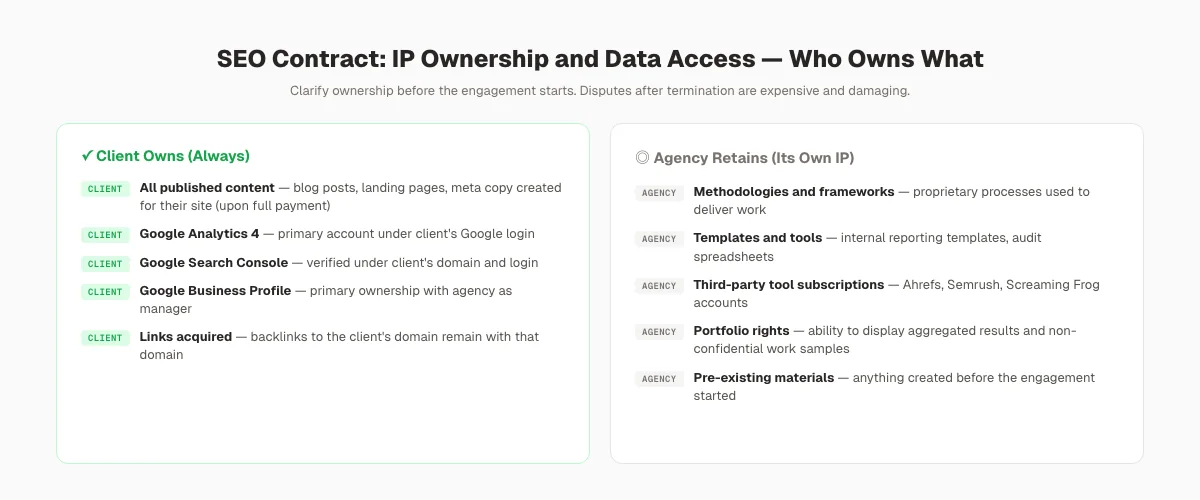
All content created specifically for the client. Blog posts, landing pages, meta descriptions, schemas. Should transfer to the client upon full payment. Example:
Upon receipt of full payment for each monthly retainer period, Provider assigns to Client all rights, title, and interest in deliverables created under this agreement, including content, optimized copy, and on-page implementation. Agency retains rights to all proprietary methodologies, frameworks, templates, and tools used to create deliverables.
Never structure an agreement where the agency retains ownership of content. Agencies that do this lose clients fast. And the practice damages industry trust.
Google Analytics and Search Console Ownership
Client accounts are always client-owned. Agency access is via a granted user role, not account ownership. This is non-negotiable. Example:
Client is responsible for maintaining primary ownership of all Google Analytics 4 and Google Search Console properties associated with their website. Provider will operate as a user with appropriate access permissions. At engagement end, Provider will remove agency access within 5 business days of the final billing date.
If you are starting a new GA4 or GSC setup for a client, create it under the client's Google account and grant yourself access. Never create it under an agency account.
Tool Access and Credentials
Specify which tools require client credentials. Standard list:
- ✓ Google Analytics 4 (client ownership, agency user access)
- ✓ Google Search Console (client ownership, agency user access)
- ✓ Google Business Profile (client ownership, agency manager access)
- ✓ CMS login (client provides credentials or creates agency account)
- ✓ Hosting/CDN access (if technical fixes required)
Offboarding and Data Handover
Most contracts ignore offboarding. This is a mistake. A clean offboarding clause prevents disputes when clients transition to a different agency or take SEO in-house. Example:
Upon contract termination, Provider will deliver within 10 business days: all final reports from the contract period, exported keyword ranking data, a summary of technical changes made during the engagement, and removal of agency access to all client-owned accounts. Provider is not responsible for ongoing maintenance of changes made during the engagement after the termination date.
Agencies that handle offboarding professionally get referrals. Agencies that ghost at termination do not.
Chapter 7: Confidentiality, Termination, and Legal Clauses
The legal clauses in an SEO contract are the ones that matter when things go wrong. Keep them short and standard. Do not try to innovate here.
Confidentiality / NDA
Both parties should be protected. The clause covers business strategies, client data, pricing, and proprietary processes. Mutual NDAs signal professionalism. Example:
Each party agrees to keep confidential all non-public information received from the other party, including pricing, strategies, analytics data, and business information. This obligation survives contract termination for a period of 2 years.
In B2B SEO engagements, confidentiality is often more important to clients than the pricing terms. B2B companies competing in tight niches do not want their SEO strategy visible to competitors.
Termination Clause
Three termination scenarios need coverage:
1. Termination for convenience (either party, after initial term):
After the initial term, either party may terminate this agreement with 30 days' written notice. Client remains responsible for payment of services rendered during the notice period.
2. Immediate termination for material breach:
Either party may terminate this agreement immediately if the other party materially breaches this agreement and fails to cure the breach within 10 business days of written notice.
3. Early termination (within initial term):
If Client terminates this agreement before completion of the initial term, Client agrees to pay a kill fee equal to 50% of the remaining balance owed under the initial term.
The kill fee protects the agency from clients who leave at month 2 of a 6-month contract after the agency has invested onboarding, strategy, and early execution hours.
Liability Limitation
Cap your liability. Without this clause, a dispute over a $3,000/month contract could theoretically expose you to claims larger than the contract value. Example:
Provider's total liability under this agreement is limited to the total fees paid in the 3 months preceding the claim. Neither party is liable for indirect, consequential, or punitive damages.
Governing Law
Name the state or jurisdiction. This matters if a dispute goes to court. Use the agency's jurisdiction when possible.
Force Majeure
Include a standard force majeure clause covering unforeseen events. Major algorithm updates, platform outages, natural disasters. That prevent delivery of services. Keep it standard; do not use it to excuse ordinary deliverable delays.
Chapter 8: The Change Order Process. Your Scope Creep Defense
Scope creep is the most common reason SEO agency margins erode. It starts with a small request: "can you also look at our social media?" It ends with the agency doing twice the work for the same retainer.
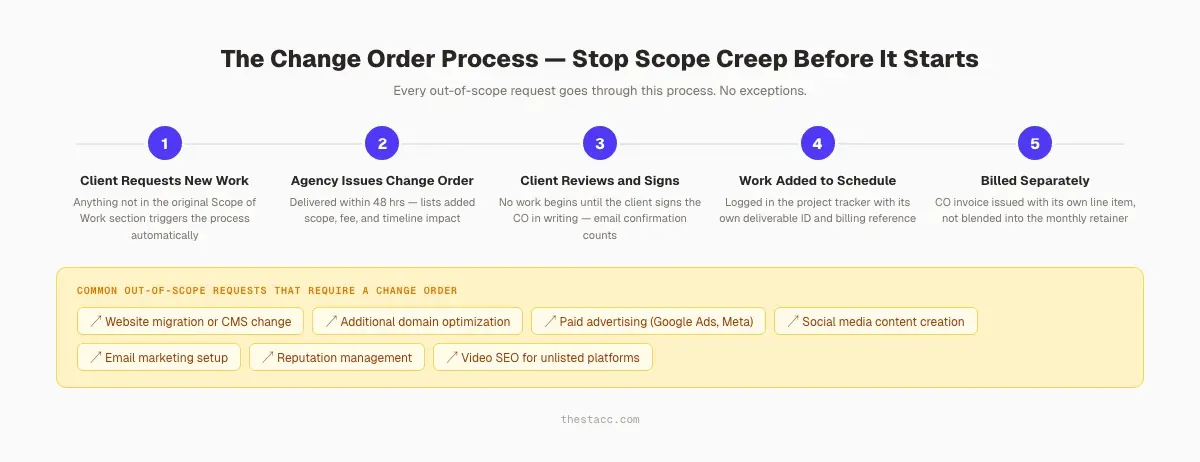
The change order process is your prevention mechanism. Without a formal process, every out-of-scope request becomes a negotiation where the agency either says yes and loses margin, or says no and damages the relationship.
The Change Order Clause
Any services not explicitly described in the Scope of Work section of this agreement are considered out-of-scope. Out-of-scope requests require a written Change Order detailing the added work, timeline, and additional fee. Work on out-of-scope requests begins only after the client signs the Change Order. Provider will deliver a Change Order quote within 2 business days of any out-of-scope request.
With this clause, "can you do X?" becomes a structured process, not a free favor. Clients who understand the process respect it. Clients who push back on it tend to be the same clients who push on every boundary.
Common Out-of-Scope Requests to Watch
The following requests come up constantly in SEO retainers and should always trigger a change order:
- Full website migrations or CMS changes
- Additional domain or subdomain optimization
- Paid advertising (Google Ads, Meta)
- Reputation management or review response
- Social media content creation
- Additional target locations beyond the agreed list
- Email marketing setup or management
- Video SEO for platforms not in original scope
Tracking Change Orders
Keep a change order log for every engagement. Number each CO, include the date, the additional scope, the fee, and the client signature. This documentation is protection if the engagement ends in dispute.
Agencies that automate their SEO workflow handle change orders more efficiently. Tracking scope, deliverables, and client communication in one place rather than across email threads.
3,500+ blogs published. Every article is SEO-scored before publish. theStacc delivers done-for-you content SEO without the contract complexity. Starting at $99/month. See Pricing →
What practitioners are saying on X
Fundamentals plus AI-search measurement remain the dual stack.
- @jakezward (Feb 2026): 2026 SEO predictions emphasize AI Overview share-of-SERP, schema for LLM token efficiency, brand mentions in AI answers as a KPI, proprietary data as a moat, and content refresh beating net-new AI slop. See the post on X.
- @hridoyreh (Mar 2026): Widely shared SEO skill tree: foundations, research, technical, on-page, content, links, AI SEO/GEO, analytics, UX, brand, programmatic — useful map for stats and how-to posts. See the post on X.
- @HlynurStefDev (Jul 2026): Public case: niche site traffic jumped from ~18 to 4,162 Google visits/month after focused technical/on-page SEO work (GSC screenshots claimed) — reminds that fundamentals still move numbers. See the post on X.
Grok, AI Overviews, and multi-engine visibility
For “seo contract template”, multi-engine visibility still starts with clear definitions, sourced numbers, and extractable section answers. Grok additionally factors live X discussion — keep public claims consistent with this page.
- Google AI Overviews: Use passage-ready answers, tables, and FAQ schema where relevant.
- ChatGPT / Perplexity: Cite named sources next to key claims.
- Grok: Maintain accurate entity facts on-site and in high-signal X posts.
Publish content built for Google and AI citations. theStacc’s Content SEO module ships SEO-scored articles structured for rankings and generative engines — including clearer entity pages models like Grok can quote.
FAQ
Not necessarily for a standard retainer agreement. Many agencies use lawyer-drafted templates adapted to their scope. For enterprise contracts above $10,000/month or agreements with international clients, legal review is worth the cost. For standard SMB retainers, a well-structured template with clear scope language protects both parties effectively.
6 months is the industry consensus. SEO results typically take 3–6 months to materialize, so a 6-month minimum aligns with realistic timelines. Shorter contracts lead to client churn before ROI is visible. Which is bad for the client and the agency. Review our done-for-you vs. agency SEO guide for more context on client expectations.
No. Google explicitly states that no one can guarantee specific ranking positions. Including a guarantee exposes you to breach-of-contract claims for events outside your control. Algorithm updates, competitor investments, client site issues. Include process guarantees (deliverables, reporting cadence) and KPI targets instead.
The client should own all content created for their site upon full payment. Agencies that retain content ownership create churn risks. Clients fear losing their content library if they switch providers. Assign content ownership to the client and protect your methodologies separately.
30 days is standard for month-to-month agreements. For agencies running large accounts with significant ongoing work, 60 days gives enough time to wind down active deliverables properly. Pair the notice period with a payment obligation for services rendered during the notice window to avoid working unpaid.
Closing
A well-drafted SEO contract protects both parties. But its real value is alignment before any work begins. Clients who sign a clear contract understand what they are buying. Agencies that enforce a clear contract build more sustainable relationships.
Start with the scope of work and deliverables table. Add payment and termination terms. Layer in the change order process. Every clause you write clearly upfront is one dispute you avoid later.
Related Tools & Resources
Free SEO Tools:
Best Lists:
Sources & references
- [1] Princeton / Georgia Tech et al. — GEO research (arXiv:2311.09735)
- [2] @hridoyreh on X — Widely shared SEO skill tree: foundations, research, technical, on-page, content, links, AI SEO/GEO, analytics, UX, bran
- [3] @jakezward on X — 2026 SEO predictions emphasize AI Overview share-of-SERP, schema for LLM token efficiency, brand mentions in AI answers

Researched, written, and published articles that compound organic traffic.
Weekly local SEO teardowns
One practical email a week. Map Pack, GBP, AI Overviews — no fluff. Unsubscribe anytime.