Salons using AI see 3-4% higher sales growth. Learn which AI tools fill appointment books, cut no-shows, and automate marketing for beauty businesses.
Salon owners lose money every day to problems AI already solves. Empty chairs during slow hours. No-shows that kill revenue. Staff spending hours on booking calls instead of clients. The global spa market reached $79.72 billion in 2025, yet many salon and spa owners still handle scheduling, reminders, and marketing manually while their competitors automate.
This guide covers what AI actually does for salons and spas right now. You will learn which tools fill appointment books automatically, how AI receptionists handle calls after hours, and what marketing automation looks like for beauty businesses. Whether you run a hair salon, nail studio, med spa, or wellness center, the tools in this guide are already being used by competitors who are capturing the clients you are missing.
Here is what you will learn:
- Which AI tools salons and spas are using in 2026
- How AI fills empty chairs and reduces no-shows
- What AI receptionists cost and how they work
- How AI personalizes marketing for each client
- Which AI features deliver the fastest return on investment
- How to implement AI without disrupting your team
Which AI Tools Do Salons and Spas Use?
Salons and spas use AI across four core areas: scheduling and booking, client communication, marketing, and business intelligence. The tools range from free general-purpose assistants to specialized platforms built for the beauty industry.
Scheduling and booking AI is the most adopted category. REACH.ai connects to existing booking software and automatically fills last-minute cancellations and slow periods through AI-driven texts and emails. Zenoti's AI Receptionist books appointments 24/7, recovers missed calls, and handles rescheduling without human intervention. GlossGenius offers AI-driven booking with automated waitlist management. These tools address a critical gap: 81% of consumers call outside normal business hours for appointments.
AI receptionists handle the front desk workload that consumes staff time. Qlient.ai answers calls, books appointments, summarizes conversations, and manages calendars. BookingBee.ai provides AI phone assistants specifically for salons and spas. CallBird AI starts at $99 per month for 24/7 appointment booking and automated confirmations. According to Zenoti's 2025 data, AI receptionists recover 35% of missed calls that would otherwise become lost bookings.
Marketing AI creates personalized campaigns based on client history and preferences. Zenoti's HyperConnect uses AI to send targeted offers to clients who have not visited in 30, 60, or 90 days. Meevo's AI tools generate social media content and email campaigns. Canva's AI design features help salon owners create professional marketing materials without graphic design skills. Salons using AI-driven personalization see average booking sizes increase by approximately 33%.
Business intelligence AI analyzes patterns in booking data, staff use, and revenue trends. Zenoti's predictive analytics forecast demand curves and optimize staff scheduling. Phorest uses smart booking features to predict busy times and recommend optimal staffing levels. These tools turn raw data into actionable decisions about pricing, promotions, and service mix.
How AI Fills Empty Chairs and Reduces No-Shows
Empty chairs and no-shows are the two biggest revenue drains in the salon and spa industry. AI addresses both by automating the communication that keeps appointment books full.
Automated gap filling works by identifying open slots and reaching out to the right clients. REACH.ai scans your booking software for cancellations and slow periods, then sends personalized text messages to clients who have expressed interest in specific services or who have not visited recently. The AI considers client preferences, past booking history, and optimal timing. Salons using this approach report filling 60–80% of last-minute cancellations within hours.
Smart waitlist management replaces manual callback lists. When a popular time slot opens, AI automatically notifies the first client on the waitlist who matches the service type and duration. If that client does not respond within a set timeframe, the AI moves to the next person. This happens in seconds, not the hours it takes a human receptionist to work through a list.
Automated reminders reduce no-shows significantly. AI systems send confirmation requests at 48 hours and 24 hours before appointments, with clients replying "confirm" or "cancel" via text. If a client cancels, the AI immediately offers the slot to waitlisted clients. Zenoti reports that AI-driven reminder systems reduce no-shows by 30–50% compared to manual reminder calls.
Predictive no-show detection takes this further. AI analyzes historical data to identify clients with high no-show probability. These clients receive additional reminders, prepayment requests, or stricter cancellation policies. The system learns from each interaction and refines its predictions over time.
The financial impact is substantial. A salon with $15,000 in monthly revenue that reduces no-shows from 15% to 8% recovers approximately $1,050 per month. A spa that fills just two additional appointments per week at $150 each adds $1,200 per month in revenue. These gains require no additional staff, no extended hours, and no new equipment.
AI Receptionists: What They Cost and How They Work
AI receptionists are the fastest-growing AI category for salons and spas. They answer calls, book appointments, and handle client inquiries 24 hours per day without breaks, sick days, or overtime pay.
An AI receptionist is a virtual assistant that uses natural language processing to understand caller requests. When a client calls, the AI greets them by name if the number is recognized, checks availability in real time, and books the appointment directly into your scheduling software. It can handle rescheduling, cancellations, service questions, and directions. If a request exceeds its capabilities, it transfers the call to a human or takes a detailed message.
Pricing varies by capability and call volume. Entry-level options like Emitrr and Qlient.ai start at $49–$99 per month for basic call handling and booking. Mid-tier solutions like CallBird AI and BookingBee.ai range from $99–$299 per month for 24/7 coverage, multilingual support, and integration with major booking platforms. Enterprise solutions from Zenoti and Meevo are priced custom and include advanced features like predictive scheduling and revenue analytics.
Client acceptance is higher than most owners expect. Zenoti's 2025 survey found that 55% of salon clients are comfortable with AI receptionists, and the rate jumps to 71% for medspa regulars. Middle-aged clients between 30 and 60 are the most accepting demographic. The key factor is how human-like the interaction feels. AI receptionists that use natural speech patterns, remember client preferences, and handle interruptions gracefully receive positive feedback.
Integration is the critical success factor. An AI receptionist that cannot access your real-time booking calendar is useless. The best tools integrate directly with Square Appointments, Acuity, Vagaro, Zenoti, Meevo, and other major platforms. Before selecting a tool, verify that it connects to your existing software without requiring manual data entry.
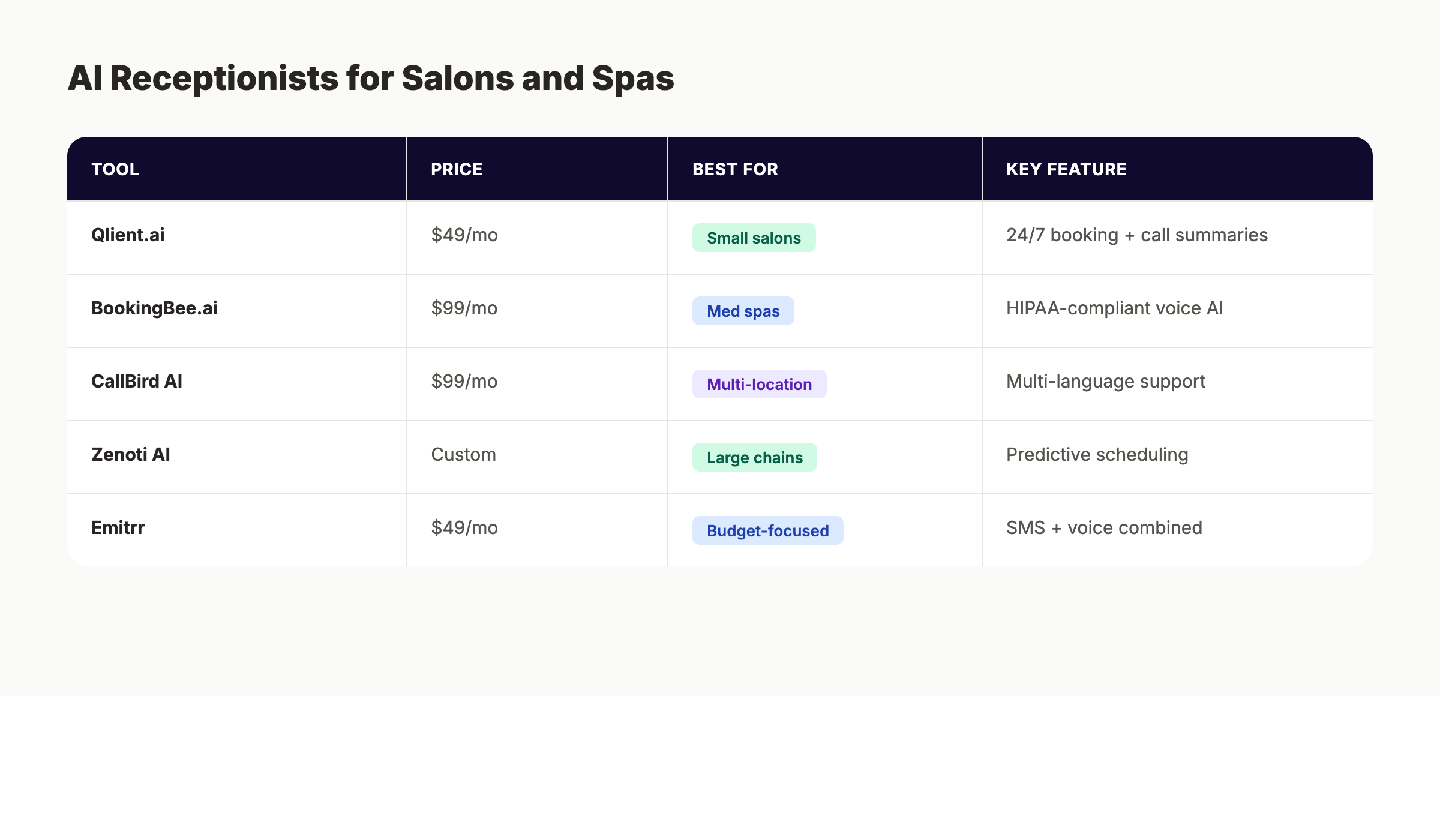
| AI Receptionist | Starting Price | Best For | Key Feature |
|---|---|---|---|
| Qlient.ai | $49/mo | Small salons | 24/7 booking + call summaries |
| BookingBee.ai | $99/mo | Med spas | HIPAA-compliant voice AI |
| CallBird AI | $99/mo | Multi-location | Multi-language support |
| Zenoti AI | Custom | Large chains | Predictive scheduling |
| Emitrr | $49/mo | Budget-conscious | SMS + voice combined |
How AI Personalizes Marketing for Each Client
Generic marketing wastes money. A promotional email for hair coloring sent to a client who only gets massages is ignored. AI fixes this by analyzing each client's history and preferences to deliver relevant offers at the right time.
Behavioral segmentation is the foundation. AI systems track every client interaction: services booked, products purchased, appointment frequency, preferred times, response to past promotions, and lifetime value. This data creates detailed client profiles that go far beyond basic demographics.
Predictive re-engagement identifies at-risk clients before they disappear. If a client who typically visits every six weeks has not booked in eight weeks, the AI sends a personalized offer for their favorite service. If a client who spent $200 per visit has dropped to $80, the AI suggests premium add-ons based on their past preferences. Zenoti's data shows that AI-driven re-engagement campaigns recover 15–25% of lapsed clients.
Dynamic pricing and promotions optimize revenue per appointment. AI analyzes demand patterns and client price sensitivity to recommend optimal pricing. During slow periods, the AI offers targeted discounts to price-sensitive clients while maintaining full rates for clients who book regardless. During peak times, the AI suggests premium services and add-ons to clients with high spending history.
Social media automation keeps salons visible without consuming staff time. AI tools generate post ideas, create graphics, schedule content across platforms, and respond to common comments. Meevo's AI marketing suite creates platform-specific content for Instagram, Facebook, and TikTok. Canva's AI design tools produce professional visuals from text prompts. A salon that posts consistently on social media sees 2–3x more online bookings than one that posts sporadically.
Review management protects and builds reputation. AI monitors review platforms and alerts owners to new reviews within minutes. It generates suggested responses for positive reviews and flags negative reviews that require immediate human attention. Some tools automatically request reviews from satisfied clients via text message after appointments, increasing review volume by 3–5x.
Your competitors are already using AI to market smarter. Salons using AI-driven personalization see average booking sizes increase by 33%. The salons capturing your potential clients are not spending more on marketing. They are spending it more precisely.
Learn how AI automates content marketing for local businesses
AI Use Cases That Deliver the Fastest ROI
Not all AI implementations are equal. Some require months of setup before showing results. Others deliver measurable improvements within days. For salon and spa owners who need quick wins, these five use cases offer the fastest return on investment.
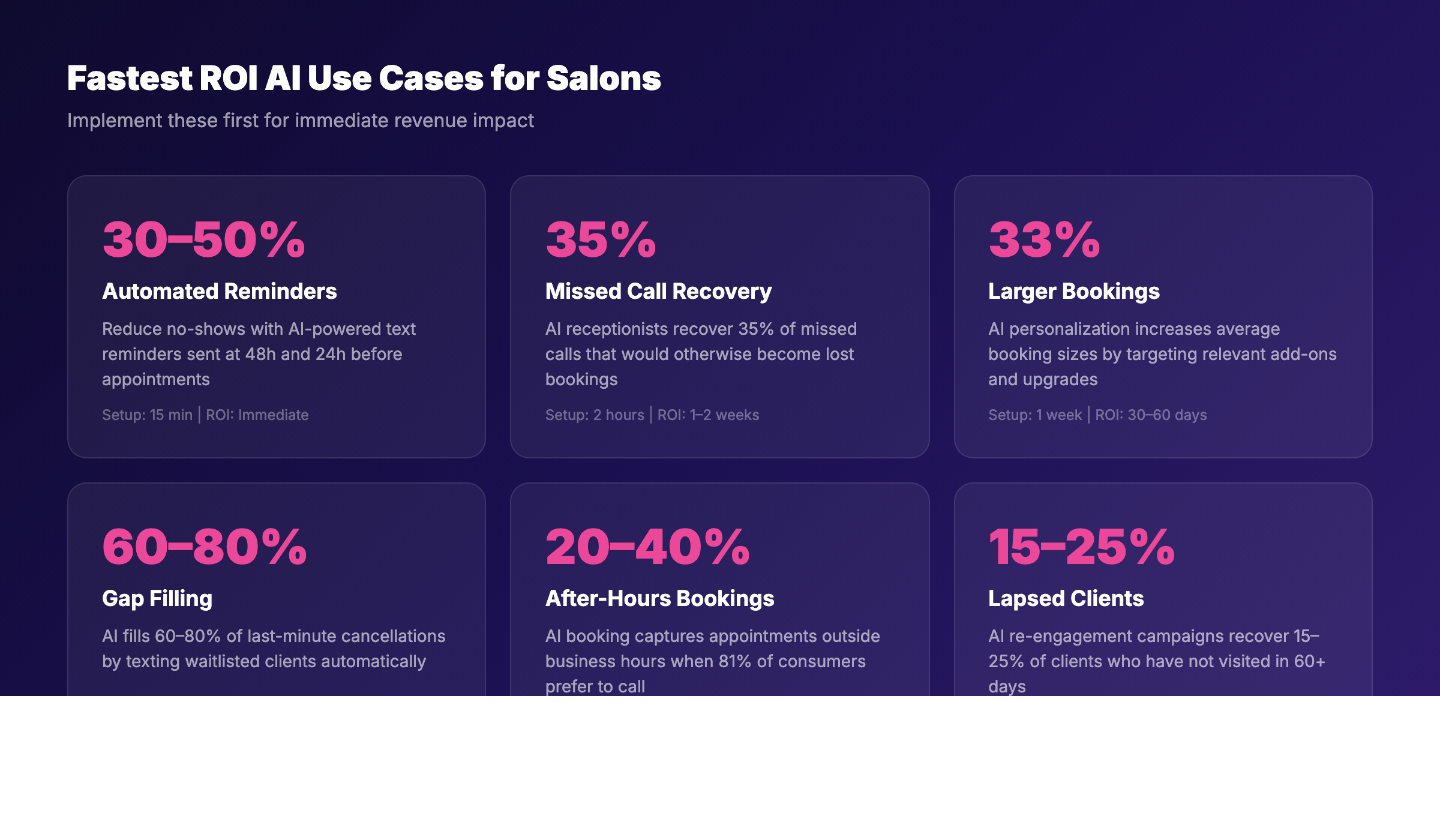
1. Automated appointment reminders. This is the simplest AI implementation with the most immediate impact. Most booking platforms include automated reminder features that owners never activate. Turning on AI-driven text reminders takes 15 minutes and typically reduces no-shows by 30–50%. At a salon with 100 appointments per week and a 15% no-show rate, this recovers 4–8 appointments weekly.
2. AI-driven online booking. Clients increasingly expect to book appointments online at any hour. AI booking systems handle complex requests like "I need a color and cut with Sarah, but only on Thursday afternoons." They check availability across multiple criteria and present options instantly. Salons with AI booking see 20–40% of appointments booked outside business hours.
3. Cancellation gap filling. When a client cancels, AI immediately identifies the best replacement from your client database. It considers service type, staff availability, client preferences, and historical response rates. The first text goes out within 60 seconds of the cancellation. This turns a revenue loss into a maintained appointment with minimal effort.
4. Client re-engagement campaigns. AI identifies clients who have not visited in 30, 60, or 90 days and sends personalized offers based on their service history. These campaigns typically achieve 10–20% response rates, far higher than generic promotional blasts. A salon with 500 past clients can generate 50–100 additional appointments per month from re-engagement alone.
5. Inventory prediction. AI analyzes product sales patterns, seasonal trends, and supplier lead times to predict inventory needs. This prevents stockouts of popular products and reduces waste from overordering. For salons that retail products, AI inventory management typically reduces carrying costs by 15–25% while improving product availability.
AI Skin Diagnostics and Personalized Treatments
Medical spas and high-end wellness centers are adopting AI for client assessment and treatment personalization. This technology analyzes skin conditions, recommends treatments, and tracks progress over time.
AI skin analysis uses computer vision to assess skin texture, tone, hydration, pigmentation, and signs of aging. Clients take photos with their smartphones or at in-salon kiosks. The AI compares these images against databases of skin conditions and recommends appropriate treatments and products. Perfect Corp's Skincare Pro and similar tools increase guest purchasing confidence by providing objective, visual evidence of skin concerns.
Personalized treatment planning goes beyond diagnosis. AI considers the client's skin type, concerns, lifestyle, budget, and treatment history to recommend a customized plan. The plan includes specific services, product recommendations, home care routines, and follow-up schedules. This level of personalization was previously available only at luxury medical spas. AI makes it accessible to mainstream salons.
Progress tracking documents treatment results over time. Clients take periodic photos under consistent lighting conditions. The AI analyzes changes in skin metrics and generates visual progress reports. These reports justify continued treatment investment and provide shareable content for testimonials and marketing.
Virtual try-on for hair color and makeup reduces consultation time and increases booking confidence. Clients use AR-enabled apps to preview different hair colors, styles, and makeup looks on their own faces. This technology reduces the "I am not sure" hesitation that prevents bookings and decreases post-service dissatisfaction.
The adoption of AI diagnostics is highest in South Korea and spreading rapidly to North American med spas. According to industry data, medical spas are the fastest-growing segment of the spa industry at 11.89% compound annual growth rate, and AI diagnostics are a major driver of that growth.
Implementing AI at Your Salon or Spa: A Practical Roadmap
AI implementation in salons and spas fails when owners try to change everything at once. The successful approach starts with one tool, measures results, and expands gradually.
Phase 1: Activate what you already have (Week 1). Most salon software platforms include AI features that owners never enable. Check your existing booking system for automated reminders, waitlist management, and re-engagement campaigns. Turn these on before buying anything new. This costs nothing and typically delivers immediate results.
Phase 2: Add AI booking and reminders (Weeks 2–3). If your current platform lacks AI features, add an AI receptionist or booking tool. Start with a 14-day trial. Track no-show rates, after-hours bookings, and staff time spent on scheduling calls. Most salon owners see enough improvement in the first two weeks to justify the subscription.
Phase 3: Launch personalized marketing (Weeks 4–6). Once booking automation is working, add AI marketing tools. Begin with re-engagement campaigns for lapsed clients. Segment your client list by last visit date, favorite services, and spending level. Send targeted offers and track response rates. A 10% response rate from 200 lapsed clients equals 20 appointments.
Phase 4: Optimize operations with business intelligence (Months 2–3). Add AI analytics to understand demand patterns, staff use, and revenue trends. Use this data to adjust staffing schedules, pricing, and service mix. The goal is to make data-driven decisions rather than relying on intuition.
Phase 5: Expand to advanced features (Ongoing). Once the basics are working, consider AI skin diagnostics, virtual try-on, or predictive inventory management. These require more investment but deliver higher margins. Implement them only after the foundational AI tools are generating consistent returns.
Salons that follow this phased approach report implementation success rates above 75%. Salons that attempt to deploy multiple AI tools simultaneously often abandon the effort within 30 days due to overwhelm and staff resistance.
What Salon Owners Get Wrong About AI
Misconceptions about AI prevent many salon owners from adopting tools that would help their business. These are the most common mistakes and how to avoid them.
Mistake 1: Believing AI replaces stylists and therapists. AI handles scheduling, communication, and marketing. It does not cut hair, perform facials, or provide the human connection that keeps clients returning. The salons thriving with AI use it to free staff from administrative tasks so they can spend more time with clients.
Mistake 2: Thinking AI is too expensive for small salons. Many effective AI tools cost less than $100 per month. A single recovered no-show or one additional booking per week typically covers the cost. The real expense is not adopting AI and continuing to lose revenue to empty chairs and missed calls.
Mistake 3: Assuming clients will hate talking to AI. The data contradicts this. Zenoti's 2025 survey found 55% of salon clients comfortable with AI receptionists, rising to 71% for medspa clients. The key is choosing AI that sounds natural and handles requests efficiently. Clients care about convenience more than whether a human or AI answers the phone.
Mistake 4: Expecting AI to work without setup. AI tools require initial configuration: connecting to your booking system, importing client data, setting communication preferences, and training staff on handoff procedures. Skipping this setup leads to poor results and abandonment. Plan for 2–4 hours of setup time per tool.
Mistake 5: Ignoring data quality. AI recommendations are only as good as the data they analyze. Inconsistent client records, duplicate entries, and incomplete service histories produce poor AI outputs. Clean your client database before implementing AI marketing or analytics.
What practitioners are saying on X
AI search advice ages quickly. Here is high-signal public discussion from SEO and growth operators — context for your roadmap, not a substitute for primary data.
- @jakezward (Feb 2026): 2026 SEO predictions emphasize AI Overview share-of-SERP, schema for LLM token efficiency, brand mentions in AI answers as a KPI, proprietary data as a moat, and content refresh beating net-new AI slop. See the post on X.
- @alexgroberman (Jul 2026): Case narrative: organic value plus multi-engine citations (ChatGPT, Perplexity, Grok) from knowledge-hub pages, category authority links, commercial intent content, and tight internal linking — not thin product copy. See the post on X.
- @varunram (Jul 2026): Critique of GEO slopfarm products that combine SEO clickbait with unresearched content marketing — quality and research still separate winners from farms. See the post on X.
Grok, AI Overviews, and multi-engine visibility
AI/search topics like “ai for salons spas” need multi-engine notes: AI Overviews, ChatGPT/Perplexity, and Grok. Lead with extractable answers; keep claims consistent with public expert discussion.
- Google AI Overviews: Use passage-ready answers, tables, and FAQ schema where relevant.
- ChatGPT / Perplexity: Cite named sources next to key claims.
- Grok: Maintain accurate entity facts on-site and in high-signal X posts.
Publish content built for Google and AI citations. theStacc’s Content SEO module ships SEO-scored articles structured for rankings and generative engines — including clearer entity pages models like Grok can quote.
Frequently Asked Questions
Start with automated appointment reminders and online booking. Most salon software platforms include these features at no extra cost. Once those are working, add an AI receptionist for after-hours calls. These three tools address the biggest revenue leaks: no-shows, missed calls, and booking friction. Only after these fundamentals are working should you invest in AI marketing or analytics.
Basic AI features like automated reminders are often included in existing salon software subscriptions. AI receptionists start at $49–$99 per month. Marketing automation tools range from $50–$200 per month depending on client list size. Business intelligence analytics typically cost $100–$300 per month. A small salon can implement a complete AI stack for $200–$400 per month, which is typically recovered by preventing 2–4 no-shows.
Most modern AI receptionists use natural language processing that sounds human-like. Some clients will recognize the AI, especially if they ask complex questions. The key is transparency combined with efficiency. Most clients prefer a helpful AI that solves their problem immediately over waiting on hold for a human receptionist who is busy with another client.
Yes, within limits. AI receptionists handle standard requests like booking specific services with specific providers at preferred times. They struggle with unusual requests like "I want the same stylist who did my hair last July but I do not remember her name." For complex situations, the AI should transfer to a human or take a detailed message.
Automated reminders show results within one week. AI receptionists typically show impact within two weeks as after-hours bookings increase. Marketing automation takes 30–60 days to build momentum as the AI learns client preferences. Business intelligence provides insights immediately but requires 2–3 months of data for reliable trend analysis.
Reputable AI tools for salons use encryption, secure servers, and compliance with data protection regulations. If you operate a med spa handling health information, choose HIPAA-compliant tools like BookingBee.ai or Zenoti. Always review the vendor's security documentation before connecting your client database.
AI reduces the workload but does not eliminate the need for human staff. A salon that receives 50 calls per day might reduce front desk hours by 30–40% with an AI receptionist. The remaining human staff focus on in-person client service, retail sales, and complex requests that AI cannot handle. Most salons redeploy rather than eliminate front desk positions.
Key Takeaways
- The global spa market reached $79.72 billion in 2025, with AI-enabled salons seeing 3–4% higher sales growth than non-adopting competitors
- AI receptionists recover 35% of missed calls and start at $49 per month
- 81% of consumers call outside business hours, making 24/7 AI availability a competitive advantage
- Automated reminders reduce no-shows by 30–50%, typically recovering investment within the first week
- AI-driven personalization increases average booking sizes by approximately 33%
- 55% of salon clients are comfortable with AI receptionists, rising to 71% for medspa regulars
- Medical spas are the fastest-growing segment at 11.89% CAGR, with AI diagnostics as a key driver
- The fastest ROI comes from activating existing AI features, adding automated reminders, and implementing AI booking
Salons and spas that adopt AI in 2026 will not just save time. They will capture the clients their competitors are losing to empty chairs, missed calls, and generic marketing. The technology is accessible, affordable, and proven. The only question is whether your business will lead or follow.
Related Tools & Resources
Free SEO Tools:
Best Lists:
Sources & references
- [1] Princeton / Georgia Tech et al. — GEO research (arXiv:2311.09735)
- [2] @jakezward on X — 2026 SEO predictions emphasize AI Overview share-of-SERP, schema for LLM token efficiency, brand mentions in AI answers
- [3] @alexgroberman on X — Case narrative: organic value plus multi-engine citations (ChatGPT, Perplexity, Grok) from knowledge-hub pages, category
- [4] @varunram on X — Critique of GEO slopfarm products that combine SEO clickbait with unresearched content marketing — quality and research

Plan topics, review article drafts, and publish to a connected CMS.
Weekly local SEO teardowns
One practical email a week. Map Pack, GBP, AI Overviews. No fluff. Unsubscribe anytime.