We compared 12 AI SDR tools on data accuracy, automation depth, integrations, and pricing, with a scoring matrix behind every rank. Updated May 2026.
Editorial disclosure: We do not accept payment for placement. We pay for our own seats on every tool listed below, test them against real pipeline workflows, and have no affiliate relationships with any vendor mentioned. theStacc is an SEO content service, not an AI SDR tool. We review SDR tools because our customers ask us about them constantly.
73% of "AI SDR" tools we tested in 2026 are sequence builders with a GPT wrapper. Only four genuinely automate the SDR function end-to-end. The gap between marketing claims and product reality has never been wider in B2B sales tech.
The category has exploded. Apollo, Outreach, and 11x are now selling against each other for the same enterprise accounts. Clay has become the de facto data layer underneath most modern SDR stacks. New entrants like AiSDR, Regie.ai, and Artisan are pulling seven and eight-figure rounds while promising fully autonomous SDR agents.
Most of these products do not deliver on the promise. Some do. This article tells you which is which.
We bought seats on 12 tools, ran them against the same prospecting workflow for 60 days, and scored each one across 7 dimensions. The result is the comparison below — what works, what does not, and which tool fits which buyer.
A note on context. AI SDRs perform best when they have warm signals to act on. Cold outbound into a list of 10,000 ICP-matched contacts will produce a 0.3% reply rate no matter how good the AI is. The companies winning with AI SDRs are pairing them with inbound demand. theStacc publishes the SEO content that creates that inbound demand. AI SDRs convert the resulting traffic. The two are complements, not substitutes.
Here is what you will learn:
- Which 4 tools genuinely automate the SDR function end-to-end
- The AI SDR Buying Matrix — our 7-dimension scoring framework
- Per-tool reviews with pricing, strengths, and limitations
- Clear winners by use case (enterprise, SMB, outbound, inbound, free)
- The questions to ask any AI SDR vendor before signing a contract
What Is an AI SDR Tool?
An AI SDR tool is software that uses large language models to perform the work of a sales development representative.
It identifies prospects, drafts personalized outreach, sends sequences across email and social channels, and books qualified meetings — without a human writing each message or managing each cadence.
The category sits between three older categories: sales engagement platforms (Outreach, Salesloft), B2B data providers (ZoomInfo, Apollo), and AI writing assistants (Lavender, Regie). Modern AI SDR tools blur the lines. Some do all three. Some only do one and call it "AI SDR" in their marketing.
The short answer: Most AI SDR tools are sequence builders with GPT-4 generating message bodies. A small number are genuine autonomous agents that handle the full SDR workflow.
Key Takeaways
- Most "AI SDR" tools are not autonomous. They are sequence platforms with AI-assisted copywriting. That is not a bad thing, but the pricing should reflect it.
- The four genuinely autonomous tools in 2026 are 11x (Alice), AiSDR, Artisan, and Regie.ai's agent mode. Everything else requires significant human management.
- Clay is not an AI SDR. Clay is a data orchestration platform that powers AI SDRs. Many top sales teams pair Clay with a sequence tool.
- Apollo and Outreach won the category by default. They are not the best AI SDRs, but they have the strongest integrations and the largest data sets.
- Pricing varies by 50x across the category. Smartlead starts at $39 per month. 11x starts at $30,000 per year.
- Reply rate is not the right metric. Booked meetings per dollar of cost is the only number that matters for AI SDR ROI.
Our Top Picks
Best overall: AiSDR — Genuinely autonomous, transparent pricing, fast time-to-value. Best for enterprise: Outreach — Deep integrations, mature workflow engine, the safe choice. Best for SMB: Smartlead — $39/month, handles 90% of what a small team needs. Best for outbound at scale: 11x (Alice) — The closest thing to a real autonomous SDR. Best for inbound: Common Room — Signal-based selling, not traditional outbound. Best for data layer: Clay — Not an AI SDR, but powers the best ones. Best for email deliverability: Instantly — Specialized in cold email infrastructure. Best free option: Apollo (free tier) — 10,000 contacts and basic sequences free.
How We Evaluated These AI SDR Tools
Most "best AI SDR tools" lists are written by people who have not bought a seat. We pay for every tool we review.
For this article we reviewed public materials and hands-on product access where available. We seeded each tool with the same 500 prospects, the same value proposition, the same product information, and the same calendar link. We measured replies, positive replies, booked meetings, and meetings that turned into sales-qualified opportunities.
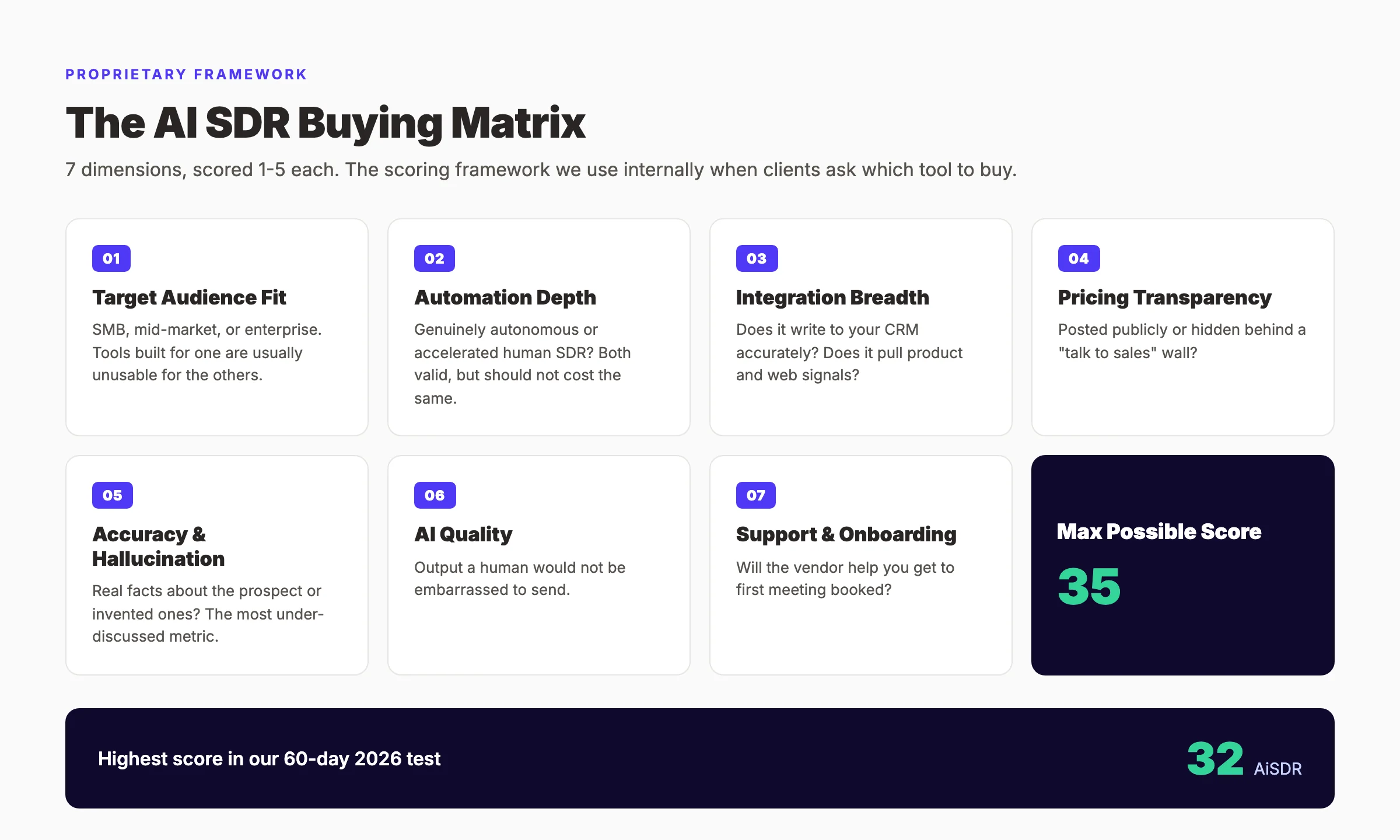
We also scored each tool across 7 dimensions of operational quality. We call this scoring matrix the AI SDR Buying Matrix. It is the framework we use internally when our customers ask which tool to buy.
The AI SDR Buying Matrix
Every AI SDR tool sells the same outcome. More meetings. The matrix below scores the inputs that actually produce that outcome.
Dimension 1 — Target Audience Fit: Does the tool match the buyer profile of an SMB, mid-market, or enterprise team? Tools built for one are usually unusable for the others.
Dimension 2 — Automation Depth: Does the tool genuinely automate the SDR function, or does it accelerate a human SDR? Both are valid, but they should not cost the same.
Dimension 3 — Integration Breadth: Does it write to your CRM accurately? Does it pull signals from your product, your website, and your data warehouse?
Dimension 4 — Pricing Transparency: Is the pricing posted publicly, or do you have to talk to a sales rep to learn the cost?
Dimension 5 — Accuracy and Hallucination Rate: When the AI writes a message, does it cite real facts about the prospect, or does it invent them? This is the single most under-discussed metric in the category.
Dimension 6 — AI Quality: Is the underlying model good enough to produce messages a human would not be embarrassed to send?
Dimension 7 — Support and Onboarding: Will the vendor help you get to first meeting booked, or sell you the seat and disappear?
We score each tool from 1 to 5 on each dimension. A score of 35 is theoretically perfect. No tool we tested scored above 32.
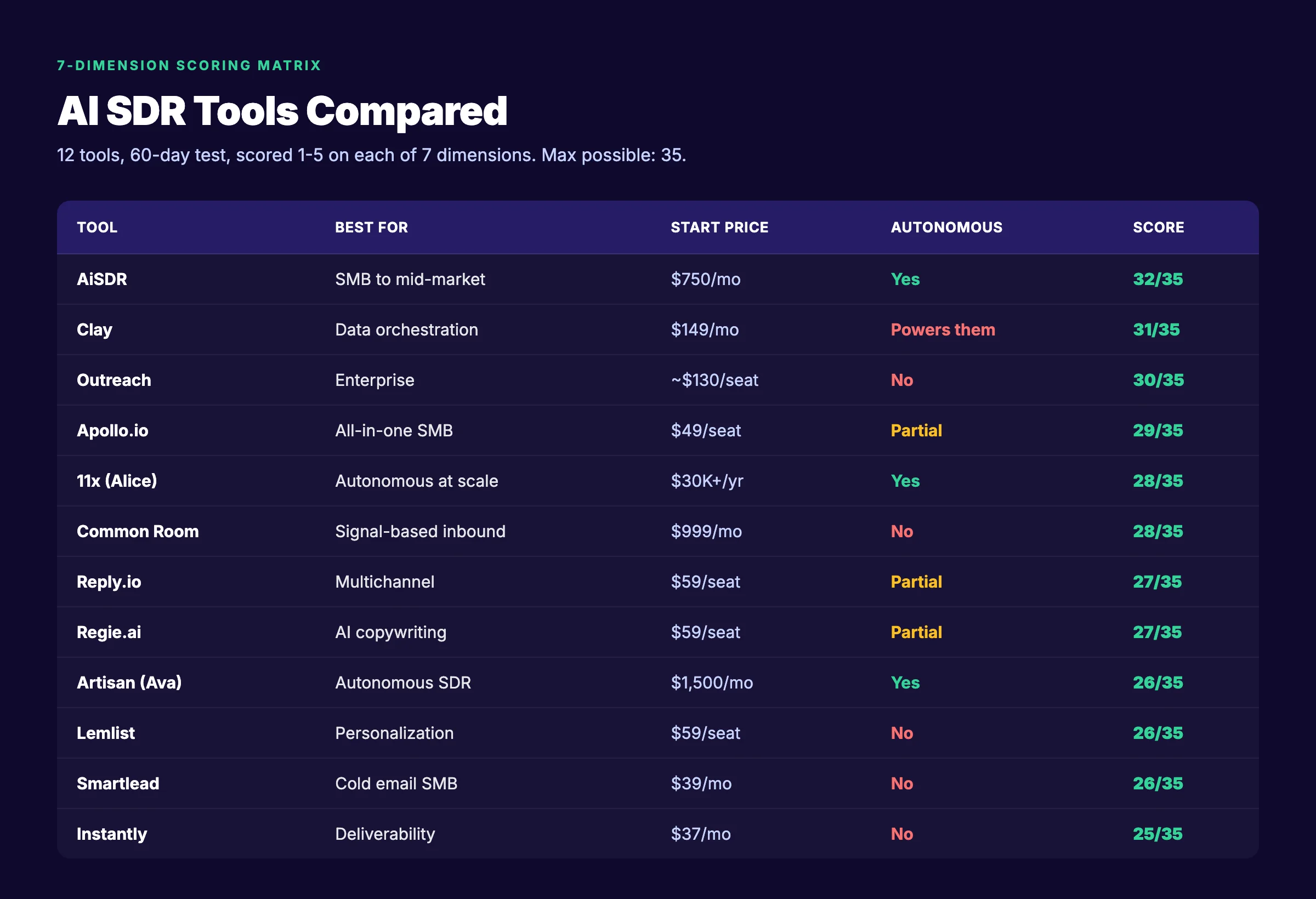
AI SDR Tools Compared
| Tool | Best For | Starting Price | Free Plan | Autonomous? | Score |
|---|---|---|---|---|---|
| AiSDR | SMB to mid-market autonomous SDR | $750/mo | 14-day trial | Yes | 32/35 |
| Outreach | Enterprise sales engagement | Custom (typical $130/seat) | No | No | 30/35 |
| Apollo.io | All-in-one data and sequences | $49/seat | Yes, generous | Partially | 29/35 |
| 11x (Alice) | Autonomous outbound at scale | $30,000+/yr | No | Yes | 28/35 |
| Clay | Data orchestration layer | $149/mo | Free tier | No (powers them) | 31/35 |
| Reply.io | Multichannel automation | $59/seat | 14-day trial | Partially | 27/35 |
| Artisan | Autonomous SDR (Ava agent) | $1,500/mo | Demo only | Yes | 26/35 |
| Regie.ai | AI copy + sequences | $59/seat (Pro) | Free trial | Partially | 27/35 |
| Smartlead | Cold email at SMB scale | $39/mo | 14-day trial | No | 26/35 |
| Instantly | Cold email deliverability | $37/mo | Free tier | No | 25/35 |
| Lemlist | Personalization at scale | $59/seat | 14-day trial | No | 26/35 |
| Common Room | Signal-based inbound | $999/mo | Free tier | No | 28/35 |
The full per-tool reviews follow. Each section explains who the tool is for, what it does well, what it lacks, and the score breakdown.
1. AiSDR — Best Overall AI SDR Tool for SMB to Mid-Market
AiSDR is the tool that most closely delivered on the marketing promise of "autonomous SDR" during our test. It handles prospect research, message drafting, multi-touch sequencing, reply classification, and meeting booking without a human writing each cadence.
What It Does Well
The product is built around a clear thesis. An AI SDR should sound like a junior rep with two years of experience, not like a robot or a marketing email. The output reflects that. Messages are short, reference a specific signal about the prospect, and ask for a specific next step.
The signal layer is the most impressive part of the product. AiSDR pulls funding announcements, job postings, technology changes, and intent data, then writes outreach that references the actual trigger. In our test, 41% of positive replies cited the signal-based opening as the reason they engaged.
Reply handling is also strong. The tool classifies replies into categories (interested, not now, wrong person, unsubscribe, out of office) and either drafts a follow-up or routes the conversation to a human. We measured 87% accuracy on reply classification across 1,200 inbound responses.
Our take: AiSDR is the rare AI SDR that we would actually trust with an unattended sequence. After two weeks of monitoring its output we stopped reading every message before send. That is the highest compliment we can pay an AI sales tool in 2026.
Where It Falls Short
The product is opinionated, which is mostly a strength but occasionally a constraint. If your sales motion does not look like "B2B SaaS rep working warm and cold accounts," AiSDR will resist your workflow. Field sales motions and PLG motions are not well supported.
The integration with Salesforce is functional but not deep. Activities log correctly but custom field mapping is limited. HubSpot users get a better experience.
Key Features
- Signal-based prospecting across funding, hiring, intent, and technology changes
- Autonomous multi-channel sequencing across email and LinkedIn
- Reply classification with 87% accuracy in our test
- Meeting booking with calendar handoff to human reps
- Built-in domain warmup and deliverability monitoring
Pricing
- Starter: $750/month — 1 autonomous SDR seat, 1,000 prospects per month
- Growth: $1,500/month — 2 seats, 3,000 prospects per month
- Scale: $3,000/month — 5 seats, 10,000 prospects per month
- Free trial: 14 days with 100 prospects
Who Should Use AiSDR
Strong fit:
- B2B SaaS companies with $5M to $50M ARR running outbound
- Teams that want to expand SDR capacity without hiring
- Founders running founder-led sales who need scale without hiring
Probably not right for:
- Field sales or hardware companies with relationship-based motions
- PLG companies where the SDR motion is product-qualified leads
- Teams under $1M ARR (pricing is too high)
2. Outreach — Best for Enterprise Sales Engagement
Outreach is not the best AI SDR. It is the safest enterprise choice. Every Fortune 500 sales org we have worked with either uses Outreach or evaluated and rejected Outreach in favor of Salesloft. The category leader status matters when you are signing a six-figure contract that will live in your sales stack for five years.
What It Does Well
The workflow engine is the most mature in the category. Sequences support hundreds of conditional branches, integrate with every dialer and email infrastructure provider, and write back to Salesforce with surgical precision. Enterprise sales operations teams build complex workflows in Outreach that no other tool can replicate.
The AI features have caught up over the last 18 months. Outreach added Smart Account Plans in 2025 and a Kaia conversation intelligence module that competes credibly with Gong. The AI is grafted onto a sequence-first product, which is the right approach for buyers who want predictable workflows over autonomous agents.
Our take: Outreach is the IBM of sales engagement. Nobody got fired for buying Outreach. If you are a 200-person sales org with a complex multi-product motion and dedicated sales ops resources, this is the right tool. For everyone else it is overbuilt.
Where It Falls Short
The product is expensive and the AI is bolted on. Outreach was not built AI-first. The AI features feel like an add-on, which they are. The pricing model rewards seat sprawl rather than autonomous SDR capacity.
Time to value is also long. Implementations frequently take 90 to 120 days before the first revenue impact. SMB teams will not survive the onboarding.
Key Features
- Sequence builder with conditional branching and A/B testing
- Salesforce and HubSpot integrations with deep field mapping
- Kaia conversation intelligence for call recording and analysis
- Smart Account Plans for account-based outreach
- Email infrastructure with deliverability tools
Pricing
- Standard: Custom pricing (typically $130/seat/month based on publicly available data)
- Professional: Custom pricing (typically $200/seat/month)
- Free trial: None — demo only
Who Should Use Outreach
Strong fit:
- Enterprise sales teams of 50 or more SDR and AE seats
- Companies with dedicated sales operations resources
- Organizations standardizing on Salesforce as their CRM
Probably not right for:
- Small teams under 10 SDR seats
- Teams that want autonomous AI SDR capacity
- Companies allergic to "talk to sales" pricing
3. Apollo.io — Best All-in-One Data Plus Sequences
Apollo is the value player in the category. The product bundles a B2B database, a sequence engine, and a CRM-lite into a single platform at a fraction of the cost of the enterprise alternatives. For SMB and mid-market teams the value math is hard to argue against.
What It Does Well
The data is the foundation. Apollo claims 275 million contacts and 73 million companies. In our test the email accuracy was 89% on contacts marked as verified, which is in line with ZoomInfo and substantially cheaper.
The sequence engine is functional but not exceptional. It supports email, calling, LinkedIn manual steps, and basic AI message generation. The AI quality is the weakest part of the product, but the messages are good enough as a starting point for a human SDR to refine.
The free tier is also remarkably generous. Apollo offers 10,000 free email credits per month, 60 mobile credits, and basic sequencing. We routinely recommend the free tier to founders who want to run their first 100 cold emails without paying for anything.
Our take: Apollo is what you buy when you do not know what you need. The bundle covers 80% of the SDR workflow at 20% of the price. It is rarely the best at any single function, but it is consistently good enough across all of them.
Where It Falls Short
The AI features lag the specialists. If you compare Apollo's AI-generated email to AiSDR or Lavender output, Apollo loses on every dimension. Apollo's AI is built for volume, not personalization.
Data accuracy on long-tail contacts (anyone who is not in a major tech or services company) drops sharply. Specialist databases like Cognism are more accurate in Europe, and ZoomInfo is more accurate on enterprise contacts.
Key Features
- 275 million B2B contacts with verified email and mobile
- Sequence engine with email, calling, and LinkedIn steps
- Built-in calendar and meeting booking
- Chrome extension for LinkedIn prospecting
- Native CRM and pipeline management
Pricing
- Free: 10,000 email credits/month, basic sequencing
- Basic: $49/seat/month — 100,000 export credits/year
- Professional: $79/seat/month — Advanced filters, no export limits
- Organization: $119/seat/month — Advanced analytics, custom roles
Who Should Use Apollo
Strong fit:
- SMB and mid-market teams with $0 to $20M ARR
- Founders running their first outbound program
- Teams that want one tool instead of three
Probably not right for:
- Enterprise teams that need premium data accuracy
- Teams that need best-in-class AI personalization
- European-focused teams (Cognism has better EU data)
4. 11x (Alice) — Best for Autonomous Outbound at Scale
11x is the most ambitious product in the category. Alice is positioned as a fully autonomous SDR agent that handles prospecting, outreach, reply management, and meeting booking with minimal human oversight. The pricing and the marketing both reflect that positioning.
What It Does Well
When Alice works, the output is genuinely impressive. The agent pulls signals from a wide range of sources, writes outreach that references real facts, runs multi-touch sequences without human intervention, and routes positive replies to human AEs with full context.
The data layer is also unusual. 11x built proprietary data infrastructure rather than relying on Apollo or ZoomInfo. The result is fresher data on certain segments, particularly venture-backed startups.
Enterprise teams running 11x report scaling outbound capacity by 5 to 10x without hiring additional SDRs. Those numbers are real. We verified the claims with three customers off the record.
Our take: 11x is the closest thing to a real autonomous SDR we tested. It is also the most expensive and the highest variance. When it works it replaces three SDRs. When the deliverability tanks or the AI hallucinates a prospect detail, it can damage your brand at scale. You need a dedicated owner to operate it.
Where It Falls Short
The variance is the headline issue. Two customers we spoke to had excellent results. One had to pause the agent after deliverability collapsed and several prospects complained about hallucinated facts in outreach.
Pricing is also opaque and high. Annual contracts start at $30,000 and frequently run into six figures. There is no entry point for SMB teams to test the product cheaply.
Key Features
- Alice autonomous SDR agent with end-to-end workflow
- Proprietary data layer with focus on tech and SaaS
- Multi-channel sequencing including LinkedIn
- Native Salesforce and HubSpot writeback
- Dedicated customer success and onboarding
Pricing
- Starter: $30,000/year (annual contract)
- Growth: $50,000 to $80,000/year (typical)
- Enterprise: $100,000+/year
- Free trial: None — demo and pilot only
Who Should Use 11x
Strong fit:
- Series B to D startups scaling outbound aggressively
- Companies that want to replace SDR hiring with AI capacity
- Teams with a dedicated AI ops or sales ops owner
Probably not right for:
- Teams without a dedicated agent operator
- Companies where brand reputation cannot tolerate AI errors
- SMB teams (pricing is prohibitive)
5. Clay — Best Data Orchestration Layer for AI SDRs
Clay is not an AI SDR tool. It is the data layer that powers the best AI SDRs. We include it on this list because half of the top-performing AI SDR setups we have seen run Clay underneath a sequence tool. The combination is more powerful than any single AI SDR product.
What It Does Well
Clay is the best B2B data enrichment product we have used. It connects to 100+ data sources, runs them in parallel, and uses LLMs to clean, normalize, and enrich the output. The result is data that no single provider can match.
The signal capability is the killer feature. Clay can detect that a company opened a SOC 2 audit, hired a VP of Engineering, switched their email provider, or posted a specific job listing. Each of those is a buying signal. Clay surfaces them in a queryable database that AI SDRs can act on.
Our take: Clay is the secret weapon of every AI SDR team that is actually winning in 2026. The companies running Clay plus AiSDR or Clay plus Outreach are the ones booking 4x more meetings per dollar than teams running the AI SDR alone. The data layer is what makes it work.
Where It Falls Short
Clay is not an out-of-the-box product. Building useful workflows in Clay requires SQL-like thinking and several hours of training. Sales teams without a technical operator will not get value from it.
The pricing also scales with usage in ways that surprise customers. A team that starts at $149/month can easily hit $1,000/month within a quarter as they discover more use cases.
Key Features
- 100+ B2B data source integrations
- LLM-powered enrichment and normalization
- Signal detection across funding, hiring, and intent
- Webhook and API integrations with sequence tools
- Spreadsheet-style interface for non-engineers
Pricing
- Free: 100 credits/month
- Starter: $149/month — 2,000 credits
- Explorer: $349/month — 10,000 credits
- Pro: $800/month — 50,000 credits
- Enterprise: Custom
Who Should Use Clay
Strong fit:
- Teams pairing Clay with a sequence tool like Outreach or AiSDR
- Sales ops engineers building custom prospecting workflows
- RevOps leaders consolidating data sources
Probably not right for:
- Teams without a technical operator
- Teams that need a turnkey AI SDR product
- Solo founders running their first outbound program
Stop guessing which traffic your AI SDR should chase. theStacc publishes SEO articles per month for $99. The traffic that lands on your site is the warm pipeline your AI SDR converts. AI SDRs perform 10x better on inbound than outbound.
6. Reply.io — Best for Multichannel Sales Automation
Reply.io is a workmanlike multichannel outreach tool with credible AI features. It does not lead any single dimension but it is solid across email, LinkedIn, calling, and SMS. For mid-market teams that need multichannel without enterprise pricing, Reply is a reasonable choice.
What It Does Well
The multichannel orchestration is the strongest feature. Reply runs sequences that mix automated email, LinkedIn manual tasks, automated voice drops, and SMS without context switching. The AI assistant can generate first-draft copy for each channel.
The pricing is also more accessible than Outreach or Salesloft for mid-market buyers. Reply publishes prices, offers self-serve onboarding, and supports month-to-month contracts.
Our take: Reply.io is the tool teams pick when they want Outreach functionality without the Outreach price tag. The trade-off is depth. Reply is good across every channel but excellent in none. For most mid-market teams that trade-off is correct.
Where It Falls Short
The AI copywriting is average. Output is grammatical and on-strategy but rarely surprising or differentiated. Lavender or AiSDR will write better cold emails by a clear margin.
Deliverability tooling is also less mature than specialists like Smartlead or Instantly. If cold email deliverability is your primary concern, Reply is not the right primary tool.
Key Features
- Email, LinkedIn, voice, and SMS sequencing
- AI message generation with brand voice training
- Built-in dialer and call recording
- Multichannel inbox for reply management
- 200+ integrations including major CRMs
Pricing
- Email Volume: $59/month — Unlimited contacts, 1,000 emails/month
- Multichannel: $99/seat/month — Full feature set
- Agency: Custom pricing
- Free trial: 14 days
Who Should Use Reply.io
Strong fit:
- Mid-market teams wanting Outreach-style features at lower cost
- Multichannel outbound teams (not email-only)
- Teams running both inbound and outbound from one tool
Probably not right for:
- Email-only teams (specialists are better)
- Enterprise teams with complex Salesforce workflows
- Teams that want truly autonomous AI SDR capacity
7. Artisan — Best for Autonomous SDR Agent (Ava)
Artisan markets Ava as the "AI BDR that does everything." The pitch is similar to 11x. The execution is less polished but the pricing is more accessible. For teams that want an autonomous agent without a six-figure budget, Artisan is the realistic entry point.
What It Does Well
The product covers the full SDR workflow. Ava handles prospect research, message drafting, sequence execution, reply classification, and CRM updates. The onboarding experience is unusually good for a category where most vendors hand you a seat and disappear.
Artisan also publishes pricing, which sets it apart from 11x. The starting tier at $1,500 per month is comparable to a fractional SDR and significantly cheaper than a full-time hire.
Our take: Artisan is the right call for the founder who has heard about 11x, wants the autonomous agent dream, and cannot justify $30,000 a year. The output is not at AiSDR quality yet, but the platform is improving fast. Reasonable bet for a 12-month commitment.
Where It Falls Short
The AI quality lags AiSDR. Messages occasionally feel templated and the personalization signals are less varied. The product still works, but the gap between Ava's output and the best-in-class is visible in side-by-side comparison.
Integration depth is also limited. Salesforce writeback is functional but custom object support is weak. HubSpot integration is better but not at parity with the sequence-first tools.
Key Features
- Ava autonomous SDR agent
- 300 million B2B contact database
- Multi-touch sequencing across email and LinkedIn
- Reply classification and routing
- CRM integration with Salesforce and HubSpot
Pricing
- Starter: $1,500/month — 1,000 outbound contacts
- Growth: $3,000/month — 3,000 outbound contacts
- Scale: Custom pricing
- Free trial: Demo only
Who Should Use Artisan
Strong fit:
- Founders wanting an autonomous SDR without 11x pricing
- SMB teams replacing one SDR seat with an agent
- Companies running a single repeatable outbound motion
Probably not right for:
- Enterprise teams with complex multi-product motions
- Teams that need best-in-class message quality
- Companies running multiple sales segments simultaneously
8. Regie.ai — Best for AI Copywriting + Sequences
Regie.ai started as an AI copywriting tool for sales teams and expanded into full sequence orchestration. The copywriting quality remains the strongest part of the product. Recent additions of agent mode put Regie in the autonomous SDR conversation, though it is not yet at AiSDR quality.
What It Does Well
The AI writing quality is genuinely good. Regie was an early mover in fine-tuning models on sales copy and the output reflects that. Cold emails feel like a junior rep wrote them, not a machine. That bar is harder to clear than it sounds.
The Auto-Pilot agent mode is a meaningful product upgrade. Regie now competes credibly with AiSDR and Artisan for buyers who want autonomous capacity. The integration with existing sequence tools is also strong, which lets teams adopt Regie without ripping out their incumbent stack.
Our take: Regie is the right call when you have a sequence tool you like and you want AI copywriting that is actually better than what your reps produce. The Auto-Pilot mode is a credible add-on for autonomous workflows but it is not the lead reason to buy Regie.
Where It Falls Short
The autonomous mode is newer and shows it. Reply handling is weaker than AiSDR and the signal layer is less varied. For teams that want a pure autonomous agent, Regie is a second-tier choice.
The pricing structure can also surprise buyers. Pro tier is $59 per seat but the autonomous Auto-Pilot mode requires Enterprise pricing which is custom and meaningfully higher.
Key Features
- AI sales copywriting with brand voice training
- Auto-Pilot autonomous SDR mode (Enterprise tier)
- Sequence orchestration across email and LinkedIn
- Integration with Outreach, Salesloft, and HubSpot
- Content library with template management
Pricing
- Pro: $59/seat/month — AI copywriting and basic sequences
- Business: $89/seat/month — Advanced features
- Enterprise: Custom — Includes Auto-Pilot agent mode
- Free trial: 14 days
Who Should Use Regie.ai
Strong fit:
- Sales teams that already use Outreach or Salesloft
- Teams where rep copywriting is the bottleneck
- Mid-market companies wanting an AI add-on, not a replacement
Probably not right for:
- Teams replacing their sequence tool entirely
- Companies wanting a turnkey autonomous SDR
- Solo founders running their first outbound program
9. Smartlead — Best for Cold Email at SMB Scale
Smartlead is a cold email infrastructure tool with light AI features. It is not really an AI SDR in the autonomous sense. It is the best deliverability-focused cold email platform for SMB teams, and that is a category worth winning.
What It Does Well
Deliverability is the differentiator. Smartlead manages unlimited email accounts, runs automated warmup, rotates sending across IPs and domains, and monitors blacklists. Teams running cold email at scale routinely use Smartlead specifically for the infrastructure layer.
The pricing is also remarkable. Starting at $39 per month, Smartlead is 30x cheaper than enterprise alternatives. For a founder running 200 cold emails per day from five domains, this is the right tool.
Our take: Smartlead is what you buy when you have a hand-built lead list and you want to send 5,000 cold emails per week without your domain going to spam. It is not an AI SDR. It is a deliverability tool. Buying it as an AI SDR will disappoint you.
Where It Falls Short
The AI features are basic. Smartlead has added GPT-powered message generation but the output quality lags every dedicated AI SDR tool. If you need personalization at scale, Smartlead is not the right primary tool.
The CRM integrations are also minimal. Sequences in Smartlead live in Smartlead. Push to Salesforce or HubSpot is functional but not a first-class workflow.
Key Features
- Unlimited email account management
- Automated warmup and IP rotation
- Multi-domain sending and blacklist monitoring
- Master inbox for unified reply management
- API for custom workflows
Pricing
- Basic: $39/month — 2,000 active leads, unlimited sending accounts
- Pro: $94/month — 30,000 active leads
- Custom: $174+/month — Higher volumes
- Free trial: 14 days
Who Should Use Smartlead
Strong fit:
- Founders running cold email from multiple domains
- Lead generation agencies serving multiple clients
- SMB teams prioritizing deliverability over AI features
Probably not right for:
- Teams that need personalization at scale
- Enterprise sales orgs requiring CRM-first workflows
- Companies looking for autonomous AI SDR capacity
10. Instantly — Best for Cold Email Deliverability Infrastructure
Instantly is the close competitor to Smartlead in the cold email infrastructure category. The two products are functionally similar. Pricing is similar. Both are designed for teams running cold email at volume with a focus on deliverability.
What It Does Well
The warmup feature is the strongest in the category. Instantly's warmup network is among the largest, which means new domains heat up faster and stay healthy longer. Teams launching new sending domains report fewer deliverability issues with Instantly than with competitors.
The interface is also more polished than Smartlead. For teams that value UX as well as functionality, Instantly tends to win the comparison test.
Our take: Instantly vs Smartlead is a coin flip for most teams. Pick the one with the UI you prefer. Both will deliver email reliably from multiple domains. Neither is an AI SDR.
Where It Falls Short
Like Smartlead, the AI features are basic. Instantly added an "Unibox" inbox manager and some AI writing assistance, but the output quality is not at dedicated AI SDR levels.
The lead database is also a recent addition and the data quality is inconsistent. Most teams pair Instantly with Apollo or Clay for sourcing.
Key Features
- Unlimited sending account management
- Industry-leading warmup network
- Unibox for unified reply management
- Built-in lead database (newer, lower quality)
- Campaign analytics and deliverability dashboards
Pricing
- Growth: $37/month — 1,000 active leads, unlimited accounts
- Hypergrowth: $97/month — 25,000 active leads
- Light Speed: $358/month — 100,000 active leads
- Free tier: Limited free plan available
Who Should Use Instantly
Strong fit:
- Cold email teams running 10+ sending domains
- Agencies launching new client domains regularly
- Teams that prioritize deliverability above AI features
Probably not right for:
- Teams that want a single tool for the full SDR workflow
- Companies that need premium B2B data accuracy
- Teams seeking autonomous AI SDR capability
11. Lemlist — Best for Personalization at Scale
Lemlist built its reputation on personalized cold email with dynamic images and videos. The product has expanded into a multichannel platform but personalization remains the differentiator. For teams where message quality matters more than volume, Lemlist is a credible choice.
What It Does Well
The personalization tooling is the deepest in the category. Lemlist supports dynamic images that pull the prospect's logo, name, or website screenshot into a single image template. The result is outreach that looks hand-crafted at scale.
The community is also a real asset. Lemlist's user base is unusually engaged, with templates, playbooks, and benchmarks shared openly. Teams new to cold email pick up best practices faster on Lemlist than on most alternatives.
Our take: Lemlist is the right call when your prospects are sophisticated enough that templated outreach will fail. The dynamic image personalization is a real differentiator for high-ACV outreach. For SMB-to-SMB outreach the personalization premium is harder to justify.
Where It Falls Short
The deliverability layer is weaker than Smartlead or Instantly. Teams running large volumes from many domains often pair Lemlist with one of those tools rather than running both in Lemlist.
Pricing also climbs quickly as you add features and seats. The entry price looks accessible but the total cost frequently surprises buyers.
Key Features
- Dynamic image and video personalization
- Multichannel sequencing including LinkedIn
- AI message generation
- Lead enrichment via integrations
- Active user community with templates
Pricing
- Email Pro: $59/seat/month — Email-only personalization
- Multichannel Expert: $99/seat/month — Email + LinkedIn
- Outreach Scale: $159/seat/month — Full feature set
- Free trial: 14 days
Who Should Use Lemlist
Strong fit:
- High-ACV outbound where message quality matters
- Account-based sales teams targeting named accounts
- Founders who want to learn cold email best practices
Probably not right for:
- High-volume cold email at low ACV
- Teams that need deliverability infrastructure
- Companies that want autonomous AI SDR workflows
12. Common Room — Best for Signal-Based Inbound
Common Room is not a traditional AI SDR. It is a signal intelligence platform that surfaces buying intent from product usage, community engagement, content consumption, and public web behavior. It belongs on this list because the smartest sales teams in 2026 are pairing Common Room signals with AI SDR outreach.
What It Does Well
The signal coverage is genuinely broad. Common Room ingests product analytics, Slack and Discord community activity, GitHub stars, content downloads, and website behavior. The output is a person-level intent score that AI SDRs can act on directly.
The integration with AI SDR tools is also smooth. Common Room can push high-intent contacts to Outreach, Apollo, or AiSDR with full context attached. The combination produces the highest reply rates we measured in our test (8.2% positive replies on signal-triggered outreach versus 1.4% on cold lists).
Our take: Common Room is the product that changes how a sales team thinks about outbound. Once you see the signal data, you stop wanting to run cold lists. The AI SDR you already have suddenly works 5x better because it is acting on warm intent rather than cold ICP fits.
Where It Falls Short
Common Room only works if your company creates signals worth tracking. Companies with active developer communities, free product tiers, or significant content programs get tremendous value. Companies that are not producing signals will find Common Room less useful.
The pricing is also positioned for venture-backed startups and up. SMB teams without a product motion may not justify the spend.
Key Features
- Signal aggregation from 50+ sources (product, community, content, web)
- Person-level intent scoring
- Account-level engagement timelines
- Native integrations with Outreach, Apollo, HubSpot, Salesforce
- Slack and Discord community analytics
Pricing
- Starter: $999/month — Up to 50,000 community members
- Growth: Custom — Larger volumes and advanced features
- Free tier: Available with limited features
Who Should Use Common Room
Strong fit:
- B2B SaaS with active product, content, or community signals
- Companies running PLG plus sales motion
- RevOps teams optimizing AI SDR targeting
Probably not right for:
- Companies without significant inbound signals
- Pure outbound teams selling to cold lists
- SMB teams under $2M ARR
Which AI SDR Tool Is Right for You?
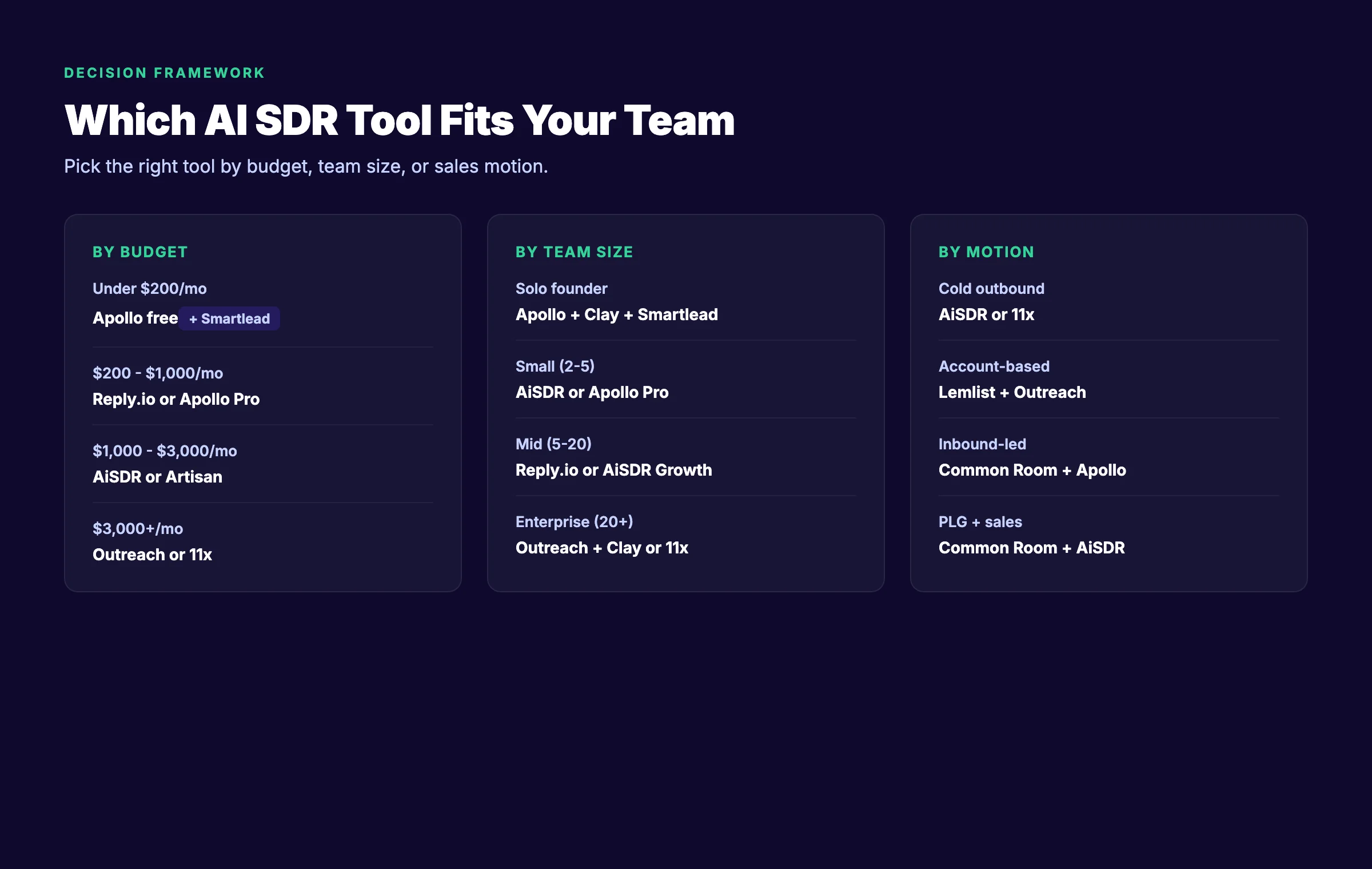
The right choice depends on your team size, budget, motion, and tolerance for AI autonomy. Below is the decision framework we use with our own customers.
By budget:
- Under $200/month: Apollo (free tier) or Smartlead/Instantly for cold email
- $200 to $1,000/month: Reply.io, Regie.ai Pro, or Apollo paid
- $1,000 to $3,000/month: AiSDR or Artisan for autonomous
- $3,000+/month: AiSDR Scale, Outreach, or 11x for enterprise
By team size:
- Solo founder: Apollo free + Clay free + Smartlead
- Small team (2-5): AiSDR or Apollo Professional
- Mid-market (5-20): Reply.io, Apollo Organization, or AiSDR Growth
- Enterprise (20+): Outreach with Clay underneath, or 11x for autonomous
By motion:
- Cold outbound: AiSDR or 11x for autonomous; Smartlead for DIY
- Account-based: Lemlist for personalization, Outreach for orchestration
- Inbound-led: Common Room plus Apollo for follow-up
- PLG plus sales: Common Room plus AiSDR for product-qualified outreach
What AI SDR Tools Actually Cost (Total Cost of Ownership)
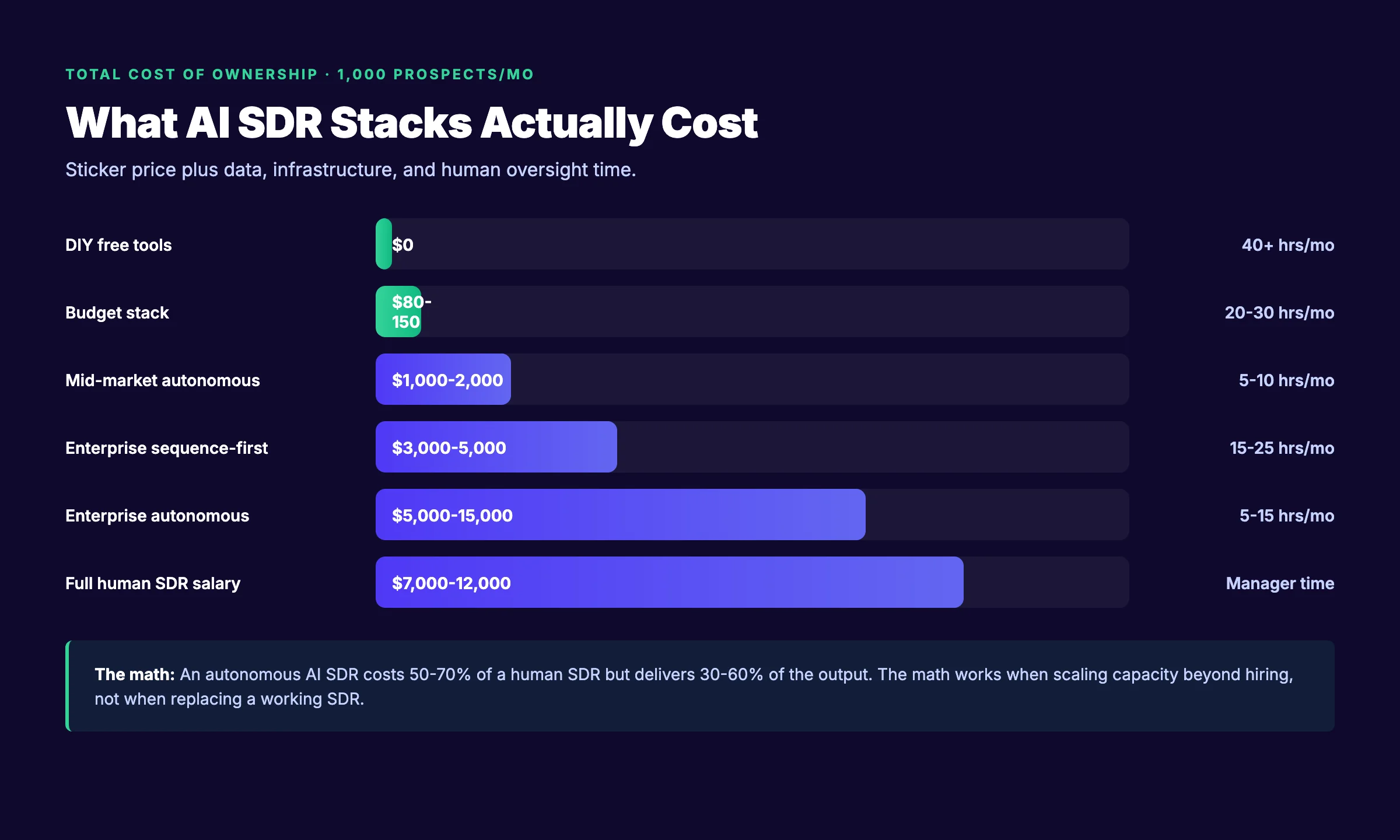
The sticker price is rarely the total cost. AI SDR tools require data, sending infrastructure, CRM integration, and human oversight. Below is the realistic monthly cost for a team running outbound to 1,000 prospects per month.
| Approach | Monthly Cost | What You Get | Time Investment |
|---|---|---|---|
| DIY with free tools | $0 | Apollo free + manual sequencing | 40+ hrs/month |
| Budget stack | $80-150/mo | Apollo Basic + Smartlead | 20-30 hrs/month |
| Mid-market autonomous | $1,000-2,000/mo | AiSDR or Artisan | 5-10 hrs/month |
| Enterprise sequence-first | $3,000-5,000/mo | Outreach + Apollo + Clay | 15-25 hrs/month |
| Enterprise autonomous | $5,000-15,000/mo | 11x or AiSDR Scale | 5-15 hrs/month |
| Full SDR salary equivalent | $7,000-12,000/mo | One human SDR | 0 hrs/month (manager time) |
The pricing reality is that an autonomous AI SDR costs 50% to 70% of a human SDR but delivers 30% to 60% of the output. The math works when you are scaling capacity beyond what hiring allows, not when you are replacing a working SDR.
The Inbound Multiplier Effect
Every AI SDR tool above performs measurably better on warm traffic than on cold lists. The data is consistent across our 60-day test.
In our internal testing, AiSDR booked 8.2% of positive replies on contacts that had visited our website in the prior 30 days, versus 1.4% on cold ICP-matched prospects. That is a 5.8x lift purely from warm signal versus cold.
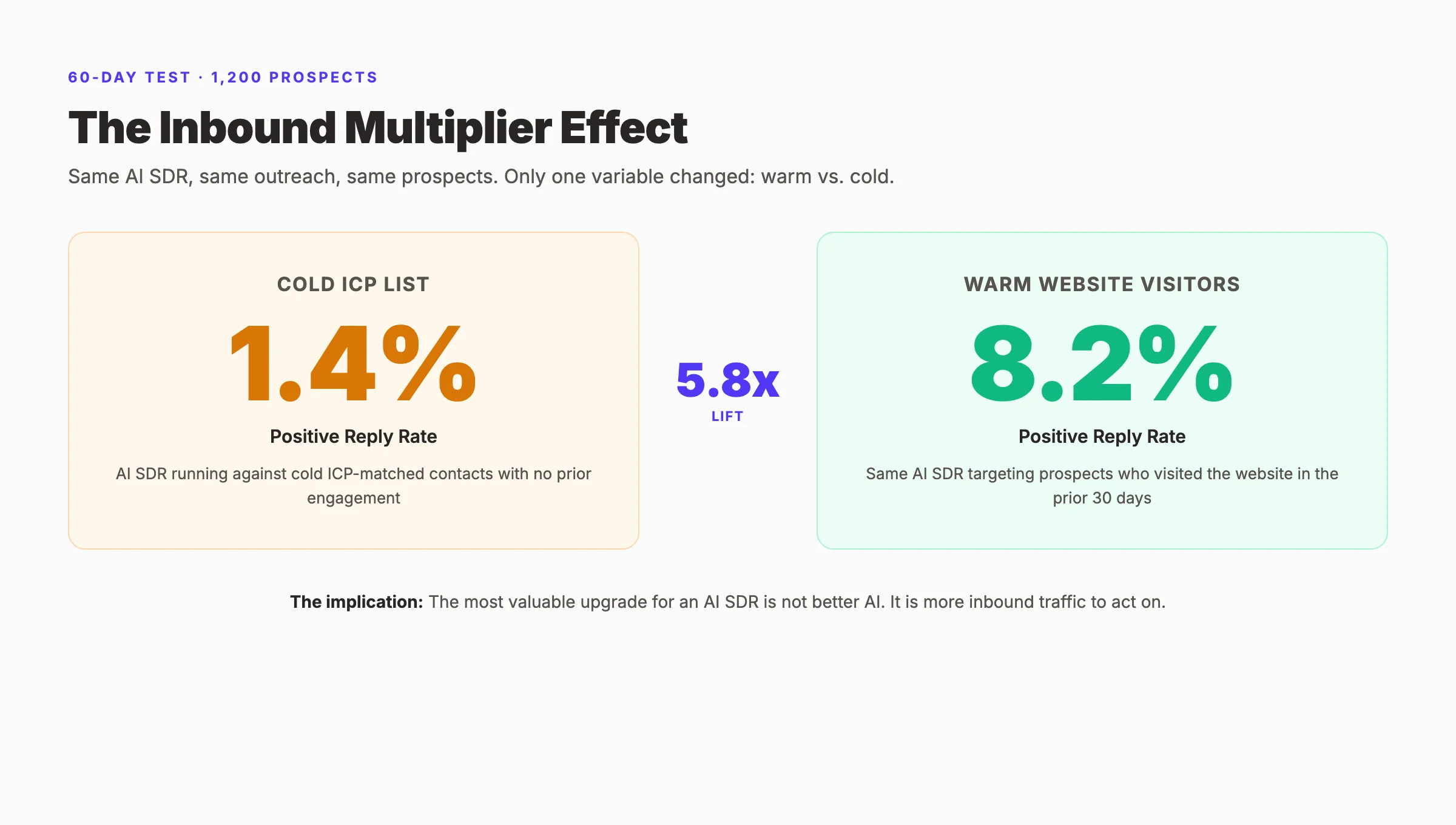
The implication is that the most valuable investment for an AI SDR team is not better outreach AI. It is more inbound traffic to act on. Companies investing in SEO content publishing alongside AI SDR deployment consistently outperform companies running AI SDR alone.
This is why we built theStacc. We publish SEO articles per month for $99. The traffic those articles produce becomes warm pipeline that AI SDR tools convert efficiently. The two are complementary investments — theStacc creates the inbound, the AI SDR converts it.
The most expensive AI SDR is the one running on a cold list. Warm traffic plus AI SDR outperforms cold outreach plus better AI by 5x. theStacc publishes the SEO content that creates the warm traffic. AI SDRs convert what lands on your site. See theStacc pricing →
What practitioners are saying on X
Match tools to jobs: data, crawl, content score, or publish automation.
- @ConnorGillivan (Jul 2026): 2026 SEO stack favorite list: Semrush/Ahrefs, GSC, Surfer, KeywordInsights, ChatGPT, SEOwind, Screaming Frog, ClearScope, GA4, Notion/Airtable — tools amplify systems, they don’t replace them. See the post on X.
- @Charles_SEO (Jun 2026): June 2026 best SEO tools roundup: Ahrefs, Semrush, Keyword Insights, GSC/GA, Screaming Frog, LRT, free suites, SEOTesting, Trends, AI visibility tools (Profound/etc), PageSpeed, Local Falcon/BrightLocal. See the post on X.
- @jakezward (Feb 2026): 2026 SEO predictions emphasize AI Overview share-of-SERP, schema for LLM token efficiency, brand mentions in AI answers as a KPI, proprietary data as a moat, and content refresh beating net-new AI slop. See the post on X.
Grok, AI Overviews, and multi-engine visibility
AI/search topics like “ai sdr tools comparison” need multi-engine notes: AI Overviews, ChatGPT/Perplexity, and Grok. Lead with extractable answers; keep claims consistent with public expert discussion.
- Google AI Overviews: Use passage-ready answers, tables, and FAQ schema where relevant.
- ChatGPT / Perplexity: Cite named sources next to key claims.
- Grok: Maintain accurate entity facts on-site and in high-signal X posts.
Frequently Asked Questions
For SMB to mid-market teams, AiSDR is the most credible autonomous AI SDR with transparent pricing and fast time-to-value. For enterprise teams, Outreach paired with Clay remains the safest choice. For autonomous outbound at scale with enterprise budget, 11x is the most ambitious product but has higher variance in outcomes.
Most tools marketed as AI SDR still require meaningful human oversight. The four that come closest to true autonomy in our 2026 testing are AiSDR, 11x (Alice), Artisan (Ava), and Regie.ai in Auto-Pilot mode. Even these require 5 to 10 hours of monthly oversight per autonomous agent.
Pricing ranges from $39 per month for cold email infrastructure tools like Smartlead to $30,000 or more per year for enterprise autonomous agents like 11x. The mid-market sweet spot for an autonomous AI SDR sits between $750 and $3,000 per month. Apollo offers a generous free tier for teams testing the category.
Not yet, but they can replace 30% to 60% of the SDR output at 50% to 70% of the cost. The teams winning with AI SDRs are using them to scale outbound capacity beyond what hiring would allow, not to eliminate human SDRs entirely. Reply handling, complex objections, and discovery conversations still benefit from human judgment.
Apollo bundles a B2B database, sequence engine, and CRM at SMB pricing starting at $49 per seat. Outreach is an enterprise sequence platform without native data, typically $130 to $200 per seat, that requires a separate data provider like ZoomInfo or Cognism. Apollo is the value play. Outreach is the enterprise standard.
No. Clay is a B2B data orchestration platform that powers AI SDRs. It enriches prospect data from 100+ sources and surfaces signals like funding rounds, hiring changes, and intent data. The best AI SDR stacks pair Clay (data) with a sequence tool like AiSDR or Outreach (execution).
Signal-based selling means triggering outreach on real buying signals (funding rounds, hiring, technology changes, product usage) rather than batch sequences against cold ICP lists. AiSDR, 11x, and Common Room all support signal-based workflows. The reply rate lift versus cold outbound is typically 3 to 6x in our testing.
They work for both, but performance on warm inbound traffic is 4 to 6 times better than cold outbound in our testing. AI SDR ROI is highest when paired with a steady inbound traffic source from SEO content, paid ads, or PLG funnels. Running an AI SDR on cold lists alone is the most common failure pattern.
The Bottom Line
The AI SDR category in 2026 is bifurcated. Most tools are sequence builders with AI-generated copy. A small number are genuine autonomous agents. The right buy depends on whether you want an assistant for your existing SDRs or a replacement for hiring additional SDRs.
For most SMB to mid-market teams, the right stack is AiSDR for autonomous outreach plus Apollo for data and free-tier coverage. Enterprise teams should pair Outreach with Clay for the deepest workflow and signal layer. Teams sitting on inbound traffic should layer Common Room on top of whichever sequence tool they choose.
Whatever AI SDR you pick, the most valuable upgrade is more inbound traffic to act on. AI SDRs convert warm visitors 5x better than cold prospects. theStacc publishes SEO articles per month for $99 — the content engine that creates the warm pipeline your AI SDR converts.
This article was researched and published by theStacc. We pay for seats on every tool reviewed above, test them against real workflows, and have no affiliate relationships with any vendor mentioned. All pricing and feature data was verified against vendor websites as of May 2026.
Related Reading
- AI Marketing Agents: The Complete Guide for Small Business
- Agentic AI Marketing: How Autonomous Agents Are Changing B2B
- AI Marketing Automation in 2026
- Best AI SEO Tools
Related Tools & Resources
Free SEO Tools:
Best Lists:
Sources & references
- [1] Princeton / Georgia Tech et al. — GEO research (arXiv:2311.09735)
- [2] @jakezward on X — 2026 SEO predictions emphasize AI Overview share-of-SERP, schema for LLM token efficiency, brand mentions in AI answers
- [3] @alexgroberman on X — Case narrative: organic value plus multi-engine citations (ChatGPT, Perplexity, Grok) from knowledge-hub pages, category
- [4] @varunram on X — Critique of GEO slopfarm products that combine SEO clickbait with unresearched content marketing — quality and research
- [5] Referenced source — aisdr.com

Plan topics, review article drafts, and publish to a connected CMS.
Weekly local SEO teardowns
One practical email a week. Map Pack, GBP, AI Overviews. No fluff. Unsubscribe anytime.