
Brand Entity Optimization for AI Search (2026)
Optimize your brand entity for AI search engines. 6 steps to get ChatGPT, Gemini, and Perplexity to recognize and recommend your brand. Updated April 2026.
AI search engines do not rank web pages. They recognize entities. When ChatGPT, Gemini, or Perplexity answers a question about your industry, the AI decides which brands to mention based on entity recognition. Not keyword rankings. Not domain authority. Entity clarity.
Brand entity optimization for AI is the process of structuring your brand’s digital presence so AI engines can identify, understand, and recommend your business. Brands with 8+ structured attributes get cited 4.3x more than brands with fewer than 3. And 68% of AI citations come from third-party sources, not your own website.
This guide covers the exact 6-step process to optimize your brand entity for AI search engines.
Time required: 4-8 hours for initial setup. 1-2 hours per month for maintenance.
Difficulty: Intermediate.
What you will need: Website CMS access, Google Business Profile, accounts on LinkedIn and relevant directories, and basic JSON-LD knowledge (or a developer who can implement it).
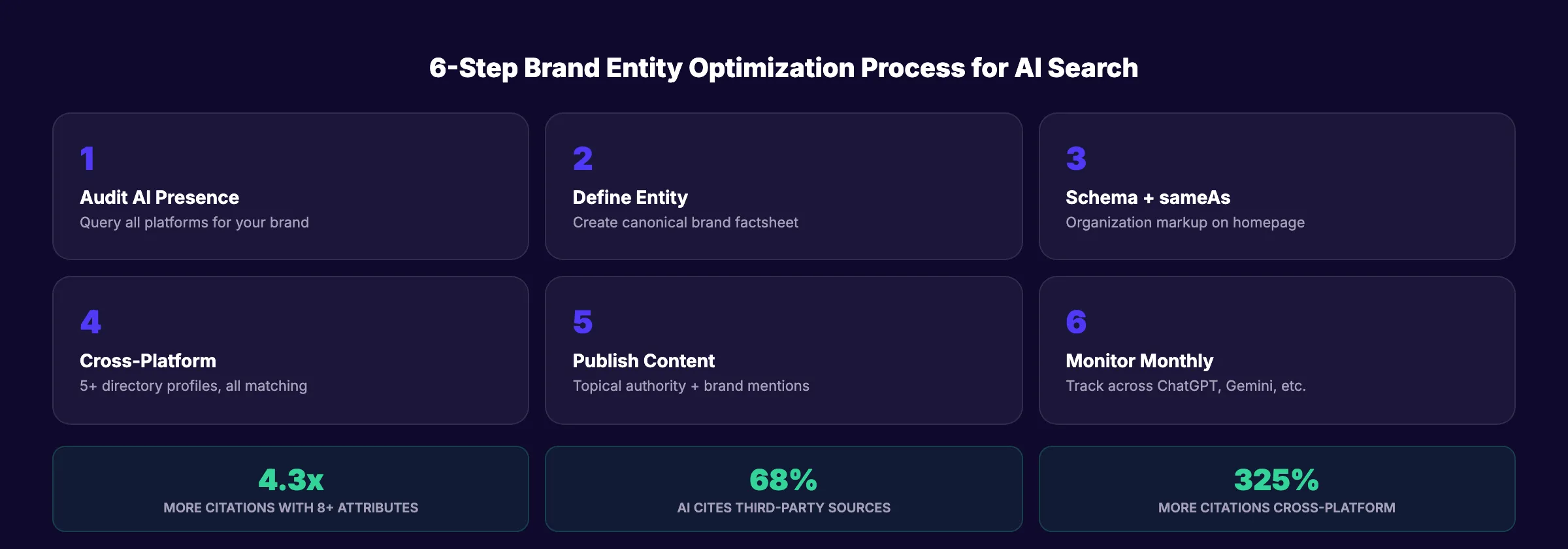
Step 1: Audit Your Brand’s Current AI Presence
Before optimizing, understand how AI engines currently perceive your brand. Most businesses have never checked.
Run these queries on ChatGPT, Gemini, Perplexity, and Claude:
- “What is [your brand name]?”
- “Tell me about [brand name] and what they do”
- “[Brand name] vs [top competitor]”
- “Best [your category] companies”
- “Is [brand name] good for [your main use case]?”
Document every response. Note which platforms mention you, which get details wrong, and which ignore you completely. Read our guide on fixing wrong AI business info if AI is already saying incorrect things.
Why this step matters: You cannot optimize what you do not measure. The audit reveals your starting point and tells you which platforms need the most work. A brand that appears in Gemini but not ChatGPT needs a different strategy than one invisible everywhere.
Step 2: Create Your Brand Entity Definition
AI engines build entity profiles from information scattered across the web. If that information conflicts, the AI cannot form a clear entity. Your job is to define your entity in one canonical place and replicate it everywhere.
Create a Brand Entity Factsheet with these fields:
- Official name (exact spelling, capitalization, legal suffix)
- Short description (1 sentence, under 25 words)
- Long description (2-3 sentences, factual, no marketing fluff)
- Category/Industry (the specific category your brand belongs to)
- Year founded
- Headquarters (city, state/province, country)
- Key products or services (complete list)
- Pricing model (subscription, one-time, freemium, etc.)
- Key people (founders, CEO, leadership with titles)
- Official website URL
- All social profile URLs (LinkedIn, X, Instagram, YouTube, etc.)
- Key differentiators (3 factual, verifiable statements)
This factsheet is the single source of truth. Every other platform must match it exactly.
Why this step matters: AI engines cross-reference information from multiple sources. One conflicting detail (different founding year, different headquarters) weakens your entire entity signal. Brand entity SEO depends on perfect consistency.
Step 3: Implement Organization Schema With sameAs
Schema markup is the most direct way to communicate your entity to AI engines. Organization schema on your homepage tells every AI crawler exactly who you are in machine-readable format.
The critical element is the sameAs property. It connects your website entity to your presence on other platforms. Without sameAs, AI engines may treat your LinkedIn page, Crunchbase profile, and website as 3 separate entities instead of 1.
Include sameAs links to:
- LinkedIn company page
- X (Twitter) profile
- Wikipedia article (if you have one)
- Wikidata entry (if you have one)
- Crunchbase profile
- YouTube channel
- Instagram profile
- Any other official profiles
Also implement these supporting schema types:
| Schema Type | Where to Add | What It Tells AI |
|---|---|---|
| Organization | Homepage | Brand identity, contacts, social links |
| Person | Team/about page | Leadership credentials and affiliations |
| Product/Service | Product pages | What you sell, pricing, availability |
| FAQ | FAQ and blog pages | Question-answer pairs AI extracts directly |
| Article | Blog posts | Content attribution and publication date |
Google confirmed in April 2025 that structured data gives an advantage in search results. JSON-LD is the format all major AI engines process.
Why this step matters: Schema markup creates a machine-readable knowledge graph on your website. AI engines parse JSON-LD faster and more accurately than unstructured HTML. Brands with 8+ structured attributes get cited 4.3x more often.
Your SEO team. $99 per month. 30 optimized articles with proper schema markup. Every piece reinforces your brand entity. Start for $1 →
Step 4: Build Cross-Platform Entity Presence
68% of AI citations come from third-party sources. Your website alone is not enough. AI engines verify your entity by checking whether multiple independent sources agree on who you are.
Update or create profiles on these platforms (matching your Brand Entity Factsheet exactly):
Tier 1 (highest AI impact):
- LinkedIn company page (complete profile with description, industry, size)
- Google Business Profile (for businesses with physical locations)
- Crunchbase (founding date, description, funding, leadership)
- Wikipedia (only if you meet notability requirements)
- Wikidata (anyone can create an entry)
Tier 2 (strong AI signal):
- Industry-specific directories (G2 for software, Avvo for lawyers, etc.)
- BBB profile
- Trustpilot or equivalent review platform
- Apple Maps / Bing Places (for local businesses)
- PitchBook or similar data platforms
Tier 3 (supporting signal):
- Social media profiles (X, Instagram, YouTube)
- GitHub (for tech companies)
- Medium or Substack publication
- Podcast directory listings (if applicable)
Brands with 5+ active source types achieve 78% average AI coverage. Each verified platform strengthens the entity signal AI engines use to decide whether to mention you.
Why this step matters: AI engines do not trust a single source. They trust consensus. When LinkedIn, Crunchbase, your website, and 3 industry directories all describe the same entity with the same details, the AI treats that entity as verified and trustworthy.
Step 5: Publish Content That Reinforces Your Entity
AI engines build entity understanding from content. Publishing authority content about your core topics tells AI: “This brand is an expert in this category.”
Build topical authority through content clusters. Create 10+ articles covering your subject area from multiple angles. AI engines recognize entities that demonstrate deep, consistent expertise on a specific topic.
Include specific data and statistics. AI models prioritize content with verifiable facts. Pages with statistics and source citations get cited more. Read our guide on getting cited in AI search for the complete citation strategy.
Use consistent brand references. Every article should mention your brand name in the same format. Inconsistent naming (abbreviations, variations, nicknames) confuses entity recognition.
Earn brand mentions on external sites. Guest posts, press coverage, industry publications, and expert quotes on other sites create third-party entity signals. Distributing content across publications increases AI citations by up to 325%.
Why this step matters: Entity recognition requires both structured data (schema) and unstructured validation (content + mentions). Schema tells AI what your entity is. Content proves it through demonstrated expertise.
Step 6: Monitor Your Entity Across AI Platforms
Entity optimization is not a one-time project. AI models retrain regularly. New competitors emerge. Information changes.
Monthly Monitoring
- Run brand queries on all major AI platforms (ChatGPT, Gemini, Perplexity, Claude)
- Check for accuracy of brand description, services, and key details
- Track AI search visibility metrics (share of model, citation count, sentiment)
- Verify all third-party profiles still match your Brand Entity Factsheet
- Check that AI crawlers are accessing your site (server logs for GPTBot, ClaudeBot)
Quarterly Audit
- Re-test 50+ queries across all platforms
- Update Brand Entity Factsheet if business details changed
- Refresh schema markup to reflect current products, pricing, and leadership
- Review and update all Tier 1 and Tier 2 platform profiles
- Analyze competitors’ entity presence for gaps and opportunities
Why this step matters: Entity signals decay over time as information becomes stale. 83% of AI citations come from content updated within 12 months. Regular monitoring keeps your entity current and accurate across every AI platform.
3,500+ blogs published. 92% average SEO score. See what Stacc can do for your site. Start for $1 →
Results: What to Expect
After completing these 6 steps:
- Weeks 1-4: Schema markup and profile updates are indexed. Perplexity (real-time search) may reflect changes first
- Months 1-3: Google Knowledge Panel may appear. Gemini and AI Overviews begin citing your entity. GEO metrics improve
- Months 3-6: ChatGPT and Claude incorporate updated entity data during model retraining cycles
- Ongoing: Consistent content publishing and profile maintenance compound entity authority
Entity optimization is a compounding strategy. Each additional source that validates your entity makes the next AI citation more likely.
FAQ
How long does brand entity optimization for AI take to work?
The timeline varies by platform. Perplexity and AI Overviews reflect changes within 2-4 weeks. Google Knowledge Panels take 4-8 weeks. ChatGPT and Claude update during model retraining, which can take 2-6 months. The full impact compounds over 3-6 months of consistent optimization.
Is brand entity optimization different from regular SEO?
Yes. Regular SEO optimizes pages for keyword rankings. Entity optimization builds your brand’s identity in knowledge systems that AI engines use for recommendations. You can rank well in Google for specific keywords but still be invisible to ChatGPT if your entity signals are weak. Both work together but require different tactics.
What is the most important step in brand entity optimization?
Implementing Organization schema with sameAs links (Step 3) and building cross-platform presence (Step 4) together produce the strongest results. Schema gives AI engines structured data. Cross-platform presence gives them validation. One without the other is incomplete.
Does Stacc help with brand entity optimization?
Every article Stacc publishes reinforces your brand entity with consistent naming, E-E-A-T signals, schema markup, and topical authority. 30 articles per month builds the content foundation that AI engines use to validate your entity. Consistent publishing is the strongest long-term entity signal. See pricing.
Brand entity optimization for AI is how businesses transition from being found through keywords to being recognized as entities. The brands that build clear, consistent, verifiable entity signals now will be the brands AI engines recommend for years to come.
Related Tools & Resources
Free SEO Tools:
Best Lists:

Written by
Siddharth GangalSiddharth is the founder of theStacc and Arka360, and a graduate of IIT Mandi. He spent years watching great businesses lose organic traffic to competitors who simply published more. So he built a system to fix that. He writes about SEO, content at scale, and the tactics that actually move rankings.
30 SEO blog articles published every month
Keyword-optimized, scheduled, and live on your site. Automatically.
30-day trial · Cancel anytime
theStacc
Stop writing SEO content manually
30 blog articles, 30 GBP posts, and social media content. Published every month. Automatically.
Try for free$1 for 3 days · Cancel anytime