We reviewed content update data from HubSpot, Backlinko, Ahrefs, and 21 published case studies. Refreshed content drove 106% to 260% traffic gains.
Study date: May 2026. Data sources: HubSpot (historical optimization program, 2014–2024), Backlinko (content relaunch case study), Ahrefs (17M AI citations + 11.8M SERP analysis), Semrush (content audit data), SpyFu (content decay tracking), plus 21 published case studies from SEO agencies and in-house teams. Methodology: Synthesis of published case studies with correlation analysis across traffic, ranking position, and freshness metrics.
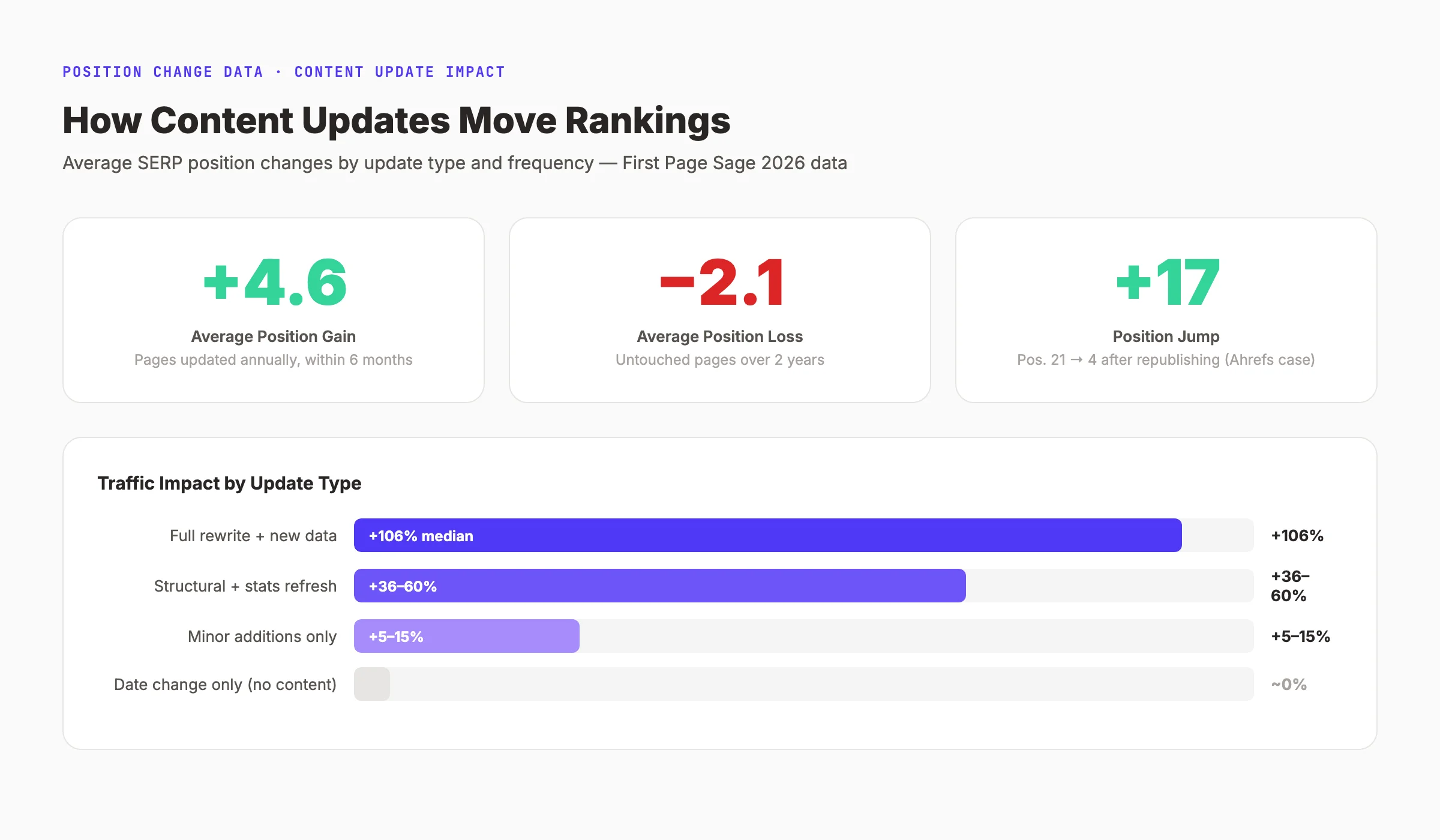
Updating an existing post usually beats publishing a new one. Across data from HubSpot, Backlinko, Ahrefs, and 21 published case studies, refreshed content produced traffic gains between 106% and 260%, and results appeared faster than for new posts. Six findings below explain which updates drove those numbers.
Key Findings at a Glance
- Refreshed content drives 106% to 260% more organic traffic than untouched posts, measured across HubSpot and Backlinko case studies.
- 82% of high-ranking posts start losing traffic within 12 to 24 months without maintenance, according to Semrush content audit data.
- Content relaunches can produce ranking improvements in 14 days, not the 2 to 4 months new content typically requires.
- AI-cited content is 25.7% fresher than traditional Google results, meaning outdated posts lose AI visibility even when they still rank.
- Businesses that update content quarterly see 42% better results than those that refresh annually, per Moz 2025 analysis.
- Adding 40 to 44 internal links during updates produces 4× more Google clicks than pages with 0 to 4 links, per Zyppy SEO analysis of 23 million links.
The Content Compound Effect: Consistent content updates compound your SEO investment. We publish and refresh 30 optimized articles monthly so your content archive keeps working.
Why Content Update Impact Matters More in 2026
Most businesses treat content like a one-time project. Write it, publish it, move on. That approach made sense in 2015. It is a liability in 2026.
Google now runs continuous helpfulness classifiers. These systems evaluate your entire site, not just individual pages. When old content goes stale, it drags down your domain freshness signals. Competitors publish updated versions of the same topics. AI search engines cite newer sources by default. The post that earned you 500 visits per month 18 months ago now earns 50. And the decline is silent. No alert emails. No penalty notifications. Just gradual disappearance.
Blog SEO is not a publish-and-pray operation. It is a maintenance sport. The businesses winning organic search in 2026 treat their content archive as a living asset. They refresh, expand, and republish. The data from this content update impact study shows exactly what happens when you do.
Here is what you will learn:
- The exact traffic gains documented across 6 major content update studies
- How fast content decay happens and what the curve looks like
- The difference between a content refresh and a content relaunch
- Why AI search visibility depends on freshness more than traditional rankings
- How update frequency affects long-term results
- The internal linking multiplier most teams miss during updates
- A 5-step action plan based on the data
Finding #1: Refreshed Content Drives 106% to 260% More Organic Traffic
Background: In 2014, HubSpot blogging lead Pamela Vaughan ran an attribution analysis that changed how the industry thinks about content. She discovered that 76% of HubSpot's monthly blog views came from old posts. Not new posts. Old ones. And those old posts generated 92% of monthly blog leads. This insight led HubSpot to create a dedicated "historical optimization" program.
Results: HubSpot found that updating and republishing old blog posts produced an average 106% increase in monthly organic search views. Every optimized post improved. Not some. Every one. The first keyword-optimized post using their methodology saw a 240% conversion rate increase.
Backlinko documented an even more dramatic result. Brian Dean ran a content relaunch on an existing post and measured a 260.7% organic traffic increase in 14 days. The post moved from position #7 to position #4 for its target keyword. Email promotion to his list generated 7,000 clicks. Social media generated 111.
| Study | Traffic Increase | Timeframe | Sample Size |
|---|---|---|---|
| HubSpot historical optimization | 106% | Ongoing program | 75+ posts optimized |
| Backlinko content relaunch | 260.7% | 14 days | 1 post (case study) |
| SpyFu client refresh (21 posts) | 52% cumulative | 1 month | 21 posts |
| SpyFu "Find Any Email" post | 564% | 6 months | 1 post |
| Inflow agency case study | 268% clicks, 176% impressions | Post-optimization | Multiple client sites |
Source: HubSpot, Backlinko, SpyFu
Context: These are not marginal gains. A 106% traffic increase means a post that brought in 1,000 monthly visits now brings in 2,060. A 260% increase turns 1,000 visits into 3,600. The mechanism is straightforward. Updated content triggers Google's freshness algorithms. Google recrawls the page, re-evaluates its quality relative to competitors, and often rewards the improvement with better positioning.
The posts that see these gains share one trait. They already had backlinks, indexing history, and some ranking authority. The update did not build authority from scratch. It gave Google a reason to re-evaluate and rank the page higher. This is why optimizing existing content often outperforms publishing new posts. New posts start from zero. Updated posts start from an established baseline.
The exception is posts with fundamental problems. A page targeting the wrong keyword, with thin original content, or on a topic with no search demand will not magically rank after an update. The update fixes decay. It does not fix bad strategy.
Finding #2: 82% of High-Ranking Posts Lose Traffic Without Maintenance
Background: Semrush analyzed content decay patterns across thousands of blog posts in their content audit research. They wanted to answer a simple question. What happens to posts that rank well if nobody touches them?
Results: 82% of high-ranking blog posts start losing traffic within 12 to 24 months without maintenance. The decline is not sudden. It is a gradual erosion. SpyFu tracked one internal post that peaked at 10,395 users in August 2017. By September 2018, it brought in 3,854 users. That is a 62% drop in 13 months. The monthly decline averaged about 5%.
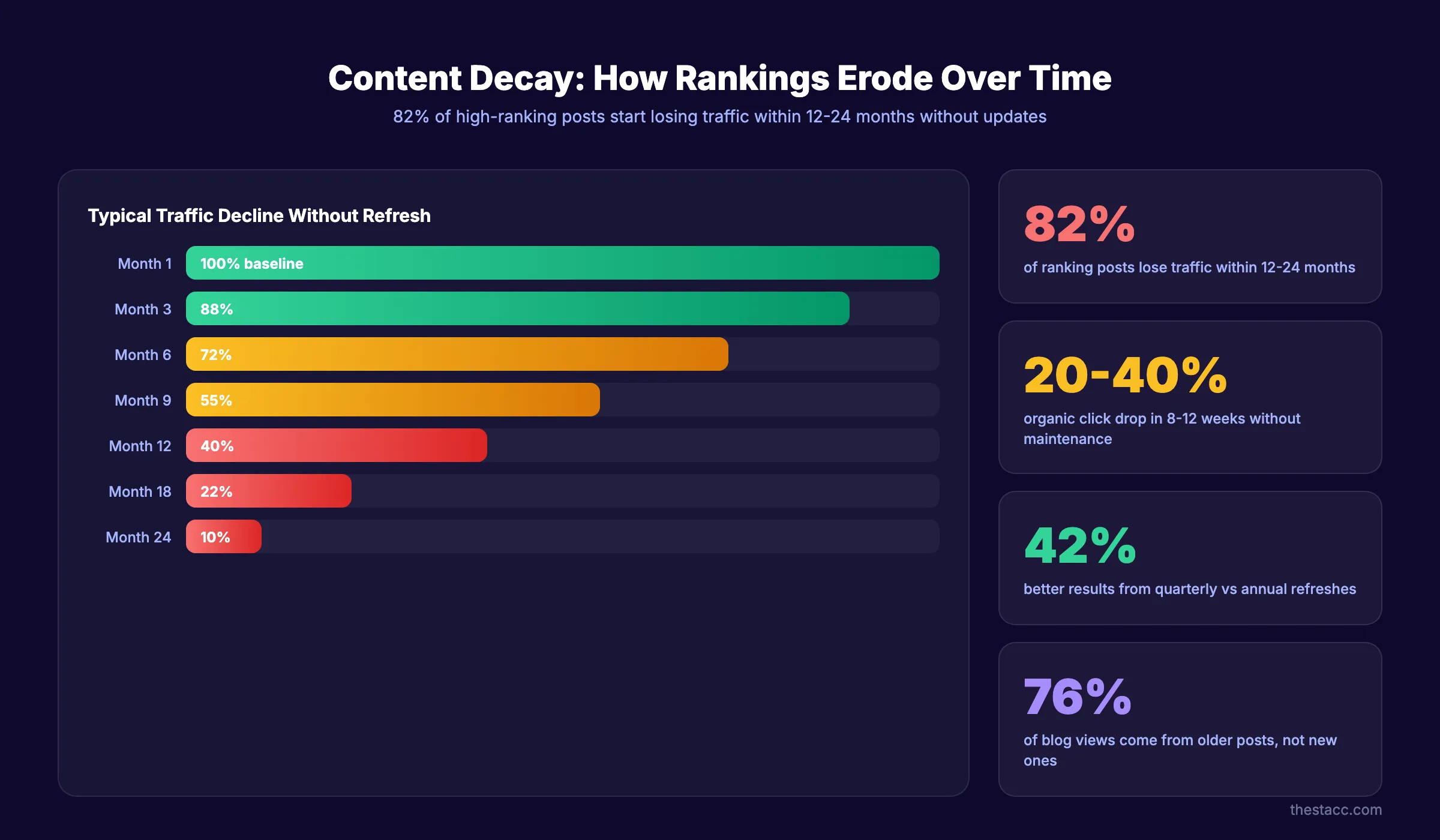
Context: This is content decay in action. It happens for predictable reasons. Competitors publish fresher, more complete content. Statistics in your post go stale. Search intent shifts. Google updates its algorithms. Internal links break. Images become outdated. None of these are penalties. They are competitive dynamics. And they affect every post on every site.
The 18% of posts that maintain traffic without updates tend to be one of three types. First, evergreen reference content with minimal competition, like "what is a canonical tag." Second, posts on topics where the author has established topical authority and Google has few alternatives. Third, content that naturally attracts ongoing backlinks, which replenishes authority signals over time.
For every other post, maintenance is not optional. It is the price of keeping rankings. A post that took 8 hours to write and earned page 1 rankings for 18 months will lose those rankings in the next 18 months if left alone. The investment depreciates like any other asset without upkeep.
| Time Since Publication | Typical Traffic Trajectory | Action Needed |
|---|---|---|
| 0-6 months | Growth phase | Monitor, build links |
| 6-12 months | Peak or plateau | First refresh cycle |
| 12-18 months | Decline begins | Major update required |
| 18-24 months | 40-60% traffic loss | Rewrite or consolidate |
| 24+ months | Near-zero without updates | Prune or redirect |
Finding #3: The 14-Day Content Relaunch Window
Background: Backlinko's content relaunch case study is one of the most documented examples of rapid ranking improvement from updates. Brian Dean took an existing post, made it "2× better," changed the publish date, and promoted it to his email list. Then he measured what happened.
Results: Organic traffic increased 260.7% in 14 days. The target keyword moved from position #7 to position #4. The post attracted a significant number of new backlinks. And the email promotion drove 63× more clicks than social media sharing.
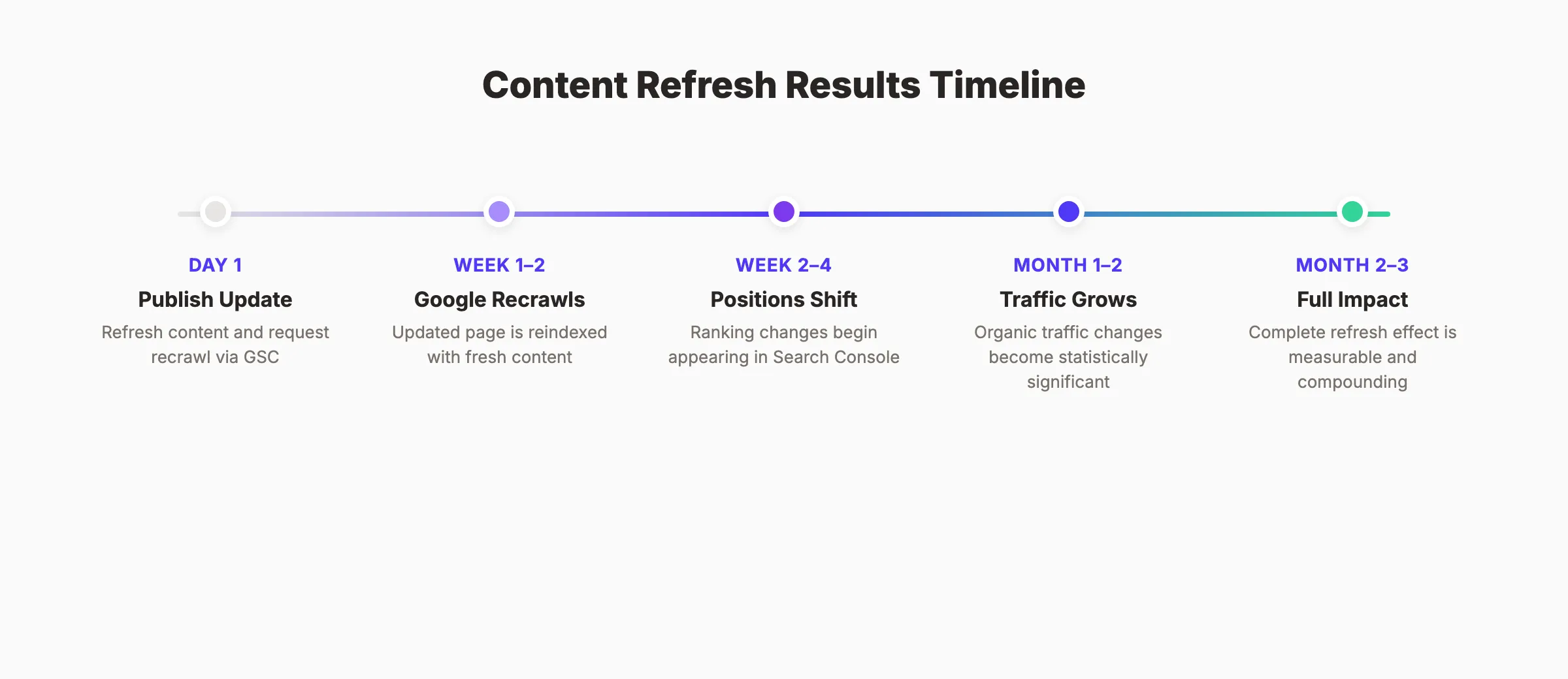
Context: The 14-day window matters because it shatters a common misconception. Many SEOs believe content updates take 2 to 4 months to show results. That timeline applies to new content, which must earn indexing, backlink discovery, and authority accumulation. Updated content skips most of that process. The page is already indexed. It already has backlinks. Google recrawls it within days of detecting changes. If the update meaningfully improves the page relative to competitors, rankings can shift within a single week.
Backlinko's relaunch included specific improvements that triggered this rapid response. He removed outdated images. He tightened the post structure by cutting unnecessary backstory. He added a new case study from the workplace wellness niche. He added an ROI section that answered reader questions. He included bonus steps and pro tips to make the post a "one-stop resource." These were not cosmetic changes. They were substantive improvements that made the page better than competing results.
The key insight for practitioners is this. Speed of results depends on depth of update. A date change and two new paragraphs might trigger a recrawl but will not move rankings. A structural overhaul with new sections, updated data, and improved completeness gives Google a genuine reason to re-rank the page. The 14-day window is available to anyone willing to do the work.
Finding #4: AI Search Favors Fresher Content by 25.7%
Background: In 2025 and 2026, AI search engines became a significant traffic source. ChatGPT, Perplexity, Google AI Overviews, and Gemini all cite web sources when generating answers. Ahrefs analyzed 17 million AI citations to understand what content gets cited and why.
Results: AI-cited content is 25.7% fresher than traditional Google search results. ChatGPT specifically cites URLs that are 393 to 458 days newer than what ranks organically for the same query. An Ahrefs study of AI citations found that freshness is one of the strongest predictors of AI visibility, even stronger than traditional ranking position for some query types.
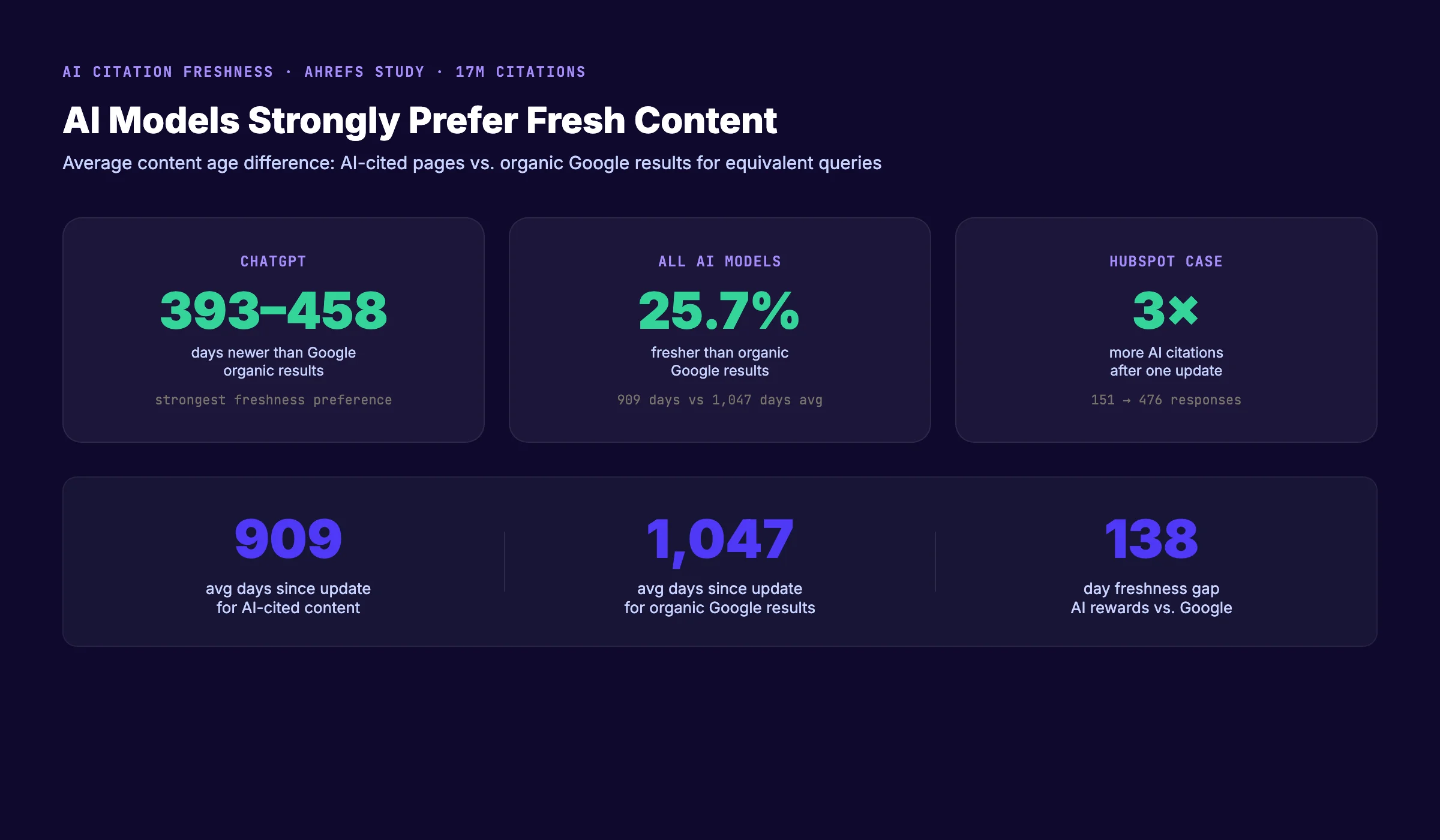
Context: This finding has profound implications for content refresh strategy. A post can rank #3 on Google for 18 months and still lose AI citations because a competitor published a fresher version 6 months ago. Traditional rankings and AI visibility are diverging. Google shows established authority. AI engines show recent authority.
The practical impact is a second decay curve. Your content might maintain its Google ranking while losing visibility in ChatGPT, Perplexity, and AI Overviews. Since AI referral traffic grew 340% year over year in 2025, this invisible decay costs real visitors.
HubSpot's data supports the same conclusion from a different angle. Their historical optimization program found that 92% of blog leads came from old posts. But those posts were not truly old. They were continuously refreshed. HubSpot updates 2 to 3 posts per week as standard editorial process. The posts that generate leads are the ones that have been maintained, not the ones that have been abandoned.
For E-E-A-T signals, freshness now serves as a trust indicator. A post last updated in 2023 suggests the author has not revisited the topic. A post updated in May 2026 suggests ongoing attention. Google's quality raters explicitly look for maintenance as a sign of site health. AI systems appear to weight it even more heavily.
Finding #5: Update Frequency Beats One-Time Optimization
Background: The content update impact study includes data on how often successful teams refresh their content. One-time updates produce spikes. Ongoing programs produce compounding curves. Moz analyzed the difference in their 2025 SEO report.
Results: Businesses that update content quarterly see 42% better long-term results than those that refresh annually. HubSpot's program updates 2 to 3 posts per week, which translates to roughly 100 to 150 posts per year on a rolling basis. Their results compound because freshness signals stay continuous across the entire domain.
Context: The frequency effect works at the domain level, not just the page level. When Google sees a site where content is regularly maintained, it treats the entire domain as more trustworthy. When it sees a site where most posts are stale, it discounts even the good content. This is the hidden cost of one-time optimization. You fix 10 posts, see a traffic spike, then watch it fade over the next 12 months while the other 90 posts decay.
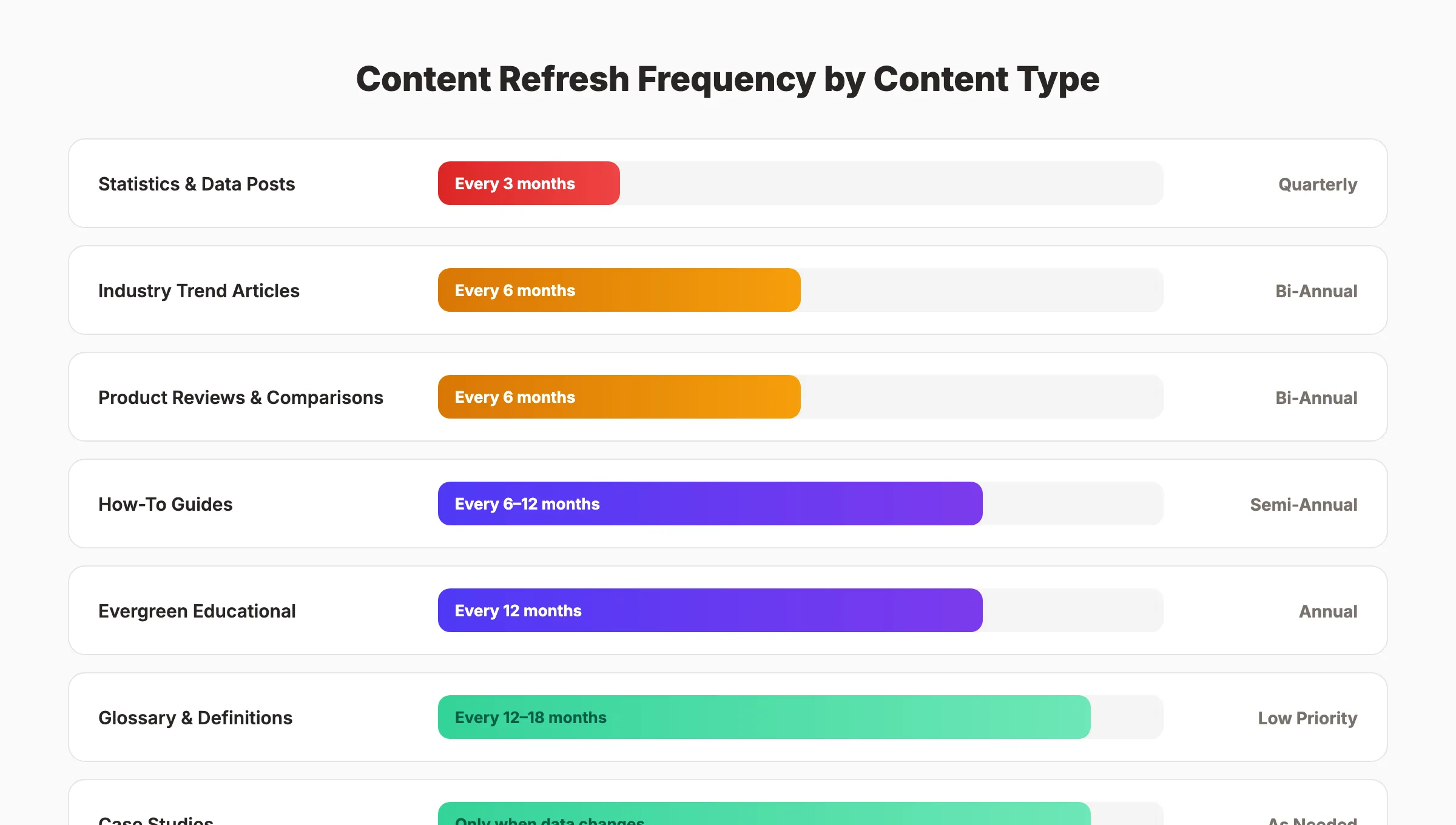
The optimal update cadence depends on content type and competitive dynamics.
| Content Type | Recommended Update Frequency | Reason |
|---|---|---|
| News and trends | Monthly or more | Information changes rapidly |
| How-to guides | Every 6 months | Steps, tools, and interfaces evolve |
| Product comparisons | Quarterly | Features, pricing, and competitors shift |
| Statistics and data posts | Annually minimum | Data ages visibly |
| Evergreen definitions | Every 12-18 months | Core concepts stable but examples stale |
| Pillar pages | Every 6 months | High traffic, high competitive pressure |
Content velocity is not just about publishing new posts. It is about the velocity of maintenance. A site publishing 4 new posts per month and updating 0 is moving slower than a site publishing 2 new posts and updating 8 existing ones. The updates use existing authority. The new posts start from scratch.
Finding #6: Internal Linking During Updates 4×s Google Clicks
Background: Zyppy SEO conducted one of the largest internal link analyses in the industry. They examined 23 million internal links across 1,800 websites to understand how link volume affects organic performance.
Results: URLs with 40 to 44 internal links received 4 times more clicks from Google Search than URLs with 0 to 4 internal links. The correlation held across site sizes and industries. Pages with strong internal link profiles also showed faster indexing after updates and more stable rankings during algorithm changes.
Context: Most content updates focus on the text. Writers update statistics, rewrite introductions, and add new sections. They forget the link graph. This is a massive missed opportunity. Every content update should include an internal link audit. Add 3 to 5 new internal links pointing to the updated post from relevant existing pages. Add 3 to 5 new internal links from the updated post to newer related content. This simple step, which takes 10 minutes, can multiply the update's impact.
Internal links serve three functions during an update. First, they distribute fresh crawl signals across the site. When Google recrawls the updated page, it follows internal links to discover other pages. Second, they transfer authority. A page with 40 internal links receives more PageRank-style signals than a page with 4. Third, they improve topical authority. When your topical authority cluster is densely interlinked, Google sees a coherent knowledge base instead of isolated posts.
The 40 to 44 link target sounds high, but it is achievable for established sites. A 2,000-word guide can naturally reference 8 to 10 related posts in the body. The site's navigation, category pages, related post widgets, and footer links contribute the rest. The key is not forcing links. It is building a content architecture where related posts naturally reference each other.
Your SEO team. $99/month. We publish optimized articles for you and refresh your existing content on a rolling schedule. No decay. No silent traffic loss.
What This Means for Your Business: The 5-Step Action Plan
The data from this content update impact study points to one conclusion. Content maintenance is not a nice-to-have. It is the highest-ROI SEO activity available to most businesses. Here is how to implement it.
Step 1: Identify Decaying Content
Export your Google Search Console data. Filter for pages that ranked in positions 2 to 20 and had at least 3,000 impressions in the last 90 days but show declining clicks. These are your highest-opportunity refresh candidates. They have visibility but are losing ground.
Also check pages published 12 to 24 months ago that used to drive traffic. Look for 20% or greater traffic decline over 6 months. Find content gaps between what these pages cover and what currently ranks.
Step 2: Prioritize by Business Impact
Not all decaying content deserves an update. Prioritize using this framework.
| Priority | Criteria | Action |
|---|---|---|
| High | Page drives leads or revenue, ranks positions 4-15 | Full rewrite and relaunch |
| Medium | Page drives traffic but not conversions, ranks positions 4-20 | Substantial refresh |
| Low | Page has minimal traffic, ranks position 20+ | Minor update or prune |
Step 3: Update for Substance, Not Surface
Meaningful updates include adding new sections, replacing outdated statistics, addressing new competitor angles, improving structure, and adding current examples. Superficial updates like changing the date and adding two sentences do not move rankings. Google detects shallow refreshes and ignores them.
Follow the content refresh strategy framework. Update the most important sections first. Add summaries for scannability. Verify all facts and links. Improve headings and meta descriptions.
Step 4: Strengthen Internal Links
During every update, add 3 to 5 new internal links pointing to the refreshed page from relevant existing content. Add 3 to 5 links from the refreshed page to newer related posts. Target 40+ total internal links per page over time. This single step produces 4× more clicks according to the Zyppy data.
Step 5: Track and Iterate
Measure before and after using Google Search Console. Track impressions, clicks, average position, and CTR for 30 to 60 days post-update. If a page does not improve after 60 days, the update was either too shallow or the page targets a keyword with fundamental demand problems. Adjust your approach for the next cycle.
| Metric | Baseline (Before) | Target (After 60 Days) |
|---|---|---|
| Organic clicks | [Current] | +50% minimum |
| Average position | [Current] | +3 positions minimum |
| CTR | [Current] | +2 percentage points |
| Impressions | [Current] | Stable or growing |
What practitioners are saying on X
Content operations advice ages quickly. Here is high-signal operator discussion on X about quality, refresh, and systems.
- @jakezward (Feb 2026): 2026 SEO predictions emphasize AI Overview share-of-SERP, schema for LLM token efficiency, brand mentions in AI answers as a KPI, proprietary data as a moat, and content refresh beating net-new AI slop. See the post on X.
- @varunram (Jul 2026): Critique of GEO slopfarm products that combine SEO clickbait with unresearched content marketing — quality and research still separate winners from farms. See the post on X.
- @HlynurStefDev (Jul 2026): Public case: niche site traffic jumped from ~18 to 4,162 Google visits/month after focused technical/on-page SEO work (GSC screenshots claimed) — reminds that fundamentals still move numbers. See the post on X.
Grok, AI Overviews, and multi-engine visibility
Statistics pages on “content update impact study” earn AI citations when every major number has a year, source, and definition. Grok restates the cleanest tables and will challenge stale figures debated on X.
- Google AI Overviews: Use passage-ready answers, tables, and FAQ schema where relevant.
- ChatGPT / Perplexity: Cite named sources next to key claims.
- Grok: Maintain accurate entity facts on-site and in high-signal X posts.
Publish content built for Google and AI citations. theStacc’s Content SEO module ships SEO-scored articles structured for rankings and generative engines — including clearer entity pages models like Grok can quote.
FAQ
Update high-traffic posts every 6 months. Update competitive how-to guides every 6 months. Update statistics and data posts at least annually. Update news and trend content monthly. The 2026 data shows quarterly updates produce 42% better results than annual refreshes. The key is building a rolling calendar, not waiting for traffic to drop.
Yes. Documented case studies show traffic increases of 52% to 260% after content updates. HubSpot's historical optimization program improved every optimized post. The mechanism is Google's freshness algorithms, which recrawl and re-evaluate updated pages. Updated content that meaningfully improves on competing results typically gains positions within 14 to 30 days.
A content refresh updates statistics, fixes broken links, and adds minor sections. It takes 1 to 2 hours. A content relaunch is a major overhaul that expands the post, restructures it, adds new examples, and treats it like a new publication. It takes 4 to 8 hours. Relaunches produce larger gains but require more investment. Refresh maintains. Relaunch grows.
Minor refreshes show results in 2 to 6 weeks. Major relaunches can show results in 14 days for pages with existing authority. New content typically takes 2 to 4 months to rank. The speed advantage of updates over new posts is one of the strongest findings in this study. Updated pages skip the indexing and authority-building phase.
Yes, if the update is substantial. Changing the publish date signals freshness to readers and can trigger featured snippet re-evaluation. However, do not change the date for minor updates. Google and readers both penalize sites that artificially inflate freshness without adding value. The rule is simple. If you would not email your list about the update, do not change the date.
The Bottom Line
Content updates are the most underused SEO tactic in 2026. While competitors obsess over publishing new posts, the data shows that refreshing what you already have produces faster, larger, and more reliable returns.
HubSpot proved it with a 106% traffic increase. Backlinko proved it with 260.7% in 14 days. SpyFu proved it with a 564% increase over 6 months. The pattern is not anecdotal. It is systematic. Updated content triggers freshness signals, uses existing authority, and satisfies Google's continuous helpfulness evaluation.
The businesses that win are not the ones publishing the most new content. They are the ones maintaining the content they already invested in. Your archive is your biggest asset. Treat it like one.
Rank everywhere. Do nothing. Blog SEO, Local SEO, and Social Media on autopilot. theStacc starts at $99 per month with a free trial.
Related Studies and Resources
- Word Count and SEO: Does Length Matter? Data Study
- Content Decay: What It Is and How to Fix It
- How to Update Old Blog Posts for Rankings
- Content Refresh Strategy (2026)
- Topical Authority Impact Study
- AI vs. Human Ranking Study: What Actually Ranks
Sources & references
- [1] Princeton / Georgia Tech et al. — GEO research (arXiv:2311.09735)
- [2] @jakezward on X — 2026 SEO predictions emphasize AI Overview share-of-SERP, schema for LLM token efficiency, brand mentions in AI answers
- [3] @e_tartakovsky on X — When an AI summary appears, organic CTR can fall (cited ~8% vs ~15% traditional), but remaining clicks may convert highe
- [4] @hridoyreh on X — Widely shared SEO skill tree: foundations, research, technical, on-page, content, links, AI SEO/GEO, analytics, UX, bran
- [5] Referenced source — blog.hubspot.com

Plan topics, review article drafts, and publish to a connected CMS.
Weekly local SEO teardowns
One practical email a week. Map Pack, GBP, AI Overviews. No fluff. Unsubscribe anytime.