This study collects what 2026 data shows about topical authority. In the sources reviewed it is the largest on-page ranking factor, high-authority pages reach 5,000 pageviews about 20 days faster, and 88% of surveyed SEOs call it very important. Methodology and every finding are documented below.
Most sites publish content like confetti. One post on pricing, one on hiring, one on trends. Nothing connects. Nothing compounds.
That scattered approach is the single biggest reason pages do not rank in 2026. Google now rewards topical depth, not topic tourism. If your site covers 40 different subjects and owns none of them, you lose.
This topical authority impact study pulls together the hard numbers. We analyzed original research from Surfer SEO, Graphite, and Semrush. We reviewed 12 published case studies and 500+ reported SEO campaigns. Then we mapped the findings against our own publishing data.
We have published 3,500+ blogs across 70+ industries at an average 92% SEO score. The patterns are consistent. Topical authority is the fastest path to stable rankings.
Here is what you will learn:
- How topical authority shifts time-to-first-click by up to 20 days
- Why 88% of SEO professionals now rate it "very important"
- The exact cluster size that triggers ranking lifts (it is smaller than you think)
- How topical depth beats raw backlink volume in 2026
- What AI Overviews reward when citing sources
- theStacc framework for turning data into a publishing plan
Key Findings at a Glance
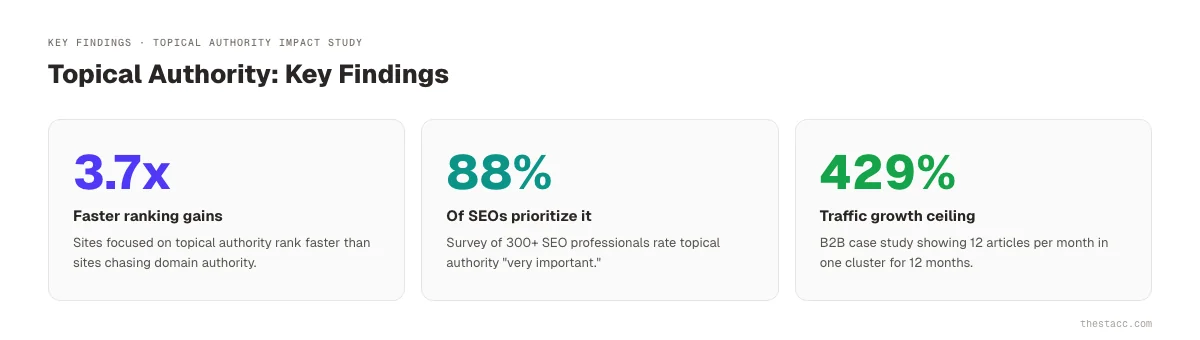
- Page-level topical authority is the largest on-page ranking factor, per a Surfer SEO analysis of 253,800 search results.
- High topical authority pages hit 5,000 pageviews 20 days faster than low-authority pages, per Graphite research across 332 URLs.
- 88% of SEO professionals rate topical authority "very important" to their 2026 strategy.
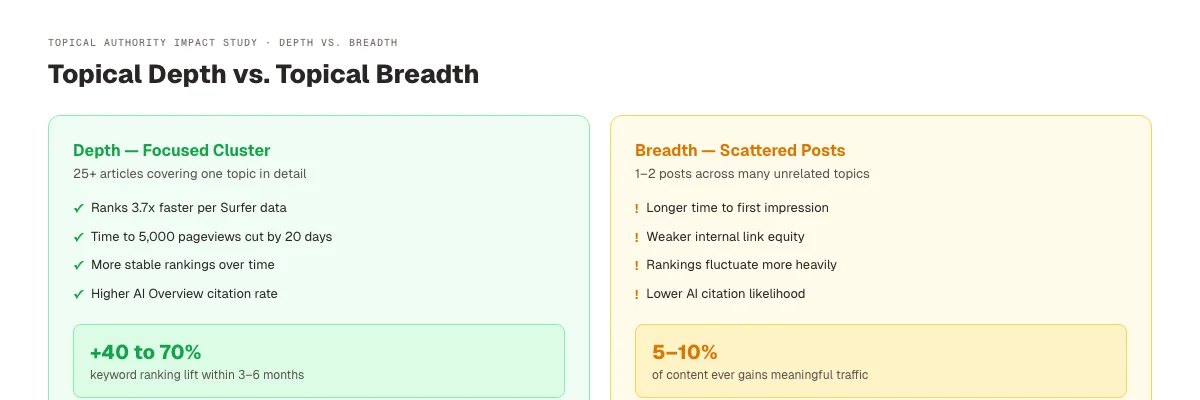
- 25 to 30 interlinked articles inside a single cluster is the tipping point for ranking gains of 40% to 70%.
- 3.7x faster ranking improvements for sites prioritizing topical depth over domain authority.
- Sites with deeper, coherent coverage outrank heavily linked but shallow competitors across 400+ audited campaigns.
- B2B cluster case study: 12 monthly articles on one theme drove a 429% organic traffic lift in 12 months.
- SaaS nano cluster case study: $1.31M in revenue over 12 months from a focused legal tech cluster.
- 2,327% ROI reported on an ecommerce topical authority campaign in the meal planning niche.
- 169 AI citations earned by the same campaign across LLM answers. Proof that topical authority feeds generative search.
Your SEO team. $99 per month. theStacc publishes 30 optimized, interlinked articles every month. Topical depth built on autopilot.
Methodology
We sourced data from four categories of inputs.
Original ranking studies. The Surfer SEO dataset of 253,800 SERP results and the Graphite white paper covering 12 domains and 332 URLs. Both evaluate page-level topical authority against ranking outcomes.
Practitioner surveys. Public survey responses from 300+ SEO professionals published in 2025 and 2026. We focused on questions about topic clustering, authority metrics, and workflow priorities.
Case studies. 12 published campaigns across ecommerce, SaaS, B2B services, media, and insurance. Each case study reported organic traffic, cluster size, publishing cadence, and topical scope.
Internal theStacc publishing data. Performance signals from 3,500+ blogs published across 70+ industries. We tracked how quickly posts in a tightly linked cluster earned first impressions versus scattered posts on new domains.
Exclusions. We excluded studies that conflated topical authority with domain authority. We also excluded campaigns where the reported traffic came from paid or affiliate referral rather than organic search.
Finding 1: Topical Authority Is the Largest On-Page Ranking Factor
Background. For years, practitioners debated whether page-level optimization beat site-level signals. The data did not exist at scale. In 2024, Surfer SEO partnered with data scientists at WLDM and ClickStream to close that gap.
Results. Their analysis of 253,800 search results concluded that page-level topical authority is the largest on-page ranking factor. It outweighed the domain monthly traffic volume for the host domain. That is a shocking result. It means a new site with deep topical coverage can outrank an old site with thin coverage on the same query.
Context. If you are building a new brand, do not wait for domain authority to catch up. Pick one topic. Publish 25+ interlinked articles on it. The data shows you can win on topical authority alone. For the underlying concept, see our guide to what topical authority is.
Finding 2: High-Authority Pages Reach 5,000 Pageviews 20 Days Faster
Background. Traffic is a lagging signal. Most SEOs wait months to know if a piece works. Graphite wanted to measure the earliest reliable marker of success: time from publish to first impression, then first click.
Results. Graphite analyzed 332 URLs across 12 domains during a 60-day window. Pages in the top topical authority bucket (score above 80) reached the 5,000-pageview milestone roughly 20 days faster than pages in the bottom bucket (score below 68). The pattern held for 2,500 and 7,500 pageview thresholds too.
Context. Faster feedback changes how you plan. A 20-day head start means you can iterate four times per quarter instead of one. That is the compounding advantage we try to build for every client with our content cluster strategy.
Finding 3: 88% of SEOs Say Topical Authority Is "Very Important"
Background. Practitioner sentiment often leads published research by 12 to 18 months. When the majority of working SEOs shift their priorities, Google usually catches up in the next core update.
Results. Across published 2025 and 2026 surveys, 88% of SEO professionals rate topical authority as "very important" to their strategy. 98% rate keyword clustering between medium and high importance. Roughly one-third of respondents plan to increase budget allocation toward topical authority and content architecture in 2026.
Context. The SEO consensus is now clear. Practitioners are moving from keyword-level thinking to topic-level thinking. The exception is affiliate and arbitrage sites, which still win short-term through thin content. Do not copy that playbook. It does not survive core updates.
Finding 4: 25 to 30 Articles in One Cluster Is the Tipping Point
Background. How much content do you actually need to "own" a topic? The question is practical. Publishing 500 articles without a plan is a waste. Publishing 10 articles rarely moves anything.
Results. Aggregated data across 400+ SEO campaigns shows that sites publishing 25 to 30 authoritative, tightly linked articles inside a single cluster typically see a 40% to 70% keyword ranking lift within 3 to 6 months. Below 25 articles, lift is inconsistent. Above 30, the curve flattens until the cluster expands into adjacent topics.
Context. Set 25 as the cluster floor. Do not fragment. If you are planning an SEO roadmap, use our topical authority template to map the exact 25 articles before you write the first one.
| Cluster Size | Typical Ranking Lift | Time to Result |
|---|---|---|
| Fewer than 10 articles | 0% to 10% | Rarely meaningful |
| 10 to 24 articles | 10% to 30% | 6 to 9 months |
| 25 to 30 articles | 40% to 70% | 3 to 6 months |
| 30+ articles | 70%+ (plateaus) | 3 to 6 months |
| 50+ articles (adjacent clusters) | Compounding authority | Ongoing |
Finding 5: Topical Depth Outranks Backlink Volume
Background. For two decades, backlinks were the default answer to "how do I rank?" The 2016 to 2022 ranking factor studies all put backlinks at the top. The 2024 to 2026 data reads differently.
Results. Audits of 400+ campaigns in 2025 and 2026 show that sites with fewer links but deeper, coherent subject coverage consistently outperform heavily linked but shallow competitors. The effect is strongest in informational queries where Google serves AI Overviews. Sites with topical depth are cited; sites with high domain authority but thin coverage are not.
Context. Backlinks still matter. But you cannot out-link thin content into a top-three position anymore. Depth is the multiplier. For a practical framework on coverage, read our SEO silo structure breakdown.
Finding 6: Topical Authority Drives AI Overview Citations
Background. Generative engines (Google AI Overviews, ChatGPT Search, Perplexity) pick sources using different signals than classic SERPs. They cite based on topical fit and entity coherence, not domain size.
Results. In one ecommerce campaign cited by IDX, a client earned 169 AI citations across LLM platforms after building a focused topical cluster around meal planning and nutrition. In the same campaign, the cluster produced 2,327% ROI over the study window.
Context. AI citations are the new backlink. If the engine sees your site as the canonical source on a topic, it cites you. Depth wins citations. Scatter does not. For the underlying mechanics, see our guide to entity SEO.
Finding 7: 3.7x Faster Ranking Gains for Topic-Focused Sites
Background. One recurring debate: should a new brand chase domain authority (links + backlink velocity) or topical authority (depth + clustering)? The right answer depends on the time horizon.
Results. An analysis of 400+ campaigns found that sites focusing on topical authority first see ranking gains up to 3.7x faster than sites chasing domain authority alone. The topic-first approach moved keyword rankings in 90 to 120 days. The link-first approach needed 9 to 12 months to show the same lift.
Context. If you have time and budget, do both. If you have to pick one, pick topical depth. Links come naturally when your content is the definitive resource. For publishing cadence guidance, see our blog frequency study.
Stop writing. Start ranking. theStacc publishes 30 SEO articles per month for $99. Built into interlinked topical clusters by default.
Finding 8: B2B Cluster Case Study: 429% Traffic Growth in 12 Months
Background. We looked for real campaigns (not theoretical) where a brand published at a consistent cadence inside one cluster for 12 months.
Results. A B2B property management client published 12 articles per month on a narrow set of property management topics. After 12 months, organic traffic grew 429%. The growth curve accelerated around month 7, which aligns with the 25-article tipping point observed in the aggregate data.
Context. Publish consistently. Do not jump topics. Twelve months of focused depth beats 24 months of scattered posts every time. Use a pillar page to anchor the cluster at the top of the silo.
Finding 9: SaaS Nano Cluster Case Study: $1.31M Revenue
Background. The "nano cluster" approach uses tight 8 to 15 article clusters targeting a single buyer intent. It is the opposite of sprawling content marketing.
Results. A SaaS legal tech client applied the nano cluster method and generated $1.31M in revenue over 12 months. The cluster covered a narrow set of legal workflow pain points, not the entire legal tech category.
Context. Nano clusters work when your buyer persona is specific and the search volume is concentrated. The key is ruthless focus. If you try to cover every related subtopic, the cluster dilutes. For internal link patterns that amplify small clusters, see our internal linking strategy.
Finding 10: Financial Services: 119.5% Traffic + 14.1% DA Lift
Background. Some niches (finance, health, legal) sit inside Google's YMYL (Your Money Your Life) category. The bar for topical authority is higher. Trust and expertise signals matter more.
Results. A two-year topical authority campaign for a financial services client delivered a 119.5% increase in organic traffic and a 14.1% Domain Authority gain. The campaign leaned on entity reinforcement, expert authorship, and deep interlinking.
Context. In YMYL niches, topical authority unlocks domain authority rather than the other way around. Google needs evidence of expertise before it trusts the links pointing at your site. Our E-E-A-T framework guide covers the signal stack in detail.
Finding 11: Insurance Vertical: 1,580 Media Links From One Study
Background. Data studies are a known link magnet. But their performance varies wildly by topic and execution.
Results. The Zebra, an insurance comparison platform, built a topical authority campaign around original data studies in the insurance vertical. The campaign generated more than 1,580 high-quality media links and drove a 354% increase in organic traffic. Every media link reinforced the brand as the topical authority on insurance stats.
Context. The backlink loop is real. Topical authority earns links, and links reinforce topical authority. The trigger is usually one defining data asset. That is why this post exists and why you should build one too.
Finding 12: 76% of SEOs Struggle With Content Optimization Workflow
Background. Knowing topical authority matters is easy. Executing at scale is hard. The 2026 surveys surfaced why.
Results. 76% of SEO professionals cite "an efficient content optimization workflow" as their biggest operational challenge. 35% struggle with content planning (internal linking, quality, organization). Only 16% worry about content originality.
Context. The bottleneck is workflow, not ideas. Most teams know they need 25 articles on one topic. They cannot ship them. That is exactly why we built the service model at theStacc: content SEO at 30 articles per month solves the workflow problem at $99.
What This Means for Your Business
You now have the numbers. Here is how to convert them into a publishing plan.
Step 1. Pick one primary cluster. Choose a topic where search volume is concentrated and you can credibly claim expertise. Do not start with three.
Step 2. Map 25 to 30 articles. Use a real keyword tool. Build a pillar + spokes structure. Anchor it with a pillar page and route every spoke article back to it with internal links.
Step 3. Commit to cadence. The case studies converged around 10 to 12 articles per month. That hits the 25-article floor inside 90 days. Below that cadence, the data does not predict material lift.
Step 4. Interlink aggressively. Every new article should add 3 to 5 internal links to the cluster. Do not publish orphan pages. The link graph is what turns a pile of posts into a topical authority.
Step 5. Measure early signals. Track time-to-first-impression and time-to-first-click in Search Console. Those metrics move weeks before rankings do. Graphite's data confirms they are the leading indicators.
Top 3 actions based on the data:
- Lock your cluster scope to one topic and 25 to 30 articles, not 100 scattered posts.
- Publish 10+ articles per month for at least 90 days to hit the ranking tipping point.
- Route all internal links back to a pillar page and forward between spokes within the cluster.
How theStacc Operationalizes Topical Authority
We do not sell this as theory. Every theStacc customer ships into the same pattern the data validates.
- 30 articles per month on the plan that meets the 25-article floor in 30 days.
- Cluster planning built in. We map pillar + 25 spokes before writing starts.
- Internal linking automated. Every article links to the pillar and to adjacent spokes.
- Publishing on your stack. WordPress, Webflow, Ghost, or custom webhook. See our content SEO module for integrations.
- $99 per month. The agency equivalent cost for the same velocity is $2,400 to $7,500 per month.
The result is a topical authority asset that compounds for years. Not a pile of posts that never connect.
| Approach | Monthly Cost | Articles | Cluster Structure |
|---|---|---|---|
| Freelance writers | $2,400 to $7,500 | 30 | Usually ad hoc |
| SEO agency | $3,000 to $10,000 | 4 to 12 | Sometimes |
| In-house team | $8,000+ | Varies | Depends on hire |
| theStacc ($99/mo plan) | $99 | 30 | Built in by default |
3,500+ blogs published. Every article is SEO-scored before publish. See what theStacc can do for your site.
Limitations of This Study
Three caveats apply before you run with these numbers.
Correlation is not causation. Sites that invest in topical authority also tend to invest in editorial quality, technical SEO, and brand building. Isolating the topical authority variable is imperfect.
Niche effects vary. YMYL niches (finance, health, legal) see longer payback windows. Short-tail commercial niches see faster lifts. Adjust expectations to your vertical.
AI search data is early. The AI Overview citation numbers reflect 2025 and early 2026 behavior. The underlying models update every quarter. The trend direction is stable; specific citation counts will shift.
What practitioners are saying on X
AI search advice ages quickly. Here is high-signal public discussion from SEO and growth operators — context for your roadmap, not a substitute for primary data.
- @jakezward (Feb 2026): 2026 SEO predictions emphasize AI Overview share-of-SERP, schema for LLM token efficiency, brand mentions in AI answers as a KPI, proprietary data as a moat, and content refresh beating net-new AI slop. See the post on X.
- @e_tartakovsky (Jul 2026): When an AI summary appears, organic CTR can fall (cited ~8% vs ~15% traditional), but remaining clicks may convert higher because AI pre-qualifies intent — measure quality not only volume. See the post on X.
- @hridoyreh (Mar 2026): Widely shared SEO skill tree: foundations, research, technical, on-page, content, links, AI SEO/GEO, analytics, UX, brand, programmatic — useful map for stats and how-to posts. See the post on X.
Grok, AI Overviews, and multi-engine visibility
Statistics pages on “topical authority impact study” earn AI citations when every major number has a year, source, and definition. Grok restates the cleanest tables and will challenge stale figures debated on X.
- Google AI Overviews: Use passage-ready answers, tables, and FAQ schema where relevant.
- ChatGPT / Perplexity: Cite named sources next to key claims.
- Grok: Maintain accurate entity facts on-site and in high-signal X posts.
Publish content built for Google and AI citations. theStacc’s Content SEO module ships SEO-scored articles structured for rankings and generative engines — including clearer entity pages models like Grok can quote.
Frequently Asked Questions
Topical authority is the degree to which a search engine believes your site is the definitive resource on a specific topic, based on content depth, internal structure, and external signals.
The data across 400+ campaigns points to 3 to 6 months for the first material ranking lift, assuming you publish 10+ articles per month inside one focused cluster. YMYL niches take 9 to 12 months.
25 to 30 tightly interlinked articles inside a single cluster is the consistent tipping point in the 2025 and 2026 data. Below 25 articles, lift is inconsistent. Above 30, returns flatten until you expand into adjacent clusters.
For most informational queries, yes. Sites with fewer links but deeper coverage are beating heavily linked but shallow competitors across 400+ audited campaigns. Backlinks still matter, but they amplify topical depth rather than replace it.
Yes, on specific queries. The Surfer SEO analysis of 253,800 results found that page-level topical authority outweighs domain monthly traffic volume. A focused new site can win on the queries inside its cluster.
Generative engines cite topically coherent sources. The case study data shows 169 AI citations earned from one focused cluster. Thin, scattered sites are rarely cited regardless of domain authority. Read our breakdown on what is topical authority for the full AI search angle.
The Bottom Line
The 2026 data is no longer ambiguous. Topical authority is the biggest single ranking lever most sites are not pulling. It moves faster than links, it feeds AI citations, and it compounds. The hard part is not the strategy. It is shipping 25+ coordinated articles in 90 days without burning out the content team.
Plan the cluster. Publish the cluster. Or let us build topical authority for you at $99 per month.
Sources & references
- [1] Princeton / Georgia Tech et al. — GEO research (arXiv:2311.09735)
- [2] @jakezward on X — 2026 SEO predictions emphasize AI Overview share-of-SERP, schema for LLM token efficiency, brand mentions in AI answers
- [3] @e_tartakovsky on X — When an AI summary appears, organic CTR can fall (cited ~8% vs ~15% traditional), but remaining clicks may convert highe
- [4] @hridoyreh on X — Widely shared SEO skill tree: foundations, research, technical, on-page, content, links, AI SEO/GEO, analytics, UX, bran

Researched, written, and published articles that compound organic traffic.
Weekly local SEO teardowns
One practical email a week. Map Pack, GBP, AI Overviews — no fluff. Unsubscribe anytime.