A topical authority template replaces one-off keyword picking with a system where every article strengthens the others. This planner covers the three-component framework: choosing and defining a topic niche, building a topic map of subtopics, and sequencing publication so coverage compounds instead of scattering across unrelated subjects.
Most SEO blogs fail for one reason: they publish random content with no system. Twelve articles on twelve different topics, each targeting a different keyword, each living in isolation. Google sees no expertise. Rankings never compound.
A topical authority template fixes that. Instead of picking keywords one at a time, you design a content system where every article strengthens every other article. And Google recognizes you as the authoritative source on your subject.
Surfer SEO's analysis of 253,800 search results found that page-level topical authority is the largest on-page ranking factor. Sites that build coverage across a topic cluster consistently outrank single high-quality posts on the same topic. Even when those posts are technically superior.
We have published 3,500+ SEO articles across 70+ industries. The difference between blogs that compound and blogs that plateau is always the same: system vs. random. This guide gives you the system.
In this guide, you will learn:
- The 3-component framework every topical authority plan needs
- A complete topic map template you can copy and use today
- A content calendar structure designed around building authority
- The internal linking architecture that amplifies every post you publish
- How to track whether your topical authority is actually growing
Table of Contents
- Chapter 1: What Topical Authority Actually Is
- Chapter 2: The 3-Component Template Framework
- Chapter 3: Step 1. Choose and Define Your Topic Niche
- Chapter 4: Step 2. Build Your Topic Map
- Chapter 5: Step 3. Create Your Publishing Calendar
- Chapter 6: Step 4. Build Your Internal Linking Architecture
- Chapter 7: The Complete Topical Authority Planner
- Chapter 8: Track and Measure Topical Authority
Chapter 1: What Topical Authority Actually Is
Topical authority is not domain authority. They are related but different.
Domain authority measures how many sites link to yours. Topical authority measures how deeply and broadly you cover a subject. Google can rank a relatively new site with strong topical authority above a high-DA site that only covers a topic superficially.
The mechanism: Google treats a site with 20 interlinked articles on email marketing as more authoritative than a site with 1 excellent email marketing article. Even if the single article is technically superior content. Breadth plus depth plus internal connections signal expertise that a single page cannot.
Read our guide on what topical authority is for the full background. This guide focuses on the practical system: the template you use to plan it.
Why Keyword Targeting Alone Fails
Keyword targeting is tactical. You find a search term, write an article, and hope it ranks. The problem: every article lives in isolation, each competing independently.
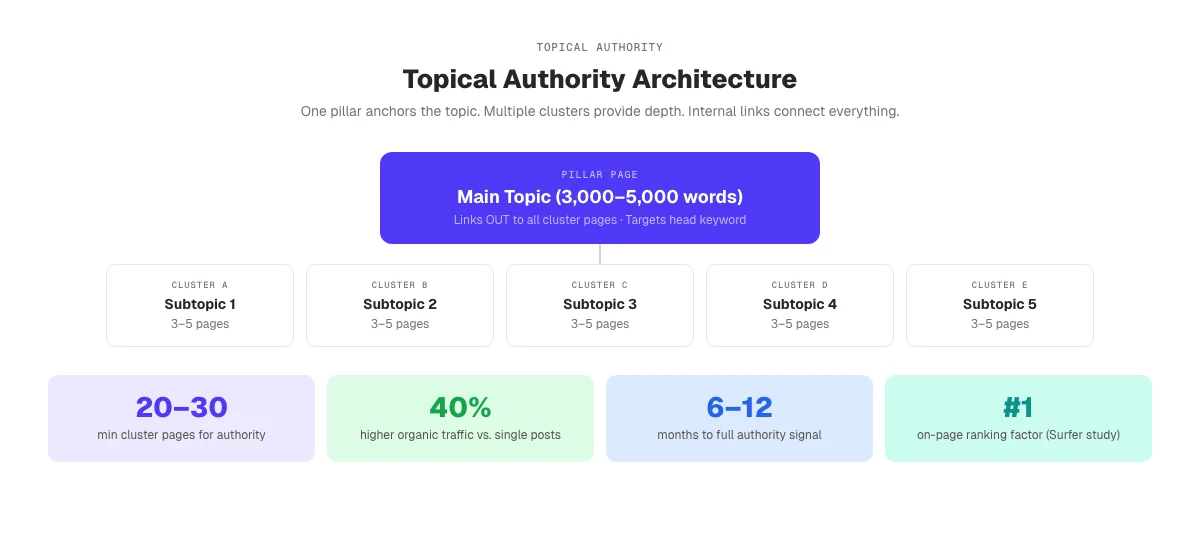
Topical authority is strategic. Every article you publish is part of a system. The pillar page anchors the topic. Cluster pages explore subtopics. Internal links connect them all. Each new article adds signal to the whole system. Not just to itself.
A site with 50 articles across 10 unrelated topics has 10 weak clusters. A site with 50 articles on one topic has 1 dominant cluster that covers every angle Google might ask about. The second site wins.
The Timeline Reality
The first 3 months establish coverage. Months 4–6 show initial ranking improvements as Google processes the cluster structure. Months 6–12 deliver compounding growth as topical coverage reaches critical mass.
This is a 6–12 month play, not a 30-day tactic. The template and planner in this guide are designed for that timeline.
Chapter 2: The 3-Component Template Framework
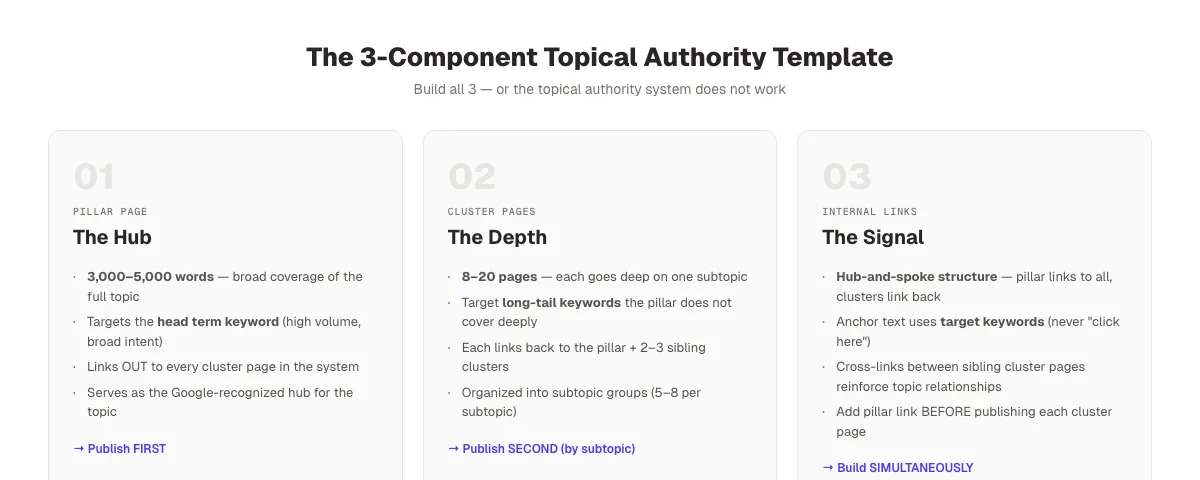
Every effective topical authority system has 3 components. Build all 3 or the system does not work.
Component 1: The Pillar Page
The pillar page is the hub. It covers the full topic at a high level. All the major subtopics, briefly explained. And links out to every cluster page for deeper coverage. Think of it as the table of contents for your topic.
Pillar pages are typically 3,000–5,000 words. They target broad head terms. They prioritize breadth over depth. Read our guide on how to write a pillar page for the full build process.
Component 2: Cluster Pages
Cluster pages go deep on individual subtopics. Each cluster page targets a specific keyword the pillar does not go deep on. Each one links back to the pillar.
A healthy cluster has 8–20 pages for most topics. Fewer than 8 and coverage is shallow. More than 20 and you risk overlapping intent. Which dilutes authority instead of building it.
Component 3: Internal Linking Architecture
Internal links are what turn a collection of articles into a topical authority signal. Without them, your articles are a library with no catalog. With them, Google can trace the relationships between every piece of content.
The architecture rule: every cluster page links to the pillar (one link, keyword-anchored), and links to 2–3 related cluster pages. The pillar links to all cluster pages. Cross-links between clusters reinforce semantic relationships.
The Template at a Glance
| Component | Volume | Target Keywords | Links Required |
|---|---|---|---|
| Pillar Page | 1 | Head term (broad) | → All cluster pages |
| Cluster Pages | 8–20 | Long-tail + specific intent | → Pillar + 2–3 sibling clusters |
| Supporting Posts | Optional | Ultra-specific questions | → Nearest cluster page |
Understanding content clusters before building this framework will speed up the planning process significantly.
Stop publishing random content. Start building authority. theStacc publishes 30 SEO articles per month. Designed as a topical cluster, not random posts.
Chapter 3: Step 1. Choose and Define Your Topic Niche
The most common topical authority mistake: picking a topic too broad to own.
"Marketing" is not a topic. "Content marketing for B2B SaaS" is a topic. "Email marketing for e-commerce brands" is a topic. The narrower your niche, the faster you reach full coverage and the faster Google recognizes authority.
Topic Selection Criteria
Use this table to evaluate any topic before committing to it:
| Criterion | Good Sign | Red Flag |
|---|---|---|
| Niche size | 50–300 target keywords | 5,000+ unrelated keywords |
| Competition | Mid-authority sites dominate | Wikipedia, major brands own every result |
| Your expertise | You can write 30+ distinct articles | You can only think of 5–6 ideas |
| Business relevance | Topic maps to your ICPs | Interesting but no commercial link |
| Existing coverage | You have some content here already | Starting from zero with competitors at scale |
The Niche Narrowing Exercise
Start with your broad category. Apply 3 filters:
- Audience filter: Who specifically? ("small business owners" not "everyone")
- Problem filter: Which problem? ("generating leads from SEO" not "SEO in general")
- Method filter: What approach? ("content-based SEO" not "all types of SEO")
Broad: "SEO" After audience filter: "SEO for small business owners" After problem filter: "SEO for small businesses that need leads, not traffic" After method filter: "Content SEO for small service businesses"
Now you have a niche you can own in 12 months. "SEO" you could not own in 12 years.
For a deeper walk through this process, our guide to creating a topical map for SEO covers the keyword research layer in detail.
Chapter 4: Step 2. Build Your Topic Map
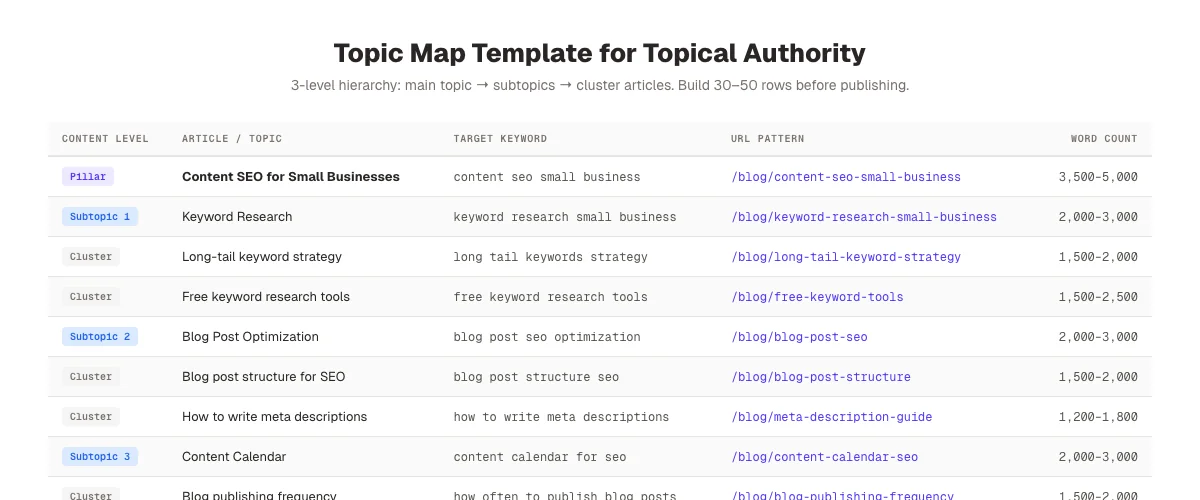
A topic map is the master plan for your entire content system. It lives in a spreadsheet. Every article you write comes from it.
The topic map has 3 levels: the main topic, the major subtopics, and the specific articles under each subtopic.
Topic Map Template
Copy this structure for your niche:
Level 1: Main Topic (Pillar Page)
- Your head term keyword
- Target: 3,000–5,000 words
- URL:
/blog/[main-topic]
Level 2: Major Subtopics (Sub-Pillar or Cluster Hubs) Each major subtopic becomes either a detailed cluster page or a mini-hub if the subtopic is large enough to have its own sub-cluster.
Level 3: Specific Articles (Cluster Pages) Targeted long-tail keywords under each subtopic.
Example Topic Map: Content SEO for Small Businesses
| Level | Topic | Keyword | URL Pattern |
|---|---|---|---|
| Pillar | Content SEO for Small Businesses | content seo for small businesses | /blog/content-seo-small-business |
| Subtopic 1 | Keyword Research | keyword research small business | /blog/keyword-research-small-business |
| Cluster | Long-tail keywords | long tail keyword strategy | /blog/long-tail-keyword-strategy |
| Cluster | Free keyword tools | free keyword research tools | /blog/free-keyword-research-tools |
| Subtopic 2 | Blog Post Optimization | blog seo optimization | /blog/blog-seo-optimization |
| Cluster | Blog post structure | blog post structure seo | /blog/blog-post-structure-seo |
| Cluster | Meta descriptions | how to write meta descriptions | /blog/meta-description-guide |
| Subtopic 3 | Content Calendar | content calendar template | /blog/content-calendar-seo |
| Cluster | Publishing frequency | how often to publish blog posts | /blog/blog-publishing-frequency |
| Cluster | Content batching | batch content creation system | /blog/batch-content-creation |
Build a topic map with 30–50 rows before you start writing. It takes 2–3 hours upfront and saves months of random publishing.
Chapter 5: Step 3. Create Your Publishing Calendar
A topic map tells you WHAT to publish. A content calendar tells you WHEN.
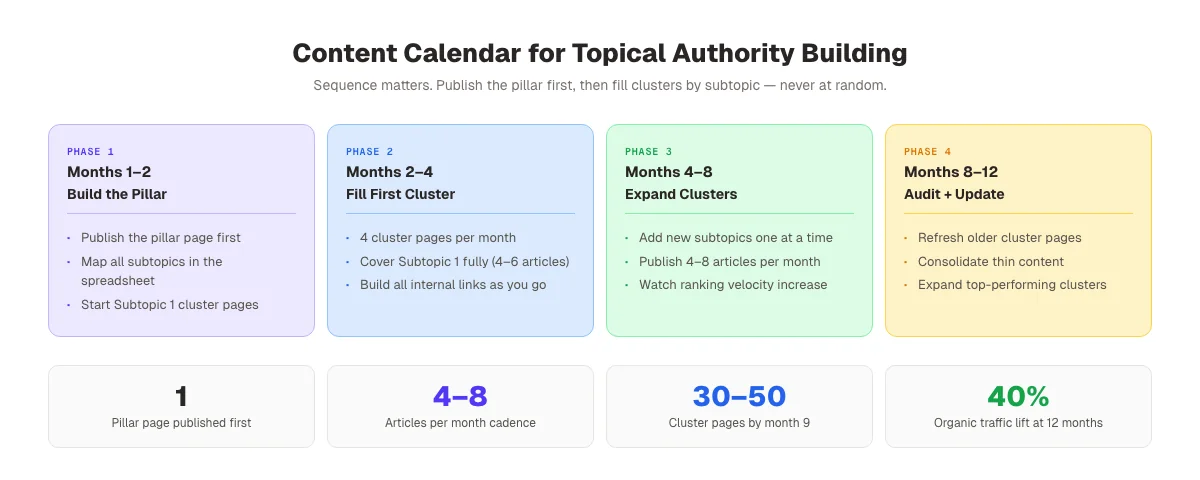
The order matters. Most teams publish in the wrong sequence and undermine their own authority building.
The Right Publishing Sequence
Phase 1 (Months 1–2): Build the Pillar Publish the pillar page first. This gives Google a hub to anchor all future cluster content against. Without it, cluster pages have nowhere to link back to.
Phase 2 (Months 2–4): Fill the First Cluster Pick your highest-priority subtopic. Publish 3–4 cluster pages in that subtopic before moving to the next. Concentrated coverage in one subtopic registers faster with Google than scattered coverage across all subtopics.
Phase 3 (Months 4–8): Expand Clusters Add new subtopics one at a time. Keep publishing cadence steady: 4–8 articles per month. Rather than publishing 20 articles in one sprint then going silent.
Phase 4 (Months 8–12): Audit and Update Update older cluster pages with new data, internal links to newer content, and expanded sections. Google rewards fresh content in established clusters.
Content Calendar Template
| Month | Publish Count | Content Type | Priority Subtopic |
|---|---|---|---|
| Month 1 | 1 | Pillar page (3,000–5,000 words) | Core topic |
| Month 2 | 4 | Cluster pages | Subtopic 1 |
| Month 3 | 4 | Cluster pages | Subtopic 1 + 2 start |
| Month 4 | 4 | Cluster pages | Subtopic 2 |
| Month 5 | 4–6 | Cluster pages | Subtopic 3 |
| Month 6 | 4–6 | Cluster pages + 1 update | Subtopic 3 + refresh Subtopic 1 |
| Month 7–9 | 6–8 | Cluster pages | Subtopics 4–5 |
| Month 10–12 | 6–8 | New clusters + major updates | Expand + consolidate |
At 4–8 posts per month, you reach 40–50 cluster pages by month 9. That is enough coverage to see significant authority effects for most niches.
Our SEO content calendar template guide has ready-made templates for tracking this across teams. Combine it with this topical map and you have a complete editorial system.
Chapter 6: Step 4. Build Your Internal Linking Architecture
Publishing content is half the work. Internal linking is the other half. Most teams publish well and link poorly. And wonder why their cluster never gains traction.
The Hub-and-Spoke Linking Rule
Every cluster page follows the same linking pattern:
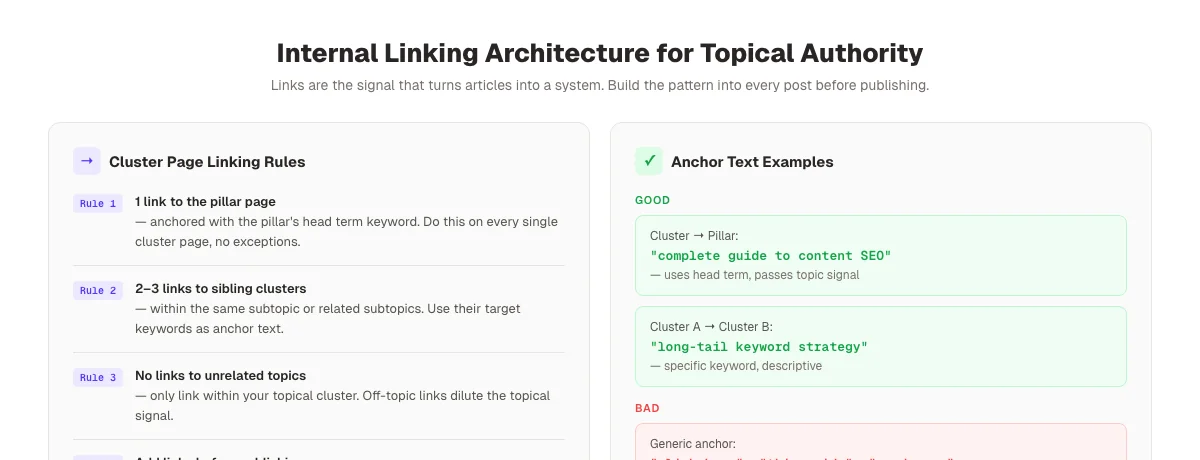
- 1 link to the pillar. Anchored with the pillar's head term
- 2–3 links to sibling cluster pages. Anchored with specific related terms
- No links between unrelated clusters. Keep links topically relevant
The pillar page links to every cluster page. This creates the hub-and-spoke structure that passes authority across the entire cluster.
Internal Linking Checklist
- ✓ Every cluster page has exactly 1 link to the pillar
- ✓ Every cluster page links to at least 2 sibling cluster pages
- ✓ Anchor text uses target keywords (not "click here" or "read more")
- ✓ Pillar page links to all cluster pages, updated when new ones publish
- ✓ No cluster page links to pages outside the topical cluster (without strong reason)
Anchor Text Rules
Anchor text matters. Generic anchors waste the link. Keyword-rich anchors pass topical signal. Examples:
| Page | Linking To | Good Anchor | Bad Anchor |
|---|---|---|---|
| Cluster page | Pillar | "complete guide to content SEO" | "this guide" |
| Cluster A | Cluster B | "long-tail keyword strategy" | "read more here" |
| Cluster page | New cluster | "blog post frequency for SEO" | "our other article" |
Building quality blog SEO practices. Including internal linking. Into your publishing workflow saves hours of retroactive linking later. Add the pillar link and 2 sibling links before you hit publish. Never after.
Your SEO team. $99/month. 30 articles per month, published in a topical cluster structure. Not random posts. No writer management needed.
Chapter 7: The Complete Topical Authority Planner
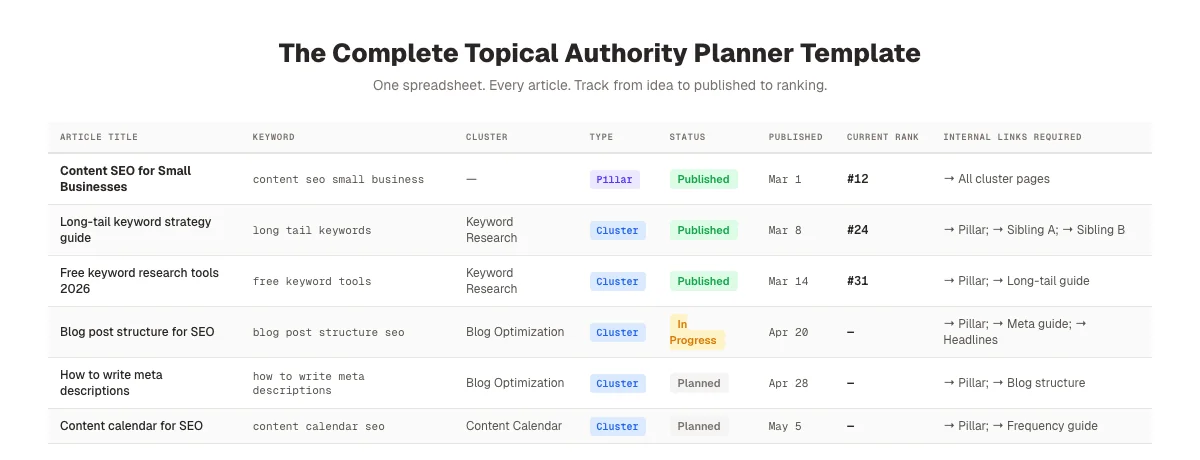
Everything above lives in one planner. This is the master document you maintain throughout the process.
Build it in a spreadsheet. One row per article. Track every article from idea to published.
The Planner Structure
| Column | What to Track |
|---|---|
| Article Title | Working title (update when finalized) |
| Target Keyword | Primary keyword (from topic map) |
| Search Intent | Informational / Commercial / Transactional |
| Cluster | Which subtopic cluster does this belong to? |
| Content Type | Pillar / Cluster / Update |
| Word Count Target | Based on SERP analysis |
| Internal Links Required | Pillar link + sibling page links (names) |
| Status | Planned / In progress / Published / Updated |
| Publish Date | Scheduled or actual |
| URL | Final URL after publication |
| Current Ranking | Track monthly |
| Notes | Algorithm updates, rewrites, redirects |
Planner Workflow
When adding new rows: Add the article title, target keyword, cluster, and required internal links before any writing starts. This front-loads the planning and prevents articles being published without proper linking.
Weekly review: Check status column. Anything "in progress" for more than 2 weeks is stalled. Identify the blocker.
Monthly review: Update the "current ranking" column for all published articles. Articles not ranking after 90 days need a review: is the keyword too competitive? Is internal linking set up? Is the content thin?
Quarterly audit: Review the planner for coverage gaps. Where do clusters need more depth? Which subtopics have only 1–2 cluster pages when they need 5+?
Sample Filled Planner Row
| Field | Example |
|---|---|
| Article Title | "How to Do Keyword Research for Small Blogs" |
| Target Keyword | keyword research small blogs |
| Search Intent | Informational |
| Cluster | Keyword Research |
| Content Type | Cluster |
| Word Count Target | 1,800 |
| Internal Links Required | → Pillar: "content SEO guide"; → Sibling: "free keyword tools"; → Sibling: "long-tail strategy" |
| Status | Published |
| Publish Date | 2026-03-14 |
| URL | /blog/keyword-research-small-blogs |
| Current Ranking | #18 (April 2026) |
| Notes | Update in Q3 with fresh tools data |
Combine this planner with strong SEO content writing practices on each article and the compound effect becomes measurable within 4–6 months.
Automating parts of the SEO workflow. Content briefs, internal link audits, publishing schedules. Reduces the overhead of maintaining a large cluster system at scale.
Chapter 8: Track and Measure Topical Authority Growth
Publishing without measuring is planning without learning. Track 4 metrics to know whether your topical authority is building.
Metric 1: Keyword Coverage
How many of your target keywords have you published content for? Track this as a percentage of your total topic map.
- Under 30% coverage: early stage, no authority signal yet
- 30–60% coverage: Google begins recognizing the cluster
- 60–80% coverage: strong authority signal for core subtopics
- 80%+ coverage: dominant authority position in the niche
Metric 2: Organic Traffic to the Cluster
Monitor Google Search Console organic clicks to all URLs in your cluster. Not just individual pages. A cluster with growing aggregate traffic is building authority even if individual pages have modest traffic.
Metric 3: Ranking Velocity
How quickly do new cluster pages rank after publishing? A cluster with established topical authority should see new pages enter the top 50 within 2–4 weeks of publishing. New sites with no authority often wait 3–6 months for the same movement. Ranking velocity accelerating over time is a clear signal your authority is compounding.
Metric 4: Traffic Share (Topical Authority Score)
Ahrefs and Semrush both allow you to measure estimated organic traffic share by domain for specific keyword sets. Pull all your target keywords into a keyword list and measure your domain's traffic share. Growing share = growing topical authority.
Our guide to building topical authority covers the full measurement stack in detail, including how to track these metrics in Google Search Console without paid tools.
What practitioners are saying on X
AI search advice ages quickly. Here is high-signal public discussion from SEO and growth operators — context for your roadmap, not a substitute for primary data.
- @hridoyreh (Mar 2026): Widely shared SEO skill tree: foundations, research, technical, on-page, content, links, AI SEO/GEO, analytics, UX, brand, programmatic — useful map for stats and how-to posts. See the post on X.
- @jakezward (Feb 2026): 2026 SEO predictions emphasize AI Overview share-of-SERP, schema for LLM token efficiency, brand mentions in AI answers as a KPI, proprietary data as a moat, and content refresh beating net-new AI slop. See the post on X.
Grok, AI Overviews, and multi-engine visibility
For “topical authority template”, multi-engine visibility still starts with clear definitions, sourced numbers, and extractable section answers. Grok additionally factors live X discussion — keep public claims consistent with this page.
- Google AI Overviews: Use passage-ready answers, tables, and FAQ schema where relevant.
- ChatGPT / Perplexity: Cite named sources next to key claims.
- Grok: Maintain accurate entity facts on-site and in high-signal X posts.
Publish content built for Google and AI citations. theStacc’s Content SEO module ships SEO-scored articles structured for rankings and generative engines — including clearer entity pages models like Grok can quote.
FAQ
There is no universal number, but 20–30 interlinked articles covering one topic is typically enough to see initial authority signals in Google's rankings. Some competitive niches require 50+ cluster pages to achieve dominant positioning. Fewer than 8–10 articles in a cluster is generally not enough to register as authoritative coverage.
Build the pillar page first. Cluster pages link back to the pillar. So publishing clusters without a pillar means those links point nowhere. The pillar also gives Google a hub to anchor its understanding of your topic before you start adding depth.
The standard timeline is 6–12 months for meaningful results. The first 3 months establish coverage and structure. Months 4–6 typically show initial ranking improvements. Months 6–12 deliver compounding traffic as Google fully processes the cluster. Sites that publish at high cadence (8+ articles/month) tend to see results faster than those publishing 1–2 per month.
Yes. But you need to niche down further than the dominant players. Instead of competing with Moz for "SEO" topical authority, build authority for "SEO for law firms" or "SEO for Shopify stores." A narrow niche with full coverage beats a broad niche with thin coverage every time.
Yes. Every article theStacc publishes is mapped to a client's content cluster. Not assigned randomly. The system tracks which subtopics need coverage, which cluster pages need internal links, and which articles need refreshing. The planner in Chapter 7 is the same system theStacc uses to manage content programs at scale.
Closing
A topical authority template turns random publishing into a compounding system. Pick one niche, build the pillar, fill the clusters, link everything together, and keep the cadence steady.
The blogs that rank in 2026 are not the ones with the best individual articles. They are the ones with the best content systems. Start with the planner in Chapter 7 and build the rest around it.
Sources & references
- [1] Princeton / Georgia Tech et al. — GEO research (arXiv:2311.09735)
- [2] @hridoyreh on X — Widely shared SEO skill tree: foundations, research, technical, on-page, content, links, AI SEO/GEO, analytics, UX, bran
- [3] @jakezward on X — 2026 SEO predictions emphasize AI Overview share-of-SERP, schema for LLM token efficiency, brand mentions in AI answers
- [4] Referenced source — surferseo.com

Researched, written, and published articles that compound organic traffic.
Weekly local SEO teardowns
One practical email a week. Map Pack, GBP, AI Overviews — no fluff. Unsubscribe anytime.
Explore this topic: Topical Authority.