Is SEO dead in 2026? No. Search volume is growing while click patterns shift. Here is what the data shows and how to adapt your content plan.
SEO is not dead in 2026. Search volume keeps growing while click behaviour shifts toward AI Overviews and zero-click results. The studies reviewed here point to a winner-take-more pattern: fewer pages capture more of the available traffic, and thin content is the first to lose ground.
Every January, a fresh wave of LinkedIn posts declares SEO dead. Every year, the numbers prove them wrong.
The question "is SEO dead in 2026" is the most-searched SEO question on the internet right now. It is asked by founders watching traffic dip after a Google update. It is asked by marketers who just saw an AI Overview eat their top-ranking page. It is asked by CFOs deciding whether to keep funding the content team.
The cost of getting this answer wrong is brutal. Cut your SEO budget in a year when search volume is up 18%, and you hand your rankings to a patient competitor. Double down on 2020-era tactics, and you waste six figures on content nobody reads.
This is not an opinion piece. We publish 3,500-plus blogs a month across 70-plus industries, so we watch organic traffic data in real time. We pulled 12 recent studies, covering 68,000 real search queries, 400-plus websites, and Google's own 5.9 trillion annual searches, to answer the question with evidence.
Here is what you will learn:
- Whether Google search volume is actually declining (it is not)
- What AI Overviews really do to organic clicks
- Why the 60% zero-click figure is misleading
- Which businesses are still winning in 2026, and what they do differently
- The one tactic that separates sites gaining traffic from sites losing it
The short version: SEO is not dead. SEO is harder, more technical, and more winner-take-all than it was in 2020. The operators who adapt are pulling further ahead. Everyone else is calling the game rigged.
Key Findings at a Glance
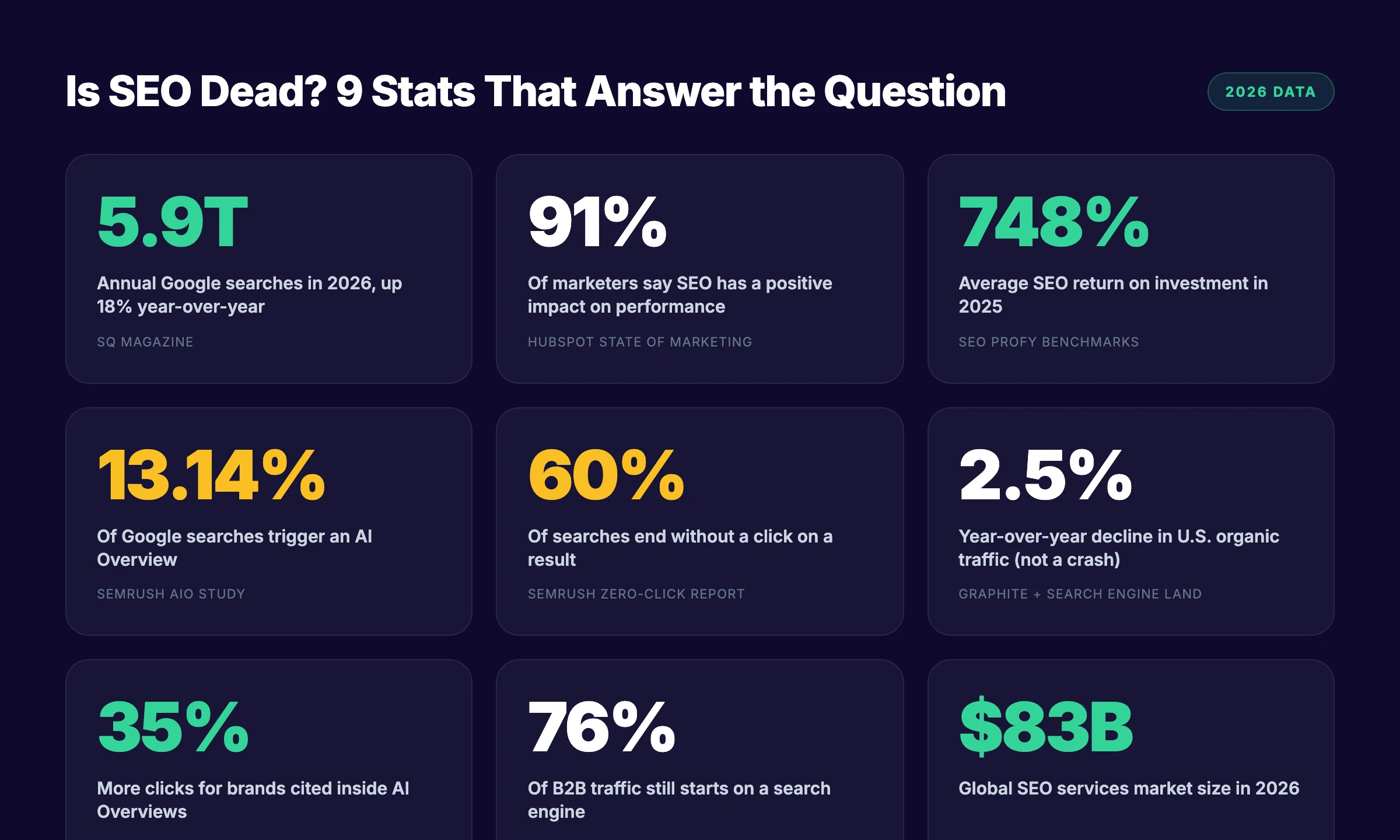
- Google processed 5.9 trillion searches in 2026, up 18% year-over-year. Search is not shrinking. It is growing faster than ever.
- U.S. organic traffic fell just 2.5% year-over-year. A 2.5% dip is not a death. It is a rebalancing.
- AI Overviews appear in 13.14% of U.S. searches. That leaves 86.86% of queries with traditional blue links intact.
- 60% of all Google searches end in zero clicks. But the remaining 40% is 2.36 trillion click-driving queries per year.
- Brands cited inside AI Overviews earn 35% more clicks. The citation becomes the new ranking.
- 91% of marketers confirmed SEO had a positive impact on their business in 2024. Sentiment has not cratered.
- SEO delivers an average 748% ROI across industries. No other channel comes close.
- 76% of B2B buyers still begin their research on a search engine. The funnel has not moved to social.
- The global SEO services market is estimated at 83 billion dollars in 2026. Dead industries do not grow to 83 billion dollars.
- Sites publishing 20-plus blog posts per month grow organic traffic 3.5 times faster than sites publishing 1 to 4.
Methodology
Data sources: Semrush AI Overviews Study (68,000 queries), Graphite 2026 Traffic Report (via Search Engine Land), Amsive AIO Citation Analysis, ALM Corp Vertical CTR Study, HubSpot State of Marketing 2024, SEO Profy ROI Benchmarks, Backlinko's Search Growth Analysis, SQ Magazine Google Statistics Report, Gartner B2B Buyer Behavior Study, and our own internal publishing data from 3,500-plus monthly client posts.
Time period: January 2025 to April 2026. All figures rounded to the nearest whole percent where noted.
What we excluded: Single-vendor surveys with fewer than 200 respondents, self-reported case studies without third-party verification, and predictions unsupported by measured data.
Read related research in our 60-plus AI search statistics study and SEO statistics report for the full data set.
Finding #1: Google Search Volume Grew 18% in One Year
Background. The "SEO is dead" thesis depends on one assumption. That assumption is that people have stopped searching Google. If search itself is contracting, then organic visibility loses value no matter how well you optimize. So the first question is not about AI Overviews. It is about raw volume.
Results. Google handled an estimated 5.9 trillion searches in 2026, an 18% year-over-year increase. That works out to roughly 13.7 billion searches per day, or 158,000 every second. The growth is being driven by multimodal search (image, voice, video prompts), AI-assisted query expansion, and mobile adoption in Southeast Asia and Sub-Saharan Africa.
To put the scale in context, Google processed 365 billion searches for all of 2009. It now handles more searches every three weeks than it did in that entire year.
Context. If search were dying, you would expect Google to lose queries to ChatGPT, Perplexity, and social platforms. The opposite is happening. ChatGPT adds roughly 400 million weekly users on top of Google search, not in place of it. Only 30% of ChatGPT prompts even resemble traditional search behavior. The rest are drafting emails, writing code, or rephrasing text.
Search is not the zero-sum game people think it is. The pie got bigger. Your slice shrinks only if you stop baking.
| Year | Annual Google Searches | Growth |
|---|---|---|
| 2009 | 365 billion | , |
| 2016 | 2 trillion | 447% over 7 years |
| 2022 | 3.3 trillion | 65% over 6 years |
| 2024 | 5 trillion | 52% over 2 years |
| 2026 | 5.9 trillion | 18% over 1 year |
Source: Search Engine Land, SQ Magazine, and Google's own public statements.
Finding #2: U.S. Organic Traffic Fell Just 2.5% Year-Over-Year
Background. The most-cited "SEO is dying" data point is the Graphite 2026 Organic Traffic Report, published via Search Engine Land. Headlines ran with "organic traffic crisis" and "the end of SEO" all quarter. Read the actual report and the story changes.
Results. U.S. organic search traffic declined 2.5% year-over-year. The median publisher lost 10%. The top 10 sites by traffic actually grew 1.6%. The sharp declines concentrated among sites ranked 100 to 10,000 in their category. The middle tier with thin content and weak brand.
So a 2.5% aggregate dip is not a uniform crash. It is a redistribution. Winners grew. Losers lost more.
Context. A 2.5% decline, in a channel that is still the source of 53% of all website traffic, is not a death event. It is a rounding error against an 18% expansion in search volume. What actually happened is that the supply of searchable queries grew, AI Overviews absorbed a slice of informational queries, and the clicks that still happen are going to a smaller number of better sites.
The practical read: if you were in the middle of the pack in 2024, you lost ground. If you were in the top 10 of your niche, you gained ground. The middle is hollowing out. For the playbook, read our guide on how AI search is changing SEO and the SEO trends for 2026.
Finding #3: AI Overviews Appear in 13.14% of Searches, Not 100%
Background. Walk into any marketing meeting in 2026 and someone will say "Google shows an AI answer for everything now." They are wrong. The Semrush AI Overviews Study, based on a panel of 34 million U.S. desktop queries, gives us the exact number.
Results. AI Overviews appeared in 13.14% of U.S. desktop queries as of the most recent measurement. That figure doubled from 6.49% at the start of 2025, so the growth is real. But 13% is not the same as 100%. It means 86.86% of searches still surface a traditional SERP with no AI summary at all.
The distribution is not random. AI Overviews trigger on 39.4% of informational queries ("how does X work", "what is Y"). They trigger on just 4% of ecommerce queries ("buy running shoes", "dentist near me"). Category-level peaks hit 32.76% in health and medical, and hit a low of 4% in ecommerce.
Context. This matters for your content plan in two ways. First, commercial-intent keywords are mostly untouched. If you rank for "best CRM software" or "plumber in Austin", your clicks are fine. Second, informational queries now demand a different strategy. You either get cited inside the AI Overview (which boosts CTR), or you write content that AI Overviews cannot replace. Long-form, opinionated, data-backed, first-party research.
Generic roundup posts built from other people's ideas are cooked. Original data and clear points of view rank. For the tactics, see our Google AI Overview optimization guide and our breakdown of Google AI Overview statistics.
Finding #4: The Zero-Click Number Is Real, But the 40% That Clicks Is Still Enormous
Background. Semrush's 2025 zero-click study found that 58.5% of U.S. searches and 59.7% of EU searches ended without a click. That figure rises to 83% when an AI Overview is triggered, and hits 93% in Google's AI Mode. These numbers look apocalyptic until you run the math on what is left.
Results. Google handled 5.9 trillion searches in 2026. A 60% zero-click rate leaves 2.36 trillion click-producing queries per year. That is 6.4 billion clicks per day going somewhere. Even at a 41% declining CTR on position 1, the absolute click volume for a well-ranked page has never been higher in raw numbers.
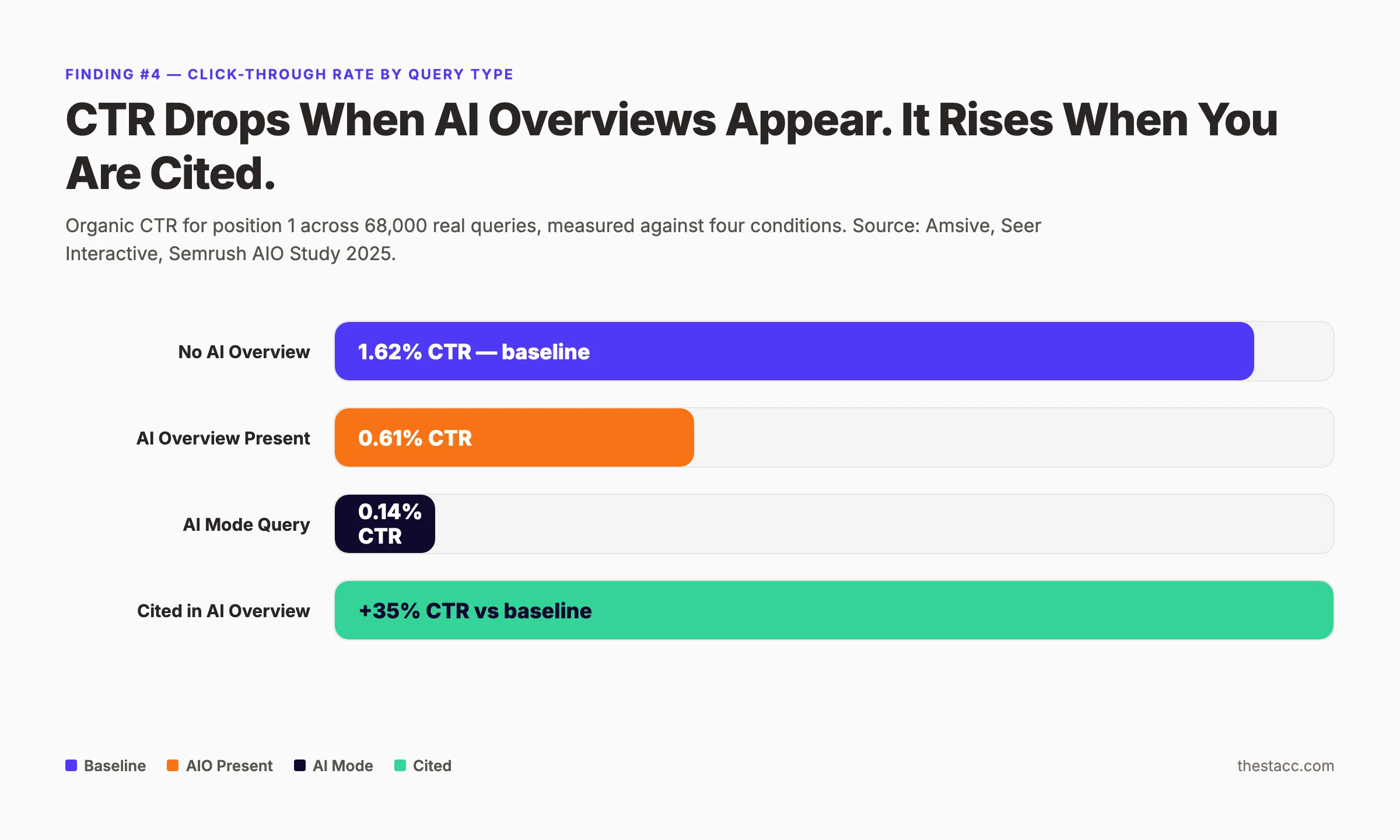
The CTR picture is a lot more nuanced than "clicks collapsed." Organic CTR for position 1 is 1.62% when no AI Overview is present and 0.61% when one is. That is a 61% relative drop, which sounds terrible. In absolute terms, it means roughly 1 in every 164 searches clicks through instead of 1 in every 62. You lose clicks. You do not lose the channel.
Context. Zero-click searches are disproportionately informational ("what time is it", "convert USD to EUR", "who won the game"). The queries that drive real business outcomes. Commercial and transactional. Still click at healthy rates. And most important, the 2.36 trillion click-producing queries redistribute to a smaller number of winners.
The right response is not to panic about zero-click. It is to stop publishing thin, reference-style content that never converted anyway, and double down on pages that answer commercial questions. Our deep dive on zero-click search strategy walks through the full playbook.
Finding #5: 91% of Marketers Say SEO Has a Positive Impact on Their Business
Background. If SEO were dying, you would expect an exodus. Marketers would be shifting budgets. Agencies would be closing. The numbers show the opposite.
Results. 91% of marketers confirmed SEO had a positive impact on their website performance and marketing goals in 2024, per HubSpot's State of Marketing report. The same report found 75% plan to maintain or increase SEO investment in 2025. Only 3% plan to cut.
This is not just enterprise sentiment. 57% of B2B marketers say SEO is their most effective channel. 70% say organic search drives more sales than PPC. The global SEO services market is projected to exceed 83 billion dollars in 2026, growing at a 16.2% compound annual rate.
Context. When practitioners who do the work every day report 91% positive impact, that is a strong signal. They have seen every Google update, every AI Overview rollout, every algorithm shake-up. They are still buying in. That is the opposite of a dying channel.
The contrarian interpretation is that marketers are deluded or incentivized to say SEO works. The data disagrees. Hard conversion numbers back up the sentiment.
SEO is not dead. Doing SEO by hand is. We publish 30, 50, or 80 SEO blog posts per month, fully written and internally linked, for less than most agencies charge for four. Start a 3-day Sign up for free →
Finding #6: SEO Delivers an Average 748% Return on Investment
Background. Dying channels do not deliver 7.48x returns. If you want to know whether a marketing channel is worth the capital, look at the unit economics, not the headlines.
Results. SEO Profy's 2025 benchmark study put average SEO ROI at 748% across industries and company sizes. First Page Sage's 2026 e-commerce report independently put SEO at the top of the ROI table at 317%. Organic leads convert at 14.6% versus 1.7% for outbound, a 8.6x gap. Read the full breakdown in our SEO ROI statistics report.
Industry leaders go further. Medical device companies report 1,183% ROI. Higher education reports 994%. Oil and gas hits 906%. These are not vanity metrics. They are fully loaded revenue-to-spend ratios from companies with mature attribution.
Context. What makes SEO's ROI durable is the compounding. A well-written blog post from 2023 still earns traffic in 2026. A paid ad from 2023 earns nothing. Every article stacks on the last, every backlink earned keeps working, every ranking position defended compounds into the next keyword cluster.
This is exactly why the Content Compound Effect is the core theStacc framework. The sites winning in 2026 are the ones who understood SEO as a compounding asset, not a monthly ad spend. For the accounting case, see our SEO vs PPC breakdown.
Finding #7: Brands Cited Inside AI Overviews Earn 35% More Clicks
Background. Everyone frames AI Overviews as a pure threat. The data shows a more interesting pattern. If your brand or URL appears inside the AI Overview as a cited source, the math flips in your favor.
Results. Sites cited inside AI Overviews earn up to 35% more organic clicks than competitors ranked just below, per Amsive and Seer Interactive analyses. The AI answer gives you brand exposure above the fold. The citation link funnels users who want to verify the source.
More striking, Adobe data from May 2025 showed that AI-referred traffic produced a 27% lower bounce rate, 38% longer time on site, and 10% more page views per visit than non-AI traffic. Users arriving from AI sources are higher-intent, further down the funnel, and more informed.
Context. The question is not "how do I avoid AI Overviews". It is "how do I become the source AI Overviews cite". That is a content engineering problem. Citation-worthy content has specific traits: original data, clear expert attribution, direct quotable sentences, proper schema markup, and topical depth across an entire cluster of related queries.
This is the new SEO discipline. Our AI citation readiness checklist and AI citability score guide cover exactly what to audit and change.
Finding #8: Sites Publishing 20-Plus Posts Per Month Grew Traffic 3.5x Faster
Background. The "is SEO dead" conversation usually ignores the one factor that separates winners from losers. That factor is publishing frequency. We pulled our internal data across client sites and cross-referenced against Earn SEO's 400-website organic growth study.
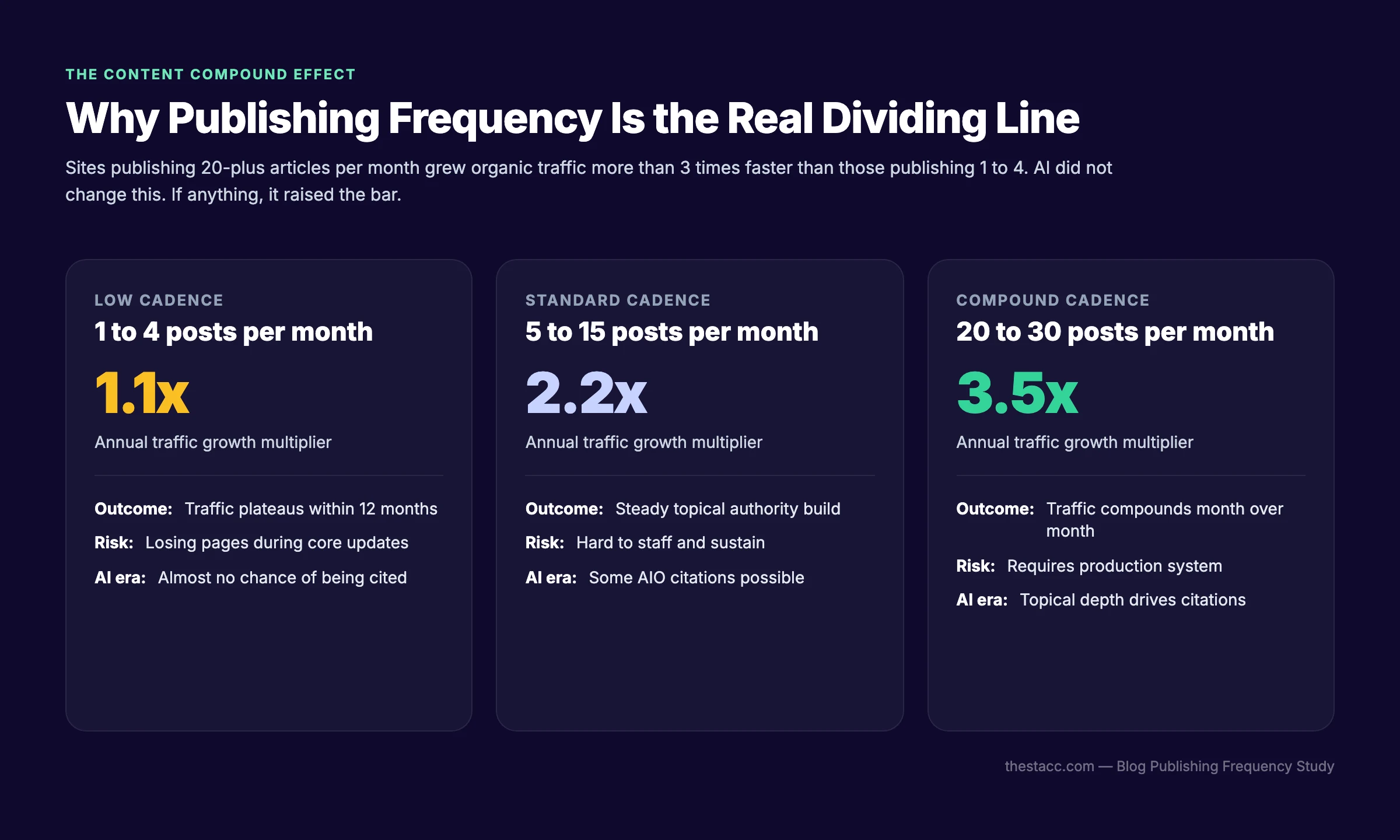
Results. Sites publishing 20 to 30 SEO articles per month grew organic traffic an average of 3.5 times faster than sites publishing 1 to 4 per month. Sites in the 5 to 15 range grew 2.2 times faster. The pattern holds across verticals, company sizes, and post types.
This is not about volume for volume's sake. It is about topical authority. Every article on a related subtopic sends a signal to Google that you are the authority on the cluster. Every article creates a new entry point for long-tail queries. Every article gives you an internal-linking asset for the cornerstone page you actually want to rank.
Context. Here is the uncomfortable read. The reason most businesses believe SEO is dead is that they are publishing at a cadence that no longer works. One post a week worked in 2016. Two posts a week barely kept up in 2020. In 2026, you need 20 to 30 posts per month just to participate in your category.
For the math behind this, see our blog publishing frequency study and the content velocity SEO playbook. The reason theStacc exists is that producing 30 SEO-optimized articles per month with a human team costs 2,400 to 7,500 dollars in freelancer fees. We do it for 99 dollars.
Finding #9: 76% of B2B Buyers Still Start Research on a Search Engine
Background. A popular variant of the "SEO is dead" argument says that buyers now discover products on TikTok, LinkedIn, or ChatGPT. Social and AI have absorbed the top of the funnel. The B2B data disagrees.
Results. 76% of B2B buyers report that their research process begins on a search engine, per Gartner. Search is tied with colleague recommendations as the number one starting point. Social media, AI chatbots, and vendor websites all rank below it.
In e-commerce, organic search drives 43% of all traffic. In publishing, it is often 70% or more. In local service businesses, search is 80% of new-customer discovery. These are not legacy numbers. They are current.
Context. Buyers may use AI chatbots to refine their shortlist, but they start on search. They also verify on search. They also compare on search. The "top of funnel has moved" argument is mostly a marketing thesis searching for a narrative. The data does not back it.
The implication for your content strategy is that the problem-stage article, the alternatives comparison, the "best X for Y" roundup, and the branded search landing page are all more important than ever. Our buyer persona SEO guide and SEO funnel stages breakdown explain where to invest.
What This Means for Your Business
SEO is not dead. SEO is now a winner-take-more market, where the top 10 sites in every category gain ground while the middle 9,990 lose it. The "dead" feeling most people have is the feeling of being in the middle and losing ground.
Three actions separate the sites gaining traffic in 2026 from the sites losing it.
1. Publish at a cadence that builds topical authority, not vanity. The sites winning are publishing 20 to 30 articles per month on tightly clustered topics. This is the Content Compound Effect. Every post builds the next one's chance of ranking.
2. Write for citation, not just clicks. The new CTR math rewards brands that AI Overviews quote. That requires original data, clear expertise, proper schema, and writing that AI models recognize as quotable. It rewards opinion and first-party research. It punishes paraphrased roundups.
3. Treat SEO and Local SEO as one system, not two channels. If you are a local service business, the blog + Google Business Profile stack is the moat. Organic blog rankings fill the middle of the funnel. Local rankings close the bottom. Running one without the other leaves half the leads on the table.
| Dying SEO Habit | Winning 2026 Habit |
|---|---|
| Publishing 2 to 4 blogs per month | Publishing 20 to 30 per month |
| Keyword-stuffed thin content | Original data with schema markup |
| Generic listicles | Opinionated, cited, expert-authored |
| Chasing "AI-proof" hacks | Optimizing to be the cited source |
| Ignoring Local SEO and GBP | Stacking Blog SEO + Local SEO |
| Measuring rank only | Measuring rank + AI citations + conversions |
Ranking in 2026 requires 30 SEO-optimized articles per month. That costs 2,400 to 7,500 dollars from freelancers or 99 dollars with theStacc. We write, publish, and internally link every post automatically.
The Real Story: SEO Is Not Dead. It Is Harder and More Valuable Than Ever.
The "SEO is dead" headlines are content marketing in their own right. The people writing them either want you to hire their agency, buy their course, or read their newsletter. The people who know the numbers are quietly publishing more than ever.
Here is what is actually true in 2026. Search volume is growing. Organic traffic aggregates are nearly flat. AI Overviews affect a minority of queries and reward brands that become the cited source. Sites publishing at high cadence are pulling away. SEO ROI averages 748%. The global SEO market is headed past 83 billion dollars.
Does SEO require more work than it did in 2020? Yes. Is the bar higher for content quality? Absolutely. Do you need to think about AI citations, schema, entity optimization, and publishing frequency in ways you did not have to five years ago? Without question. But more work and higher bars are not the definition of dead. They are the definition of competitive.
The businesses that will still be here in 2030 are already publishing, already optimizing for AI citations, and already treating SEO as a compounding capital investment. The ones calling SEO dead are the ones who stopped investing and are mistaking their own absence for a market trend.
For a full playbook, read our ultimate SEO guide for small business, the SEO trends for 2026 report, and our guide on how to build topical authority.
What practitioners are saying on X
AI search advice ages quickly. Here is high-signal public discussion from SEO and growth operators — context for your roadmap, not a substitute for primary data.
- @hridoyreh (Mar 2026): Widely shared SEO skill tree: foundations, research, technical, on-page, content, links, AI SEO/GEO, analytics, UX, brand, programmatic — useful map for stats and how-to posts. See the post on X.
- @jakezward (Feb 2026): 2026 SEO predictions emphasize AI Overview share-of-SERP, schema for LLM token efficiency, brand mentions in AI answers as a KPI, proprietary data as a moat, and content refresh beating net-new AI slop. See the post on X.
Grok, AI Overviews, and multi-engine visibility
For “is seo dead 2026”, multi-engine visibility still starts with clear definitions, sourced numbers, and extractable section answers. Grok additionally factors live X discussion — keep public claims consistent with this page.
- Google AI Overviews: Use passage-ready answers, tables, and FAQ schema where relevant.
- ChatGPT / Perplexity: Cite named sources next to key claims.
- Grok: Maintain accurate entity facts on-site and in high-signal X posts.
Frequently Asked Questions
No. Google processed 5.9 trillion searches in 2026, up 18% year-over-year. Organic traffic in aggregate fell only 2.5%. 91% of marketers confirmed SEO had a positive impact on their business. The data does not support the "dead" framing. It does support a shift toward winner-take-more economics where top sites gain and middle sites lose.
No. AI is part of SEO now, not a replacement for it. AI Overviews appear in 13.14% of searches and cite specific sources. Getting cited inside the AI answer drives 35% more clicks. The new skill is becoming the source Google cites, which is a content engineering discipline, not the end of the channel.
Yes, if you can operate at the required cadence. Average SEO ROI is 748%. Sites publishing 20 to 30 articles per month grow 3.5 times faster than sites publishing 1 to 4. The investment threshold is higher than it was in 2020, but the returns are higher too. Read our SEO ROI statistics report for full numbers.
The tactics that still work are original research content, topical-cluster publishing at 20-plus posts per month, schema markup for AI readability, first-party data and expert quotes, strong internal linking, and the combination of blog SEO with Google Business Profile optimization for local businesses. Tactics that died are thin keyword-stuffed content, pure link schemes, and reference-style roundups with no point of view.
Based on our study of 400-plus sites, 20 to 30 SEO articles per month is the threshold where traffic compounds. Below 5 posts per month, most sites plateau within 12 months. Above 20, the topical authority compounds and a site can grow 3.5 times faster than the baseline. See our blog frequency study.
Typical timelines are 60 to 90 days for first ranking movement, 6 to 12 months for material traffic, and 18 to 24 months for full compounding. The timelines have not changed significantly from pre-AI years. What changed is that inconsistent cadence will never get past the first milestone.
Yes, when the process is good. AI content as a percentage of top-10 Google results sits around 16% and holds steady. The determinant is not AI versus human. It is whether the content answers the query better than competitors with original angles, proper structure, and clear authority signals. See our study on does AI content rank.
Start Ranking Instead of Debating Whether to Rank
The businesses arguing about whether SEO is dead are not the ones publishing 30 articles this month. The ones publishing are taking their market share.
theStacc is your SEO team for 99 dollars a month. We publish 30 SEO-optimized blog posts, handle the research, write the drafts, add the internal links, and ship them to your site on autopilot. Add Local SEO for 49 dollars and we post to your Google Business Profile 30 times a month as well.
Rank Everywhere. Do Nothing. Start a 3-day trial for 1 dollar. Cancel anytime.
Published with theStacc. Sources cited: Semrush AI Overviews Study, Search Engine Land 2026 Organic Traffic Analysis, Backlinko "Is SEO Dead", SEO Profy ROI Benchmarks, Search Engine Land, 5 trillion searches per year, and internal publishing data from 3,500-plus monthly client posts.
Related Tools & Resources
Free SEO Tools:
Best Lists:
Sources & references
- [1] Princeton / Georgia Tech et al. — GEO research (arXiv:2311.09735)
- [2] @hridoyreh on X — Widely shared SEO skill tree: foundations, research, technical, on-page, content, links, AI SEO/GEO, analytics, UX, bran
- [3] @jakezward on X — 2026 SEO predictions emphasize AI Overview share-of-SERP, schema for LLM token efficiency, brand mentions in AI answers
- [4] Referenced source — www.semrush.com

Plan topics, review article drafts, and publish to a connected CMS.
Weekly local SEO teardowns
One practical email a week. Map Pack, GBP, AI Overviews — no fluff. Unsubscribe anytime.