
Ecommerce Link Building: The Complete Guide (2026)
Everything you need to know about ecommerce link building in one 8-chapter guide. Covers product pages, digital PR, and internal linking. Updated 2026.
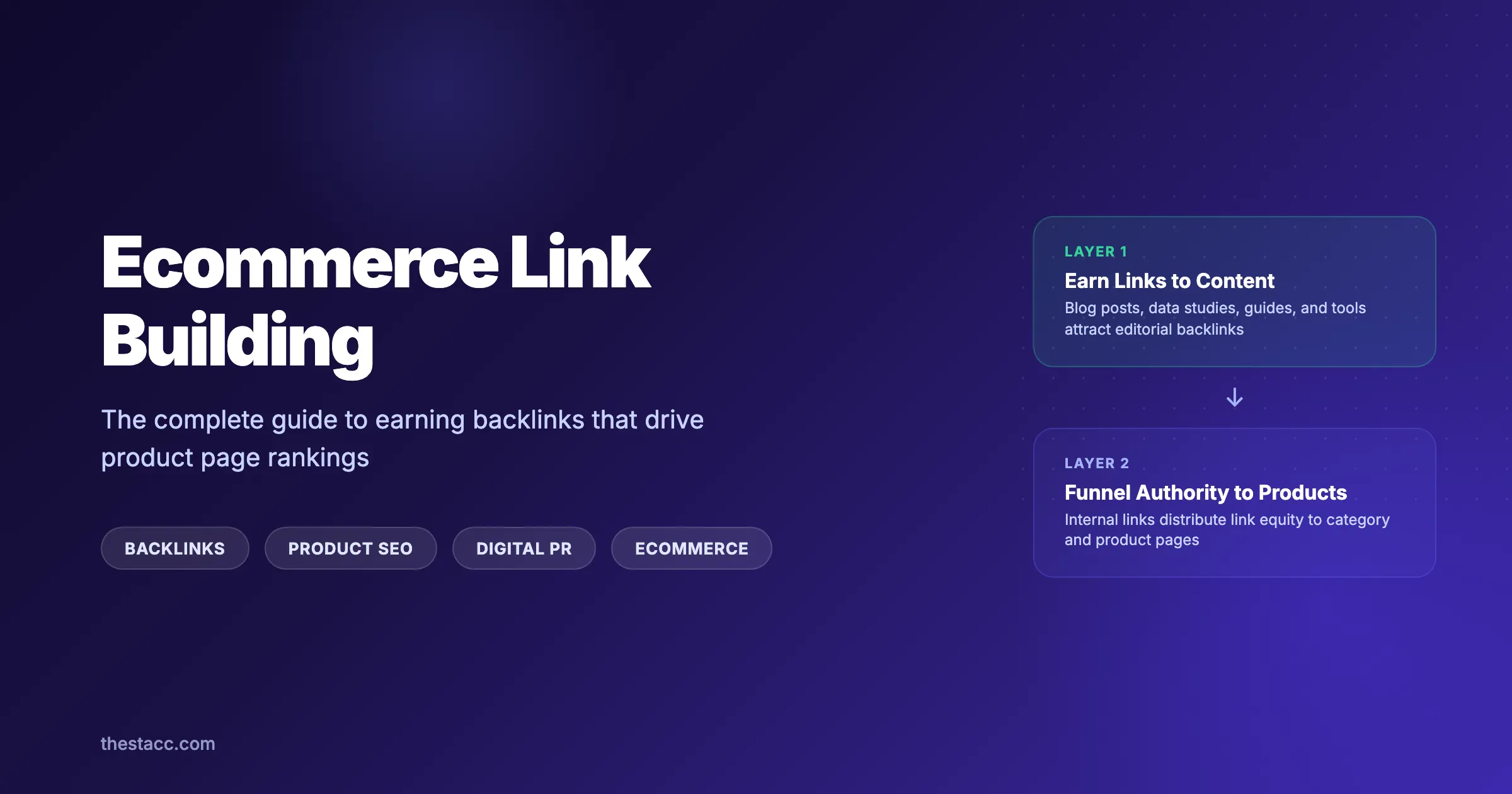
Most ecommerce stores earn backlinks to their blog. Almost none earn backlinks to the pages that actually generate revenue.
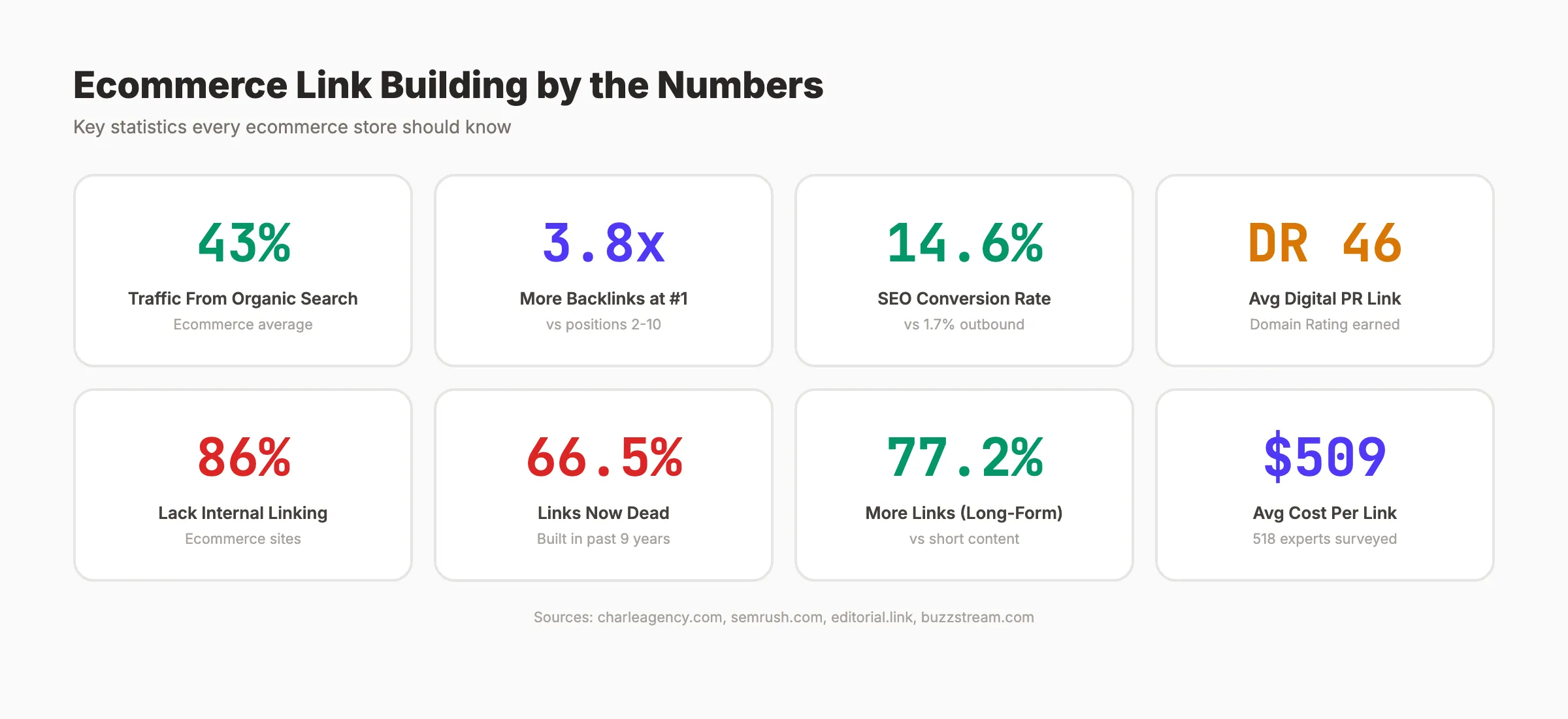
43% of all ecommerce traffic comes from organic Google search. The stores that rank on page 1 have 3.8x more backlinks than those on page 2. Yet 86% of ecommerce sites lack optimized internal linking to move that authority where it matters.
This guide covers ecommerce link building from strategy to execution. Not generic advice. Specific tactics for product pages, category pages, and content assets that drive sales.
We have published 3,500+ blogs across 70+ industries. Ecommerce brands make up a significant share of that work, and we see the same link building gaps repeat across every store.
Here is what you will learn:
- Why product page links are hard to earn and how to get them anyway
- The two-layer strategy that top ecommerce sites use to build authority
- 8 ecommerce-specific link building tactics with real benchmarks
- How to funnel blog link equity to your money pages through internal linking
- Measurement frameworks beyond “count your backlinks”
- Common mistakes that waste budget or trigger penalties
Chapter 1: Why Ecommerce Link Building Is Different
Link building for ecommerce stores follows different rules than link building for SaaS companies, agencies, or publishers. The core challenge: your most important pages are commercial.
The Product Page Problem
Nobody wants to link to a product page. Bloggers see it as running a free advertisement. Journalists ignore commercial URLs. Even resource page curators skip anything that looks like a sales pitch.
This creates a paradox. The pages you need authority on are the pages nobody wants to link to. Category pages face the same problem. They exist to sell, not to educate.
The Two-Layer Strategy
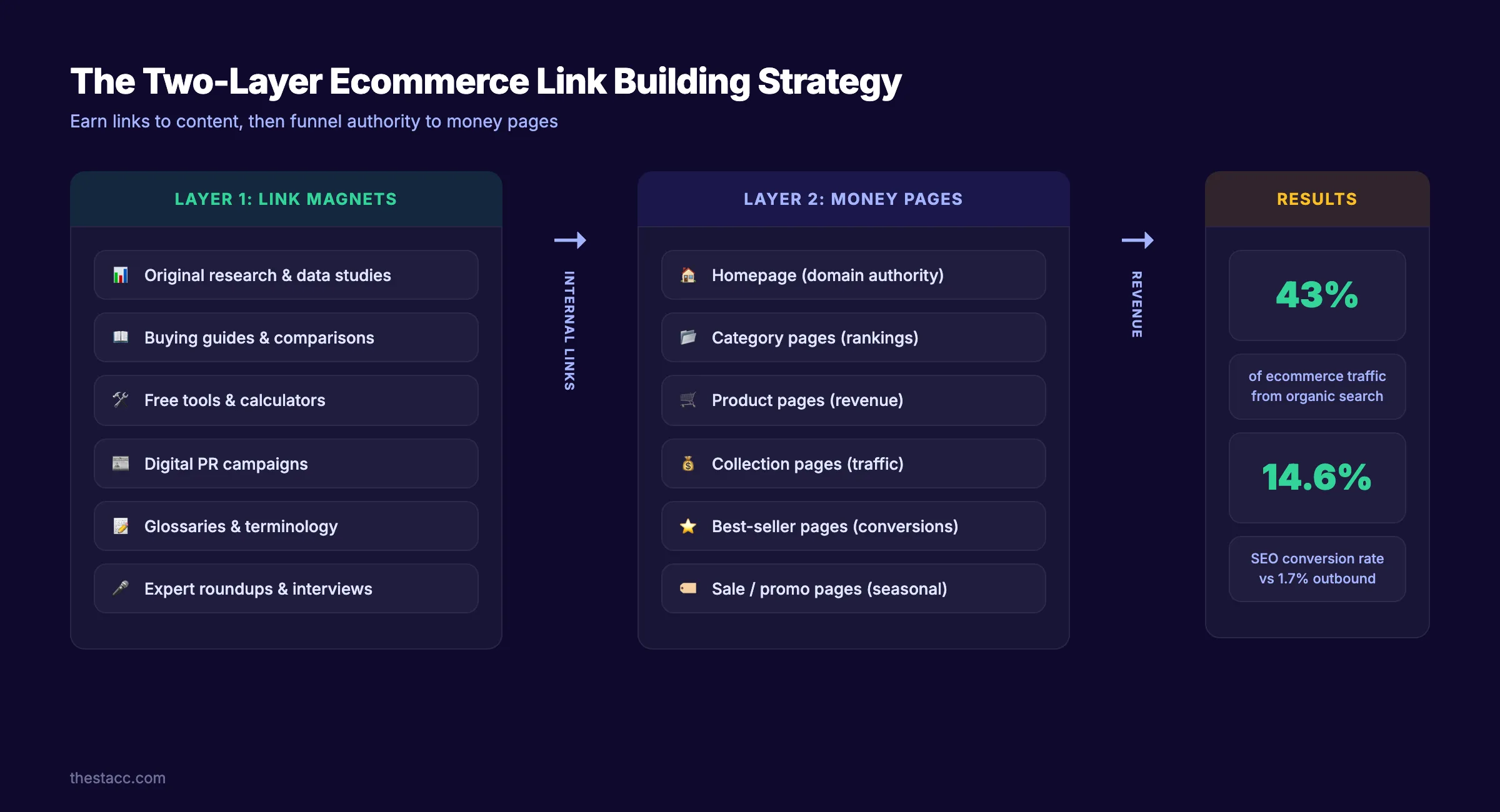
The best ecommerce link building programs solve this with two layers:
Layer 1: Earn links to content assets. Blog posts, data studies, buying guides, and tools attract editorial links because they provide value without asking for a sale.
Layer 2: Funnel authority to money pages through internal linking. Every backlink earned on a blog post distributes domain authority across your entire site. Strategic internal links send that authority directly to product and category pages.
86% of ecommerce sites fail at Layer 2. They earn links to their blog but never connect that equity to their product catalog. The result: a strong blog that ranks and a product section that does not.
What Makes a Link Valuable for Ecommerce
Not all backlinks carry equal weight. For ecommerce stores, prioritize:
| Factor | Why It Matters for Ecommerce |
|---|---|
| Topical relevance | A link from a cooking blog to your cookware store beats a link from a tech blog |
| Referring domain authority | Links from DR 40+ domains move rankings faster |
| Do-follow status | 78% of ecommerce backlinks are do-follow. Maintain that ratio. |
| Anchor text diversity | Mix branded, generic, and keyword anchors to avoid penalties |
| Link placement | In-content editorial links pass more authority than sidebar or footer links |
Chapter 2: Build Link-Worthy Content Assets
Your blog is not decoration. It is your link-earning engine. The content you publish determines how many backlinks your store attracts.
Content Formats That Earn the Most Links
Long-form content generates 77.2% more backlinks than shorter pieces. “Why” and “what” content (FAQs, explainers, buying guides) earns 25.8% more backlinks than other formats.
The best content types for ecommerce link building:
Original research and data studies. Survey your customers. Analyze your sales data. Publish industry benchmarks. One well-promoted data study can earn more links than 50 blog posts. Ahrefs earned 1,777 referring domains from a single statistics page.
Buying guides and comparison content. “Best [product category] for [use case]” posts attract links from people evaluating options. Include real testing data, photos, and honest recommendations.
Interactive tools and calculators. A sizing calculator, ROI estimator, or product quiz earns links every time someone references the problem it solves. Build once, earn links for years.
Glossaries and terminology pages. If your niche has specialized vocabulary, create a glossary. People link to definitions constantly. These pages compound in value as your glossary grows.
How to Structure Content for Link Attraction
Every piece of content should include at least one of these elements:
- A specific, quotable statistic (journalists cite numbers)
- A visual asset like a chart or infographic (bloggers embed these)
- A unique framework or methodology (industry writers reference these)
- A downloadable resource (creates a reason to link rather than copy)
Content without a link hook is content that sits idle. Before publishing anything, ask: “Why would someone link to this instead of just reading it?”
Stop writing. Start ranking. Stacc publishes 30 optimized articles per month for $99. Start for $1 →
Chapter 3: Digital PR for Ecommerce Stores
Digital PR is the most effective link building method in 2026. 52% of ecommerce sites already use it. That number rises to 72% among the largest stores.
Why Digital PR Outperforms Other Tactics
Digital PR-earned backlinks average a Domain Rating of 46. Compare that to guest post links, which often come from DR 20-30 sites. The quality gap is massive.
A single successful PR campaign can earn 20-50 editorial links from major publications in one week. That is more than most stores earn in a quarter through other methods.
PR Angles That Work for Ecommerce
Data-driven studies. Analyze your sales data to uncover trends. “We analyzed 50,000 orders and found [surprising insight]” gives journalists a story with numbers attached.
Seasonal trend reports. Release data before major shopping events. “Black Friday spending in [category] rose 34% year over year” earns coverage during peak media interest.
Product innovation stories. If you manufacture or design products, the creation process itself is a story. Behind-the-scenes content attracts lifestyle and industry press.
Consumer behavior surveys. Survey 500+ consumers about a topic related to your niche. Package the results with charts and quotable findings. Journalists use these as source material.
Local economic impact. If your business supports local suppliers or artisans, that is a story local and national publications want to tell.
Pitching Journalists
Write the subject line as a headline. Journalists receive hundreds of pitches daily. Your subject line must communicate the story in under 10 words.
Keep the pitch under 150 words. Include the key stat in the first sentence. Link to the full data. Offer yourself as an available source for quotes.
Chapter 4: Get Backlinks to Product and Category Pages
This is the hardest part of ecommerce link building. Most guides skip it because the advice is harder to give. Here are the tactics that actually work.
Product Roundup Placements
“Best [product] for [use case]” articles are the most direct path to product page links. Bloggers and publishers write these to monetize affiliate traffic. Your product belongs on those lists.
How to get placed:
- Search
"best [your product category]" + [year]to find active roundup posts - Identify the author and find their contact information
- Send a short pitch with your product name, one unique selling point, and an offer to send a sample
- Follow up once after 5 days if no response
This works because roundup authors actively look for products to feature. You are helping them complete their content.
Influencer Product Reviews
Send products to niche influencers and bloggers for honest reviews. Request a do-follow link to your product page. Disclose the gifted product relationship as required by Google and FTC guidelines.
Focus on micro-influencers (5,000-50,000 followers) in your niche. They have higher engagement rates and are more likely to include editorial links.
Discount Code Link Building
Create exclusive discount codes for bloggers and publishers. When they share the code, they link to your product or category page. The discount gives their audience a reason to click through.
This is especially effective for coupon and deal aggregator sites that maintain permanent pages for brand discounts.
Niche Edits on Existing Content
Find published articles that mention your product category but do not link to your store. Reach out to the author and suggest adding your product as a relevant resource.
This works best when your product genuinely fits the context. Forced placements get rejected or removed.
Your SEO team. $99 per month. 30 optimized articles, published automatically. Start for $1 →
Chapter 5: Outreach Strategies That Convert
52.3% of SEO professionals say link building is the most challenging part of their job. Most of that difficulty comes from poor outreach.
Personalization Beats Volume
Personalized outreach emails with the recipient’s first name achieve 75%+ open rates. Mass templated emails get 1-2% response rates. The math is clear: 50 personalized emails outperform 1,000 generic ones.
Every outreach email should reference:
- A specific article or page on the recipient’s site
- Why your content is relevant to their audience
- One clear ask (link, mention, feature)
Outreach Templates That Work
For unlinked brand mentions:
Subject: Quick question about [their article title]
Hi [Name], I noticed you mentioned [your brand] in your piece about [topic]. Thanks for the reference. Would you be open to adding a link to [specific page URL]? Happy to share the post with our audience too. Thanks, [Your name]
Unlinked mention conversion rates run 30-50%. These are the highest-converting outreach emails because the author already chose to reference you.
For broken link replacements:
Subject: Broken link on [their page title]
Hi [Name], I found a broken link on your [page title] page. The link to [dead URL] returns a 404. We have a similar resource at [your URL] that covers the same topic. Might be a good replacement. Either way, thought you’d want to know. [Your name]
62.4% of ecommerce websites contain broken links. That means your competitors’ sites are full of broken link opportunities waiting to be claimed.
For resource page inclusion:
Subject: Resource suggestion for [their page title]
Hi [Name], I came across your [topic] resource page. Great collection. We recently published [your resource title] which covers [specific angle]. It might be a good fit for the [specific section] of your page. Here is the link: [URL]. Thanks for considering it. [Your name]
Keep every outreach email under 100 words. The shorter the pitch, the higher the response rate.
Chapter 6: Internal Linking as a Link Building Multiplier
This is the chapter most ecommerce link building guides skip. It is also the most important.
Why Internal Linking Matters More for Ecommerce
You will earn most backlinks to informational content. Blog posts, guides, and data studies attract editorial links. Product and category pages do not.
Internal linking bridges this gap. Every backlink earned on your blog distributes authority through your site’s link graph. Strategic internal links direct that authority to your highest-value commercial pages.
The Hub-and-Spoke Architecture
Structure your content like this:
- Hub (category page): /shoes/running-shoes
- Spokes (blog posts): /blog/best-running-shoes-flat-feet, /blog/running-shoe-buying-guide, /blog/how-to-choose-running-shoes
Every spoke links to the hub. Every spoke earns backlinks through content marketing and outreach. The hub receives authority from every spoke without needing a single direct backlink.
Internal Linking Best Practices for Ecommerce
- Link from every blog post to 2-3 relevant product or category pages
- Use descriptive anchor text that includes the target page’s keyword
- Add contextual links within the body text (not just “related products” widgets)
- Link from high-authority pages to pages that need ranking help
- Audit internal links quarterly to fix broken paths and add new connections
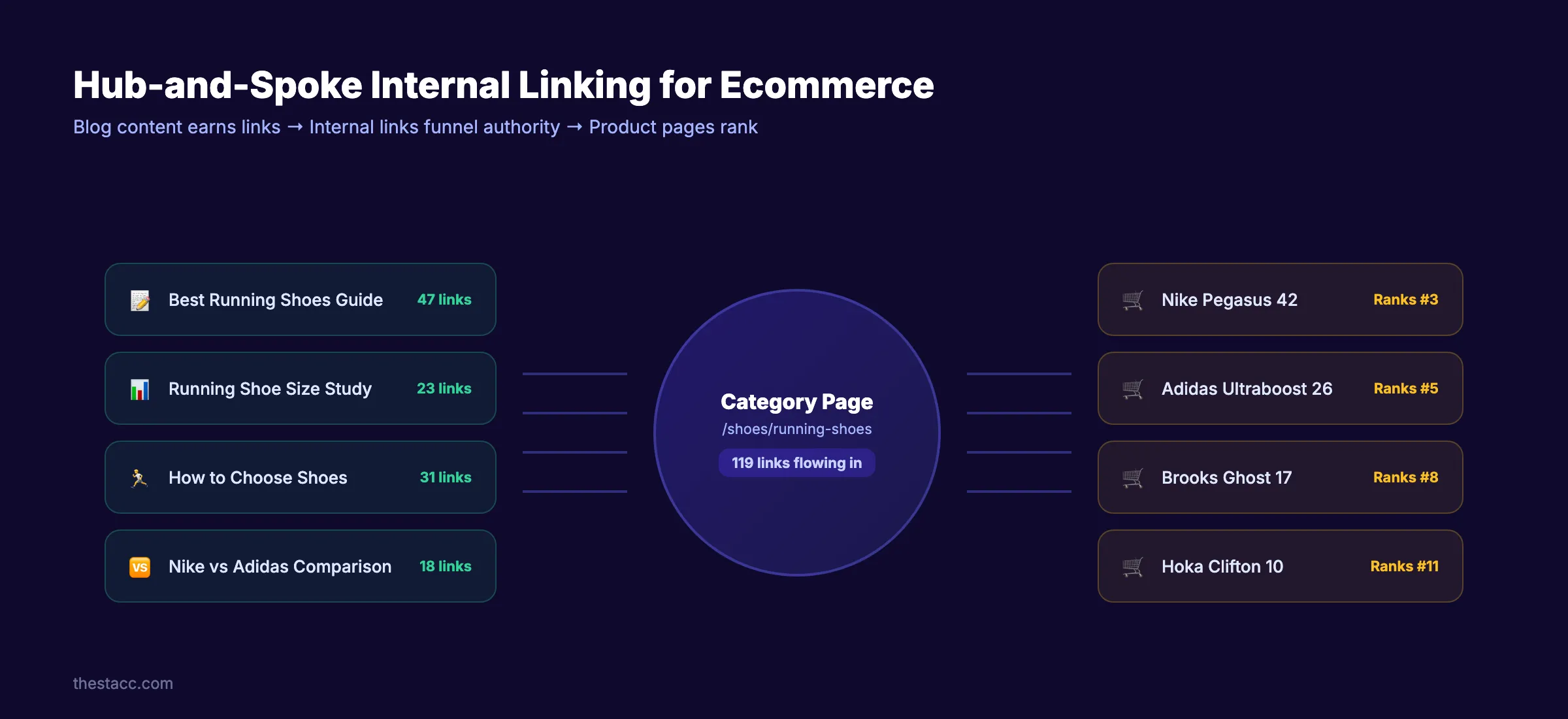
86% of ecommerce sites lack optimized internal linking. Fixing this is often the fastest way to improve product page rankings without earning a single new backlink.
For a deeper dive, read our internal linking guide.
3,500+ blogs published. 92% average SEO score. See what Stacc can do for your site. Start for $1 →
Chapter 7: Measuring Ecommerce Link Building ROI
Counting backlinks is not enough. Ecommerce link building must connect to revenue.
The Metrics That Matter
| Metric | What It Tells You | How to Track |
|---|---|---|
| Referring domains (monthly growth) | How fast your link profile is growing | Ahrefs / Semrush |
| Domain Rating / Authority | Overall site authority trend | Ahrefs / Moz |
| Organic traffic to linked pages | Whether links are driving rankings | Google Analytics + Search Console |
| Keyword ranking movement | Whether authority is translating to positions | Rank tracker |
| Referral traffic from backlinks | Direct traffic value of each link | Google Analytics referral report |
| Revenue from organic channel | The bottom-line impact | GA4 ecommerce tracking |
| Cost per link | Whether your budget is efficient | Total spend / links earned |
Budget Benchmarks
The average acceptable cost per quality backlink is $509, based on a survey of 518 SEO experts. For ecommerce stores:
| Monthly Budget | Expected Links | Best Tactics |
|---|---|---|
| Under $1,000 | 3-7 | Unlinked mentions, broken links, testimonials |
| $1,000-$3,000 | 8-15 | Content creation + outreach, resource pages |
| $3,000-$5,000 | 15-25 | Digital PR + content marketing + outreach |
| $5,000+ | 25-50+ | Full-scale digital PR + influencer program |
78.1% of businesses report positive ROI from link building. But results take time. 57.1% of experts expect measurable results within 1-3 months. Set expectations accordingly.
Connect Links to Revenue
SEO-driven customers convert at 14.6% compared to 1.7% for traditional outbound. Track organic revenue growth alongside your link building efforts to calculate true ROI.
The formula: (Organic revenue increase / Link building spend) = ROI multiplier.
Chapter 8: Ecommerce Link Building Mistakes to Avoid
These mistakes waste budget and risk penalties. Avoid every one.
Mistake 1: Buying Links Without Disclosure
Google’s spam policies explicitly prohibit buying links for ranking purposes without proper disclosure. Sites that rely on purchased links saw ranking drops of 20+ positions in 40% of cases.
If you pay for a sponsored placement, use rel="sponsored" on the link. Undisclosed paid links are the fastest path to a manual penalty.
Mistake 2: Ignoring Link Decay
66.5% of links created in the past 9 years are now dead. Links break when sites go down, pages get deleted, or content gets reorganized.
Run a backlink audit monthly. When a valuable link breaks, reach out to the site owner to reclaim it. A lost link is easier to recover than a new link is to earn.
Mistake 3: Earning Links to the Blog Only
The blog earns links. But if those links never flow to product and category pages, your money pages stay stuck. This is the most common ecommerce link building failure.
Fix it with the hub-and-spoke internal linking architecture from Chapter 6.
Mistake 4: Over-Optimizing Anchor Text
If every backlink uses your exact target keyword as anchor text, Google flags it as manipulative. A natural link profile includes branded anchors (55-70%), generic phrases (15-20%), and keyword variations (10-20%).
Mistake 5: Chasing Quantity Over Relevance
One link from a cooking blog to your kitchenware store outperforms 50 links from unrelated sites. Topical relevance is the strongest signal of link quality.
Focus on sites where your target customers read, not sites with the highest Domain Rating.
Mistake 6: Neglecting Technical SEO
62.4% of ecommerce websites contain broken links. 53% lack canonical tags. Technical SEO problems undermine every link you earn.
Fix your on-page foundation before investing in link building. A technically broken site wastes the authority backlinks send to it.
FAQ
How do I get backlinks to product pages?
Product roundup placements, influencer reviews, discount code partnerships, and niche edits are the four most effective methods. Target “best [product category]” articles and pitch your product for inclusion. Send samples to niche bloggers for honest reviews with do-follow links.
How much does ecommerce link building cost?
The average cost per quality backlink is $509. Most ecommerce stores spend $1,000-$5,000 per month on link building. Digital PR campaigns cost more upfront but earn higher-authority links (average DR 46) at a lower per-link cost.
Is link building still worth it for ecommerce in 2026?
Yes. 43% of all ecommerce traffic comes from organic search. Pages in position 1 have 3.8x more backlinks than pages in positions 2-10. 78.1% of businesses report positive ROI from link building. The cost increases every year, so starting now compounds your advantage.
How long does ecommerce link building take to show results?
57.1% of experts expect measurable results within 1-3 months. Individual links can impact rankings within weeks for low-competition keywords. High-competition product keywords take 3-6 months of consistent link building to see movement.
What is the best link building strategy for ecommerce?
Digital PR earns the highest-quality links (average DR 46). Content marketing with hub-and-spoke internal linking is the most sustainable long-term approach. The best programs combine both: earn editorial links through PR and content, then funnel that authority to product pages through internal links.
Does Stacc help ecommerce stores with SEO?
Stacc publishes 30 SEO-optimized articles per month for $99. For ecommerce stores, that means 30 new content assets that attract backlinks, build topical authority, and funnel link equity to product pages through internal linking.
Ecommerce link building is a two-layer game. Earn links to content. Funnel authority to products. The stores that master both layers dominate organic search.
Start with one tactic from this guide. Execute it for 90 days. Measure the results. Then add a second tactic. The links compound. The rankings follow.
Rank everywhere. Do nothing. Blog SEO, Local SEO, and Social on autopilot. Start for $1 →

Written by
Siddharth GangalSiddharth is the founder of theStacc and Arka360, and a graduate of IIT Mandi. He spent years watching great businesses lose organic traffic to competitors who simply published more. So he built a system to fix that. He writes about SEO, content at scale, and the tactics that actually move rankings.
30 SEO blog articles published every month
Keyword-optimized, scheduled, and live on your site. Automatically.
30-day trial · Cancel anytime
theStacc
Stop writing SEO content manually
30 blog articles, 30 GBP posts, and social media content. Published every month. Automatically.
Start Your $1 Trial$1 for 3 days · Cancel anytime