A moving company SEO guide covering local and interstate demand, Google Business Profile, compliant reviews, and measurement tied to booked jobs.
Moving company SEO is the work of earning unpaid visibility when households and businesses plan a move and compare providers. It is not a switch you flip for instant calls, and it is not a page you clone for every city. This guide is the single owner of the moving-SEO head intent: strategy, the seven-stage funnel, and measurement tied to booked and completed jobs. For the commercial proposition and product fit, see our page for movers.
Two things make moving different from the emergency trades most SEO advice is written for. Demand is mostly planned, with weeks or months of lead time, and the job is bounded by crews, trucks, licenses, and quote capacity. A plan that outruns those constraints creates enquiries you cannot serve, which wastes spend and damages reviews.
What this guide covers, in order:
- The job economics that separate moving from emergency services
- How ranking actually works, with no shortcut and no outcome promise
- The local-versus-interstate model, and when a service-area page earns its place
- Google Business Profile, reviews within platform and FTC rules, and the technical basics
- A seven-stage funnel and four formulas for measuring booked and completed jobs
What SEO for a moving company actually covers
Search engine optimization for a moving company is the work of earning unpaid visibility when households and businesses plan a move and compare providers online. It covers your Google Business Profile, service pages, reviews, content, and technical health. The goal is qualified enquiries that become booked, completed jobs, not raw traffic or form fills.
The head intent behind "moving company SEO" folds several questions into one: how ranking works, whether the work is worth it, and how local and interstate SEO differ. This guide answers all three as sections rather than splitting them into thin, competing pages, which matches how Google treats the topic.
Directional context only: DataForSEO's US keyword data (updated June 2026) lists "moving company SEO" and "SEO for moving companies" near 1,000 monthly searches each, with a cost per click around forty-four dollars and low difficulty, and with recent months well below the late-2025 peak. That describes how owners and agencies search for help, not consumer moving demand, and it is not a traffic, lead, or revenue forecast for your business.
Moving job economics: why demand is planned, not urgent
Moving demand is mostly planned, with weeks or months of lead time, not the no-heat urgency of emergency trades. That shape changes the economics: local residential, interstate, commercial, specialty, packing-only, labor-only, and storage jobs carry different tickets and decision cycles. Pull ticket size, margin, and seasonality from your own records; portable numbers are unavailable.
Because customers plan ahead, they research earlier, compare more options, and care more about trust signals than a same-day emergency caller does. Your SEO has to carry that longer decision cycle: clear service pages, verifiable authority for interstate work, and reviews that describe real jobs. The constraint that should set your pace is operational. A crew and a truck can only be in one place on a given date, so acquisition should rise and fall with the capacity you actually have.
| Move type | Typical ticket structure (qualitative) | Urgency and decision cycle | Primary search modifiers | Authority and trust signals | Page or section owner | Exclusions |
|---|---|---|---|---|---|---|
| Local residential | Hourly or crew-based; set by your own rate card | Planned; weeks of lead time; compares several movers | [city] movers, local movers, movers near me | Proximity, accurate profile, recent reviews | Local residential service page | No interstate or authority claims |
| Interstate / USDOT | Weight and distance based; set by your own estimates | Longer cycle; higher research and verification | long-distance movers, interstate movers, cross-country | USDOT and FMCSA registration customers can verify | Interstate and long-distance page | No legal or pricing advice |
| Commercial / office | Project based; scoped to the business | Committee decision; procurement timeline | office movers, commercial movers, business relocation | Commercial experience, scheduling reliability | Commercial and office page | No residential packing advice |
| Specialty (piano, antiques, senior) | Item or handling based; quoted per job | Planned; trust and handling proof matter most | piano movers, antique moving, senior moving | Documented handling, relevant reviews | Specialty service page | No packing, safety, or insurance instruction |
| Packing-only | Labor and materials based; quoted per scope | Add-on or standalone; planned | packing services, packing help [city] | Clear scope, reviews mentioning packing | Packing service page | No how-to packing instruction |
| Labor-only | Hourly crew, customer supplies the truck | Shorter cycle; price and availability led | loading help, unloading help, labor-only movers | Availability, clear scope, reviews | Labor-only service page | No truck or storage claims |
| Storage | Recurring; set by your own facility terms | Planned; often paired with a move | moving and storage, storage [city] | Facility details, access, reviews | Storage service page | No facility or insurance advice |
Plan SEO around jobs you can actually complete. If you are unsure which move types and markets to prioritize, a short working session can map demand to your real capacity.
How ranking works for movers, with no shortcut
How to rank is this guide's core, and there is no separate shortcut. Google rewards helpful, reliable, people-first pages, a complete and accurate Business Profile, relevant service pages, real reviews, and a crawlable mobile-friendly site. AI features follow the same rules; Google states there is no special optimization trick for them.
The mechanics are the sections that follow: an eligible, accurate Business Profile; on-page work that matches each page to one topic; local signals built on relevance, distance, and prominence; content that answers real questions; reviews earned inside the rules; and a technically sound site. None of these is a growth hack, and none of them promises a position. A top-three organic result is a target, never a guarantee.
Google's own guidance is the anchor here. Its documentation says to create helpful, reliable, people-first content rather than pages built for every search variation, and its note on AI features and your website confirms that the same people-first, well-structured, crawlable practices apply with no special trick. If a tactic claims to shortcut either, treat it with doubt.
Local vs interstate SEO: one model, two playing fields
Local and interstate movers compete on different playing fields. A local mover wins within a tight radius on proximity, an accurate Business Profile and service area, and reviews. An interstate mover competes on broader national terms and trust signals such as USDOT and FMCSA registration across markets. Neither model needs a page for every city.
A local mover's ceiling is set by geography. You cannot move your warehouse closer to every searcher, so you strengthen relevance and prominence: a complete profile, accurate categories and service area, consistent name and address details, and a steady flow of genuine reviews. Content supports that by answering the questions local customers ask before they call.
An interstate mover plays a wider game. The search terms are broader and less tied to one city, and the buyer verifies authority before committing. Registration with FMCSA and a USDOT number are not marketing copy; they are signals a customer can check, so they belong on the page and in the profile as facts, not slogans. Across both models, the rule is the same: serve the areas you genuinely cover, and do not manufacture pages to fake coverage you do not have.
Google Business Profile for movers
For most movers the Business Profile is the most consequential surface in local search. Google states eligible profiles require in-person customer contact during stated hours, and that lead-generation agents and online-only businesses are not eligible. A service-area mover may hold one profile for its real operating location and must represent it accurately.
Eligibility comes first. Google's rules say an eligible Business Profile requires in-person contact with customers during your stated hours, and that lead-generation agents and online-only businesses are not eligible. Confirm you qualify before you optimize, because an ineligible profile can be removed and take your reviews with it.
Service-area accuracy is the second gate. A mover that travels to customers is allowed one service-area profile for its operating location, and it must represent that location and service area honestly. List the cities and ZIP codes your crews actually serve. Do not claim areas your trucks do not reach, and do not open extra profiles to manufacture coverage.
Then complete every field: legal business name with no keyword stuffing, "Moving company" or "Mover" as the primary category, accurate secondary categories, a service area that matches reality, and a description that states your services and, for interstate work, your USDOT number. Add real photos of your crew, trucks, and completed moves, and post updates that reflect actual availability rather than generic slogans.
On-page SEO for moving company websites
On-page SEO lets Google read, understand, and match each page to a specific search. Give every important page a unique title, a clear meta description, one focused topic, and content that answers the query behind it. Build pages for real services and real places you serve, and treat a new page as earned, not automatic.
Start with service pages that mirror how you actually sell: local residential, interstate and long-distance, commercial and office, packing, labor-only, storage, and any specialty you genuinely offer. Each page targets one topic, names the service and the area it applies to, explains your process at a high level, and routes the visitor to an estimate request. One page per real service beats a single catch-all page and a pile of thin clones.
Service-area-page gate. A service-area page earns its place only when all of these hold: you genuinely send crews there, you can say something specific and true about serving that area, you have capacity to take the work, and the page is not a near-duplicate of another. If any condition fails, do not publish it. Google treats substantially similar regional pages that funnel users onward as doorway abuse, and many unoriginal pages as scaled-content abuse. Default to fewer, real pages.
Local SEO and the map pack
The map pack is where nearby searches convert into calls, and it rests on three factors: relevance, distance, and prominence. You control relevance with a complete profile and accurate categories, and prominence with reviews, citations, and links. You cannot change distance, so you strengthen the signals you actually own.
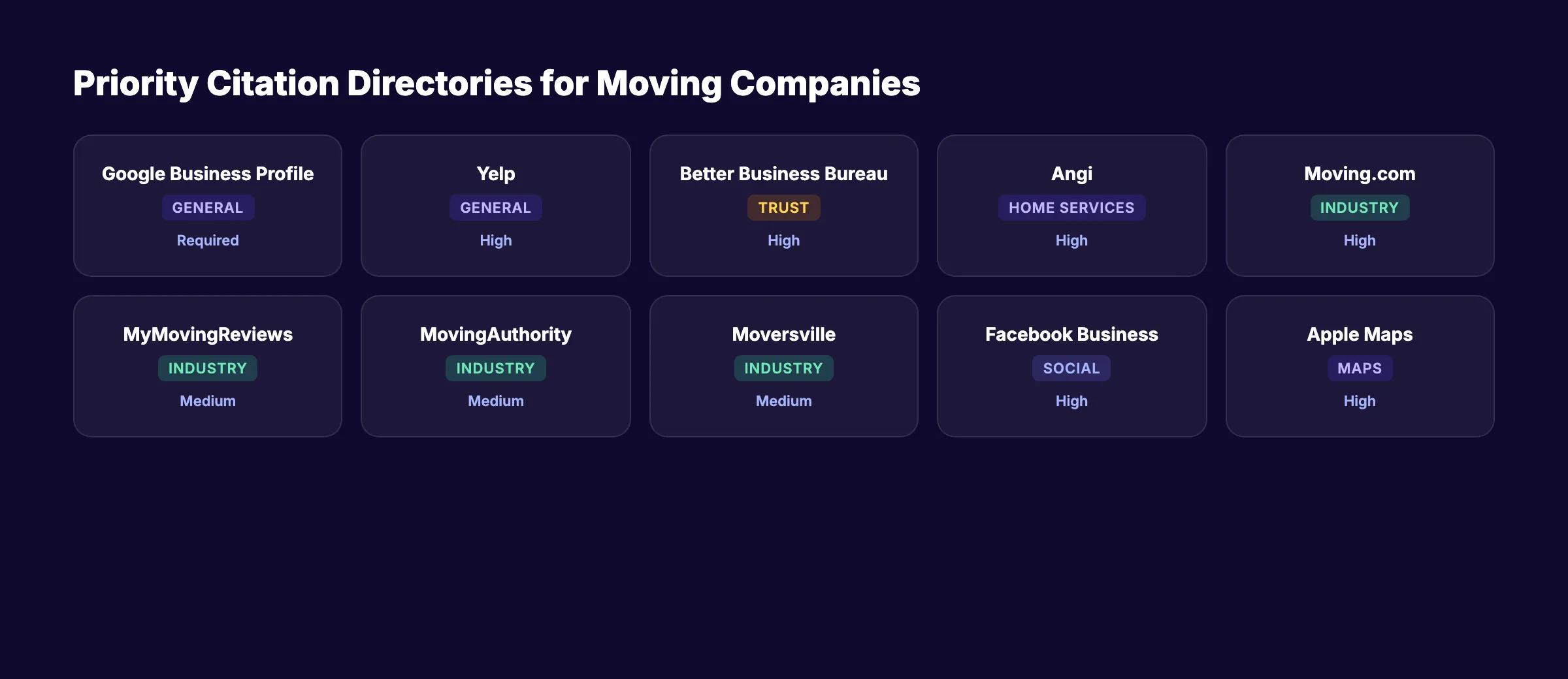
Relevance is how well your profile and pages match the query, and you raise it by completing every field and choosing accurate categories. Distance is how close your operating location is to the searcher, and it is mostly fixed. Prominence is how established your business looks online, and you build it with genuine reviews, consistent citations, and mentions from real local organizations.
A citation is any online mention of your business name, address, and phone number. Keep those details identical everywhere they appear, because small differences create doubt about whether two listings are the same business. Industry directories and general directories both matter, but consistency matters more than chasing a ranked list of sites. Earn mentions from chambers of commerce, real estate partners, and local organizations you actually work with rather than buying placements.
Seasonality-aware SEO planning
US moving demand is widely understood to concentrate around the summer, the school calendar, and lease turnover, so content and profile work should be front-loaded before that window. The exact curve is yours alone: confirm the timing and size from your own booking history rather than any published share, which is unavailable for your market.
Front-loading means you build and refresh pages, update your profile, and line up reviews before the busy window opens, not during it. It also means acquisition should be capacity-aware: when crews and trucks are fully booked, you slow the channels that create new enquiries rather than stacking leads you cannot serve. The goal is to match demand to dates you can actually honor.
Seasonality planning card. Before your busy window: refresh core service pages, confirm profile accuracy and photos, and clear your review backlog. During it: pace acquisition to booked capacity, and pause or throttle channels when dates fill. After it: review what converted and what did not. Confirm every timing and every threshold from your own first-party booking data, not from any industry average.
Content that builds authority without a city-page factory
Content builds authority when it answers the questions your coordinators hear and proves you run real moves. Google favors helpful, reliable, people-first pages and warns against creating a page for every search variation. Write from operator detail, cover each topic once and well, and resist doorway or scaled-content patterns that add no user value.
The strongest topics come from your own phones: the questions customers ask before they book and the confusion that slows a quote. Turn each recurring question into one thorough page, written as someone who schedules crews and confirms move dates, not as a generic list of tips. Operator detail is what separates your page from a thousand interchangeable articles, and it is what gives Google something worth citing.
The boundary that protects you is restraint. Google explicitly advises against creating a page for every search variation, and its spam policies name doorway and scaled-content abuse as the patterns to avoid. Cover each topic once, do it well, refresh it when facts change, and let a smaller set of strong pages compound rather than a large set of thin ones.
Reviews the right way: platform rules and the FTC
Reviews are the most visible trust signal a mover has, and the rules are strict. Google permits asking genuine customers for reviews but prohibits incentives, and the FTC Consumer Reviews and Testimonials Rule bars specified fake or false reviews and incentives tied to sentiment. Ask every customer honestly, then reply with care and privacy.
Every completed move is a review opportunity, and the safest system is also the simplest: ask each genuine customer for an honest review after the job is done, with nothing of value tied to leaving it. Google's policy lets you ask genuine customers for reviews but prohibits incentives, and it asks you to protect privacy in public replies. Timing the request while the experience is fresh, and making the link easy to use, is the whole playbook.
The legal line is equally clear. The FTC Consumer Reviews and Testimonials Rule prohibits specified fake or false reviews and reviews incentivized on positive or negative sentiment. Do not buy reviews, do not write them yourself, do not offer a discount for a five-star rating, and do not suppress honest criticism. Respond to every review, thank customers by name without exposing private details, and move complaints to a private channel to resolve them.
Technical SEO for moving company websites
Technical SEO lets Google crawl, index, and render your site without friction. Google uses the mobile version of a page for indexing and recommends a mobile-friendly site with accessible rendered content. Page experience is broader than one score, and strong Core Web Vitals do not guarantee rankings, so treat speed and stability as basics, not a trick.
Most moving searches start on a phone, and Google uses the mobile version of your site for indexing, so the mobile experience is the one that counts. Make sure pages load quickly, the tap-to-call button and estimate form work on a small screen, and the content Google renders is the content a visitor sees. A site that is slow or broken on mobile loses ground it cannot win back with more content.
Keep the structure clean so Google can find every important page within a few clicks, connect related pages with internal links, and submit a sitemap through Search Console. Remember that page experience is broader than any single score and that good Core Web Vitals do not guarantee a ranking. Treat technical health as the floor everything else stands on, fix real errors, and then return your attention to the profile, the pages, and the reviews.
Measuring moving-company SEO: the seven-stage funnel
Measure SEO as a funnel with seven distinct stages: impression, click, call click, form submission, qualified enquiry, booked job, and completed job. Each stage has a source system and an owner, and no pre-booking stage counts as a booked job. Analytics events record configured actions, not offline moves, so define every transition in writing first.
The discipline that protects you is simple: never call a form fill a booked job, and never call a booking a completed job. Google Analytics can record recommended lead events such as generate_lead, qualify_lead, and close_convert_lead, and you can mark an event as a key event, but an event only records the configured action. It does not, by itself, prove an offline move happened. The booked and completed stages live in your scheduling and job-management systems, and those systems are the source of truth.
| Stage | Business rule | Source system | Owner | Timestamp |
|---|---|---|---|---|
| Impression | A result or profile was shown for a query | Search Console and Business Profile insights | Marketing owner | Time of impression |
| Click | The searcher opened the site or profile | Search Console and analytics | Marketing owner | Time of click |
| Call click | The searcher tapped to call from a surface | Business Profile insights and call tracking | Intake owner | Time of call click |
| Form submission | The visitor submitted an estimate or contact form | Form and analytics events | Intake owner | Time of submission |
| Qualified enquiry | The enquiry met the written service, area, move-type, capacity, and date rule | Quote or CRM log | Intake owner | Time of qualification |
| Booked job | A deposit was taken or a move date was confirmed | Scheduling and CRM | Booking and dispatch owner | Time of booking |
| Completed job | The job was marked completed | Job-management and CRM | Operations owner | Time of completion |
Only four formulas are approved for reporting, and each must keep every field so the number can be audited. They replace any portable benchmark, because the only rates that matter are the ones computed from your own first-party records.
| Formula | Numerator | Denominator | Evidence window | Source system | Owner | Exclusions |
|---|---|---|---|---|---|---|
| Qualified-enquiry rate | Unique enquiries marked qualified under the written service, area, move-type, capacity, and date rule | All unique attributable enquiries in the same window | One declared 28-day window | Quote or CRM log plus channel source field | Intake owner | Duplicates, spam, out-of-area, unsupported move type, employment and vendor enquiries |
| Booked-job rate | Unique qualified enquiries with a confirmed booking (deposit or confirmed move date) | All unique qualified enquiries created in the same cohort | 28-day enquiry cohort plus the stated booking-cycle lag | Scheduling and CRM | Booking and dispatch owner | Quotes not accepted; reschedules counted once |
| Cost per booked job | Direct channel spend attributable to the cohort | Unique booked jobs from that cohort | One declared 28-day acquisition cohort plus booking lag | Ad and vendor invoice plus job-management records | Marketing owner with operations sign-off | Owner labor unless explicitly costed, canceled, no-show, uncompleted, and unattributable jobs |
| Completed-job rate | Booked jobs marked completed | Booked jobs in the same cohort | Booked cohort plus completion lag | Job-management and CRM | Operations owner | Cancellations, no-shows, and incomplete jobs |
Failure-state checklist
Define these states in writing before you compute any rate, so they are excluded or counted once rather than mistaken for demand:
- Out-of-area enquiry the mover cannot serve
- Unsupported move type outside the written scope
- No crew or truck capacity on the requested date
- Requested date unavailable
- Duplicate lead from the same customer
- Employment or vendor enquiry, not a move
- Quote not accepted
- Cancellation or no-show
- Incomplete job not marked completed
Measure the job, not the form. If you want a measurement plan that separates qualified enquiries from booked and completed jobs for your own operation, we can sketch it with you.
Doing SEO in-house versus with help
A mover can run SEO in-house, hire help, or blend the two; the right split depends on time, skill, and how many markets you serve. Keep ownership of strategy and measurement inside the business, and judge any tool or service by what it actually does today, not by promised savings, output counts, or results.
If you use software, judge it by current capabilities rather than outcomes. Our Content SEO module can research, draft, queue, and review content. Our Local SEO module covers Business Profile posts, review replies, citations, and rank tracking. Our Social Media module covers scheduled posts and approval flows across named networks. None of that replaces your ownership of the numbers, and none of it is a promise of rankings, leads, or revenue.
The decision is operational. A single-market mover with a coordinator who owns the website and the reports can keep most of the work in-house. A multi-market operator, or a team without the hours or the skill, usually benefits from help on execution while keeping strategy and measurement internal. Whichever path you choose, the seven-stage funnel and the four formulas in the previous section are how you hold any option accountable.
Licensing and authority: interstate versus in-state
Interstate household-goods movers are federally regulated and must register with FMCSA and hold operating authority and a USDOT number; customers can verify registration and complaint history through Protect Your Move. In-state moves are regulated by state agencies, so confirm those rules with your state regulator. This is information, not legal advice.
For SEO, authority is something a customer can check, not something you assert. If you handle interstate moves, state your USDOT number on your profile and your interstate page, and know that customers can verify your registration and complaint history through FMCSA's Protect Your Move. If you operate only within one state, the rules come from your state agency, and you should confirm them directly rather than relying on any national summary.
Licensing and authority note. Interstate (across state lines) household-goods movers are federally regulated and must be registered with FMCSA and hold operating authority and a USDOT number. In-state moves are regulated by state agencies, so confirm the requirements with your state regulator. This block is informational only and is not legal, insurance, claims, tax, or safety advice; licensing review is the owner's responsibility.
FAQ
These eight answers cover the questions movers ask most when planning SEO: what it is, how it differs from emergency trades, the local-versus-interstate split, city pages, measurement, in-house versus hired help, timing, and review rules. Each answer below matches the FAQ schema on this page word for word.
SEO for a moving company is the work of earning unpaid visibility when households and businesses plan a move and compare providers. It covers your Google Business Profile, service pages, reviews, content, and technical health. The aim is qualified enquiries that turn into booked, completed jobs, not raw traffic or form fills.
Moving demand is mostly planned, with weeks or months of lead time, while plumbing and HVAC searches are often urgent same-day problems. That changes the keywords, the decision cycle, and how capacity limits acquisition. Movers sell scheduled jobs with crews and trucks, so SEO must be paced to quote capacity and available dates, not maximum call volume.
Yes. Local movers compete within a tight radius on proximity, an accurate Business Profile and service area, and reviews. Interstate movers compete on broader national terms and on trust signals such as USDOT and FMCSA registration that customers can verify. The mechanics overlap, but the playing field, keywords, and authority signals differ.
No. Google warns that substantially similar regional pages that funnel users onward can be doorway abuse, and that many unoriginal pages can be scaled-content abuse. Build a service-area page only when you genuinely serve that area, can say something specific and true about it, and have the capacity to take the work. Default to fewer, real pages.
Track seven separate stages: impression, click, call click, form submission, qualified enquiry, booked job, and completed job. Give each stage a written rule, a source system, and an owner. A form fill is a submission, not a booking; a booking needs a deposit or a confirmed move date; a completed job is marked done in your job-management system.
Either can work. In-house fits a mover with time, a clear market, and someone who owns the website and the numbers. Outside help fits multi-market operators or teams without the skill or hours. Keep strategy and measurement owned inside the business either way, and judge any option by what it does today, not by promised results.
There is no fixed timeline, and any page that promises one is guessing. Progress depends on your market, your starting point, how much you publish, and how complete your profile and citations are. Watch your own leading indicators, such as profile impressions, calls, and qualified enquiries, and compare the same month year over year rather than month to month.
Ask every genuine customer for an honest review after a completed move, with no incentive, discount, or reward tied to leaving it or to its sentiment. Google permits asking genuine customers but prohibits incentives, and the FTC rule bars specified fake or false reviews and incentives conditioned on sentiment. In replies, protect customer privacy.
Your next move
Moving-company SEO is a system, not a switch: define your job economics, complete your profile, build pages for real services and places, earn reviews within the rules, and measure every stage from impression to completed job. Start with the section that matches your biggest gap, and confirm every number from your own records.
The movers who plan this work before the busy window, and who pace acquisition to the crews and trucks they actually have, build visibility that holds after the season ends. Pick one section, do it properly, and let the result compound into the next.
Turn this guide into a plan for your operation. Bring your markets, your move types, and your capacity, and we will map the next steps with you.
Sources & references
- [1] FMCSA — Protect Your Move (verify interstate mover registration and complaint history)
- [2] Google Business Profile Help — Eligibility for a Business Profile (in-person contact; lead-generation and online-only ineligible)
- [3] Google Business Profile Help — Service-area businesses (one profile for the real operating location; represent the service area accurately)
- [4] Google Business Profile Help — Get more reviews (ask genuine customers; no incentives; protect privacy)
- [5] U.S. Federal Trade Commission — Consumer Reviews and Testimonials Rule: Questions and Answers
- [6] Google Search Central — Creating helpful, reliable, people-first content
- [7] Google Search Central — Spam policies (doorway abuse and scaled content abuse)
- [8] Google Search Central — Mobile-first indexing and mobile-friendly sites
- [9] Google Search Central — Understanding page experience in Google Search results
- [10] Google Analytics Help — Recommended lead events (generate_lead, qualify_lead, close_convert_lead)
- [11] Google Analytics Help — Mark an event as a key event
- [12] Google Search Central — AI features and your website (no special AI optimization trick)

Manage Google Business Profile posts, review replies, and local rank tracking.
Weekly local SEO teardowns
One practical email a week. Map Pack, GBP, AI Overviews. No fluff. Unsubscribe anytime.
Explore this topic: Best moving company marketing agencies in 2026: 12 ranked · Best Moving Company Marketing Software: All-in-One Platform or Dedicated Stack?.