
100 Ways to Promote Your Website (By Category)
100 proven ways to promote your website organized by channel. Free and paid strategies for SEO, social, email, and more. Updated for 2026.
Stacc Editorial • 2026-04-04 • SEO Tips
In This Article
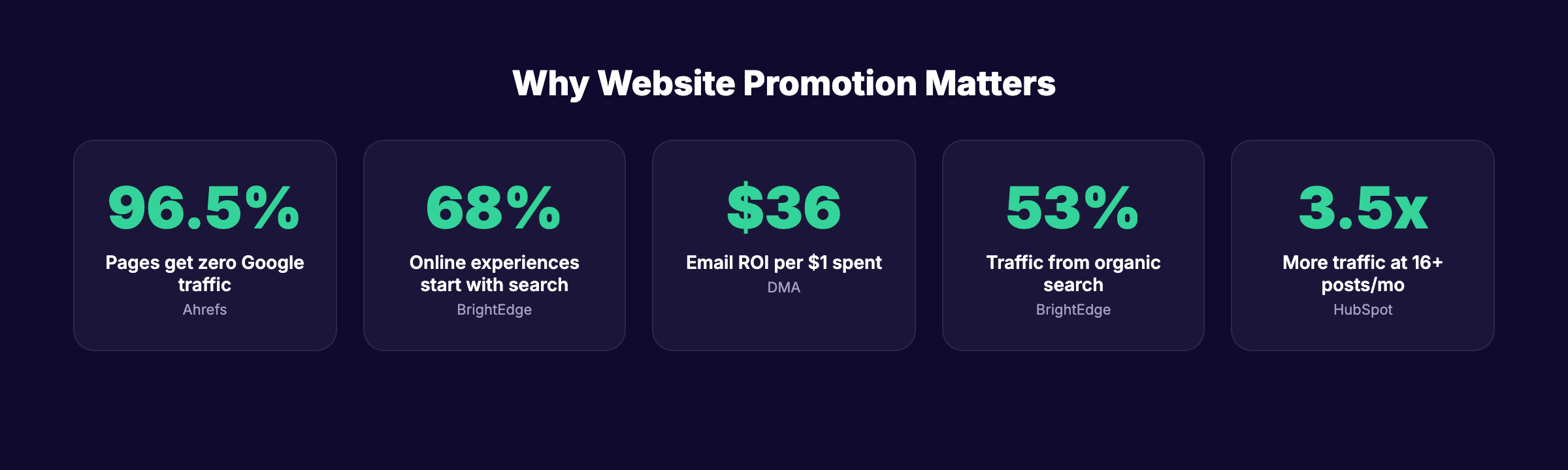
96.55% of all web pages get zero traffic from Google. Your website does not need a redesign. It needs promotion.
We compiled 100 ways to promote your website, organized into 10 categories. Every method here works in 2026. Some are free. Some cost money. All of them drive visitors to your site when executed consistently.
We have published 3,500+ blog posts across 70+ industries. This is every promotion tactic we know, use, or have tested for our clients.
Jump to any category using the list below.
- SEO and Organic Search — 15 ways
- Content Marketing — 12 ways
- Social Media — 12 ways
- Email Marketing — 10 ways
- Local and Maps — 10 ways
- Community and Forums — 8 ways
- Partnerships and Outreach — 10 ways
- Video and Multimedia — 8 ways
- Paid Advertising — 8 ways
- Creative and Unconventional — 7 ways
SEO and Organic Search {#seo}
Organic search drives 53% of all website traffic. These tactics make your site visible to people already searching for what you offer.
1. Target long-tail keywords. Long-tail keywords (3+ words) have lower competition and higher intent. A page targeting “best CRM for real estate agents” converts better than one targeting “CRM.” Use keyword research tools to find them.
2. Optimize title tags for every page. Your title tag is the first thing searchers see. Include your primary keyword in the first 60 characters. Make it specific and benefit-driven. “7 Ways to Cut Energy Bills” beats “Energy Tips.”
3. Write unique meta descriptions. Each page needs a meta description between 145 and 155 characters. Include the target keyword, a benefit, and a reason to click. Google uses these as SERP snippets 63% of the time.
4. Fix your internal linking structure. Link related pages to each other using descriptive anchor text. Internal links help Google discover pages and distribute authority. Aim for 3 to 5 internal links per 1,000 words.
5. Build backlinks through outreach. Backlinks remain the strongest off-page SEO signal. Email website owners with a genuine reason to link: a better resource, updated data, or a broken link replacement.
6. Optimize images with alt text. Every image should have descriptive alt text that includes relevant keywords naturally. This helps Google Images send traffic and improves accessibility.
7. Submit an XML sitemap to Google Search Console. A sitemap tells Google every page on your site. Submit it through Search Console and check for indexing errors monthly.
8. Improve page speed. Pages that load in under 3 seconds keep visitors. Every additional second increases bounce rate by 32%. Compress images, enable caching, and minimize JavaScript.
9. Earn featured snippets. Structure content to answer specific questions in 40 to 60 words. Use tables, numbered lists, and clear headings. Featured snippets appear above position 1 and capture 8% of clicks.
10. Optimize for on-page SEO. Place your keyword in the title, first 100 words, at least one H2, meta description, and image alt text. Follow a proven blog post structure.
11. Target People Also Ask questions. Google shows “People Also Ask” boxes for most queries. Create content that directly answers these questions. Structure answers under H2 or H3 headings with concise 2 to 3 sentence responses.
12. Fix broken links and 404 errors. Broken links waste crawl budget and frustrate users. Run a monthly crawl with Screaming Frog or Ahrefs Site Audit. Redirect broken URLs to relevant pages.
13. Add structured data markup. Schema markup helps Google understand your content type. Add Article, FAQ, HowTo, or Product schema. Pages with structured data earn rich results that increase click-through rates.
14. Create content clusters. Group related content around a pillar page. A content cluster signals topical authority to Google. Link every supporting article to the pillar and to each other.
15. Run a quarterly SEO audit. Check indexing status, keyword rankings, Core Web Vitals, and backlink profile every 3 months. Fix issues before they compound into traffic losses.
Your SEO team. $99 per month. 30 optimized articles, published automatically. Start for $1 →
Content Marketing {#content}
Content is the fuel that powers every other promotion channel. Every blog post, guide, and resource you create becomes a permanent traffic asset.
16. Publish blog posts consistently. Companies publishing 16+ posts per month see 3.5x more traffic, according to HubSpot research. Aim for 8 to 12 per month minimum.
17. Create the definitive guide for your topic. One 4,000+ word guide that covers a topic better than anything else on page 1 earns backlinks and rankings for years. Go deeper than competitors.
18. Write listicles with genuine depth. Lists attract clicks and shares. But each item needs 30 to 60 words of actionable insight. “100 Ways to Promote Your Website” only works if every item teaches something.
19. Publish original research or data studies. Run a survey. Analyze your own data. Original statistics earn backlinks naturally because journalists and bloggers cite them. Even a sample size of 100 produces quotable findings.
20. Create free tools or calculators. A free SEO audit tool, ROI calculator, or headline analyzer drives traffic and earns links. Interactive tools get shared more than static content.
21. Build a resource library. Templates, checklists, swipe files, and frameworks. Package them as downloadable resources. Gate them behind email opt-in forms to build your list simultaneously.
22. Write comparison posts. “[Tool A] vs [Tool B]” posts capture commercial search intent. Buyers search for comparisons before purchasing. Be fair and factual.
23. Publish case studies with real numbers. “How [Client] Increased Traffic by 340% in 6 Months” outperforms generic advice. Real results build trust and attract prospects in similar situations.
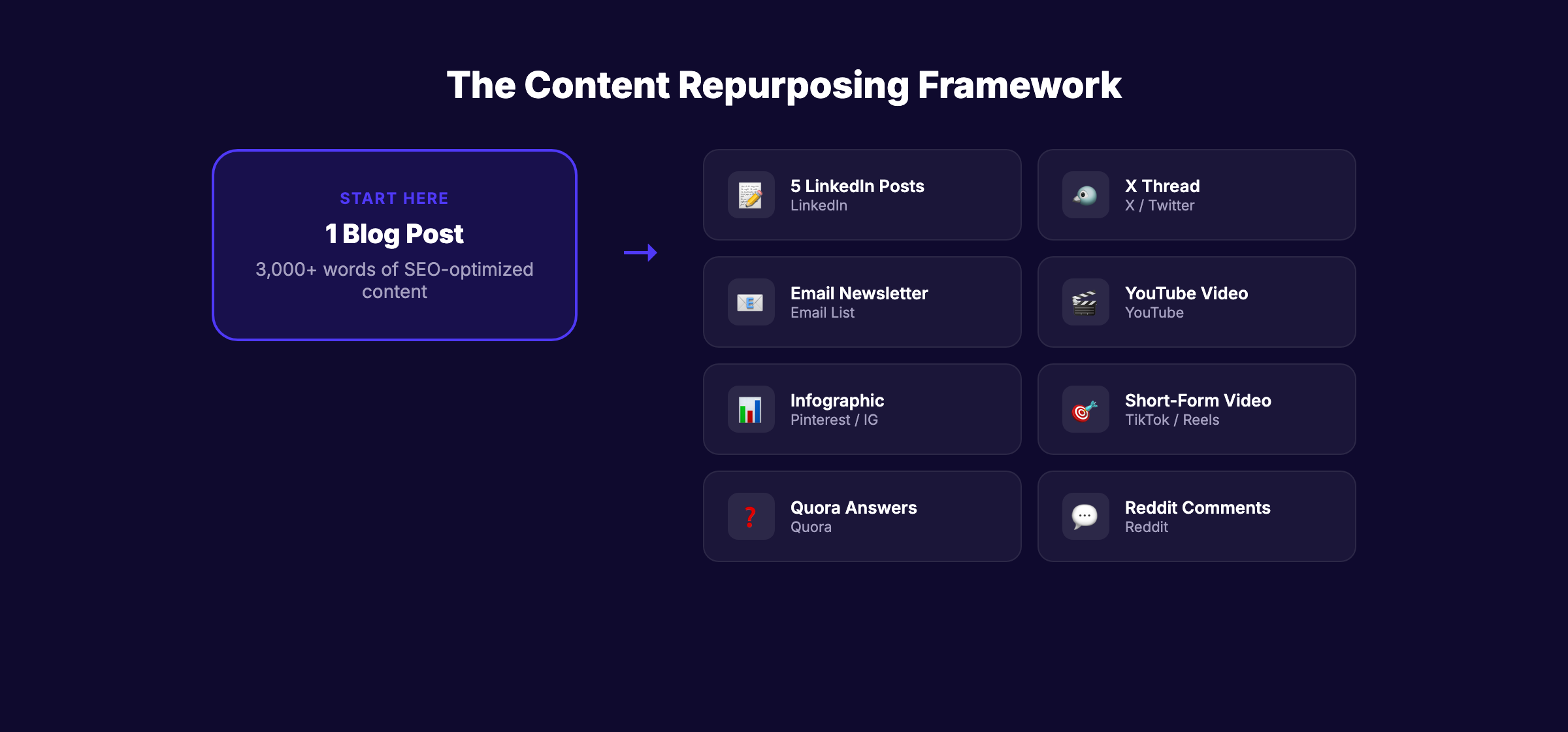
24. Repurpose top-performing content. Take your highest-traffic blog post and turn it into a video, infographic, podcast episode, and 5 social posts. One piece of content feeds 7+ channels.
25. Update and refresh old content. Content decays. Update statistics, add new sections, and refresh examples every 6 to 12 months. Google rewards freshness. Refreshed posts often regain lost rankings within weeks.
26. Answer Quora questions with links to your content. Find questions related to your expertise. Write detailed 200+ word answers. Link to your relevant blog post as a deeper resource.
27. Create an annual trends or statistics post. “[Your Industry] Statistics 2026” posts earn backlinks all year. Update them annually. They become the go-to citation source for writers in your space.
Social Media {#social}
Social media does not replace SEO. But it amplifies content reach, builds brand recognition, and sends referral traffic while organic rankings build.
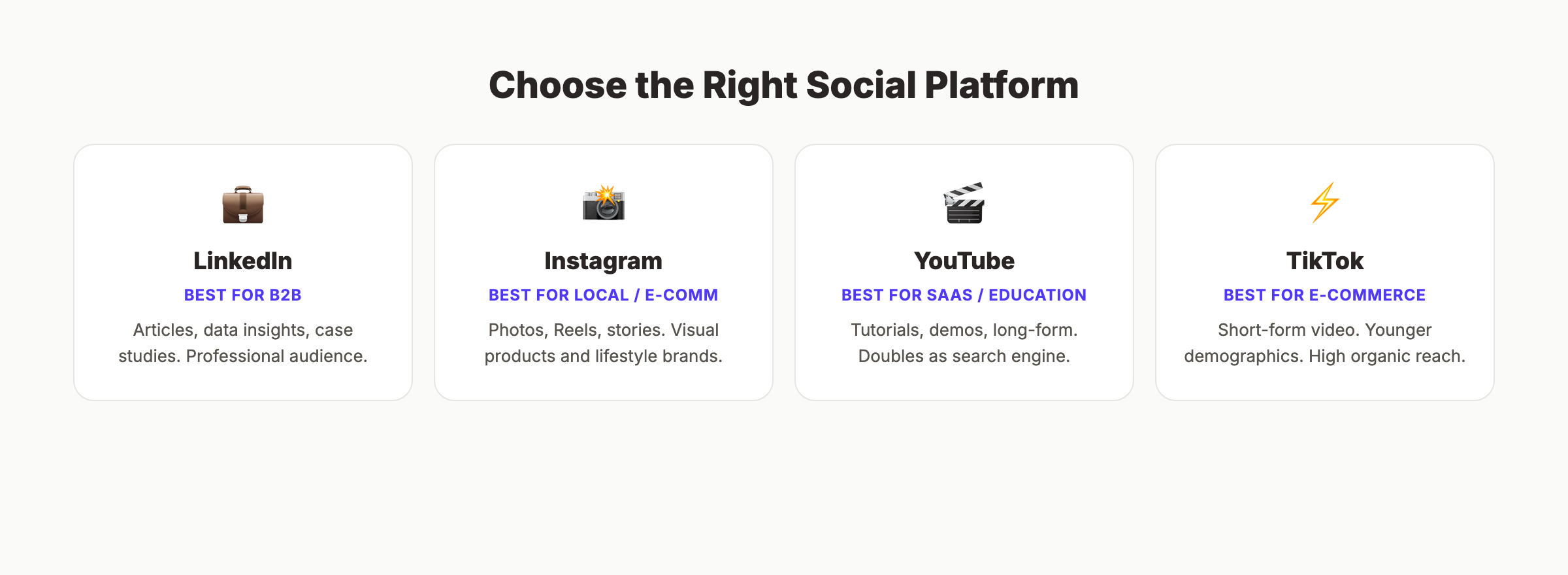
28. Pick 1 to 2 platforms and go deep. Do not spread thin across 6 platforms. Choose where your audience spends time. B2B: LinkedIn. Local: Facebook and Instagram. E-commerce: Instagram and TikTok. Read our social media marketing guide for local businesses.
29. Share every blog post on social. Every new article gets a social post linking back to your site. Write a hook that makes people want the full version.
30. Post LinkedIn articles and carousels. LinkedIn organic reach is higher than any other B2B platform. Long-form posts and document carousels earn hundreds of impressions without spending a cent.
31. Create Instagram Reels from blog content. Take 3 key tips from a blog post and record a 30-second Reel. Add text overlays. Link to the full post in your bio.
32. Pin your best content on Pinterest. Pinterest is a visual search engine with a long content lifespan. Infographics and list posts perform well. Each pin links back to your page.
33. Start an X (Twitter) thread series. Turn data points and frameworks from your blog into threaded posts. Threads earn 10x the engagement of single tweets. End with a link to the full article.
34. Join and post in Facebook Groups. Find groups where your audience hangs out. Contribute valuable advice. When relevant, link to your content. Do not spam. Build reputation first.
35. Create a social media calendar. Plan 4 weeks of posts in advance. Mix content types: blog links, tips, questions, behind-the-scenes, and user stories. Consistency beats virality.
36. Use social proof in posts. Share screenshots of results, testimonials, and metrics. “We published 30 articles this month. Organic traffic up 47%.” Numbers stop the scroll.
37. Cross-promote across platforms. Share your YouTube video on LinkedIn. Post your Instagram Reel to TikTok. Turn a LinkedIn article into a blog post. Each platform feeds the others.
38. Engage in comments on others’ posts. Comment on posts from industry leaders and potential clients. Insightful comments put your name and profile link in front of their entire audience.
39. Run social media polls and questions. Polls generate 2 to 3x more engagement than standard posts. Use poll results as data for a blog post. Then share the blog post back to social.
Stop writing. Start ranking. Stacc publishes 30 SEO articles per month for your business, on autopilot. Start for $1 →
Email Marketing {#email}
Email returns $36 for every $1 spent. No algorithm changes. No pay-to-play. Direct access to people who want to hear from you.
40. Add email opt-in forms to every page. Header, sidebar, footer, and within blog content. The more visible the form, the faster your list grows. A visitor who leaves without subscribing is a visitor lost.
41. Create a lead magnet. Offer a free checklist, template, guide, or tool in exchange for an email address. Lead magnets convert 3 to 5x better than “subscribe to our newsletter.”
42. Set up a welcome email sequence. New subscribers get 3 to 5 emails over their first week. Introduce your best content, your story, and a clear next step. This drives repeat visits.
43. Send a weekly newsletter. Share your latest blog post, a quick tip, and one resource recommendation. Consistent weekly emails keep your site top of mind.
44. Segment your list by interest. Send SEO content to people who signed up for SEO resources. Send local marketing content to local business owners. Segmented emails get 14% higher open rates.
45. Use exit-intent popups. These trigger when a visitor moves to leave your site. They capture 2 to 4% of abandoning visitors without interrupting the reading experience.
46. Run a re-engagement campaign. Subscribers who have not opened in 90 days get a “still interested?” email. Re-engage or remove them. Clean lists deliver higher open rates and better deliverability.
47. Include social sharing buttons in emails. Let subscribers forward your newsletter or share it on social. One share from a subscriber reaches their entire network at zero cost.
48. A/B test subject lines. Small changes in subject lines produce 10 to 30% swings in open rate. Test one variable at a time: length, personalization, urgency, or question vs. statement.
49. Promote content upgrades within blog posts. A blog post about SEO includes a downloadable SEO checklist. A post about email marketing includes email templates. Contextual offers convert at 5 to 15%.
Local and Maps {#local}
46% of all Google searches have local intent. If you serve customers in a specific area, these tactics put you in front of people searching nearby.
50. Claim and optimize your Google Business Profile. Fill out every field. Add photos, services, products, and a keyword-rich description. Incomplete profiles lose to competitors who finish theirs.
51. Post to GBP weekly. Share updates, offers, and blog content directly on your Google Business Profile. Active profiles appear more often in the local pack.
52. Get more Google reviews. Ask every satisfied customer. Send a direct link to your review page. Businesses with 50+ reviews rank higher in Maps than those with 10.
53. Respond to every review. Google confirms that responding to reviews improves local ranking. Thank positive reviewers. Address negative ones professionally.
54. Build local citations. List your business in Yelp, Bing Places, Apple Business Connect, and industry-specific directories. Ensure NAP consistency across all listings.
55. Choose the right GBP categories. Your primary category is the strongest ranking signal. Pick the most specific one. Add 3 to 5 relevant secondary categories.
56. Add photos and videos to GBP monthly. Businesses with 100+ photos get 520% more calls than average. Upload team photos, interior shots, product images, and short videos.
57. Optimize for Google Maps rankings. Proximity, relevance, and prominence determine Maps rankings. You cannot control proximity. You can control relevance (categories, keywords) and prominence (reviews, citations, links).
58. Create location-specific landing pages. If you serve multiple cities, create a page for each. “Plumber in Austin” targets different searches than “Plumber in Dallas.” Each page needs unique content.
59. Get listed on Nextdoor. Nextdoor reaches local homeowners directly. Claim your business page and engage in neighborhood discussions. Read our Nextdoor for business guide.
3,500+ blogs published. 92% average SEO score. See what Stacc can do for your site. Start for $1 →
Community and Forums {#community}
Online communities are where your audience asks questions, shares problems, and looks for recommendations. Show up with value and they come to your site.
60. Answer questions on Reddit. Find subreddits where your audience hangs out. Provide genuinely helpful answers. Link to your content only when it adds real value. Reddit sends targeted referral traffic.
61. Participate in industry Slack groups. Many industries have active Slack communities. Join 2 to 3. Share insights and resources. Become the person people think of when a topic comes up.
62. Contribute to niche forums. Industry-specific forums still exist and drive traffic. HVAC-Talk for HVAC professionals. BiggerPockets for real estate investors. Find yours.
63. Comment on industry blogs. Leave thoughtful comments on popular blogs in your space. Insightful comments with your name and URL reach the blog’s entire audience.
64. Host or join Twitter/X Spaces. Live audio discussions attract engaged audiences. Host a weekly conversation on a topic your audience cares about. Pin your website link in your profile.
65. Start a Discord or community server. Build your own community. Share exclusive content, early access, and direct interaction. Members become your most loyal visitors and evangelists.
66. Write detailed Product Hunt reviews. If you serve tech or SaaS audiences, review relevant products on Product Hunt. Your profile links back to your site.
67. Contribute to GitHub discussions. For technical audiences, GitHub discussions and README contributions put your name and links in front of developers. Open-source contributions earn respect and referral traffic.
Partnerships and Outreach {#partnerships}
Other people’s audiences are the fastest way to reach new visitors. Partnerships multiply your reach without multiplying your budget.
68. Write guest posts on high-authority blogs. One guest post on a DA 60+ site sends referral traffic and passes link equity. Pitch original angles. Write better content than the host site normally publishes.
69. Get featured on podcasts. Pitch yourself as a guest on podcasts your audience listens to. Every episode includes your name and website in the show notes. Prepare 3 clear talking points.
70. Launch an affiliate program. Let bloggers, reviewers, and creators earn commission for sending you customers. You only pay for results. Affiliate traffic is pre-qualified by the referrer’s endorsement.
71. Create a referral program for customers. Give existing customers a unique link and reward both parties. A 10% discount or account credit motivates sharing. Word of mouth at scale.
72. Collaborate on co-branded content. Partner with a complementary business on a joint guide, webinar, or resource. Both businesses promote to their full audience. Traffic doubles.
73. Do expert roundup contributions. When bloggers compile “X experts share their tips” posts, participate. Your name, bio, and website appear alongside industry authorities.
74. Use HARO and journalist outreach. Help A Reporter Out connects you with journalists seeking sources. One quote in a Forbes or Inc. article earns a high-authority backlink and brand exposure.
75. Get listed in curated resource lists. Find “best [your category] resources” posts. Email the author and make a case for inclusion. These pages send steady referral traffic.
76. Run a co-marketing webinar. Partner with a non-competing business that shares your audience. Each business promotes the webinar. Attendees discover both sites.
77. Sponsor a newsletter in your niche. Newsletter sponsorships cost $50 to $500 for niche audiences. A single placement in the right newsletter sends hundreds of targeted visitors to your landing page.
Rank everywhere. Do nothing. Blog SEO, Local SEO, and Social on autopilot. Start for $1 →
Video and Multimedia {#video}
Video is the most consumed content format online. YouTube is the second-largest search engine. Short-form video reaches audiences that never search Google.
78. Start a YouTube channel. Publish 1 to 2 videos per week. Optimize titles and descriptions for search. Include your website link in every description and pin a comment linking to related blog content.
79. Create YouTube Shorts from blog content. Pull 1 tip from a blog post. Record a 30 to 60 second vertical video. Shorts get pushed to new audiences through YouTube’s algorithm.
80. Record podcast episodes. A podcast builds a loyal audience that visits your site for show notes, resources, and related articles. Publish consistently and distribute across Apple, Spotify, and YouTube.
81. Build infographics from data. Turn statistics and frameworks into visual infographics. Share them on Pinterest, LinkedIn, and in blog posts. Infographics earn 3x more shares than other content formats.
82. Create slide decks and share on SlideShare. Turn presentations into SlideShare uploads. Each slide deck includes your URL. SlideShare content ranks in Google and reaches a professional audience.
83. Host live webinars. Teach something valuable. Promote the registration page across all channels. Record the webinar and repurpose it as an on-demand resource, blog post, and social clips.
84. Embed videos in blog posts. Blog posts with embedded video increase average time on page by 88%. Longer dwell time signals quality to Google and improves rankings.
85. Create GIFs and short animations. Quick visual demonstrations of your product or service are shareable and attention-grabbing. Use them in emails, social posts, and blog content.
Paid Advertising {#paid}
Paid channels deliver traffic immediately. Use them to fill the gap while organic channels build, test new keywords, and scale what already works.
86. Run Google Search ads. Appear at the top of Google for any keyword you choose. Start with $20 to $50 per day. Send traffic to dedicated landing pages, not your homepage.
87. Set up retargeting campaigns. Show ads to people who already visited your website. Retargeting ads convert 10x higher than cold traffic. Install a pixel from Google and Meta on your site.
88. Test Facebook and Instagram ads. Target by demographics, interests, and behavior. Start with a lookalike audience based on your existing customers. Video ads typically outperform static images.
89. Run LinkedIn ads for B2B. LinkedIn lets you target by job title, company size, and industry. Higher CPCs ($5 to $12) but higher-quality leads for B2B services and SaaS.
90. Use Google Display Network for awareness. Banner ads across millions of websites build brand recognition at low CPCs ($0.50 to $2). Best for retargeting and top-of-funnel awareness.
91. Sponsor relevant newsletters. Many niche newsletters accept sponsors. A $100 to $500 placement reaches 5,000 to 50,000 targeted subscribers. Track clicks with UTM parameters.
92. Advertise on Reddit. Reddit ads let you target specific subreddits where your audience already engages. CPCs are lower than Google or LinkedIn. Native-format ads blend with organic content.
93. Test TikTok ads for e-commerce. TikTok’s ad platform reaches younger demographics with video-first creative. Product demonstration videos convert well. Start with $50 per day and test.
Creative and Unconventional {#creative}
These methods go beyond standard channels. They work because most competitors never try them.
94. Optimize for AI search engines. ChatGPT, Perplexity, and Google AI Overviews cite web content in their responses. Structure answers for extraction. Build topical authority. Read our guide on getting cited in AI search.
95. Create an AI Overview optimization strategy. Google AI Overviews pull from pages ranking in the top 10. Ranking well in traditional search directly feeds AI visibility.
96. Get your brand mentioned on Reddit and forums. AI models heavily cite Reddit. Semrush data shows Reddit has a 40% citation frequency across major AI language models. Genuine community presence builds visibility in both search and AI.
97. Submit to startup and product directories. Product Hunt, Crunchbase, G2, Capterra, and AppSumo drive targeted traffic and build backlinks. Launch day on Product Hunt alone can send thousands of visitors.
98. Offer free workshops or training. Host a free 30-minute training session. Promote the signup page everywhere. Attendees become email subscribers and warm leads who know your site.
99. Create a Chrome extension or free tool. A simple browser extension related to your niche puts your brand in front of users daily. Link back to your site from the extension’s settings page and Chrome Web Store listing.
100. Get featured in “best of” roundup articles. Search Google for “best [your category]” and “top [your niche] companies.” Email the authors of these articles. Make a clear case for inclusion with stats and differentiation.
Your 90-Day Website Promotion Plan
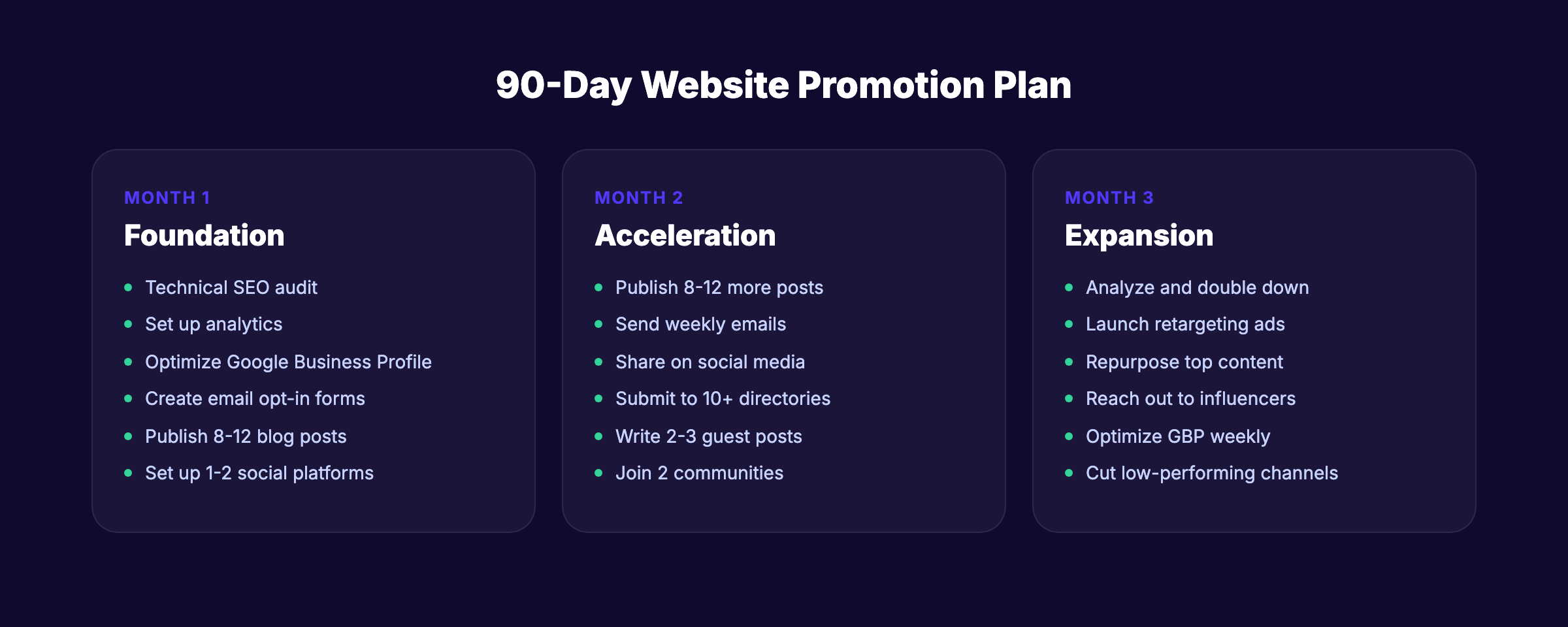
Do not try all 100 methods at once. Use this phased plan.
Month 1: Foundation (Week 1 to 4)
- Run a technical SEO audit and fix all issues
- Set up Google Search Console and Google Analytics
- Claim and optimize your Google Business Profile
- Create email opt-in forms and a lead magnet
- Publish 8 to 12 SEO-optimized blog posts
- Set up 1 to 2 social media accounts
- Submit your site to 10+ directories
Month 2: Acceleration (Week 5 to 8)
- Publish 8 to 12 more blog posts (target 20+ total)
- Send weekly emails to your growing list
- Share every blog post on social media
- Write 2 to 3 guest posts with backlinks
- Start participating in 2 online communities
- Repurpose top content into video and social formats
Month 3: Expansion (Week 9 to 12)
- Analyze top-performing content and double down
- Launch retargeting ads for website visitors
- Reach out to 3 to 5 micro-influencers or podcast hosts
- Review all channels and cut what does not convert
- Update and refresh your best-performing posts
- Plan the next quarter based on what works
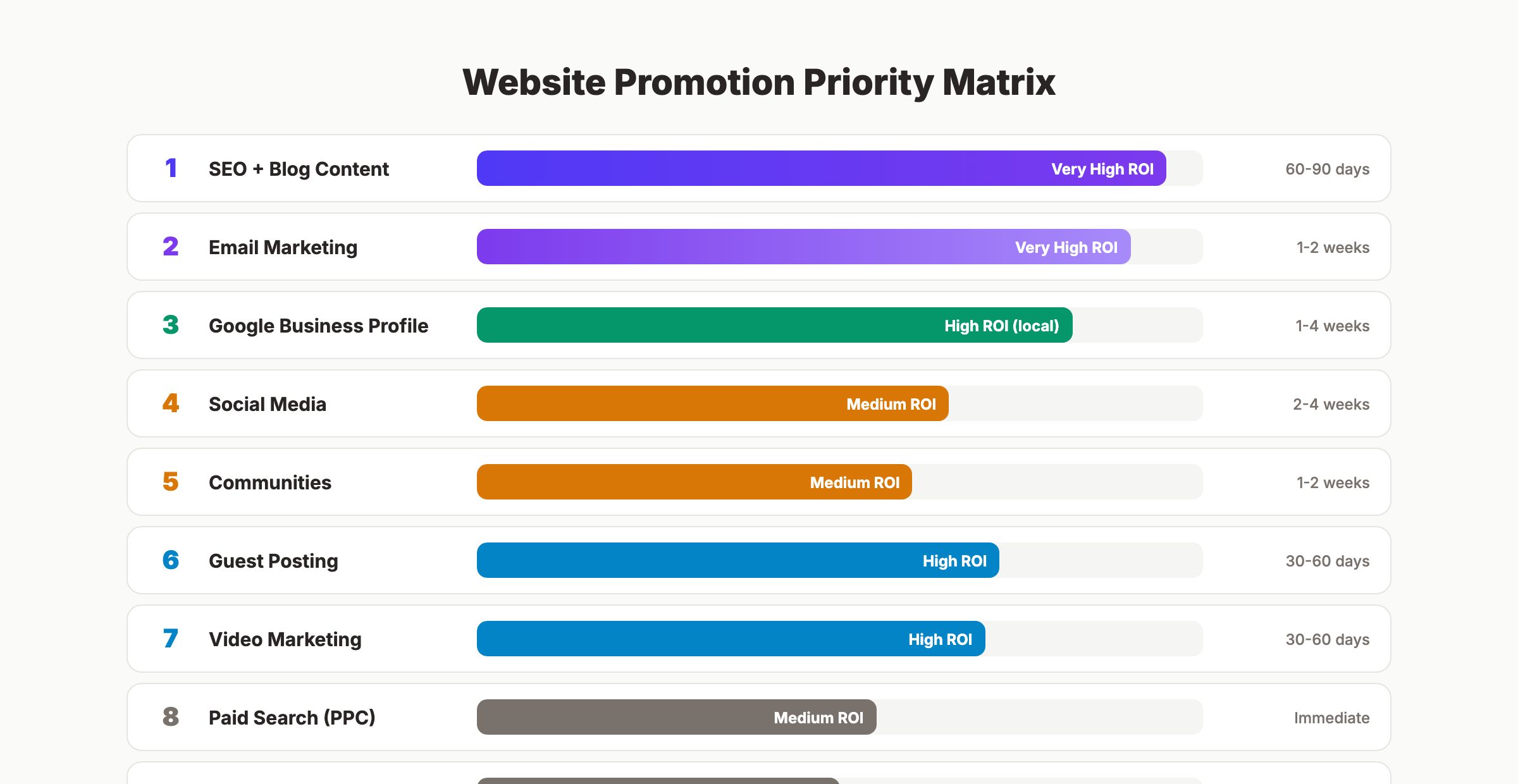
By month 3, you will have multiple traffic sources compounding. SEO builds the foundation. Email creates direct access. Social amplifies reach. Paid channels accelerate growth.
Skip the agency. Keep the results. Stacc starts at $99 per month with a $1 trial. Start for $1 →
FAQ
How long does it take to see results from website promotion?
Paid channels (PPC, paid social) deliver traffic within hours. SEO and content marketing take 60 to 90 days for initial ranking movement. Email marketing drives results within 1 to 2 weeks. The best strategy combines quick wins from paid channels with long-term organic growth from SEO and content.
What is the cheapest way to promote a website?
SEO, content marketing, email, social media, and community participation are free or near-free. The investment is time. Publishing blog posts costs nothing but drives traffic for years. Services like Stacc publish 30 SEO articles per month starting at $99, which is 70 to 90% cheaper than hiring an agency.
How many of these methods should I use at once?
Start with 3 to 5. Master SEO, email, and one social platform first. Add new channels only after the first ones are producing consistent results. Spreading across 10 channels simultaneously means doing all of them poorly.
Do social media posts directly help SEO?
Social links are typically nofollow and do not directly boost rankings. Social media helps indirectly by driving traffic, increasing brand searches, and generating content that others link to. A viral post can earn backlinks from journalists and bloggers.
Should I focus on free or paid promotion first?
Start with free methods (SEO, content, social, communities) to build a foundation. Add paid channels when you know which keywords convert and which audiences respond. Paid amplifies what already works. It cannot fix what does not.
How do I know which promotion channels are working?
Set up Google Analytics and track traffic by source. Use UTM parameters for email and social. Monitor Google Search Console for organic performance. Review weekly. Cut channels that deliver nothing after 60 days. Double investment in channels that convert.
Did we miss a method? This list gets updated regularly. The businesses that grow fastest are not the ones using the most channels. They are the ones that pick 3 to 5, execute consistently, and measure everything.
Start today. The traffic you build this quarter compounds into next year’s revenue.
Written and published by Stacc. We publish 3,500+ articles per month across 70+ industries. All data verified against public sources as of March 2026.
