
Welcome Email Sequence: 8 Steps to Build One
Build a welcome email sequence that converts. 8 steps, real examples, and proven timing. Welcome emails earn 86% open rates.
Most businesses collect email addresses and then do nothing with them for days. That silence costs real money. New subscribers are most engaged in the first 60 minutes after signing up. Every hour you wait, open rates drop.
A welcome email sequence fixes this problem permanently. It turns passive signups into engaged readers, qualified leads, and paying customers on autopilot.
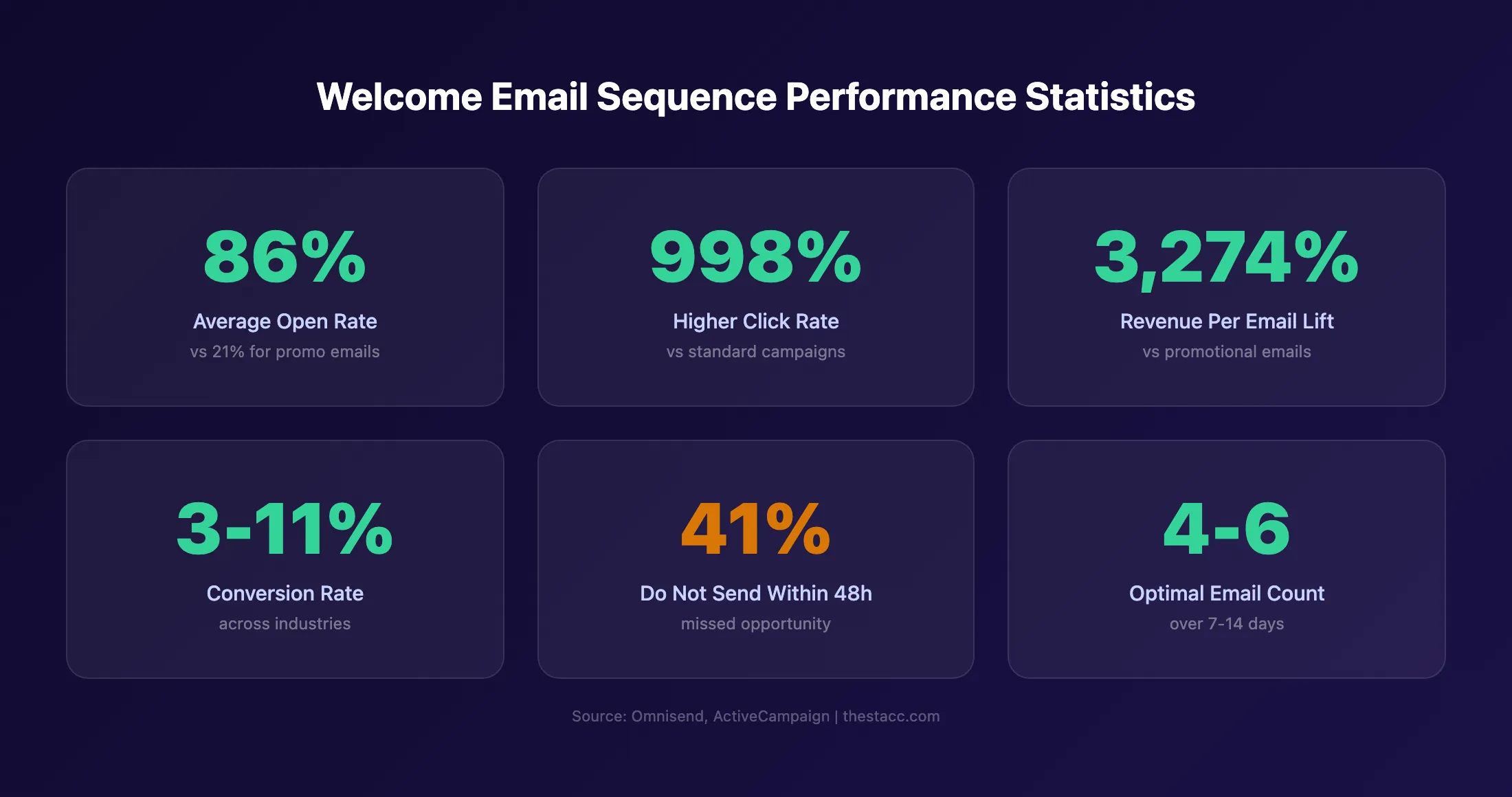
We publish 3,500+ blogs across 70+ industries and have seen firsthand how email and content work together to drive growth. The data backs it up. Welcome emails earn an average 86% open rate, according to Omnisend research. That is 4 times higher than standard promotional emails.
Here is what you will learn in this guide:
- What a welcome email sequence is and why it matters
- How to structure an 8-step welcome email flow from scratch
- What to include in each email (with formulas and examples)
- How to set timing, automation triggers, and performance benchmarks
- Common mistakes that kill welcome sequence performance
What Is a Welcome Email Sequence?
A welcome email sequence is a series of automated emails sent to new subscribers after they join your list. Most effective sequences contain 4 to 6 emails spread over 7 to 14 days.
The goal is simple. Move a stranger from “I just signed up” to “I trust this brand and want to buy.”
Each email in the sequence has a specific job. The first email confirms the subscription and sets expectations. The middle emails build trust through stories, education, and social proof. The final email presents a clear offer or call to action.
Think of it as a guided onboarding experience. A new subscriber does not know your best content, your origin story, or your strongest products. The welcome sequence introduces all of that in a logical, pressure-free order.
| Element | Single Welcome Email | Welcome Email Sequence |
|---|---|---|
| Emails sent | 1 | 4-6 |
| Timeline | Immediate | 7-14 days |
| Trust building | Minimal | Gradual |
| Conversion rate | 1-2% | 3-11% |
| Revenue per email | Baseline | 3,274% higher |
| Subscriber retention | Low | High |
A single welcome email gets the job done. A welcome email sequence gets results. The difference in email marketing ROI is dramatic.
Why this matters: Brands that skip the welcome sequence lose their highest-engagement window. Subscribers who do not hear from you within 48 hours are 41% less likely to open future emails.
Why Welcome Email Sequences Convert Better Than Any Other Email
The numbers tell a clear story.
Welcome emails generate a 998% higher click rate than promotional campaigns, according to Omnisend data. The average conversion rate for a welcome series sits at 3% to 11%, depending on industry and offer strength.
Here is why the performance gap is so wide.
Timing matches intent. Someone who just subscribed actively chose to hear from you. That decision is fresh. Their attention is available right now, not next Tuesday.
Frequency builds familiarity. One email introduces your brand. Five emails make subscribers feel like they know you. That familiarity drives trust, and trust drives purchases.
Automation removes human error. A welcome sequence runs 24 hours a day, 7 days a week. No one forgets to send it. No one delays it. Every subscriber gets the same experience regardless of when they sign up.
The data from email marketing statistics confirms that automated sequences outperform manual campaigns across every metric. Open rates, click rates, and revenue per email are all higher.
Graham Cochrane, a creator and entrepreneur, increased revenue 89% by moving his pitch earlier in his welcome sequence. That single change, moving from email 6 to email 4, produced a measurable revenue increase with zero additional subscribers.
For content marketing strategy to work, you need a system that captures and converts the attention your content generates. A welcome email sequence is that system.
Step 1: Define Your Sequence Goals and Map the Flow
Every effective welcome email sequence starts with a plan. Do not open your email platform and start writing. Define the destination first.
Specifically:
- Decide on your primary conversion goal (purchase, booking, free trial, or content engagement)
- Choose the number of emails (5 is the sweet spot for most businesses)
- Map the emotional arc from introduction to conversion
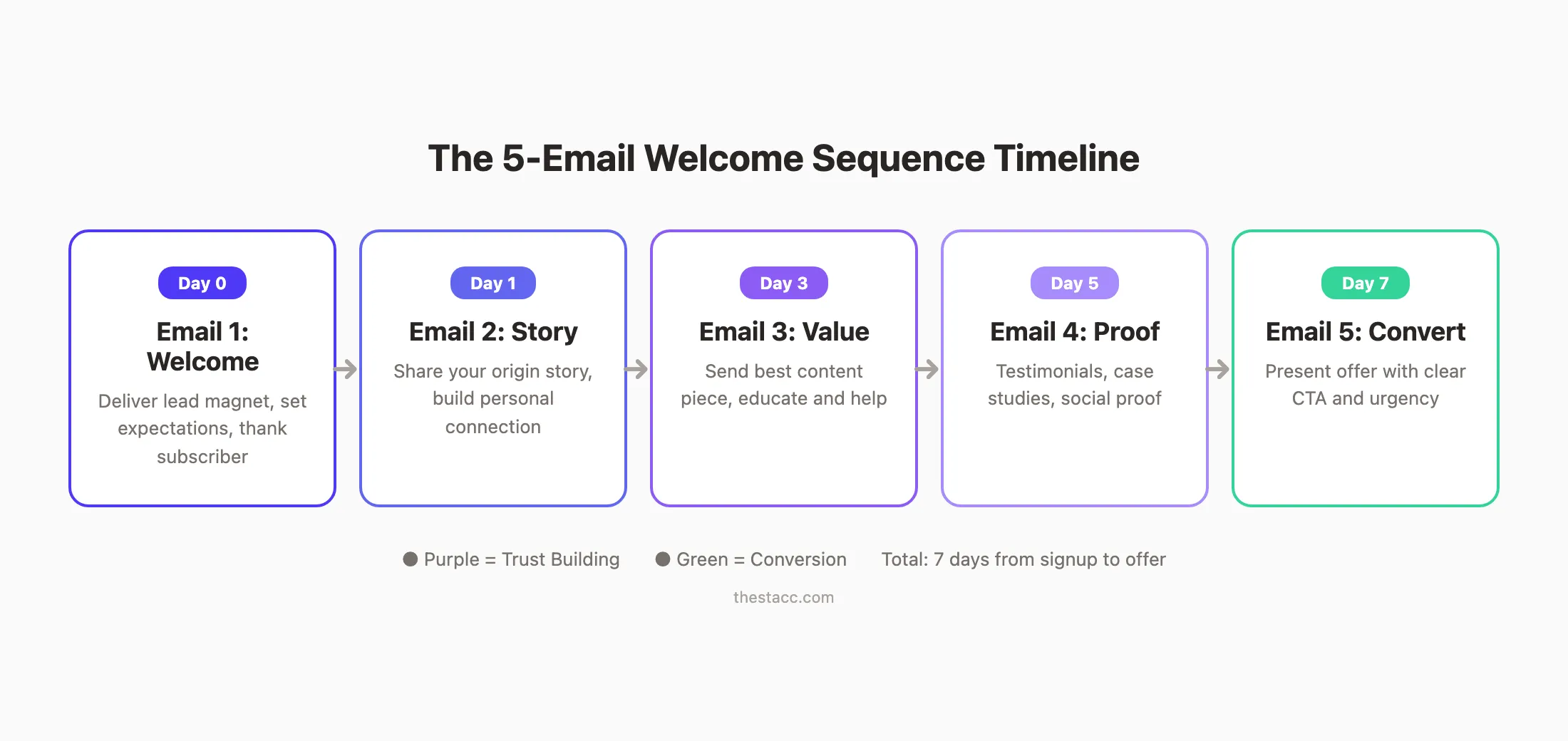
Here is a proven 5-email framework that works across industries:
| Day | Purpose | Emotional State | |
|---|---|---|---|
| Email 1 | Day 0 | Welcome + deliver lead magnet | Excited, curious |
| Email 2 | Day 1 | Share your story | Interested, connecting |
| Email 3 | Day 3 | Educate with best content | Engaged, learning |
| Email 4 | Day 5 | Social proof + credibility | Trusting, convinced |
| Email 5 | Day 7 | Conversion offer | Ready to act |
This framework follows Eugene Schwartz’s stages of awareness. It moves subscribers from problem-aware to solution-aware to product-aware across 7 days.
Why this step matters: Without a clear map, most welcome sequences feel random. Subscribers sense the lack of direction and disengage. Planning the arc first ensures each email builds on the previous one.
Pro tip: Keep a spreadsheet with each email’s subject line, send day, primary goal, and one call to action. This prevents scope creep and keeps the sequence focused. Your content calendar approach should extend to email planning as well.
Step 2: Write Email 1. The Instant Welcome
Email 1 is the most important email in your entire sequence. It sets the tone for everything that follows.
Send it immediately. Not 1 hour later. Not the next morning. The moment someone subscribes, email 1 should land in their inbox. Delays at this stage reduce open rates by up to 50%.
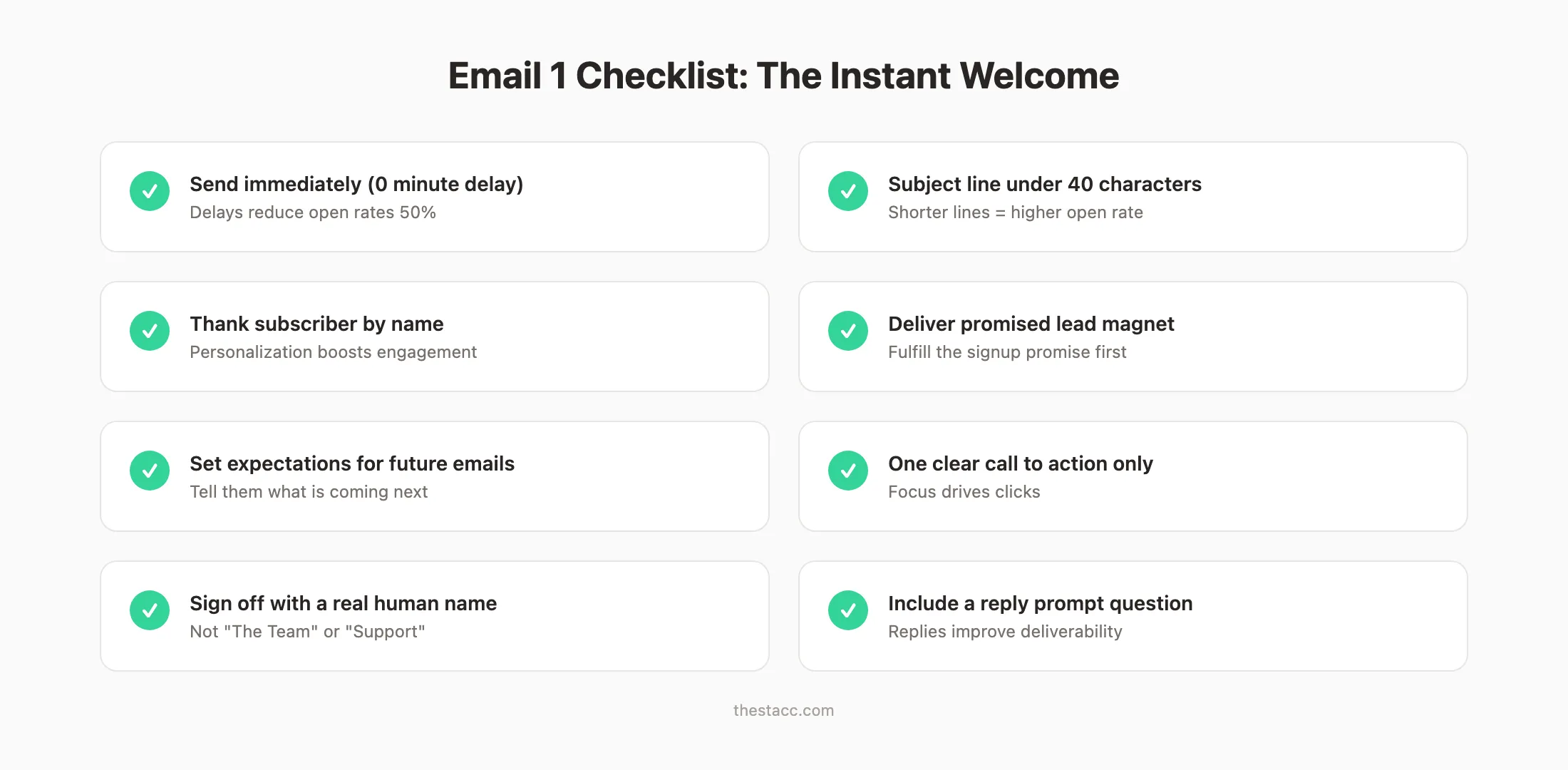
Here is what email 1 must include:
Subject line: Keep it under 40 characters. Use the subscriber’s name if available. Examples:
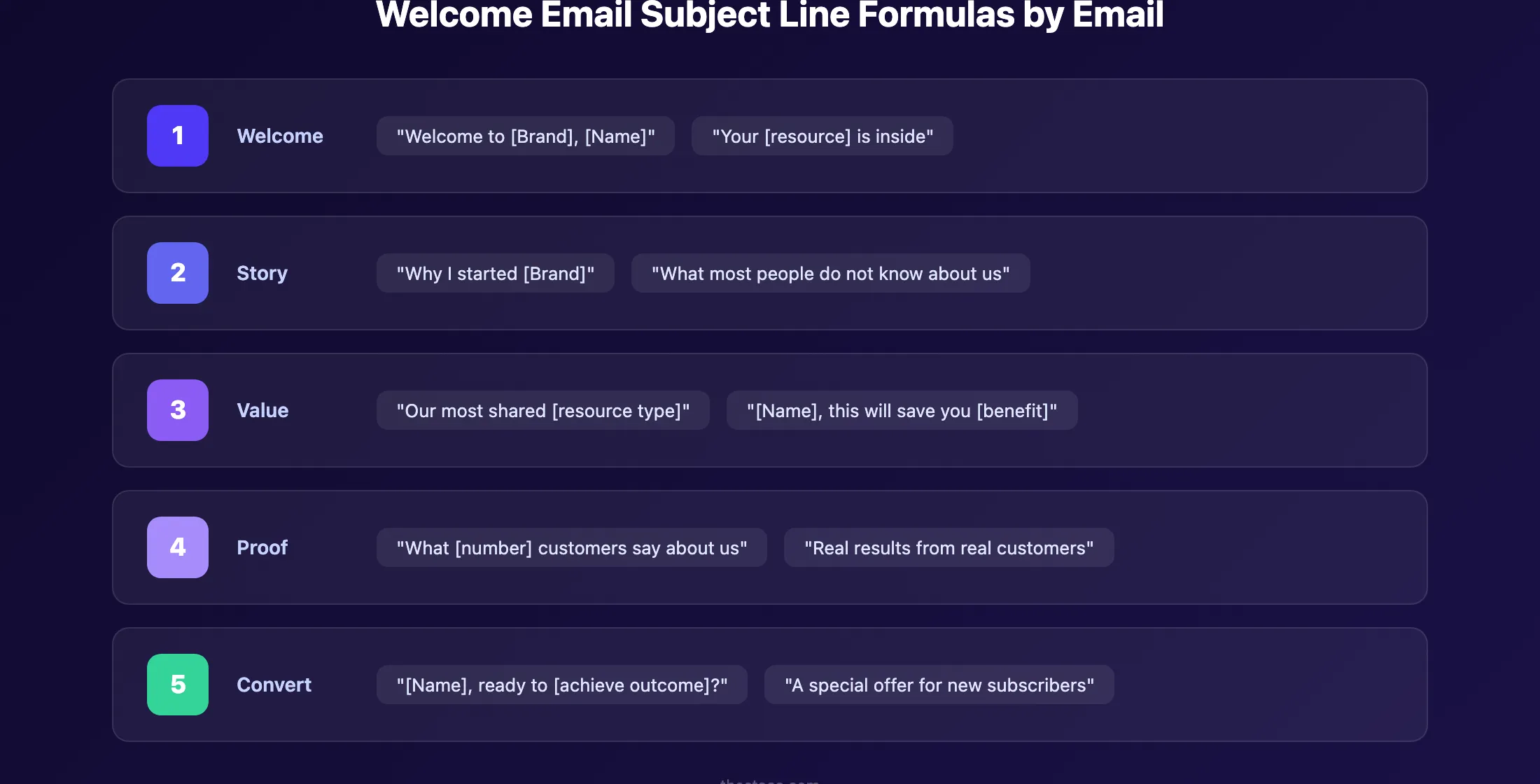
- “Welcome to [Brand], [First Name]”
- “Your [lead magnet] is inside”
- “[First Name], here is what happens next”
Body structure:
- Thank them for subscribing (1-2 sentences)
- Deliver the promised lead magnet or resource
- Set expectations for what emails are coming
- Include 1 clear call to action
- Sign off with a real name, not “The Team”
A strong email 1 template looks like this:
Subject: Welcome to [Brand]. Your [resource] is here
Hi [First Name],
Thank you for joining. Here is the [resource] you requested: [link].
Over the next week, I will send you [number] emails covering [topic]. Each one is short and actionable.
Tomorrow, I will share [preview of email 2 topic].
Talk soon, [Your name]
Why this step matters: Email 1 teaches subscribers to open your emails. A strong first impression creates a pattern. A weak one trains them to ignore you.
For more on writing effective email subject lines, check out our dedicated guide. The subject line alone determines whether 80% of your emails get opened.
Pro tip: Add a reply prompt. Ask one simple question like “What is your biggest challenge with [topic]?” Replies improve deliverability by signaling to email providers that your messages are wanted.
Your email and content strategy should work together. Stacc publishes 30+ blog posts per month that drive subscribers to your list automatically. Start for $1 →
Step 3: Write Email 2. Share Your Story and Build Trust
Email 2 arrives 24 hours after the welcome email. Its job is to make your brand human.
Most businesses skip the story email. They jump straight to selling. That is a mistake. People buy from brands they relate to, not brands that pitch immediately.
Here is the structure for a high-performing story email:
Subject line options:
- “Why I started [brand]”
- “The story behind [brand/product]”
- “What most people do not know about us”
Body framework:
- Open with a relatable problem you faced (2-3 sentences)
- Describe the turning point or “aha” moment
- Connect that story to the subscriber’s situation
- Close with a soft next step (read a blog post, check out a resource)
The story does not need to be dramatic. It needs to be honest. A dentist explaining why they focus on anxious patients is a story. A plumber describing a disaster call that changed how they run their business is a story.
Your content marketing for small business works the same way. Authentic narratives outperform polished corporate messaging every time.
Why this step matters: Story emails have the highest reply rates in most welcome sequences. Replies build a direct relationship and improve your email deliverability score with providers like Gmail and Outlook.
Pro tip: End with a P.S. line. Something like “P.S. Tomorrow I am sending you our most popular [resource type]. Keep an eye out.” This creates anticipation for email 3.
Step 4: Write Email 3. Deliver Value and Educate
Email 3 sends on day 3. This is your value-delivery email. Share the single best piece of content or insight you have.
Do not hold back. The instinct to save your best material for paying customers is wrong. Generosity builds trust faster than any sales tactic.
Here is what works best for email 3:
| Content Type | Best For | Example |
|---|---|---|
| Blog post link | Service businesses | ”Our guide to [solving X]“ |
| Video tutorial | Product businesses | ”Watch: How to set up [feature]“ |
| Checklist or template | Consultants | ”Download: Our [topic] checklist” |
| Case study | B2B companies | ”How [client] achieved [result]“ |
| Quick tips list | All businesses | ”5 ways to [achieve outcome] today” |
Subject line options:
- “Our most shared [resource type]”
- “The [topic] guide 10,000+ people bookmarked”
- “[First Name], this will save you [time/money]”
Body structure:
- Reference a pain point your audience faces
- Introduce your content as the fix
- Give 2-3 bullet points of what they will learn
- Link to the resource
- Tease email 4
If you publish SEO blog posts or educational content, your email 3 can link directly to that material. This drives traffic to your site while also building subscriber trust.
Why this step matters: Email 3 separates the serious subscribers from the casual ones. People who click through and consume your content are 3 to 5 times more likely to convert later.
Pro tip: Track which content gets the most clicks in email 3. Use that data to improve your SEO content writing and create more of what your audience actually wants.
Step 5: Write Email 4. Social Proof and Credibility
Email 4 arrives on day 5. By now, subscribers know who you are and what you teach. This email answers the unspoken question: “Can I trust this brand to deliver results?”
Social proof is the answer.
Here are the most effective types of social proof for email 4:
- Customer testimonials with specific numbers (“We increased traffic 340% in 6 months”)
- Case study summaries with before-and-after results
- Review counts and ratings (“4.8 stars from 2,100+ reviews”)
- Media mentions or awards (“Featured in [publication]”)
- User count or milestones (“Join 15,000+ businesses using [product]”)
Subject line options:
- “What [number] customers say about [brand]”
- “Real results from real [customers/readers]”
- “[Customer name] went from [problem] to [result]”
Body structure:
- Acknowledge that trust takes time (1 sentence)
- Share 2-3 specific testimonials or data points
- Link to a full case study or reviews page
- Transition to tomorrow’s email with a preview
For guidance on creating compelling proof content, see our guide on how to write case studies that convert.
Why this step matters: Social proof reduces perceived risk. A subscriber who has seen 3 positive testimonials is significantly more likely to click “buy” when the offer email arrives.
Turn blog content into a subscriber growth engine. Stacc publishes SEO-optimized articles that bring new subscribers to your list every week. Start for $1 →
Step 6: Write Email 5. The Conversion Email
Email 5 arrives on day 7. This is where you make the ask.
By this point, you have welcomed the subscriber, shared your story, delivered value, and provided proof. The foundation is set. A direct offer now feels natural rather than pushy.
Here is the conversion email framework:
Subject line options:
- “A special offer for new subscribers”
- “[First Name], ready to [achieve outcome]?”
- “Here is your next step”
Body structure:
- Remind them of the problem you solve (1-2 sentences)
- Restate the key benefit of your product or service
- Present the offer with specific details (price, timeline, deliverables)
- Add urgency if genuine (limited spots, trial expiration, bonus deadline)
- Include 1 clear call-to-action button
- Add a P.S. with a testimonial or guarantee
| Conversion Element | Why It Works | Example |
|---|---|---|
| Specific pricing | Removes guessing | ”$99/month for 30 articles” |
| Time-bound offer | Creates urgency | ”Trial ends in 72 hours” |
| Risk reversal | Lowers barrier | ”Cancel anytime. No contracts.” |
| Testimonial in P.S. | Last-second proof | ”P.S. [Name] signed up last week and already…” |
The conversion rate on email 5 depends heavily on emails 1 through 4. If you did the trust-building work, conversion rates of 3% to 11% are realistic.
If you want to understand how to measure content marketing ROI, tracking welcome sequence conversion rates is one of the clearest starting points.
Why this step matters: Without a conversion email, your welcome sequence is just a content series. The whole point is to guide subscribers toward a specific action. Make the ask clear.
Pro tip: Test two versions of the offer email. Send half your subscribers version A (discount-focused) and half version B (value-focused). Track which one produces more revenue, not just more clicks.
Step 7: Set Up Automation and Timing
The best welcome email sequence in the world fails if the automation breaks. This step ensures your emails send reliably, on time, every time.
Choose your automation platform. Every major email tool supports welcome sequences. Mailchimp, Klaviyo, ConvertKit, ActiveCampaign, and Brevo all offer automation builders. Pick the one that fits your budget and list size.
Set the trigger. The automation starts when someone completes a specific action:
- Submits a signup form
- Downloads a lead magnet
- Creates an account
- Makes a first purchase
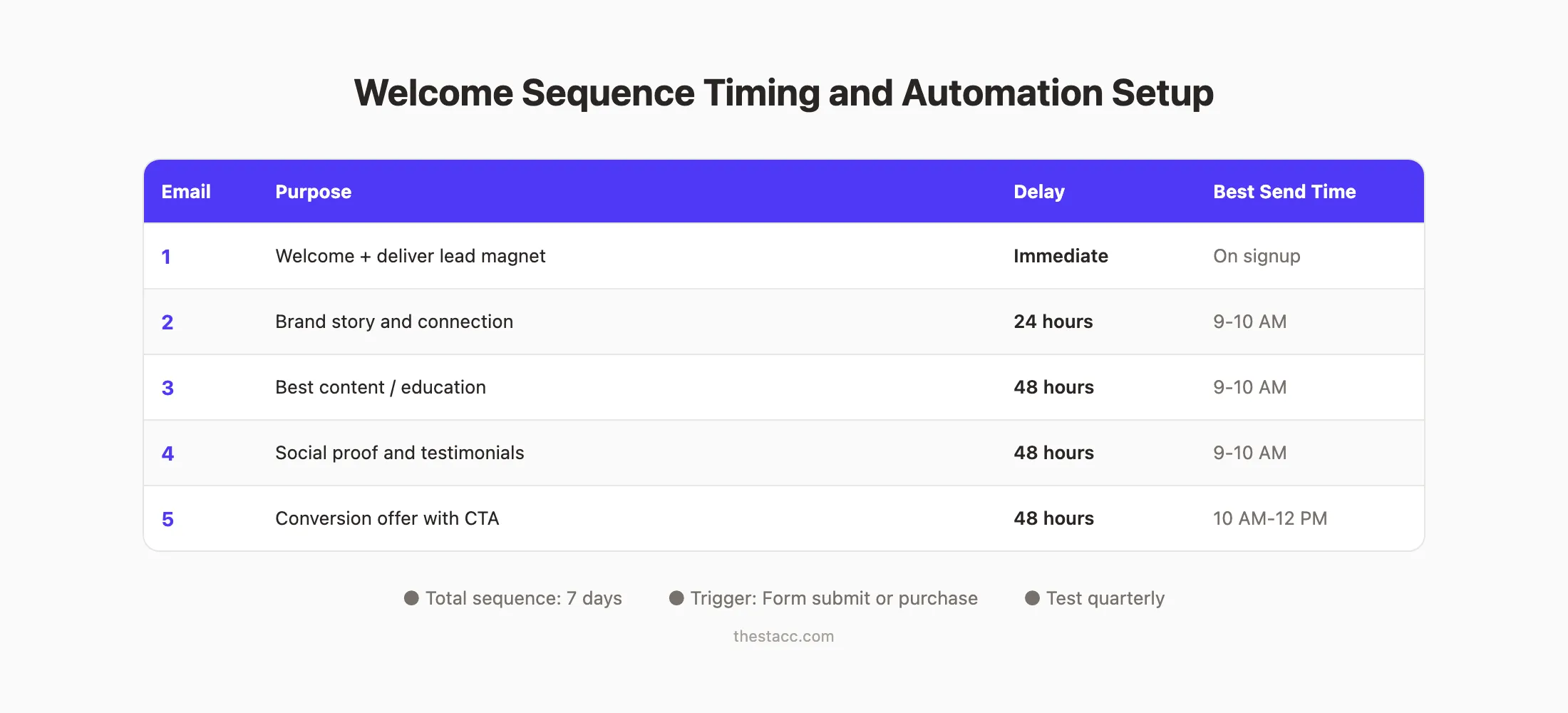
Configure timing between emails:
| Send Delay | Best Time | |
|---|---|---|
| Email 1 | Immediate (0 minutes) | Whenever they sign up |
| Email 2 | 24 hours | 9-10 AM local time |
| Email 3 | 48 hours after email 2 | 9-10 AM local time |
| Email 4 | 48 hours after email 3 | 9-10 AM local time |
| Email 5 | 48 hours after email 4 | 10 AM-12 PM local time |
Test before launching. Subscribe to your own sequence with a personal email. Read every email on mobile and desktop. Click every link. Check for broken images, typos, and formatting issues.
For a deeper dive into automating your marketing workflows, read our email automation guide.
Why this step matters: A single broken link or skipped email destroys the trust you built over the previous 5 days. Automation errors are invisible until a subscriber complains, and most never do. They just leave.
Pro tip: Set a calendar reminder to test your welcome sequence every 90 days. Links break. Products change. Offers expire. A quarterly audit keeps everything current.
Step 8: Measure, Test, and Optimize
Launching the sequence is not the end. It is the starting line.
Here are the 6 metrics that tell you whether your welcome email sequence is performing:
| Metric | Good Benchmark | Action if Low |
|---|---|---|
| Open rate (email 1) | 60%+ | Rewrite subject line |
| Open rate (emails 2-5) | 40%+ | Improve email 1 engagement |
| Click rate | 10%+ | Strengthen CTAs and content |
| Unsubscribe rate | Under 1% | Reduce frequency or improve relevance |
| Conversion rate | 3%+ | Rework offer email |
| Revenue per email | Varies by industry | Test pricing and urgency |
Run A/B tests on these elements first:
- Subject lines (highest impact for lowest effort)
- Send timing (morning vs. afternoon)
- Email length (short vs. long)
- CTA button text and color
- Offer type (discount vs. free trial vs. bonus)
Check your content marketing statistics benchmarks to understand where your industry stands. A 40% open rate might be excellent for B2B software but below average for a local service business.
Why this step matters: Welcome sequences that never get updated decay over time. What worked 6 months ago might underperform today. Regular optimization keeps your sequence competitive.
Pro tip: Review the sequence performance monthly for the first 3 months. After that, quarterly reviews are enough unless you see a sudden drop in metrics.
Stop guessing what content to create. Stacc handles blog strategy, writing, and publishing so you can focus on converting the traffic. Start for $1 →
Results: What to Expect
After completing these 8 steps, here is a realistic timeline:
- Week 1: Welcome sequence is live and sending to new subscribers
- Week 2-4: First batch of data comes in. Open rates and click rates become visible.
- Month 2: Enough data to run meaningful A/B tests on subject lines and timing
- Month 3: Optimized sequence producing consistent conversion rates of 3% or higher
Do not expect overnight revenue explosions. A well-built welcome email sequence is a long-term asset. It compounds over time as your email list grows.
For context, businesses with optimized welcome sequences generate 3,274% more revenue per email than those sending standard promotional campaigns. That gap widens as your subscriber count increases.
Common Welcome Email Mistakes to Avoid
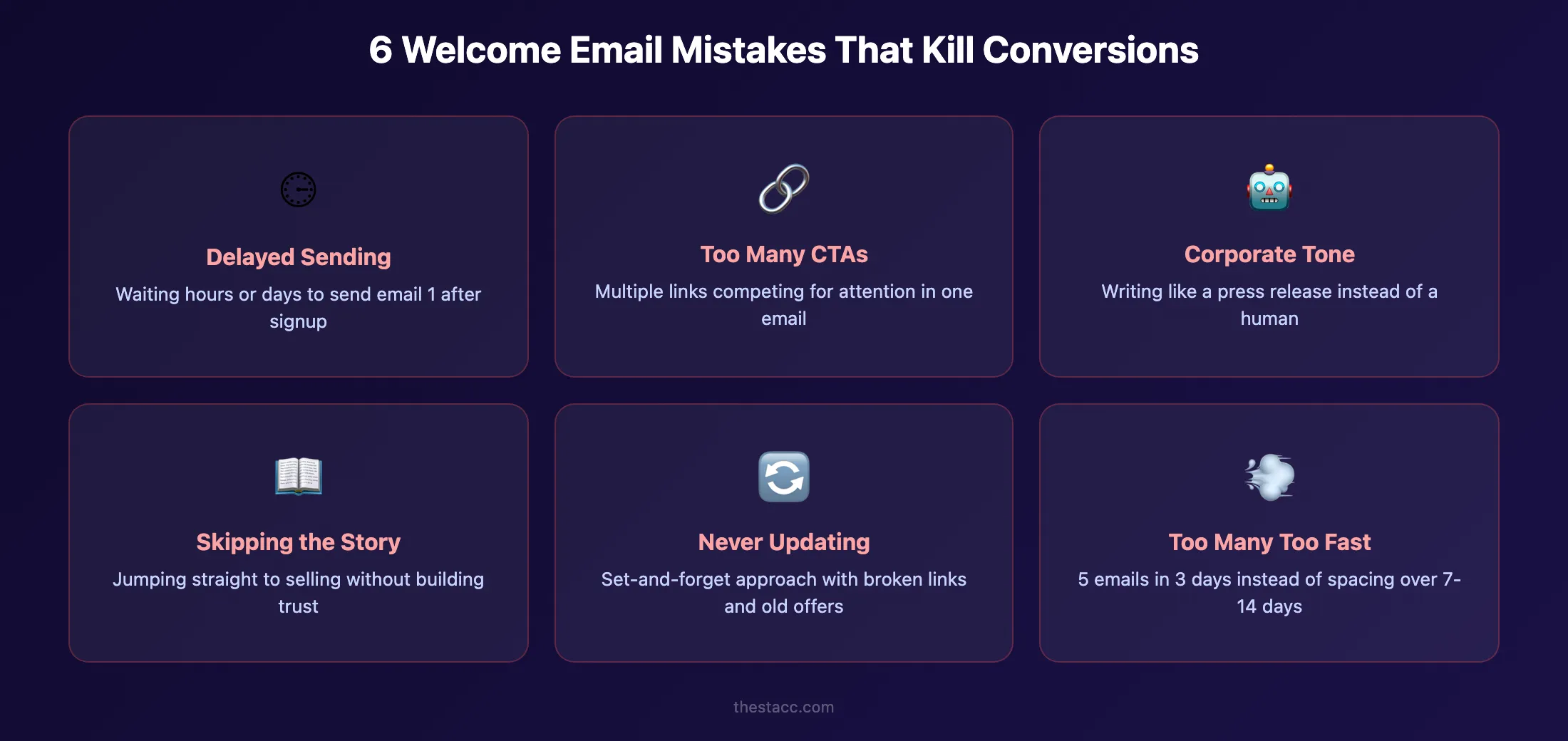
Even well-planned welcome sequences fail when these mistakes creep in.
Waiting too long to send email 1. Every minute between signup and the first email reduces engagement. Send immediately. Not in 1 hour. Not in a batch the next morning.
Including too many calls to action. Each email gets 1 CTA. One. Not a menu of 5 links competing for attention. Focus drives clicks. Clutter kills them.
Writing corporate-speak instead of human language. Your welcome emails should read like a message from a real person. Use first person. Use short sentences. Skip the jargon.
Skipping the story email. Data shows that story-driven emails generate the highest reply rates. Replies improve deliverability. Better deliverability means more people see your future emails.
Never testing or updating. A welcome sequence is not a “set it and forget it” asset. Test subject lines quarterly. Update links and offers when they change. Review metrics monthly.
Sending too many emails too fast. Five emails in 3 days feels aggressive. Space them out over 7 to 14 days. Give subscribers time to read and absorb each message.
For more ideas on keeping subscribers engaged after the welcome sequence ends, explore our email newsletter ideas guide.
Frequently Asked Questions
How many emails should a welcome sequence include?
Five emails over 7 to 14 days is the most effective structure for most businesses. Fewer than 3 emails does not build enough trust. More than 7 risks subscriber fatigue. Start with 5 and adjust based on your open rate and unsubscribe data.
What is a good open rate for welcome emails?
Welcome emails average 50% to 86% open rates, depending on industry and list quality. That is 2 to 4 times higher than regular marketing emails. If your welcome email open rate falls below 40%, your subject line or sender name needs work. Check HubSpot’s email benchmarks for industry-specific data.
Should I include a discount in my welcome email sequence?
Only if discounts are part of your normal pricing strategy. A discount in the welcome sequence sets the expectation that future emails will contain deals. If you sell a service, offer a free resource or consultation instead. If you sell products, a 10% to 15% first-purchase discount in email 5 works well.
When should I send the first welcome email?
Immediately. Zero delay. The ActiveCampaign research found that 39% of brands send welcome emails, but 41% do not send anything within 48 hours. Sending within seconds of signup captures peak interest.
Can I use the same welcome sequence for all subscribers?
You can start with one universal sequence. As your list grows past 1,000 subscribers, consider segmenting by signup source. Someone who downloaded a pricing guide needs different emails than someone who subscribed to a blog. Segment-specific sequences convert 30% to 50% higher than generic ones.
How do I transition from the welcome sequence to regular emails?
After the welcome sequence ends, subscribers should automatically enter your regular email marketing flow. Set this up in your automation tool by adding an “end of sequence” action that moves contacts to your main newsletter list. Avoid a gap between the last welcome email and your first regular broadcast.
A welcome email sequence is the highest-ROI automation most businesses never build. You now have the 8-step framework to create one that actually converts. Start with email 1 today, test weekly, and optimize monthly.
Your subscribers are waiting to hear from you.
Related Tools & Resources
Free SEO Tools:
Best Lists:

Written by
Siddharth GangalSiddharth is the founder of theStacc and Arka360, and a graduate of IIT Mandi. He spent years watching great businesses lose organic traffic to competitors who simply published more. So he built a system to fix that. He writes about SEO, content at scale, and the tactics that actually move rankings.
30 SEO blog articles published every month
Keyword-optimized, scheduled, and live on your site. Automatically.
30-day trial · Cancel anytime
theStacc
Stop writing SEO content manually
30 blog articles, 30 GBP posts, and social media content. Published every month. Automatically.
Start Your $1 Trial$1 for 3 days · Cancel anytime