
Email Subject Lines: The Definitive Guide (2026)
Write email subject lines that get opened. 10 proven formulas, length data, A/B testing framework, and 50+ examples. Backed by open rate data. Updated 2026.
47% of email recipients decide whether to open an email based on the subject line alone. The other 53% check the sender name first. Either way, your email subject lines determine whether your message gets read or deleted.
That single line of text is the most important piece of copy in your entire email. You can write the best offer, the most compelling story, or the most useful content inside. None of it matters if nobody opens the email.
Here is the worse statistic: 69% of people report emails as spam based on the subject line alone. One bad subject line loses more than an open. It damages your sender reputation and pushes future emails into the spam folder.
We have published 3,500+ blog posts across 70+ industries. Every one required a headline that earned the click. Email subject lines follow the same rules. This guide covers the exact formulas, data, and testing framework we use and recommend.
In this guide, you will learn:
- The data behind what makes subject lines work (and fail)
- 10 proven subject line formulas with examples for each
- The ideal subject line length backed by open rate data
- How personalization, emojis, and power words affect opens
- A/B testing methods that actually produce reliable results
- The most common subject line mistakes and how to fix them
- 50+ ready-to-use subject line templates by category
The Data Behind Email Subject Lines
Most subject line advice is based on opinions. This section is based on numbers. Understanding the data helps you make decisions that move open rates, not guesses.
Open Rate Benchmarks
| Metric | 2025-2026 Benchmark |
|---|---|
| Average email open rate | 42-44% |
| Good open rate | 35-45% |
| Excellent open rate | 50%+ |
| Average click-through rate | 2-5% |
| Click-to-open rate | 6-8% |
One important caveat: Apple Mail Privacy Protection (introduced in iOS 15) pre-loads tracking pixels, inflating open rate data. Apple Mail accounts for roughly 46% of email clients. Your true open rate is likely lower than your dashboard shows. Focus on click-through rates and conversions alongside opens for a more accurate picture.
What the Data Says About Subject Lines
- 47% of recipients open emails based on the subject line alone
- 69% report emails as spam based on the subject line alone
- Personalized subject lines increase open rates by 10-14% on average
- Subject lines under 50 characters get 12% higher open rates and 75% higher click-through rates
- Adding the word “free” increases opens by approximately 10% (but can trigger spam filters if overused)
- Emojis in subject lines produce a 4.7% higher open rate on average
- Odd numbers in subject lines outperform even numbers
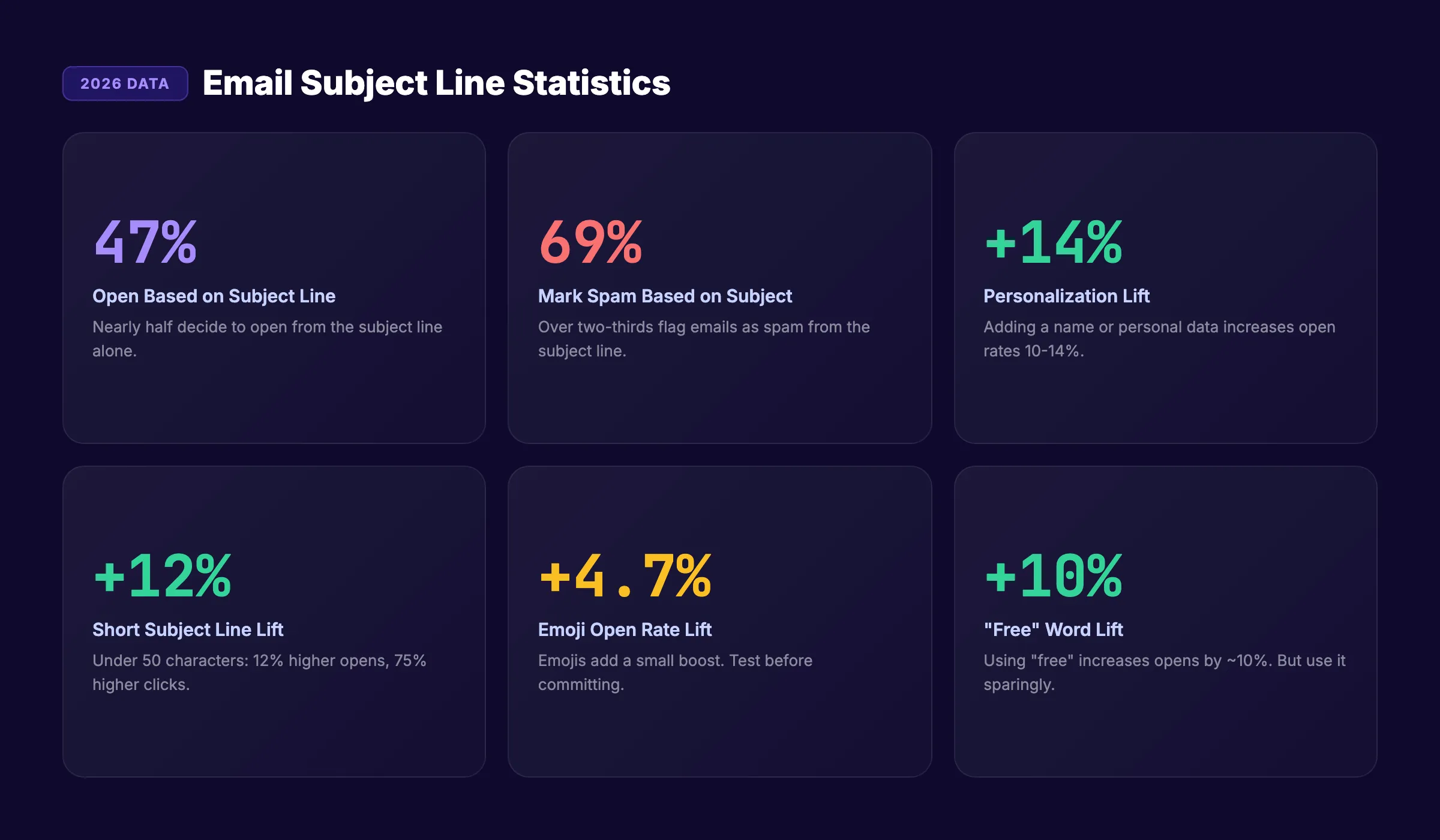
These numbers show a clear pattern: short, specific, personalized subject lines win. Vague, long, generic ones lose. The rest of this guide shows you exactly how to write the winning kind.
For more context on email performance metrics, see our guide on content marketing statistics.
10 Proven Email Subject Line Formulas
These formulas work across industries, audience sizes, and email types. Each one triggers a specific psychological response that drives opens.
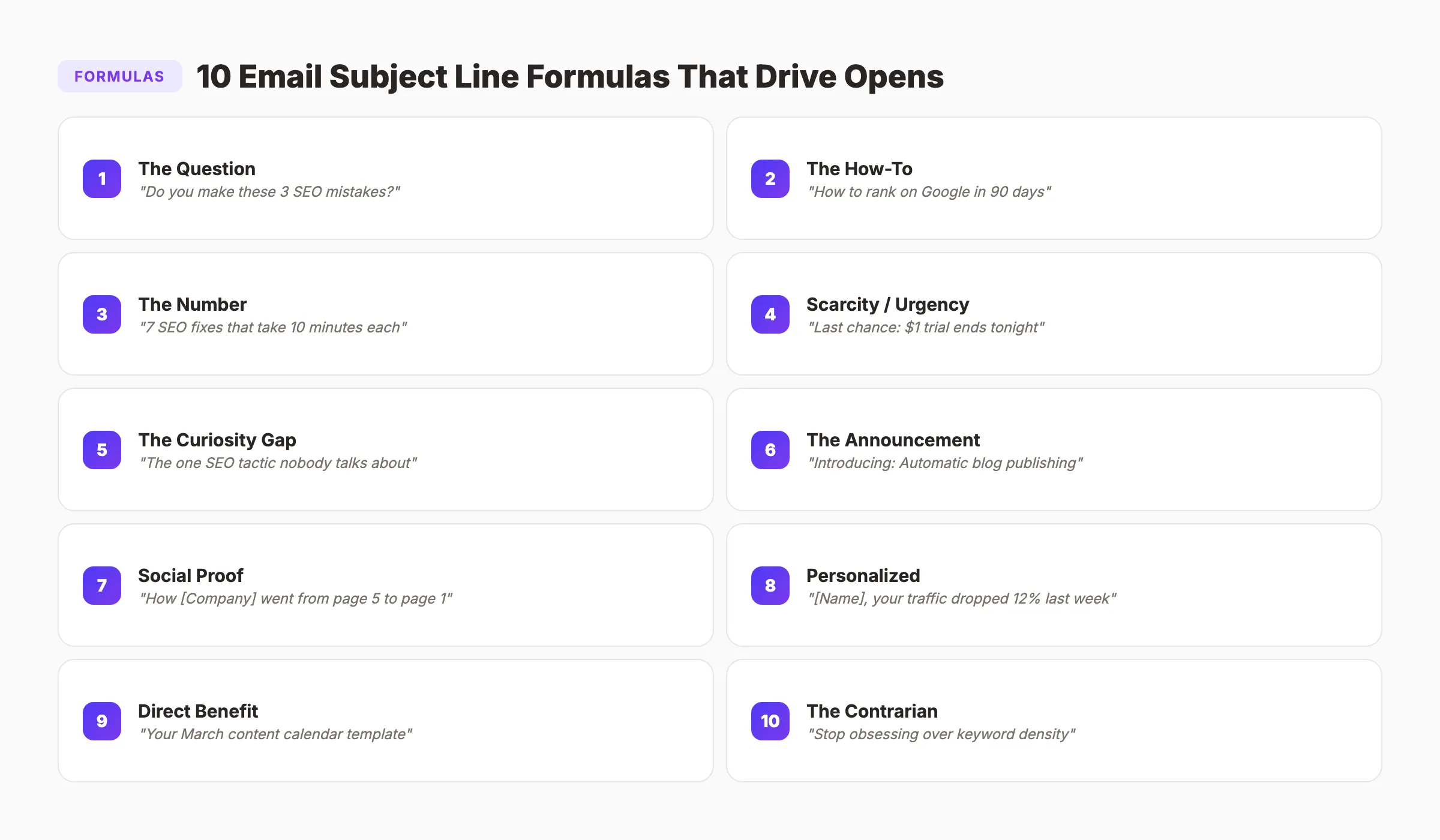
1. The Question Formula
Ask a question that makes the reader think about their own situation.
Why it works: Questions create an open loop in the brain. The reader feels compelled to answer, which means they engage with your subject line instead of scrolling past it.
Examples:
- “Do you make these 3 SEO mistakes?”
- “What would you do with 30 extra hours per month?”
- “Are your blog posts actually driving traffic?”
- “Ready to stop writing and start ranking?”
Best for: Newsletters, lead nurture sequences, re-engagement emails.
2. The How-To Formula
Promise a specific, useful outcome in clear language.
Why it works: “How to” forces clarity. The reader knows exactly what they will learn. No ambiguity. No guessing. That predictability builds trust.
Examples:
- “How to rank on Google in 90 days”
- “How to write blog posts that drive organic traffic”
- “How to get 50 five-star reviews in 30 days”
- “How to automate your SEO without an agency”
Best for: Educational emails, onboarding sequences, content promotion.
3. The Number Formula
Lead with a specific number. Odd numbers outperform even ones.
Why it works: Numbers stand out visually in an inbox full of text. They also promise a defined scope. “7 tips” is less overwhelming than “many tips.”
Examples:
- “7 SEO fixes that take 10 minutes each”
- “3 emails that recover 15% of lapsed customers”
- “11 blog post ideas that rank without backlinks”
- “5 subject line mistakes killing your open rates”
Best for: Tip lists, roundups, content promotion, blog post emails.
4. The Scarcity and Urgency Formula
Add a real deadline or limited quantity.
Why it works: Scarcity triggers loss aversion. People act faster when they believe something is about to disappear. But the urgency must be genuine. Fake deadlines destroy trust.
Examples:
- “Last chance: $1 trial ends tonight”
- “Only 3 spots left for March onboarding”
- “48 hours left to lock in this rate”
- “Your offer expires at midnight”
Best for: Sales emails, flash promotions, trial expiration reminders.
5. The Curiosity Gap Formula
Hint at something interesting without revealing the full answer.
Why it works: The brain hates incomplete information. When you open a loop by implying there is something worth knowing, readers open the email to close that loop.
Examples:
- “The one SEO tactic nobody talks about”
- “We analyzed 10,000 blog posts. Here is what we found.”
- “This small change doubled our organic traffic”
- “The #1 reason your emails go to spam”
Best for: Newsletters, content teasers, thought leadership.
Stop writing. Start ranking. Stacc publishes 30 SEO articles per month for $99. Every article follows proven headline formulas like these. Start for $1 →
6. The Announcement Formula
Introduce something new. New products, features, or content.
Why it works: People want to be the first to know. “Introducing” and “New” signal fresh information worth opening.
Examples:
- “Introducing: Automatic blog publishing”
- “New: Weekly SEO performance reports”
- “We just launched something you have been asking for”
- “Big news for [Company] customers”
Best for: Product launches, feature updates, company news.
7. The Social Proof Formula
Reference results, testimonials, or data from real people.
Why it works: Third-party validation is more persuasive than self-promotion. When someone sees that others have succeeded, they want to learn how.
Examples:
- “How [Company] went from page 5 to page 1 in 60 days”
- “92% average SEO score. Here is how.”
- “3,500+ blogs published. This is what we learned.”
- “Sarah doubled her traffic in 90 days. Here is her strategy.”
Best for: Case study emails, testimonial campaigns, product proof.
8. The Personalized Formula
Include the recipient’s name, company, location, or behavior data.
Why it works: Personalization signals relevance. An email that says “[Name], your March SEO report” feels like a 1-to-1 message, not a mass blast. Open rates increase 10-14% with personalization.
Examples:
- “[Name], your website traffic dropped 12% last week”
- “[Name], 3 new blog ideas for [Industry]”
- “[City] businesses are ranking faster. Here is why.”
- “[Name], your trial ends in 24 hours”
Best for: Drip campaigns, transactional emails, re-engagement sequences.
9. The Direct Benefit Formula
State exactly what the reader gets. No cleverness. No games.
Why it works: Clarity beats creativity in most email marketing contexts. When subscribers know exactly what is inside, they open if the benefit matches their need.
Examples:
- “Your March content calendar template”
- “Free SEO audit checklist (PDF)”
- “The blog post outline template we use for every article”
- “30 blog topic ideas for [Industry]”
Best for: Lead magnets, resource delivery, content upgrades.
10. The Contrarian Formula
Challenge a common belief or popular advice.
Why it works: Disagreement is attention-grabbing. When someone says “stop doing X” or “X is wrong,” readers open the email to see the argument.
Examples:
- “Stop obsessing over keyword density”
- “Why most SEO audits are a waste of money”
- “Blogging daily is bad advice. Here is why.”
- “You do not need backlinks to rank (in most cases)”
Best for: Thought leadership, newsletters, opinion pieces.
Subject Line Length: What the Data Shows
Length is one of the most debated topics in email marketing. The data gives a clear answer, but it depends on your audience and email type.
Length Benchmarks
| Character Count | Open Rate Impact | Best For |
|---|---|---|
| Under 30 characters | Above average opens | Triggered emails, reminders |
| 30-50 characters | Highest overall performance | Newsletters, promotions |
| 50-70 characters | Average performance | Detailed announcements |
| 70+ characters | Below average, mobile truncation | Avoid for most emails |
Mobile vs. Desktop Display
| Device | Visible Characters | % of Opens |
|---|---|---|
| iPhone (Mail app) | 30-40 characters | ~46% |
| Gmail (mobile) | 40-45 characters | ~28% |
| Gmail (desktop) | 70+ characters | ~15% |
| Outlook (desktop) | 55-60 characters | ~8% |
67% of emails are opened on mobile. That means most of your audience sees only 30-45 characters of your subject line. Front-load the most important words. Put the keyword, number, or benefit first.
Bad: “We wanted to share some exciting news about our new SEO features” Good: “New: Automatic blog publishing is here”
The bad example wastes 30 characters before reaching the point. The good example delivers the news in 38 characters. Mobile users see the full message.
Strong subject lines follow the same principles as strong blog headlines. The most important information comes first.
Personalization Beyond First Names
Most marketers stop at merge tags. “[Name], check this out” is better than nothing. But true personalization goes deeper.
5 Levels of Email Personalization
| Level | What It Is | Open Rate Lift | Example |
|---|---|---|---|
| 1. No personalization | Generic subject line | Baseline | ”Monthly newsletter” |
| 2. Name merge tag | First name in subject | +10-14% | “[Name], your monthly update” |
| 3. Behavior-based | References past actions | +15-25% | “[Name], you viewed 3 listings in [City]“ |
| 4. Segment-based | Content matches segment | +20-30% | “SEO tips for restaurants (your industry)“ |
| 5. Dynamic + triggered | Real-time data insertion | +30-50% | “[Name], your traffic dropped 8% this week” |
Level 5 requires automation and real-time data. Most businesses can reach Level 3 or 4 with basic email platform features. The jump from Level 1 to Level 3 produces the biggest ROI improvement.
Personalization That Works
- Location: “[City] businesses are ranking faster this quarter”
- Industry: “SEO for [Industry]: 3 quick wins”
- Behavior: “You downloaded our content calendar. Here is the next step.”
- Purchase history: “Your last order shipped. Track it here.”
- Engagement level: “We miss you. Here is what you missed this month.”
Personalization works because it signals relevance. A relevant email is worth opening. A generic email is not.
Your SEO team. $99 per month. 30 optimized articles, published automatically. Every headline optimized for clicks. Start for $1 →
Emojis in Subject Lines: When to Use Them
Emojis are polarizing. Some marketers swear by them. Others avoid them entirely. The data sits in the middle.
Emoji Performance Data
| Metric | With Emoji | Without Emoji |
|---|---|---|
| Open rate | +4.7% higher | Baseline |
| Click-through rate | +3.3% higher | Baseline |
| Spam risk | Slightly higher | Lower |
Emoji Best Practices
Do:
- Use 1 emoji maximum per subject line
- Place the emoji at the beginning or end (not the middle)
- Match the emoji to the content (🔥 for urgency, 📊 for data, ✅ for checklists)
- Test emoji vs. no-emoji with your specific audience
Do not:
- Use 3+ emojis (triggers spam filters)
- Use emojis as word replacements (“Get 👀 on your 📧”)
- Use emojis in transactional or formal emails
- Assume all email clients render emojis the same way
The safest approach: test emojis with a 10% sample before rolling out to your full list. Some audiences love them. Others mark emoji-heavy emails as spam. Your data decides.
Power Words That Increase Opens
Certain words consistently outperform others in subject lines. These are not spam triggers. They are words that signal value, urgency, or exclusivity.
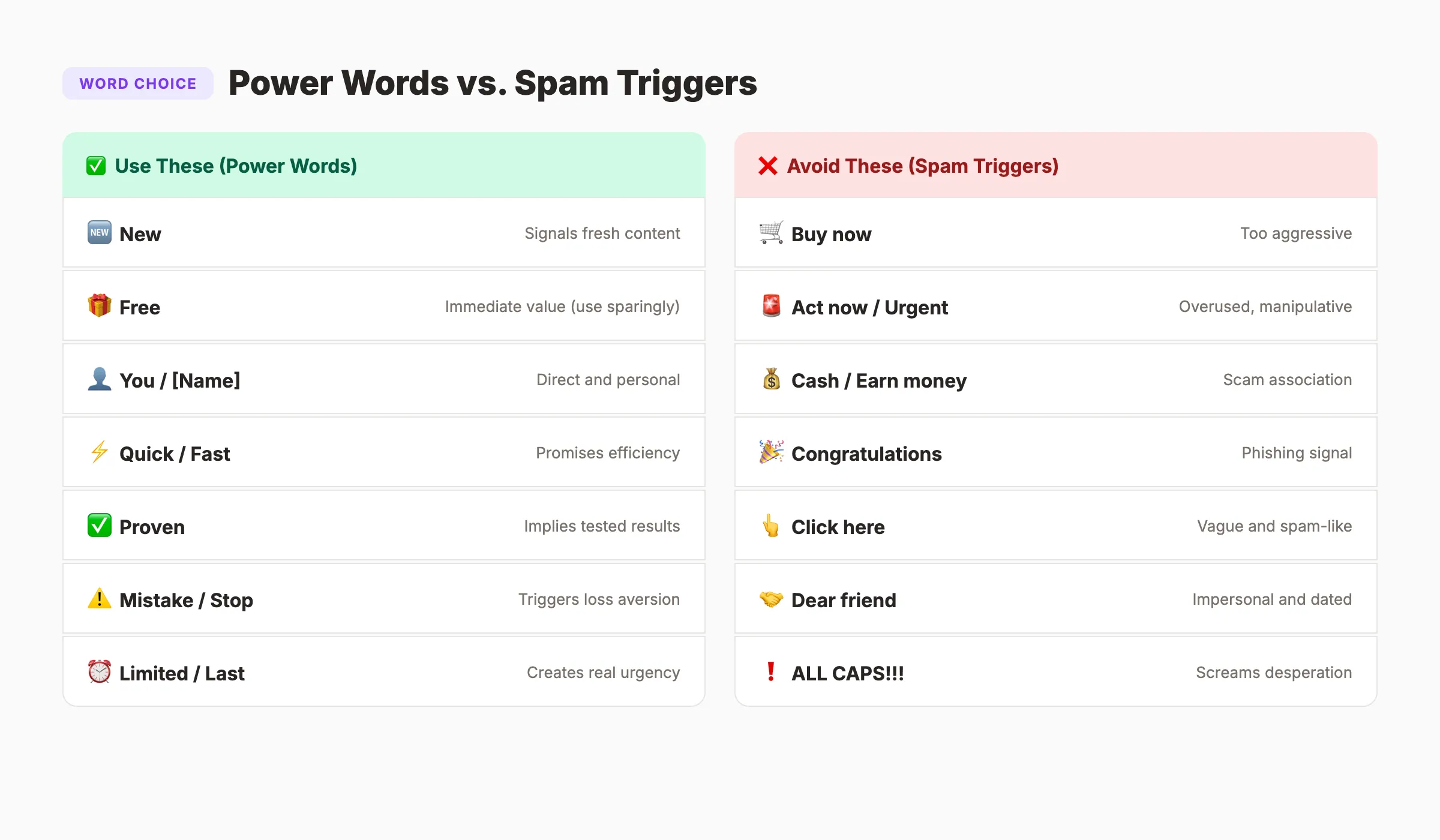
High-Performing Subject Line Words
| Word/Phrase | Why It Works | Use In |
|---|---|---|
| ”New” | Signals fresh content | Announcements, launches |
| ”Free” | Immediate value (use sparingly) | Lead magnets, trials |
| ”You” / “[Name]“ | Direct, personal | Any email type |
| ”Quick” / “Fast” | Promises efficiency | Tips, how-to emails |
| ”Proven” | Implies tested results | Case studies, data emails |
| ”Mistake” / “Stop” | Triggers loss aversion | Educational, contrarian |
| ”Because” | Gives a reason | Explanations, arguments |
| ”Limited” / “Last” | Creates urgency | Promotions, deadlines |
Words to Avoid
| Word/Phrase | Why It Hurts | Risk |
|---|---|---|
| ”Buy now” | Too aggressive | Spam filter trigger |
| ”Act now” / “Urgent” | Overused, feels manipulative | Spam filter trigger |
| ”Cash” / “Earn money” | Associated with scams | High spam risk |
| ”Congratulations” | Phishing signal | Very high spam risk |
| ”Click here” | Vague, spam-like | Moderate spam risk |
| ”Dear friend” | Impersonal and dated | Low open rate |
The difference between “limited” and “act now” is trust. “Limited” describes a real constraint. “Act now” is a command from a stranger. One builds urgency. The other triggers suspicion.
For more on writing copy that converts in digital channels, see our guide on SEO content writing.
How to A/B Test Subject Lines
Writing good subject lines is a skill. Testing them is a science. A/B testing removes guesswork and replaces it with data.
The A/B Testing Framework
Step 1: Choose one variable.
Test only one thing at a time. If you change the length, the tone, and the personalization all at once, you will not know which change caused the result.
Variables to test:
- Length (short vs. long)
- Personalization (name vs. no name)
- Emoji (with vs. without)
- Formula (question vs. statement)
- Power word (urgency vs. curiosity)
- Number (with vs. without)
Step 2: Set your sample size.
Send version A to 10% of your list and version B to another 10%. Wait 2-4 hours. Send the winner to the remaining 80%.
Minimum list size for reliable results: 1,000 subscribers. Below that, results are often noise. For lists under 1,000, run the A/B test across multiple sends and track cumulative data.
Step 3: Measure the right metric.
Open rate is the obvious metric. But also track:
- Click-through rate (did the subject line attract the right audience?)
- Unsubscribe rate (did it attract the wrong audience?)
- Reply rate (for sales or relationship emails)
- Conversion rate (did opens translate to action?)
A subject line that gets 50% opens but 0% clicks is worse than one that gets 35% opens and 5% clicks. Opens without action are vanity metrics.
Step 4: Document everything.
Keep a testing log:
| Date | Variable Tested | Version A | Version B | Winner | Lift |
|---|---|---|---|---|---|
| 3/15 | Personalization | ”Your March report" | "[Name], your March report” | B | +12% opens |
| 3/22 | Length | ”7 SEO tips for Q2" | "7 quick SEO tips to boost your Q2 rankings fast” | A | +8% opens |
| 3/29 | Emoji | ”New feature alert" | "🚀 New feature alert” | A | +2% opens (not significant) |
After 10-20 tests, patterns emerge. Those patterns become your subject line playbook.
Common A/B Testing Mistakes
- Testing with too few subscribers. Below 1,000, most results are statistically meaningless.
- Changing multiple variables. Test one thing. Only one.
- Ending tests too early. Wait at least 4 hours before declaring a winner.
- Ignoring click data. Opens without clicks mean the subject line attracted curiosity but not the right audience.
- Not documenting results. Without a log, you repeat the same tests and learn nothing.
3,500+ blogs published. 92% average SEO score. Every headline A/B tested. See what Stacc can do for your content. Start for $1 →
Common Subject Line Mistakes
These are the mistakes we see most often. Each one costs opens, clicks, and revenue.
1. Writing the Subject Line Last
Most marketers write the email first and the subject line as an afterthought. This is backwards. The subject line is the ad for your email. Write 5-10 subject line options before you write the email body. Then choose the best one.
2. Summarizing the Email Content
Your subject line should not summarize what is inside. It should sell the open. “March Newsletter: Company Updates, New Features, and Tips” tells the reader everything. They have no reason to open.
“One change that doubled our March traffic” creates a reason to open.
3. Being Vague
“Quick update” and “Touching base” are invisible in a crowded inbox. Vague subject lines give the reader no reason to prioritize your email over the 50 others competing for attention.
4. Using All Caps or Excessive Punctuation
“HUGE SALE!!! DON’T MISS OUT!!!” triggers spam filters and screams desperation. Calm, confident subject lines outperform yelling every time.
5. Making Promises You Cannot Keep
If your subject line says “free SEO audit” and the email asks them to schedule a paid consultation, you have broken trust. Misleading subject lines get opens once. They get unsubscribes forever.
6. Ignoring Mobile Preview Text
The preview text (preheader) is the second line readers see after the subject line on mobile. Most email platforms default to “View this email in your browser” if you leave it blank. That wastes prime real estate. Write custom preview text that complements your subject line.
7. Never Testing
Sending the same subject line style for every email means you are optimizing based on instinct, not data. Even one A/B test per month produces insights that compound over a year.
For more on writing effective digital copy, see our guide on how to write SEO blog posts.
50+ Email Subject Line Templates by Category
Use these templates as starting points. Swap in your own data, brand name, and specifics.
Newsletter Subject Lines
- “This week in [Industry]: 3 things you need to know”
- “[Month] roundup: What worked, what did not”
- “The [topic] insight everyone missed this week”
- “Your weekly [Industry] briefing ([Date])”
- “[Name], here is what changed in [topic] this week”
Promotional Subject Lines
- “[Percentage] off [Product]. Ends [Day].”
- “Your exclusive offer inside (valid 48 hours)”
- “We rarely do this. [Percentage] off everything.”
- “Last day: [Offer] expires at midnight”
- “[Product] is back in stock. Limited quantity.”
Welcome Email Subject Lines
- “Welcome to [Brand]. Here is what to expect.”
- “[Name], you are in. Your first [benefit] is inside.”
- “3 things to do in your first week with [Brand]”
- “Your [lead magnet] is ready to download”
- “Nice to meet you, [Name]. Let us get started.”
Re-Engagement Subject Lines
- “We miss you, [Name]. Here is what you missed.”
- “It has been a while. 3 new things since your last visit.”
- “Still interested in [topic]? We have something new.”
- “[Name], should we keep sending these?”
- “Before you go: One thing you should see”
Blog Content Promotion Subject Lines
- “New post: [Blog title]”
- “[Name], we wrote this for people like you”
- “[Number] [topic] tips (3-minute read)”
- “The [topic] guide we wish we had when we started”
- “We published [number] posts this month. Here are the best 3.”
Sales and Outreach Subject Lines
- “[Name], quick question about [Company]”
- “Idea for [Company]: [one-line pitch]”
- “[Mutual connection] suggested I reach out”
- “[Company] + [Your Brand]: A potential fit?”
- “Can I send you a 2-minute demo?”
Transactional Subject Lines
- “Your order [#] has shipped. Track it here.”
- “[Name], your invoice for [Month] is ready”
- “Your [Product] trial expires in 3 days”
- “Password reset requested for [Account]”
- “Your [Report/Document] is ready to view”
For more ideas on structuring content that drives traffic from email, see our guide on blog post structure for SEO.
Subject Lines for Specific Industries
Different industries have different audiences. The tone, urgency, and content of your subject line should match your reader.
Real Estate
- “[City] home prices dropped 3% this month”
- “New listing: [Address] at $[Price]”
- “[Name], your home valuation is ready”
- “2 spots left for Saturday open house”
Healthcare and Wellness
- “Your appointment is tomorrow at [Time]”
- “The 2-minute stretch that fixes desk posture”
- “[Name], your wellness check-in”
- “3 sleeping positions that help back pain”
SaaS and Technology
- “[Name], your usage report for [Month]”
- “New feature: [Feature name] is live”
- “Your [Product] trial ends in 24 hours”
- “How [Customer] reduced churn by 30%“
Ecommerce
- “Your cart is waiting ([Product name] inside)”
- “Back in stock: [Product]. Limited quantity.”
- “[Name], we picked these for you”
- “Flash sale: 40% off everything for 6 hours”
Professional Services
- “[Name], your [Month] performance report”
- “3 strategies for Q2 that your competitors are not using”
- “A question about [Company] growth”
- “Your industry is changing. Here is what to do.”
For industry-specific content strategies, explore our guides on real estate SEO, dental SEO, and local SEO.
Rank everywhere. Do nothing. Blog SEO, Local SEO, and Social on autopilot. Stacc starts at $99/mo. Start for $1 →
The Subject Line Writing Process
Instead of staring at a blank line, use this process for every email you send.
Step 1: Write 10 Subject Lines
Do not write one subject line. Write 10. Speed matters more than perfection at this stage. Set a 5-minute timer and write as many as you can.
Step 2: Cut to 3 Finalists
Evaluate each option against these criteria:
- Under 50 characters
- Specific (includes a number, name, or concrete detail)
- Matches the email content
- Uses one of the 10 formulas
- Would you open this email?
Step 3: Check for Spam Triggers
Run your finalists through a spam word checker. Avoid:
- More than 3 punctuation marks
- ALL CAPS words
- “Free” more than once
- Exclamation marks in every subject line
Step 4: A/B Test the Top 2
Send version A to 10% and version B to 10%. Wait 2-4 hours. Send the winner to the remaining 80%.
Step 5: Log the Result
Add the winner to your subject line swipe file. Over time, this file becomes your most valuable marketing asset.
This same discipline of testing and iteration applies to optimizing content for SEO. Small improvements compound into major results.
FAQ
What is a good open rate for email in 2026?
The average open rate across industries is 42-44%. A good rate is 35-45%. Excellent is 50%+. But Apple Mail Privacy Protection inflates these numbers by pre-loading tracking pixels. Focus on click-through rates and conversions alongside open rates for a more accurate measure of engagement.
How long should an email subject line be?
30 to 50 characters is the sweet spot for most emails. 67% of emails are opened on mobile, where only 30-45 characters are visible. Front-load the most important words. Subject lines under 50 characters get 12% higher open rates and 75% higher click-through rates than longer ones.
Should I use emojis in email subject lines?
Test before committing. Emojis produce a 4.7% average lift in open rates. But some audiences mark emoji-heavy emails as spam. Use one emoji maximum, placed at the beginning or end. A/B test emoji vs. no-emoji with your specific list before making it standard practice.
How often should I A/B test subject lines?
Every send, if your list is large enough (1,000+ subscribers). For smaller lists, test one variable per week across multiple sends and track cumulative data. Even one test per month gives you 12 data points per year. That is 12 chances to improve.
What words trigger spam filters in subject lines?
“Act now,” “cash,” “earn money,” “congratulations,” “click here,” “no obligation,” and excessive use of “free” all raise spam risk. Avoid ALL CAPS, multiple exclamation marks, and more than 3 punctuation marks per subject line. Most modern spam filters also flag subject lines that look deceptive compared to the email content.
How do I write subject lines for cold emails?
Keep cold email subject lines under 40 characters. Use the recipient’s name or company name. Reference a specific pain point or mutual connection. Avoid anything promotional. “Quick question about [Company]” and “[Mutual connection] suggested I reach out” consistently outperform generic pitches.
The best email subject line is the one your specific audience opens. Start with the formulas in this guide. Test relentlessly. Document what works. Over 12 months, your subject line performance will compound the same way consistent SEO publishing compounds organic traffic.
Write 10. Test 2. Send the winner. Repeat.
Related Tools & Resources
Free SEO Tools:
Best Lists:

Written by
Siddharth GangalSiddharth is the founder of theStacc and Arka360, and a graduate of IIT Mandi. He spent years watching great businesses lose organic traffic to competitors who simply published more. So he built a system to fix that. He writes about SEO, content at scale, and the tactics that actually move rankings.
30 SEO blog articles published every month
Keyword-optimized, scheduled, and live on your site. Automatically.
30-day trial · Cancel anytime
theStacc
Stop writing SEO content manually
30 blog articles, 30 GBP posts, and social media content. Published every month. Automatically.
Start Your $1 Trial$1 for 3 days · Cancel anytime