
Email Marketing ROI (2026): Strategies, Tactics & Examples
email marketing roi strategies for 2026: proven tactics, real case studies, tools, and metrics to drive growth and ROI.
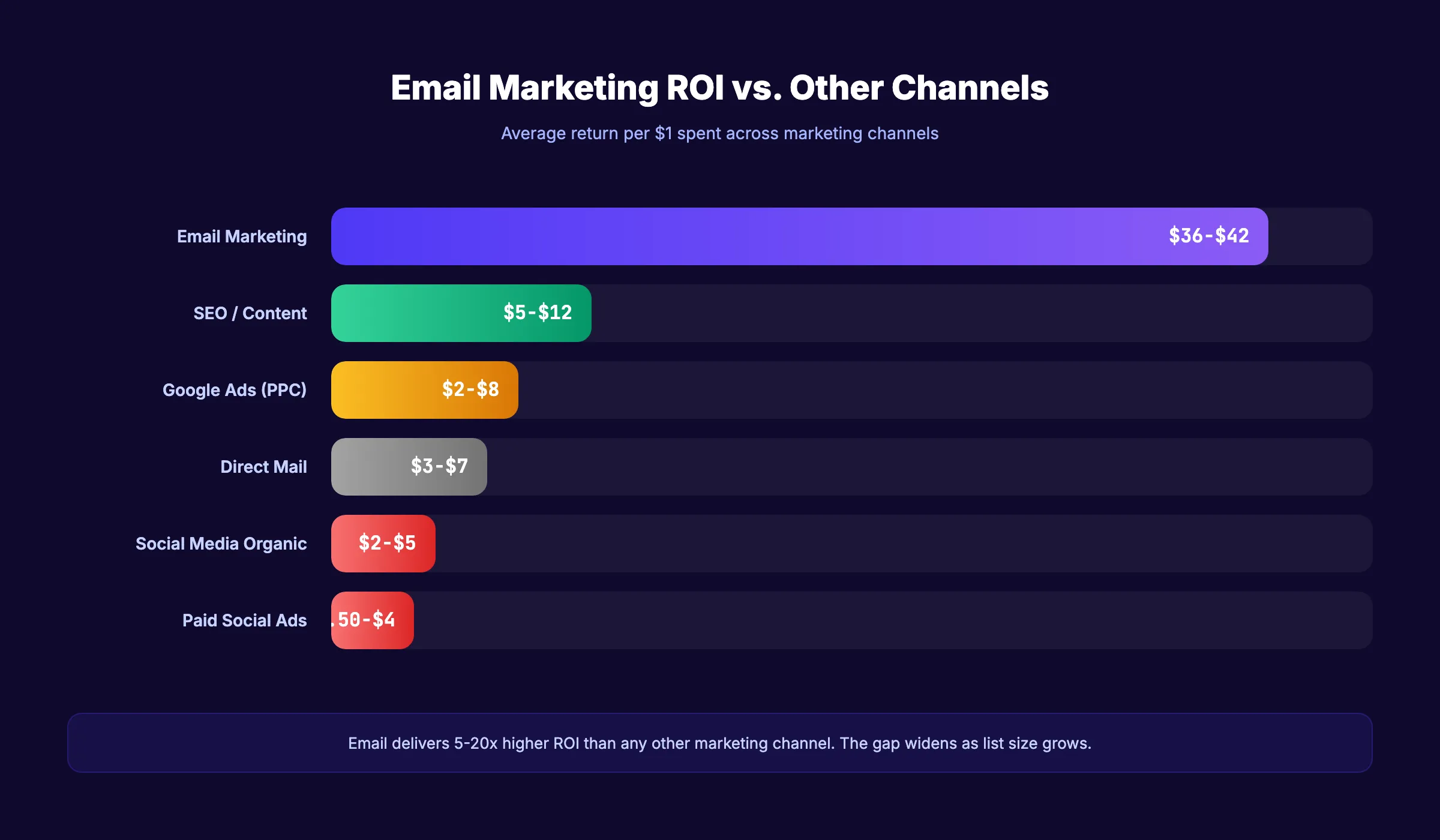
Most marketing channels are a guessing game. You spend money on ads, post on social media, and hope the numbers go up. Email marketing ROI removes the guesswork. For every $1 spent on email, businesses earn $36 to $42 back. That is a 3,600 to 4,200% return.
No other channel comes close. Not paid search. Not social media. Not display ads. Email has held the top ROI position for over a decade and the gap is widening. Yet most businesses either underinvest in email or fail to track their returns accurately.
The problem is not that email marketing does not work. The problem is that most companies do not know their actual email marketing ROI. They send campaigns, check open rates, and call it a day. Open rates do not pay the bills. Revenue does.
We have published 3,500+ articles across 70+ industries and studied what separates high-ROI email programs from underperformers. This guide covers the formula, the benchmarks, and the strategies that move the needle.
Here is what you will learn:
- The exact formula for calculating email marketing ROI
- Industry-specific benchmarks so you know where you stand
- Why automated emails generate 30 times more revenue per send
- 8 proven strategies to increase your email ROI
- How to track attribution when multiple channels overlap
- The metrics that actually predict email revenue
What Is Email Marketing ROI and Why Does It Matter?
Email marketing ROI measures how much revenue your email campaigns generate relative to what you spend on them. It is the single most important metric for proving that email deserves budget, headcount, and attention.
Why ROI Beats Open Rates
Open rates are vanity metrics. A 40% open rate means nothing if nobody buys. Click rates are better but still incomplete. ROI ties email directly to revenue. It answers the only question leadership cares about: “How much money did email make us?”
41% of marketers name email as their most effective channel. That is more than double the next closest option (social media and paid search, both at 16%). The reason is measurable returns.
Email vs. Every Other Channel
| Channel | Average ROI | Cost to Start | Scales With List Size? |
|---|---|---|---|
| Email marketing | $36 to $42 per $1 | $0 to $50/mo | Yes |
| SEO / Content | $5 to $12 per $1 | $500 to $5,000/mo | Slowly |
| Google Ads (PPC) | $2 to $8 per $1 | $500+/mo | No (cost per click rises) |
| Social media organic | $2 to $5 per $1 | Free (time cost) | No (algorithm limits) |
| Facebook/Instagram ads | $1.50 to $4 per $1 | $500+/mo | No (auction-based) |
| Direct mail | $3 to $7 per $1 | $1+/piece | No (per-unit cost) |
Email scales better than any other channel. The cost of sending 1,000 emails is nearly identical to sending 10,000 emails. That ratio improves with every subscriber you add. Large enterprises with big lists see ROI as high as 44:1 ($44 per $1 spent).
How to Calculate Email Marketing ROI
The formula is simple. The inputs are where most businesses get stuck.
The Basic Formula
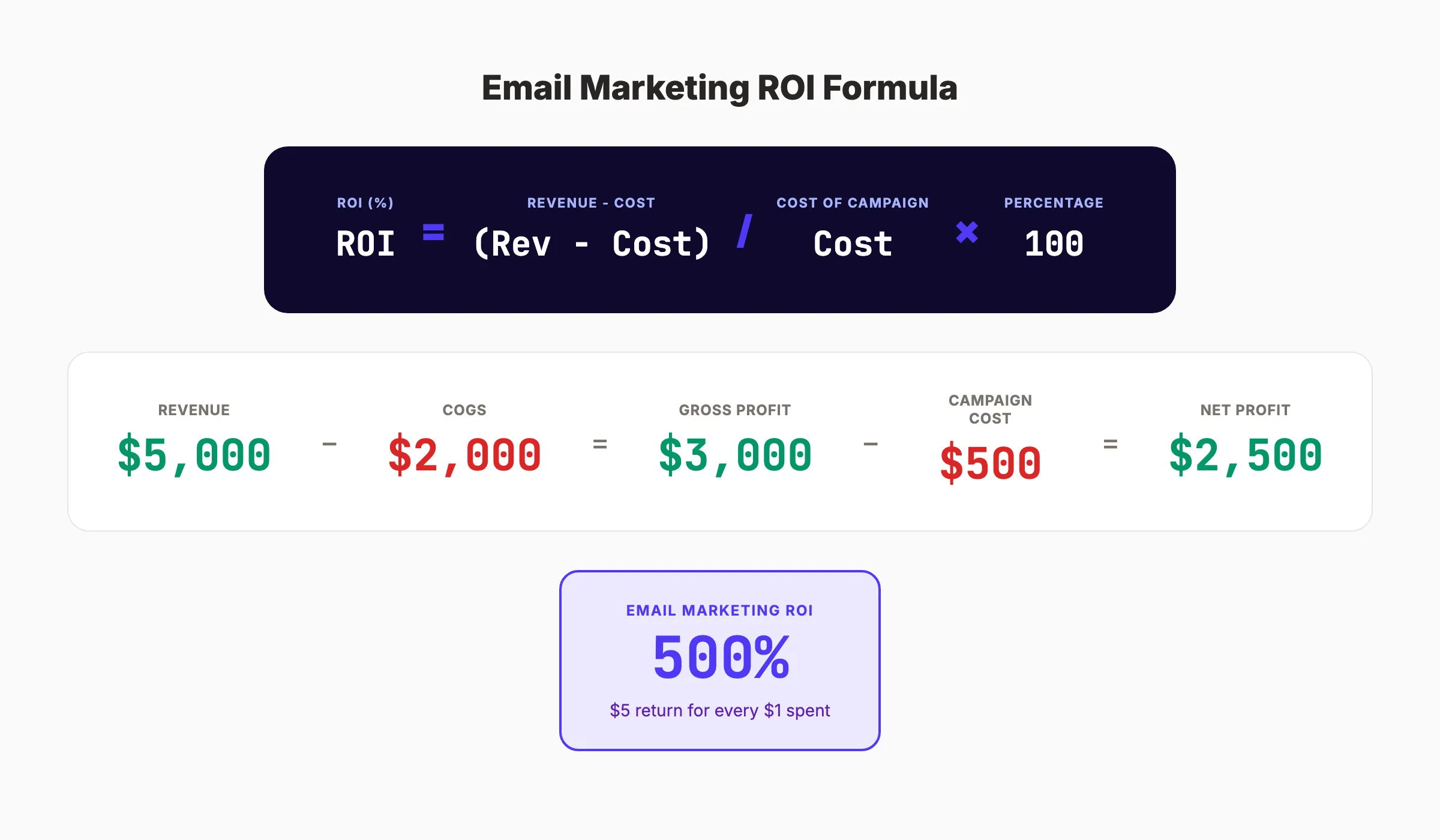
Email Marketing ROI (%) = [(Revenue from Email - Cost of Email) / Cost of Email] x 100
Example: You spend $500 on an email campaign. It generates $5,000 in revenue with $2,000 in product costs (COGS). Your gross profit is $3,000.
ROI = [($3,000 - $500) / $500] x 100 = 500% (or $5 return per $1 spent)
What Counts as “Cost of Email”
Most businesses undercount their email costs, which inflates their ROI number. Include all of these:
| Cost Category | Examples | Typical Range |
|---|---|---|
| Email platform | Mailchimp, Klaviyo, ActiveCampaign fees | $20 to $500/mo |
| Staff time | Hours spent writing, designing, scheduling | $500 to $5,000/mo |
| Design tools | Canva Pro, stock photos, template costs | $20 to $200/mo |
| List management | Cleaning tools, verification services | $10 to $100/mo |
| Third-party services | Freelance copywriters, email consultants | $0 to $3,000/mo |
If your marketing manager spends 10 hours per week on email at $40/hour, that is $1,600/month in labor cost. Most ROI calculations ignore this and overstate returns.
What Counts as “Revenue from Email”
Track revenue from email through:
- Direct attribution: A subscriber clicks a link in your email and purchases. Your email platform tracks this automatically.
- Promo code attribution: Unique codes per campaign (e.g., “SPRING25”) tied to email-specific offers.
- UTM parameters: Add tracking codes to every link. Google Analytics shows which emails drove which conversions.
- Last-touch attribution: The last channel a buyer interacted with before purchasing gets the credit.
Most email platforms (Klaviyo, Mailchimp, ActiveCampaign) track direct attribution natively. For a broader view, connect email data to your SEO ROI calculator or Google Analytics.
Your SEO team. $99 per month. Stacc publishes 30 optimized articles per month that drive traffic. More traffic means more email subscribers and higher ROI. Start for $1 →
Email Marketing ROI Benchmarks by Industry
Not all industries see the same returns. E-commerce businesses typically outperform B2B companies because email drives direct purchases. B2B companies see longer sales cycles where email nurtures leads but the final sale happens offline.
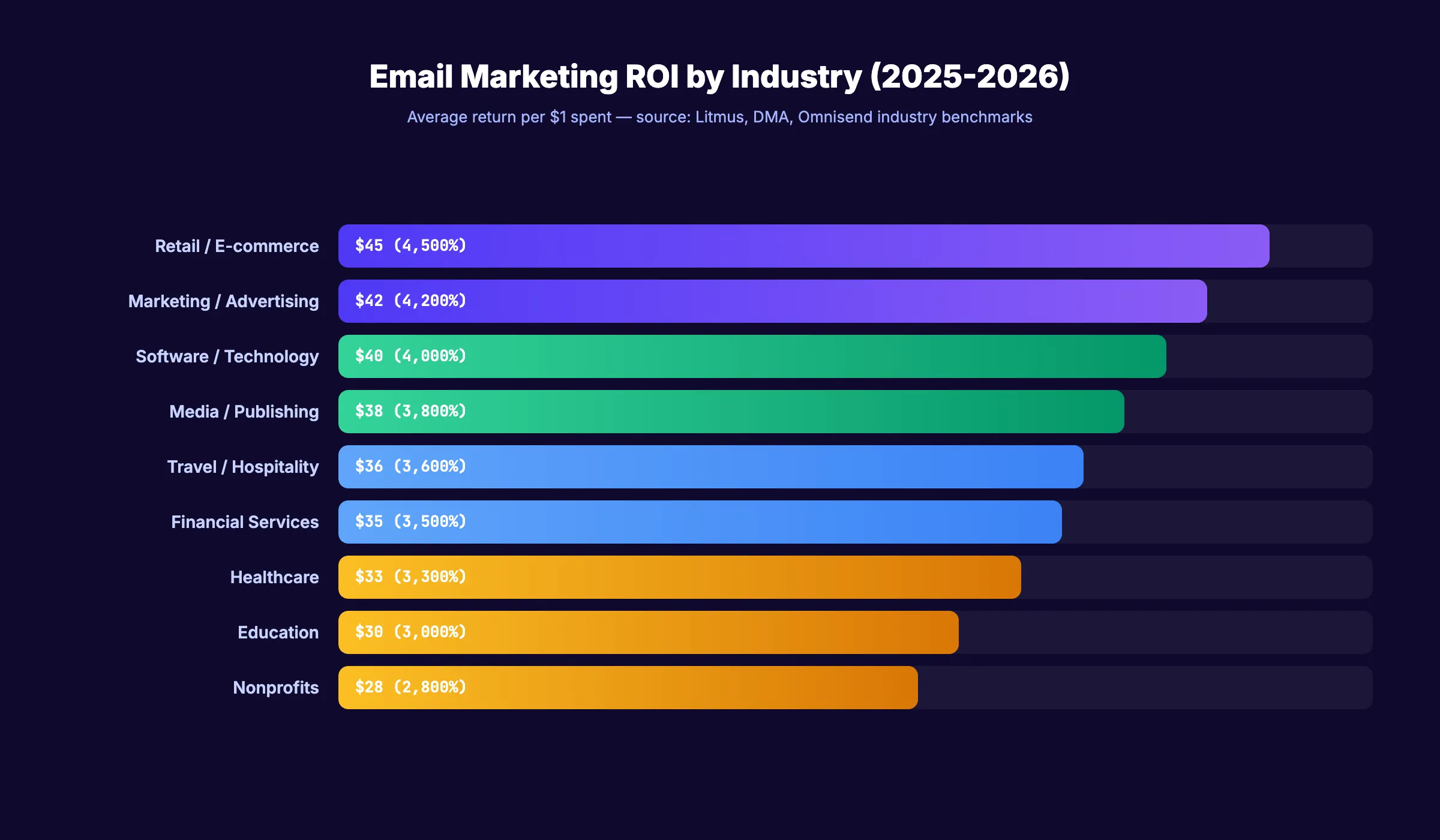
ROI by Industry (2025-2026 Data)
| Industry | Average ROI per $1 Spent | Key Driver |
|---|---|---|
| Retail and e-commerce | $45 (4,500%) | Direct product purchases |
| Marketing and advertising | $42 (4,200%) | Client acquisition + retention |
| Software and technology | $40 (4,000%) | Trial sign-ups + upsells |
| Media and publishing | $38 (3,800%) | Subscriptions + ad revenue |
| Travel and hospitality | $36 (3,600%) | Booking conversions |
| Financial services | $35 (3,500%) | Lead generation + nurturing |
| Healthcare | $33 (3,300%) | Appointment bookings |
| Education | $30 (3,000%) | Course enrollments |
| Nonprofits | $28 (2,800%) | Donation campaigns |
ROI by Business Size
| Business Size | Average ROI | Why |
|---|---|---|
| Enterprise (10,000+ subscribers) | $44 per $1 | Economies of scale. Lower per-email cost. |
| Mid-market (1,000-10,000) | $36 per $1 | Solid list size. Room to optimize. |
| Small business (under 1,000) | $28 per $1 | Smaller list. Higher per-subscriber costs. |
Small businesses see lower ROI because platform fees represent a larger percentage of their total spend. A business paying $50/month for Mailchimp with 200 subscribers pays $0.25 per subscriber. A business paying $200/month for 20,000 subscribers pays $0.01 per subscriber. Scale matters.
That said, $28 per $1 is still exceptional. No other channel available to small businesses delivers that return. If you are building your email list, the ROI improves as your list grows.
The Automation Advantage: Why Automated Emails Win
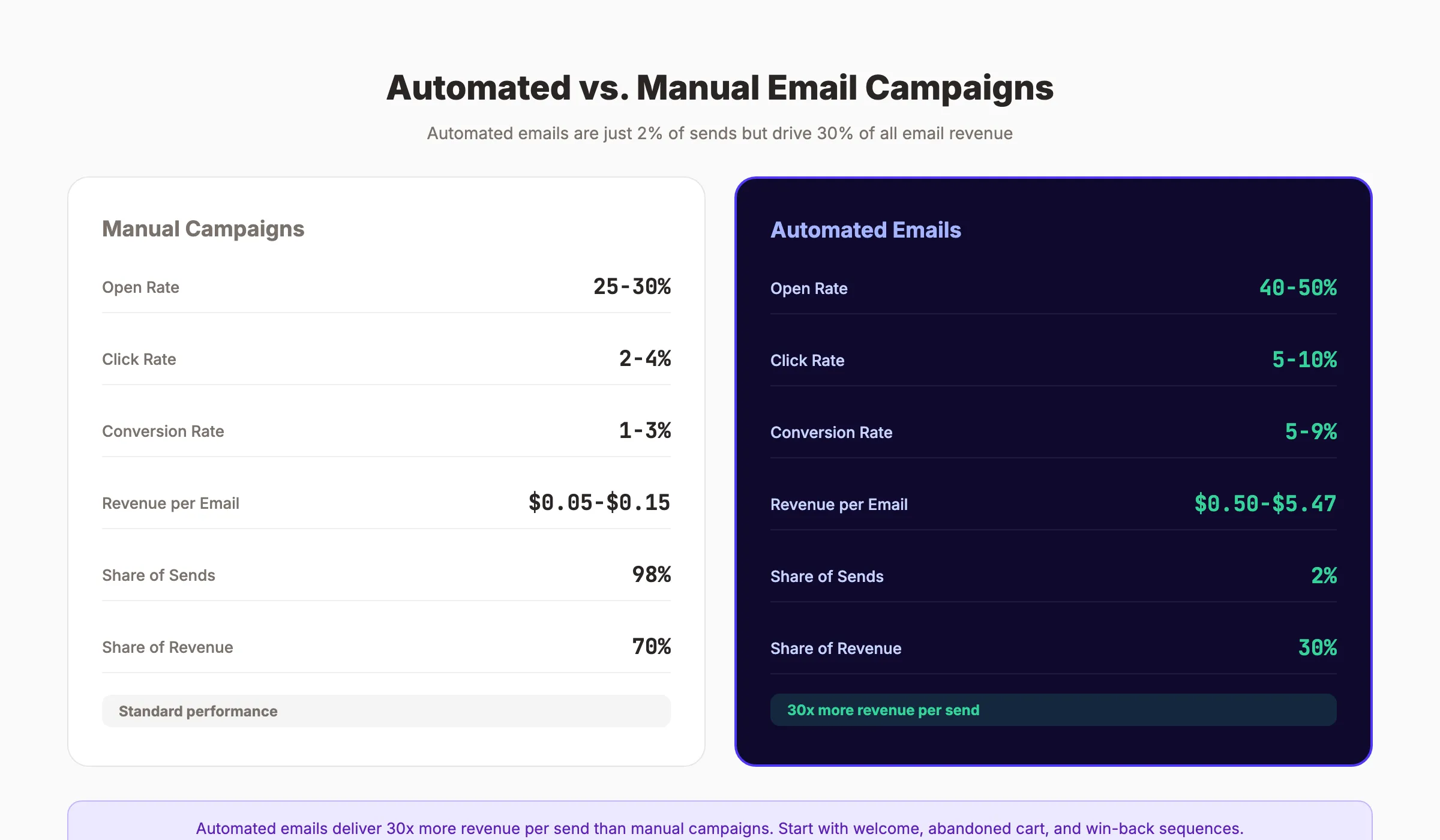
This is the single most important insight in email marketing ROI. Automated emails account for just 2% of all email sends. They generate 30% of all email revenue. That is a 30x revenue multiplier compared to manual campaigns.
Automated vs. Manual Campaign Performance
| Metric | Manual Campaigns | Automated Emails | Difference |
|---|---|---|---|
| Open rate | 25 to 30% | 40 to 50% | +60 to 70% |
| Click rate | 2 to 4% | 5 to 10% | +150% |
| Conversion rate | 1 to 3% | 5 to 9% | +200 to 300% |
| Revenue per email | $0.05 to $0.15 | $0.50 to $5.47 | +1,000 to 3,600% |
| Share of total sends | 98% | 2% | , |
| Share of total revenue | 70% | 30% | , |
The reason automated emails perform better is timing. A welcome email arrives the moment someone subscribes. An abandoned cart email arrives 1 hour after the buyer leaves. A rebooking reminder arrives exactly when the client needs one.
Manual campaigns arrive whenever the marketer remembers to send them. Timing drives ROI.
The 5 Highest-ROI Automations
-
Welcome sequence , 320% more revenue per email than standard campaigns. The first email a subscriber receives sets the tone for the entire relationship.
-
Abandoned cart. Recovers 5 to 15% of abandoned purchases. E-commerce businesses without abandoned cart emails leave thousands of dollars on the table every month.
-
Post-purchase follow-up. Drives reviews, referrals, and repeat purchases. Costs nothing to send. Generates long-term customer lifetime value.
-
Browse abandonment. Targets visitors who viewed products but did not add to cart. Lower conversion than cart abandonment but higher volume.
-
Re-engagement (win-back). Reactivates lapsed subscribers before they churn. A 3-email sequence with escalating offers recovers 5 to 12% of inactive contacts.
If you run a service business like a salon, these automations translate directly to rebooking reminders, birthday offers, and loyalty rewards. See our guide on email marketing for salons for industry-specific automation examples.
Stop writing. Start ranking. Stacc publishes 30 SEO articles per month for your site. Every article drives organic traffic that feeds your email list. Start for $1 →
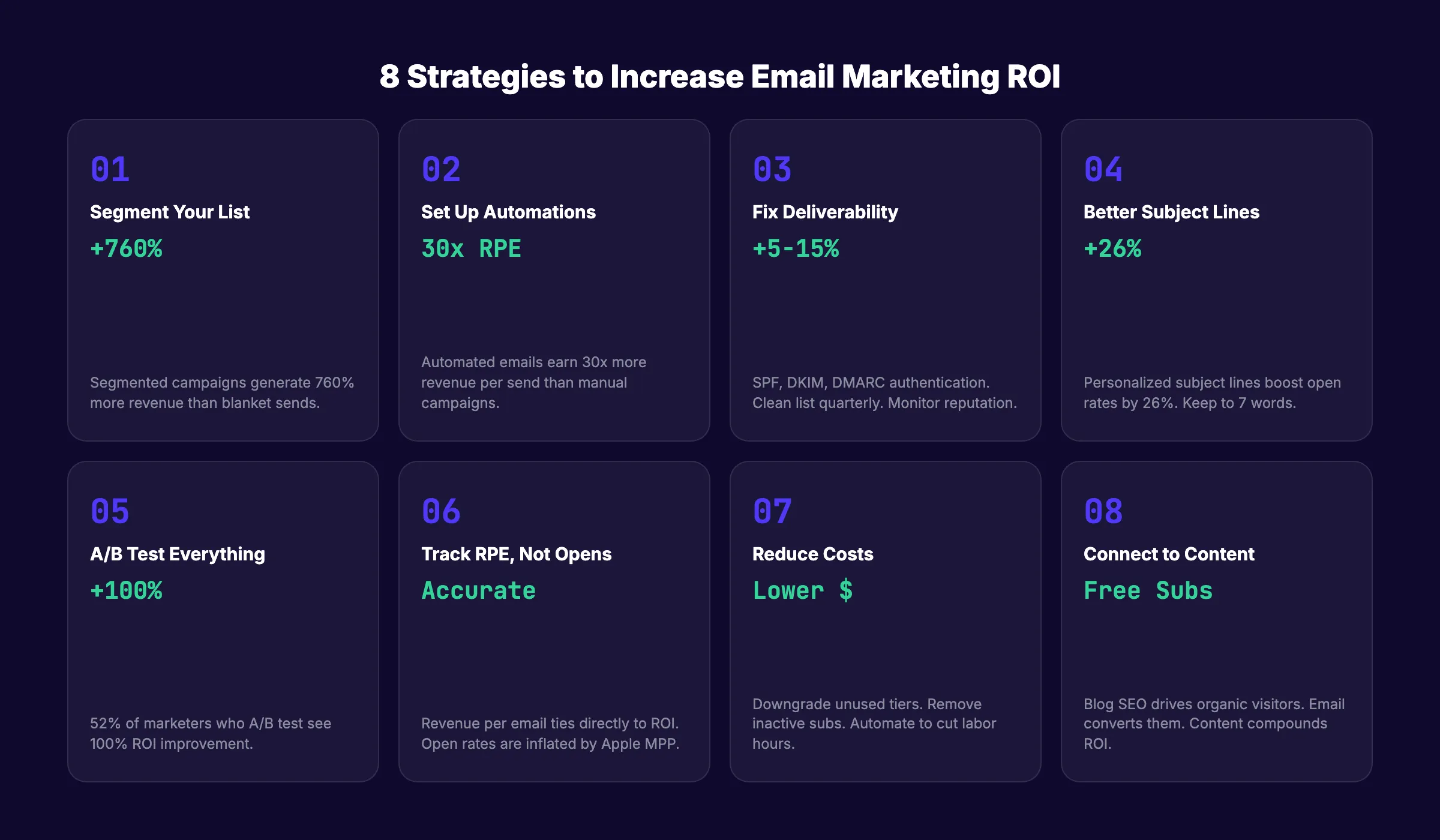
8 Strategies to Increase Your Email Marketing ROI
Knowing your ROI is step one. Improving it is where the money is. These 8 strategies are ranked by impact.
1. Segment Your List
Segmented email campaigns generate 760% more revenue than unsegmented broadcasts. Sending the same email to everyone wastes most of the list’s potential.
Segment by:
- Purchase history (what they bought, how much they spent)
- Engagement level (active, at-risk, inactive)
- Customer lifecycle stage (new, repeat, VIP, lapsed)
- Source of sign-up (which lead magnet or channel)
- Demographics (location, industry, company size)
Even basic segmentation (active vs. inactive) improves ROI immediately.
2. Set Up Core Automations
Every dollar spent on automation returns more than any dollar spent on manual campaigns. Start with 3 automations:
- Welcome sequence (3 to 5 emails over 10 days)
- Abandoned cart or service reminder (1 to 3 emails)
- Re-engagement campaign (3 emails for 90-day inactive subscribers)
These 3 workflows handle the highest-value moments in the customer lifecycle automatically.
3. Improve Deliverability
Emails that land in spam generate zero revenue. Deliverability directly affects ROI.
- Authenticate your domain with SPF, DKIM, and DMARC records
- Clean your list quarterly (remove hard bounces and inactive subscribers)
- Avoid spam trigger words in subject lines (“FREE!!!”, “Act now”, “Limited time”)
- Monitor your sender reputation using Google Postmaster Tools
- Keep complaint rates below 0.1%
A 5% improvement in deliverability on a 10,000-subscriber list means 500 more people see your email. At a 3% conversion rate, that is 15 more sales per campaign.
4. Write Better Subject Lines
The subject line determines whether the email gets opened. A 10% increase in open rate flows directly to more clicks, more conversions, and higher ROI.
| Strategy | Impact | Example |
|---|---|---|
| Personalization (first name) | +26% open rate | ”Sarah, your order ships tomorrow” |
| Numbers and specifics | +15% open rate | ”3 ways to save $200 this month” |
| Urgency (real, not fake) | +22% open rate | ”Sale ends at midnight” |
| Question format | +10% open rate | ”Ready for your summer refresh?” |
| Emoji (test first) | +15% open rate | ”Your birthday gift is inside” |
Keep subject lines to 7 words and 41 characters for mobile optimization. 60% of emails are read on phones.
5. A/B Test Everything
52% of marketers who A/B test their emails see a 100% improvement in ROI. Test one variable at a time:
- Subject lines (the highest-impact test)
- Send time (morning vs. afternoon vs. evening)
- CTA button text and color
- Email length (short vs. long)
- Personalization (name in subject vs. not)
Run each test for at least 1,000 sends per variant. Anything less lacks statistical significance.
6. Focus on Revenue per Email, Not Open Rate
Open rates are unreliable due to Apple Mail Privacy Protection (which auto-loads tracking pixels). Revenue per email (RPE) is the metric that ties directly to ROI.
RPE = Total Email Revenue / Total Emails Sent
Track RPE by campaign type. Compare automated vs. manual. Compare segments. The campaigns with the highest RPE deserve more sends and more investment.
7. Reduce Costs Without Reducing Quality
Lower costs improve ROI without needing more revenue. Look for waste:
- Downgrade email platform tiers if you do not use premium features
- Use templates instead of custom design for routine emails
- Automate workflows to reduce staff hours spent on manual sends
- Remove inactive subscribers to reduce platform costs (most charge by list size)
A business sending 10,000 emails per month does not need an enterprise plan. Match the tool to the task.
8. Connect Email to Your Content Strategy
Email and content marketing are force multipliers. Blog posts drive organic traffic to your site. Email captures those visitors. Nurture sequences convert them into buyers.
The flywheel: Publish blog content → Capture email subscribers → Nurture with automated sequences → Convert to customers → Measure ROI → Reinvest in more content.
Businesses that connect email to content marketing see higher ROI because they acquire subscribers through organic search (free) instead of paid ads (expensive). Every blog post that ranks on Google becomes a permanent subscriber acquisition channel.
For companies tracking content marketing ROI, email is the conversion engine that turns readers into revenue.
Tracking Email Marketing ROI: Metrics That Matter
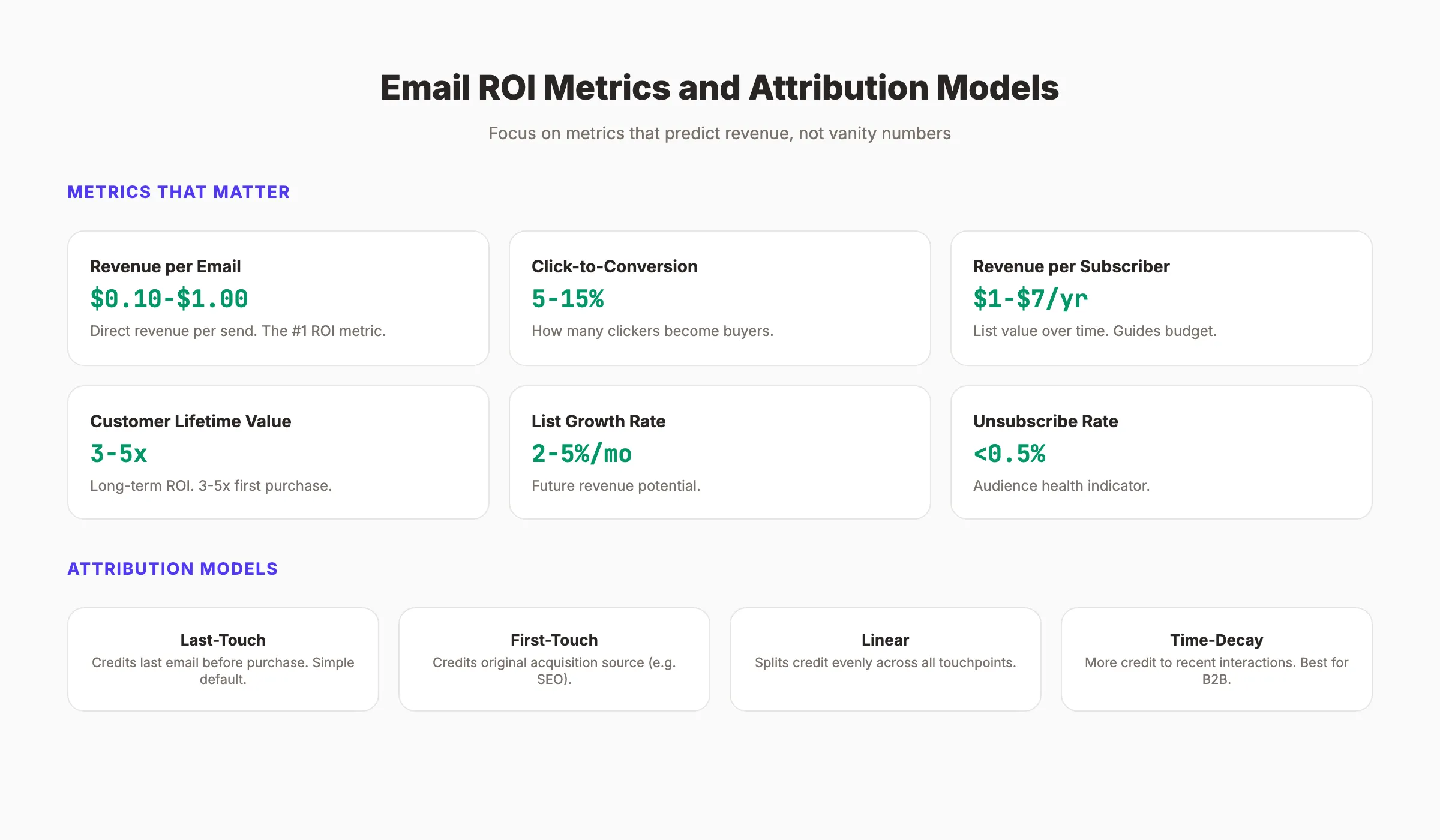
Not all metrics predict ROI. Some are vanity metrics that look good on reports but do not correlate with revenue. Focus on the ones that do.
The ROI Metric Stack
| Metric | What It Predicts | Target Benchmark |
|---|---|---|
| Revenue per email (RPE) | Direct revenue per send | $0.10 to $1.00 (varies by industry) |
| Click-to-conversion rate | How many clickers become buyers | 5 to 15% |
| Revenue per subscriber | List value over time | $1 to $7 per year per subscriber |
| Customer lifetime value (CLV) | Long-term email ROI | 3 to 5x first purchase value |
| List growth rate | Future revenue potential | 2 to 5% monthly |
| Unsubscribe rate | Audience health | Under 0.5% per campaign |
Metrics to Stop Obsessing Over
- Open rate. Apple Mail Privacy inflates this number. It is no longer reliable as a primary metric.
- Total emails sent. Sending more emails does not mean earning more revenue.
- List size (alone). A big list of unengaged subscribers costs money and hurts deliverability.
Track SEO KPIs alongside email metrics for a complete picture of your marketing performance. Email does not operate in isolation. It converts traffic that other channels generate.
Attribution Models for Email
Email rarely works alone. A customer might find your site through Google, subscribe via a lead magnet, receive 5 emails, and then purchase after clicking the 6th. Which channel gets the credit?
| Attribution Model | How It Works | Best For |
|---|---|---|
| Last-touch | Credits the last email clicked before purchase | Simple, common default |
| First-touch | Credits the original source (e.g., SEO visit) | Understanding acquisition |
| Linear | Splits credit evenly across all touchpoints | Multi-channel businesses |
| Time-decay | Gives more credit to recent touchpoints | Long sales cycles (B2B) |
Most small businesses should start with last-touch attribution. It is the simplest to implement and the default in most email platforms. Graduate to multi-touch models as your data infrastructure matures.
3,500+ blogs published. 92% average SEO score. See what Stacc can do for your site. Start for $1 →
FAQ
What is a good email marketing ROI?
The industry average is $36 to $42 per $1 spent (3,600 to 4,200%). Anything above $20 per $1 is solid. E-commerce businesses often exceed $45 per $1. If your ROI is below $10 per $1, your list quality, automation, or targeting needs work.
How do I calculate email marketing ROI if I sell services, not products?
Use the same formula but replace product revenue with service revenue. If a $500 email campaign brings 3 new clients worth $2,000 each ($6,000 total revenue), your ROI is [($6,000 - $500) / $500] x 100 = 1,100%. Service businesses often see higher ROI per conversion because the average transaction value is larger.
Does email marketing ROI include the cost of building the email list?
It depends on how you calculate it. Most benchmarks measure campaign-level ROI (cost of sending vs. revenue generated). A more complete calculation includes list-building costs (lead magnets, pop-up tools, paid ads for subscriber acquisition). Include both for an accurate picture.
Why is my email ROI lower than the $36 average?
Common reasons: sending to an unsegmented list, no automation workflows, poor deliverability (emails landing in spam), weak subject lines, or including only platform costs without staff time. Start with segmentation and one automation (welcome sequence) to see immediate improvement.
How long does it take to see ROI from email marketing?
Automated sequences (welcome emails, abandoned carts) generate returns within the first week. Manual campaigns depend on list size and engagement. Most businesses see positive ROI within 30 to 60 days of launching a structured email program. The returns compound over time as the list grows.
How does content marketing affect email ROI?
Content marketing drives organic traffic to your website. That traffic converts into email subscribers through lead magnets and opt-in forms. More subscribers means more potential revenue per campaign. Businesses that combine content marketing with email see higher ROI because they acquire subscribers for free through search instead of paying for ads. Read our guide on content marketing statistics for more data on how content and email work together.
Email marketing ROI is not fixed. It is a function of your list quality, your automation strategy, and your willingness to test and optimize. The businesses earning $45 per $1 are not using a secret tool. They are segmenting their lists, automating their highest-value emails, and measuring revenue per email instead of open rates. Start with the formula. Benchmark against your industry. Then work through the 8 strategies one at a time. Every improvement compounds.
Related Tools & Resources
Free SEO Tools:
Best Lists:

Written by
Siddharth GangalSiddharth is the founder of theStacc and Arka360, and a graduate of IIT Mandi. He spent years watching great businesses lose organic traffic to competitors who simply published more. So he built a system to fix that. He writes about SEO, content at scale, and the tactics that actually move rankings.
30 SEO blog articles published every month
Keyword-optimized, scheduled, and live on your site. Automatically.
30-day trial · Cancel anytime
theStacc
Stop writing SEO content manually
30 blog articles, 30 GBP posts, and social media content. Published every month. Automatically.
Start Your $1 Trial$1 for 3 days · Cancel anytime