
Email List Building (2026): Strategies, Tactics & Examples
Step-by-step email list building guide guide for 2026: proven tactics, real examples, common mistakes to avoid, and implementation tips.
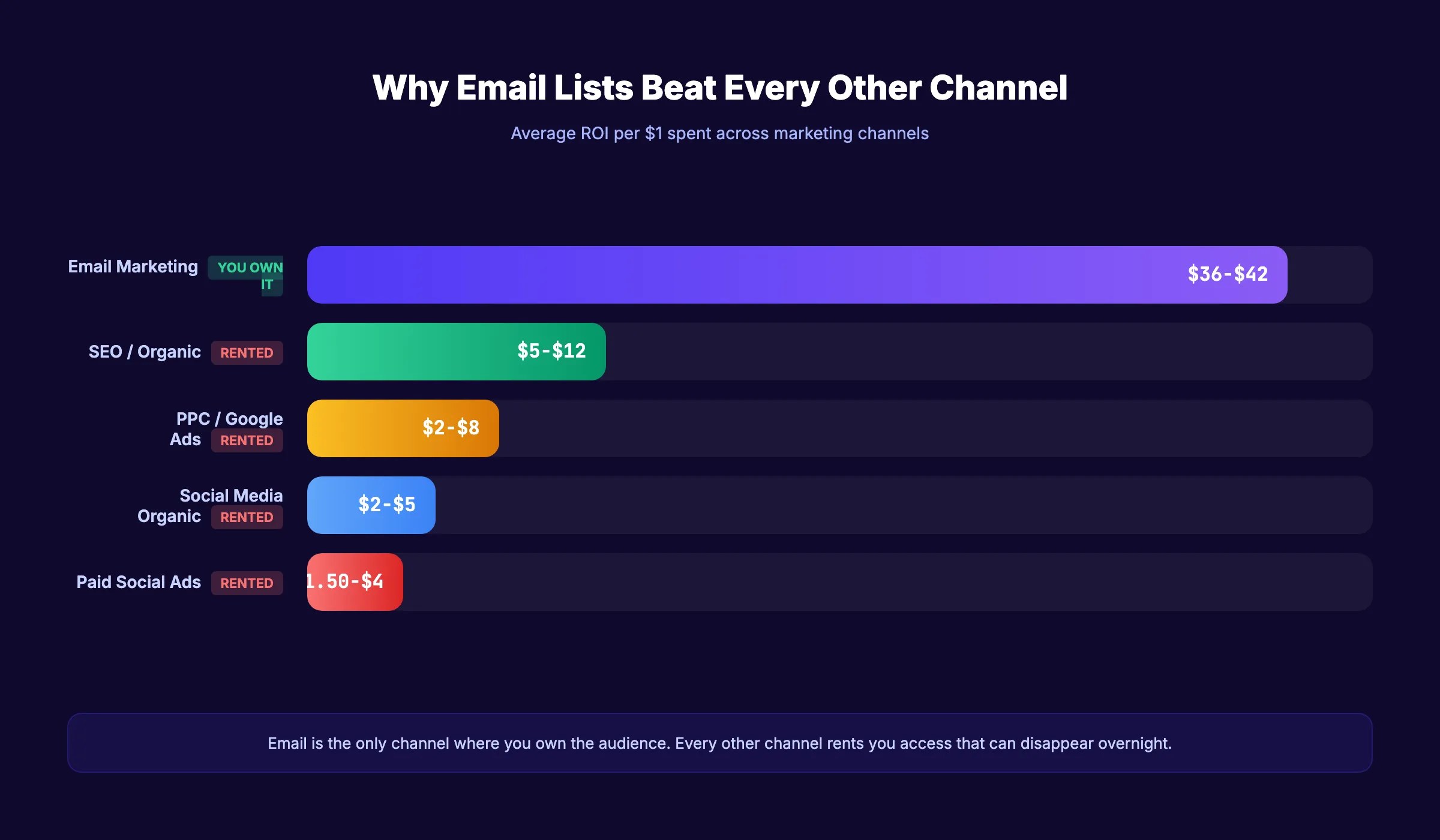
Most businesses treat email list building as an afterthought. They add a generic “Subscribe to our newsletter” form in the footer and wonder why nobody signs up. Meanwhile, companies with intentional list-building strategies generate $36 to $42 for every $1 they spend on email marketing.
That gap is not about tools or technology. It is about strategy. The average email opt-in rate sits at 1.95%. Top performers hit 6.5% or higher. The difference comes down to what you offer, where you offer it, and how you ask.
There will be 4.6 billion email users worldwide by 2026. That is more than half the planet. Your audience checks email every day. The question is whether they check yours.
We have published 3,500+ articles across 70+ industries and tested every list-building tactic from pop-ups to quizzes to gated content. This guide covers what actually works.
Here is what you will learn:
- Why email lists outperform every other marketing asset
- The 10 highest-converting list-building strategies
- How to create lead magnets that convert at 10% or higher
- Where to place opt-in forms for maximum sign-ups
- How to maintain list health and prevent subscriber decay
- Growth benchmarks to measure your progress against
Why Your Email List Is Your Most Valuable Marketing Asset
Social media followers are rented. Search rankings shift with every algorithm update. Paid ads stop working the moment you stop paying. Your email list is the only marketing channel you own.
The ROI Numbers
Email marketing generates $36 to $42 for every $1 spent. No other channel comes close.
| Channel | Average ROI | You Own the Audience? |
|---|---|---|
| Email marketing | $36 to $42 per $1 | Yes |
| SEO / Organic search | $5 to $12 per $1 | No (Google owns rankings) |
| Social media organic | $2 to $5 per $1 | No (algorithms control reach) |
| Paid social ads | $1.50 to $4 per $1 | No (pay-to-play) |
| PPC / Google Ads | $2 to $8 per $1 | No (stops when budget stops) |
The reason email wins is direct access. When you send an email, it arrives in the inbox. No algorithm decides whether your subscriber sees it. No competitor can outbid you for placement.
Email List Size vs. Revenue
A list of 2,000 engaged subscribers will outperform a list of 10,000 disengaged contacts every time. Quality beats quantity. Marketers who segment their email lists see 760% more revenue than those who send the same email to everyone.
The goal is not a big list. The goal is an engaged list that drives revenue.
The 10 Highest-Converting Email List Building Strategies
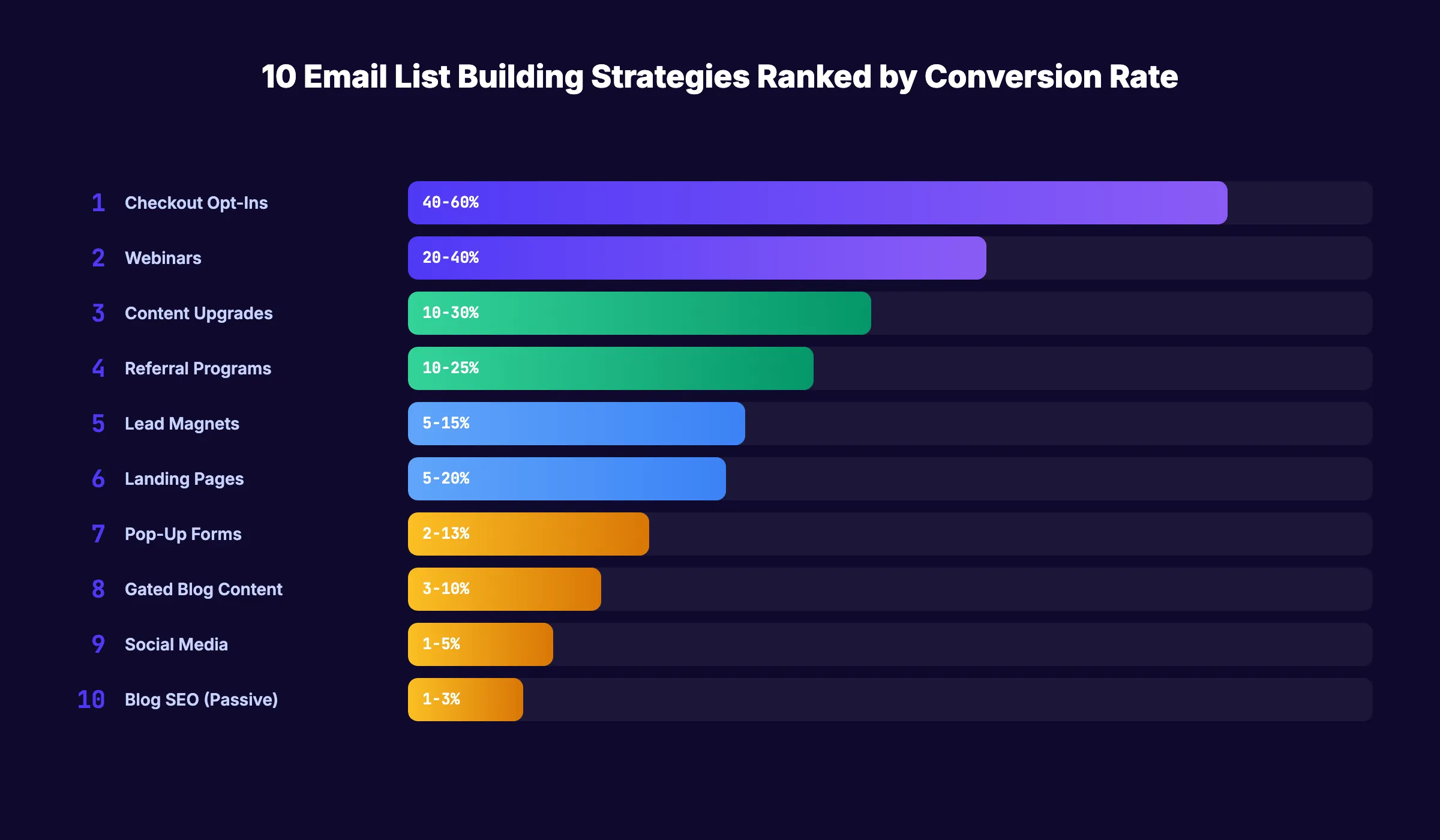
Every strategy below has been tested by real businesses. They are ranked by average conversion rate and ease of implementation.
1. Lead Magnets (5 to 15% Conversion Rate)
A lead magnet is something valuable you give away in exchange for an email address. The best lead magnets solve a specific problem immediately.
What converts best in 2026:
| Lead Magnet Type | Avg. Conversion Rate | Time to Create |
|---|---|---|
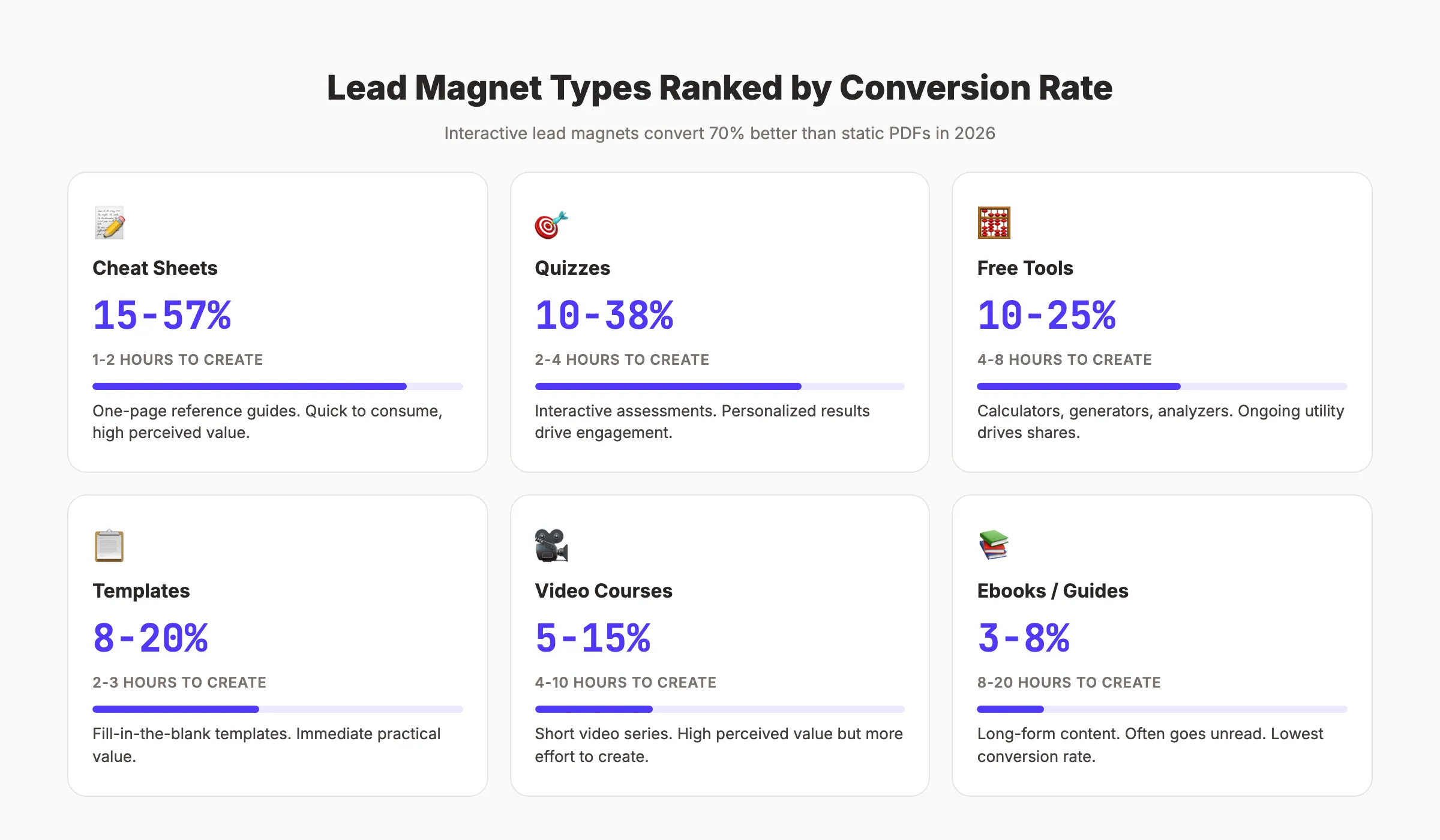
| Quizzes and assessments | 10 to 38% | 2 to 4 hours |
| Cheat sheets and checklists | 15 to 57% | 1 to 2 hours |
| Templates and swipe files | 8 to 20% | 2 to 3 hours |
| Free tools and calculators | 10 to 25% | 4 to 8 hours |
| Short video courses | 5 to 15% | 4 to 10 hours |
| Ebooks and guides | 3 to 8% | 8 to 20 hours |
Interactive lead magnets (quizzes, calculators, assessments) now convert 70% better than static PDFs. The reason is engagement. A quiz takes 2 minutes. A 40-page ebook sits unread in a downloads folder.
The lead magnet formula: Solve one specific problem in under 5 minutes. “The Complete Guide to Everything” does not convert. “5-Minute SEO Audit Checklist” does.
2. Pop-Up Forms (2 to 13% Conversion Rate)
Pop-ups have a bad reputation. They also work. Mailchimp reports that adding a pop-up form increases list growth rates by an average of 50.8%.
The key is timing and relevance:
- Exit-intent pop-ups appear only when the visitor moves to leave. Less intrusive. Strong conversion rates.
- Scroll-triggered pop-ups appear after a visitor reads 50 to 70% of a page. They have already shown interest.
- Timed pop-ups appear after 30 to 60 seconds on site. Avoid showing them in the first 10 seconds.
Gamified pop-ups (spin-to-win wheels, scratch cards) achieve a 13.23% average conversion rate according to OptiMonk data. That is 6 times the average opt-in rate.
3. Content Upgrades (10 to 30% Conversion Rate)
A content upgrade is a lead magnet specific to the page the visitor is reading. If someone reads your post about blog headlines, offer a “50 Headline Templates” PDF at the bottom of that post.
Content upgrades convert at 10 to 30% because the offer matches the intent. The visitor already cares about the topic. The upgrade gives them more of what they came for.
Rules for content upgrades:
- One upgrade per blog post (not a generic offer)
- The upgrade extends the article (templates, checklists, worksheets)
- Place the opt-in form inline, mid-article and at the end
- Deliver instantly via email autoresponder
4. Landing Pages (5 to 20% Conversion Rate)
A dedicated landing page with zero navigation and one call to action converts better than any sidebar form. Remove the header, footer, and menu. The only option should be to subscribe or leave.
Landing page essentials:
- Clear headline stating what the visitor gets
- 3 to 5 bullet points listing specific benefits
- One form field (email only) or two (name + email)
- Social proof (subscriber count, testimonials, logos)
- Benefit-oriented button text (“Get My Free Checklist” not “Submit”)
“Submit” and “Sign Up” are the worst-performing button labels. They describe the action instead of the benefit. “Get My Free Guide” outperforms “Submit” by 30% or more in most tests.
5. Gated Content on Your Blog (3 to 10% Conversion Rate)
Your blog already attracts visitors through organic traffic. Gating a portion of your best content turns readers into subscribers.
Two approaches work:
- Partial gate: Show the first 50% of the article freely. Require an email to read the rest.
- Bonus gate: The full article is free. A bonus resource (checklist, template, data) requires an email.
Bonus gates perform better because they do not frustrate readers. The visitor gets full value from the article and extra value from the bonus.
6. Webinars and Live Events (20 to 40% Registration Conversion)
Over 73% of marketing leaders rank webinars among their best lead magnets. Registration requires an email address, and attendees are highly engaged.
The webinar itself does not need to be long. 30 to 45 minutes is the sweet spot. Provide actionable content in the session and pitch your product or next step at the end.
Record every webinar. The replay becomes an evergreen lead magnet you can promote for months.
Your SEO team. $99 per month. Stacc publishes 30 optimized articles per month on autopilot. More content means more visitors to convert into subscribers. Start for $1 →
7. Social Media Lead Generation
Your social media followers already know your brand. Convert them into email subscribers with these methods:
- Link-in-bio pages with email sign-up forms (use Linktree, Stan, or a custom page)
- Instagram Stories with “Link” stickers pointing to lead magnets
- LinkedIn newsletter subscriptions that also capture email addresses
- Facebook and Instagram lead ads with pre-filled email forms
- Twitter/X pinned posts promoting your lead magnet
The goal is not to build your audience on social media. It is to move that audience from social (where you do not own the relationship) to email (where you do).
8. Referral Programs (Variable, Often 10 to 25% of New Subscribers)
Your best subscribers bring their friends. A referral program rewards existing subscribers for sharing your newsletter.
How to structure a referral program:
| Referrals | Reward |
|---|---|
| 1 friend subscribes | Free resource or template |
| 3 friends subscribe | Exclusive content or early access |
| 5 friends subscribe | Free product, consultation, or discount |
| 10 friends subscribe | Premium access or high-value gift |
Tools like SparkLoop, ReferralHero, and Viral Loops integrate with most email platforms to automate the tracking and reward delivery.
9. Checkout and Transaction Opt-Ins (40 to 60% Opt-In Rate)
If you sell anything online, the checkout page is your highest-converting email collection point. The buyer is already providing their email for the receipt. Add a checkbox: “Send me tips and exclusive offers.”
Transaction-based opt-ins convert at 40 to 60% because the trust barrier is already cleared. The person just gave you money. Subscribing to emails is a smaller ask by comparison.
Keep the checkbox unchecked by default if you operate in GDPR regions. In the US, a pre-checked box is acceptable under CAN-SPAM but still better left unchecked for trust.
10. Blog SEO as a List-Building Engine
Every blog post that ranks on Google is a permanent subscriber acquisition channel. A post generating 500 organic visitors per month converts 10 to 25 new subscribers if the opt-in form is placed well.
This is why content marketing strategy and email list building are inseparable. The blog attracts the traffic. The lead magnet converts the traffic. The email list monetizes the traffic.
Build your blog around topics your ideal subscribers search for. Write posts that answer specific questions. Place relevant lead magnets inside every post. This flywheel compounds over time.
For businesses without a content team, services like Stacc publish 30 SEO articles per month automatically. Every article becomes another entry point for email sign-ups.
Where to Place Opt-In Forms for Maximum Conversions
Most websites put a single opt-in form in the footer and call it done. That form converts at 0.5% or less because nobody scrolls to the footer to subscribe. Strategic placement makes the difference.
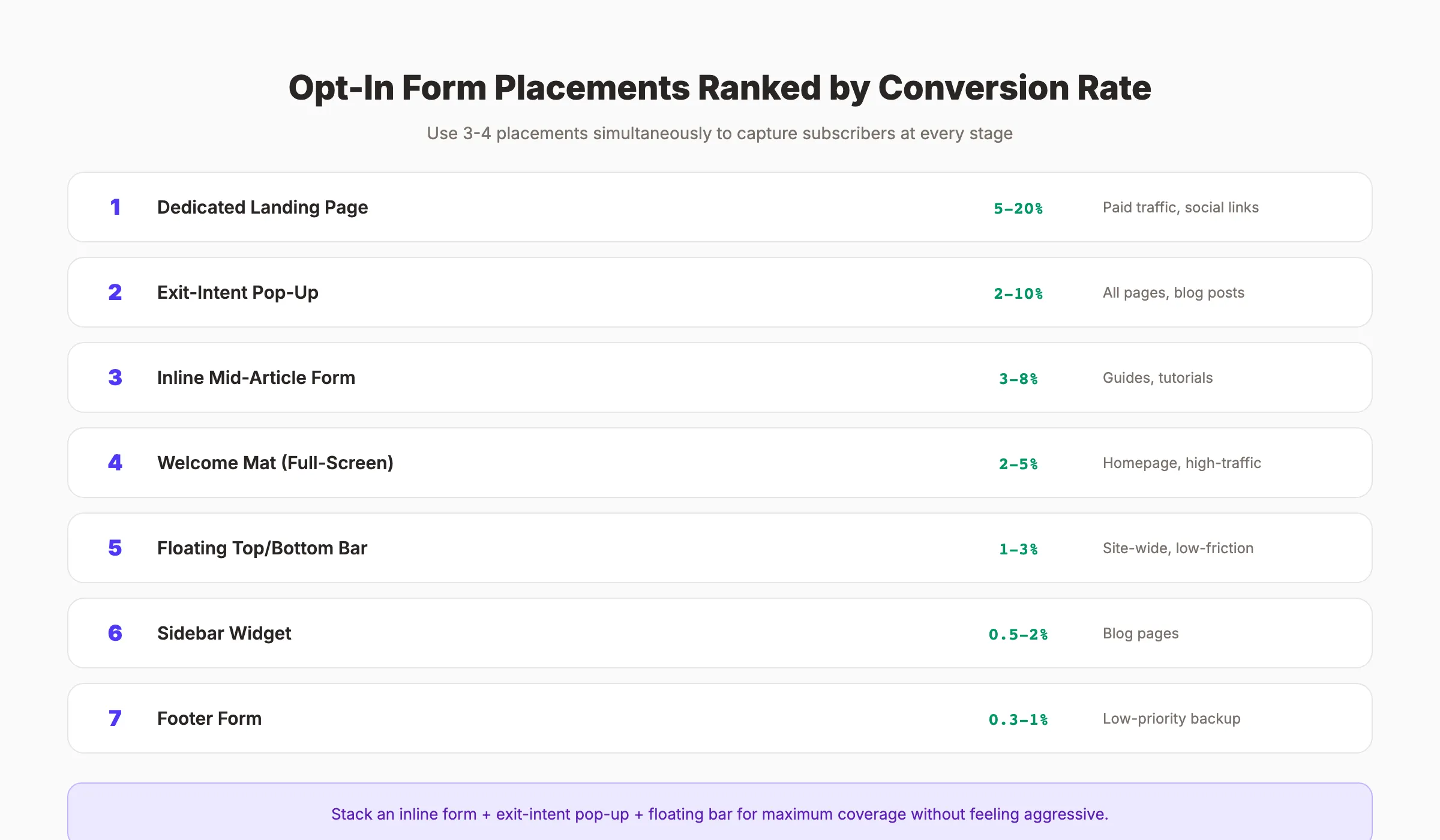
The 7 Highest-Converting Form Placements
| Placement | Conversion Rate | Best For |
|---|---|---|
| Dedicated landing page | 5 to 20% | Paid traffic, social media links |
| Exit-intent pop-up | 2 to 10% | All pages, especially blog posts |
| Inline mid-article | 3 to 8% | Blog posts, guides, tutorials |
| Welcome mat (full-screen) | 2 to 5% | Homepage, high-traffic pages |
| Floating bar (top or bottom) | 1 to 3% | Site-wide, low-friction |
| Sidebar widget | 0.5 to 2% | Blog pages |
| Footer form | 0.3 to 1% | Low-priority backup |
The stacking strategy: Use 3 to 4 placements simultaneously. An inline form mid-article, an exit-intent pop-up, and a floating bar will capture subscribers at different stages of engagement. This does not feel aggressive if each form offers genuine value.
Mobile Optimization Is Non-Negotiable
60% of emails are read on mobile devices. Your opt-in forms must work on small screens.
- Form fields are large enough to tap with a thumb
- Pop-ups take up no more than 50% of the screen (Google penalizes full-screen mobile pop-ups)
- Button text is readable at 16px or larger
- The form loads in under 2 seconds
- Auto-fill works for email fields
Google explicitly penalizes intrusive interstitials on mobile. A pop-up that blocks the entire screen on a phone will hurt your SEO rankings and your conversion rate.
Stop writing. Start ranking. Stacc publishes 30 SEO articles per month for your site. More traffic means more email subscribers. Start for $1 →
Post-Subscription: What Happens After They Sign Up
Getting the subscriber is only half the work. What you send in the first 48 hours determines whether they stay engaged or never open another email.
The Welcome Sequence (3 to 5 Emails)
Every new subscriber should receive an automated welcome sequence:
Email 1 (Immediate): Deliver the promised lead magnet. Set expectations for what they will receive and how often. Thank them.
Email 2 (Day 1 to 2): Share your best piece of content. Link to your most popular blog post, case study, or resource. Build value early.
Email 3 (Day 3 to 5): Tell your story. Who you are, what you do, and why it matters to them. Make it personal.
Email 4 (Day 5 to 7): Invite engagement. Ask a question. Request a reply. Subscribers who reply are 5 to 10 times more likely to stay engaged long-term.
Email 5 (Day 7 to 10): Soft pitch. Introduce your product or service with a relevant offer. No hard sell. Connect it to the problem your lead magnet addressed.
Welcome emails generate 320% more revenue per email than other promotional emails. Skipping the welcome sequence is leaving money on the table.
Segment From Day One
The moment someone subscribes, tag them based on:
- Source: Which lead magnet, form, or page did they subscribe from?
- Interest: What topic brought them to your site?
- Stage: Are they a browser, a prospect, or a buyer?
Segmented email campaigns produce 760% more revenue than unsegmented broadcasts. If you send the same email to every subscriber, you are wasting most of the list.
Use your email platform’s automation to tag subscribers automatically. Most platforms (Mailchimp, ConvertKit, ActiveCampaign, Klaviyo) support this natively.
Maintaining List Health: Growth, Decay, and Hygiene
An email list is a living asset. It grows, it decays, and it needs regular maintenance. Ignore list hygiene and your deliverability drops, your open rates tank, and your emails start landing in spam.
Email List Decay Is Real
Every email list loses 20 to 30% of its subscribers per year through:
- Unsubscribes (normal and healthy)
- Inactive subscribers who stop opening emails
- Changed email addresses (job changes, provider switches)
- Hard bounces (invalid addresses)
A list of 5,000 today becomes a list of 3,500 to 4,000 in 12 months if you do not actively replenish it.
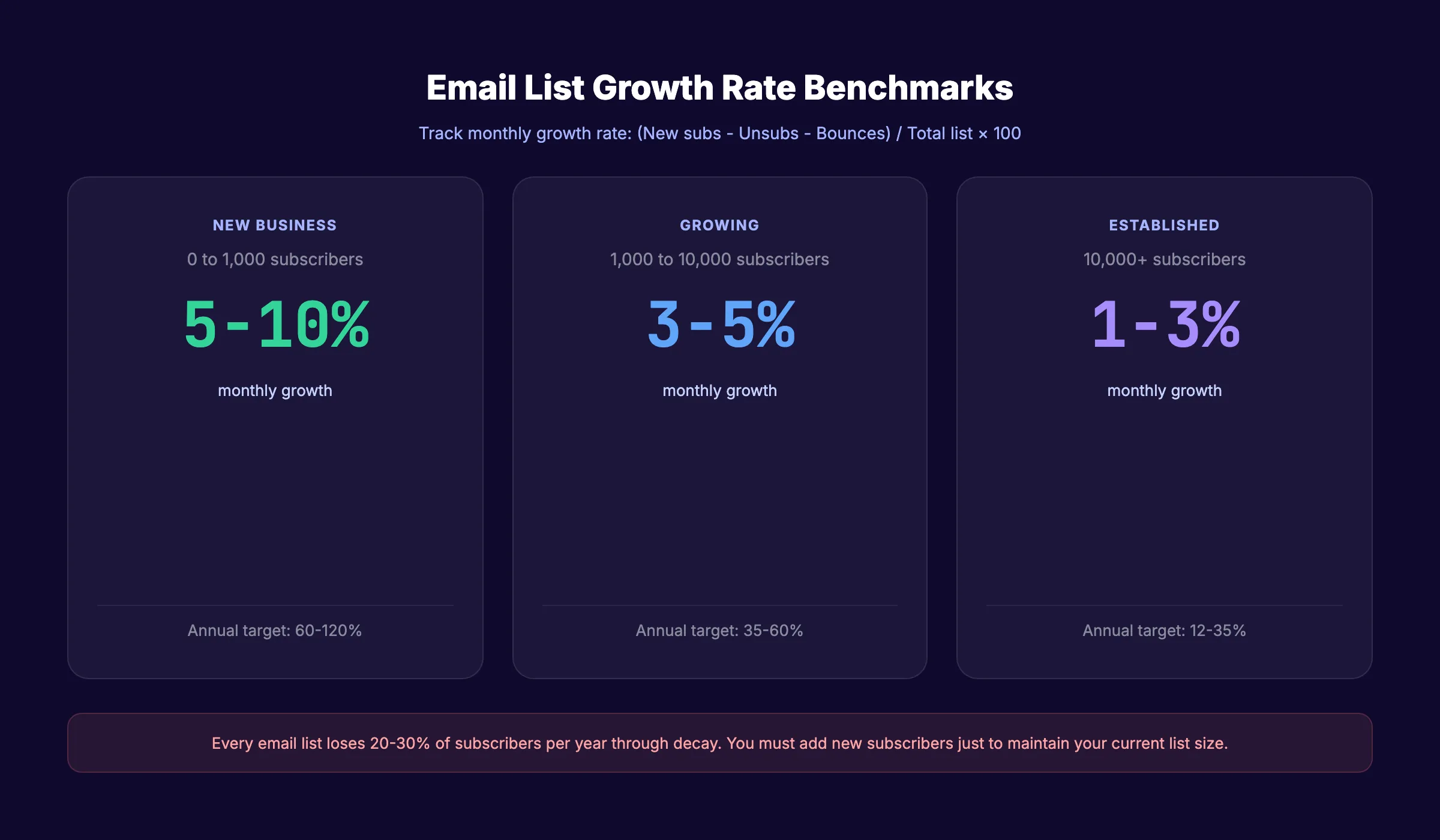
Growth Rate Benchmarks
| Business Stage | Healthy Monthly Growth | Annual Target |
|---|---|---|
| New (0 to 1,000 subscribers) | 5 to 10% | 60 to 120% |
| Growing (1,000 to 10,000) | 3 to 5% | 35 to 60% |
| Established (10,000+) | 1 to 3% | 12 to 35% |
Calculate your growth rate monthly: (New subscribers - Unsubscribes - Bounces) / Total list size x 100. Track this alongside your total list size.
The Quarterly Cleaning Checklist
- Remove all hard bounces (invalid addresses)
- Tag subscribers inactive for 90+ days
- Send a re-engagement campaign to inactive subscribers
- Remove subscribers who do not re-engage after 2 attempts
- Verify email addresses using ZeroBounce, NeverBounce, or similar tools
- Check for spam traps (recycled addresses that flag senders)
- Review and update segmentation tags
A clean list of 3,000 engaged subscribers delivers more revenue than a dirty list of 10,000. Vanity metrics do not pay the bills.
Email List Building Tools: What You Actually Need
You do not need 10 tools. You need 3: an email platform, an opt-in form builder, and a lead magnet delivery system. Most modern email platforms handle all 3.
Platform Comparison
| Platform | Best For | Free Plan | Starting Price |
|---|---|---|---|
| Mailchimp | Beginners, small businesses | Up to 500 contacts | $13/mo |
| ConvertKit | Creators, bloggers | Up to 1,000 contacts | $9/mo |
| ActiveCampaign | Advanced automation | No free plan | $15/mo |
| Klaviyo | E-commerce businesses | Up to 250 contacts | $20/mo |
| Brevo (Sendinblue) | Transactional + marketing | Up to 300 emails/day | $9/mo |
| Constant Contact | Local businesses | No free plan | $12/mo |
Choose based on your business type:
- Selling physical products? Klaviyo integrates with Shopify and WooCommerce natively.
- Running a blog or creator business? ConvertKit’s tagging and automation is built for content creators.
- Small business with a local content marketing focus? Mailchimp or Constant Contact covers the basics.
- Need advanced automation workflows? ActiveCampaign is the standard.
Dedicated Opt-In Form Tools
If your email platform’s built-in forms are limited, these tools specialize in high-converting opt-in experiences:
- OptinMonster. Pop-ups, floating bars, exit-intent. The most options.
- Sumo (BDOW!). Free tier available. Simple pop-ups and scroll boxes.
- Hello Bar. Top-of-page notification bars. Clean and minimal.
- Thrive Leads. WordPress plugin with A/B testing built in.
Lead Magnet Delivery
Most email platforms deliver the lead magnet automatically in the welcome email. For larger files or gated content, use:
- Google Drive or Dropbox links in the confirmation email
- Gumroad (free product listing with email capture)
- A hidden page on your website accessible only via the welcome email link
3,500+ blogs published. 92% average SEO score. See what Stacc can do for your site. Start for $1 →
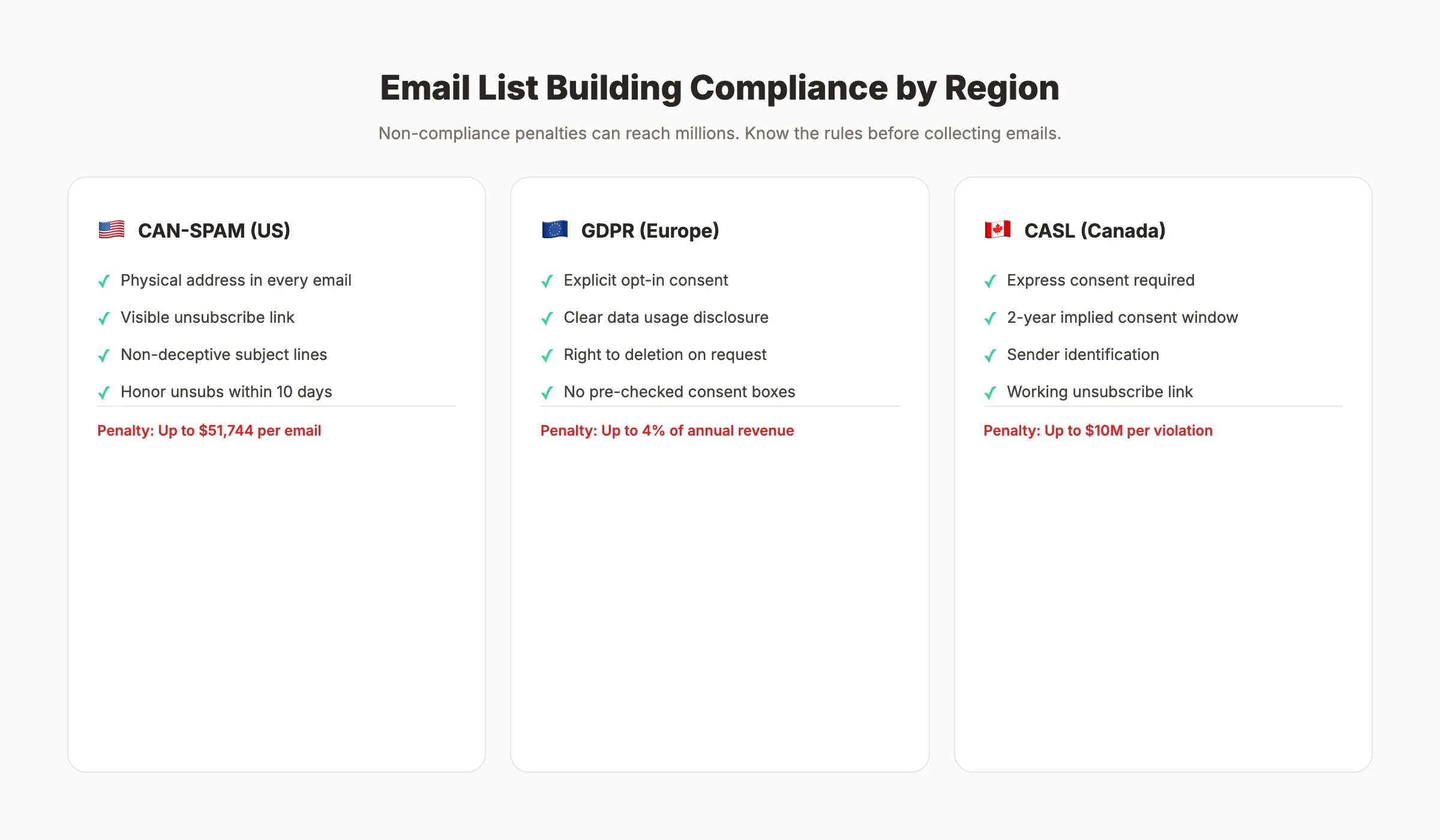
Compliance: Legal Rules for Email List Building
Building an email list without proper consent is not just unethical. It is illegal in most countries. Here are the rules you must follow.
CAN-SPAM (United States)
- Every marketing email must include a physical mailing address
- Every email must have a visible unsubscribe link
- Unsubscribe requests must be honored within 10 business days
- Subject lines must not be deceptive
- Penalty: Up to $51,744 per violation
GDPR (European Union)
- Explicit opt-in consent required (no pre-checked boxes)
- Subscribers must know how their data will be used
- Right to be forgotten (delete all data on request)
- Applies to any business emailing EU residents, regardless of location
- Penalty: Up to 4% of annual global revenue
CASL (Canada)
- Express consent required before sending marketing emails
- Existing business relationship provides 2 years of implied consent
- Must identify the sender and include contact information
- Penalty: Up to $10 million per violation
Universal Best Practices
- Never buy or rent email lists
- Use double opt-in for all website sign-ups
- Include a privacy statement near every opt-in form
- Keep records of when and how each subscriber opted in
- Make unsubscribing easy (one click, no login required)
- Process unsubscribes immediately
Your email platform handles most technical compliance automatically. But you are responsible for how you collect addresses and what you promise subscribers.
FAQ
How long does it take to build an email list of 1,000 subscribers?
It depends on your traffic and conversion rate. A website with 5,000 monthly visitors and a 3% opt-in rate adds 150 subscribers per month. At that pace, you reach 1,000 in about 7 months. Higher traffic and better lead magnets shorten the timeline. Paid ads can accelerate it to 4 to 8 weeks.
Should I use single or double opt-in?
Double opt-in (requiring email confirmation) produces a higher-quality list with better deliverability and fewer spam complaints. Single opt-in grows the list faster but includes more invalid addresses. Use double opt-in unless you have a specific reason not to. GDPR-regulated businesses should always use double opt-in.
Is it worth buying an email list?
No. Purchased lists contain people who never asked to hear from you. Open rates drop below 5%. Spam complaints spike. Your sender reputation tanks. Your email platform may ban your account. Build your list organically. It takes longer but produces subscribers who actually want your content.
How often should I email my list?
1 to 2 emails per week is the sweet spot for most businesses. Less than 1 per month causes subscribers to forget who you are. More than 3 per week increases unsubscribes. Test your frequency and track unsubscribe rates to find the right cadence for your audience.
What is a good email opt-in conversion rate?
The average across all industries is 1.95%. Anything above 3% is good. Above 5% is excellent. The best lead magnets with dedicated landing pages can convert at 10 to 30%. Pop-ups average 2 to 5%. If your opt-in rate is below 1%, your offer or placement needs work.
How does blog content help build an email list?
Every blog post that ranks on Google brings organic visitors to your site. Each visitor is a potential subscriber. Place relevant lead magnets inside your posts, use inline opt-in forms, and gate bonus content. A blog producing 10,000 monthly visitors at a 3% opt-in rate adds 300 subscribers per month. That is why SEO content writing and email list building go hand-in-hand.
Your email list compounds over time. Every subscriber you add today is someone you can reach next month, next quarter, and next year without paying for another ad click. Start with one strong lead magnet. Place it where your audience already visits. Build the welcome sequence. Clean the list quarterly. The businesses that treat email list building as a system instead of a one-time project are the ones that win.
Related Tools & Resources
Free SEO Tools:
Best Lists:

Written by
Siddharth GangalSiddharth is the founder of theStacc and Arka360, and a graduate of IIT Mandi. He spent years watching great businesses lose organic traffic to competitors who simply published more. So he built a system to fix that. He writes about SEO, content at scale, and the tactics that actually move rankings.
30 SEO blog articles published every month
Keyword-optimized, scheduled, and live on your site. Automatically.
30-day trial · Cancel anytime
theStacc
Stop writing SEO content manually
30 blog articles, 30 GBP posts, and social media content. Published every month. Automatically.
Start Your $1 Trial$1 for 3 days · Cancel anytime