Voice Commerce: The Complete Guide (2026)
Voice commerce lets consumers buy products through voice assistants. Learn how it works, key stats, and how to optimize your business. Updated April 2026.
Siddharth Gangal • 2026-04-02 • SEO Tips
In This Article
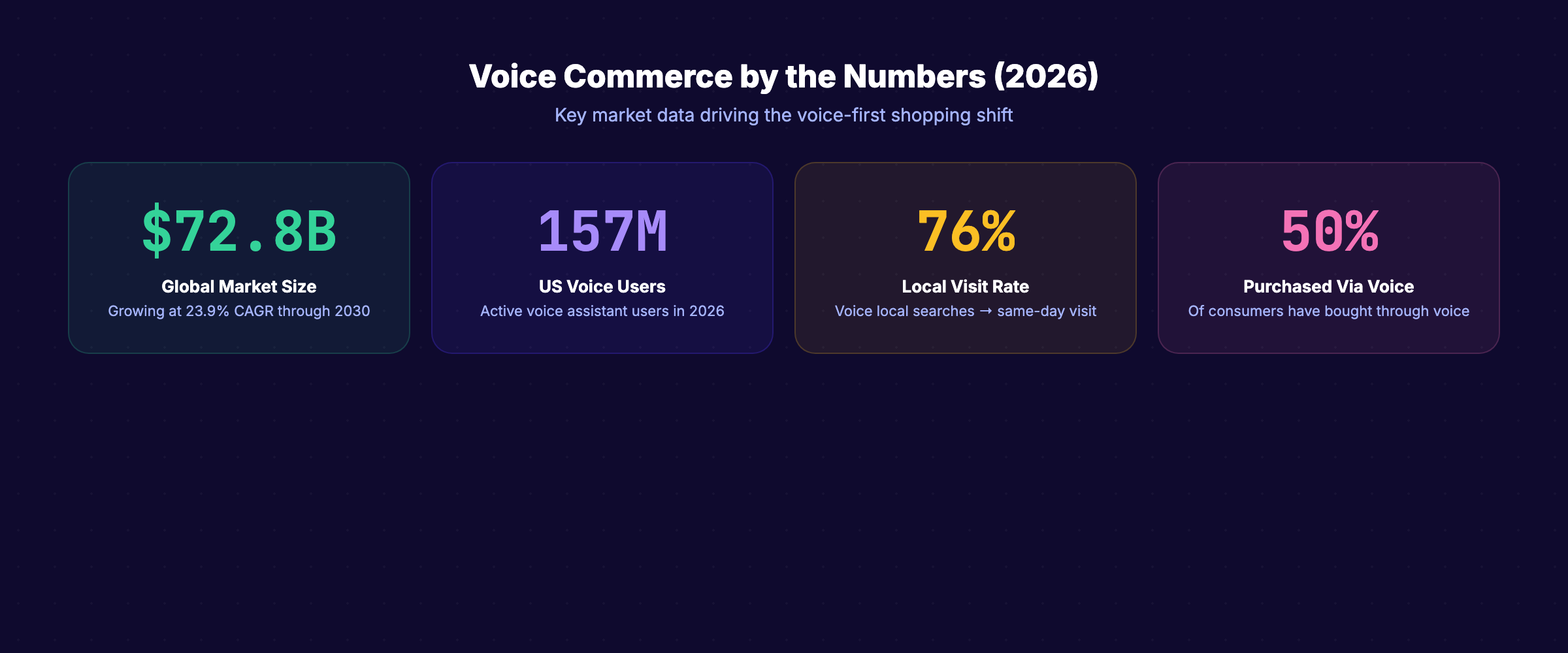
The global voice commerce market reached $72.8 billion in 2026 and is growing at 23.9% annually. 157.1 million Americans now use voice assistants. And 50% of consumers have already made a purchase using voice commands.
Voice commerce is the practice of buying products and services through voice-enabled devices. Consumers speak to Alexa, Google Assistant, or Siri instead of typing, clicking, and browsing. The assistant finds products, compares options, and completes the purchase.
For businesses, voice commerce creates a new discovery channel where traditional SEO rules do not fully apply. Voice queries average 29 words compared to 3 to 4 words for typed searches. And 76% of voice searches with local intent result in a same-day visit.
We have published 3,500+ SEO articles across 70+ industries and tracked how voice search reshapes local and ecommerce discovery. This guide covers what voice commerce is, how it works, the market data behind the shift, and how to optimize your business for voice-driven sales.
Here is what you will learn:
- What voice commerce means and how it differs from traditional ecommerce
- The technology stack behind voice-enabled purchasing
- Market size data and consumer adoption statistics
- How voice search changes SEO and content strategy
- The optimization checklist for voice commerce visibility
- How voice commerce connects to AI search and the answer economy
What Is Voice Commerce?
Voice commerce is any purchase or shopping decision made through voice-enabled technology. A consumer speaks a command to a smart speaker, phone assistant, or connected device. The device interprets the request, searches for relevant products, and can complete the transaction without the consumer touching a screen.
The simplest example: “Alexa, reorder my coffee pods.” Alexa checks your purchase history, confirms the product and price, and places the order using your stored payment method. The entire transaction happens in under 15 seconds.
But voice commerce extends far beyond reorders. Modern voice assistants handle product discovery (“find running shoes for flat feet under $120”), price comparison (“is this cheaper on Amazon or Walmart”), and complex purchasing decisions (“book a restaurant for 4 people Saturday at 7 PM near downtown”).
Voice Commerce vs Traditional Ecommerce
| Factor | Traditional Ecommerce | Voice Commerce |
|---|---|---|
| Input method | Typed keywords, clicks | Spoken natural language |
| Query length | 3-4 words average | 29 words average |
| Product display | Visual grid with images | Single spoken recommendation |
| Decision process | Browse, compare, add to cart | Ask, listen, confirm |
| Results shown | 10-50 products per page | 1-3 recommendations |
| Transaction speed | 3-10 minutes per purchase | Under 60 seconds |
| Device | Computer, phone, tablet | Smart speaker, phone, car, TV |
The critical difference is selection. On a website, consumers see dozens of options. Through voice, they hear 1 to 3 recommendations. The brands that voice assistants recommend capture the sale. The brands they skip lose entirely.
How Voice Commerce Technology Works
Voice commerce runs on 3 core technologies working together.
Automatic Speech Recognition (ASR)
ASR converts spoken words into text. When you say “order paper towels,” the device converts your audio into a text string the system can process. Modern ASR achieves 95%+ accuracy in quiet environments.
Natural Language Understanding (NLU)
NLU interprets the text to determine what you actually want. “Order paper towels” and “I need more paper towels” and “can you get me paper towels” all mean the same thing. NLU extracts the intent (purchase) and the entity (paper towels) regardless of phrasing.
Text-to-Speech Synthesis (TTS)
TTS generates the spoken response. The assistant reads product names, prices, and delivery estimates back to you. Quality TTS sounds natural, not robotic, which builds consumer trust in the purchasing process.
These 3 technologies connect to commerce APIs that access product catalogs, inventory data, pricing, and payment processing. The technical chain runs: voice input → ASR → NLU → product search → recommendation engine → TTS → voice confirmation → payment processing.
For businesses, the optimization opportunity sits in the product search and recommendation engine layer. That is where voice assistants decide which products to recommend. And that decision depends on the same signals that drive SEO: structured data, authority, reviews, and content quality.
Your SEO team. $99 per month. 30 optimized articles per month build the content signals that voice assistants use to recommend your brand. Start for $1 →
Voice Commerce Market Data
The numbers behind voice commerce show sustained growth across every metric.
| Metric | Data Point | Source |
|---|---|---|
| Global market size (2026) | $72.8 billion | Ringly/Industry reports |
| Projected market (2030) | $147.9 billion | Grand View Research |
| CAGR (2024-2030) | 20% | Grand View Research |
| US voice assistant users (2026) | 157.1 million | Industry estimates |
| Consumers who purchased via voice | 50% | Capital One Shopping |
| Voice searches with local intent resulting in same-day visit | 76% | Local SEO research |
| Smart speaker ownership (US households) | 35%+ | Consumer surveys |
| Share of voice answers from Position Zero | 40-60% | Featured snippet studies |
Who Uses Voice Commerce
Voice commerce adoption varies by demographic and use case.
Highest adoption: Routine reorders (groceries, household supplies), local business searches (“restaurants near me”), and quick information queries that lead to purchases.
Growing adoption: Fashion and beauty product discovery, travel booking, and B2B procurement for office supplies.
Lower adoption: High-consideration purchases (electronics, furniture) where consumers want to see the product before buying. These queries often start with voice but finish on a screen.
The pattern is clear. Voice commerce excels at convenience purchases and local discovery. For businesses in these categories, voice optimization is not optional.
Voice Commerce by Industry
| Industry | Voice Commerce Use Case | Adoption Level | Revenue Potential |
|---|---|---|---|
| Grocery and household | Reorders, list building, delivery scheduling | High | $15B+ annually |
| Local services | ”Find a [business] near me” queries | High | Direct store visits |
| Restaurant and food delivery | Ordering, reservations, menu queries | High | 20%+ of orders |
| Travel and hospitality | Flight booking, hotel search, car rental | Medium-high | $8B+ annually |
| Fashion and beauty | Product discovery, shade matching, reviews | Medium | Growing fast |
| Electronics | Research and price comparison (often finishes on screen) | Medium-low | Discovery stage |
| B2B procurement | Routine supply reorders, inventory checks | Emerging | Office supplies lead |
The industries with the highest voice commerce adoption share 2 traits: frequent repeat purchases and clear product specifications. Groceries and household supplies fit perfectly. Complex, visual, or high-consideration purchases are slower to adopt but growing.
How Voice Search Changes SEO
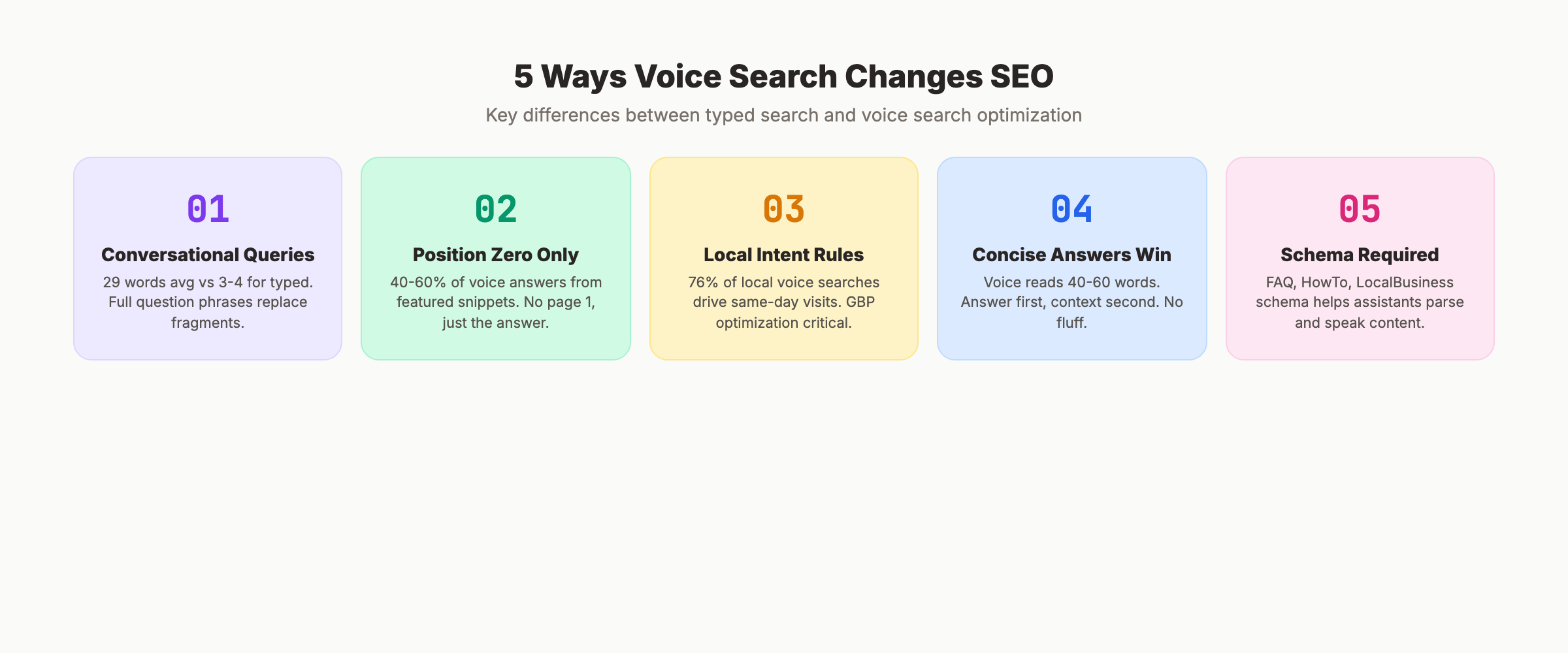
Voice search requires different optimization than traditional typed search. Here are the 5 key differences that affect your content strategy.
1. Conversational Queries Replace Keywords
Typed search: “best plumber Austin TX” Voice search: “Who is the best plumber near me that is open right now?”
Voice queries are longer, more specific, and phrased as complete questions. Keyword research for voice must target question-based phrases, not 2 to 3 word keyword fragments.
2. Position Zero Wins Everything
40 to 60% of voice answers come from featured snippets (Position Zero). If your content does not hold the featured snippet, voice assistants skip it. There is no “page 1” in voice search. There is only the answer.
Our guide on getting featured snippets covers the exact formatting that earns Position Zero.
3. Local Intent Dominates
76% of voice searches with local intent result in a same-day store visit. “Find a dentist near me” and “what time does the hardware store close” are high-conversion voice queries.
Local businesses that optimize their Google Business Profile and maintain strong local SEO capture this traffic. Businesses with incomplete profiles lose it.
4. Answers Must Be Concise
Voice assistants read a 40 to 60 word answer. They do not read a 2,000-word article. Your content must contain a direct, concise answer in the first paragraph of each section. This is the same principle behind optimizing your first 200 words for AI retrieval.
Structure content with clear H2 questions and 40 to 60 word direct answers immediately below each heading.
5. Schema Markup Drives Selection
FAQ, HowTo, and LocalBusiness schema help voice assistants understand and extract your content. Without structured data, voice assistants struggle to parse your content into a speakable answer.
Our schema markup SEO guide covers the implementation for each schema type.
3,500+ blogs published. 92% average SEO score. Every article uses answer-first formatting that voice assistants can extract and recommend. Start for $1 →
The Voice Commerce Optimization Checklist
Use this checklist to prepare your business for voice-driven discovery and purchasing.
Content Optimization
- Target question-based long-tail keywords (who, what, where, when, how, why)
- Answer each question directly in the first 40 to 60 words of the section
- Keep answer paragraphs under 3 sentences (voice assistants prefer brevity)
- Use conversational language that mirrors how people speak
- Create FAQ pages for common customer questions
- Structure all content with clear on-page SEO best practices
Technical SEO
- Add FAQ schema to every page with question-answer content
- Add HowTo schema to instructional content
- Add LocalBusiness schema with complete business information
- Add speakable schema properties to key passages
- Ensure pages load under 3 seconds (voice results favor fast sites)
- Verify mobile-friendliness (most voice searches originate from mobile devices)
Local SEO for Voice
- Claim and fully optimize your Google Business Profile
- Maintain accurate NAP (name, address, phone) across all directories
- Keep business hours current (voice assistants filter by availability)
- Generate consistent reviews (voice assistants use ratings for recommendations)
- Create location-specific content for each service area
- Build local citations on major directories
Product Data (for Ecommerce)
- Add Product schema with price, availability, and review ratings
- Ensure product descriptions use natural language (not keyword-stuffed)
- Maintain accurate real-time inventory data
- Optimize for Amazon Alexa by maintaining strong seller metrics and Prime eligibility
- Use clear, speakable product names (not codes or abbreviations)
Voice Commerce and the Broader AI Search Shift
Voice commerce does not exist in isolation. It connects directly to 3 other trends reshaping how consumers find and buy products.
Voice Commerce + Agentic Commerce
Voice is becoming the primary interface for agentic commerce. Consumers speak their intent. AI agents execute the research, comparison, and purchase. The voice command “find me a nonstop flight to London under $600” triggers an agentic workflow where the AI searches airlines, evaluates options, and books the flight.
Voice is the input. Agentic commerce is the engine. Together they create a zero-screen purchasing experience.
Voice Commerce + The Answer Economy
Voice search is the purest expression of the answer economy. Every voice query expects a direct answer. There are no links to browse. There are no pages to scroll. The assistant gives one answer, and the consumer acts on it.
Businesses that structure their content for answer-first formatting win in both voice search and AI-generated answers. The optimization is the same. Lead with the answer. Back it with data. Structure for extraction.
Voice Commerce + LLM Visibility
Voice assistants increasingly use LLM technology to generate responses. When a consumer asks Google Assistant a complex question, the response draws from the same AI models that power Google AI Mode.
LLM visibility determines whether your brand appears in voice assistant recommendations. The signals that drive LLM citations (brand authority, content depth, multi-platform presence) also drive voice commerce recommendations.
The businesses that invest in AI search visibility automatically improve their voice commerce visibility. The overlap is 80% or more.
The Convergence Advantage
Here is the practical takeaway. You do not need separate optimization strategies for voice commerce, AI search, and traditional SEO. The actions that improve one channel improve all 3.
Answer-first content formatting works for voice search, AI Overviews, ChatGPT citations, and featured snippets. Schema markup helps voice assistants, AI crawlers, and Google Search. Brand authority signals drive recommendations across every AI-enabled channel.
This convergence means that every investment in content quality and technical SEO pays dividends across an expanding number of discovery channels. The businesses publishing 30 articles per month build the content density that feeds all of these channels simultaneously. The Content Compound Effect applies across voice, AI, and traditional search.
Voice Commerce for Different Business Types
Local Service Businesses
Voice search is the highest-impact channel for local businesses. “Find a plumber near me” and “best pizza delivery open now” are voice queries that convert directly to revenue.
Priority actions: Optimize your Google Business Profile with complete information, accurate hours, and active reviews. Create location-specific content that answers common customer questions. Maintain a dynamic GBP with weekly posts and fresh photos.
Ecommerce Brands
Voice commerce for ecommerce focuses on product discovery and reorder convenience. The brands that appear in voice product recommendations earn the sale.
Priority actions: Add complete Product schema to every product page. Use natural language product descriptions. Maintain Amazon seller metrics for Alexa recommendations. Build brand recognition through consistent content publishing.
Restaurants and Hospitality
“Find a restaurant near me” is one of the most common voice queries. Voice assistants use GBP data, reviews, and menu information to generate recommendations.
Priority actions: Keep menus, hours, and reservation links current. Generate consistent reviews (volume and recency both matter). Add Menu schema markup if applicable.
B2B Companies
Voice commerce for B2B is emerging through routine procurement. Operations managers use voice to reorder office supplies, check inventory levels, and trigger purchasing workflows. The opportunity for B2B companies is building the structured product data that voice procurement systems can query.
Priority actions: Ensure product catalogs include clear, speakable product names. Build FAQ content around common procurement questions. Create content that builds topical authority in your product category so voice assistants recognize your brand as a category leader.
Content Publishers
Publishers benefit from voice search through content discovery. When voice assistants answer questions by citing sources, publishers with answer-first content formatting get the citation. The traffic comes through follow-up screen interactions where users read the full article after hearing the voice summary.
Priority actions: Structure content with question-based H2 headings. Place direct answers in the first 40 to 60 words of each section. Implement Article and FAQ schema on all content pages. Focus on getting cited in AI search as the principles overlap directly with voice citation.
Rank everywhere. Do nothing. Blog SEO, Local SEO, and Social on autopilot. Build voice commerce visibility while you focus on your business. Start for $1 →
FAQ
Is voice commerce the same as voice search?
No. Voice search is the act of using voice to find information. Voice commerce is the act of using voice to make a purchase. Voice search often leads to voice commerce, but not all voice searches result in a transaction. Optimizing for voice search improves both information discovery and purchase conversion.
Which voice assistant has the largest market share?
Amazon Alexa leads in smart speaker market share. Google Assistant dominates on mobile devices. Apple Siri has the largest installed base across iPhones and Apple devices. Optimize for all 3 by focusing on structured data, featured snippets, and strong local SEO signals.
Do I need a special app or integration for voice commerce?
For basic voice discovery (appearing in voice search results), no special integration is needed. Standard SEO optimization and schema markup are sufficient. For transactional voice commerce (letting customers buy through voice), you need platform-specific integrations (Alexa Skills for Amazon, Actions on Google for Google Assistant).
How important is voice commerce for local businesses?
Critical. 76% of voice searches with local intent result in a same-day visit. Local businesses with optimized GBP profiles, strong reviews, and location-specific content capture this high-intent traffic. Businesses without these signals are invisible to voice assistants.
What percentage of voice search answers come from featured snippets?
40 to 60% of voice answers pull from Position Zero (featured snippets). Structuring your content with clear questions as H2 headings and direct 40 to 60 word answers immediately below is the most effective way to capture voice search visibility.
How does voice commerce relate to AI search optimization?
Voice commerce is one channel within the broader AI search shift. The optimization principles overlap significantly with generative engine optimization and LLM visibility. Answer-first content formatting, schema markup, and brand authority signals all improve visibility across voice, AI Overviews, ChatGPT, and Perplexity simultaneously.
Voice commerce is growing at 20%+ annually because consumers prefer speaking over typing for routine purchases and local discovery. The businesses that optimize for voice now will own the recommendations when the next 50 million users adopt voice assistants. Start with the content optimization checklist above. Then add schema markup and local SEO signals. Every improvement compounds across voice, AI search, and traditional SEO simultaneously. The earlier you start, the wider the gap between you and competitors who wait.
Written and published by Stacc. We publish 3,500+ articles per month across 70+ industries. All data verified against public sources as of March 2026.