
What Is Agentic Commerce? The Complete Guide (2026)
Agentic commerce lets AI agents shop, compare, and buy on behalf of consumers. Learn what it means for SEO, ecommerce, and your business. Updated April 2026.
During Cyber Week 2025, 20% of all global orders were influenced by AI agents or shopping assistants. By 2030, McKinsey projects agentic commerce will drive $3 to $5 trillion in annual transaction volume globally.
Agentic commerce is not a buzzword. It is a structural shift in how people buy things online. AI agents now research products, compare prices, filter options, and complete purchases on behalf of consumers. The human never visits your website. The agent does.
For businesses that depend on organic traffic, this changes everything. The question is no longer “how do I rank?” It is “how do I get selected by an AI agent?”
We have published 3,500+ SEO articles across 70+ industries and tracked how AI search features reshape organic discovery. This guide explains what agentic commerce is, how it works, which platforms are driving it, and what your business needs to do about it.
Here is what you will learn:
- What agentic commerce means and how it differs from traditional ecommerce
- The major platforms building AI shopping agents right now
- How agentic commerce changes SEO and organic discovery
- What businesses must do to stay visible when AI agents shop for consumers
- The market data behind this shift and what it means for 2026 and beyond
What Is Agentic Commerce?
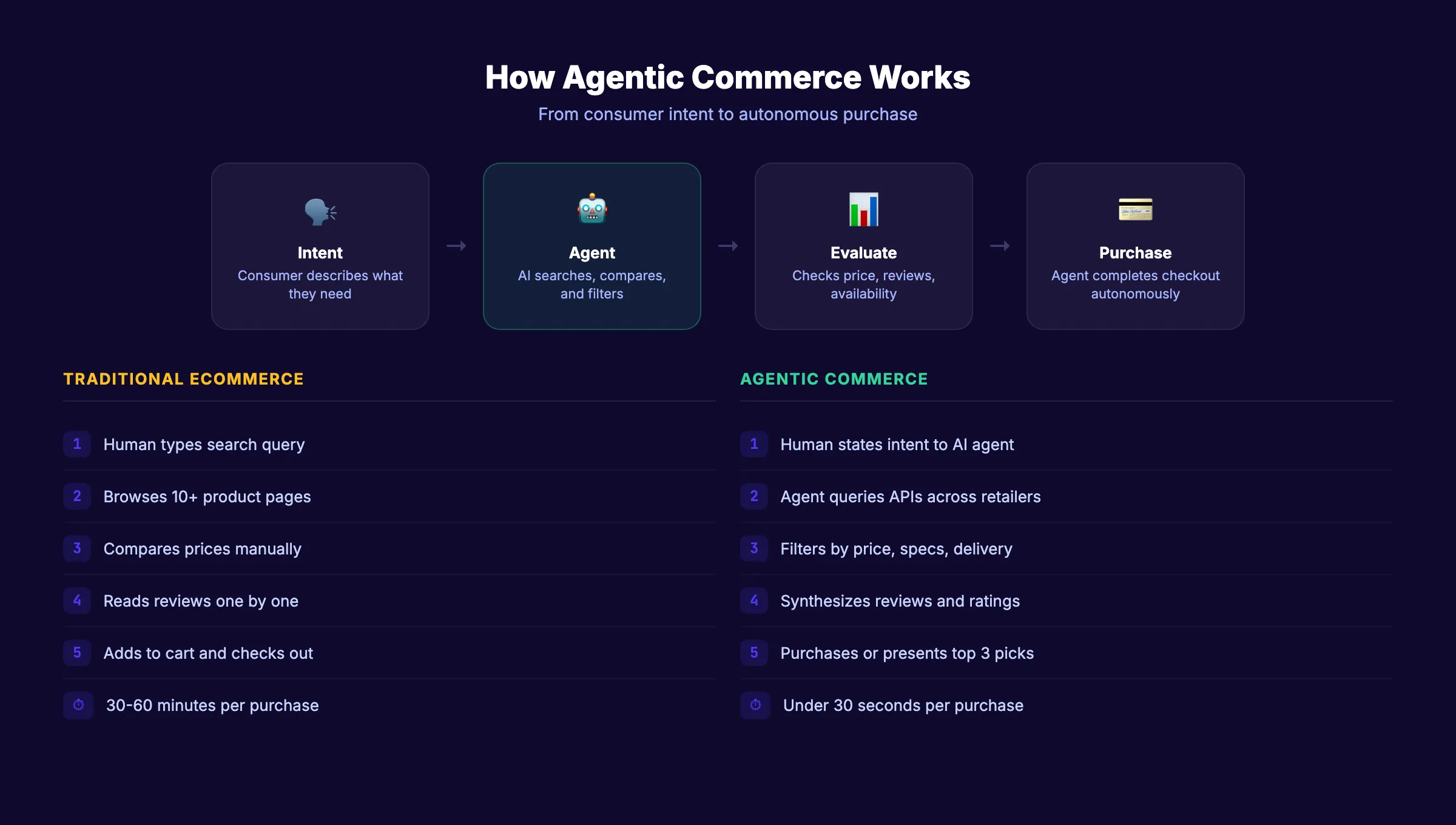
Agentic commerce is an approach to buying and selling where AI agents act on behalf of consumers or businesses to research, compare, negotiate, and complete purchases. The agent operates autonomously within boundaries the user sets.
Think of it this way. Traditional ecommerce requires a person to search, browse, compare, add to cart, and check out. Agentic commerce removes every step except the initial intent.
A consumer tells an AI agent: “Find me a camping tent under $150. Deliver by Friday. Four-season rated.” The agent searches across retailers, evaluates reviews and specifications, compares prices and delivery options, and either recommends the best match or purchases it directly.
The key word is autonomy. These are not chatbots that answer questions. They are goal-oriented systems that plan, reason, and act without needing human approval at every step.
How Agentic Commerce Differs from Previous AI Shopping
| Feature | Chatbot Era (2020-2023) | AI Recommendations (2024) | Agentic Commerce (2025+) |
|---|---|---|---|
| User role | Types queries, makes decisions | Reviews suggestions, clicks to buy | Sets intent, agent handles the rest |
| Agent action | Answers questions | Suggests products | Researches, compares, and purchases |
| Data sources | Single retailer catalog | Multiple product feeds | Cross-platform APIs and real-time inventory |
| Transaction | User completes checkout | User clicks affiliate link | Agent completes checkout autonomously |
| Personalization | Basic history-based | Preference-based | Context-aware (budget, past behavior, location) |
The shift is from assisted shopping to delegated shopping. The consumer does not browse. The agent does.
The Major Platforms Driving Agentic Commerce
Every major tech company has entered this space. Here are the 4 platforms that matter most for businesses in 2026.
Google Shopping and AI Mode
Google announced agentic commerce tools that let users track product prices and authorize Google to purchase on their behalf when conditions are met. Currently available with select merchants including Wayfair, Chewy, and Shopify stores.
Google also introduced the Universal Commerce Protocol (UCP), a standardized way for retailers to make their product data accessible to AI agents. This matters for SEO because UCP compliance determines whether your products are eligible for agent-driven discovery.
OpenAI and ChatGPT Shopping
OpenAI launched the Agentic Commerce Protocol (ACP), which allows merchants to feed product catalogs directly into ChatGPT. The current model focuses on product discovery. ChatGPT surfaces products, and shoppers click through to your store to buy.
ChatGPT charges a 4% transaction fee through ACP with no listing fees. Integration works through direct API connections or through Shopify Agentic Storefronts.
Perplexity Buy with Pro
Perplexity built “Buy with Pro,” a feature that lets Pro subscribers compare and purchase products directly inside the Perplexity interface. Products with PayPal checkout enabled can process transactions without leaving the platform.
Perplexity charges nothing to merchants. Products with in-platform checkout receive a ranking boost in Perplexity product discovery results.
Amazon Buy for Me
Amazon launched “Buy for Me,” which purchases items from third-party retailers outside Amazon. The AI agent finds what you need, completes the purchase on the external retailer site, and handles the transaction while you stay inside the Amazon app.
This is significant because Amazon is using its own AI agent to buy from competitors, demonstrating that agentic commerce creates cross-platform purchasing behavior.
Platform Comparison at a Glance
| Platform | Transaction Model | Merchant Cost | Checkout Location | Integration Path |
|---|---|---|---|---|
| Google AI Mode | Agent buys on retailer site | Standard Google Shopping | Retailer site | Universal Commerce Protocol |
| ChatGPT (ACP) | Discovery + click-through | 4% transaction fee | Merchant site | Shopify or direct API |
| Perplexity | In-platform purchase | Free for merchants | Inside Perplexity app | PayPal checkout |
| Amazon Buy for Me | Agent buys on external site | N/A (third-party purchase) | External retailer | No direct integration yet |
Each platform handles transactions differently. That means brands need to optimize for multiple agent protocols, not just one. The fragmentation is similar to what happened with social media marketing in the early 2010s. Early movers on each platform captured disproportionate market share.
Stop writing. Start ranking. Stacc publishes 30 SEO articles per month for $99. Stay visible to both human searchers and AI agents. Start for $1 →
How Agentic Commerce Changes SEO
Most SEO advice in 2026 still focuses on ranking for keywords. Agentic commerce makes that framework incomplete. Here is what changes.
From Ranking to Eligibility
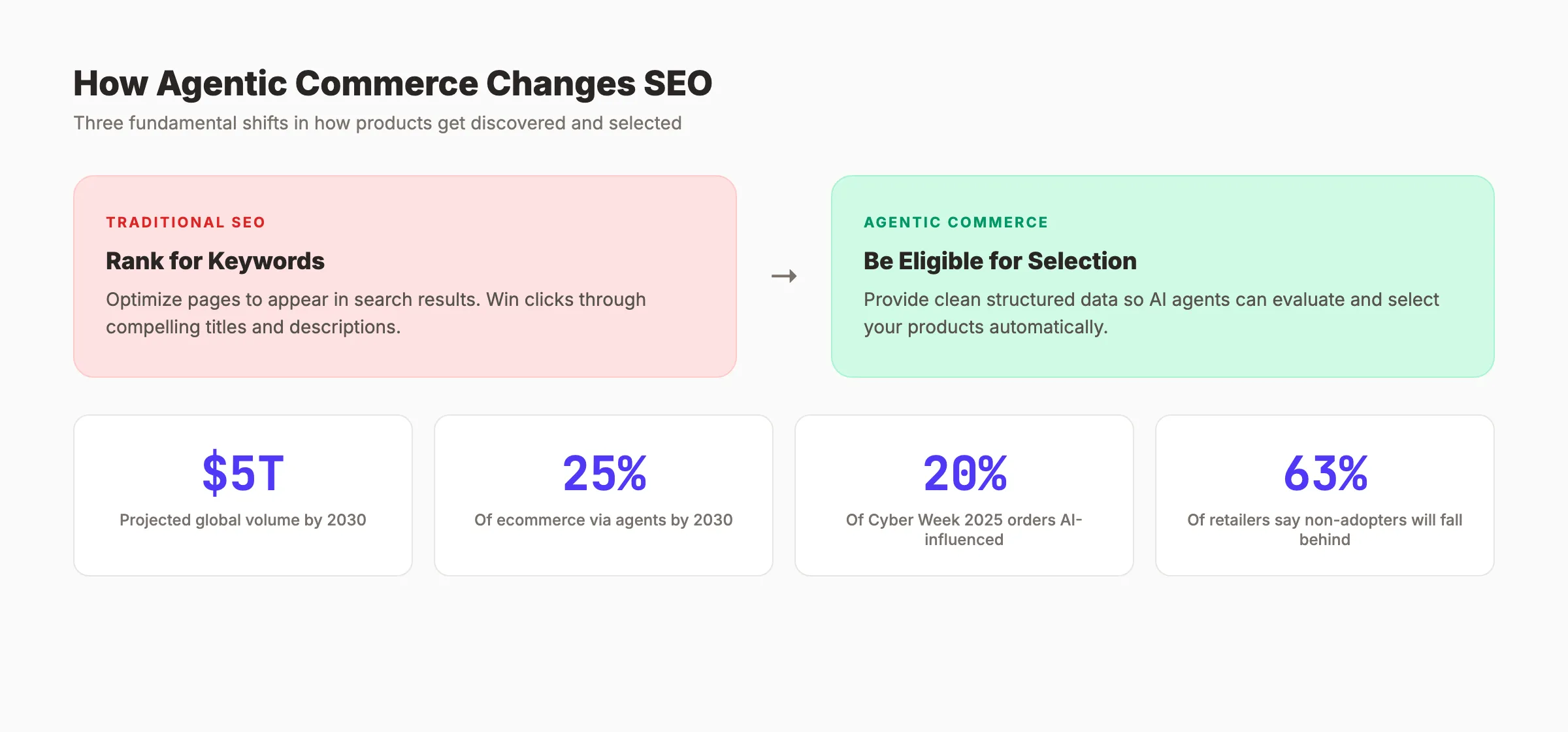
The question shifts from “do we rank well?” to “are we eligible to be selected?” AI agents do not browse 10 blue links. They query APIs, evaluate structured data, and filter options based on criteria the consumer set.
If your product data is incomplete, inconsistent, or inaccessible to AI agents, your products will not be considered. You are not competing for visibility. You are competing for eligibility.
This is a fundamental shift in search intent. The intent no longer belongs to a human typing a query. It belongs to an agent interpreting a goal.
From Persuasion to Data Quality
Traditional ecommerce SEO relies on persuasive product descriptions, compelling images, and conversion-optimized landing pages. Those still matter for human visitors. But AI agents do not read persuasive copy. They read structured data.
An agent deciding between 2 camping tents evaluates:
- Price accuracy (does the listed price match the checkout price?)
- Inventory availability (is this item actually in stock?)
- Delivery speed (can it arrive by the user’s deadline?)
- Return policy (what are the terms?)
- Review signals (what is the aggregate rating and review count?)
The brand with cleaner data wins. Not the brand with better copywriting.
From Keywords to Entities
AI agents understand products as entities, not keyword strings. They match product attributes to user requirements. If your product data uses inconsistent naming, missing attributes, or outdated specifications, the agent cannot make an accurate match.
Schema markup becomes critical. Product schema with price, availability, review ratings, brand, and SKU gives agents the structured data they need to evaluate your products.
For a deeper look at how AI search reshapes organic discovery, read our guide on how AI search is changing SEO.
The Market Data Behind Agentic Commerce
The numbers make the urgency clear.
| Metric | Data Point | Source |
|---|---|---|
| Market size (2025) | $5.71 billion | Grand View Research |
| Market size (2026) | $7.71 billion | Grand View Research |
| Projected market (2033) | $65.47 billion | Grand View Research |
| CAGR (2026-2033) | 35.7% | Grand View Research |
| US ecommerce spending via agents by 2030 | $190-$385 billion | Morgan Stanley |
| Global transaction volume by 2030 | $3-$5 trillion | McKinsey |
| Cyber Week 2025 AI-influenced orders | 20% of global orders | Salesforce |
| Retailers who believe non-adopters will fall behind | 63% | Industry survey |
| Projected ecommerce share by agents (2030) | 25% of global sales | Analyst consensus |
The growth trajectory is not linear. It is exponential. And 63% of global retailers now agree that companies without AI agent capabilities will fall behind within 2 years.
Morgan Stanley estimates that agentic shoppers could capture 10% to 20% of US ecommerce market share by 2030.
For context, total US ecommerce in 2025 was approximately $1.2 trillion. A 10% to 20% share means $120 to $240 billion in purchases where a human never visited a product page.
What Businesses Must Do to Prepare
Most advice about agentic commerce is vague. Here are the specific actions that matter, ranked by priority.
1. Fix Your Product Data
This is the most important step. AI agents cannot recommend products with incomplete or inconsistent data.
Action items:
- Audit all product feeds for missing attributes (price, availability, shipping, returns)
- Ensure prices match across your website, Google Merchant Center, and third-party marketplaces
- Update inventory data in real-time or near-real-time (stale inventory data disqualifies you)
- Add complete schema markup to all product pages (Product, Offer, AggregateRating)
- Standardize product titles and descriptions across all channels
2. Enable Agent Access to Your Data
Agents need machine-readable access to your product catalog.
Action items:
- Implement Google’s Universal Commerce Protocol (UCP) when available for your platform
- Connect to OpenAI’s Agentic Commerce Protocol if you sell through Shopify
- Enable PayPal checkout to qualify for Perplexity Buy with Pro
- Maintain an up-to-date Google Merchant Center feed
- Create an llms.txt file that describes your product catalog structure
- Ensure AI crawlers can access your product pages
3. Build Brand Authority That Agents Can Verify
AI agents evaluate brand trustworthiness before recommending products. Reviews, ratings, and third-party mentions all factor into agent decision-making.
Action items:
- Generate consistent Google reviews (volume and recency both matter)
- Maintain a fully optimized Google Business Profile
- Build your presence on review platforms (G2, Trustpilot, industry-specific directories)
- Earn editorial mentions on authoritative sites (agents use third-party signals)
- Publish original content that demonstrates E-E-A-T signals
4. Optimize Content for AI Discovery
Even in agentic commerce, content still drives organic discovery. The difference is that content now serves both human readers and AI agents.
Action items:
- Structure content with clear H2/H3 headings and on-page SEO best practices
- Answer specific product questions directly in your content (agents extract passages)
- Build topical authority around your product categories
- Create comparison content that agents can cite when evaluating options
- Optimize for AI Overviews and generative engine optimization
3,500+ blogs published. 92% average SEO score. Every article builds the topical authority that AI agents use to evaluate your brand. Start for $1 →
Real-World Examples of Agentic Commerce
Agentic commerce is not theoretical. It is happening now across multiple industries.
Consumer Retail
A shopper tells ChatGPT: “I need running shoes for flat feet, under $120, available in size 11.” The agent queries product feeds from Nike, Brooks, ASICS, and New Balance. It filters by arch support specifications, price, size availability, and delivery speed. It recommends 3 options with pros and cons. The shopper picks one and the agent completes checkout.
The brands that appeared in that recommendation had clean product data, accurate inventory, and strong review signals. The brands that did not had missing attributes or inconsistent pricing.
B2B Procurement
An operations manager tells an AI agent: “Reorder our standard office supplies when inventory drops below 20% of capacity. Stay within our existing vendor agreements and approved budget.” The agent monitors inventory levels, identifies when restocking is needed, compares current pricing across approved vendors, and places the order automatically.
Travel and Services
A user tells Perplexity: “Book me a nonstop flight to London next week under $600. No red-eyes. Economy plus or better.” The agent checks airlines, evaluates loyalty program benefits based on the user payment cards, identifies the best option, and either books it or presents the top 3 choices for approval.
In each case, the AI agent replaces 30 to 60 minutes of manual research and comparison with a single interaction that takes under 30 seconds.
The pattern across all 3 examples is the same. The brands with the most complete, accurate, and structured product data get recommended. The brands with missing attributes, stale inventory, or inconsistent pricing get filtered out before the consumer ever sees them.
Agentic Commerce and Local Businesses
Agentic commerce is not limited to large ecommerce brands. Local businesses are affected too.
When a consumer asks an AI agent “find a plumber near me who can come today and has good reviews,” the agent queries Google Business Profile data, checks business hours, reads review sentiment, and recommends based on availability and ratings.
Local businesses with incomplete GBP profiles, no recent reviews, or outdated hours will not appear in agent recommendations. The same local SEO fundamentals that drive Google Maps rankings now drive agent-based local discovery.
The businesses that invest in local SEO signals today are building the foundation for agentic commerce visibility tomorrow.
This is not speculation. Google already uses GBP data in AI Mode responses for local queries. When AI agents fully integrate with local discovery, the businesses with the strongest local SEO signals will dominate agent-based recommendations. The ones with incomplete profiles will be invisible.
Rank everywhere. Do nothing. Blog SEO, Local SEO, and Social on autopilot. Build the signals AI agents use to recommend your business. Start for $1 →
What Agentic Commerce Means for the Future of SEO
SEO is not dying. It is evolving. Agentic commerce adds a new layer to organic strategy.
The traditional funnel (search → click → browse → buy) compresses into a single agent interaction (intent → selection → purchase). That means:
Content still matters. AI agents cite sources. The content you publish builds topical authority that agents evaluate when deciding which brands to trust.
Technical SEO matters more. Structured data, page speed, crawlability, and data accuracy all become selection criteria, not just ranking factors.
Brand matters most. When an agent evaluates 5 identical products, it recommends the brand with the strongest trust signals. Reviews, mentions, authority, and consistency determine selection.
Volume compounds faster. A site that publishes 30 articles per month builds topical authority signals 10x faster than one publishing 3. In an agentic commerce world, that topical authority becomes a trust signal that AI agents use to evaluate brand credibility. The Content Compound Effect applies directly to agent-based discovery.
The businesses that treat SEO as a trust-building exercise (not just a ranking exercise) will thrive in the agentic commerce era. Start with clean data, consistent content, and verifiable brand signals.
For a practical checklist on optimizing your content for AI discovery, read our blog GEO checklist and guide to getting cited in AI search.
FAQ
Is agentic commerce the same as conversational commerce?
No. Conversational commerce uses chatbots to help you shop. You still make every decision. Agentic commerce delegates the entire shopping process to an AI agent. The agent researches, compares, and can complete the purchase autonomously. The shift is from assisted shopping to delegated shopping.
Which platforms support agentic commerce right now?
Google (through AI Mode and Shopping), OpenAI (through ChatGPT and the Agentic Commerce Protocol), Perplexity (through Buy with Pro), and Amazon (through Buy for Me) are the 4 major platforms. Shopify has built Agentic Storefronts that connect to multiple platforms. More are launching throughout 2026.
How does agentic commerce affect small businesses?
Small businesses with clean product data, strong reviews, and accurate inventory can compete. AI agents do not favor large brands by default. They favor the brands with the most complete and trustworthy data. A small business with 200 five-star reviews and accurate pricing can beat a large retailer with inconsistent data.
Do I need to change my SEO strategy for agentic commerce?
Yes, but the changes build on existing fundamentals. Prioritize structured data and schema markup, product data accuracy, brand authority signals, and AI crawler access. These improvements help your traditional SEO too.
How much of ecommerce will go through AI agents?
Analysts project 25% of global ecommerce sales will be enabled by AI agents by 2030. Morgan Stanley estimates $190 to $385 billion in US ecommerce spending through agents by 2030. The adoption curve is accelerating.
What is Google’s Universal Commerce Protocol?
UCP is a standardized framework that lets retailers make their product data accessible to AI agents. It defines how product information (pricing, inventory, shipping, returns) should be structured so agents can read and act on it. Think of it as schema markup for agentic commerce.
Agentic commerce is the next evolution of how people buy online. The shift from human browsing to agent-based purchasing is already underway. The businesses that prepare now will capture the traffic and transactions that others lose.

Written by
Siddharth GangalSiddharth is the founder of theStacc and Arka360, and a graduate of IIT Mandi. He spent years watching great businesses lose organic traffic to competitors who simply published more. So he built a system to fix that. He writes about SEO, content at scale, and the tactics that actually move rankings.
30 SEO blog articles published every month
Keyword-optimized, scheduled, and live on your site. Automatically.
30-day trial · Cancel anytime
theStacc
Stop writing SEO content manually
30 blog articles, 30 GBP posts, and social media content. Published every month. Automatically.
Start Your $1 Trial$1 for 3 days · Cancel anytime