
Dynamic GBP: The New Local Ranking Factor (2026)
Dynamic Google Business Profiles now outrank static ones in the local pack. Learn what signals Google rewards and how to optimize. Updated April 2026.
Businesses that have not posted a GBP update or photo in 30+ days are reporting dramatic drops in Google Maps impressions. Meanwhile, businesses with active profiles are seeing ranking gains without changing anything else about their SEO.
The concept of a dynamic GBP is simple. Google no longer treats your Google Business Profile as a static directory listing. It treats it as a live engagement surface. The businesses that post regularly, respond to reviews, upload fresh photos, and keep their information current get rewarded with better local pack rankings.
The businesses that “set it and forget it” quietly lose visibility.
According to the 2026 Local Search Ranking Factors report, GBP signals now account for 32% of all map pack ranking factors. And behavioral engagement signals are climbing faster than any other category.
We have published 3,500+ SEO articles across 70+ industries and manage local SEO campaigns for businesses in every vertical. This guide explains what a dynamic GBP is, why Google rewards active profiles, and exactly what to do about it.
Here is what you will learn:
- What makes a GBP “dynamic” versus “static”
- The specific activity signals Google uses as ranking factors
- How GBP engagement feeds into AI-generated local results
- The posting frequency and content types that move the needle
- A complete checklist for maintaining a high-activity GBP
- How to measure whether your GBP activity is working
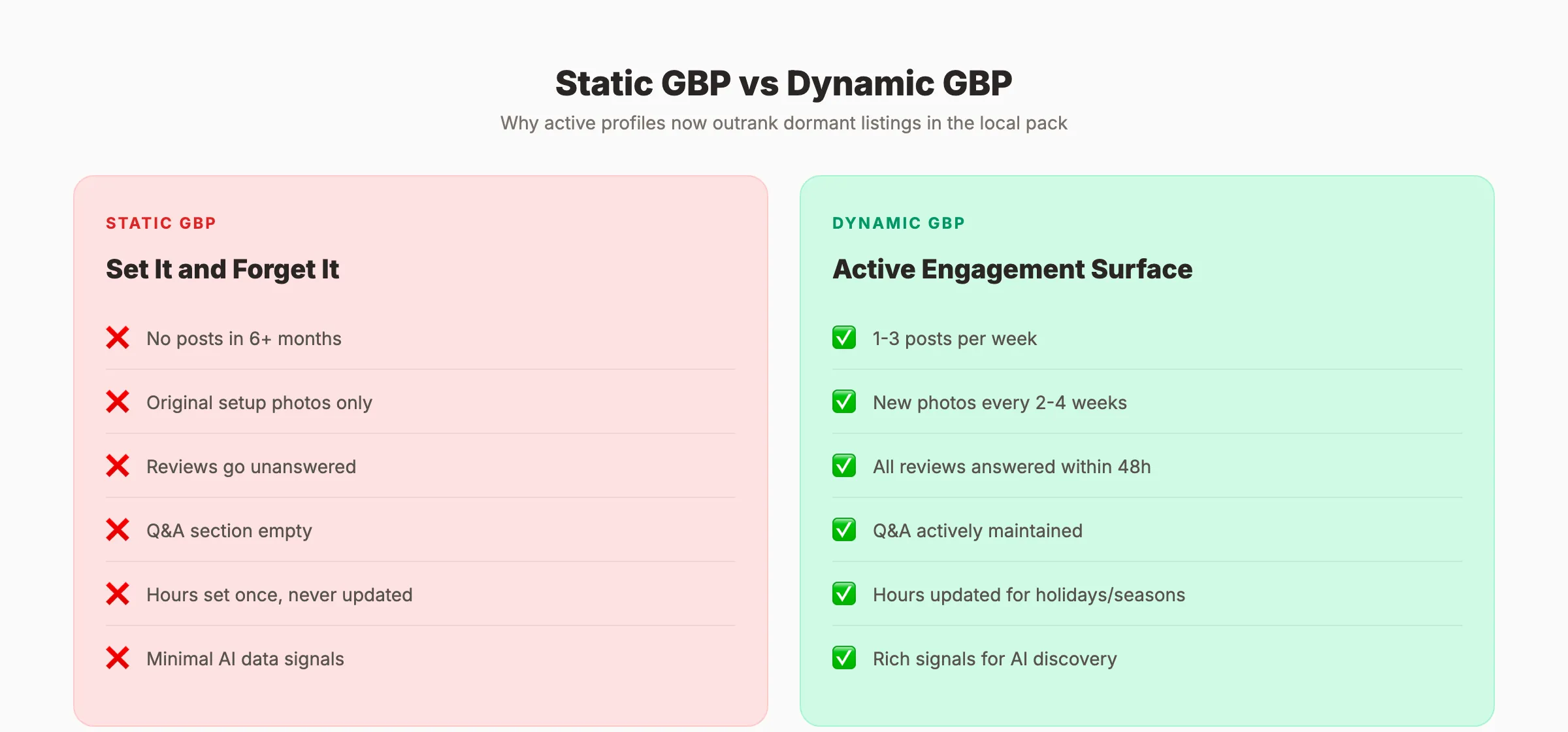
What Is a Dynamic GBP?
A dynamic GBP is a Google Business Profile that generates continuous activity signals. Posts, photos, review responses, Q&A answers, booking interactions, and updated information all contribute to a profile that Google considers “alive.”
A static GBP is the opposite. The business claimed the listing, filled in the basics, and never touched it again. Hours are correct. The category is right. But there are no posts, no recent photos, and reviews go unanswered.
For years, the static approach worked. NAP consistency (name, address, phone number) and category selection drove most of the ranking signal. That era is over.
Static vs Dynamic GBP Comparison
| Signal | Static GBP | Dynamic GBP |
|---|---|---|
| Posts | None or last post 6+ months ago | 1-3 posts per week |
| Photos | Original photos from setup only | New photos every 2-4 weeks |
| Reviews | Reviews exist but no responses | Every review gets a response within 48 hours |
| Q&A | Empty or unanswered | Active answers to common questions |
| Hours | Set once, rarely updated | Updated for holidays, seasonal changes |
| Products/Services | Basic list or empty | Complete with descriptions and pricing |
| Booking links | Missing | Active appointment or reservation links |
Google built GBP into an active engagement surface. For retailers, that means real-time product inventory through Merchant Center. For service businesses, it means appointment booking, Q&A, and post activity. For restaurants, it means menus, wait times, and reservation links.
The platform expects ongoing input. It rewards the businesses that provide it.
Why Google Rewards Dynamic Profiles
Google wants to show users the most relevant, active, and trustworthy local businesses. A dynamic profile signals all three.
Freshness Equals Relevance
A business that posted yesterday looks more relevant than one that posted 6 months ago. Google uses freshness signals to determine whether a business is actively operating and serving customers.
This is not speculation. Businesses publishing at least 2 posts per month show stronger completeness scores and visibility after core algorithm updates. Businesses that let their profiles go dormant see measurable drops.
Engagement Equals Trust
When users click, call, request directions, view photos, or interact with posts on your GBP, Google receives confirmation that your listing is useful. High engagement rates tell Google that real customers find your business valuable.
The reverse is also true. A profile with zero clicks, zero calls, and zero interactions tells Google nobody cares about your listing. Low engagement suppresses ranking potential.
Activity Compounds
Dynamic GBP management creates a self-reinforcing cycle. Consistent posting builds freshness. Freshness improves rankings. Better rankings increase profile views. More views generate more reviews. More reviews further improve rankings.
This compounding effect is the same principle behind the Stacc Stack Method. Blog SEO + Local SEO activity compound together. Every piece of fresh content on your website AND your GBP reinforces the other.
Your SEO team. $99 per month. 30 optimized articles plus 30 GBP posts. Blog SEO and Local SEO working together. Start for $1 →
The Specific Signals That Move Rankings
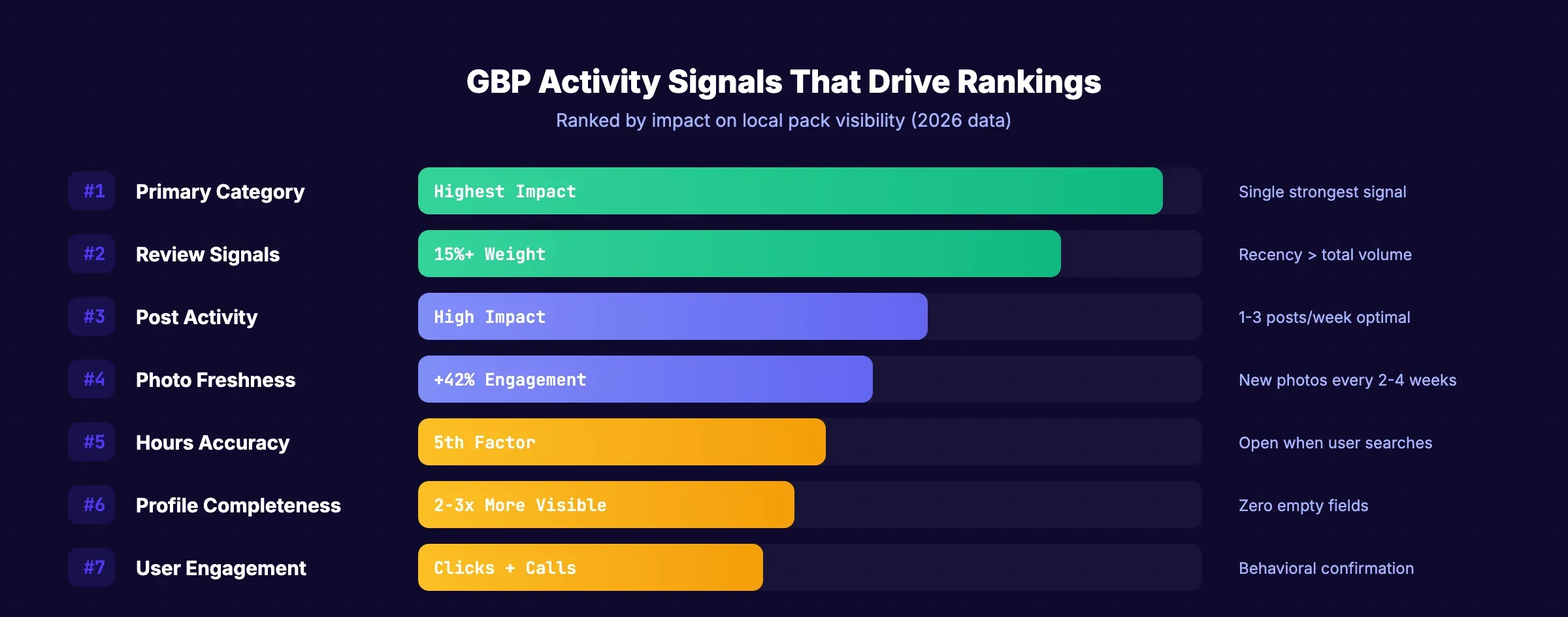
Not all GBP activity carries equal weight. Here are the signals that matter most, ranked by impact based on the 2026 local search ranking factors data.
1. Primary Category Selection (Still Number 1)
Your primary GBP category remains the single strongest ranking signal. It determines which searches your profile appears for. Getting this wrong means nothing else matters.
Action: Verify your primary category matches your most important service. Add 2-5 additional categories for secondary services.
2. Review Signals (15%+ of Ranking Weight)
Review volume, recency, and rating quality carry major weight. But recency now outweighs total volume. A business with 50 reviews and 5 new ones this month outranks a business with 200 reviews and none in the past 3 months.
Action: Request reviews within 24 hours of service completion. Respond to every review within 48 hours. Our guide on getting more Google reviews covers the full system.
3. GBP Post Activity
Posts are a direct freshness signal. Google reads post content for keyword relevance and topical context. Offer and Event post types with expiration dates generate stronger signals than generic Update posts.
Action: Post 1 to 3 times per week. Use Offer and Event formats when possible. Include relevant service keywords naturally.
4. Photo and Video Freshness
Profiles with photos receive 42% more direction requests than those without. But the key is recency. A profile with 50 photos from 3 years ago is less valuable than one with 10 photos from this month.
Action: Upload new photos every 2 to 4 weeks. Include interior shots, team photos, completed work, and customer interactions. Video tours perform well for service businesses.
5. Operating Hours Accuracy
Being open when a user searches is now the 5th most important factor for local pack rankings. Inaccurate hours damage both rankings and customer trust.
Action: Audit hours quarterly. Update for every holiday 2 weeks before the date. Add special hours for seasonal changes.
6. Profile Completeness
Properly configured profiles are 2 to 3 times more likely to appear in the Map Pack and AI Overviews than incomplete listings. Every empty field is a missed signal.
Action: Fill out every single section of your GBP. Services, products, business description, attributes, payment methods, accessibility features. Zero empty fields should be your target.
7. User Engagement Metrics
How often users interact with your photos, click your Q&A, linger on your profile, and take action (call, get directions, visit website) are primary ranking signals. These behavioral metrics tell Google whether your listing is useful to searchers.
Action: Make your profile worth interacting with. Add compelling photos that invite clicks. Write a business description that answers common questions. Include a clear call-to-action in every post.
For the complete GBP optimization process, read our dedicated guide.
Dynamic GBP and AI-Generated Local Results
This is the part most local businesses miss. GBP signals no longer just affect the traditional map pack. They feed directly into AI-generated local results.
When someone asks Google AI Mode “find a dentist near me with weekend hours,” the AI pulls from your GBP data. It checks your hours, reviews, photos, and post activity to determine whether to recommend you.
The same applies when someone asks ChatGPT or Perplexity for local business recommendations. These AI models pull from Google Maps data, review aggregators, and local content. A dynamic GBP generates more signals for AI models to evaluate.
What AI Pulls from Your GBP
| Data Point | How AI Uses It |
|---|---|
| Review sentiment | Determines recommendation confidence |
| Review recency | Filters for currently active businesses |
| Post content | Extracts service descriptions and offers |
| Photo freshness | Assesses whether business looks current |
| Service completeness | Matches user requirements to offerings |
| Operating hours | Filters by availability for time-sensitive queries |
| Q&A content | Answers specific user questions directly |
A static GBP provides AI with minimal data. A dynamic GBP provides AI with rich, current signals across every dimension.
This has a direct impact on the answer economy. When AI generates local recommendations, it favors businesses with verifiable, recent activity signals. A dynamic GBP makes your business citable by AI. A static GBP makes your business invisible.
The practical implication is significant. Local businesses now compete for visibility in 3 channels simultaneously: the traditional local pack, Google AI Mode, and third-party AI assistants like ChatGPT and Perplexity. A dynamic GBP feeds all 3 channels. A static GBP feeds none of them effectively.
For more on how AI search is changing SEO, including local search, read our full analysis. And for AI-specific optimization, check our generative engine optimization guide.
3,500+ blogs published. 92% average SEO score. Blog SEO and Local SEO compound together. Every post strengthens your local visibility. Start for $1 →
The Dynamic GBP Optimization Checklist
Use this checklist to transform a static GBP into a dynamic one. Start with the highest-impact items.
Weekly Actions
- Publish 1-3 GBP posts (Offer or Event format preferred)
- Respond to all new reviews within 48 hours
- Answer any new Q&A questions
- Check messages and respond promptly
Bi-Weekly Actions
- Upload 2-3 new photos (recent work, team, interior)
- Review and update service descriptions if needed
- Check that all contact information is correct
Monthly Actions
- Request reviews from recent customers (aim for 5+ new reviews per month)
- Analyze GBP Insights for engagement trends
- Update products or services with current pricing
- Add new FAQ entries based on common customer questions
Quarterly Actions
- Audit operating hours (update for upcoming holidays)
- Review and update primary and additional categories
- Refresh business description with current services
- Check competitor GBP activity for gaps and opportunities
- Verify all NAP citations match your GBP exactly
One-Time Setup (If Not Already Done)
- Complete every GBP field (zero empty sections)
- Enable appointment booking or reservation links
- Add all services with descriptions
- Upload at least 10 high-quality photos
- Write a complete business description with target keywords
- Add schema markup to your website matching your GBP data
For local businesses that want this handled automatically, Stacc Local SEO publishes 30 GBP posts per month for $49. Combined with Blog SEO ($99 for 30 articles), both feeds compound into stronger local SEO performance.
How to Measure Dynamic GBP Performance
Activity without measurement is guesswork. Track these metrics to know whether your dynamic GBP strategy is working.
GBP Insights Metrics
| Metric | What It Tells You | Target |
|---|---|---|
| Search impressions | How often your profile appears | Increasing month-over-month |
| Discovery searches | Users who found you through category searches | Growing trend |
| Direct searches | Users who searched your brand name | Stable or growing |
| Website clicks | Users who clicked through to your site | Increasing with post activity |
| Direction requests | Users who asked for directions | Correlated with photo freshness |
| Phone calls | Users who called from your listing | Correlated with review quality |
Advanced Tracking
Go beyond basic GBP Insights with these methods:
- Track local pack rankings for your top 20 keywords using a rank tracker
- Monitor review velocity (new reviews per month) against competitors
- Compare your GBP post frequency to top 3 local competitors
- Use UTM parameters on GBP links to track conversions from profile visits
- Measure the correlation between posting activity and impression changes
The pattern is consistent. Businesses that increase their GBP activity from zero posts to 4+ posts per month see measurable impression gains within 30 to 60 days. The effect compounds over time as engagement metrics improve.
Benchmarking Against Competitors
Measurement is most useful when compared against your local competitors. Check the top 3 businesses ranking in your local pack for these metrics:
- How many posts did they publish this month?
- When was their most recent photo uploaded?
- What is their review response rate?
- How many total reviews do they have versus your count?
- Are they using Offer or Event post types?
If your competitors post 4 times per month and you post zero, the gap is clear. Match their activity as a baseline, then exceed it. The business with the highest consistent activity level holds the ranking advantage over time.
Use this competitive analysis alongside your local SEO strategy to identify the specific activity gaps between your GBP and the profiles that currently outrank you.
Rank everywhere. Do nothing. Blog SEO, Local SEO, and Social on autopilot. Stacc keeps your GBP active while you run your business. Start for $1 →
Common Mistakes That Kill Dynamic GBP Performance
Knowing what to do is half the equation. Here is what to avoid.
Posting generic content. “Happy Monday! Hope everyone has a great week!” is not a GBP post. It contains zero keyword signals and provides no value. Post about specific services, offers, and business updates instead.
Ignoring negative reviews. Unanswered negative reviews signal that the business does not care. Respond professionally to every negative review within 24 hours. Acknowledge the issue and offer a resolution path.
Using stock photos. Google can detect stock imagery. Real photos of your actual business, team, and work perform better than polished stock images. Authenticity signals trust.
Inconsistent hours. If your GBP says you close at 5 PM and a customer arrives at 4:30 to find you closed, that generates a negative engagement signal. Keep hours accurate down to the minute.
Sporadic activity bursts. Posting 10 times in one week and then going silent for 2 months is worse than posting once per week consistently. Google rewards consistent activity patterns over sporadic bursts.
Neglecting the Q&A section. Unanswered questions on your GBP are a missed opportunity. They are also a negative signal. If customers ask and you do not answer, competitors who do answer gain the trust signal.
Not tracking performance. Many businesses increase their GBP activity but never check whether it works. Without tracking impressions, clicks, and calls through GBP Insights, you cannot know which actions drive results. Measure everything. Adjust based on data.
Duplicate or conflicting information. If your GBP shows different hours, phone numbers, or addresses than your website or other directories, Google loses trust in your listing. Ensure NAP consistency across every platform where your business appears.
For more local SEO pitfalls to avoid, read our local SEO statistics post with data on what drives and destroys local rankings.
FAQ
Is a dynamic GBP really a ranking factor?
Yes. The 2026 Local Search Ranking Factors study confirms that behavioral and engagement signals (posts, photos, reviews, clicks, calls) are climbing fast in importance. GBP signals account for 32% of map pack ranking factors. Active profiles consistently outrank dormant ones for the same keywords.
How often should I post on my Google Business Profile?
1 to 3 times per week is the recommended frequency. Posting at least weekly keeps your profile fresh in Google’s algorithm. Use Offer and Event post types with expiration dates for stronger freshness signals. Consistency matters more than volume.
Does responding to reviews affect my ranking?
Yes. Review response rate and speed are engagement signals. Responding to all reviews within 48 hours tells Google your business is actively managed. Businesses with 100% response rates rank higher in the local pack than those with partial or zero response rates.
Can GBP posts help me rank for specific keywords?
GBP posts contribute keyword context to your profile. When you write a post about “emergency plumbing repair in Austin,” Google associates those terms with your profile. This supports ranking for related local queries. Do not keyword-stuff. Write naturally about your services.
How does dynamic GBP activity affect AI search results?
Google AI Mode and other AI models pull directly from GBP data when generating local recommendations. Review recency, photo freshness, post activity, operating hours, and service completeness all factor into whether AI recommends your business. A dynamic GBP provides AI with richer data to evaluate.
What is the minimum activity level to avoid ranking decay?
Post at least twice per month. Upload new photos at least monthly. Respond to all reviews within 48 hours. Businesses that drop below this baseline for 30+ days risk measurable impression declines. The safest approach is weekly posting with consistent review management.
The era of setting up a Google Business Profile and walking away is over. Google rewards the businesses that treat GBP as a live engagement channel. Start with the weekly checklist above and build from there. Every post, photo, and review response compounds into stronger local visibility.
Related Tools & Resources
Free SEO Tools:
Best Lists:

Written by
Siddharth GangalSiddharth is the founder of theStacc and Arka360, and a graduate of IIT Mandi. He spent years watching great businesses lose organic traffic to competitors who simply published more. So he built a system to fix that. He writes about SEO, content at scale, and the tactics that actually move rankings.
Automate your Google Business Profile content
30 GBP posts, local SEO articles, and review responses. Published every month automatically.
30-day trial · Cancel anytime
theStacc
Stop writing SEO content manually
30 blog articles, 30 GBP posts, and social media content. Published every month. Automatically.
Try for free$1 for 3 days · Cancel anytime