
10 Best Review Management Software in 2026
We tested 10 review management software tools and ranked them by features, pricing, and automation. See the best fit for your business. March 2026.
Last updated: March 2026
Our Top Picks:
- Best overall: Birdeye. Automated review collection across 200+ sites
- Best for SMS requests: Podium. Text-based review collection that converts
- Best for enterprise: Reputation.com. Multi-location management at scale
- Best for local SEO agencies: BrightLocal. Review monitoring plus local rank tracking
- Best for small business: NiceJob. Simple setup, automatic review funnels
How We Tested and Ranked This Review Management Software
Choosing the best review management software should not take weeks of research. But most “best of” lists are written by people who have never managed a single review campaign.
We publish 3,500+ blogs across 70+ industries. Many of our clients are local businesses where Google reviews directly affect revenue. That gives us a front-row seat to how review management software performs in real-world conditions.
We evaluated each tool across 5 criteria: review collection automation, multi-platform monitoring, response management, reporting depth, and pricing transparency.
Below you will find our honest breakdown of 10 tools. Every section includes pricing, strengths, weaknesses, and exactly who each tool fits best.
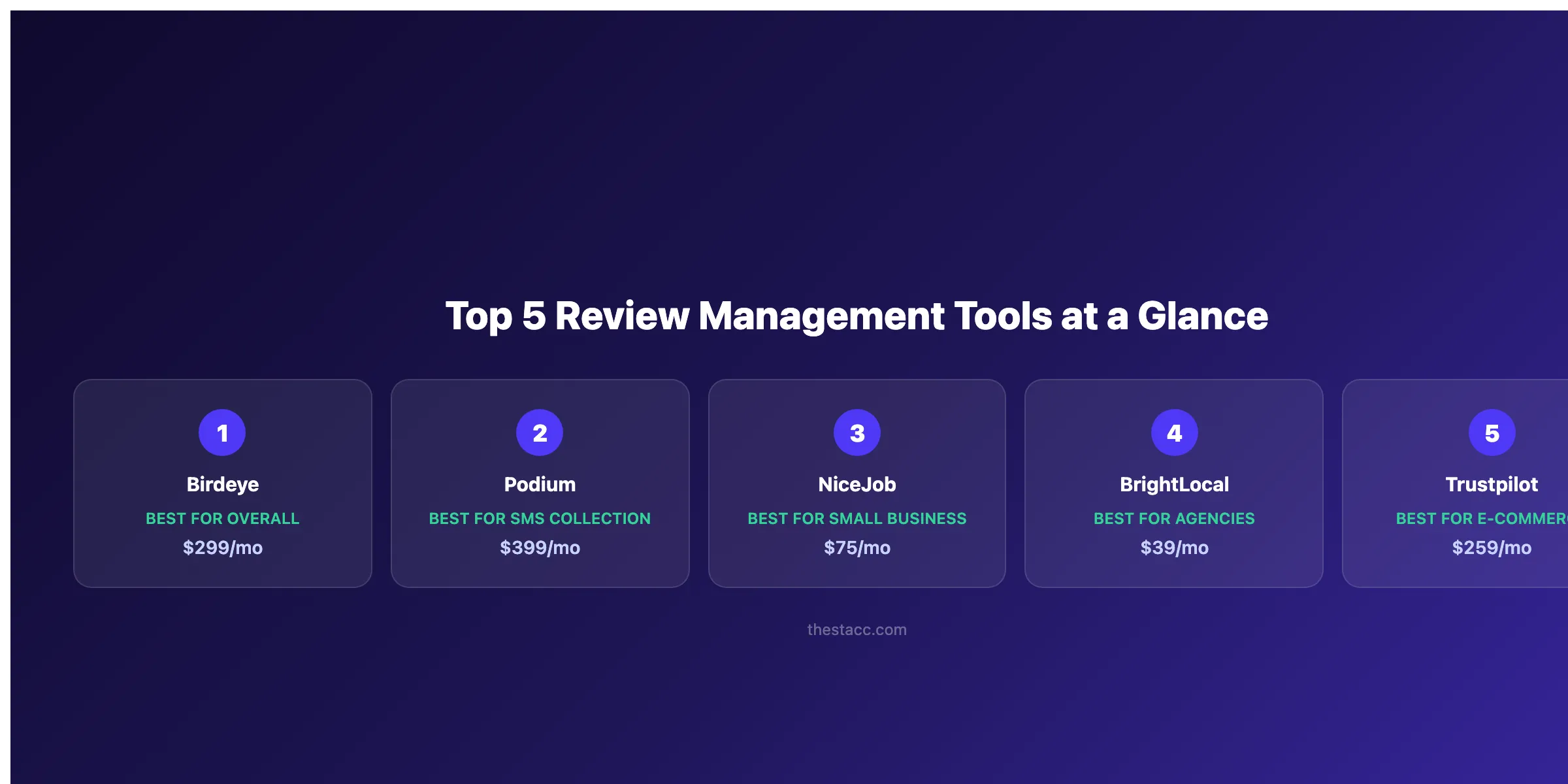
What We Looked For
| Criteria | What We Measured |
|---|---|
| Review Collection | Automated requests via SMS, email, and in-app prompts |
| Monitoring Reach | Number of platforms tracked (Google, Yelp, Facebook, industry sites) |
| Response Tools | AI suggestions, templates, bulk response, sentiment routing |
| Reporting | Dashboards, trend analysis, competitor benchmarking, exports |
| Pricing | Transparency, per-location costs, hidden fees, free trials |
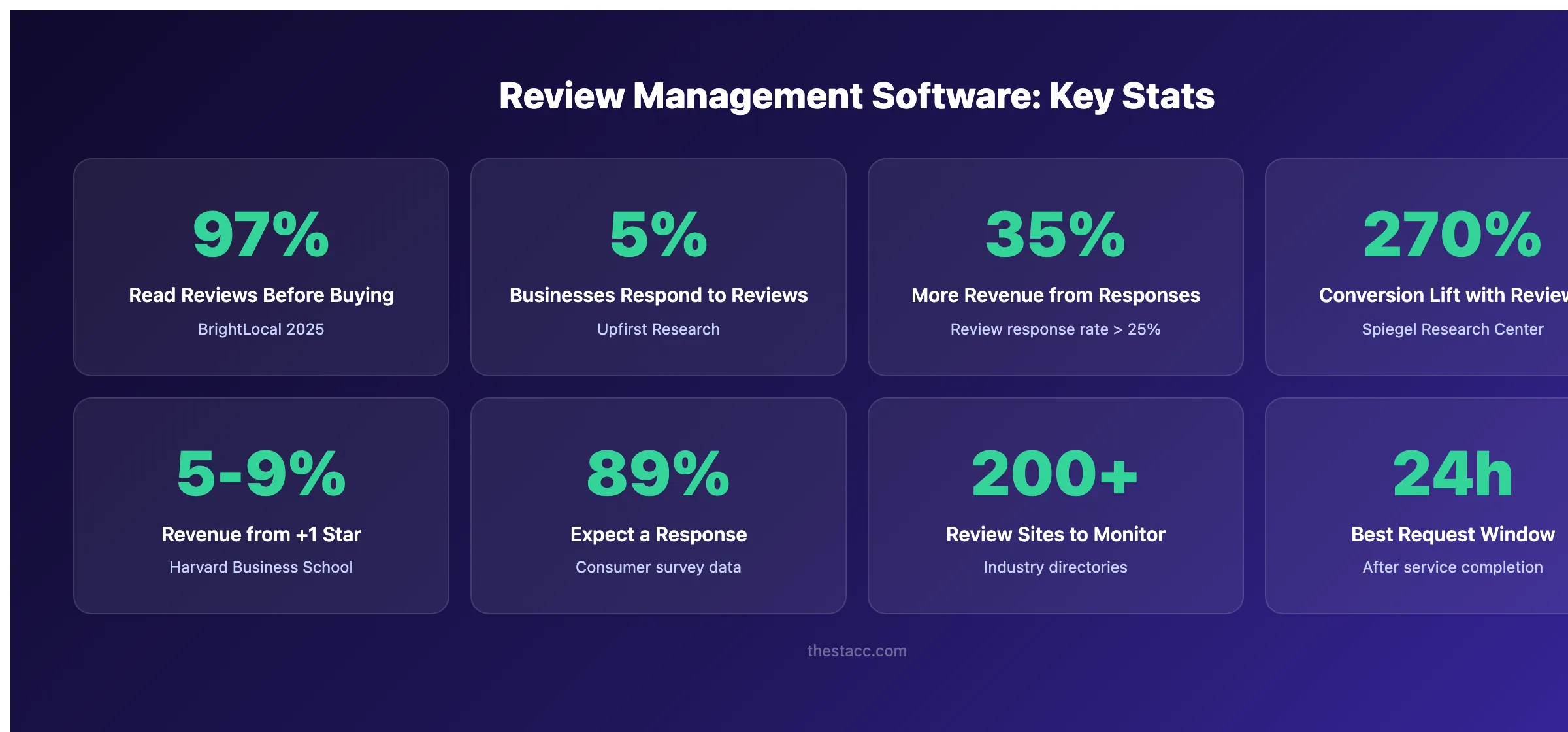
97% of consumers read reviews before choosing a local business. Yet only 5% of businesses respond to reviews. The gap between consumer expectations and business response rates is where review management software earns its value.
Review Management Software Compared
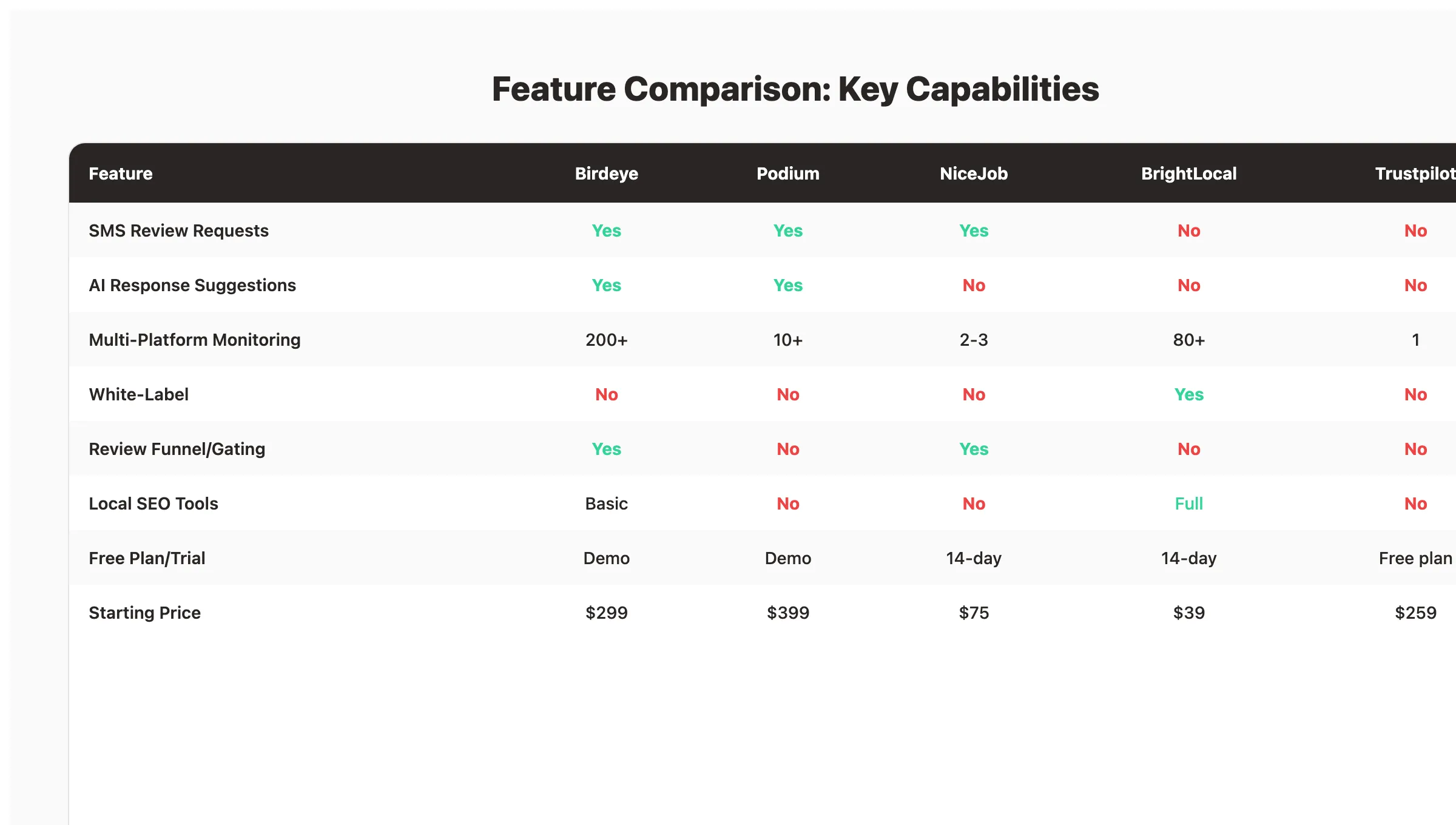
| Tool | Best For | Starting Price | Free Trial? | Key Strength |
|---|---|---|---|---|
| Birdeye | Overall automation | $299/mo | ✅ Demo | 200+ review site monitoring |
| Podium | SMS review requests | $399/mo | ✅ Demo | Text-first customer communication |
| Reputation.com | Enterprise brands | Custom pricing | ✅ Demo | AI analytics at scale |
| ReviewTrackers | Multi-location chains | $119/mo | ✅ | Operational review insights |
| Yext | Listings + reviews | $199/mo | ✅ Demo | Unified listing and review hub |
| NiceJob | Small businesses | $75/mo | ✅ 14-day | Autopilot review funnels |
| Trustpilot | E-commerce brands | $259/mo | ✅ Free plan | Consumer trust and social proof |
| BrightLocal | Local SEO agencies | $39/mo | ✅ 14-day | Review tracking + SEO tools |
| GatherUp | Automated follow-up | $99/mo | ✅ Demo | First-party review campaigns |
| Grade.us | White-label agencies | $110/mo | ✅ 14-day | Full white-label review platform |
Every tool on this list solves a different slice of the review management problem. The right choice depends on your business size, location count, and budget.
1. Birdeye. Best Review Management Software Overall
Birdeye dominates the review management space for one reason: coverage. The platform monitors reviews across 200+ sites and automates the entire collection-to-response workflow.
What It Does Well
Birdeye sends automated review requests via SMS and email right after a customer interaction. The timing matters. Requests sent within 24 hours of service get 3 to 5 times more responses than delayed requests.
The platform aggregates reviews from Google, Facebook, Yelp, Healthgrades, Avvo, and over 200 other industry-specific sites into a single dashboard. You see every review, respond from one place, and track sentiment trends over time.
Their AI response feature generates reply suggestions based on review content and sentiment. For businesses managing 50+ locations, this alone saves hours per week.
Our Take: Birdeye is the most complete review management platform we have tested. The 200+ site coverage means you will not miss reviews on niche directories that competitors ignore. The price reflects that depth.
Where It Falls Short
Birdeye is expensive. At $299 per month as a starting point, it prices out most solopreneurs and single-location businesses. The contract terms also require annual commitment for the best rates.
Key Features
- Automated SMS and email review requests with customizable timing
- AI-generated response suggestions with sentiment detection
- 200+ review site monitoring from a single dashboard
- Review widgets for embedding social proof on your website
- Competitive benchmarking against local competitors
Pricing
- Standard: $299/month. Core review management features
- Professional: $399/month. Adds surveys, messaging, and web chat
- Enterprise: Custom pricing. Full platform with API access
- Free trial: Demo available on request
Who Should Use Birdeye
Strong fit:
- Multi-location businesses (10+ locations) needing centralized management
- Healthcare, legal, and home services businesses with industry-specific review sites
Probably not right for:
- Single-location businesses under $500/month marketing budget
2. Podium. Best for SMS-Based Review Collection
Podium built its reputation on one insight: people respond to texts faster than emails. Their text-first approach to review collection consistently generates higher response rates than email-only platforms.
What It Does Well
Podium sends review requests via SMS and routes the customer directly to your Google review page. No app downloads. No extra steps. The friction reduction makes a real difference.
The platform also doubles as a customer messaging hub. You can handle reviews, payments, and customer conversations from a single inbox. For businesses that already communicate with customers via text, Podium fits naturally into the workflow.
Response rates on Podium campaigns average 15 to 20% higher than email-only review platforms. That data comes from Podium’s own published case studies, but it aligns with what we see across local businesses.
Our Take: If your customers already text you, Podium is a no-brainer. The review-to-text pipeline converts well. The price is steep, but the platform does more than just reviews.
Where It Falls Short
At $399 per month minimum, Podium is one of the most expensive options. The pricing is opaque. You cannot see exact costs without a sales call. For businesses that only need review management (not payments or messaging), you are paying for features you will not use.
Key Features
- SMS-first review request campaigns with direct Google integration
- Unified inbox for reviews, messages, and payments
- Payment processing with text-to-pay invoices
- Web chat widget that converts to SMS conversations
- Team management with assignment and routing rules
Pricing
- Core: $399/month. Reviews, messaging, and basic features
- Pro: $599/month. Adds automation, AI, and analytics
- Enterprise: Custom pricing. Multi-location, API access
- Free trial: Demo available on request
Who Should Use Podium
Strong fit:
- Service businesses already using SMS to communicate (dental, auto, HVAC)
- Businesses wanting an all-in-one communication plus review platform
Probably not right for:
- E-commerce brands that do not have direct SMS relationships with customers
3. Reputation.com. Best Review Management Software for Enterprise
Reputation.com serves enterprise brands with hundreds or thousands of locations. The platform processes millions of reviews and uses AI to extract operational insights from unstructured feedback data.
What It Does Well
The Reputation Score is the platform’s signature metric. It combines review volume, rating, recency, response rate, and sentiment into a single benchmark. Enterprise teams use it to compare locations, identify underperformers, and track improvement over time.
Their AI engine analyzes review text to surface recurring themes. If customers at Location 47 keep mentioning “wait times,” the platform flags it. That turns reviews from a marketing channel into an operational feedback loop.
Our Take: Reputation.com is overkill for small businesses. But for chains with 100+ locations, no other tool matches the depth of its location-level analytics and operational insights.
Where It Falls Short
Pricing is entirely custom and enterprise-level. Expect $1,000+ per month. The onboarding process is complex. The platform requires dedicated time to configure properly. Small teams will struggle to extract value from the advanced features.
Key Features
- Reputation Score benchmarking across all locations
- AI-driven sentiment and theme analysis from review text
- Automated review response with brand-approved templates
- Competitive intelligence and local market comparison
- Survey integration for proactive feedback collection
Pricing
- Custom pricing. Based on location count and features
- Typical range: $1,000 to $3,000+/month for mid-size chains
- Enterprise: Volume discounts for 500+ locations
- Free trial: Demo available on request
Who Should Use Reputation.com
Strong fit:
- Franchise brands and chains with 50+ locations
- Healthcare networks, hospitality groups, and automotive dealerships
Probably not right for:
- Any business under 20 locations or under $1,000/month budget
4. ReviewTrackers. Best for Multi-Location Review Insights
ReviewTrackers focuses on turning reviews into business intelligence. The platform tracks reviews across 100+ sites and delivers operational insights that go beyond star ratings.
What It Does Well
ReviewTrackers aggregates reviews and applies natural language processing to categorize feedback by topic. You can filter by location, date range, keyword, and sentiment to find patterns.
The platform excels at multi-location reporting. Franchise owners and regional managers get location-by-location performance dashboards with clear benchmarks. Automated alerts notify the right team member when a negative review appears at their location.
Their Ask Tool feature automates review request campaigns via email and SMS. The setup is simpler than Birdeye or Podium, with fewer moving parts.
Our Take: ReviewTrackers strikes a good balance between depth and usability. The reporting is better than BrightLocal. The price is lower than Birdeye. For 5 to 50 location businesses, it is the sweet spot.
Where It Falls Short
The review request tools are functional but not as polished as Podium or Birdeye. The platform also lacks the payment processing and messaging features that all-in-one platforms offer.
Key Features
- Review aggregation from 100+ sites with real-time alerts
- Natural language processing for topic and sentiment analysis
- Location-level performance dashboards and benchmarking
- Automated email and SMS review request campaigns
- Competitive monitoring and local market analysis
Pricing
- Standard: $119/month. Up to 5 locations
- Professional: Custom pricing , 6+ locations with advanced features
- Enterprise: Custom pricing. Dedicated support, API access
- Free trial: Available for 14 days
Who Should Use ReviewTrackers
Strong fit:
- Franchise owners and multi-location businesses (5 to 50 locations)
- Operations teams that want to use reviews for service improvement
Probably not right for:
- Single-location businesses that need simple review collection only
5. Yext. Best for Combined Listing and Review Management
Yext started as a business listing management platform and expanded into reviews. The result is a tool that keeps your NAP data consistent across directories while managing reviews from the same dashboard.
What It Does Well
Yext syncs your business information across 200+ directories and maps services. When you update your hours, address, or phone number, it pushes everywhere. That listing accuracy matters for local SEO. Inconsistent NAP data hurts local rankings.
The review management module monitors reviews across those same directories. You respond from one dashboard. The AI-generated response suggestions adapt to review sentiment and length.
For businesses that struggle with listing accuracy and review management simultaneously, Yext solves both problems in one subscription.
Our Take: Yext is the best choice when listing management is your primary need and review management is secondary. If you already have clean listings, a dedicated review tool offers more depth for less money.
Where It Falls Short
Review management is not Yext’s core strength. The review collection tools are basic compared to Birdeye or Podium. You do not get the SMS campaign sophistication or the depth of sentiment analysis that dedicated platforms offer. The pricing is also high for what the review module alone delivers.
Key Features
- Business listing sync across 200+ directories and maps
- Review monitoring and response from a unified dashboard
- AI response suggestions based on sentiment analysis
- Knowledge graph for structured business data management
- Analytics dashboard tracking listing views and review trends
Pricing
- Emerging: $199/month. Listings + basic reviews
- Essential: $399/month. Adds analytics and social management
- Complete: $499/month. Full platform access
- Free trial: Demo available on request
Who Should Use Yext
Strong fit:
- Businesses with listing accuracy problems across multiple directories
- Multi-location brands that need listing and review management combined
Probably not right for:
- Businesses that already have clean listings and only need review tools
Your online reputation runs on reviews, listings, and content. Stacc handles the content side automatically. 30 SEO articles per month. $99. Start for $1 →
6. NiceJob. Best Review Management Software for Small Business
NiceJob is the review management tool built for businesses that do not have a marketing department. The setup takes 15 minutes. The automation handles the rest.
What It Does Well
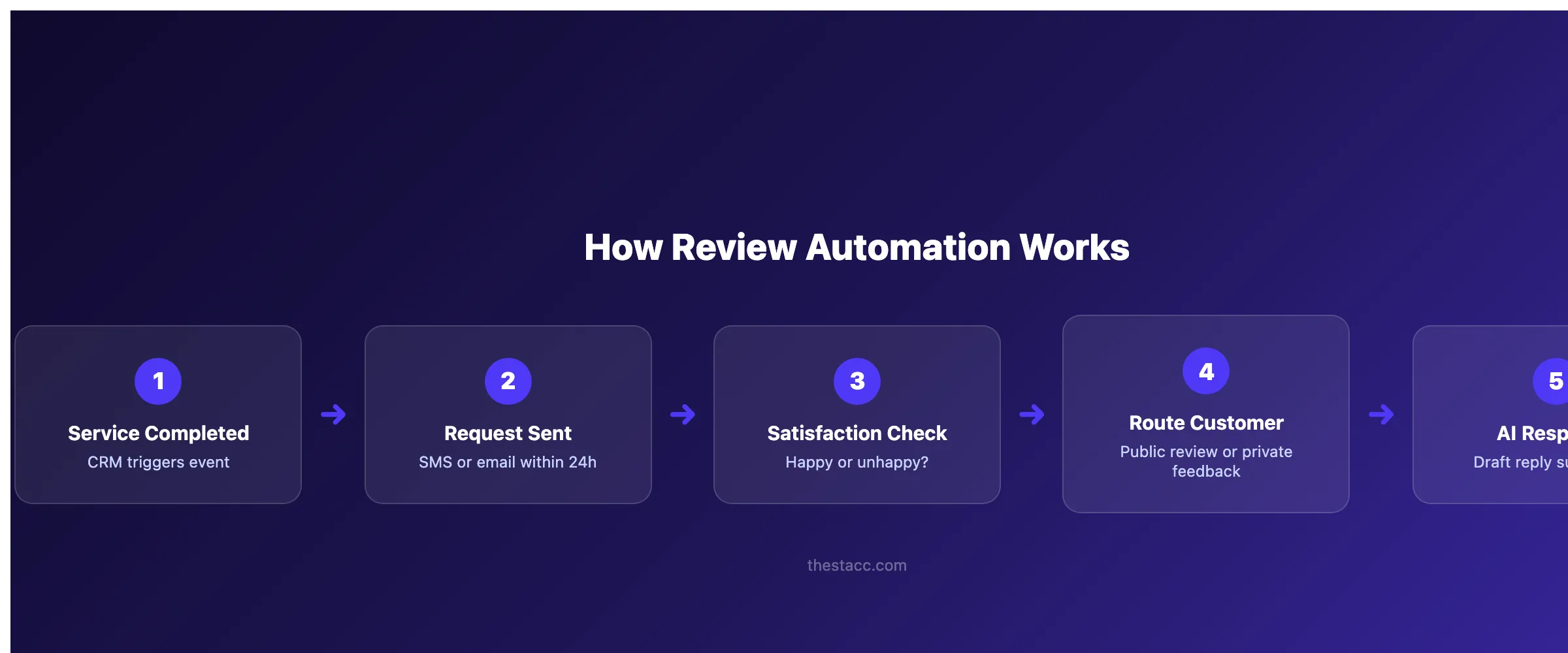
NiceJob sends review requests to customers automatically after you mark a job complete. The platform integrates with 1,000+ business tools through Zapier. Finish a project in your CRM, and NiceJob triggers the review request.
The review funnel is smart. Happy customers get directed to Google or Facebook. Unhappy customers get directed to a private feedback form. That filtering protects your public rating while still capturing improvement feedback.
NiceJob also creates a review website. It is a standalone page that displays all your reviews with schema markup for search engines. For small businesses without a review showcase page, this is a quick win.
Our Take: NiceJob is the easiest review management tool to set up and forget. For single-location businesses under $100/month budget, it is the strongest value on this list.
Where It Falls Short
NiceJob lacks the multi-location management features that Birdeye and ReviewTrackers offer. The reporting is basic. If you need competitive benchmarking or operational insights from review data, look elsewhere.
Key Features
- Automated review request sequences triggered by CRM events
- Smart review funnel that routes by customer sentiment
- Standalone review website with schema markup included
- 1,000+ integrations via Zapier for workflow automation
- Social proof widgets for your website and email signatures
Pricing
- Grow: $75/month. Automated review requests and monitoring
- Grow + Websites: $99/month. Adds a review-powered website
- Annual billing: Save 20% with yearly commitment
- Free trial: 14-day free trial available
Who Should Use NiceJob
Strong fit:
- Single-location service businesses (home services, dental, restaurants)
- Business owners who want zero-maintenance review automation
Probably not right for:
- Businesses managing 10+ locations that need centralized reporting
7. Trustpilot. Best for E-Commerce Review Management
Trustpilot is the most recognized consumer review platform globally. Over 1 million businesses use it. The brand name itself carries trust weight that other platforms cannot match.
What It Does Well
Trustpilot reviews appear directly in Google search results as seller ratings. That visibility drives click-through rates. Studies show that star ratings in search results increase CTR by 15 to 30%.
The platform offers both a free plan and paid tiers. The free plan lets you claim your profile, respond to reviews, and display a basic Trustpilot widget. For e-commerce brands, the paid tiers add automated review invitations, product-level reviews, and advanced analytics.
Trustpilot’s TrustBox widgets embed on product pages, checkout pages, and landing pages. Displaying reviews near purchase decisions boosts conversion rates by up to 270%.
Our Take: Trustpilot is the default for e-commerce brands. The Google integration and consumer recognition make it uniquely valuable. But it is a review display platform, not a full reputation management suite.
Where It Falls Short
Trustpilot does not aggregate reviews from other platforms. You only manage Trustpilot reviews within Trustpilot. If you need to monitor Google, Yelp, and Facebook reviews from one dashboard, you still need a separate tool.
The review gating controversy also matters. Trustpilot prohibits filtering reviews by sentiment before publishing. Some businesses prefer platforms where they can route unhappy customers to private feedback first.
Key Features
- Google Seller Rating integration for search visibility
- TrustBox widgets for product pages and checkout flows
- Automated review invitation campaigns via email
- Product-level and service-level review collection
- Free plan for basic profile management and response
Pricing
- Free: Claim profile, respond to reviews, basic widget
- Standard: $259/month. Automated invitations, analytics
- Growth: $559/month. Advanced widgets, competitive data
- Enterprise: Custom pricing. API, multi-brand support
- Free trial: Free plan available permanently
Who Should Use Trustpilot
Strong fit:
- E-commerce brands that want Google Seller Ratings in search results
- D2C brands building consumer trust through third-party validation
Probably not right for:
- Local service businesses that need multi-platform review aggregation
8. BrightLocal. Best for Local SEO Agencies
BrightLocal is not a pure review management tool. It is a local SEO platform with review management built in. That combination makes it the best choice for agencies managing multiple client locations.
What It Does Well
BrightLocal tracks reviews across Google, Facebook, Yelp, and 80+ industry-specific directories. The review monitoring dashboard shows new reviews, response status, and rating trends for each client.
The platform also includes citation tracking, rank tracking, and local search audits. Agencies get a single tool for local SEO reporting instead of stitching together 3 separate subscriptions.
White-label reports let agencies brand the review data and send it to clients directly. The report builder is one of the best in the industry for client-facing deliverables.
Our Take: BrightLocal is the most cost-effective option for agencies. At $39/month, you get review monitoring plus a full local SEO toolkit. No other tool matches that value for agency use cases.
Where It Falls Short
BrightLocal does not send review request campaigns. It monitors and reports on reviews but does not help you generate new ones. You need a separate tool (like NiceJob or GatherUp) for active review solicitation.
Key Features
- Review monitoring across Google, Facebook, Yelp, and 80+ directories
- Local rank tracking and citation audit tools included
- White-label reporting for agency client deliverables
- Competitor review benchmarking by location
- GBP audit and optimization recommendations
Pricing
- Track: $39/month. Up to 3 locations per report
- Manage: $49/month. Adds review management features
- Grow: $59/month. Full platform with API access
- Free trial: 14-day free trial available
Who Should Use BrightLocal
Strong fit:
- SEO agencies managing multiple client locations
- Consultants who need local SEO tools with built-in review monitoring
Probably not right for:
- Businesses that need active review generation campaigns
9. GatherUp. Best for Automated Review Follow-Up
GatherUp (formerly GetFiveStars) specializes in the post-service feedback loop. The platform automates review requests, captures first-party feedback, and routes customers to the right review platform based on their satisfaction level.
What It Does Well
GatherUp’s multi-step campaign system sends an initial feedback request. Based on the response, it either directs satisfied customers to leave a public review or captures private feedback from dissatisfied customers. This two-step approach protects your public rating.
The first-party review feature collects testimonials on your own website. Those reviews include schema markup that can trigger rich snippets in search results. For businesses focused on SEO, first-party reviews provide unique content that third-party platforms do not offer.
GatherUp also offers Net Promoter Score tracking. You can measure customer loyalty over time and correlate NPS trends with review performance.
Our Take: GatherUp’s two-step review funnel is the most thoughtful on this list. The first-party review approach also gives you SEO benefits that pure third-party platforms miss.
Where It Falls Short
The interface looks dated compared to Birdeye or Podium. The mobile experience needs improvement. Multi-location management exists but lacks the polish of enterprise-focused competitors.
Key Features
- Two-step review funnel with satisfaction-based routing
- First-party review collection with schema markup for SEO
- Net Promoter Score tracking and trend analysis
- Automated SMS and email review request campaigns
- Review widget builder for website social proof display
Pricing
- Single Location: $99/month. Full feature set for 1 location
- Multi-Location: Custom pricing. Volume discounts available
- Agency: Custom pricing. White-label and client management
- Free trial: Demo available on request
Who Should Use GatherUp
Strong fit:
- Service businesses that want to protect their public rating with sentiment routing
- Businesses focused on building first-party review content for SEO
Probably not right for:
- E-commerce brands that need product-level review collection
10. Grade.us. Best for White-Label Agency Review Management
Grade.us is built for marketing agencies that need to manage review campaigns under their own brand. Every element of the platform can be white-labeled, from the dashboard to the review request emails.
What It Does Well
The white-label capability is the deepest on this list. Agencies brand the entire platform. Clients never see the Grade.us name. That professionalism matters for agency retention.
Grade.us also offers a review funnel landing page builder. You create custom pages that filter customers by satisfaction before directing them to review platforms. The landing pages are hosted and do not require any development work.
The platform supports review monitoring across 100+ sites and integrates with major CRMs. For agencies running review campaigns for 20+ clients simultaneously, the multi-tenant architecture keeps everything organized.
Our Take: Grade.us is the best white-label option for agencies. If your clients expect branded reporting and you manage review campaigns as a service, Grade.us justifies its price.
Where It Falls Short
The user interface is functional but not modern. The platform lacks the AI response features that Birdeye and Reputation.com offer. Direct integrations are more limited than Podium or NiceJob.
Key Features
- Full white-label platform with custom branding at every touchpoint
- Review funnel landing page builder with satisfaction routing
- Review monitoring across 100+ sites with automated alerts
- Multi-tenant architecture for agency client management
- Drip email and SMS review request campaign builder
Pricing
- Solo: $110/month , 1 seat, up to 10 client profiles
- Partner: $180/month , 3 seats, up to 25 client profiles
- Agency: $400/month , 10 seats, up to 100 client profiles
- Free trial: 14-day free trial available
Who Should Use Grade.us
Strong fit:
- Marketing agencies offering review management as a standalone service
- Consultants who need branded client-facing review platforms
Probably not right for:
- Individual businesses that do not need white-label features
Reviews drive rankings. Content drives traffic. Stacc publishes 30 SEO-optimized articles per month on autopilot. Pair it with your review management tool. Start for $1 →
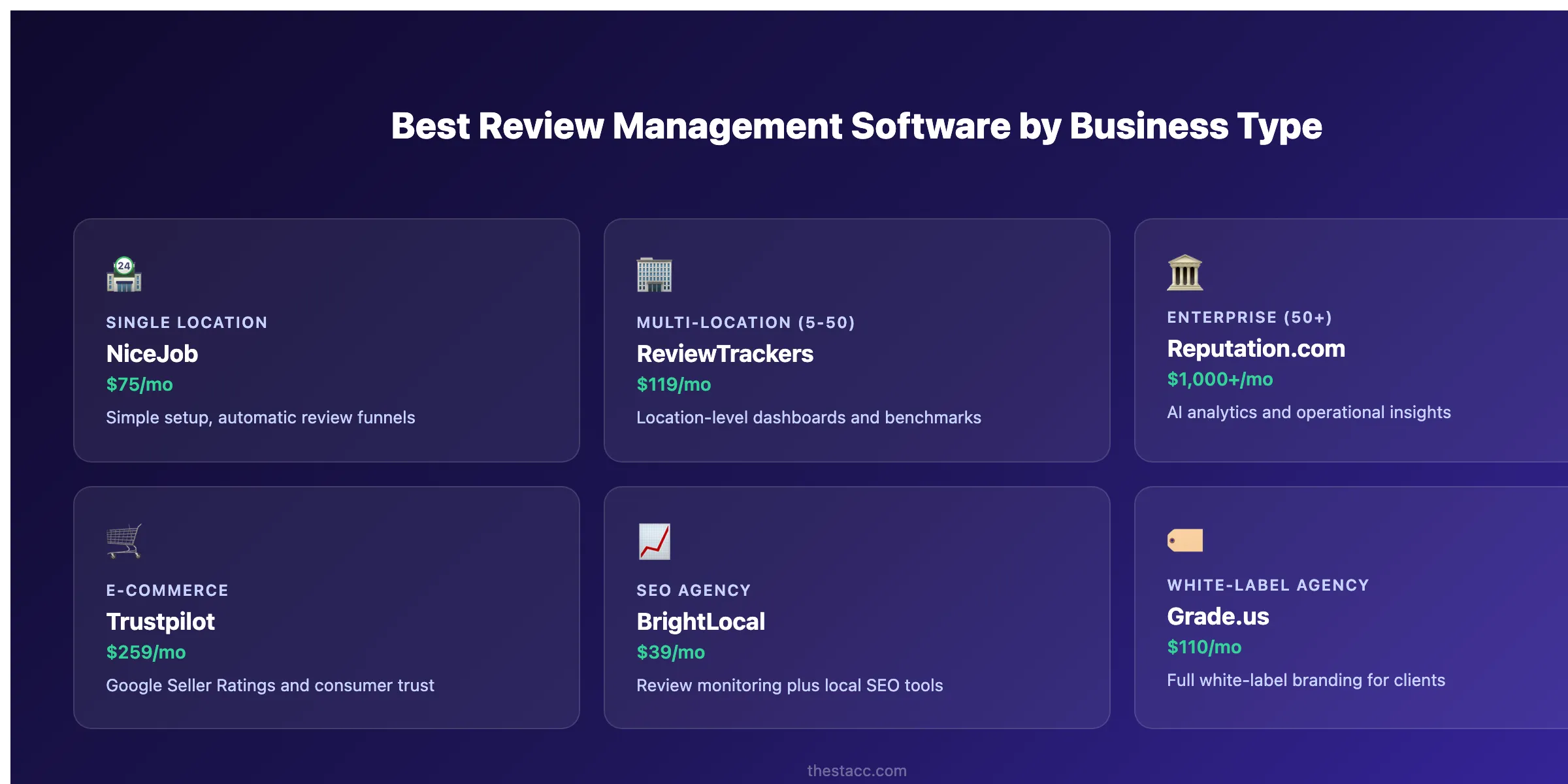
Which Review Management Software Is Right for You?
What is your budget?
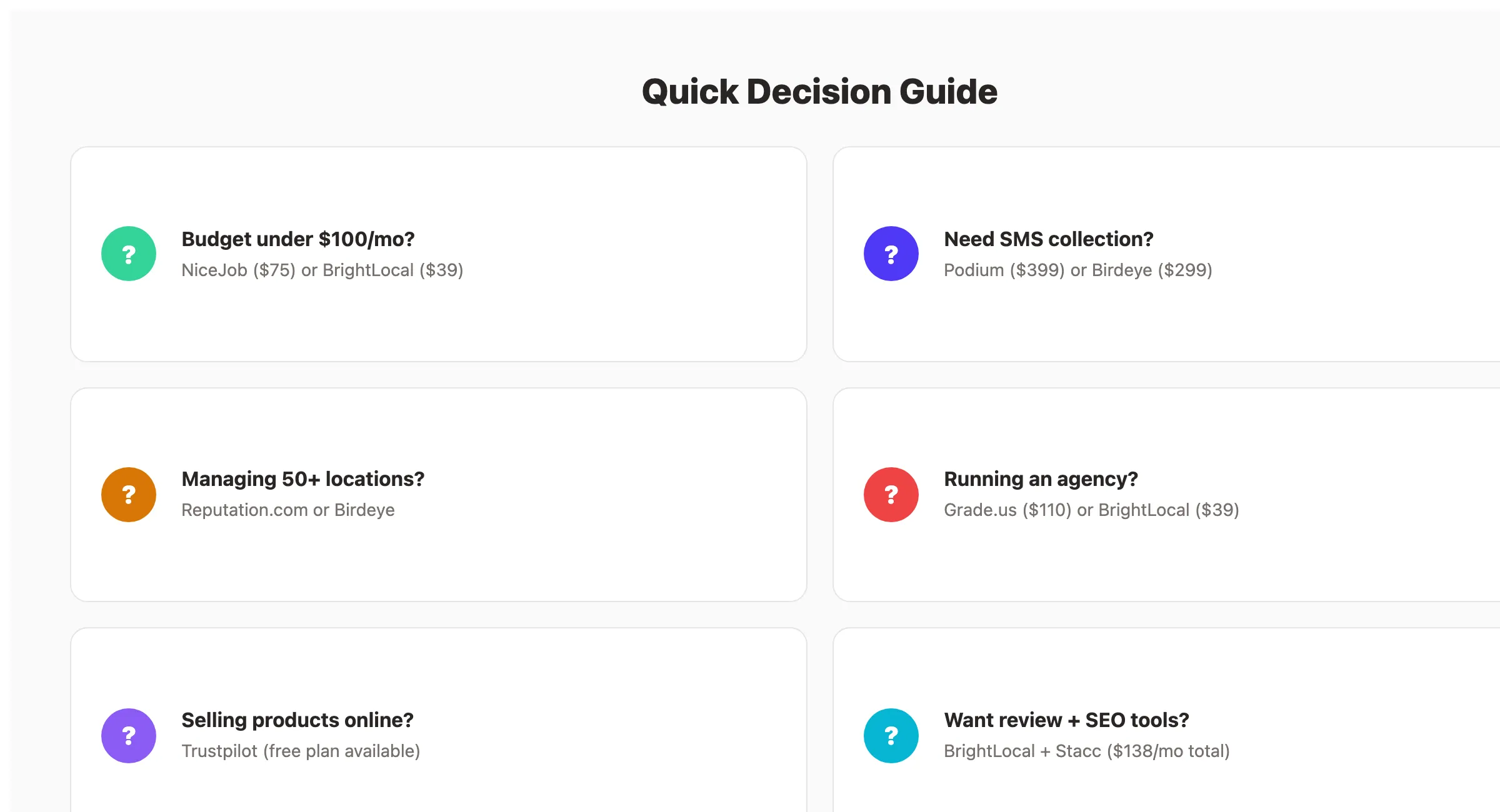
- Under $50/month. BrightLocal ($39/month, monitoring only)
- $50 to $150/month. NiceJob ($75) or GatherUp ($99) for active collection
- $150 to $400/month. ReviewTrackers, Yext, or Trustpilot
- $400+/month. Birdeye or Podium for full automation
What is your location count?
- 1 location. NiceJob (simplest) or GatherUp (most thoughtful funnel)
- 2 to 20 locations. ReviewTrackers (best value per location)
- 20+ locations. Birdeye (most complete) or Reputation.com (enterprise analytics)
What do you actually need?
- “I just need review monitoring”. BrightLocal (cheapest, includes local SEO tools)
- “I need to generate more reviews”. NiceJob or Podium (best collection automation)
- “I need white-label for clients”. Grade.us (deepest white-label platform)
- “I need reviews plus listings”. Yext (unified listing and review management)
- “I need e-commerce reviews”. Trustpilot (strongest consumer brand recognition)
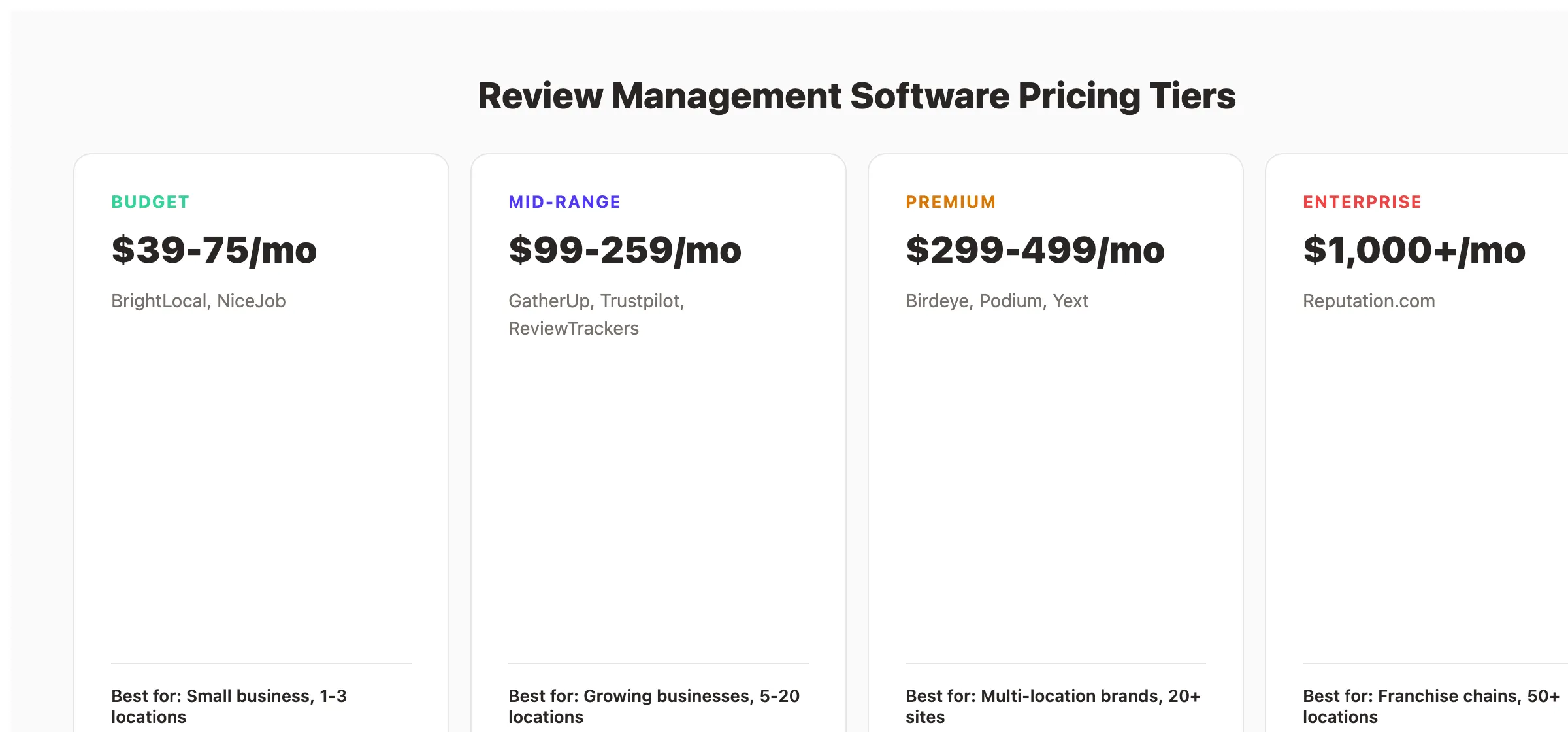
What Does Review Management Actually Cost?
| Approach | Monthly Cost | What You Get | Time Investment |
|---|---|---|---|
| Manual monitoring | $0 | Check each site individually | 10 to 20 hrs/month |
| Budget tool (BrightLocal) | $39/mo | Monitoring + local SEO tools | 3 to 5 hrs/month |
| Mid-range tool (NiceJob) | $75/mo | Automated collection + monitoring | 1 to 2 hrs/month |
| Premium tool (Birdeye) | $299/mo | Full automation + AI responses | 30 min/month |
| Enterprise (Reputation.com) | $1,000+/mo | Advanced analytics + operations data | 2 to 5 hrs/month |
| Reputation agency | $3,000 to 10,000/mo | Fully managed review campaigns | 1 to 2 hrs/month (meetings) |
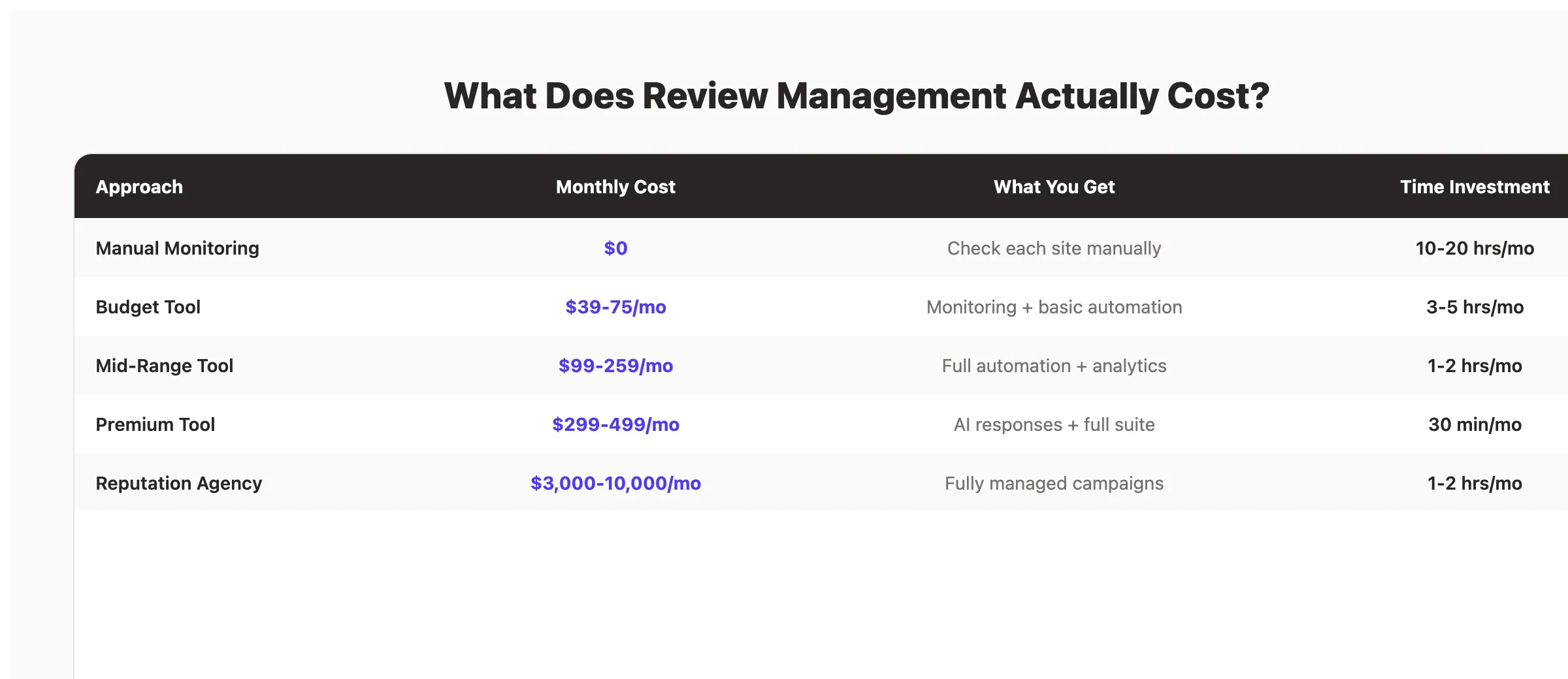
The math favors automation. A business responding to 50 reviews per month spends roughly 8 hours on manual responses. At $50/hour labor cost, that is $400/month in staff time. An AI-assisted tool at $99 to $299/month pays for itself immediately.
Reviews also compound. Every positive review improves your average rating. Every response improves your response rate. Both metrics affect local search rankings. The ROI multiplies over time. One study found businesses that respond to at least 25% of their reviews earn 35% more revenue than those that do not.
How to Choose the Right Review Management Software
Choose Birdeye if:
- You manage 10+ locations and need the broadest review site coverage
- You want AI response suggestions and competitive benchmarking
Choose Podium if:
- Your customers already communicate via text message
- You want reviews, messaging, and payments in one platform
Choose Reputation.com if:
- You are an enterprise with 50+ locations
- You need operational insights from review data, not just ratings
Choose NiceJob if:
- You run a single-location service business
- You want the simplest setup and lowest maintenance
Choose BrightLocal if:
- You are an agency managing local SEO for multiple clients
- You need review management tools bundled with rank tracking
Choose Trustpilot if:
- You sell products online and want Google Seller Ratings
- Consumer brand recognition matters to your conversion funnel
Choose GatherUp if:
- You want first-party reviews with SEO schema markup
- You value a two-step satisfaction funnel that protects your rating
Choose Grade.us if:
- You are an agency selling review management as a standalone service
- Full white-label branding is a requirement for your client relationships
Frequently Asked Questions
What is the best review management software in 2026?
Birdeye is the best overall review management software for most businesses. It covers 200+ review sites, offers AI response tools, and handles multi-location management. For small businesses on a budget, NiceJob at $75/month delivers the strongest automation per dollar. For agencies, BrightLocal bundles review monitoring with local SEO tools starting at $39/month.
Are there free review management tools?
Trustpilot offers a permanent free plan for basic profile management and review response. Google Business Profile itself is free and lets you respond to Google reviews directly. BrightLocal offers a 14-day free trial. For free review monitoring without management features, Google Alerts can track brand mentions. The limitation of all free options: no automated review collection.
How much does review management software cost?
Review management software ranges from $39/month (BrightLocal) to $1,000+/month (Reputation.com). Most small businesses spend $75 to $299/month. Enterprise platforms with custom pricing typically start at $1,000. The price usually scales with location count. A single-location business should expect $75 to $150/month for a capable tool.
Do online reviews actually affect local SEO rankings?
Yes. Google confirms that review quantity, quality, and response rate influence local pack rankings. Local SEO statistics show that businesses in the top 3 local results average 47 reviews. A 1-star rating increase can boost revenue by 5 to 9%. Responding to reviews signals active management, which Google rewards. Pairing review management with local SEO and Google Business Profile optimization creates the strongest local ranking foundation.
Can AI respond to reviews automatically?
Most modern review management tools offer AI-generated response suggestions. Birdeye, Podium, and Reputation.com all include this feature. The AI drafts a response based on review sentiment and content. However, fully automated publishing without human review carries risk. A poorly generated response to a negative review can make the situation worse. Best practice: use AI to draft, then approve before publishing.
What is the difference between review management and reputation management?
Review management focuses specifically on collecting, monitoring, and responding to customer reviews. Reputation management is broader. It includes review management plus social media monitoring, brand mention tracking, crisis response, and public relations. Tools like Birdeye and Reputation.com span both categories. Tools like NiceJob and Grade.us focus on reviews specifically.
The Bottom Line
Review management software saves time, protects your rating, and directly impacts revenue. For most single-location businesses, NiceJob ($75/month) or GatherUp ($99/month) delivers the best automation per dollar. For multi-location brands, Birdeye ($299/month) or ReviewTrackers ($119/month) provides the reporting depth you need. Agencies should look at BrightLocal ($39/month) or Grade.us ($110/month) for client management.
Reviews are one side of the local ranking equation. Content is the other. Stacc publishes 30 SEO articles per month on autopilot for $99. Combine review management with consistent content publishing and your local rankings compound faster.
Start for $1 → See the difference in 3 days
This article was researched and published by Stacc. The same platform businesses use to publish SEO content automatically. All pricing and features were verified against public sources as of March 2026.

Written by
Siddharth GangalSiddharth is the founder of theStacc and Arka360, and a graduate of IIT Mandi. He spent years watching great businesses lose organic traffic to competitors who simply published more. So he built a system to fix that. He writes about SEO, content at scale, and the tactics that actually move rankings.
Stop researching. Start ranking.
30 SEO blog articles published to your site every month. No writers, no workflow, no waiting.
30-day trial · Cancel anytime
theStacc
Stop writing SEO content manually
30 blog articles, 30 GBP posts, and social media content. Published every month. Automatically.
Start Your $1 Trial$1 for 3 days · Cancel anytime