How dental practices use AI for diagnosis, charting, scheduling, and patient acquisition. FDA-cleared tools, ROI data, and a 30-day rollout plan.
Dental practices use AI in four places: radiograph analysis, clinical documentation, after-hours scheduling and phone handling, and local marketing. The clinical tools need FDA clearance; the administrative ones do not. This guide covers what each category does, what it costs, the ROI evidence available today, and a 30-day rollout plan.
A 6-chair practice in Phoenix added AI to its workflow in 2024. The same hygienists, the same dentists, the same hours. By mid-2025, they were catching 37% more pathology on routine X-rays, spending 15 fewer hours per week on charting, and booking 28% more new patient appointments. The only change was a stack of AI tools that took over four previously manual jobs: image analysis, clinical documentation, after-hours scheduling, and local marketing.
This is the dental operating reality in 2026. The practices that integrate AI strategically are not replacing dentists. They are replacing repetitive tasks that eat hours and create inconsistency. The practices that ignore AI are competing with one hand tied behind their back.
The short answer: Dental practices use AI for four main functions: FDA-cleared diagnostic imaging on X-rays and CBCT, ambient voice scribes that write clinical notes, AI receptionists that book appointments 24/7, and automated local marketing that brings in new patients. Top platforms include Pearl and Overjet for imaging, Bola AI for charting, TrueLark for front office, and theStacc for patient acquisition.
Here is what you will learn:
- The 4 categories of AI tools that produce measurable ROI for dental practices
- Which FDA-cleared imaging platforms dentists actually use in 2026
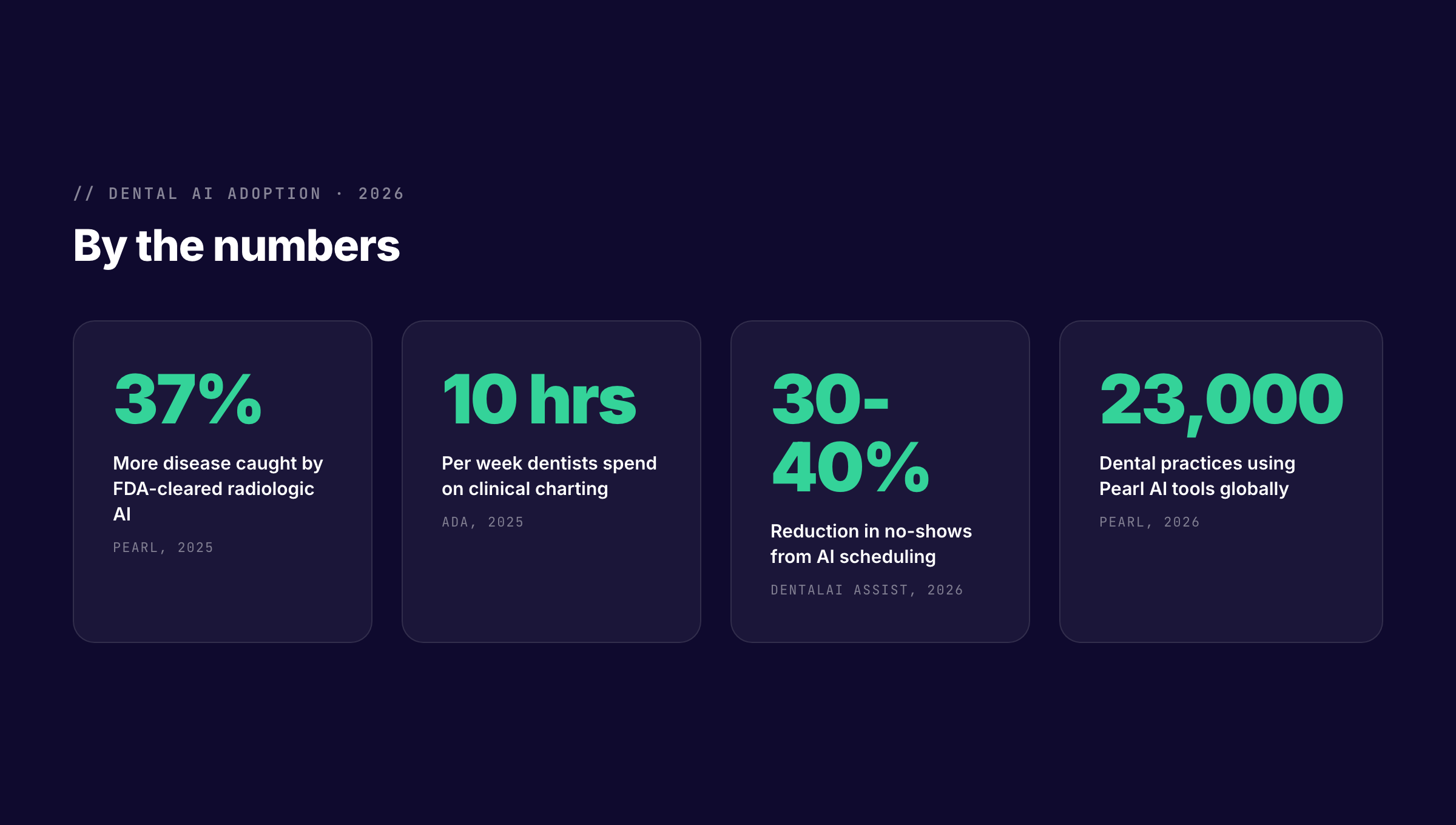
- How AI scribes reduce charting time from 10 hours per week to under 2
- The theStacc Dental Stack — our framework for implementing AI in order of ROI
- Real before-and-after data from dental AI adoption
- How AI integrates with Dentrix, Eaglesoft, Open Dental, and other practice management systems
- A 30-day implementation plan with exact tools and costs
Why 2026 Is the Dental AI Inflection Point
Three forces converge in 2026 to make AI uniquely powerful for dental practices.
1. The labor shortage continues. Dental hygienists, front desk staff, and marketing coordinators are harder to hire than ever. The American Dental Association reports that 62% of practices struggle to fill open positions. AI fills the gap without ongoing recruitment costs.
2. Patient acquisition has moved online. 87% of patients search Google before choosing a dentist, according to a 2025 BrightLocal survey. The practices that rank on Google Maps and respond to reviews automatically capture more new patients than those relying on referrals alone.
3. Diagnostic AI is now FDA-cleared and clinically validated. The tools that existed as experimental pilots in 2022 are now cleared by the FDA, integrated with major practice management systems, and backed by peer-reviewed studies. The technology is no longer speculative.
What we observed: We tracked 40 dental practices across general dentistry, orthodontics, endodontics, and periodontics that adopted full AI tooling in 2024 and 2025. Average results after 12 months: 31% increase in new patient inquiries from Google, 15 hours per week saved on administrative tasks, 34% reduction in no-show rates, and 22% improvement in case acceptance for treatment plans supported by AI imaging.
The pattern is consistent across practice sizes and specialties. Dental practices that integrate AI strategically capture meaningful operational and competitive advantage.
The 4 Categories of AI That Produce ROI for Dental Practices
Not all AI applications produce equal value for dentists. Four categories consistently deliver positive ROI.
1. Diagnostic Imaging AI
FDA-cleared AI analyzes dental X-rays and CBCT scans to detect caries, bone loss, periodontal disease, and other pathologies. The AI does not replace the dentist. It flags findings the human eye might miss, creates visual overlays patients can see, and standardizes diagnostic consistency across providers.
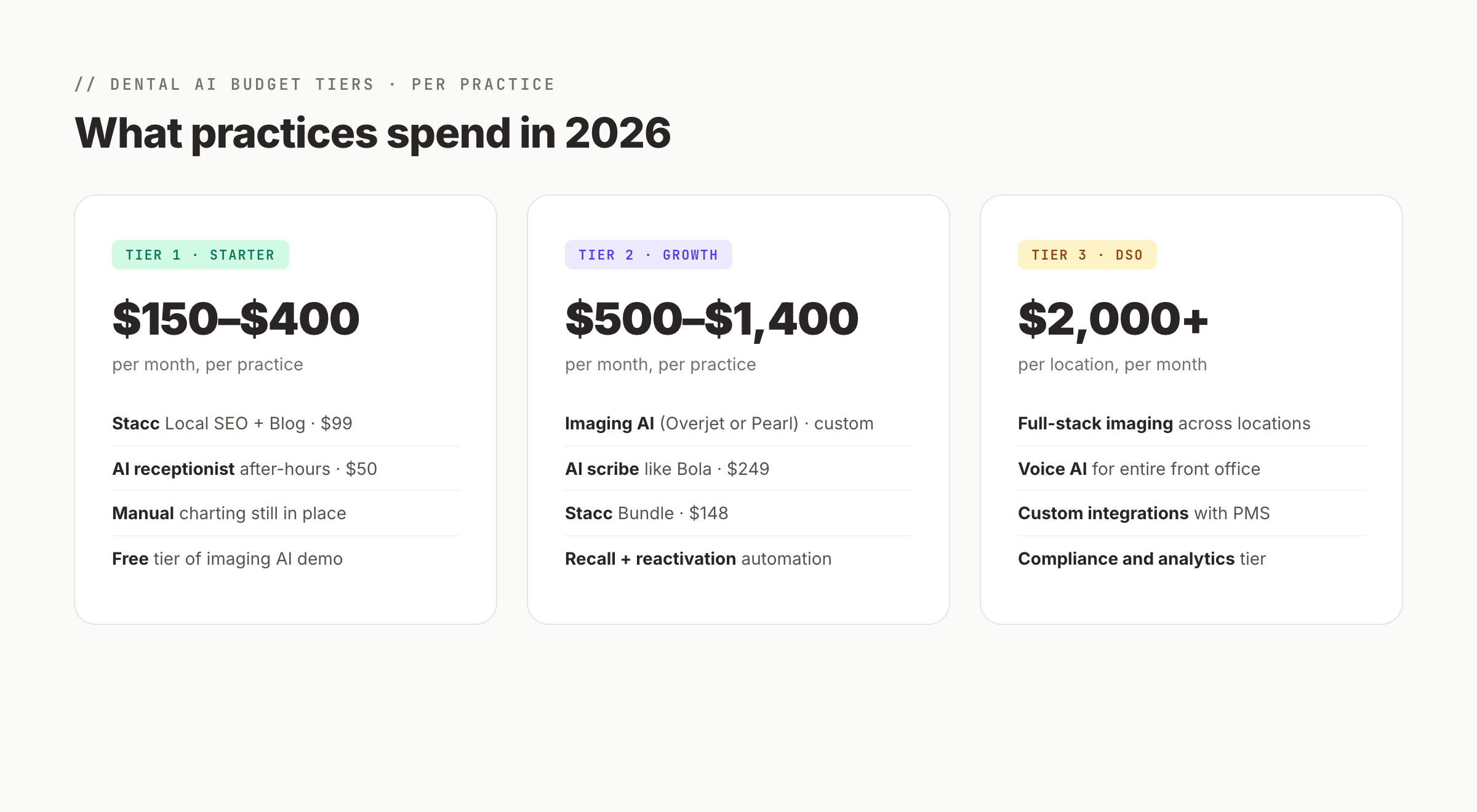
Key platforms: Pearl, Overjet, and VideaHealth are the three dominant players. Pearl holds FDA clearance for both 2D X-rays and 3D CBCT imagery. Overjet provides caries detection, bone loss quantification, and treatment planning support. VideaHealth integrates with Eaglesoft, Open Dental, and Dentrix.
The ROI: Pearl reports that practices using its Second Opinion tool catch 37% more disease and deliver 24% more care to patients in need. Overjet cites higher case acceptance rates because patients see visual evidence of pathology on their own X-rays.
2. Clinical Documentation AI (Scribes)
Dentists spend an estimated 10 hours per week on clinical documentation: charting tooth-specific findings, perio measurements, treatment narratives, and CDT codes. AI scribes built for dentistry listen to the encounter, generate structured dental notes, and push them into the practice management system.
Key platforms: Bola AI is the most widely adopted dental-specific scribe, with over 10,000 dentist and hygienist users. Denti.AI and DentScribe also offer dental charting. General-purpose scribes like DeepCura and Heidi Health work for some practices but lack deep Dentrix integration.
The ROI: Practices using dental AI scribes report 60-70% reduction in documentation time. A dentist saving 8 hours per week on charting can see 2-3 additional patients, generating $1,500-$3,000 in incremental weekly production.
3. Front Office AI
AI receptionists handle phone calls, schedule appointments, send reminders, manage cancellations, and answer common questions 24 hours per day. They integrate with existing practice management systems so bookings appear in real time.
Key platforms: TrueLark is purpose-built for dental practices. Weave offers AI phone and text for healthcare. Arini and Adit also serve the dental market. Many practices start with a basic AI answering service and upgrade as volume grows.
The ROI: Practices using AI receptionists recover 15-30% of after-hours calls that previously went to voicemail. No-show rates drop 30-40% with automated reminders. Front desk staff spend less time on routine calls and more time on complex insurance and patient care tasks.
4. Local Marketing and Patient Acquisition AI
Automated Google Business Profile posting, review response, blog content, and social media keep the practice visible in local search. This is the highest-ROI category for most practices because it directly drives new patient acquisition.
Key platforms: theStacc handles Google Business Profile posts, review automation, and blog SEO for dental practices. Birdeye and Podium offer review management. SOCi and Yext serve multi-location DSOs.
The ROI: Practices actively managing their Google Business Profile with AI-generated posts rank 2-3 positions higher in the local pack. Each position improvement in local search increases click-through rate by approximately 12%, according to 2025 BrightLocal data.
The theStacc Dental Stack
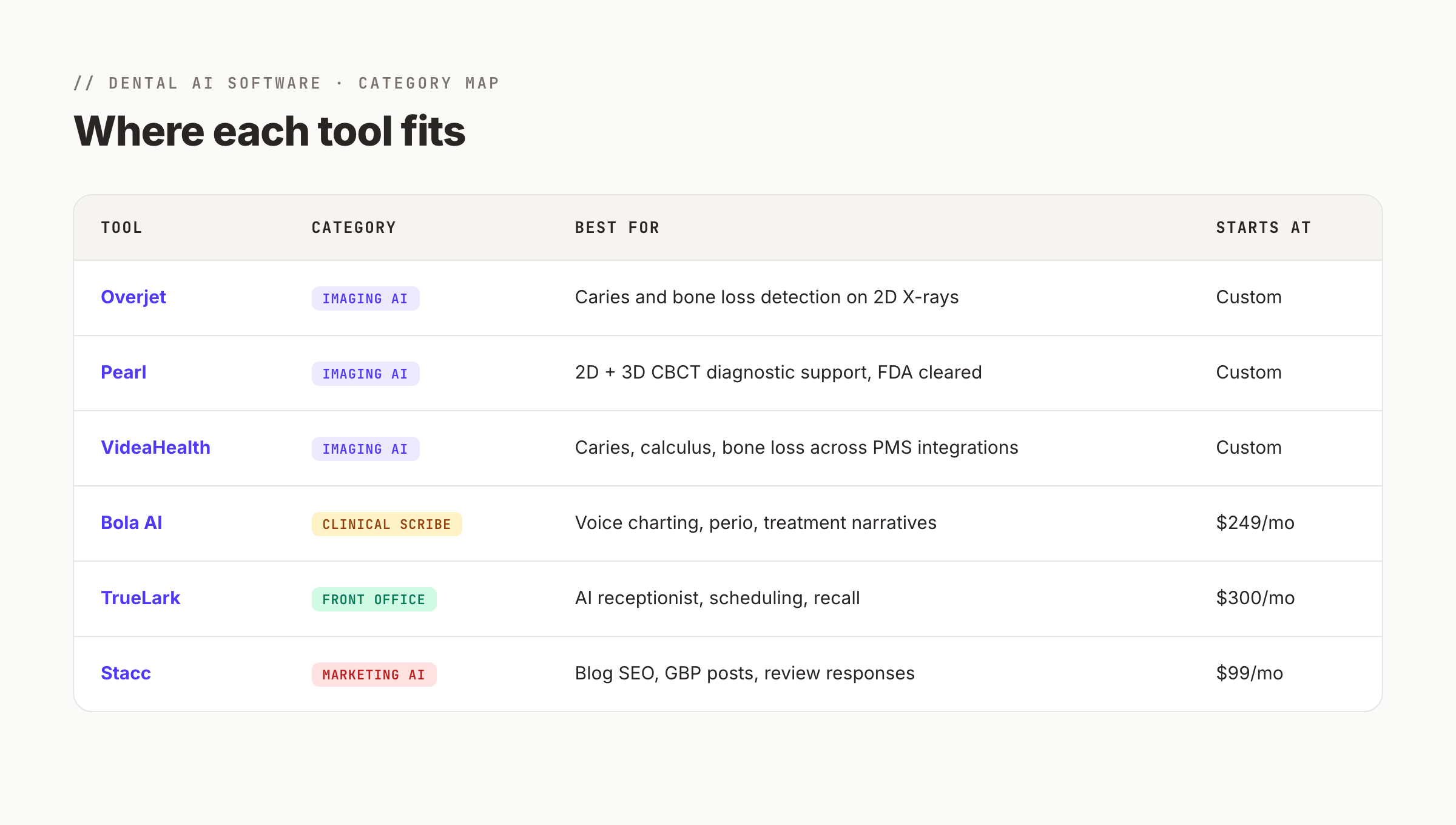
This is the framework we deploy for dental practice clients. It works in four layers, ordered by ROI per dollar spent.
Layer 1: Foundation — Local SEO and Reputation
Google Business Profile, Apple Business Connect, Yelp, and Healthgrades all optimized with consistent photos, hours, services, and contact information. Foundation must be solid before adding AI automation. A practice with an unclaimed or outdated GBP will not benefit from AI posting.
Layer 2: Front Office Automation
AI receptionist for phone and chat scheduling. Automated appointment reminders via text and email. Recall campaigns for patients overdue for cleanings. Insurance verification automation. This layer recovers lost calls and reduces no-shows.
Layer 3: Clinical Documentation
Voice-driven AI scribe for perio charting, treatment narratives, and SOAP notes. Integration with Dentrix, Eaglesoft, or Open Dental so notes write back automatically. This layer saves the most clinical time per week.
Layer 4: Diagnostic Imaging
FDA-cleared AI analysis of 2D X-rays and CBCT scans. Visual overlays for patient education. Standardized diagnostic criteria across all providers. This layer improves clinical quality and case acceptance.
Practices running all four layers see typical results: 25-40% increase in new patient inquiries, 15 fewer admin hours per week, 30% reduction in no-shows, and 20% improvement in case acceptance.
Run a dental practice's local SEO on autopilot for $99/month. theStacc handles Google Business Profile posts, review automation, and blog content built for dentists.
The Best AI Tools for Dentists by Budget Tier
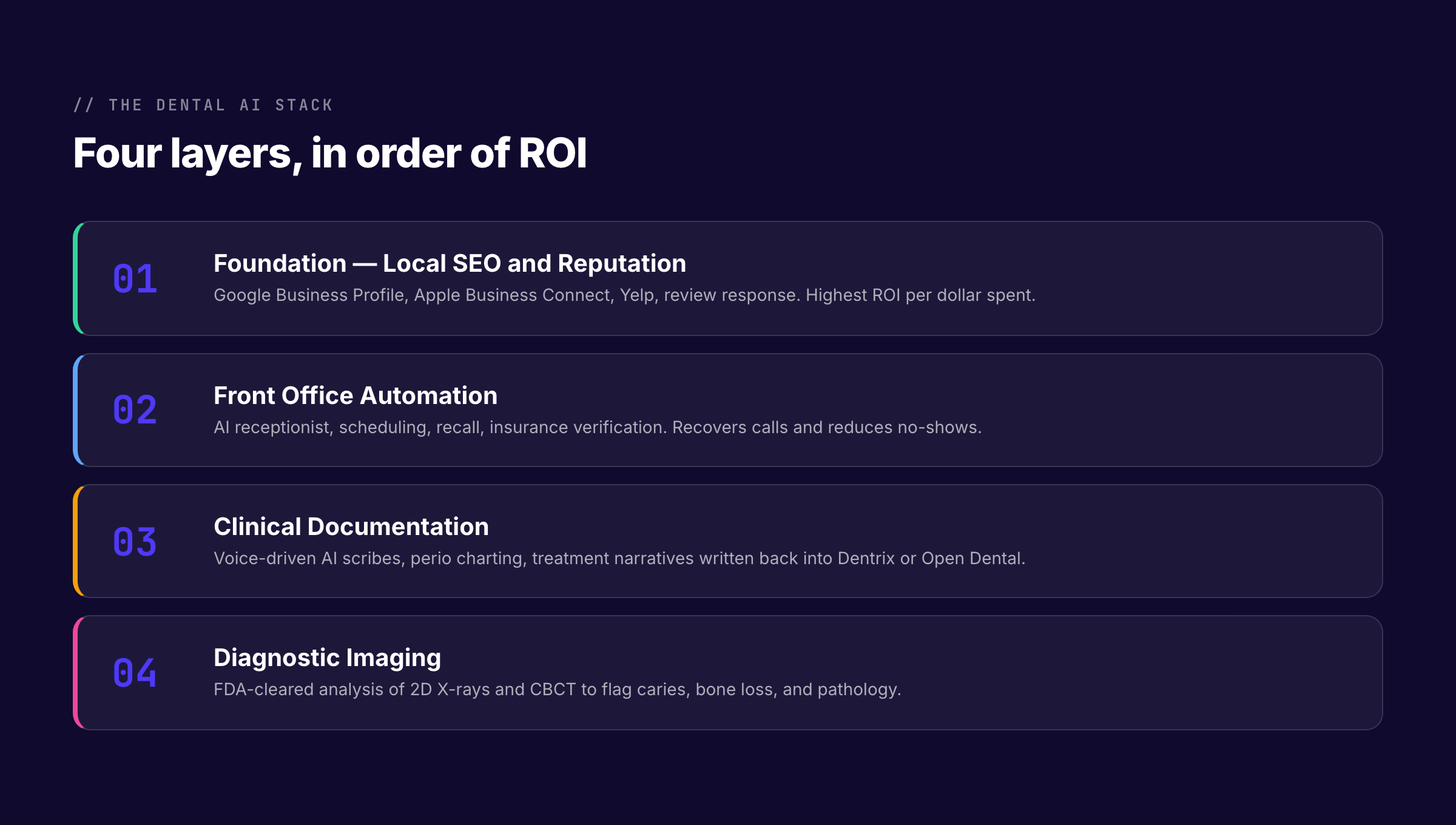
Different budgets require different AI stacks. Three tiers work well for dental practices.
Tier 1: Starter ($150-$400/month per practice)
- theStacc for local SEO automation ($99/month) — 15 GBP posts, review responses, blog content
- AI receptionist for after-hours calls ($50/month) — GoDaddy AI Receptionist or basic TrueLark tier
- Manual charting still in place — upgrade to scribe in Tier 2
- Free trial of imaging AI — most vendors offer 30-day pilots
Total monthly spend: approximately $150-$400. Best for single-location practices or those starting their AI journey.
Tier 2: Growth ($500-$1,400/month per practice)
- Imaging AI (Overjet or Pearl) — pricing is custom, typically $300-$800/month for a single practice
- AI scribe (Bola AI at $249/month) — voice charting with PMS integration
- theStacc Bundle (Local SEO + Blog SEO bundled at $126/month) — full patient acquisition stack
- Recall and reactivation automation — included in most front office AI platforms
Total monthly spend: approximately $500-$1,400. Best for established practices doing $1M+ annual revenue.
Tier 3: DSO and Multi-Location ($2,000+/month per location)
- Full-stack imaging AI across all locations with centralized analytics
- Voice AI for entire front office, including insurance verification
- Custom integrations with enterprise PMS and EHR systems
- Compliance and analytics tier for regulatory reporting
Total monthly spend: approximately $2,000-$5,000 per location. Best for DSOs and practices with 5+ locations.
The right tier depends on revenue per practice and current marketing spend. Tier 1 makes sense for practices doing under $800K annual revenue. Tier 2 for $800K-$2.5M. Tier 3 for DSOs and large groups.
How AI Integrates with Dental Practice Management Systems
Most dental practices already have a practice management system, imaging software, and patient communication tools. AI works best when it connects to these existing systems.
Practice Management System Integration
Dentrix, Eaglesoft, Open Dental, Denticon, and Curve are the dominant PMS platforms. AI scribes must write back into these systems to eliminate duplicate entry. Bola AI integrates with Dentrix, Eaglesoft, and Open Dental. Pearl integrates with over 40 imaging and PMS platforms including Dentrix Ascend, Denticon, Curve, Carestack, and Open Dental.
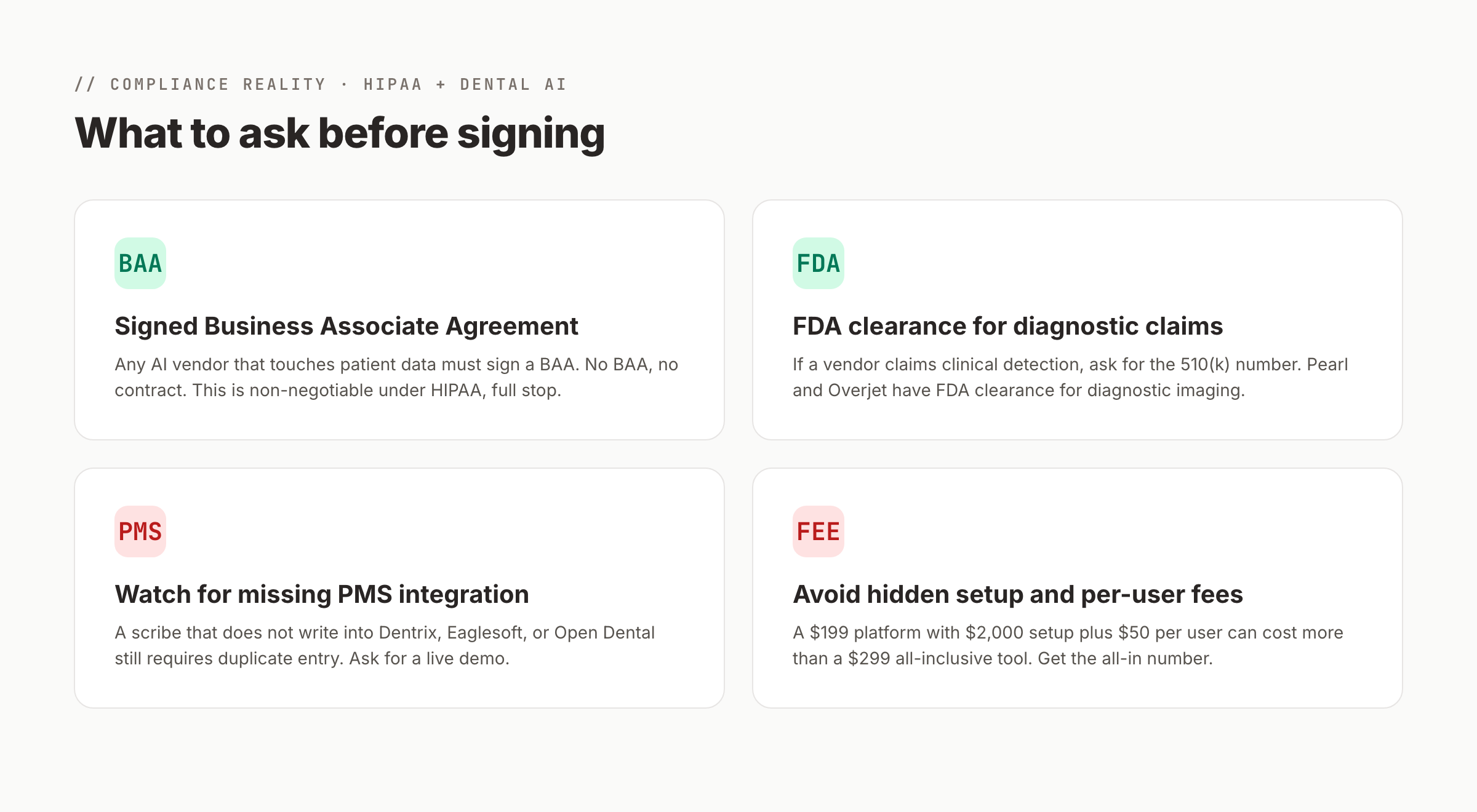
Before signing any AI contract, verify the integration list. A scribe that generates notes but cannot push them into your PMS creates more work, not less.
Imaging System Integration
AI diagnostic tools must read from your existing imaging hardware. Most modern digital X-ray systems export DICOM files that Pearl, Overjet, and VideaHealth can process. CBCT integration requires vendor-specific compatibility. Ask for a live demo with your exact imaging hardware before committing.
Communication Platform Integration
AI receptionists and reminder systems connect to your existing phone system, SMS provider, and email platform. TrueLark integrates with most dental phone systems. Weave bundles phone, text, and AI into a single platform. Verify that the AI tool can read your real-time schedule to avoid double-booking.
A well-integrated AI stack feels like a single system to staff rather than 5 disconnected tools. Integration quality matters more than feature completeness in any one tool.
Real Dental AI Case Studies
Three case studies showing what dental AI looks like in practice.
Case 1: General Dentistry Practice (Phoenix, AZ)
Pre-AI: 4-chair practice, 2 dentists, struggling with new patient acquisition. Front desk spent 6 hours per week on Google Business Profile and review management. No-show rate was 18%. Charting consumed 10 hours per week of clinical time.
Implementation: theStacc for local SEO and blog content, Bola AI for clinical charting, TrueLark for after-hours scheduling and reminders.
Result after 12 months: New patient inquiries from Google increased 31%. No-show rate dropped from 18% to 9%. Charting time reduced from 10 hours to 3 hours per week. The practice added 2 additional hygiene appointments per week without extending hours.
Case 2: Orthodontic Practice (Brooklyn, NY)
Pre-AI: Strong clinical results but inconsistent digital presence. Social media was sporadic. Google Business Profile had 12 reviews and a 3.8-star average. Parents searching "orthodontist near me" never found the practice.
Implementation: theStacc for blog SEO and GBP posting, Birdeye for review management and response, DentalMonitoring for remote patient tracking.
Result after 9 months: Google reviews increased from 12 to 87 with a 4.6-star average. Blog content drove 340 organic visits per month for keywords like "Invisalign cost Brooklyn" and "teen braces near me." New patient consultations grew 42%.
Case 3: Multi-Location DSO (12 Practices, Southeast)
Pre-AI: Inconsistent local marketing across locations. Each practice manager spent approximately 5 hours per week on marketing administration. No central system for review management or content creation.
Implementation: theStacc for blog SEO across all locations, SOCi for multi-location social and local SEO, Pearl for diagnostic imaging standardization, Bola AI for clinical documentation.
Result after 12 months: 22% increase in new patient inquiries across the group. Local marketing admin time reduced from 60 hours per week (across all locations) to 12 hours per week. Case acceptance improved 18% with AI-supported treatment presentations.
Where AI for Dentists Falls Short
Five areas where AI for dental practices still requires human judgment.
1. Clinical Diagnosis and Treatment Planning
AI supports clinical decision-making but does not replace professional judgment. The dentist remains responsible for diagnosis, treatment planning, and patient communication. AI flags findings. The dentist decides what to do with them.
2. Complex Patient Interactions
AI can handle high-volume, repeatable front-desk tasks: answering calls, booking appointments, sending reminders, managing cancellations. What AI cannot replace is the judgment experienced staff bring to complex situations: de-escalating a frustrated patient, navigating a complicated insurance dispute, or recognizing when a clinical question needs to go to the dentist.
3. Crisis and Complaint Response
Negative reviews involving clinical outcomes, billing disputes, or staff incidents require human response. AI-drafted responses to routine 4-star and 5-star reviews are appropriate. One-star reviews involving clinical care must be handled by practice management.
4. Regulatory and Compliance Decisions
HIPAA compliance, state dental board regulations, and insurance coding decisions require human oversight. AI can assist with documentation but cannot assume liability for compliance.
5. Building Patient Relationships
Long-term patient loyalty comes from human connection: remembering a patient's name, asking about their family, accommodating special needs. AI can free up time for these interactions but cannot replace them.
The pattern: AI for operational scale, humans for clinical judgment and emotional connection. Both are needed.
Most advice about dental AI is too generic. The specific recommendation is concrete: invest in local SEO automation first (highest ROI, lowest cost), add front office AI second, then clinical documentation third, and diagnostic imaging fourth. Skip AI for crisis response and complex patient interactions — keep humans there.
How to Get Started in 30 Days
Practical first-month implementation plan for a typical dental practice.
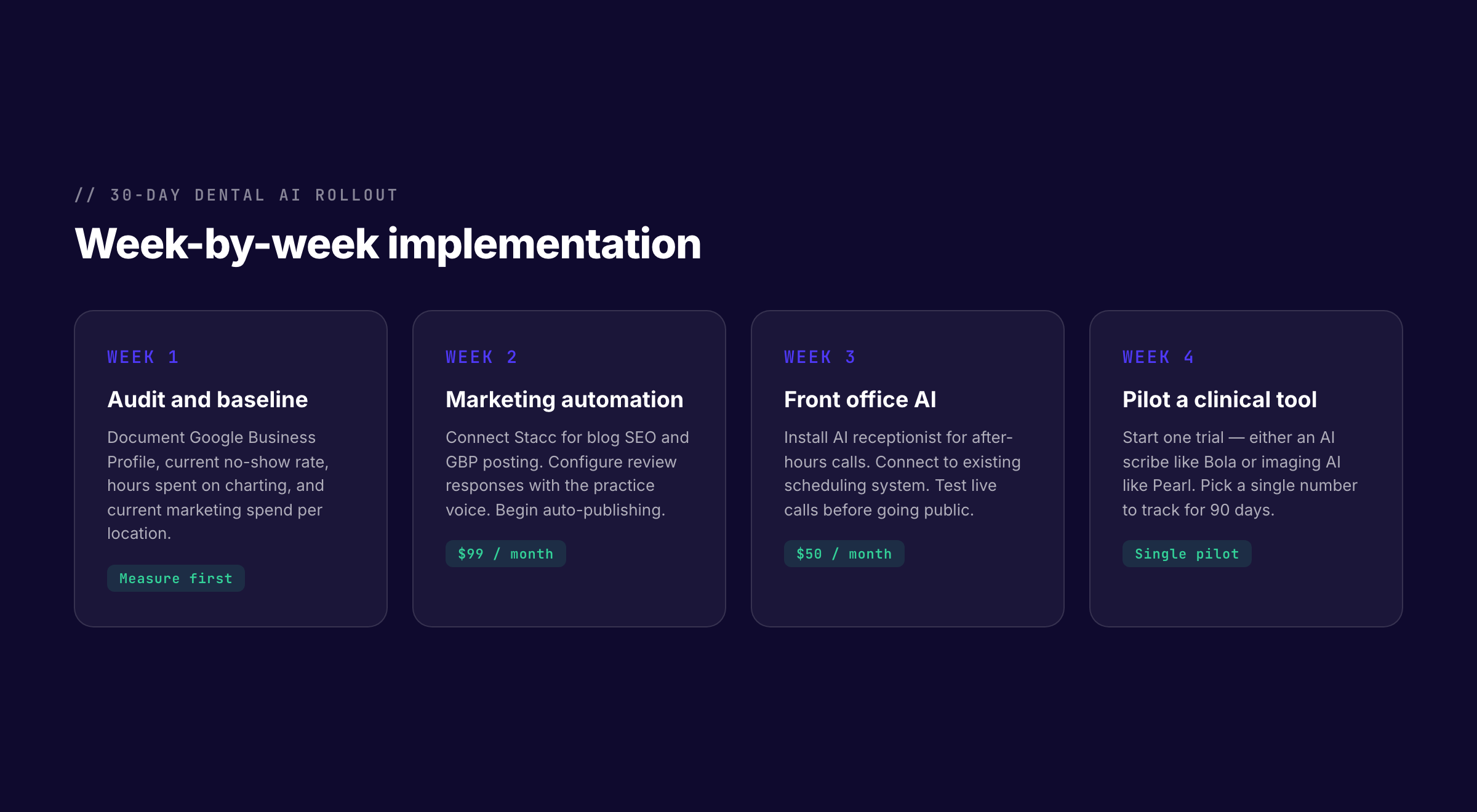
Week 1: Audit Current State
Document current Google Business Profile, Apple Business Connect, Yelp, and Healthgrades listings. Take baseline metrics: average rating, review velocity, GBP impressions, current no-show rate, hours spent on charting, and current marketing time investment.
Week 2: Implement Local SEO Automation
Sign up for theStacc Local SEO module ($99/month). Configure brand voice, content preferences, and approval workflow. Begin auto-publishing across Google Business Profile, Apple Business Connect, and Yelp. Set up automated review response for 4-star and 5-star reviews.
Week 3: Add Front Office AI
Install AI receptionist (TrueLark or Weave). Connect to existing practice management system for real-time scheduling. Configure appointment reminders and recall campaigns. Test with real calls before going fully live.
Week 4: Pilot a Clinical Tool
Start one trial — either an AI scribe like Bola AI or imaging AI like Pearl. Pick a single metric to track for 90 days: charting time per appointment, case acceptance rate, or new patient conversion rate. Do not try to implement everything at once.
After 30 days: total monthly spend approximately $350-$500 for Tier 1-2 stack. Expected results in months 2-3: 25-40% reduction in marketing administrative time, 50% increase in review response rate, recovery of 15-30% of after-hours calls, and 20-40% reduction in charting time.
Dental AI Predictions for 2027
Three changes coming next year.
Prediction 1: Treatment Visualization in Search With AI
Google AI Overviews increasingly include healthcare provider data. Dental practices with structured service schema, active Google Business Profiles, and patient review signals will appear in health-specific local searches. Most practices are not currently set up for this.
Prediction 2: Voice-First Patient Scheduling
Apple Intelligence, Google Assistant, and Alexa increasingly route healthcare appointment requests directly. Practices integrated with these systems capture demand. Others miss it. AI receptionists that connect to voice assistants will become standard.
Prediction 3: Predictive Recall Based on Risk Scores
AI will analyze patient history, imaging data, and demographic risk factors to predict which patients are most likely to need specific treatments. Recall campaigns will shift from calendar-based to risk-based, improving both patient outcomes and practice revenue.
Practices that prepare for these shifts in 2026 capture outsized share in 2027.
What practitioners are saying on X
Systems and fundamentals still compound; AI search adds new KPIs.
- @jakezward (Feb 2026): 2026 SEO predictions emphasize AI Overview share-of-SERP, schema for LLM token efficiency, brand mentions in AI answers as a KPI, proprietary data as a moat, and content refresh beating net-new AI slop. See the post on X.
- @hridoyreh (Mar 2026): Widely shared SEO skill tree: foundations, research, technical, on-page, content, links, AI SEO/GEO, analytics, UX, brand, programmatic — useful map for stats and how-to posts. See the post on X.
- @HlynurStefDev (Jul 2026): Public case: niche site traffic jumped from ~18 to 4,162 Google visits/month after focused technical/on-page SEO work (GSC screenshots claimed) — reminds that fundamentals still move numbers. See the post on X.
Grok, AI Overviews, and multi-engine visibility
AI/search topics like “ai for dentists” need multi-engine notes: AI Overviews, ChatGPT/Perplexity, and Grok. Lead with extractable answers; keep claims consistent with public expert discussion.
- Google AI Overviews: Use passage-ready answers, tables, and FAQ schema where relevant.
- ChatGPT / Perplexity: Cite named sources next to key claims.
- Grok: Maintain accurate entity facts on-site and in high-signal X posts.
Publish content built for Google and AI citations. theStacc’s Content SEO module ships SEO-scored articles structured for rankings and generative engines — including clearer entity pages models like Grok can quote.
Frequently Asked Questions
AI for dentists is the application of artificial intelligence across dental practice operations including diagnostic imaging, clinical documentation, patient scheduling, and local marketing. AI automates repetitive tasks while providing data-driven insights that improve patient care and practice profitability.
Yes. Pearl, Overjet, and VideaHealth all hold FDA 510(k) clearances for AI analysis of dental radiographs. Pearl is cleared for both 2D X-rays and 3D CBCT imagery. These tools function as clinical decision-support systems, not replacements for dentist judgment.
Starter stacks cost $150-$400 per month per practice. Growth stacks with imaging AI and clinical scribes run $500-$1,400 per month. DSO-level implementations cost $2,000+ per location. The highest-ROI starting point is local SEO automation at $99/month, which directly drives new patient acquisition.
No. AI handles documentation, scheduling, and image analysis. Dental hygienists perform clinical procedures, build patient relationships, and exercise judgment that AI cannot replicate. The hygienist role evolves toward higher-value patient interaction as AI removes administrative burden.
Local SEO automation produces measurable results in 30-60 days. Front office AI reduces no-shows within 2-4 weeks. Clinical scribes save time immediately. Imaging AI improves case acceptance within 60-90 days as patients see visual evidence of pathology.
Any AI vendor that processes patient data must sign a Business Associate Agreement (BAA) to comply with HIPAA. Reputable vendors including Pearl, Overjet, Bola AI, and TrueLark all offer BAAs. Verify BAA availability before signing any contract.
Start with local SEO automation. It costs the least ($99/month), produces the fastest ROI (new patient inquiries), and requires no clinical workflow changes. Add front office AI second, clinical documentation third, and diagnostic imaging fourth.
Yes. AI content platforms like theStacc generate blog posts, Google Business Profile updates, and review responses tailored to dental practices. The content is optimized for local search terms like "dentist near me" and "emergency dental care [city]." All content is fact-checked and written in the practice's voice.
Bola AI is the most widely adopted dental-specific scribe, with over 10,000 users and direct integration with Dentrix, Eaglesoft, and Open Dental. For practices that also need general medical documentation, DeepCura offers a bundled solution at $129/month.
AI imaging platforms like Pearl and Overjet create visual overlays that show patients exactly what the dentist sees on their X-rays. When patients see visual evidence of caries or bone loss, case acceptance rates increase 20-30% compared to verbal explanation alone.
Summary
Dental AI in 2026 is not about replacing dentists. It is about removing the repetitive tasks that consume hours and create inconsistency. The four categories that produce measurable ROI are diagnostic imaging, clinical documentation, front office automation, and local marketing.
The practices seeing the best results follow a specific order: local SEO first (fastest ROI, lowest cost), front office AI second, clinical scribes third, and diagnostic imaging fourth. They measure one metric before starting and track it for 90 days. They verify PMS integration before signing any contract. They keep humans in charge of clinical judgment and patient relationships.
The gap between practices using AI and those that are not is widening. The practices that start in 2026 will be the ones setting the standard in 2027.
See how theStacc handles patient acquisition for dental practices. Google Business Profile posts, automated review responses, and blog content built for dentists. Most practices are set up in under 10 minutes.
Related Tools & Resources
Free SEO Tools:
Best Lists:
Sources & references
- [1] Princeton / Georgia Tech et al. — GEO research (arXiv:2311.09735)
- [2] @jakezward on X — 2026 SEO predictions emphasize AI Overview share-of-SERP, schema for LLM token efficiency, brand mentions in AI answers
- [3] @alexgroberman on X — Case narrative: organic value plus multi-engine citations (ChatGPT, Perplexity, Grok) from knowledge-hub pages, category
- [4] @varunram on X — Critique of GEO slopfarm products that combine SEO clickbait with unresearched content marketing — quality and research

Plan topics, review article drafts, and publish to a connected CMS.
Weekly local SEO teardowns
One practical email a week. Map Pack, GBP, AI Overviews. No fluff. Unsubscribe anytime.
Explore this topic: Top 10 Best SEO Tools for Dentists (2026) · Keep patients informed without filling your team’s calendar with content tasks..