
Content Governance: The Complete Guide (2026)
Learn how to build a content governance framework that keeps your brand consistent and your team efficient. Covers models, SEO, and AI. Updated 2026.
Siddharth Gangal • 2026-03-29 • Content Strategy
In This Article
Most businesses publish content without a system to manage it. Blog posts contradict each other. Brand voice shifts between channels. Outdated pages sit live for years. Nobody knows who approves what.
This is the content governance problem. And it gets worse as you publish more.
63% of marketers struggle to attribute ROI to their content efforts. The data governance market alone is projected to reach $5.28 billion by 2026. The root cause is often not the content itself. It is the absence of rules, roles, and processes governing how content gets created, published, maintained, and retired.
Content governance fixes this. It is the operating system behind every piece of content your business produces.
We have published 3,500+ SEO articles across 70+ industries. Managing content at that scale requires governance. This guide covers everything we have learned about building a content governance framework that works for teams of any size.
Here is what you will learn:
- What content governance is and why it matters for SEO
- The 3 governance models (centralized, decentralized, hybrid)
- How to build a governance framework in 6 steps
- The connection between governance and content strategy
- How to govern AI-generated content
- A self-assessment checklist to score your current governance maturity
What Is Content Governance?
Content governance is the set of policies, processes, roles, and standards that control how content gets created, reviewed, published, maintained, and retired across an organization.
Think of it as the operating manual for your content operation. Strategy defines what to create and why. Governance defines who creates it, how it gets approved, what standards it must meet, and when it gets updated or removed.
Without governance, content operations rely on tribal knowledge. One person knows the brand voice. Another knows the approval process. A third knows where assets live. When any of them leaves, the system breaks.
Content Governance vs Content Strategy
These terms get confused constantly. They serve different purposes.
| Aspect | Content Strategy | Content Governance |
|---|---|---|
| Focus | What to create and why | How to manage and control it |
| Scope | Topics, audiences, channels | Policies, roles, workflows |
| Output | Content calendar, editorial plan | Style guide, approval process, audit schedule |
| Owner | Content strategist or marketing lead | Cross-functional governance board |
| Timeframe | Campaign or quarter-based | Ongoing and permanent |
Content strategy answers “What should we publish?” Content governance answers “How do we make sure everything we publish meets our standards?”
You need both. Strategy without governance produces inconsistent content. Governance without strategy produces well-managed content that nobody reads.
Content Governance vs Content Management
Content management is the technology layer. Your CMS, DAM, and publishing tools. Content governance is the policy layer that sits above the technology. It defines the rules your content management system enforces.
A CMS can enforce role-based permissions. But governance decides which roles exist and what each role can do. A CMS can require metadata fields. But governance defines what metadata matters and why.
Why Content Governance Matters for SEO
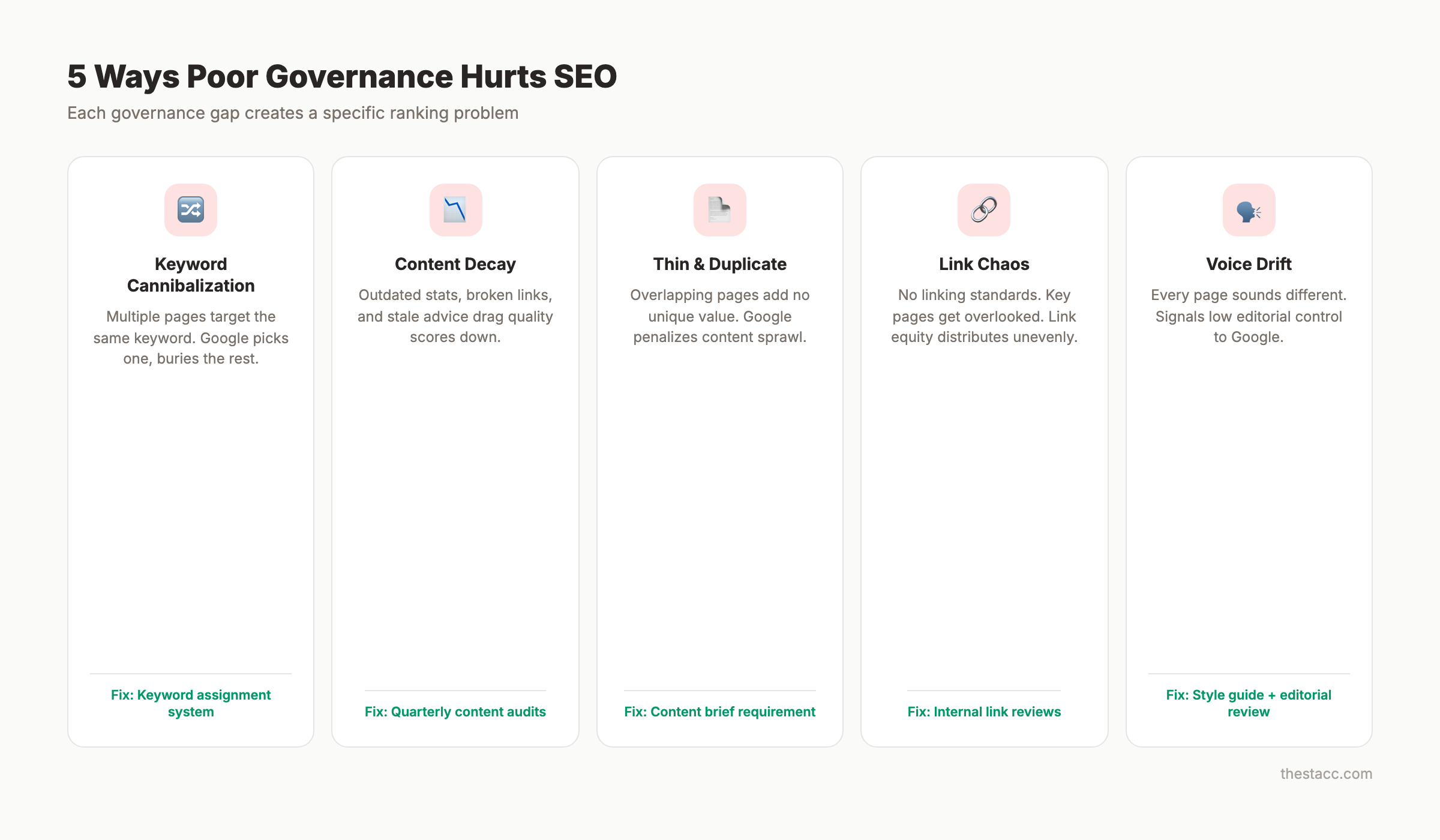
Most content governance guides ignore SEO entirely. That is a mistake. Poor governance directly damages search rankings in at least 5 ways.
Keyword Cannibalization
Without governance, multiple authors create content targeting the same keywords. Two blog posts compete for the same search query. Google picks one. The other gets buried. A governance framework prevents this with a content calendar and keyword assignment system that tracks which page targets which keyword.
Content Decay
Published content loses relevance over time. Statistics go stale. Links break. Recommendations become outdated. Without a governance process for content audits, decaying pages drag down your site’s overall quality score.
Organizations with formal content governance report a 90% reduction in errors on published pages. That accuracy directly affects E-E-A-T signals that Google uses to evaluate content quality.
Duplicate and Thin Content
Content sprawl creates pages that overlap, repeat, or add no value. Google penalizes sites with excessive thin content. Governance prevents this through mandatory content briefs that verify each new page serves a unique purpose.
Inconsistent Internal Linking
Internal linking requires coordination. Without governance, each author links to whatever they remember. Key pages get overlooked. Link equity distributes unevenly. A governance policy that mandates internal link reviews solves this.
Brand Voice Drift
Google’s helpful content system evaluates whether content demonstrates expertise and a consistent perspective. A site where every page sounds like a different author signals low editorial control. Governance enforces voice consistency through style guides and editorial review.
The Compounding Cost of No Governance
Each of these 5 problems compounds over time. A site with 50 ungoverned pages has manageable issues. A site with 500 ungoverned pages has a systemic SEO problem that takes months to fix. The earlier you implement governance, the less technical debt you accumulate.
80% of data analytics insights fail to deliver business outcomes due to lack of governance. Content is no different. Publishing without governance produces volume, not results.
Stop writing. Start ranking. Stacc publishes 30 SEO articles per month for $99. Every article follows our internal content governance framework for consistency and quality. Start for $1 →
The 3 Content Governance Models
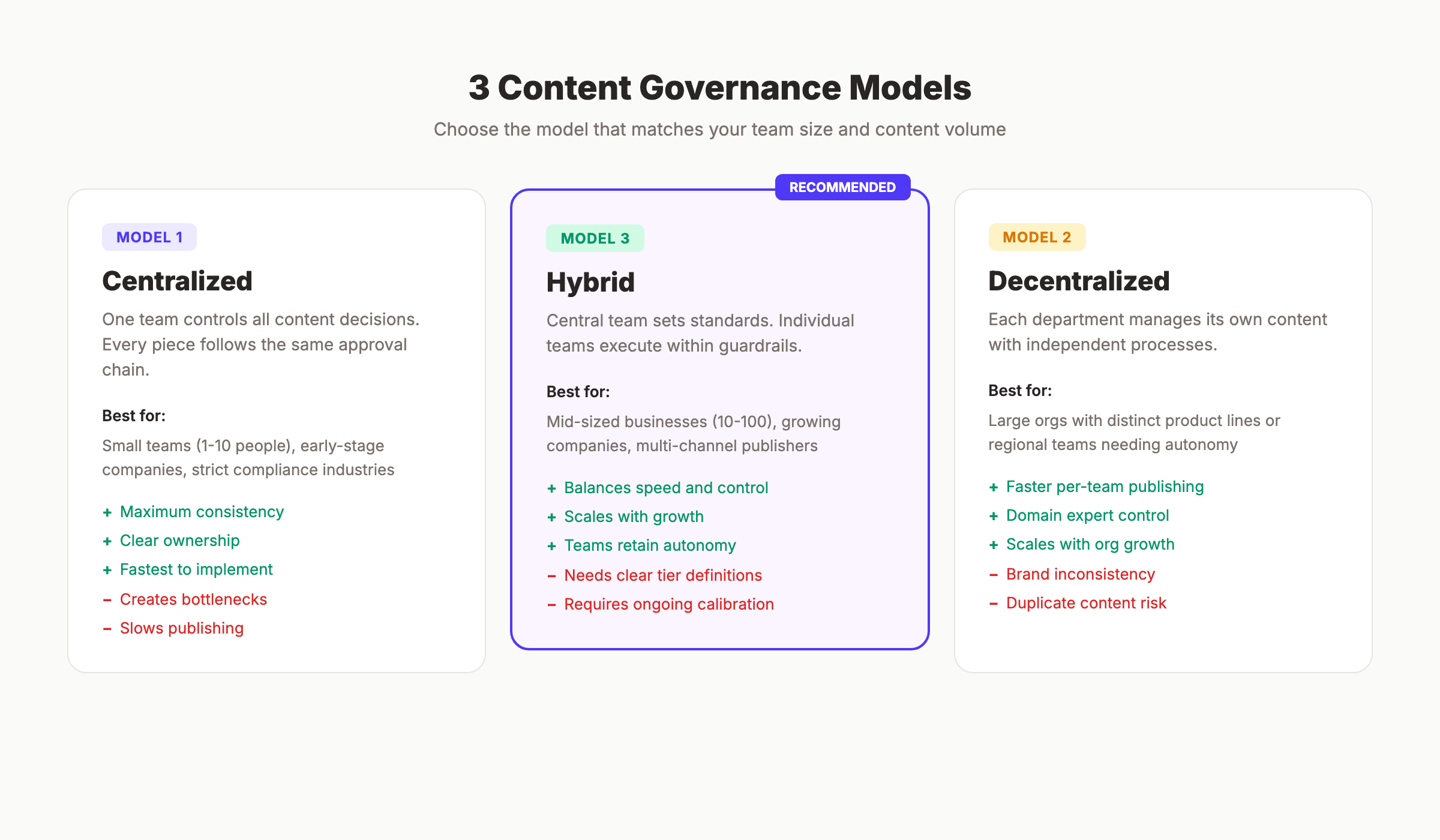
Every organization falls into one of 3 governance models. The right choice depends on your team size, content volume, and organizational structure.
Centralized Governance
One team or person controls all content decisions. Every piece of content goes through the same approval process. Brand voice, quality standards, and publishing schedules are managed from a single point.
Best for: Small teams (1 to 10 people), early-stage companies, businesses with strict compliance requirements.
Advantages:
- Maximum consistency across all channels
- Clear ownership and accountability
- Fastest to implement
- Easiest to maintain quality standards
Disadvantages:
- Creates bottlenecks as content volume grows
- Slows down publishing speed
- Central team becomes a single point of failure
Decentralized Governance
Individual teams or departments manage their own content. Marketing publishes marketing content. Product publishes product content. Each team follows its own process.
Best for: Large organizations with distinct product lines or regional teams that need autonomy.
Advantages:
- Faster publishing within each team
- Domain experts control their own content
- Scales with organizational growth
Disadvantages:
- Brand inconsistency across teams
- Duplicate content across departments
- No single source of truth for standards
- Difficult to maintain SEO coordination
Hybrid Governance
A central team sets standards, templates, and approval criteria. Individual teams execute within those guardrails. The central team reviews high-visibility content. Teams self-govern for routine content.
Best for: Mid-sized businesses (10 to 100 people), growing companies, organizations publishing across multiple channels.
Advantages:
- Balances consistency with speed
- Central standards prevent brand drift
- Teams retain autonomy for routine work
- Scales better than centralized models
Disadvantages:
- Requires clear documentation of what is “routine” vs “high-visibility”
- Needs ongoing calibration as the organization evolves
Most businesses that publish 20 or more pieces of content per month need hybrid governance. Centralized models cannot keep pace with that volume. Decentralized models sacrifice too much consistency.
How to Build a Content Governance Framework
Building governance does not require enterprise software or a 6-month project. Start with these 6 steps. Each one adds a layer of control without creating bureaucracy.
Step 1: Assign Ownership
Content governance fails without a clear owner. Someone must be accountable for maintaining standards, resolving disputes, and updating policies.
For small teams, this is often the content lead or marketing manager. For larger organizations, create a governance board with representatives from content, SEO, legal, and brand.
The owner’s responsibilities:
- Maintain and update the style guide
- Approve new content types and channels
- Resolve conflicts between teams
- Schedule and oversee content audits
- Track governance KPIs
Step 2: Document Your Standards
Write down the rules your content must follow. This is not optional. Undocumented standards are not standards. They are preferences that change with whoever is in charge.
Your standards document should cover:
- Brand voice and tone: How your brand sounds across different contexts
- Style rules: Punctuation, capitalization, formatting, number treatment
- SEO requirements: Minimum word count, keyword placement, meta description standards
- Image standards: Alt text requirements, file naming, compression specs
- Accessibility: WCAG compliance level, heading hierarchy, color contrast minimums
- Legal and compliance: Disclosure requirements, copyright attribution, privacy language
Step 3: Define Your Workflow
Map the exact path content follows from idea to publication to retirement. Every stage needs a defined action and a responsible person.
| Stage | Action | Owner |
|---|---|---|
| Ideation | Submit content brief with keyword target | Author |
| Approval | Review brief against content calendar | Content lead |
| Creation | Write draft following style guide | Author |
| Editorial review | Check voice, accuracy, SEO, links | Editor |
| Legal review (if needed) | Check compliance, disclosures | Legal |
| Publication | Publish and verify formatting | Publisher |
| Monitoring | Track performance at 30, 60, 90 days | SEO lead |
| Maintenance | Update outdated content quarterly | Author |
| Retirement | Remove or redirect underperforming pages | Content lead |
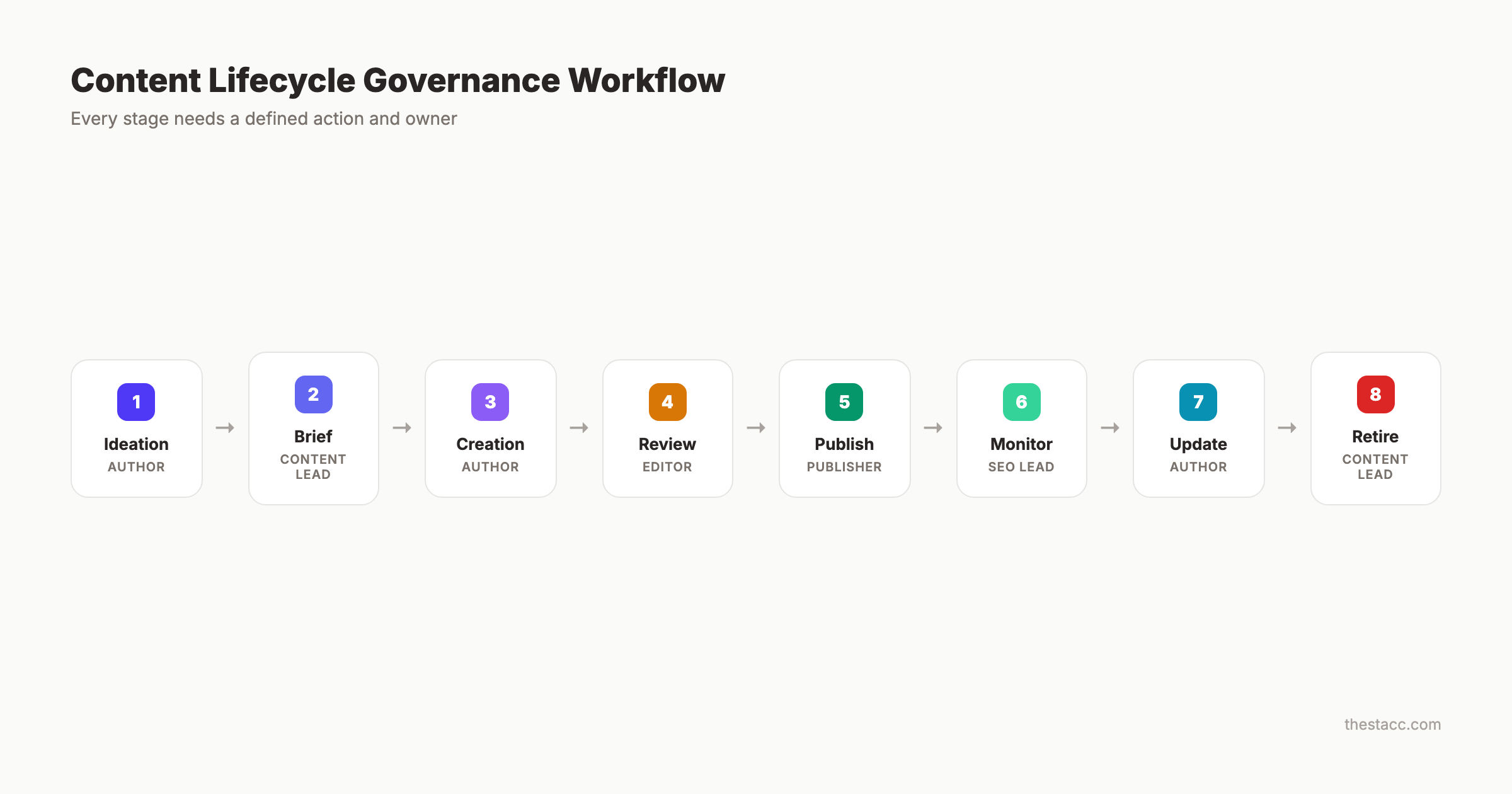
Most governance guides stop at “Publication.” That is only the halfway point. Content that lives on your site affects SEO and brand reputation for years. The maintenance and retirement stages matter as much as creation.
Step 4: Build a Content Inventory
You cannot govern what you do not know exists. Audit every piece of content your organization has published. This includes blog posts, landing pages, help docs, social media templates, email sequences, and downloadable assets.
Use a spreadsheet or content audit tool to catalog:
- URL or file location
- Content type (blog, landing page, email, etc.)
- Owner or author
- Last updated date
- Target keyword (for SEO content)
- Current status (active, needs update, candidate for retirement)
- Performance data (traffic, conversions, rankings)
This inventory becomes the foundation for ongoing governance. It tells you what exists, what needs attention, and what should be removed.
Step 5: Set Review Cycles
Content does not govern itself. Schedule recurring reviews to catch issues before they compound.
| Review Type | Frequency | Scope |
|---|---|---|
| Editorial spot check | Weekly | Sample 5 to 10 recent publications |
| SEO performance review | Monthly | All published content, focus on content decay |
| Full content audit | Quarterly | Entire content inventory |
| Style guide review | Biannually | Update standards based on new learnings |
| Governance framework review | Annually | Evaluate model, roles, and processes |
Step 6: Measure Governance Effectiveness
Governance without measurement is guesswork. Track these KPIs to prove governance creates value.
Quality KPIs:
- Error rate on published content (target: below 2%)
- Brand voice consistency score (use a tool like Acrolinx or manual spot checks)
- Percentage of content meeting SEO standards on first publish
Efficiency KPIs:
- Average time from brief to publication
- Number of revision rounds before approval
- Percentage of content published on schedule
Performance KPIs:
- Organic traffic from governed content vs ungoverned legacy content
- Content marketing ROI by content type
- Content utilization rate (percentage of published content that drives measurable results)
Your SEO team. $99 per month. 30 optimized articles, published automatically. Stacc handles the content creation. Your governance framework handles the rest. Start for $1 →
Content Governance Tools and Technology
You do not need enterprise software to start governing content. But the right tools make enforcement easier as you scale.
Most organizations already own tools that support governance. The gap is not technology. It is configuring existing tools to enforce content standards.
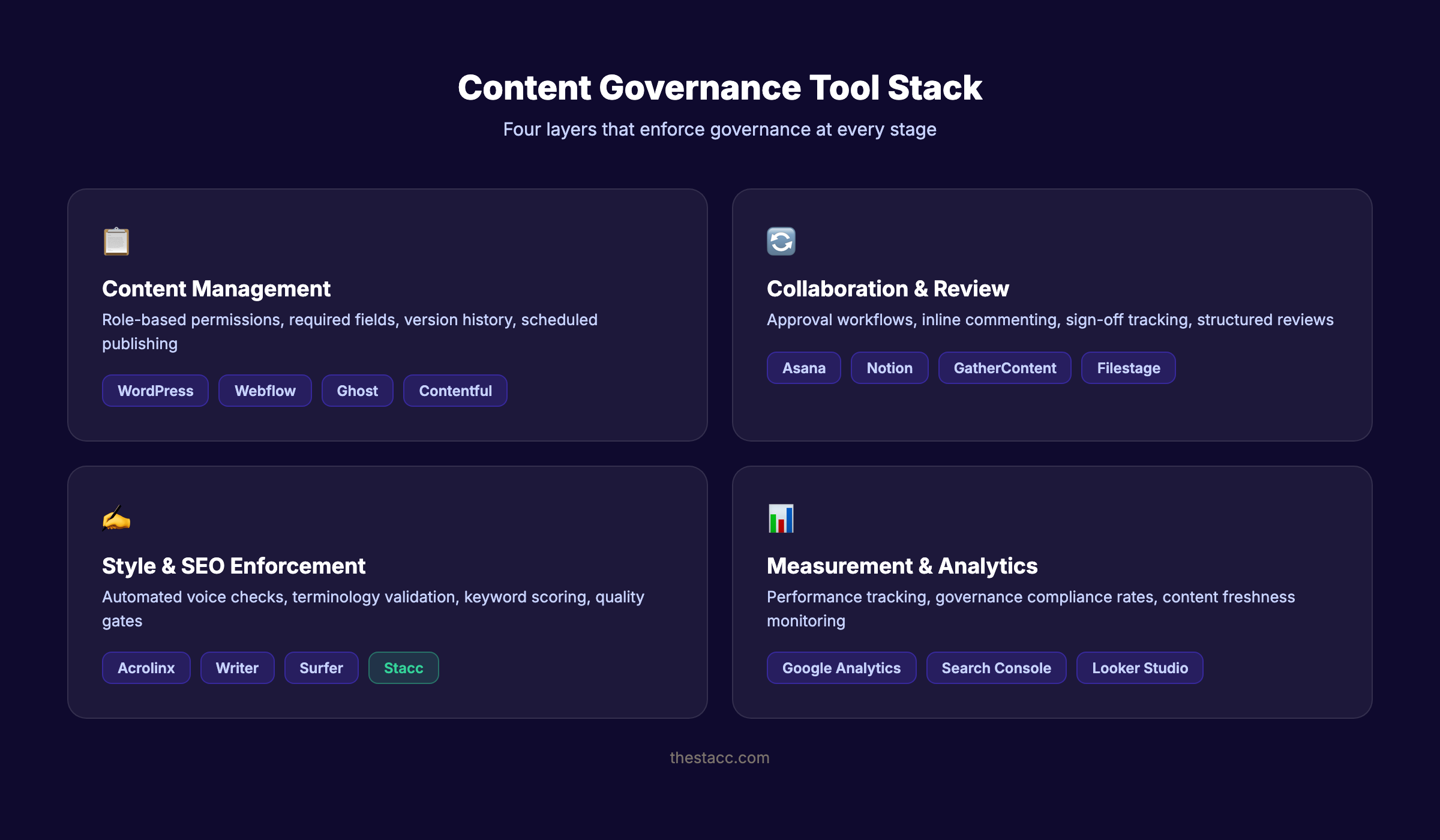
Content Management Layer
Your CMS is the first enforcement point. WordPress, Webflow, Ghost, and headless CMS platforms like Contentful all support role-based permissions. Configure them to match your governance roles.
Key CMS governance features to activate:
- Role-based publishing permissions. Authors draft. Editors review. Publishers push live. No role skips the chain.
- Required metadata fields. Force authors to enter target keyword, category, and meta description before saving a draft.
- Version history. Track every change to every page. Roll back when needed.
- Scheduled publishing. Align content releases with your editorial calendar instead of publishing ad hoc.
Collaboration and Review Layer
Content review creates the most governance friction. Reduce it with tools designed for approval workflows.
| Tool Category | Examples | Governance Function |
|---|---|---|
| Project management | Asana, Trello, Monday | Track content from brief to publication |
| Document collaboration | Google Docs, Notion | Inline commenting and version control |
| Content review | Filestage, GatherContent | Structured approval with sign-off tracking |
| Style enforcement | Acrolinx, Writer | Automated brand voice and terminology checks |
| SEO validation | Surfer, Clearscope, Stacc | Keyword targeting and content quality scoring |
Measurement Layer
Governance only works if you measure compliance. Connect your analytics stack to track governed content performance versus ungoverned legacy content.
Google Analytics, Google Search Console, and your CMS analytics provide the data. Build a dashboard that tracks error rates, publishing cadence, and content freshness by governance status.
Organizations that track governance KPIs report 34% faster content production cycles. The measurement itself creates accountability.
Starting Without Budget
No budget for specialized tools? Start with what you have:
- Google Docs for collaborative drafting with commenting
- Google Sheets for content inventory and editorial calendar
- Slack or Teams for approval notifications
- Google Search Console for SEO performance tracking
- A shared style guide document that every contributor bookmarks
The tool does not matter. The enforcement does. A Google Sheet with clear ownership columns and review dates governs better than an enterprise platform nobody uses.
Rank everywhere. Do nothing. Blog SEO, Local SEO, and Social on autopilot. Stacc starts at $99/mo with a $1 Strategy trial. Start for $1 →
Content Governance for AI-Generated Content
AI changes the governance equation. Teams now produce content 5 to 10x faster than they did 2 years ago. Speed without governance creates risk.
88% of organizations use AI in at least one business function. But only 43% have established AI governance councils. The gap between AI adoption and AI governance is where brand damage, legal exposure, and SEO penalties live.
AI Content Governance Checklist
Every piece of AI-generated content should pass through this review before publication:
- Fact-checked all claims, statistics, and citations against original sources
- Verified no hallucinated information (fake studies, nonexistent sources)
- Confirmed brand voice matches style guide standards
- Checked for AI writing patterns that reduce credibility
- Verified unique perspective (not a generic summary of existing content)
- Confirmed target keyword placement and on-page SEO standards
- Reviewed for potential copyright or IP concerns
- Checked against existing content inventory for duplication
- Applied appropriate disclosures per company policy
- Added internal links to verified, existing pages
AI Governance Policies to Define
Your governance framework needs explicit AI rules:
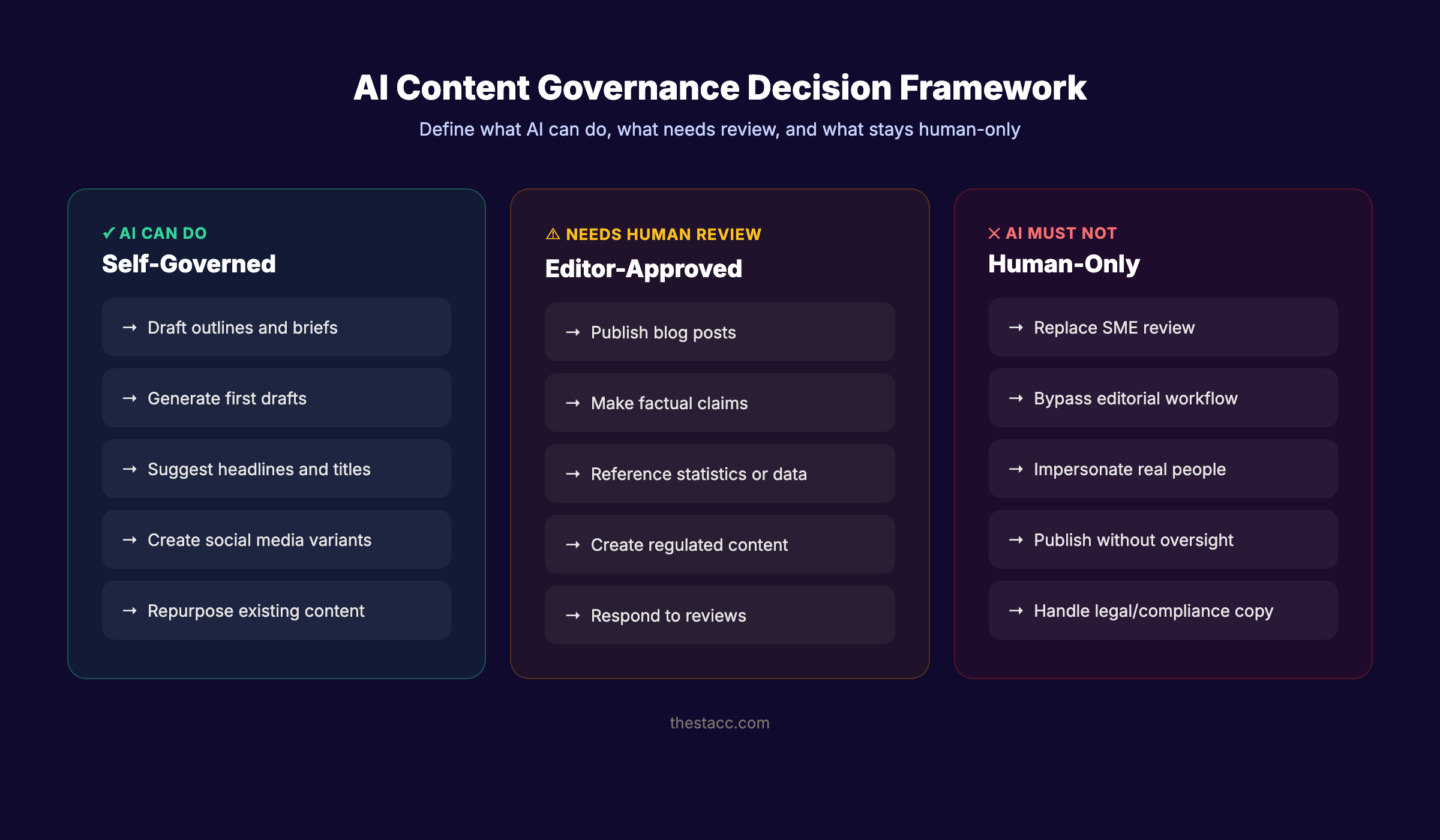
What AI can do: Draft outlines, generate first drafts, suggest headlines, create social media variations, repurpose existing content.
What AI cannot do without human review: Publish directly, make factual claims without verification, create content for regulated industries (healthcare, finance, legal), respond to customer reviews or complaints.
What AI should never do: Replace subject matter expert review, bypass your editorial workflow, generate content that impersonates a real person.
How to Scale Governance Without Adding Bureaucracy
Governance that slows teams down gets abandoned. The goal is control without friction. Here is how to scale governance as content volume increases.
Automate the Repeatable Checks
Manual review should focus on judgment calls. Automate everything else.
Automated checks that save time:
- SEO validation. Tools like Surfer or Stacc score content against keyword targets before publication.
- Style enforcement. Tools like Writer or Acrolinx flag brand voice violations in real time.
- Link checking. Automated crawlers catch broken internal links before readers do.
- Freshness alerts. Set automated reminders when content passes its review date.
Tier Your Review Process
Not every piece of content needs the same level of review. Create tiers based on visibility and risk.
| Content Tier | Examples | Review Level |
|---|---|---|
| Tier 1 (High visibility) | Homepage, product pages, press releases | Full governance board review |
| Tier 2 (Medium visibility) | Blog posts, case studies, landing pages | Editor + SEO review |
| Tier 3 (Low visibility) | Social posts, internal docs, email variants | Self-governed with spot checks |
This tiered approach lets teams move fast on routine content while protecting high-stakes pages.
Train New Contributors Quickly
Every new team member or freelancer is a governance risk. Reduce onboarding friction with:
- A one-page governance quick-start guide (not a 40-page manual)
- Template files pre-loaded with required metadata fields
- A checklist that maps to your approval workflow
- Access to 3 example posts that meet all standards
Organizations at higher content maturity levels use integrated governance structures. New contributors align faster when standards are embedded in templates, not buried in documentation.
Review the Framework Itself
Governance is not static. Review your framework when any of these events occur:
- Team size changes by more than 25%
- A new content channel launches
- Content volume doubles
- A major quality incident happens
- Annual calendar review (at minimum)
The best governance frameworks evolve quarterly. The worst ones get written once and forgotten.
Content Governance Maturity Assessment
Most governance guides tell you what to build. None help you measure where you stand today. Use this 5-level maturity model to score your current state.
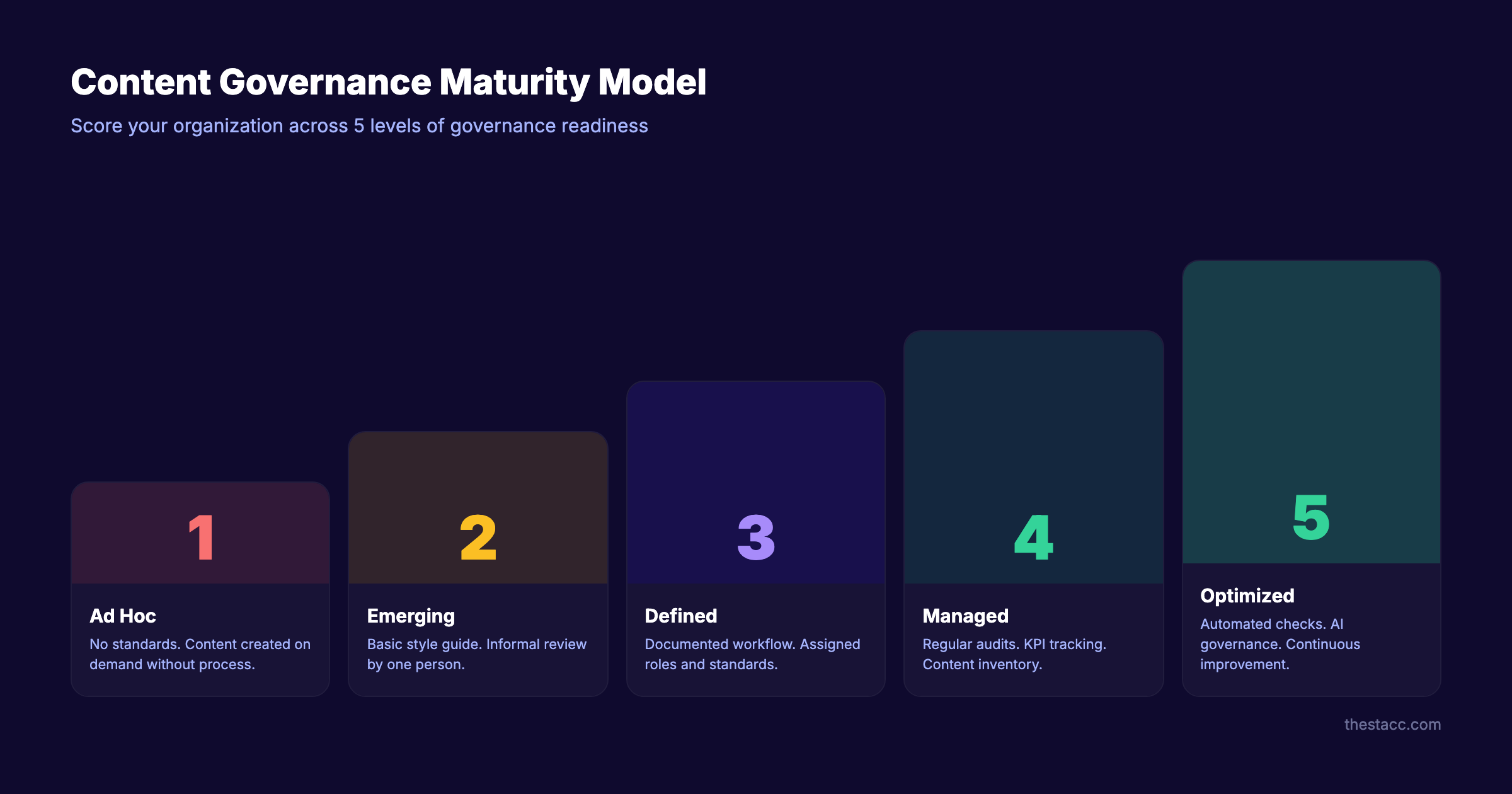
| Level | Name | Description | Score |
|---|---|---|---|
| 1 | Ad Hoc | No formal governance. Content created on demand with no standards. | 0 to 20 |
| 2 | Emerging | Basic style guide exists. One person informally reviews content. | 21 to 40 |
| 3 | Defined | Documented standards, defined workflow, assigned roles. | 41 to 60 |
| 4 | Managed | Regular audits, KPI tracking, content inventory maintained. | 61 to 80 |
| 5 | Optimized | Automated enforcement, AI governance, continuous improvement cycle. | 81 to 100 |
How to score yourself: Review each governance component below. Score 0 (nonexistent), 1 (informal), or 2 (formal and documented) for each. Total score maps to your maturity level.
- Style guide and brand voice documentation
- Defined content creation workflow
- Content approval process with assigned roles
- Content inventory or asset catalog
- Regular content audit schedule
- SEO governance (keyword tracking, cannibalization prevention)
- AI content review process
- Content retirement and archival policy
- Governance KPIs and reporting
- Cross-channel consistency standards
Score 0 to 4: Level 1 (Ad Hoc). Start with Steps 1 and 2 from the framework above. Score 5 to 8: Level 2 (Emerging). Formalize your workflow and build a content inventory. Score 9 to 12: Level 3 (Defined). Add regular audits and KPI tracking. Score 13 to 16: Level 4 (Managed). Implement AI governance and automation. Score 17 to 20: Level 5 (Optimized). Focus on continuous improvement and advanced analytics.
Common Content Governance Mistakes
These errors undermine governance efforts. Avoid them from the start.
Mistake 1: Over-engineering the process. Enterprise-grade governance for a 5-person team creates frustration and resistance. Start simple. Add complexity only when the current system fails to prevent real problems.
Mistake 2: No content retirement policy. Content does not have an expiration date stamped on it. But it should. Pages with outdated statistics, broken links, and irrelevant advice actively hurt your SEO. Schedule retirement reviews as part of your regular audit cycle.
Mistake 3: Governance without enforcement. A style guide nobody reads is not governance. Build enforcement into your workflow. Require checklist completion before publication. Use automated tools for formatting and SEO checks where possible.
Mistake 4: Ignoring existing content. New governance often applies only to future content. But the hundreds of pages already on your site still affect rankings and brand perception. Include legacy content in your governance inventory from day one.
Mistake 5: Treating governance as a one-time project. Governance is an ongoing process. Standards evolve. Team members change. Channels emerge. Review your governance framework at least annually. Update it when your content operation changes materially.
Mistake 6: Skipping metadata governance. Metadata is the invisible infrastructure that makes content findable and trackable. Every asset needs structured data describing its purpose, target audience, keywords, and performance history. Without metadata standards, your content inventory becomes a filing cabinet with no labels.
Mistake 7: Separating governance from SEO. Content governance and SEO strategy are not separate disciplines. Every governance decision affects search performance. Keyword assignment prevents cannibalization. Review cycles prevent content decay. Voice standards support E-E-A-T. Treat SEO as a governance requirement, not an afterthought.
3,500+ blogs published. 92% average SEO score. Every article follows our governance framework. See what Stacc can do for your content operation. Start for $1 →
FAQ
What is content governance?
Content governance is the set of policies, processes, roles, and standards that control how content gets created, reviewed, published, maintained, and retired. It ensures consistency, quality, and accountability across every piece of content an organization produces.
What is the difference between content governance and content strategy?
Content strategy defines what to create and why. Content governance defines how to manage it. Strategy produces a content calendar and editorial plan. Governance produces style guides, approval workflows, and audit schedules. You need both for an effective content operation.
How do I start with content governance?
Start by assigning a single owner. Then document your brand voice and style standards. Define your content workflow from ideation to retirement. Build a content inventory of everything currently published. Add review cycles and KPIs. Start simple and expand as your team grows.
Does content governance affect SEO?
Yes. Governance prevents keyword cannibalization, content decay, thin content, and inconsistent internal linking. Organizations with formal governance report 90% fewer errors on published pages. Those quality improvements directly affect search rankings and organic traffic.
How do you govern AI-generated content?
Create an AI content review checklist that covers fact-checking, brand voice, originality, SEO standards, and legal compliance. Define what AI can and cannot do without human review. Never let AI publish directly without editorial oversight. Add AI-specific policies to your existing governance framework.
What is a content governance model?
A governance model defines who has authority over content decisions. The 3 main models are centralized (one team controls everything), decentralized (each team governs itself), and hybrid (central standards with team-level execution). Most growing businesses perform best with a hybrid model.
Content governance is not bureaucracy. It is the system that turns scattered content efforts into a consistent, measurable operation. Start with clear ownership, documented standards, and a defined workflow. Add review cycles and measurement. Expand governance as your content operation grows.
Written and published by Stacc. We publish 3,500+ articles per month across 70+ industries. All data verified against public sources as of March 2026.
