
Digital Authority AI Models Trust: The Complete Guide
Learn how AI models evaluate digital authority and trust signals. Covers entity identity, E-E-A-T, citation patterns, and 7 chapters to build AI credibility.
Most businesses still treat SEO like a Google-only game. That era is over.
ChatGPT now has over 900 million weekly active users. Perplexity processes millions of queries per day. Google AI Overviews appear on more than 30% of searches. These AI systems do not rank pages. They cite sources. And the sources they cite are the ones they trust.
Digital authority is no longer about where you rank on a results page. It is about whether AI models consider your brand credible enough to quote.
We have published 3,500+ blog posts across 70+ industries. We have tracked how AI models select, cite, and surface content. This guide covers everything we know about building the kind of digital authority that AI models trust.
Here is what you will learn:
- What digital authority means in the age of AI search
- The 3 trust signal categories every AI model evaluates
- How ChatGPT, Perplexity, and Google AI Overviews choose which sources to cite
- The E-E-A-T framework and why it matters more now than ever
- How to build entity identity signals AI can verify
- How to earn third-party evidence that triggers citations
- A step-by-step audit to measure your current AI trust score
What Digital Authority Means in AI Search
Digital authority is the collective signal strength that tells AI models your brand is a credible source on a given topic.
Traditional SEO measured authority through backlinks, domain rating, and keyword rankings. AI search measures authority differently. It evaluates entity identity, content consistency, third-party validation, and topical depth.
Here is the critical difference. Google shows you a list of 10 links. AI models give you one answer. That answer pulls from sources the model trusts most.
Authority Is Now a Filter, Not a Factor
In traditional search, low-authority pages could still rank for long-tail keywords. In AI search, authority works as a binary filter.
If an AI model does not trust your brand, it will not cite you. Period. There is no position 7 in an AI-generated answer. You are either in the response or you are not.
According to Semrush’s research on AI trust signals, roughly 90% of ChatGPT citations come from pages ranked at position 21 or lower in Google. Your best-ranking pages are often the least likely to be cited in an AI response.
This means traditional SEO rankings and AI citations are two separate games.
The Three Pillars of AI Authority
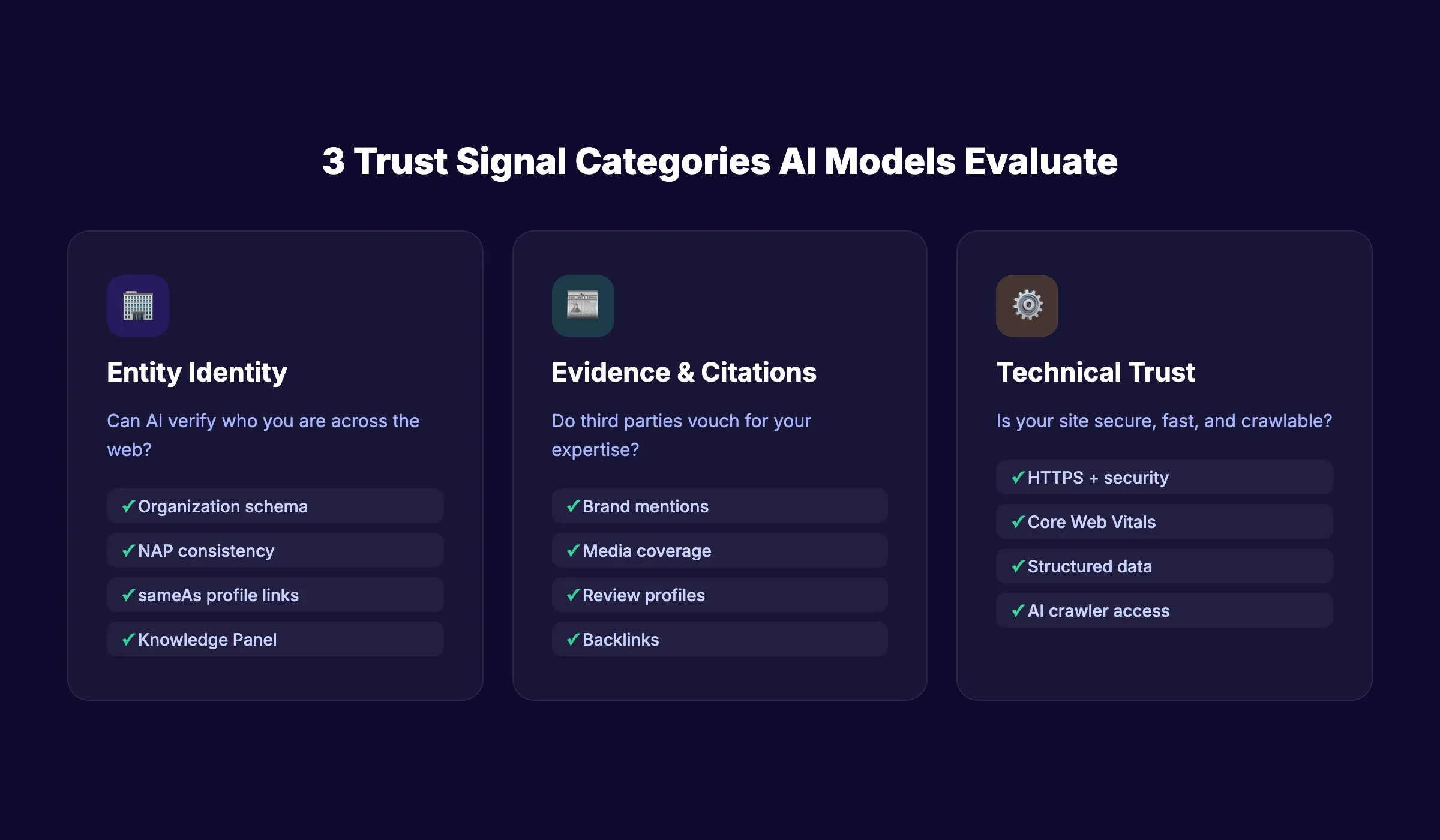
Every AI model evaluates three categories of trust signals:
| Pillar | What It Measures | Examples |
|---|---|---|
| Entity Identity | Who you are and whether that identity is consistent | Schema markup, NAP consistency, social profiles, Wikipedia presence |
| Evidence and Citations | Whether third parties vouch for you | Backlinks, brand mentions, media coverage, review platform profiles |
| Technical Trust | Whether your site is secure, fast, and accessible | HTTPS, Core Web Vitals, mobile optimization, structured data |
These three pillars form the foundation of every chapter in this guide.
How AI Models Evaluate Trust Differently
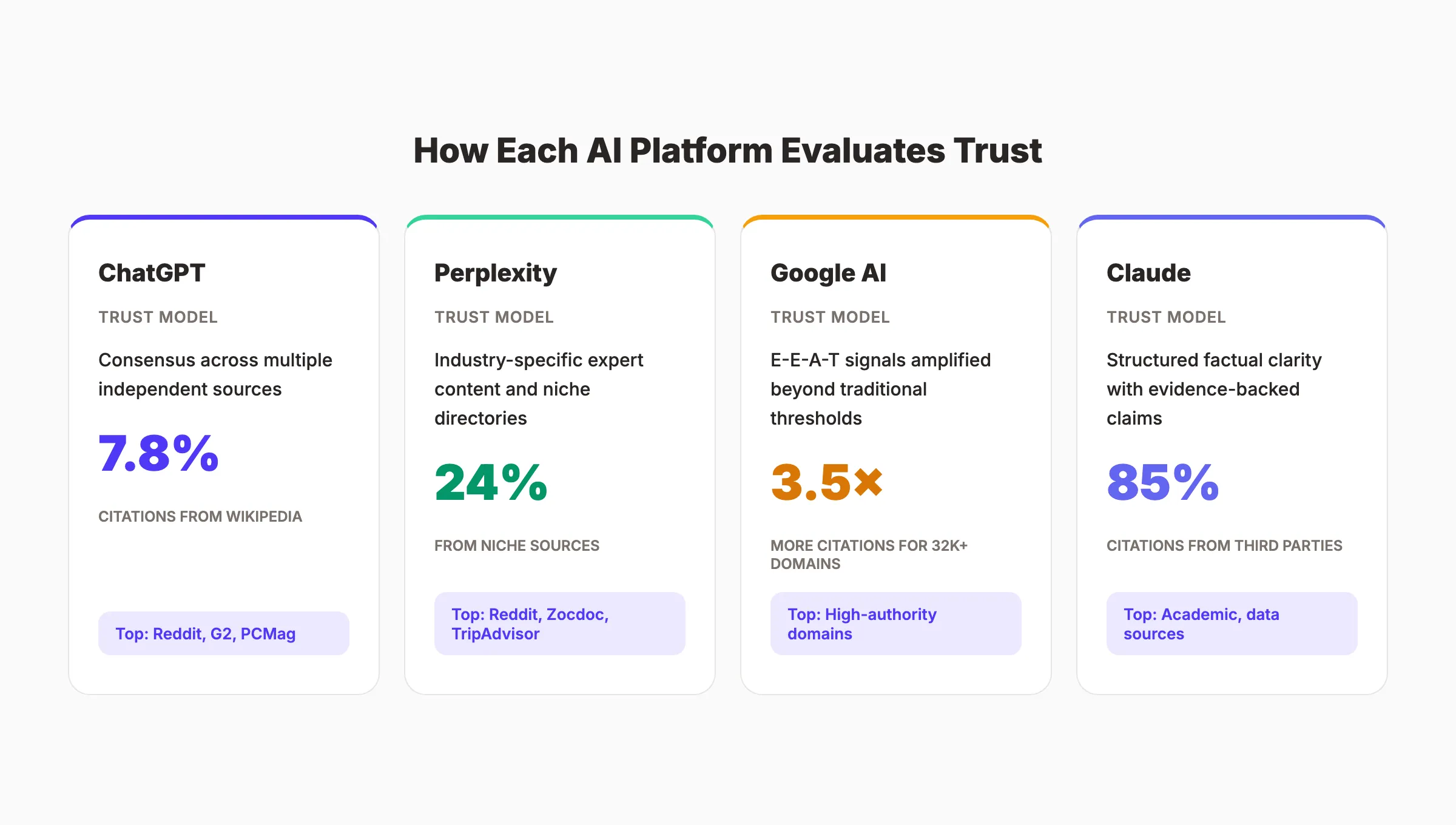
Not every AI model uses the same trust evaluation. ChatGPT, Perplexity, Google AI Overviews, and Claude each prioritize different signals.
Understanding these differences is essential. Optimizing for one platform does not guarantee visibility on another.
ChatGPT: Consensus-Based Trust
ChatGPT values what the internet agrees on. It pulls from multiple independent sources and looks for consensus.
The top sources ChatGPT cites for B2B content include Reddit, G2, PCMag, Capterra, and Gartner. Wikipedia is the single most-cited source at 7.8% of total citations.
What this means: ChatGPT prioritizes third-party validation over branded content. Your own website is less important than what other credible sites say about you.
Perplexity: Expert and Niche Source Trust
Perplexity sources more narrowly. It leans into industry-specific directories and expert content rather than general listings.
Reddit is the leading source for Perplexity at 6.6% of citations. For healthcare queries, Zocdoc drives citations. For hospitality, TripAdvisor dominates. Niche sources make up 24% of all Perplexity citations.
What this means: Perplexity rewards deep expertise in specific verticals. Industry-specific authority matters more than general domain strength.
Google AI Overviews: E-E-A-T Amplified
Google AI Overviews apply the same E-E-A-T framework that powers traditional search, but with higher thresholds.
Pages that demonstrate experience, expertise, authoritativeness, and trustworthiness get priority. Media coverage, author credentials, and structured data all amplify these signals.
What this means: If you already rank well in traditional Google search, you have a head start. But AI Overviews demand stronger trust signals than organic results.
Claude: Structured Clarity
Claude evaluates content based on clarity, factual accuracy, and structured presentation. It favors well-organized content with clear claims backed by evidence.
What this means: Content structure and factual density matter. Vague claims without supporting data get ignored.
| AI Model | Primary Trust Signal | Top Citation Source | Key Differentiator |
|---|---|---|---|
| ChatGPT | Consensus across sources | Wikipedia (7.8%) | Third-party validation matters most |
| Perplexity | Expert niche authority | Reddit (6.6%) | Industry-specific depth wins |
| Google AI Overviews | E-E-A-T signals | High-authority domains | Traditional SEO signals still matter |
| Claude | Structured factual clarity | Academic and data sources | Evidence-backed claims required |
Your SEO team. $99 per month. Stacc publishes 30 optimized articles per month. Every one built for the kind of authority AI models trust. Start for $1 →
Entity Identity: Making Your Brand Verifiable
Entity identity is the most overlooked trust signal in AI search. It answers one question: can AI models confirm that your brand is real and consistent across the web?
AI models cross-reference your website against every other mention of your brand online. If the information matches, trust goes up. If it conflicts, trust drops.
Organization Schema Markup
Schema markup is the most direct way to tell AI models who you are. Organization schema connects your brand name, logo, founding date, social profiles, and contact information into a machine-readable format.
Here is what to include:
- Organization name. Exact legal name, used consistently everywhere
- Logo URL. Direct path to your primary logo file
- sameAs array. Links to every official social profile and directory listing
- Contact information. Phone, email, address (matching your Google Business Profile)
- Founding date. Establishes entity age and stability
The sameAs property is critical. It tells AI models that your website, LinkedIn, Twitter, Facebook, and directory listings all belong to the same entity.
NAP Consistency Across Platforms
NAP stands for Name, Address, Phone number. AI models check whether this information is identical across every platform where your brand appears.
Check these platforms for consistency:
- Google Business Profile
- LinkedIn company page
- Facebook business page
- Yelp listing
- Industry-specific directories
- Better Business Bureau
- Crunchbase (for SaaS and tech companies)
- Chamber of Commerce listings
One inconsistency can weaken your entity signal. A different phone number on Yelp versus your website creates doubt. AI models interpret inconsistency as a trust risk.
Wikipedia and Knowledge Panel Presence
Wikipedia is the single most-cited source by ChatGPT. Having a Wikipedia page or being mentioned in relevant Wikipedia articles significantly boosts your entity recognition.
Knowledge Panels in Google Search also feed into AI models. If Google has already verified your entity through a Knowledge Panel, AI systems inherit that trust.
Building toward a Knowledge Panel requires:
- Consistent entity information across the web
- Media coverage from recognized publications
- Structured data on your website
- A Wikidata entry (the database behind Wikipedia)
Author Entity Signals
For content-heavy sites, individual author entities matter as much as organization entities.
AI models evaluate whether the person writing the content has verifiable expertise. Anonymous blog posts carry almost zero authority signal.
Build author entity signals by:
- Creating detailed author bio pages with credentials and links
- Linking author profiles to LinkedIn, Twitter, and industry publications
- Including author schema markup on every article
- Publishing guest content on third-party sites under the same author name
Evidence and Citations: Third-Party Proof
Entity identity tells AI who you are. Evidence tells AI why you should be trusted. This is the signal category with the highest impact on AI citations.
According to Ahrefs’ analysis of 75,000 brands in AI Overviews, brand web mentions show a stronger correlation with AI visibility than backlinks, domain rating, or any on-site factor studied.
Brand Mentions Over Backlinks
Traditional SEO taught us that backlinks are the currency of authority. In AI search, brand mentions carry equal or greater weight.
A page discussed in a Reddit thread, cited in a LinkedIn post, or referenced in an industry newsletter earns citation signals that traditional link building does not capture.
The difference is subtle but important. A backlink requires someone to link to your URL. A brand mention only requires someone to name your brand in a relevant context. AI models track both.
Where Your Brand Needs to Appear
Domains with profiles on third-party review and comparison platforms have 3 times higher chances of being cited by ChatGPT. These platforms include:
| Platform Type | Examples | Why It Matters |
|---|---|---|
| Software review sites | G2, Capterra, TrustRadius | ChatGPT’s top citation sources for B2B |
| Consumer review sites | Trustpilot, Yelp, BBB | Validates customer experience claims |
| Community platforms | Reddit, Quora, Stack Exchange | 48% of AI citations come from community platforms |
| Industry directories | Clutch, GoodFirms, industry-specific listings | Perplexity favors niche directories |
| Media publications | Forbes, Inc, industry trade publications | Strongest authority signal for all AI models |
Earning Media Coverage
Media coverage is one of the strongest trust signals. A mention in a respected publication carries more weight than dozens of posts on your own website.
Practical approaches to earn media coverage:
- Publish original research or data studies that journalists can reference
- Offer expert commentary on trending industry topics
- Build relationships with reporters who cover your industry
- Use HARO (Help a Reporter Out) and similar journalist query services
- Create newsworthy content like annual industry reports or benchmark studies
The Citation Chain Effect
AI models follow citation chains. If Source A cites Source B, and Source B cites your brand, the trust flows through the chain.
This means your content strategy should target direct mentions and mentions in the sources that AI models already trust.
For example, getting referenced in a Wikipedia article or an academic paper creates a citation chain that AI models trace back to your brand with high confidence.
3,500+ blogs published. 92% average SEO score. See what Stacc can do for your site. Start for $1 →
E-E-A-T: The Trust Framework AI Amplifies
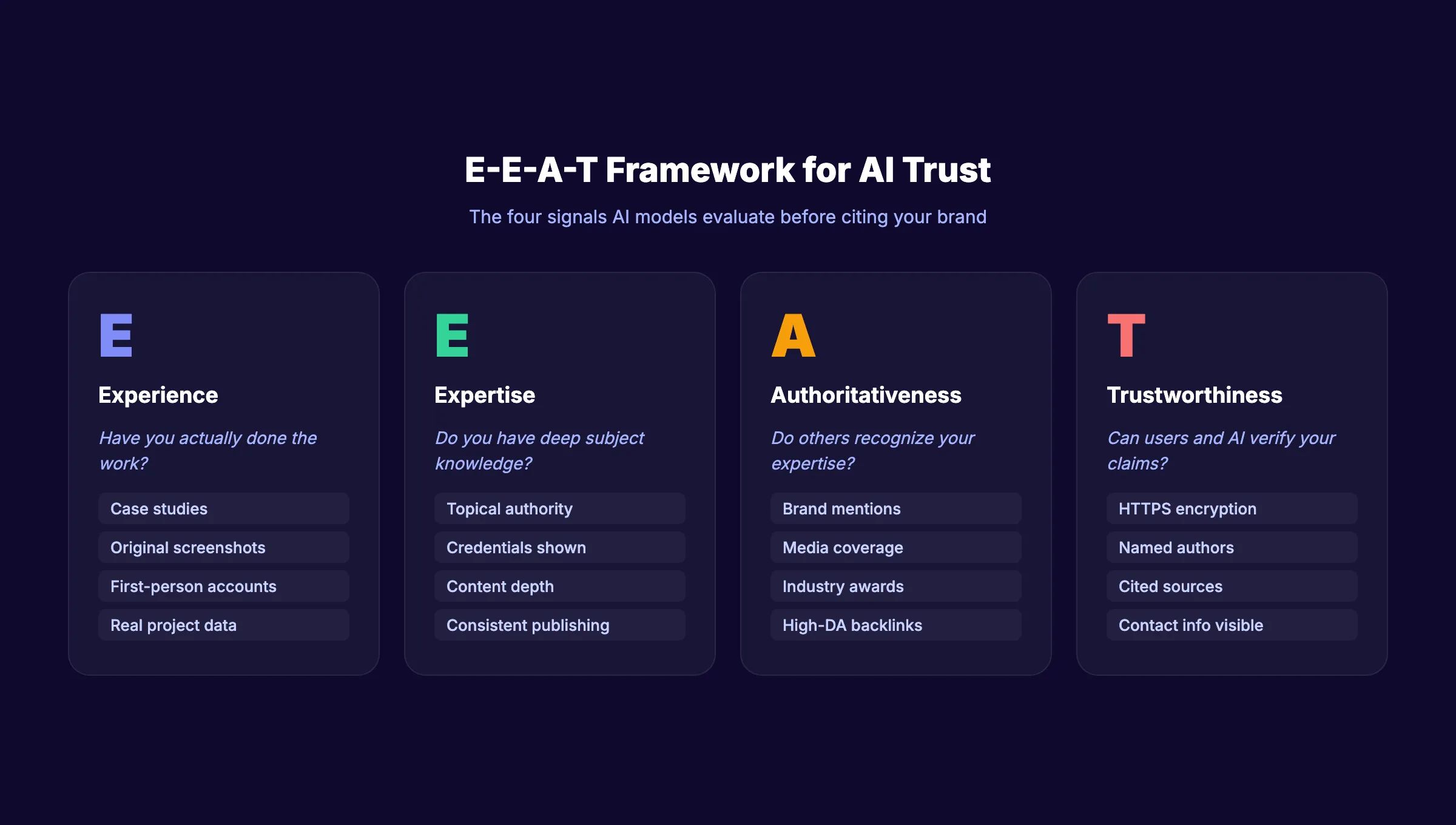
Google introduced E-E-A-T (Experience, Expertise, Authoritativeness, Trustworthiness) as a quality framework. AI models have amplified its importance far beyond what traditional search ever required.
In 2026, E-E-A-T behaves as both a ranking filter and an AI visibility filter. If an AI model does not trust your brand, it will not include you in the answer.
Experience: Show You Have Done the Work
Experience is the newest addition to the E-E-A-T framework. It asks: has the content creator actually done what they are writing about?
AI models detect experience signals through:
- First-person accounts and case studies with specific results
- Original screenshots, photos, and data from real projects
- Detailed process descriptions that only someone with hands-on experience would know
- Customer testimonials and real-world outcomes
Generic advice that anyone could write from reading other articles does not pass the experience test.
Expertise: Prove You Know the Subject
Expertise goes deeper than experience. It measures whether the content creator has formal knowledge, credentials, or deep topical authority.
Build expertise signals by:
- Publishing deep topical authority clusters that cover every angle of your subject
- Displaying certifications, degrees, and professional affiliations
- Creating content hubs that interlink related topics
- Maintaining consistent publishing on your core topics over time
Authoritativeness: Earn Recognition From Others
Authoritativeness is the external validation layer. It is not what you say about yourself. It is what others say about you.
The signals AI models use to evaluate authoritativeness:
- Backlinks from high-authority domains in your industry
- Brand mentions on trusted platforms (Reddit, industry publications, review sites)
- Speaking engagements, conference presentations, podcast appearances
- Awards, certifications, and industry recognition
- Partnerships with recognized organizations
Trustworthiness: The Master Signal
Trustworthiness sits at the center of E-E-A-T. Google calls it the most important factor.
Trust signals include:
- HTTPS encryption on every page
- Clear contact information and physical address
- Transparent authorship with named, verifiable authors
- Privacy policy and terms of service
- Accurate, up-to-date information (no outdated stats or broken links)
- Consistent information across all owned and third-party properties
E-E-A-T Audit Checklist
Use this checklist to audit your current E-E-A-T signal strength:
- Every article has a named author with a bio page and credentials
- Author profiles link to LinkedIn and external publications
- Content includes first-person experience and original data
- At least 5 high-authority backlinks per core topic
- Brand appears on 3+ third-party review platforms
- Media coverage from at least 1 recognized publication
- HTTPS active on all pages
- Contact page with physical address and phone number
- Privacy policy and terms of service published and linked
- All statistics cited with source links
Technical Trust Signals AI Models Check
Technical trust signals are the infrastructure layer. They do not directly prove your expertise, but they remove reasons for AI models to distrust you.
A site with slow load times, missing HTTPS, or broken structured data sends a signal: this organization does not maintain its digital presence carefully.
HTTPS and Security
Every AI model checks whether a site uses HTTPS. An unsecured HTTP site will almost never get cited.
Beyond basic HTTPS:
- Use HSTS headers to force secure connections
- Implement Content Security Policy headers
- Keep SSL certificates current (expired certificates destroy trust)
- Run security headers through Mozilla Observatory
Core Web Vitals
Core Web Vitals measure user experience. AI models use these metrics as proxy signals for content quality.
| Metric | What It Measures | Good Threshold |
|---|---|---|
| LCP (Largest Contentful Paint) | Loading speed | Under 2.5 seconds |
| INP (Interaction to Next Paint) | Responsiveness | Under 200 milliseconds |
| CLS (Cumulative Layout Shift) | Visual stability | Under 0.1 |
Sites that fail Core Web Vitals send a negative technical trust signal. AI models interpret poor site performance as a sign of low organizational quality.
Structured Data Implementation
Structured data is the language AI models use to understand your content. Without it, AI must guess what your page is about.
Priority schema types for AI trust:
- Organization. Your brand entity with sameAs links
- Article/BlogPosting. Content metadata with author, date, publisher
- Author/Person. Individual expertise and credentials
- FAQ. Question-and-answer pairs AI can extract directly
- HowTo. Step-by-step processes for instructional content
- BreadcrumbList. Site structure and content hierarchy
You can generate and validate your structured data using our Schema Markup Generator.
AI Crawler Access
AI models can only cite content they can crawl. Many sites accidentally block AI crawlers through restrictive robots.txt rules.
Check whether these crawlers can access your content:
- GPTBot (OpenAI / ChatGPT)
- Google-Extended (Google AI features)
- Anthropic (Claude)
- PerplexityBot (Perplexity AI)
- Bytespider (ByteDance AI)
Review your robots.txt configuration and consider creating an llms.txt file that helps AI models understand your site structure.
Skip the agency. Keep the results. Stacc starts at $99 per month with a $1 trial. Start for $1 →
Building a Content Strategy for AI Authority
Content is where all trust signals converge. Entity identity, evidence, E-E-A-T, and technical signals all amplify or undermine your content.
The businesses that AI models cite most share one pattern: consistent, deep, well-structured content on focused topics over time.
Topical Authority Over Keyword Volume
AI models evaluate topical authority by measuring how thoroughly you cover a subject. Publishing one article on a topic is not enough.
A topical authority strategy requires:
- A pillar page that covers the broad topic
- 10-20 supporting articles that address subtopics in depth
- Internal links that connect every piece in the cluster
- A topical map that identifies every subtopic worth covering
- Consistent publishing cadence (weekly minimum)
Content Depth and Factual Density
AI models favor content with high factual density. Every claim should have supporting evidence. Every stat should have a source.
Compare these two approaches:
| Weak Content | Strong Content |
|---|---|
| ”SEO is important for businesses" | "Businesses that publish 16+ blog posts per month get 3.5 times more traffic than those publishing 4 or fewer (HubSpot, 2024)" |
| "AI is changing search" | "ChatGPT drives 87.4% of all AI referral traffic, with 810 million daily active users as of early 2026" |
| "You need good content" | "Pages not updated quarterly are 3 times more likely to lose AI citations (Semrush)” |
Every paragraph should contain at least one specific number, name, or verifiable fact.
Content Freshness
AI models penalize stale content. Pages not updated within 90 days are significantly more likely to lose citations.
Build freshness into your content strategy:
- Audit existing content quarterly and update outdated statistics
- Add publication and last-updated dates to every article
- Use dateModified schema markup so AI models can verify freshness
- Remove or redirect content that is no longer accurate
- Track content decay and address declining pages before they lose trust
Publishing Cadence and Consistency
One of the strongest authority signals is publishing volume combined with consistency. Sporadic publishing does not build authority.
The data supports aggressive publishing:
- Sites publishing 30+ articles per month build topical authority faster than competitors
- Consistent publishing over 6+ months creates compounding authority signals
- Each article that earns citations strengthens the authority of every other article on the site
This is what we call the Content Compound Effect. Every article stacks on the last. SEO compounds.
How to Audit Your AI Trust Score
You cannot improve what you do not measure. This chapter provides a step-by-step audit framework to evaluate your current digital authority for AI trust.
Step 1: Entity Identity Audit
Check your brand identity consistency across platforms:
| Check | Tool | Pass/Fail |
|---|---|---|
| Organization schema on homepage | Schema Markup Generator | |
| sameAs links to all official profiles | Manual review | |
| NAP matches across Google, LinkedIn, Yelp, directories | Manual review | |
| Author schema on all articles | Schema validator | |
| Knowledge Panel exists in Google | Search your brand name |
Step 2: Evidence and Citation Audit
Measure your third-party validation:
- Count brand mentions on Reddit, Quora, and industry forums
- Check profiles on G2, Capterra, Trustpilot, and industry directories
- Count media mentions from recognized publications
- Review backlink profile for high-authority referring domains
- Search your brand name in ChatGPT, Perplexity, and Google AI Overviews
Sites with over 32,000 referring domains are 3.5 times more likely to be cited by ChatGPT than those with under 200.
Step 3: E-E-A-T Signal Audit
Evaluate your experience, expertise, authoritativeness, and trustworthiness:
- Every article has a named author with verifiable credentials
- Content includes original data, screenshots, or case studies
- At least 3 content clusters covering core topics in depth
- External sites link to your content as a reference
- Your brand has been mentioned in at least 1 publication with editorial standards
Step 4: Technical Trust Audit
Run these technical checks:
- HTTPS active with valid certificate
- Core Web Vitals passing (use Google PageSpeed Insights)
- All AI crawlers allowed in robots.txt
- Organization, Article, and Author schema implemented
- llms.txt file published and accessible
- No broken internal or external links
- Mobile-friendly layout confirmed
Step 5: AI Visibility Check
The final step is testing whether AI models actually cite your brand:
- Open ChatGPT, Perplexity, and Google AI Overviews
- Search for queries your brand should appear for
- Note whether your brand is mentioned, cited, or absent
- Compare your visibility to your top 3 competitors
- Track these results monthly to measure progress
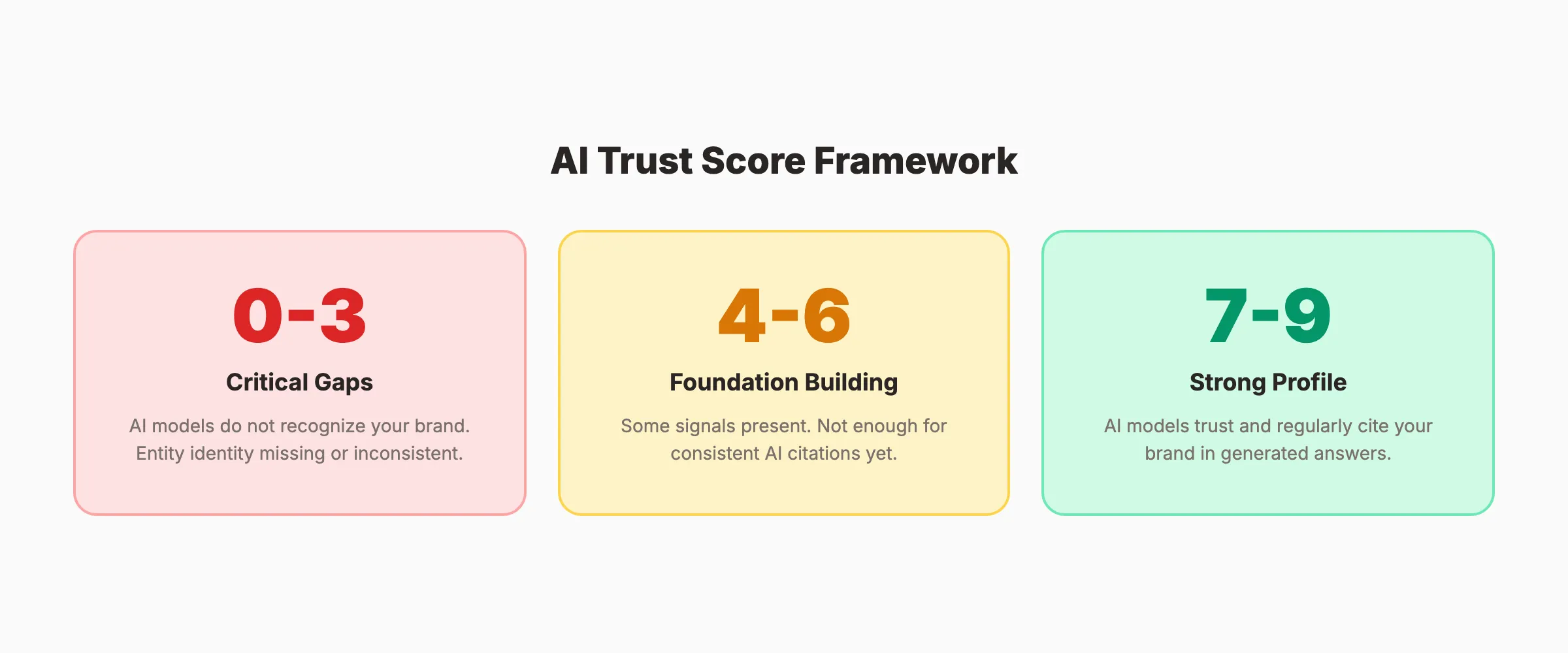
Use this scoring framework:
| Score | Level | What It Means |
|---|---|---|
| 0-3 | Critical gaps | AI models do not recognize your brand |
| 4-6 | Foundation building | Some signals present, but not enough for consistent citations |
| 7-9 | Strong profile | AI models trust and regularly cite your brand |
Rank everywhere. Do nothing. Blog SEO, Local SEO, and Social on autopilot. Start for $1 →
FAQ
What is digital authority in AI search?
Digital authority is the combined signal strength that tells AI models your brand is a credible, citable source on a specific topic. It includes entity identity, third-party evidence, E-E-A-T signals, and technical trust factors. Unlike traditional domain authority, it determines whether AI models include your brand in generated answers.
How do AI models decide which sources to cite?
Each AI model uses different criteria. ChatGPT prioritizes consensus across multiple independent sources. Perplexity favors industry-specific expert content and niche directories. Google AI Overviews amplify E-E-A-T signals. All models check entity consistency, content freshness, and third-party validation before citing a source.
Do backlinks still matter for AI search visibility?
Backlinks still matter, but brand mentions now carry equal or greater weight. According to Ahrefs research on 75,000 brands, web mentions show a stronger correlation with AI visibility than backlinks or domain rating. A mention in a Reddit thread or industry publication earns citation signals that traditional link building does not provide.
How often should I update content to maintain AI trust?
Pages not updated within 90 days are 3 times more likely to lose AI citations. Update statistics, examples, and dates quarterly at minimum. Use dateModified schema markup so AI models can verify your content freshness.
What is the difference between SEO and AEO?
SEO (Search Engine Optimization) focuses on ranking web pages in search results. AEO (Answer Engine Optimization) focuses on getting your brand cited in AI-generated answers. SEO gets you listed. AEO gets you quoted. Both require strong authority signals, but AEO demands higher trust thresholds and more consistent entity signals.
Can small businesses build digital authority for AI trust?
Yes. Small businesses can build AI trust through consistent publishing, accurate entity information across platforms, third-party review profiles, and deep topical coverage in their niche. Perplexity in particular favors niche expertise over broad domain strength. Start with entity consistency and build from there.
Digital authority for AI trust is not a one-time project. It is an ongoing practice of making your brand verifiable, citable, and consistently present across the platforms AI models rely on.
The businesses that earn AI citations in 2026 are the ones that publish consistently, maintain entity accuracy, earn third-party mentions, and keep their technical infrastructure clean.
Start with the audit in Chapter 7. Fix entity identity gaps first. Then build evidence. Then scale content. The compound effect takes hold within 60 to 90 days.

Written by
Siddharth GangalSiddharth is the founder of theStacc and Arka360, and a graduate of IIT Mandi. He spent years watching great businesses lose organic traffic to competitors who simply published more. So he built a system to fix that. He writes about SEO, content at scale, and the tactics that actually move rankings.
30 SEO blog articles published every month
Keyword-optimized, scheduled, and live on your site. Automatically.
30-day trial · Cancel anytime
theStacc
Stop writing SEO content manually
30 blog articles, 30 GBP posts, and social media content. Published every month. Automatically.
Start Your $1 Trial$1 for 3 days · Cancel anytime