Marketing to AI Agents in 2026: The Complete Playbook
AI agents now influence 10% of brand revenue. Here is your step-by-step playbook for marketing to AI agents in 2026. Updated April 2026.
Stacc Editorial • 2026-04-04 • Content Strategy
In This Article
Your next customer might not have a pulse.
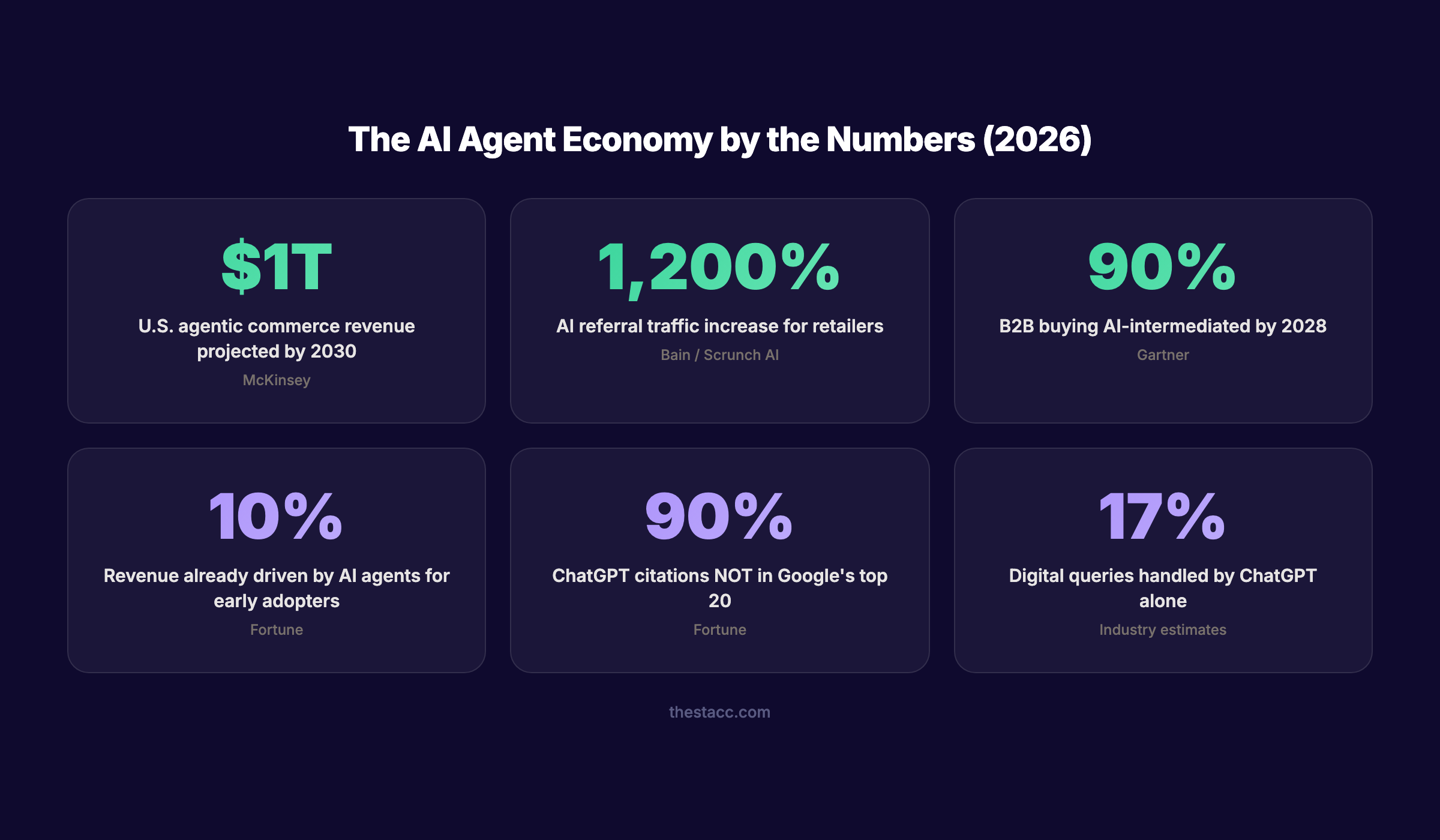
AI agents already drive 10% of revenue for brands that optimized early. The rest? Invisible. Not to humans. To the machines making purchasing decisions on their behalf.
McKinsey projects $900 billion to $1 trillion in U.S. agentic commerce revenue by 2030. Gartner says 90% of B2B buying will be AI agent intermediated by 2028. This is not a trend. It is a structural shift in how commerce works.
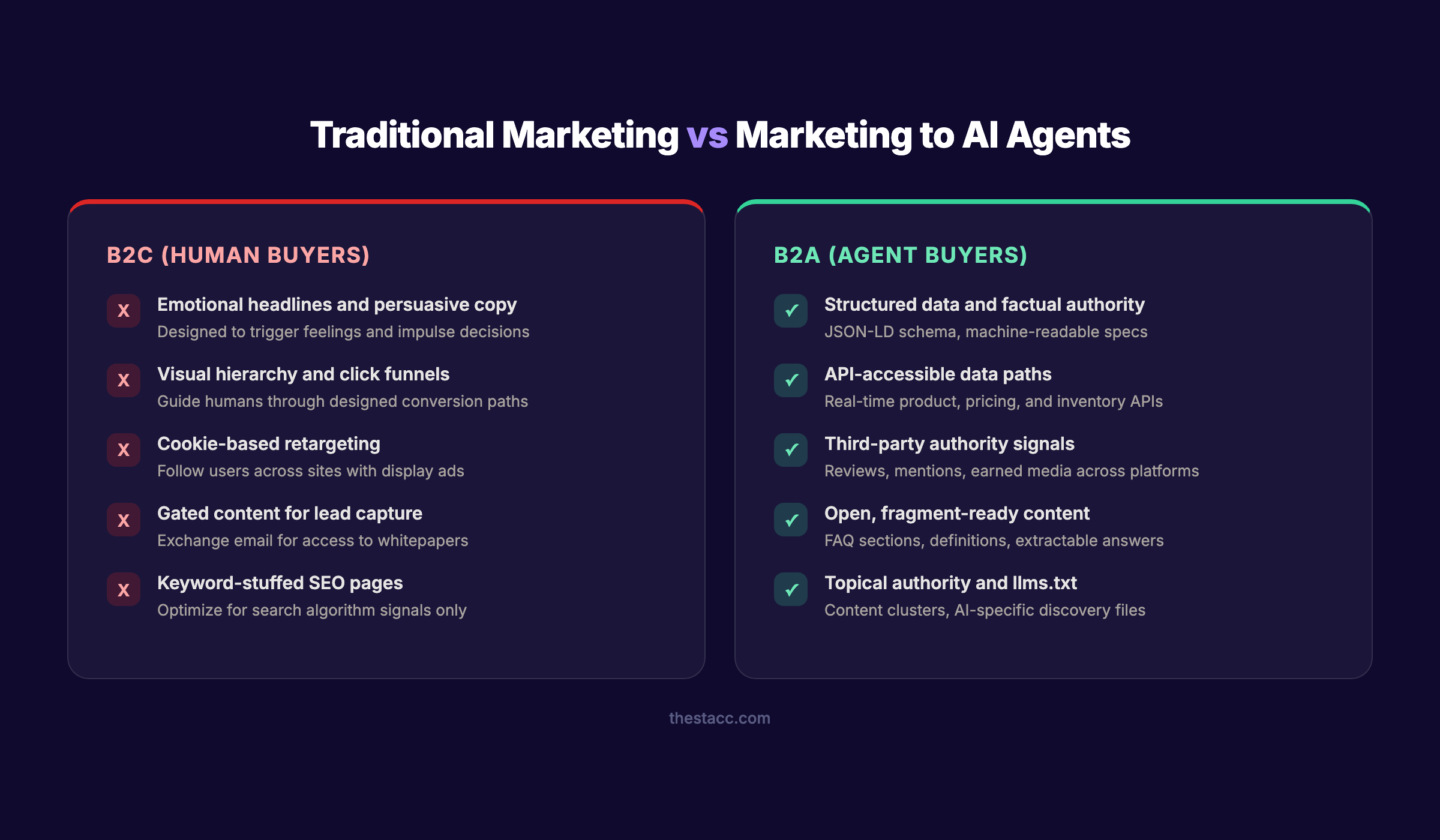
Marketing to AI agents requires a different playbook than marketing to humans. Agents do not scroll. They do not respond to emotional headlines. They parse structured data, compare specs, and execute transactions based on factual authority signals.
We have published 3,500+ blogs across 70+ industries. We watch ranking signals shift in real time. The shift toward agentic commerce is the biggest change in marketing since mobile.
Here is what you will learn:
- What changed in marketing in 2026 and why it matters
- 8 tactics that work right now for reaching AI agents
- 5 outdated strategies you need to stop immediately
- Your prioritized action plan for the rest of 2026
- The tools and resources you need to execute
What Changed in Marketing in 2026
Five shifts reshaped how brands reach buyers this year. Each one moves power away from traditional search and toward AI agents.
Change 1: Two Agentic Commerce Protocols Launched
In January 2026, Google partnered with Shopify to launch the Universal Commerce Protocol (UCP). The same month, OpenAI and Stripe released the Agentic Commerce Protocol (ACP). Both protocols let AI agents discover products, negotiate pricing, and complete purchases without human intervention.
What to do: Review both protocols. Determine which aligns with your tech stack. If you sell through Shopify, UCP integration is straightforward. For Stripe-based checkout, explore ACP compatibility.
Change 2: AI Referral Traffic Exploded
Traffic from AI sources jumped 1,200% for retailers between July 2024 and February 2025. That growth has not slowed. Target alone saw 40% month-over-month growth in ChatGPT-referred traffic. AI referral is now a measurable acquisition channel.
What to do: Set up UTM tracking for AI referral sources. Add ChatGPT, Perplexity, Claude, and Gemini as recognized channels in your analytics platform.
Change 3: Google Lost Search Dominance
Google’s market share dropped below 90% for the first time since 2015. ChatGPT now commands an estimated 17% of digital queries. The search market is fragmenting. If your entire strategy depends on Google rankings, you are exposed.
What to do: Diversify your content strategy across multiple AI platforms. Optimize for ChatGPT, Claude, Perplexity, and Google AI Overviews simultaneously.
Change 4: AI Citations Broke the SEO Playbook
Here is the statistic that should alarm every marketer: 90% of ChatGPT citations do not appear in Google’s first 20 search results. Only 12% of URLs overlap between AI tools and Google’s top 10. Ranking on Google no longer guarantees visibility in AI-powered discovery.
What to do: Audit your AI share of voice. Ask ChatGPT, Claude, and Perplexity about your product category. If they do not mention you, your AI visibility is zero.
Change 5: B2B Procurement Went Agent-First
Gartner reports that 80% of B2B sales interactions already happen digitally. By 2028, 90% of B2B buying will be AI agent intermediated. The B2B funnel is collapsing. Agents evaluate vendors based on structured data, third-party reviews, and factual authority — not sales decks.
What to do: Ensure your product data is machine-readable. Publish comparison content, technical documentation, and structured data that agents can parse without visiting your website.
What Is Working Right Now for Marketing to AI Agents
These 8 tactics produce measurable results in Q2 2026. Each one addresses how AI agents discover, evaluate, and recommend brands.
Tactic 1: Structured Data and Schema Markup
AI agents rely on structured data to understand what your business does, what you sell, and how you compare to alternatives. JSON-LD schema is the language machines read.
Implement these schema types at minimum:
| Schema Type | Purpose | Priority |
|---|---|---|
| Organization | Brand identity and entity recognition | Critical |
| Product | Pricing, availability, specifications | Critical |
| FAQPage | Direct answers to common queries | High |
| HowTo | Step-by-step process content | High |
| Review / AggregateRating | Social proof for agent evaluation | High |
| Article | Content freshness and authorship | Medium |
| BreadcrumbList | Site structure for crawling | Medium |
Google’s Structured Data Testing Tool validates your implementation. Test every template page, not just the homepage.
Tactic 2: Implement an llms.txt File
The llms.txt file is a new standard that tells AI agents what your site contains and how to find key pages. Think of it as robots.txt for large language models. HBR reports that early adopters see 12-25% traffic increases from AI sources after implementation.
Place your llms.txt at the root of your domain. Include:
- Company description and core products
- Key page URLs with brief descriptions
- API endpoints (if applicable)
- Content categories and navigation structure
- Contact and support information
This single file can determine whether AI agents include your brand in their recommendations.
Tactic 3: Agent-Readable Content Architecture
AI agents extract information differently than humans browse. They need content that is fragment-ready — meaning any paragraph can stand alone as a useful answer without needing the full page context.
Structure every page with:
- Semantic HTML (
<article>,<section>,<aside>tags) - Clear H2 and H3 hierarchy
- One idea per paragraph
- Optimized opening paragraphs with the core answer upfront
- Definitions near first usage of technical terms
<time datetime="">tags for freshness signals
Content that is easy for machines to extract gets cited more. Content buried in JavaScript-rendered carousels gets ignored.
Tactic 4: Third-Party Authority Building
This is the most counterintuitive shift. According to Bain, over 90% of LLM-cited content comes from nonbranded sources. AI agents trust third-party mentions more than anything you say about yourself.
Your third-party authority checklist:
- Accurate Wikipedia entry (or Wikidata for smaller brands)
- Active Reddit and forum presence with genuine contributions
- Guest posts on authoritative industry publications
- Mentions in independent product comparisons and reviews
- Consistent NAP (name, address, phone) across all directories
- Crunchbase, G2, Capterra, and Trustpilot profiles updated
This is the E-E-A-T framework applied to machines. Agents verify your claims by cross-referencing external sources. If nobody else mentions your brand, agents will not either.
Tactic 5: API-Exposed Product Data
AI agents that execute purchases need real-time access to your product catalog, pricing, and inventory. Retailers who expose this data through APIs become what Silicon Foundry calls “agent-friendly storefronts.”
Prioritize exposing:
- Product catalog with specifications
- Real-time pricing and availability
- Fulfillment options and shipping timelines
- Loyalty program data and customer history
- Return policies and guarantees
This matters beyond e-commerce. B2B SaaS companies should expose pricing tiers, feature matrices, and integration compatibility through structured, machine-readable formats.
Tactic 6: FAQ and Definition-Rich Content
AI agents answer questions. If your content provides clear, direct answers, agents cite you. If your content buries answers under paragraphs of context, agents skip you.
Every product page and blog post should include:
- FAQ sections with specific question-answer pairs
- Definition blocks for industry terms
- Comparison tables with clear data points
- Step-by-step guides with numbered sequences
Our Blog GEO Checklist covers 15 steps for making content AI-visible. FAQ sections are the single highest-impact format for AI citation.
Stop writing. Start ranking. Stacc publishes 30 optimized SEO articles per month for $99. Start for $1 →
Tactic 7: Agent Experience (AX) Design
Aviv Shamny coined the term “Agent Experience” to describe the new discipline replacing traditional UX for machine interactions. AX focuses on how AI agents discover, evaluate, and transact with your brand touchpoints.
AX design principles:
| Traditional UX | Agent Experience (AX) |
|---|---|
| Visual hierarchy | Data hierarchy |
| Emotional engagement | Factual accuracy |
| Click-through funnels | API-accessible data paths |
| Social proof badges | Machine-verifiable trust signals |
| Persuasive copy | Structured, parseable specifications |
| Cookie-based tracking | Token-based authentication |
The brands winning in 2026 design for both audiences. Humans still make high-stakes decisions. But agents handle the research, comparison, and shortlisting.
Tactic 8: Share of Model Tracking
“Share of Model” is the new KPI. It measures how frequently AI systems recommend your brand when users ask about your product category. MarTech introduced this metric as the AI-era equivalent of share of voice.
Track it monthly:
- Query ChatGPT, Claude, Perplexity, and Gemini with 10-15 category questions
- Record which brands appear in each response
- Calculate your mention frequency as a percentage
- Track changes month over month
- Correlate with AI referral traffic in analytics
This is the visibility metric that matters now. If your Share of Model is zero, all other marketing to AI agents is theoretical. Measure your AI share of voice before optimizing anything else.
What Is NOT Working Anymore
These 5 strategies produced results in 2024. In 2026, they actively hurt your AI visibility.
Stop Doing 1: Keyword-Only SEO
Traditional keyword optimization targets Google’s algorithm. AI agents evaluate content based on topical authority, factual accuracy, and structured data. A page stuffed with keywords but lacking depth gets skipped by agents entirely.
Do this instead: Build content clusters around topics, not keywords. Cover subjects in full depth with interlinked content that demonstrates expertise.
Stop Doing 2: Gating Your Best Content
Content behind email gates is invisible to AI agents. They cannot fill out forms. They cannot exchange an email for a whitepaper. Every gated resource is a dead end for machine discovery.
Do this instead: Publish your best content openly. The visibility you gain from AI citations outweighs the leads you capture through gates. Use content depth as the lead magnet, not access restrictions.
Stop Doing 3: JavaScript-Heavy Rendering
AI crawlers struggle with JavaScript-dependent content. If your pages require client-side rendering to display product data, pricing, or key information, most AI agents will see an empty page.
Do this instead: Server-side render all critical content. Use semantic HTML. Test your pages with JavaScript disabled — what agents see is what you get.
Your SEO team. $99 per month. 30 optimized articles, published automatically. Start for $1 →
Stop Doing 4: Brand-Only Content Strategies
Publishing content only on your own domain is a single point of failure. AI agents cross-reference multiple sources. If your brand only appears on your website, agents classify you as unverified.
Do this instead: Invest in third-party authority. Get mentioned on review sites, industry publications, forums, and comparison platforms. The 90% nonbranded citation statistic from Bain tells the story.
Stop Doing 5: Traditional Retargeting
When AI agents handle product discovery, they do not generate cookies. They do not build browser histories. They do not trigger pixel-based retargeting sequences. Bain calls this the “data invisibility problem” — customers convert through agents without leaving a trace in your database.
Do this instead: Build attribution models that track AI referral sources. Implement server-side tracking. Focus on making your brand the one agents recommend, not the one that follows humans across the web.
Your 2026 Action Plan for Marketing to AI Agents
Here is exactly what to do, in order of impact.
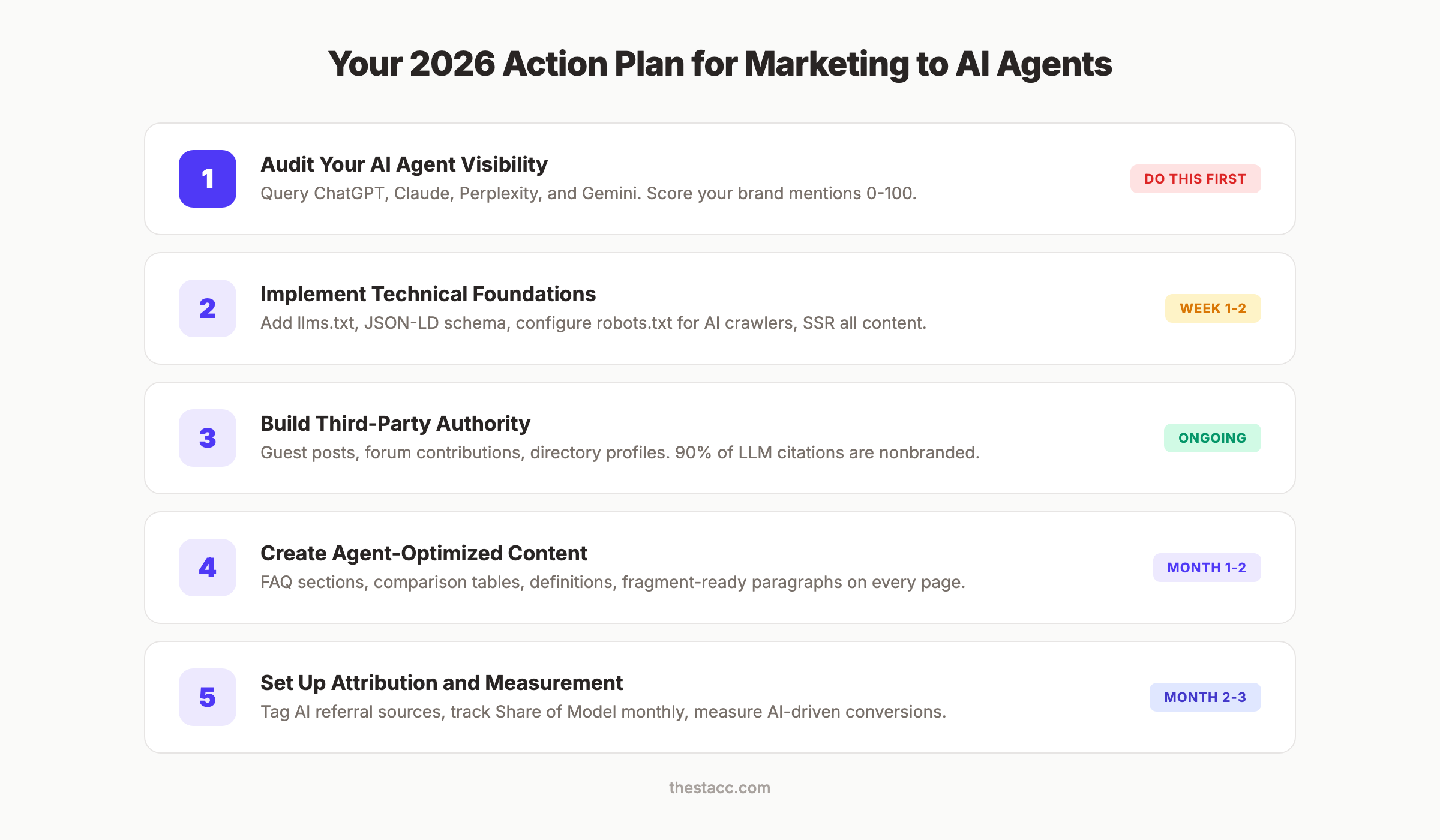
Priority 1 (Do This First): Audit Your AI Agent Visibility
Before optimizing anything, measure where you stand. Query ChatGPT, Claude, Perplexity, and Google Gemini with 15-20 questions about your product category. Record every response.
How to run the audit:
- Ask “What are the best [your category] tools?” across all 4 platforms
- Ask “How does [your brand] compare to [competitor]?”
- Ask “What do users say about [your brand]?”
- Document which platforms mention you, which ignore you, and which mention competitors instead
- Score yourself 0-100 based on mention frequency and accuracy
This audit takes 2 hours. It reveals exactly where your AI visibility gaps are. Everything that follows depends on this baseline.
Priority 2: Implement Technical Foundations
With your audit complete, fix the infrastructure that AI agents need.
- Add
llms.txtto your domain root - Implement JSON-LD schema on all key pages (Organization, Product, FAQPage)
- Configure
robots.txtto allow GPTBot, ClaudeBot, PerplexityBot, and OAI-SearchBot - Server-side render all critical content
- Add semantic HTML tags (
<article>,<section>,<time>) - Test page load with JavaScript disabled
This is the technical SEO foundation for AI agent visibility. Without it, no content strategy matters.
Priority 3: Build Third-Party Authority
Start earning nonbranded mentions. This takes longer than technical fixes, so begin immediately.
Monthly targets:
- 2-3 guest posts on industry publications
- 5-10 genuine Reddit/forum contributions in your niche
- Update all directory profiles (G2, Capterra, Trustpilot, Crunchbase)
- Pitch 1-2 journalists or analysts for product mentions
- Respond to HARO and Qwoted requests in your domain
Within 90 days, your third-party mention footprint should be 3-5 times larger than today.
Priority 4: Create Agent-Optimized Content
Restructure your content production for dual-audience publishing. Every piece should work for human readers and AI agents simultaneously.
Content production checklist:
- FAQ section on every product and blog page
- Comparison tables with specific data points (not vague claims)
- Internal linking between related content (3-5 links per 1,000 words)
- First 200 words contain the core answer to the page’s topic
- Definition blocks for technical terms
-
<time>tags on all dates for freshness signals
Publish at high frequency. AI agents favor sites with fresh, regularly updated content. The Content Compound Effect applies even more strongly for machine discovery.
3,500+ blogs published. 92% average SEO score. See what Stacc can do for your site. Start for $1 →
Priority 5: Set Up Attribution and Measurement
Build the measurement infrastructure to track AI-driven revenue.
- Tag AI referral sources in Google Analytics (ChatGPT, Claude, Perplexity, Gemini)
- Track Share of Model monthly with the 15-question audit method
- Monitor AI referral traffic as a percentage of total traffic
- Set up conversion tracking specifically for AI-referred sessions
- Report AI visibility alongside traditional SEO metrics
Attribution is the gap nobody has solved well. The brands that figure it out first will allocate budget more effectively than competitors still guessing.
Tools and Resources for Marketing to AI Agents in 2026
For AI visibility auditing:
- Stacc AI Share of Voice Tracker — Manual methodology for tracking brand mentions across AI platforms
- Scrunch AI — Automated AI referral traffic analytics
- Profound — AI brand monitoring across LLM outputs
For technical implementation:
- Schema Markup Generator — Build JSON-LD structured data for your pages
- Google Rich Results Test — Validate schema implementation
- Screaming Frog — Crawl your site the way AI agents do
- llms-txt.cloud — Generate and validate your
llms.txtfile
For content optimization:
- Stacc — Automated SEO content publishing at 30 articles per month for $99. Every article is structured for both human readers and AI agents
- GEO Checklist — 15-step checklist for AI-visible content
- Clearscope or Surfer SEO — Content optimization for topical coverage
For third-party authority:
- HARO / Qwoted — Earn journalist mentions
- G2 and Capterra — Maintain review profiles
- Ahrefs or Semrush — Track backlink and mention growth
Free resources:
- Google AI Overview Optimization Guide
- Claude Search Optimization Guide
- Agentic Commerce Explained
- Get Cited by AI Search Engines
- AI Search Statistics 2026
FAQ
What is marketing to AI agents?
Marketing to AI agents means optimizing your brand, content, and product data so that AI agents — autonomous software programs that research, compare, and purchase on behalf of humans — can discover, evaluate, and recommend your business. It requires structured data, third-party authority, and machine-readable content rather than traditional advertising.
How do AI agents decide which brands to recommend?
AI agents evaluate brands based on factual accuracy, third-party mentions, structured data quality, content freshness, and cross-platform consistency. Over 90% of LLM citations come from nonbranded third-party sources. Agents verify claims by cross-referencing multiple data points, not by reading persuasive marketing copy.
What is the difference between SEO and marketing to AI agents?
Traditional SEO optimizes for Google’s ranking algorithm using keywords, backlinks, and technical signals. Marketing to AI agents optimizes for how large language models retrieve and cite information. The two overlap in areas like structured data and content quality, but diverge in tactics. AI agents value FAQ formats, llms.txt files, and third-party mentions more than traditional ranking factors.
What is agentic commerce?
Agentic commerce is the emerging model where AI agents autonomously discover, compare, negotiate, and purchase products or services on behalf of consumers and businesses. Two major protocols — Google/Shopify’s Universal Commerce Protocol and OpenAI/Stripe’s Agentic Commerce Protocol — launched in January 2026 to standardize these transactions.
How much revenue do AI agents drive for brands today?
Early-adopting brands report that AI agents drive approximately 10% of total revenue. AI referral traffic to retailers increased 1,200% between July 2024 and February 2025. McKinsey projects $900 billion to $1 trillion in U.S. agentic commerce by 2030, with global projections reaching $3-5 trillion.
Can Stacc help with marketing to AI agents?
Stacc publishes 30 optimized SEO articles per month for $99. Every article is structured with semantic HTML, FAQ sections, internal linking, and schema markup that AI agents can parse and cite. The Blog GEO Checklist is built into every piece of content we publish.
Marketing to AI agents in 2026 rewards the businesses that execute on fundamentals. Structured data, third-party authority, machine-readable content, and consistent measurement. The brands that treat AI agents as a real audience — not a buzzword — will capture the next trillion-dollar market before competitors realize it exists.
Rank everywhere. Do nothing. Blog SEO, Local SEO, and Social on autopilot. Start for $1 →
Written and published by Stacc. We publish 3,500+ articles per month across 70+ industries. All data verified against public sources as of March 2026.