
Autonomous SEO to 24/7 Content Pipelines (2026): Guide
Practical autonomous seo guide strategies for 2026: step-by-step tactics, real examples, and tools to improve rankings and drive organic traffic.
86% of marketers now use AI tools for content briefs, keyword research, and technical audits. Yet most still run their SEO manually. One article at a time. One optimization at a time. One publish button at a time.
Autonomous SEO eliminates that bottleneck. It is a system that researches keywords, writes content, optimizes for search, publishes to your CMS, and monitors rankings without waiting for human input at every step. The pipeline runs 24 hours a day. It does not take weekends off.
The difference between using AI tools and running autonomous SEO is the difference between owning a calculator and owning an accountant. One waits for instructions. The other completes the job.
We have published 3,500+ blogs across 70+ industries using automated content pipelines. This guide covers everything we have learned about building, scaling, and governing autonomous SEO systems that actually produce results.
Here is what you will learn:
- What autonomous SEO means and how it differs from AI-assisted SEO
- The 6-stage pipeline architecture that runs content production end to end
- How to set up keyword discovery, writing, optimization, and publishing on autopilot
- Quality control systems that prevent bad content from going live
- The governance framework that keeps autonomous pipelines on track
- Real performance data and ROI benchmarks
Chapter 1: What Autonomous SEO Actually Means
Most teams confuse AI-assisted SEO with autonomous SEO. They are fundamentally different operating models.
AI-Assisted SEO vs. Autonomous SEO
AI-assisted SEO means a human uses AI tools to speed up manual tasks. You prompt ChatGPT for a blog draft. You use Surfer to check keyword density. You copy the output into WordPress. The human remains the bottleneck at every stage.
Autonomous SEO removes the human from routine execution. The system receives a goal (“rank for 50 keywords in the B2B SaaS category”) and executes the entire workflow independently. Research, writing, optimization, publishing, and monitoring happen without manual intervention.
| Factor | AI-Assisted SEO | Autonomous SEO |
|---|---|---|
| Human role | Executor using AI tools | Strategist overseeing AI systems |
| Workflow | Prompt → Output → Manual publish | Goal → Automated pipeline → Auto-publish |
| Speed | 2-4 articles per day per person | 5-30 articles per day per pipeline |
| Consistency | Varies by operator skill and availability | Uniform quality, 24/7 operation |
| Scalability | Linear (more people = more output) | Exponential (more pipelines = more output) |
The 3 Levels of SEO Automation
Level 1. Tool Automation: Individual tasks are automated. Keyword research tools pull data. Rank trackers send alerts. Each tool operates independently.
Level 2. Workflow Automation: Multiple tools connect via APIs or platforms like Zapier and n8n. A keyword list triggers content briefs, which trigger writing, which triggers publishing. Handoffs are automated but the pipeline is rigid.
Level 3. Autonomous SEO: AI agents make decisions within the pipeline. The system identifies keyword opportunities, prioritizes them by ROI potential, selects the right content format, writes and optimizes the article, publishes it, and adjusts strategy based on performance data. This is what we cover in this guide.
Most teams operate at Level 1. The highest-performing teams operate at Level 3. The gap between them widens every quarter.
Why 24/7 Matters
Google processes an estimated 18 billion searches per day in 2026. Search behavior does not pause. Your competitors who publish 2-4 articles per week compete against teams publishing 2-4 articles per day.
An autonomous pipeline does not sleep. It does not take holidays. It publishes at 3 AM on a Sunday with the same quality as 10 AM on a Tuesday. For content velocity, consistency beats bursts every time.
Chapter 2: The 6-Stage Autonomous Content Pipeline
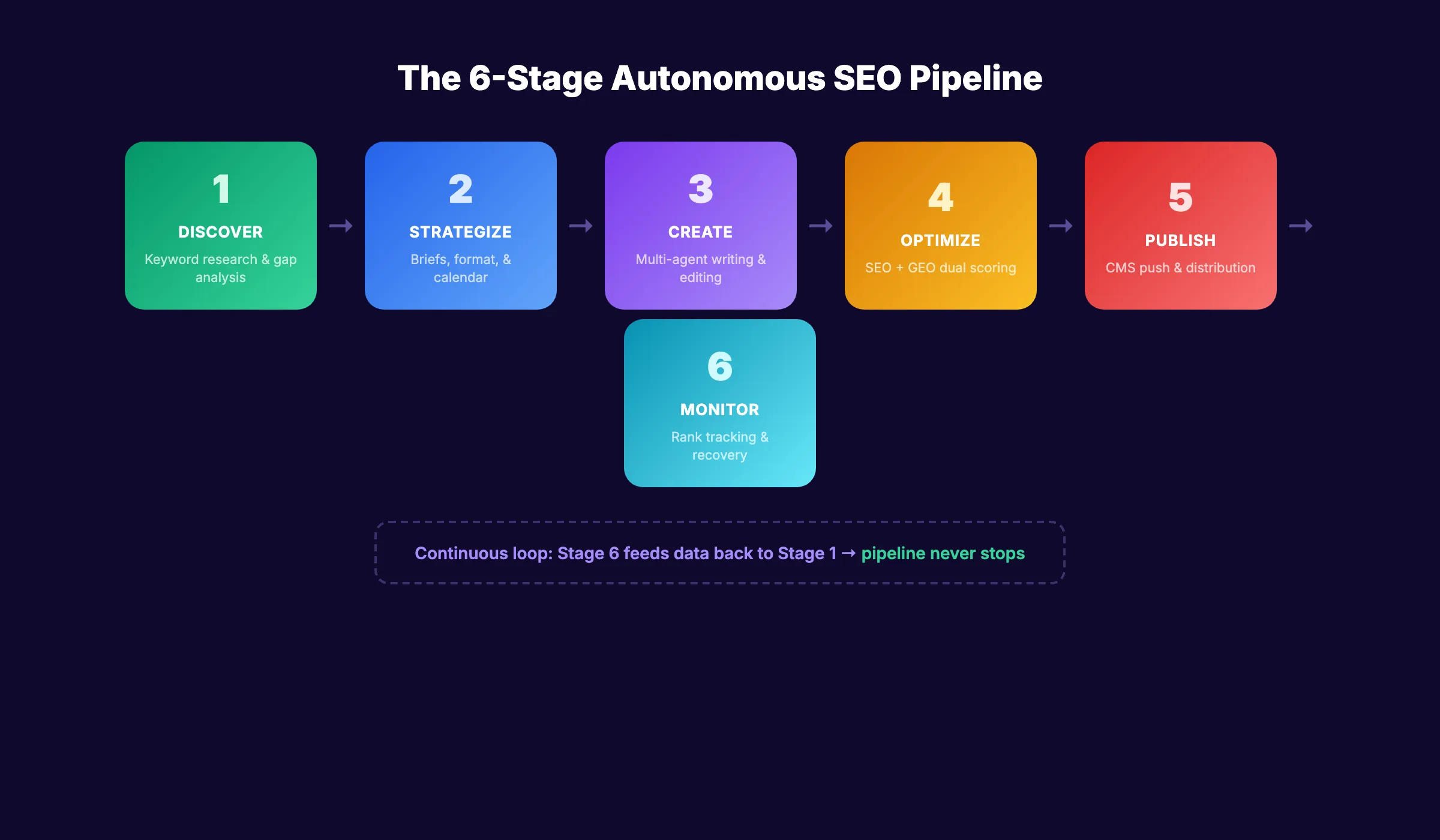
Every autonomous SEO system follows the same fundamental architecture. Six stages, each feeding the next, running continuously.
Stage 1: Keyword Discovery
The pipeline begins with automated keyword identification. The system scans search data, competitor rankings, trending topics, and content gaps to build a prioritized list of target keywords.
Inputs: Search console data, competitor domains, industry seed terms, content gap analysis. Outputs: Ranked keyword opportunities with search volume, difficulty, and intent classification.
The discovery engine runs continuously, not as a monthly sprint. New opportunities surface daily. A good system identifies them within 24 hours.
This stage replaces the manual keyword research process that most teams run quarterly or monthly. Autonomous systems make it perpetual.
Stage 2: Content Strategy
The strategy stage determines what to create for each keyword. It analyzes SERP intent, selects the optimal content format (guide, listicle, comparison, how-to), and generates a structured brief.
Inputs: Prioritized keyword list, SERP analysis, competitor content audit. Outputs: Content briefs with H2/H3 structure, target word count, required elements, and internal linking targets.
The strategy agent does not create one brief at a time. It generates briefs in batches, scheduling them across a publishing calendar that maintains consistent output.
Stage 3: Content Creation
This is where most teams stall. Writing is the bottleneck. An autonomous pipeline uses AI writing agents with specialized roles to produce draft content at scale.
The key distinction: you do not prompt the system for each article. The strategy stage feeds briefs directly into the creation stage. The writing agent produces complete drafts following brand voice rules, target word counts, and SEO requirements.
At Stacc, we use AI content creation workflows that produce 30-80 articles per month per client. The writing stage runs 24/7 and queues completed drafts for the next stage.
Stop writing. Start ranking. Stacc publishes 30 optimized articles per month for $99. Start for $1 →
Stage 4: SEO Optimization
Raw drafts are not ready to publish. The optimization stage handles keyword placement, internal linking, meta descriptions, image alt text, header hierarchy, and schema markup.
This stage applies on-page SEO best practices automatically. It checks keyword density, verifies internal links point to real pages, ensures H2/H3 structure follows SEO guidelines, and validates meta descriptions are within character limits.
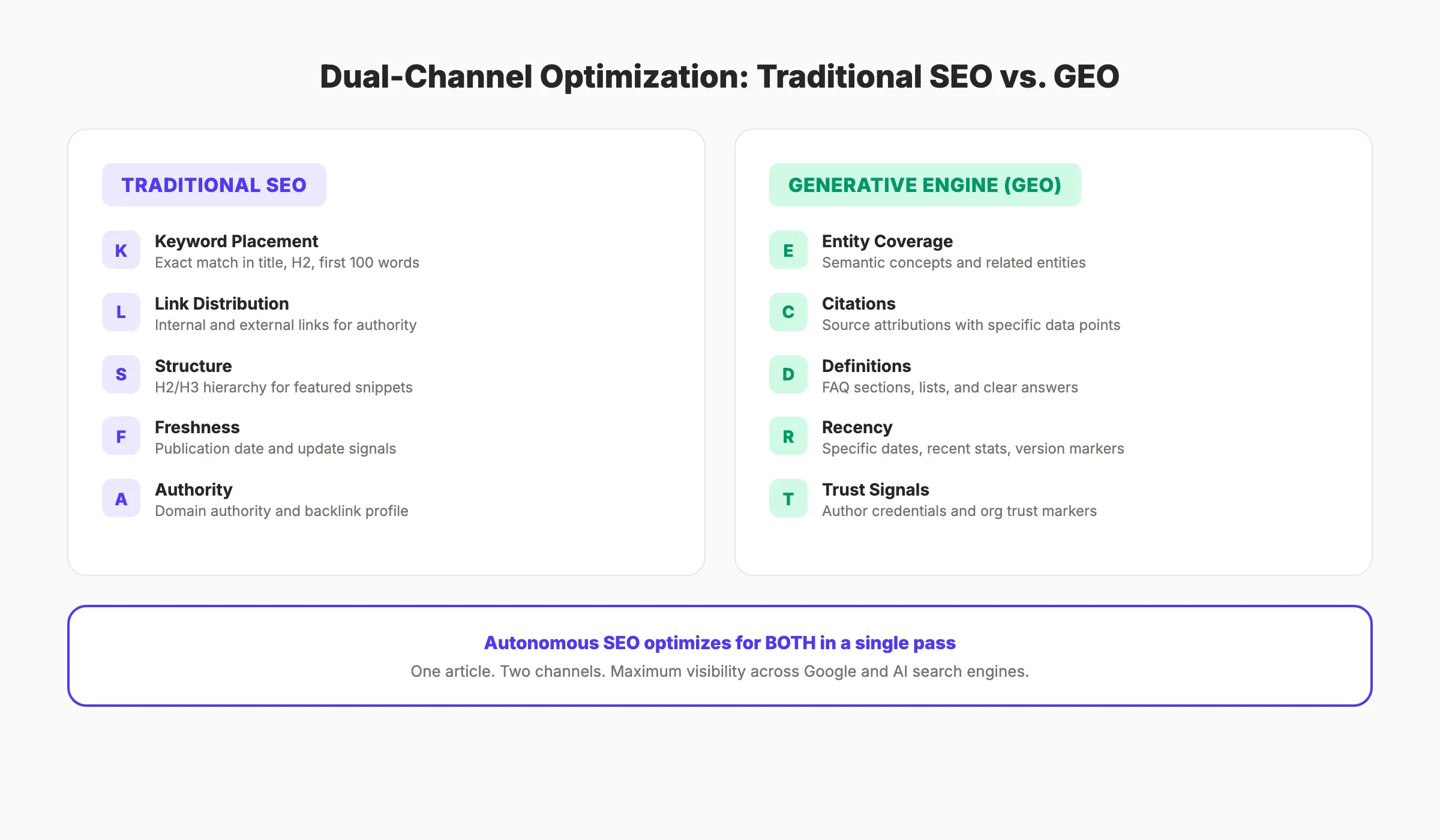
The optimization agent also handles dual-channel scoring: traditional SEO signals and Generative Engine Optimization (GEO) signals. Content needs to rank on Google and get cited by AI search engines. Both require different optimization approaches applied to the same article.
Stage 5: Publishing
The publishing stage pushes finished content to your CMS. WordPress, Webflow, Ghost, or custom systems via API. It handles formatting, image uploads, category assignment, and scheduling.
Autonomous publishing does not mean uncontrolled publishing. The system can operate in 3 modes:
- Full autopilot: Content publishes automatically after passing quality gates
- Approval required: Content queues for human review before publishing
- Scheduled release: Content publishes at optimal times based on audience data
Most teams start with approval-required mode and graduate to full autopilot after 30-60 days of consistent quality.
Stage 6: Monitoring and Recovery
The final stage closes the loop. The system tracks rankings, traffic, engagement, and conversions for every published article. When performance drops below thresholds, it triggers automated recovery.
Recovery workflows include:
- Refreshing outdated content with new data and examples
- Expanding thin sections that competitors now cover better
- Updating internal links based on newly published content
- Resubmitting updated pages for faster indexing via IndexNow protocol
This continuous monitoring replaces the quarterly content audit with daily automated checks. Problems get caught in days, not months.
Chapter 3: Building Your Keyword Discovery Engine
The discovery engine is the foundation. Without a steady flow of keyword opportunities, the pipeline starves.
Automated Gap Analysis
The discovery engine compares your current rankings against competitor domains to identify keywords they rank for and you do not. This runs daily, not monthly.
Set up monitoring for 5-10 competitor domains. The system tracks their new rankings and flags keywords where you have zero presence but the topic aligns with your business.
Pair this with your own search console data. Keywords where you rank in positions 11-30 represent immediate optimization opportunities. Keywords with high impressions but low clicks indicate title or meta description problems.
Intent Classification
Not every keyword is worth pursuing. The discovery engine classifies each opportunity by search intent:
| Intent Type | Example | Action |
|---|---|---|
| Informational | ”what is autonomous SEO” | Write a guide or explainer |
| Commercial | ”best SEO automation tools” | Write a comparison or best-list |
| Transactional | ”SEO automation software pricing” | Create a landing page |
| Navigational | ”Frase login” | Skip (branded competitor query) |
The system filters out navigational queries and low-value keywords automatically. Only actionable opportunities reach the strategy stage.
Opportunity Scoring
Each keyword receives a composite score based on 4 factors:
- Search volume. How many people search for this monthly
- Keyword difficulty. How hard it is to rank in the top 10
- Business relevance. How closely it aligns with your product or service
- Content gap. Whether you already have content targeting this keyword
Keywords with high volume, low difficulty, high relevance, and no existing coverage score highest. These are your quick wins.
The scoring model runs continuously. As your site authority grows and new content publishes, scores recalculate to reflect your evolving competitive position. This keeps the pipeline focused on the highest-ROI opportunities at any given time.
Chapter 4: Content Creation at Scale Without Losing Quality
Speed without quality is worse than no content at all. Google’s helpful content system penalizes sites that publish high volumes of low-value content. The creation stage must produce content that meets editorial standards at scale.
The Multi-Agent Writing Approach
Single-prompt AI writing produces mediocre content. The autonomous approach uses specialized agents for each function:
- Research agent: Gathers data, statistics, examples, and competitor angles
- Outline agent: Structures the article with H2/H3 hierarchy and key points per section
- Writing agent: Produces the full draft following the outline and brand voice rules
- Editing agent: Checks grammar, tone consistency, factual accuracy, and readability
Each agent does one job well. The combined output is stronger than any single prompt could produce. This is the same multi-agent orchestration pattern used across modern AI systems.
Quality Control Gates
Every article must pass automated quality checks before advancing to the optimization stage:
- Word count meets target (minimum 1,500 for hub entries, 3,000+ for guides)
- Zero plagiarism flags
- Readability score within target range
- All factual claims have supporting sources
- Brand voice compliance check passes
- No duplicate content with existing published articles
Articles that fail any gate route to a revision queue. The writing agent receives specific feedback on what failed and regenerates the affected sections. No article reaches publishing without passing every gate.
Brand Voice Enforcement
Autonomous content must sound like your brand. Not like generic AI output.
Configure your pipeline with explicit voice rules:
- Vocabulary lists: Words to use and words to ban
- Sentence structure rules: Maximum sentence length, paragraph limits, active voice requirements
- Tone guidelines: Confident versus cautious, technical versus accessible, formal versus conversational
Your SEO team. $99 per month. 30 optimized articles, published automatically. Start for $1 →
The system checks every draft against these rules and flags violations. This is the same principle behind our guide on content governance for AI teams. Without enforced voice rules, autonomous content drifts toward generic AI patterns within weeks.
Handling E-E-A-T Signals
Google evaluates Experience, Expertise, Authoritativeness, and Trustworthiness. Autonomous content must demonstrate these signals.
Experience: Include specific examples, case data, and operational insights that only come from doing the work. Generic advice signals AI generation.
Expertise: Cite authoritative sources. Link to primary research. Include data points with attribution.
Authoritativeness: Publish under real author profiles with verifiable credentials. Link to author pages with expertise signals.
Trustworthiness: Accurate data, transparent sourcing, clear disclosure of affiliations, and regular content updates.
Most autonomous pipelines fail at E-E-A-T because they prioritize volume over credibility. Build E-E-A-T checks into your quality gates from day one.
Chapter 5: SEO Optimization on Autopilot
The optimization stage transforms good content into rankable content. Every element that affects search visibility gets automated.
On-Page SEO Automation
The optimization agent handles these elements for every article:
Title tags: Generated within 60-character limits, keyword-first placement, power word inclusion.
Meta descriptions: 145-155 characters, keyword included, benefit statement, freshness signal.
Header hierarchy: Validates H1 → H2 → H3 flow with no skipped levels. Ensures primary keyword appears in at least one H2.
Internal linking: Scans your existing content library and inserts 3-5 relevant internal links per 1,000 words. Only links to pages that exist. Uses descriptive anchor text.
Image optimization: Generates alt text for every image. Compresses files. Ensures proper formatting for image SEO.
Schema markup: Adds Article, FAQ, and HowTo schema where appropriate. Validates against Google’s structured data guidelines.
Dual-Channel Optimization
In 2026, ranking on Google is not enough. AI Overviews now appear in approximately 60% of all search queries. Your content needs to rank on traditional search AND get cited by AI search engines.
Traditional SEO optimization focuses on keyword density, backlinks, and technical signals. Generative Engine Optimization focuses on factual density, clear attributions, structured data, and authoritative sourcing.
The autonomous optimization stage applies both simultaneously:
| Signal | Traditional SEO | GEO |
|---|---|---|
| Keywords | Exact-match placement in title, H2, first 100 words | Semantic coverage of related entities and concepts |
| Links | Internal and external link distribution | Source citations with specific data points |
| Structure | H2/H3 hierarchy for featured snippets | FAQ sections, numbered lists, clear definitions |
| Freshness | Publication date, content updates | Specific dates, recent statistics, version markers |
| Authority | Domain authority, backlink profile | Author credentials, organizational trust signals |
An article optimized for only one channel leaves traffic on the table. Autonomous systems optimize for both in a single pass.
Technical SEO Automation
Beyond content optimization, autonomous systems handle technical SEO tasks:
- Crawl monitoring: Detects and fixes crawl errors within hours
- Index management: Submits new pages via IndexNow for faster indexing
- Site speed: Identifies slow pages and recommends performance fixes
- Canonical management: Prevents duplicate content issues across the site
- XML sitemap updates: Automatically adds new pages and removes deleted ones
These technical tasks run continuously. Manual teams check them weekly or monthly. Autonomous systems check them hourly.
Chapter 6: Publishing and Distribution Automation
Content that sits in a draft folder generates zero traffic. The publishing stage eliminates the gap between “done” and “live.”
CMS Integration Architecture
Autonomous pipelines connect to your CMS via API. Common integration patterns:
WordPress: REST API or Application Password authentication. The pipeline pushes finished HTML, assigns categories and tags, sets featured images, and schedules publication times.
Webflow: CMS API for content items. Requires structured data matching your collection schema.
Ghost: Admin API with JWT authentication. Supports full HTML content, custom metadata, and scheduled publishing.
Custom systems: Webhook integration with HMAC-SHA256 verification for security.
The publishing agent handles formatting differences between platforms. Content created once publishes correctly everywhere.
Publishing Cadence Optimization
Not all publishing schedules are equal. The autonomous system tests and optimizes publishing times based on your audience data.
Key variables:
- Day of week: B2B content performs better Tuesday through Thursday. Consumer content peaks on weekends.
- Time of day: Match your target audience’s active hours, not your team’s working hours.
- Frequency: Our data shows that publishing 30+ articles per month consistently outperforms publishing fewer, longer pieces.
- Distribution: Spread publications evenly rather than publishing in bursts.
The pipeline schedules each article for its optimal publishing window. A 24/7 pipeline means you can publish at 6 AM in your target market’s timezone even if your team is asleep.
3,500+ blogs published. 92% average SEO score. See what Stacc can do for your site. Start for $1 →
Post-Publish Distribution
Publishing is not the end. The distribution stage triggers downstream actions:
- Social media: Generates and schedules posts for LinkedIn, X, and Facebook
- Email: Adds the article to your next newsletter batch
- Internal linking: Updates existing articles with links to the new content
- IndexNow submission: Notifies search engines of the new page immediately
- Performance tracking: Initializes rank tracking for target keywords
This automated distribution replaces the manual promotion checklist that most teams skip when they are busy. The autonomous system never skips it. Content gets promoted consistently, every single time.
Chapter 7: Monitoring, Recovery, and Continuous Improvement
An autonomous SEO pipeline is not a set-and-forget system. It is a self-improving loop.
Automated Performance Monitoring
The monitoring stage tracks every published article across these metrics:
- Rankings: Position for target keyword and related terms
- Traffic: Organic sessions, click-through rate from SERP
- Engagement: Time on page, scroll depth, bounce rate
- Conversions: Goal completions attributed to organic search
- AI citations: Mentions in AI Overviews and other AI search results
Thresholds trigger automated responses. A ranking drop of 5+ positions triggers a content review. A traffic decline of 20%+ triggers a competitive analysis. These responses happen within 24 hours, not at the next monthly review meeting.
Content Recovery Workflows
When the monitoring system detects declining performance, recovery workflows activate automatically:
Freshness updates: Replace outdated statistics, examples, and references. Add new information published since the original article.
Competitive gap filling: Compare the declining article against current top-ranking competitors. Identify new sections, examples, or data they cover that your article does not.
Internal link injection: Link from newer, higher-performing articles to the declining page. This passes authority and signals relevance.
Technical checks: Verify no crawl errors, broken links, or speed regressions affect the page.
This automated content refresh strategy catches decay early. Manual teams discover decay months later when the damage is harder to reverse.
The Compound Effect
Every article the pipeline publishes strengthens the entire system.
New articles create more internal linking opportunities. More internal links distribute authority more effectively. Higher authority improves rankings for existing articles. Better rankings generate more traffic data. More data improves the keyword discovery engine. Better keywords produce better articles.
This is the Content Compound Effect in action. It is why teams running autonomous SEO pipelines see accelerating returns over time while manual teams see linear growth at best.
After 90 days, a well-built autonomous pipeline produces measurably better results than its first month. After 6 months, the gap is dramatic.
Chapter 8: Governance. Keeping Autonomous Systems Under Control
Autonomous does not mean unsupervised. The teams that get the best results from autonomous SEO invest as much in governance as they do in the pipeline itself.
Why Governance Matters
Without governance, autonomous pipelines produce volume without direction. Articles target irrelevant keywords. Content drifts off-brand. Quality degrades gradually until Google notices and traffic drops.
Deloitte’s 2026 research found that AI programs with human oversight were 2x more likely to achieve cost savings of 75% or more. Governance is not a brake on performance. It is a multiplier.
The 3-Layer Governance Model
Layer 1. Strategic Guardrails
Set by leadership. Updated quarterly.
- Approved topic categories and keyword themes
- Brand voice rules and banned terms
- Content quality minimums (word count, source count, E-E-A-T score)
- Publishing frequency caps
- Budget limits for tools and API costs
Layer 2. Automated Quality Gates
Built into the pipeline. Run on every article.
- Plagiarism detection
- Factual accuracy verification
- Brand voice compliance scoring
- SEO optimization scoring
- Duplicate content detection
Layer 3. Human Review Checkpoints
Performed by team members. Frequency decreases as trust builds.
- Week 1-4: Review every article before publishing
- Month 2-3: Spot-check 50% of articles
- Month 4+: Spot-check 10-20% of articles
- Ongoing: Review all articles flagged by automated quality gates
This graduated approach balances speed with control. You maintain quality without creating a bottleneck that defeats the purpose of automation.
Common Governance Mistakes
Over-governing: Requiring human approval on every article permanently. This turns autonomous SEO back into AI-assisted SEO.
Under-governing: Setting up the pipeline and walking away. No system is perfect on day one. Active tuning produces better results.
Governing the wrong things: Approving individual articles instead of setting rules the system follows. Focus governance on strategy, voice, and quality standards. Not on individual word choices.
Rank everywhere. Do nothing. Blog SEO, Local SEO, and Social on autopilot. Start for $1 →
Chapter 9: ROI and Performance Benchmarks
The business case for autonomous SEO is straightforward. Compare the cost of the pipeline to the cost of doing the same work manually.
Cost Comparison
| Metric | Manual Team | Autonomous Pipeline |
|---|---|---|
| Articles per month | 8-12 (2-3 writers) | 30-80 (1 pipeline) |
| Cost per article | $200-500 (writer + editor + SEO) | $3-15 (API + hosting costs) |
| Monthly content spend | $2,400-6,000 | $99-499 (platform) |
| Time to publish | 5-10 days per article | 2-24 hours per article |
| Consistency | Varies by writer availability | Uniform, 24/7 |
| Scaling cost | Linear (hire more writers) | Minimal (add capacity) |
The math works at every scale. A solo founder publishing 30 articles per month through Stacc spends $99 versus $6,000+ with freelance writers. An enterprise team publishing 80 articles per month saves $15,000-40,000 monthly.
Performance Benchmarks
Based on our data across 3,500+ published articles:
- Average SEO score: 92%
- Time to first ranking movement: 60-90 days
- Percentage of articles ranking page 1 within 6 months: 34%
- Average monthly organic traffic per article after 6 months: 180-450 sessions
- Content that maintains or improves ranking after 12 months: 71%
These numbers vary by industry competitiveness and domain authority. New domains with no existing authority see slower initial results but comparable long-term performance once the compound effect takes hold.
ROI Calculation Framework
Calculate your autonomous SEO ROI with this formula:
Monthly ROI = (Organic Traffic Value - Pipeline Cost) / Pipeline Cost
Organic Traffic Value = Monthly organic sessions x Conversion rate x Average customer value
Example: 10,000 organic sessions x 2% conversion rate x $500 average deal = $100,000 monthly traffic value. Pipeline cost: $499/month. ROI: 199x.
Even at conservative estimates, the average ROI for SEO is $22.10 for every $1 spent. Autonomous SEO amplifies this by reducing the cost denominator while maintaining or increasing the output numerator.
FAQ
What is autonomous SEO?
Autonomous SEO is a system that handles the full content lifecycle without manual intervention at every step. It researches keywords, creates content briefs, writes articles, optimizes for search engines, publishes to your CMS, and monitors performance. The human role shifts from executing tasks to setting strategy and reviewing results.
How many articles can an autonomous SEO pipeline produce per month?
Output depends on the system and quality requirements. Most autonomous pipelines produce 30-80 articles per month while maintaining editorial standards. Stacc publishes 30 articles per month on its Starter plan and up to 80 on its Pro plan. Programmatic SEO pipelines targeting long-tail keywords can produce hundreds of pages per month.
Does autonomous SEO work for small businesses?
Yes. Small businesses benefit the most because they cannot afford the 2-3 person content team needed for manual SEO. An autonomous SEO service like Stacc provides the equivalent output of a full content team for $99 per month. No hiring, no management, no waiting.
Will Google penalize AI-generated content?
No. Google does not penalize content based on how it was created. Google penalizes content that fails to help users. Autonomous SEO pipelines that include quality gates, E-E-A-T signals, and genuine value pass Google’s helpful content evaluation. Google’s own documentation confirms this position.
How long before an autonomous SEO pipeline shows results?
Expect initial ranking movement within 60-90 days. Meaningful traffic growth appears at 3-6 months. The compound effect accelerates results over time. Sites publishing 30+ articles per month consistently see faster timelines than sites publishing sporadically.
What is the difference between autonomous SEO and SEO automation?
SEO automation refers to automating individual tasks like rank tracking, site audits, or report generation. Autonomous SEO connects all tasks into a self-running pipeline where the system makes decisions and executes end-to-end workflows. Automation handles tasks. Autonomous SEO handles strategy execution.
The SEO teams still running manual workflows are competing against pipelines that never stop. Every day without an autonomous system is a day your competitors publish more, optimize faster, and compound further ahead.
Start with one pipeline. Set governance from day one. Measure everything. Scale what works.
The teams that build autonomous SEO systems now will own the organic search results of 2027.
Related Tools & Resources
Free SEO Tools:
Best Lists:

Written by
Siddharth GangalSiddharth is the founder of theStacc and Arka360, and a graduate of IIT Mandi. He spent years watching great businesses lose organic traffic to competitors who simply published more. So he built a system to fix that. He writes about SEO, content at scale, and the tactics that actually move rankings.
30 SEO blog articles published every month
Keyword-optimized, scheduled, and live on your site. Automatically.
30-day trial · Cancel anytime
theStacc
Stop writing SEO content manually
30 blog articles, 30 GBP posts, and social media content. Published every month. Automatically.
Try for free$1 for 3 days · Cancel anytime