
Claude Search Optimization (2026): Strategies, Tactics & Examples
claude search optimization guide for 2026: strategies, tactics, real examples, and implementation steps to get results faster.
Claude Search Optimization: The Complete Guide (2026)
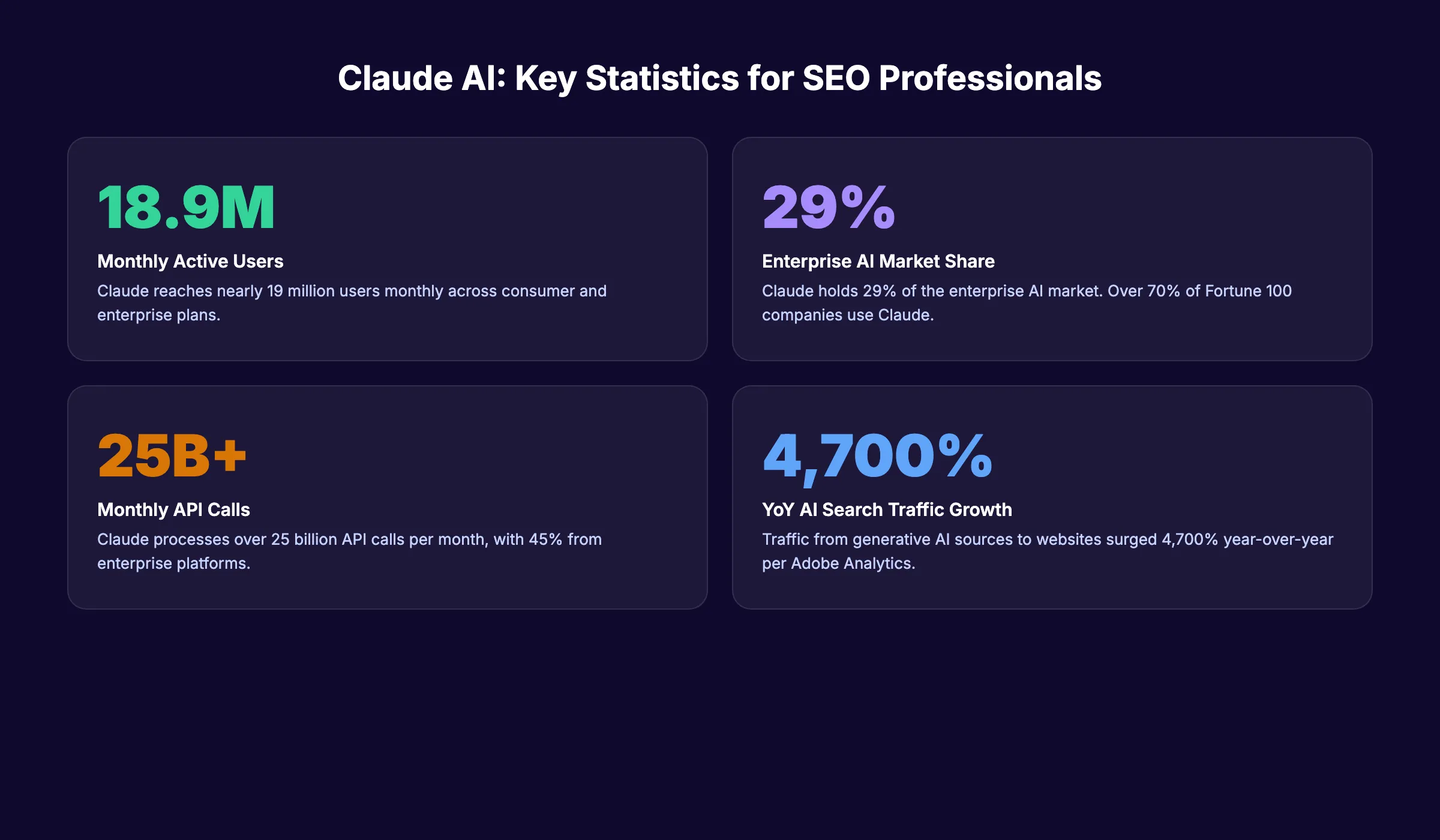
Most SEO professionals still optimize for one search engine. Google. But 18.9 million people now ask Claude for answers every month. Traffic from generative AI sources to websites grew 4,700% year-over-year according to Adobe Analytics.
Claude is not a toy for developers. It holds 29% of the enterprise AI market. Over 70% of Fortune 100 companies use it. And when Claude answers a question, it cites sources with inline links that drive real traffic.
If your content does not appear in Claude search results, you are invisible to a fast-growing audience.
In this guide, you will learn:
- How Claude search works and where it pulls sources from
- The 3 Anthropic bots you need to allow in your robots.txt
- Content formats Claude prefers to cite
- Technical setup for maximum Claude visibility
- How Claude search optimization differs from ChatGPT and Perplexity optimization
- A complete checklist to audit your site today
We publish 3,500+ blog posts across 70+ industries and track AI search visibility across every major platform. This guide covers everything we know about getting cited by Claude.
Table of Contents
- Chapter 1: What Is Claude and Why SEO Professionals Should Care
- Chapter 2: How Claude Search Works Under the Hood
- Chapter 3: Anthropic’s 3 Bots and Your robots.txt Strategy
- Chapter 4: How Claude Evaluates Source Quality
- Chapter 5: Content Formatting That Earns Claude Citations
- Chapter 6: Technical Optimization for Claude Search
- Chapter 7: Claude vs ChatGPT vs Perplexity Optimization
- Chapter 8: How to Check If Claude Cites Your Content
- Chapter 9: The Complete Claude Search Optimization Checklist
- FAQ
Chapter 1: What Is Claude and Why SEO Professionals Should Care {#ch1}
Claude is an AI assistant built by Anthropic. It processes text, answers questions, and now searches the web to ground its responses with real-time information. For SEO professionals, Claude represents a new answer engine that cites sources with clickable links.
Claude Is Not Just Another Chatbot
Claude processes over 25 billion API calls per month. 45% of those come from enterprise platforms. This is not a consumer novelty. It is infrastructure that businesses rely on for research, analysis, and decision-making.
The consumer numbers tell their own story. Claude reached 18.9 million monthly active users in early 2026. It logged 202.9 million website visits in January 2026 alone. Growth on the paid consumer side is accelerating faster than any competitor.
How Claude Differs from Google AI Overviews
Google AI Overviews appear above search results and pull from indexed pages. Claude operates differently. Users have a conversation. They ask follow-up questions. They refine their intent in real time.
This changes what “ranking” means. In Google, you need to rank for a specific query. In Claude, you need content that answers a broad topic well enough to be retrieved across dozens of related questions.
The Enterprise Factor Matters for SEO
Claude holds roughly 29% of the enterprise AI market. Anthropic’s enterprise revenue surpassed OpenAI’s by mid-2025, per Business of Apps. Decision-makers at Fortune 100 companies use Claude daily.
If you sell to enterprises, your audience is already asking Claude questions about your industry. The question is whether Claude cites your content or your competitor’s.
Chapter 2: How Claude Search Works Under the Hood {#ch2}
Understanding how Claude retrieves information is the foundation of Claude search optimization. Claude has two knowledge sources: its training data and live web search. The way it decides between them determines whether your content has a chance to appear.
Training Data vs Live Web Search
Claude’s training data has a knowledge cutoff. For questions about well-established facts, definitions, or historical topics, Claude answers from memory. It does not search the web for these.
For current events, recent statistics, product comparisons, and time-sensitive topics, Claude triggers its web search tool. This is where the opportunity exists. When Claude searches the web, it retrieves real pages, reads them, and cites them in its response.
The Search Pipeline
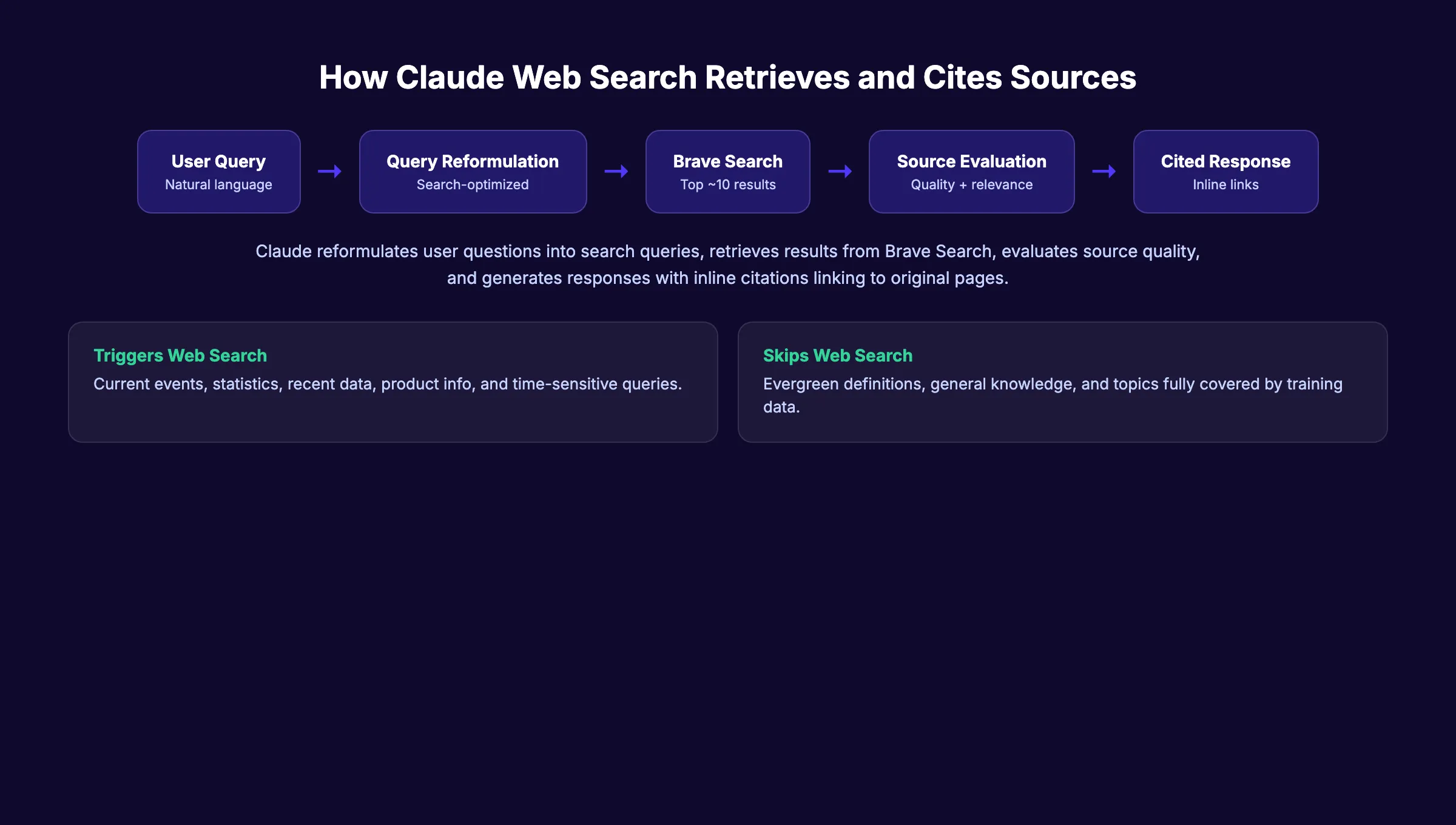
Claude follows a specific retrieval process:
- Query detection. Claude determines if the question needs current information
- Query reformulation. It converts the natural language question into a search-optimized query
- Source retrieval. It pulls approximately 10 results from its search index
- Content evaluation. It reads and assesses each source for quality and relevance
- Citation integration. It generates a response with inline links to the best sources
Brave Search Powers Claude
This is a detail most generative engine optimization guides miss. Claude’s web search runs on Brave Search, not Google or Bing. This has direct implications.
Your pages must be indexed by Brave to appear in Claude search results. Brave’s index works differently from Google’s. Content becomes eligible for Brave’s index when visited by at least 20 unique Brave browser users with data-sharing enabled. Enterprise sites with strong organic visibility typically meet this threshold passively.
But if your site is new or low-traffic, verify your Brave indexing status. Search for your domain on search.brave.com to confirm.
When Claude Skips Web Search
Claude does not search the web for every question. Evergreen definitions, general knowledge, and topics fully covered by training data get answered from memory. No web search means no citation opportunity.
The exception is when users explicitly request a web search. Phrases like “search the web for” or “find recent data on” force Claude to use its search tool regardless of query type.
Your content does not need to rank on Google to appear in Claude. Claude pulls from Brave Search, which has its own index and ranking signals. Start for $1 →
Chapter 3: Anthropic’s 3 Bots and Your robots.txt Strategy {#ch3}
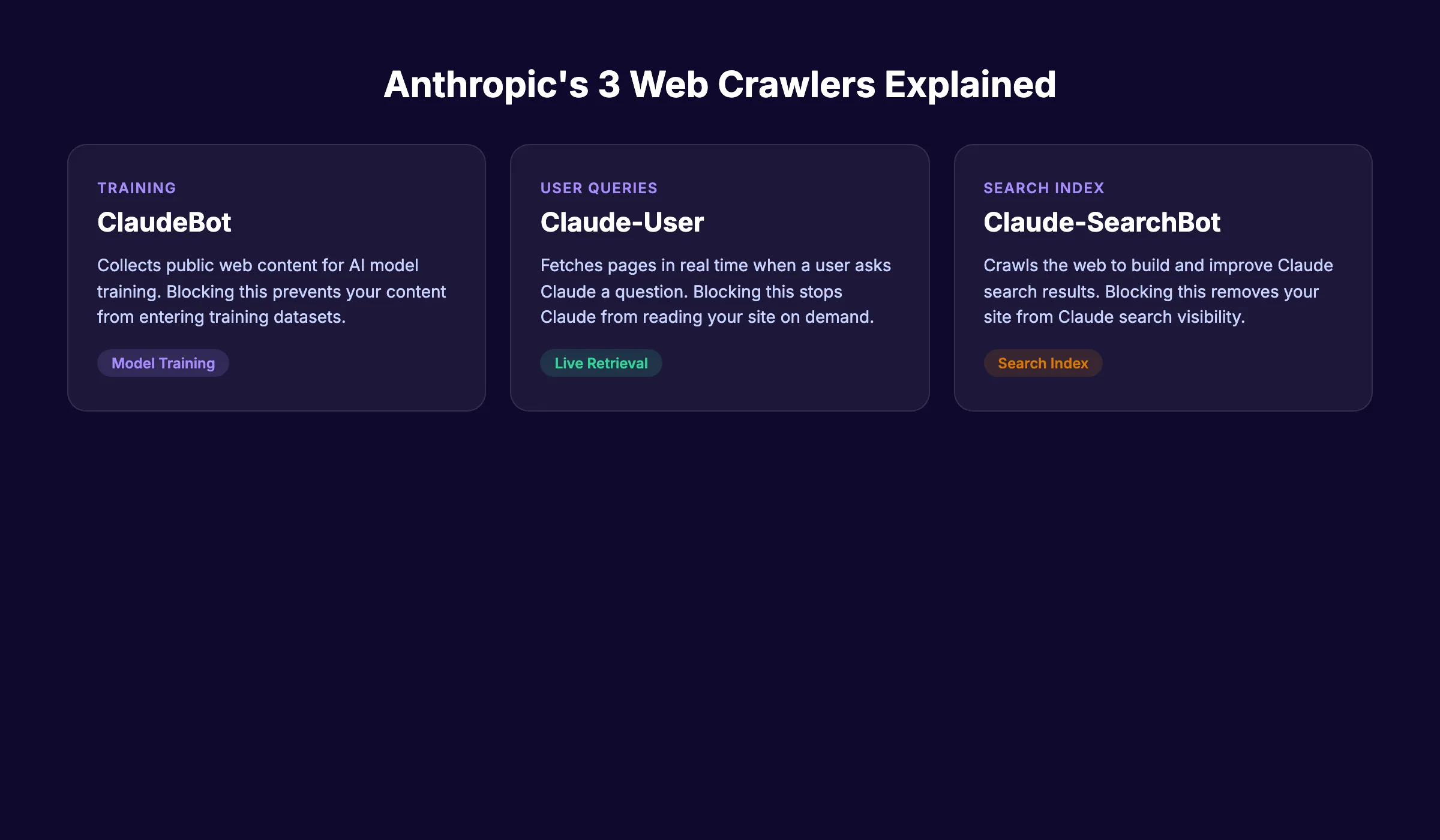
Anthropic operates 3 separate web crawlers. Each serves a different purpose. Each can be independently controlled through your robots.txt file. Getting this wrong means losing Claude visibility without realizing it.
ClaudeBot: Model Training
ClaudeBot collects public web content for training Anthropic’s AI models. Blocking ClaudeBot prevents your content from entering future training datasets. This does not affect search visibility directly, but it reduces the chance that Claude “knows” about your brand from training data.
Claude-User: Real-Time Retrieval
Claude-User fetches pages when a user asks Claude a question that requires web access. If someone asks Claude about your product and you block Claude-User, Claude cannot read your page. It will cite a competitor instead.
Claude-SearchBot: Search Index
Claude-SearchBot crawls the web to build and improve Claude search results. Blocking this bot removes your content from Claude’s search index entirely. This is the most damaging bot to block if you care about Claude search optimization.
The Critical Difference from Other AI Crawlers
All 3 of Anthropic’s bots respect robots.txt directives. This matters because other platforms are less transparent. OpenAI warns that robots.txt rules may not apply to ChatGPT-User. Perplexity’s user-initiated fetcher largely ignores robots.txt.
Anthropic gives you granular control. You can allow search indexing while blocking training data collection. You can permit real-time retrieval while restricting the search crawler. Each decision is independent.
Recommended robots.txt Configuration
For maximum Claude search optimization visibility:
User-agent: ClaudeBot
Allow: /

User-agent: Claude-User
Allow: /

User-agent: Claude-SearchBot
Allow: /
If you want to block training but allow search:
User-agent: ClaudeBot
Disallow: /

User-agent: Claude-User
Allow: /

User-agent: Claude-SearchBot
Allow: /
Read our full guide on how to optimize your robots.txt file for all AI crawlers, including GPTBot, Googlebot, and PerplexityBot.
Chapter 4: How Claude Evaluates Source Quality {#ch4}
Claude does not cite every page it retrieves. It evaluates sources through a multi-layered quality framework before deciding what to reference. Understanding this framework is the core of Claude search optimization.
Topical Relevance
Claude measures how precisely your content addresses the user’s query. A page about “SEO tools” will not get cited for a question about “local SEO for dentists.” Specificity wins. Pages that address narrow, well-defined topics earn more citations than broad overviews.
This is why building topical authority across a content cluster matters for AI visibility. A single page rarely covers enough depth. A cluster of 20 related articles signals to Claude that your site is an authority on the topic.
E-E-A-T Signals
Claude evaluates Experience, Expertise, Authoritativeness, and Trustworthiness in ways that mirror Google’s quality guidelines. But Claude does it through content analysis, not through backlink counts or domain ratings.
Claude looks for:
- Author expertise indicators in the content itself
- Cross-reference consistency with other authoritative sources
- Depth of analysis beyond surface-level explanations
- Primary source data that cannot be found elsewhere
Factual Accuracy
Claude will not cite content containing errors or misleading claims. It cross-references retrieved sources against each other and against its training data. Pages with inaccurate statistics, outdated information, or unverifiable claims get filtered out.
This is where many sites fail. A blog post that says “Google processes 8.5 billion searches per day” without a source will not earn a citation. A blog post that says “Google processes 8.5 billion searches per day according to Internet Live Stats” has a better chance.
Content Extractability
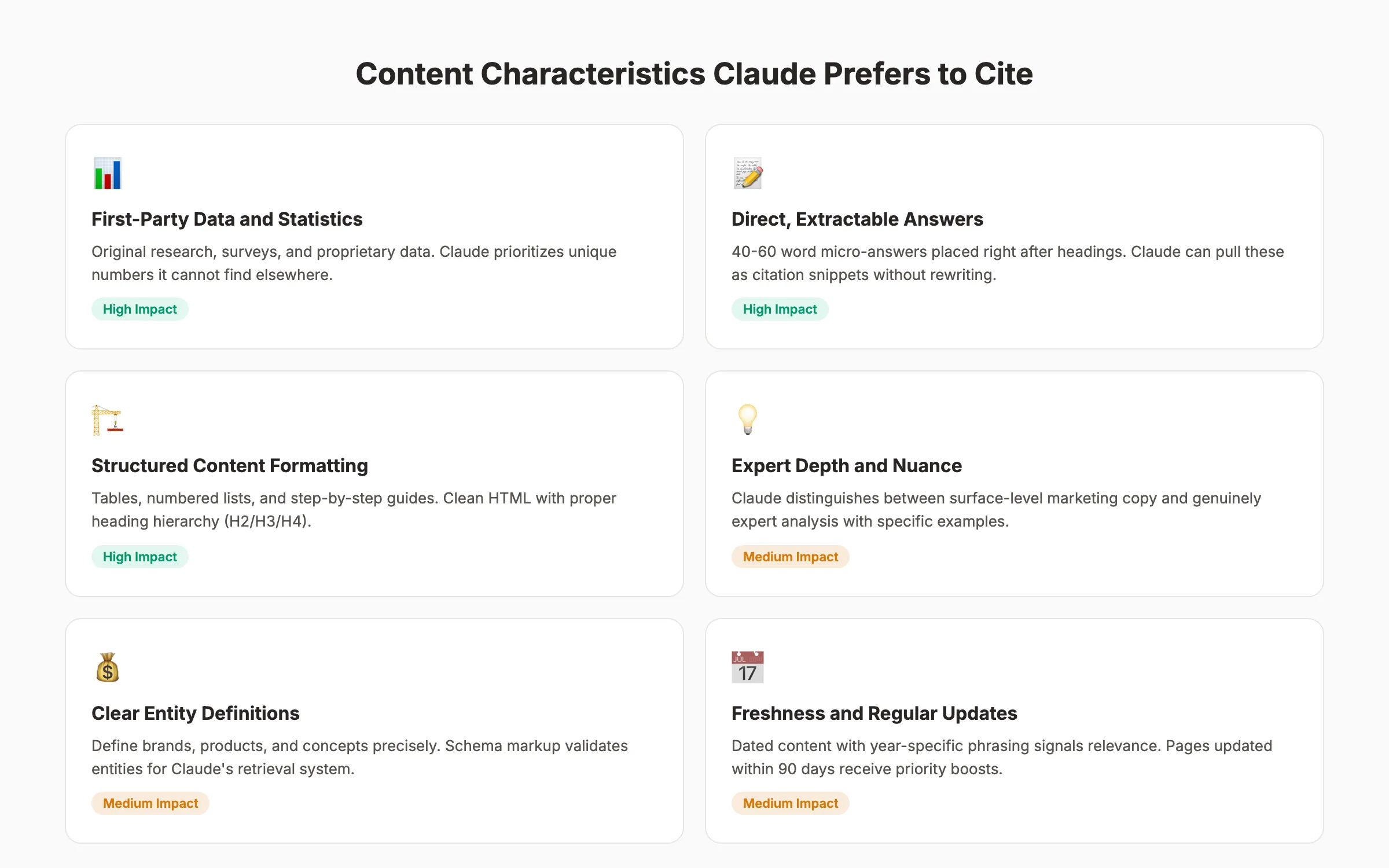
Claude favors content it can extract cleanly. Short, direct answers placed right after headings. Tables with clear column labels. Numbered steps with concise descriptions.
The concept is called “extractability.” Claude needs to pull a snippet from your page and present it in its response without extensive rewriting. Pages structured for easy extraction get cited more often than pages written in flowing narrative prose.
92% average SEO score across 3,500+ published articles. We build the content authority signals Claude looks for, on autopilot. Start for $1 →
Chapter 5: Content Formatting That Earns Claude Citations {#ch5}
Claude does not read pages the way humans do. It processes structure, identifies answer patterns, and extracts the most relevant sections. Formatting your content for Claude citation readiness is a discipline with specific rules.
The Answer-First Model
Place a 40 to 60 word direct answer immediately after each H2 heading. Claude can pull this as a citation snippet without rewriting.
Bad approach:
“There are many factors that influence how businesses approach their online presence. One of the most important considerations is…”
Good approach:
“Claude search optimization is the practice of formatting and structuring web content so Claude AI cites it in search responses. It combines technical crawl access, content extractability, and entity authority signals.”
The direct answer satisfies Claude’s retrieval system. The paragraphs that follow provide supporting depth.
Question-Based Headings
Match your H2 and H3 headings to the conversational queries users ask Claude. Claude reformulates user questions into search queries. Pages with headings that mirror those queries rank higher in Claude’s retrieval.
| Weak Heading | Strong Heading |
|---|---|
| Our Approach | How Does Claude Search Optimization Work? |
| Key Features | What Content Does Claude Prefer to Cite? |
| Getting Started | How Do You Set Up Your Site for Claude Search? |
Tables for Comparisons and Data
Claude excels at extracting tabular data. Every comparison, feature list, or data set should be in a table, not in paragraph form. Our AI citability score guide covers this in depth.
| Format | Claude Citation Probability | Why |
|---|---|---|
| Tables | High | Easy to extract, structured data |
| Numbered lists | High | Clear sequential information |
| FAQ sections | High | Direct question-answer pairs |
| Short paragraphs | Medium | Depends on answer placement |
| Long narrative | Low | Difficult to extract cleanly |
FAQ Sections at the End
Add 4 to 6 FAQ items to every page. Use the exact questions your audience asks. Claude retrieves FAQ sections frequently because they match the question-answer format of user interactions.
Use proper markup. Each question as a bold heading. Each answer as a concise paragraph of 40 to 80 words. Our AI citation readiness checklist provides a full audit framework.
Statistics and Data Points
Claude prioritizes pages with specific, sourced numbers. Vague claims like “most businesses struggle with SEO” earn zero citations. Specific claims like “68% of online experiences begin with a search engine according to BrightEdge” give Claude something concrete to reference.
Include at least 3 cited statistics per 1,000 words. Link to the original source for each.
Chapter 6: Technical Optimization for Claude Search {#ch6}
Content quality gets you cited. Technical setup determines whether Claude can find and read your content in the first place. Both sides must work together for effective Claude search optimization.
Schema Markup as Entity Validation
Claude uses structured data to validate entities. JSON-LD schema markup tells Claude what your page is about, who wrote it, and what type of content it contains.
Priority schemas for Claude optimization:
- Article. Establishes content type, author, and publish date
- FAQPage. Marks up question-answer pairs for direct extraction
- HowTo. Structures step-by-step content for process queries
- Organization. Defines your brand entity and relationships
The Role of llms.txt
An llms.txt file provides AI systems with structured information about your site. It describes your content organization, priority pages, and citation preferences.
Adoption of llms.txt is still early. Major AI platforms have not formally committed to recognizing it as a standard. But it acts as a useful signal. Setting one up takes 10 minutes and has zero downside. Read our step-by-step guide on how to create llms.txt.
Semantic HTML and Clean Structure
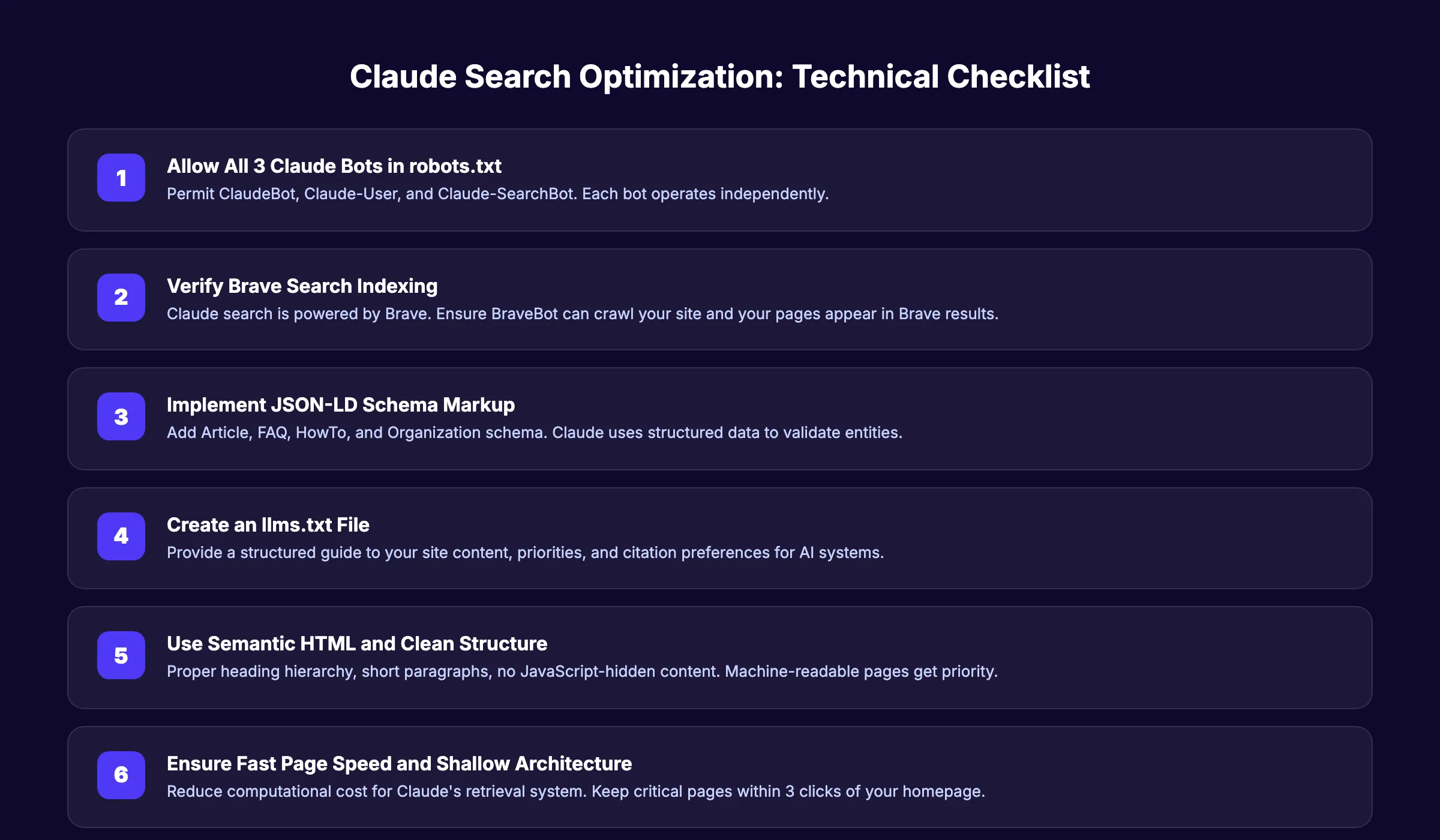
Claude’s retrieval system processes HTML. Complex JavaScript that hides content, excessive ads that break layouts, and client-side rendering that produces empty HTML all reduce your chances of being cited.
Use proper heading hierarchy. H1 for the title. H2 for chapters. H3 for subsections. No skipping levels. No headings used for styling purposes.
Short paragraphs of 2 to 4 sentences maximum. Each paragraph should communicate one idea. Claude reads and evaluates content in chunks. Shorter chunks are easier to assess and extract.
Page Speed and Architecture
Claude’s retrieval system has computational costs. Pages that load quickly and serve clean HTML reduce that cost. Fast pages get preferred over slow pages that contain equivalent content.
Keep critical pages within 3 clicks of your homepage. A shallow site architecture enables quick crawl access for Claude-SearchBot.
Brave Search Indexing
Since Claude search runs on Brave, your pages need to appear in Brave’s index. Most established sites with organic traffic get indexed automatically. New or low-authority sites may need to build visibility through consistent publishing and external links.
Search for your most important pages on search.brave.com. If they do not appear, your Claude search optimization work will have zero impact regardless of content quality.
Stacc publishes 30 to 80 SEO articles per month for every client. That consistent output builds the authority signals both Google and Claude reward. Start for $1 →
Chapter 7: Claude vs ChatGPT vs Perplexity. What to Optimize Differently {#ch7}
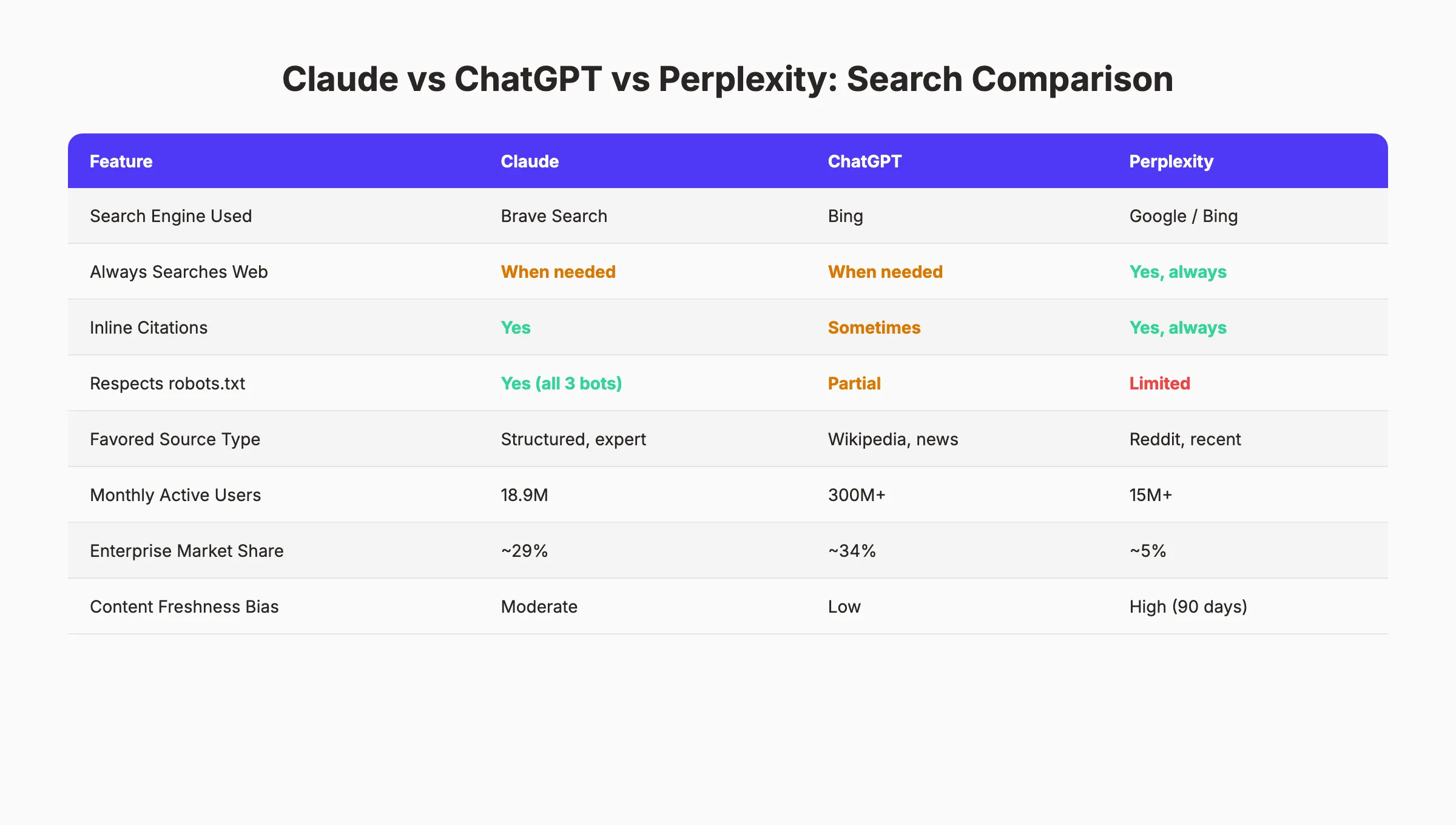
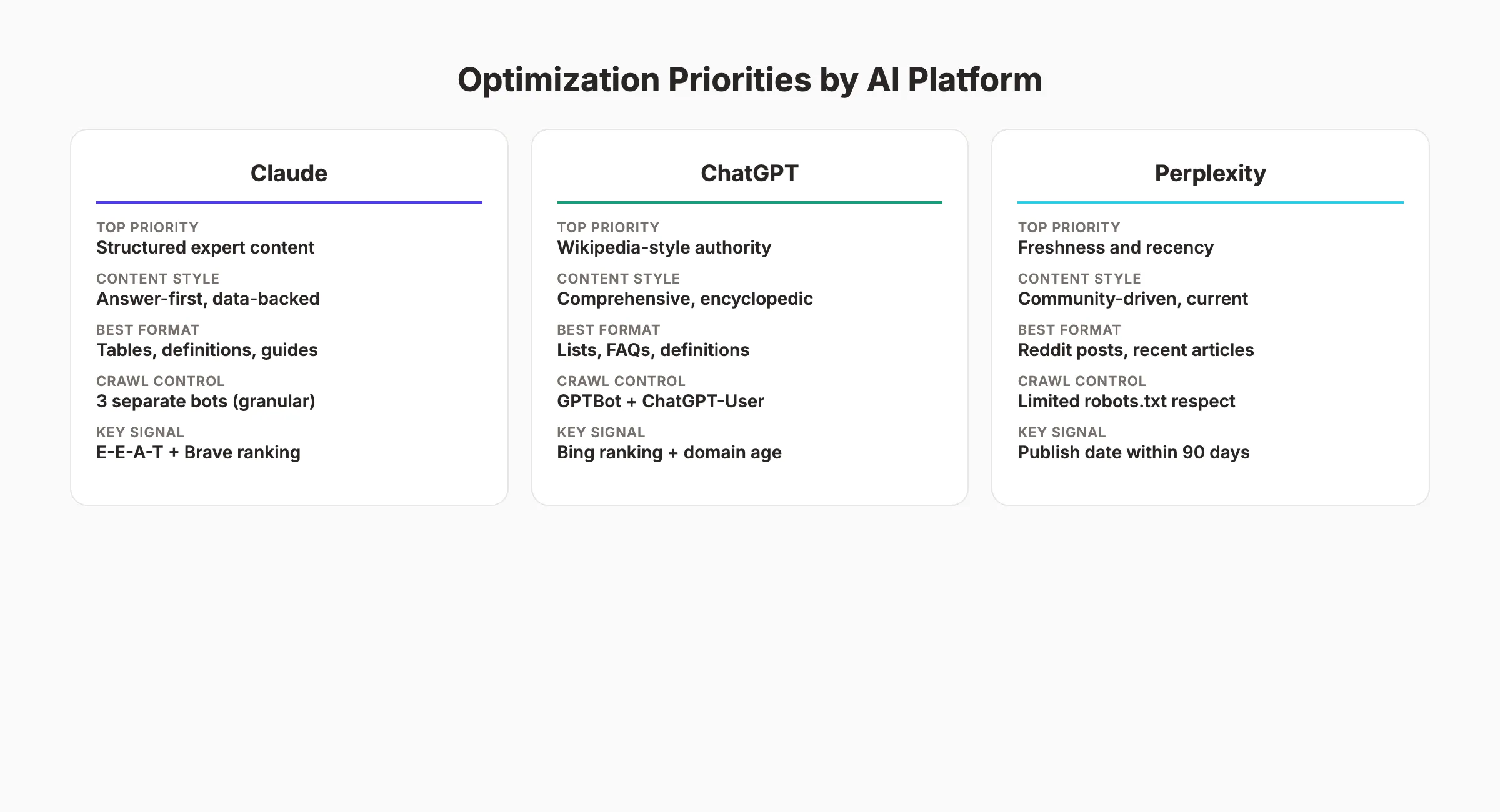
Each AI platform processes and cites content differently. A strategy that works for Claude may fail on ChatGPT or Perplexity. Here is what changes across the 3 major platforms. For a deeper dive, read our guide on GEO vs SEO and how AI search engines choose sources.
Claude: Structured Expert Content
Claude uses Brave Search. It favors well-structured pages with clear headings, direct answers, and evidence-backed claims. Claude synthesizes information rather than quoting directly. It prefers longer, coherent passages with logical flow.
Your priority for Claude: answer-first formatting, JSON-LD schema, and topical depth across a content cluster.
ChatGPT: Wikipedia-Style Authority
ChatGPT uses Bing for web search. Research shows Wikipedia accounts for 47.9% of ChatGPT’s most-cited sources. News sites and educational resources follow. ChatGPT favors encyclopedic content and often lifts bullet points and FAQs verbatim.
Your priority for ChatGPT: thorough definitions, bullet-point formatting, and Bing indexation. Our ChatGPT vs Claude for SEO comparison covers the full breakdown.
Perplexity: Freshness Above All
Perplexity shows the strongest citation behavior of any AI platform. It always searches the web. Its citation patterns skew heavily toward Reddit (46.7% of top sources) and content published within the past 90 days.
Your priority for Perplexity: recent publish dates, community engagement on Reddit, and time-stamped data.
What Works Across All 3 Platforms
Some signals matter everywhere:
| Signal | Claude | ChatGPT | Perplexity |
|---|---|---|---|
| Clear, specific answers | Yes | Yes | Yes |
| Structured data / schema | Yes | Partial | Minimal |
| Cited statistics | Yes | Yes | Yes |
| Consistent publishing | Yes | Yes | Yes |
| First-party data | High priority | Medium priority | Medium priority |
| robots.txt compliance | Full respect | Partial | Limited |
The common thread is quality. All 3 platforms prefer content that provides specific, verifiable, well-structured answers. The generative engine optimization guide covers cross-platform strategy in full detail.
Chapter 8: How to Check If Claude Cites Your Content {#ch8}
You cannot optimize what you do not measure. Checking whether Claude recommends or cites your content requires a different approach than checking Google rankings.
Manual Testing
The most reliable method is direct testing. Open Claude (claude.ai) with a paid plan that includes web search. Ask questions your target audience would ask. Look for your domain in the inline citations.
Test at least 10 to 15 queries per topic area. Claude responses vary based on query phrasing, timing, and context. A single test gives an incomplete picture.
Brand Entity Queries
Ask Claude directly about your brand. “What is [Brand Name]?” and “Tell me about [Brand Name] and what they do.” Claude’s response reveals how it perceives your brand entity.
If Claude provides inaccurate information about your brand, you have an entity problem. The fix involves consistent brand definitions across your website, schema markup, and third-party mentions.
Track Referral Traffic
Claude includes clickable links in its responses. When users click those links, they arrive on your site. Check your analytics for referral traffic from claude.ai or anthropic.com domains.
Google Analytics 4 can track this. Create a custom segment for referral traffic from AI platforms. Our guide on how to track AI search visibility walks through the full setup.
Third-Party Monitoring Tools
Several tools now track AI search citations. They query multiple AI platforms with target keywords and log when your domain appears in responses. This is the most scalable approach for ongoing monitoring.
| Method | Scalability | Cost | Accuracy |
|---|---|---|---|
| Manual Claude testing | Low | Free | High |
| Analytics referral tracking | Medium | Free | Medium |
| Third-party citation tools | High | Paid | Medium-High |
Entity Clustering and Recognition
Claude builds entity models. It connects your brand to topics, products, and industry categories. The more consistently you define your entity across your site and external platforms, the more likely Claude is to recognize and cite you.
Read our guide on entity clustering for SEO for a deep framework on building entity signals that AI platforms recognize.
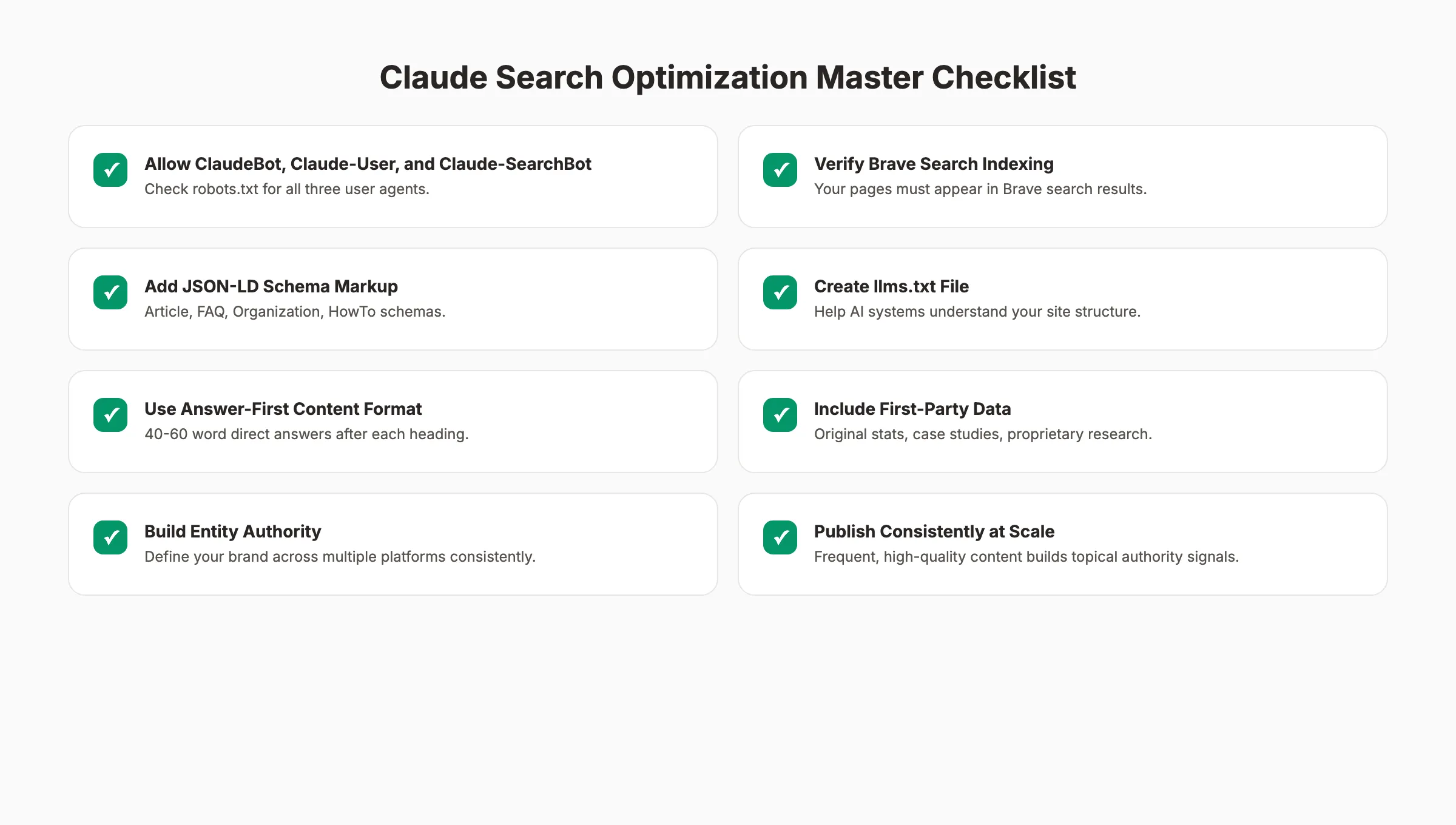
Chapter 9: The Complete Claude Search Optimization Checklist {#ch9}
Use this checklist to audit your site for Claude search readiness. Check each item. Fix gaps in order of priority from top to bottom.
Technical Setup
- Allow ClaudeBot in robots.txt
- Allow Claude-User in robots.txt
- Allow Claude-SearchBot in robots.txt
- Allow BraveBot in robots.txt
- Verify pages appear in Brave Search results
- Implement Article schema (JSON-LD) on content pages
- Implement FAQPage schema on pages with FAQ sections
- Implement Organization schema on your homepage
- Create an llms.txt file in your root directory
- Ensure pages render without JavaScript dependency
- Achieve page load time under 3 seconds
Content Formatting
- Place 40 to 60 word direct answers after each H2
- Use question-based H2 and H3 headings
- Include at least 2 tables per content page
- Add FAQ section with 4 to 6 questions at the end
- Include 3+ cited statistics per 1,000 words
- Keep paragraphs to 2 to 4 sentences maximum
- Use semantic HTML with proper heading hierarchy
Authority Signals
- Publish consistently (20+ articles per month for fastest results)
- Build topical clusters around core topics
- Include first-party data and original research
- Define your brand entity in schema and on-page content
- Maintain consistent brand information across all platforms
- Earn mentions and citations from authoritative external sources
Monitoring
- Test 10 to 15 queries weekly on Claude with web search enabled
- Track referral traffic from claude.ai in analytics
- Monitor brand entity accuracy in Claude responses
- Compare citation rates against competitors
Stacc handles the entire content pipeline. 30 to 80 articles per month, published on autopilot, built for both Google and AI search visibility. Start for $1 →
FAQ {#faq}
What is Claude search optimization?
Claude search optimization is the practice of structuring and formatting web content so Anthropic’s Claude AI cites it in search responses. It combines technical setup (robots.txt, schema, Brave indexing), content formatting (answer-first structure, tables, FAQ sections), and authority signals (consistent publishing, topical depth, entity definition). The goal is to appear as a cited source when Claude users ask questions about your topics.
Does Claude use Google to search the web?
No. Claude web search is powered by Brave Search. Your pages must be indexed by Brave, not just Google, to appear in Claude search results. Most sites with established organic traffic get indexed automatically. New sites should verify their Brave indexing by searching for their domain on search.brave.com.
Can I block Claude from crawling my site but still appear in Claude search?
It depends on which bot you block. Anthropic operates 3 bots. Blocking ClaudeBot only stops training data collection. Blocking Claude-SearchBot removes you from Claude’s search index. Blocking Claude-User prevents Claude from reading your pages in real time. For maximum visibility, allow all 3 bots.
How is Claude search optimization different from regular SEO?
Traditional SEO focuses on Google rankings through backlinks, keyword density, and technical crawlability. Claude search optimization focuses on content extractability, answer-first formatting, entity authority, and Brave Search indexation. The two strategies overlap on quality content, but the technical requirements and ranking signals differ.
How do I check if Claude cites my website?
Test manually by asking Claude questions with web search enabled. Track referral traffic from claude.ai in your analytics. Use third-party AI citation monitoring tools for scalable tracking. Ask Claude directly about your brand to see how it represents your entity.
Does publishing more content help with Claude citations?
Yes. Consistent, high-quality publishing builds topical authority signals that Claude values. Sites with deep content clusters across a topic area earn more citations than sites with isolated articles. Publishing 20 to 30 articles per month on related topics creates the authority foundation that makes individual pages more likely to be cited.
AI search is not a future trend. It is a current channel that 18.9 million people use every month. Claude search optimization gives your content a presence in that channel. Start with the technical checklist, format your content for extractability, and publish at a pace that builds real authority.
Your SEO team. $99/month. Stacc publishes the content that Google and Claude both reward. Start for $1 →

Written by
Siddharth GangalSiddharth is the founder of theStacc and Arka360, and a graduate of IIT Mandi. He spent years watching great businesses lose organic traffic to competitors who simply published more. So he built a system to fix that. He writes about SEO, content at scale, and the tactics that actually move rankings.
30 SEO blog articles published every month
Keyword-optimized, scheduled, and live on your site. Automatically.
30-day trial · Cancel anytime
theStacc
Stop writing SEO content manually
30 blog articles, 30 GBP posts, and social media content. Published every month. Automatically.
Try for free$1 for 3 days · Cancel anytime