
Cross-Platform GEO (2026): Strategies, Tactics & Examples
cross platform geo guide for 2026: strategies, tactics, real examples, and implementation steps to get results faster.
You rank on page 1 of Google. Your traffic is still declining. The reason is that AI search engines now answer the queries your pages used to win. And each AI platform pulls content from different sources, using different ranking signals.
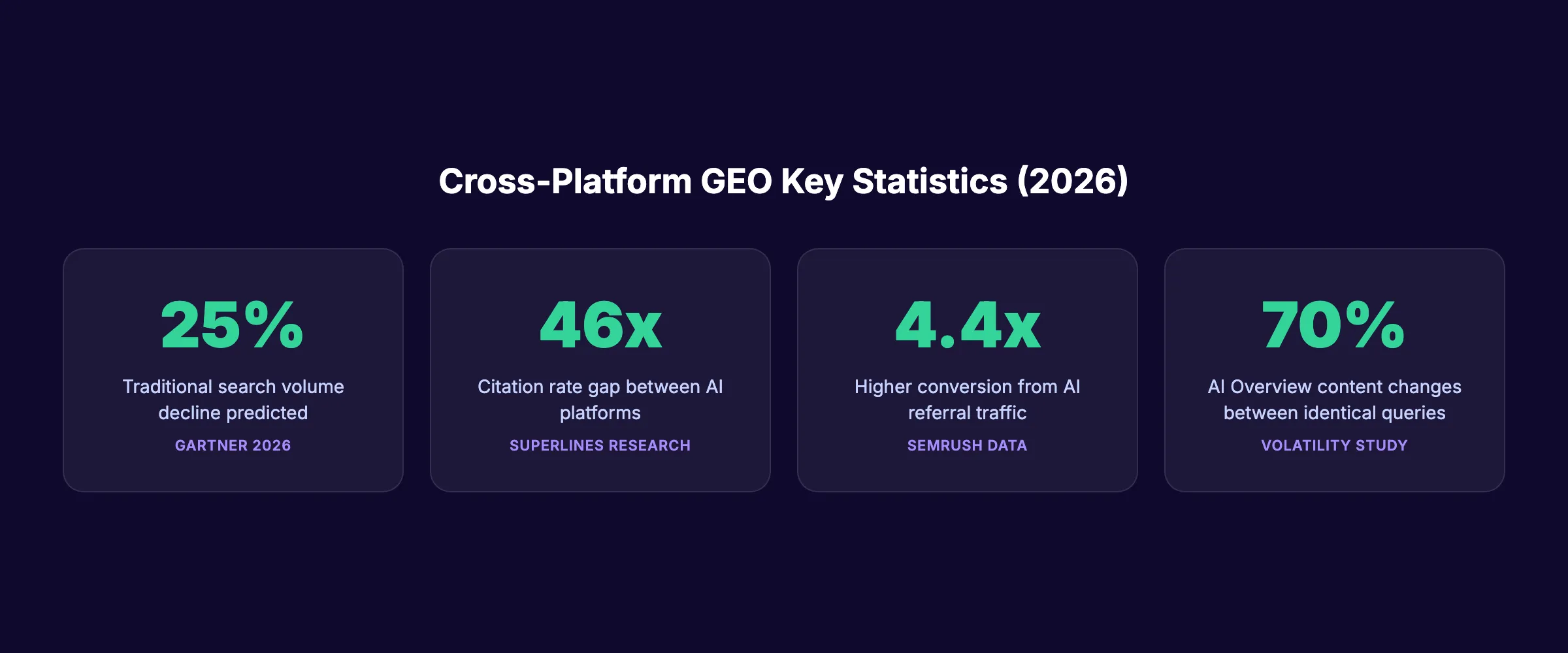
Gartner predicts traditional search volume will drop 25% by the end of 2026. ChatGPT reaches 900 million weekly users. Google AI Overviews appear on 25% of searches. Perplexity processes 780 million queries per month. Optimizing for just one of these platforms leaves you invisible on the rest.
Cross-platform GEO is the practice of optimizing your content to get cited in AI-generated answers across all major AI search engines simultaneously. Not just Google. Not just ChatGPT. All of them.
We publish 3,500+ blog posts across 70+ industries with a 92% average SEO score. We optimize every piece for both traditional search and AI visibility across 6 platforms. This guide covers everything we know about cross-platform GEO.
Here is what you will learn:
- What cross-platform GEO is and why single-platform optimization fails
- How Google AI Overviews, ChatGPT, Perplexity, Claude, Gemini, and Copilot each source content differently
- Platform-specific optimization strategies for each AI search engine
- Content formatting patterns that maximize citation rates across all platforms
- The technical layer: llms.txt, AI crawlers, schema markup, and robots.txt
- How to measure GEO success when rankings do not exist in AI search
- The 6 most common cross-platform GEO mistakes and how to fix them
Table of Contents
- Chapter 1: What Is Cross-Platform GEO?
- Chapter 2: How Cross-Platform GEO Differs From Traditional SEO
- Chapter 3: How Each AI Platform Sources and Cites Content
- Chapter 4: Platform-Specific Optimization Strategies
- Chapter 5: Content Formatting for Maximum AI Citability
- Chapter 6: Structured Data, Schema, and Entity Optimization
- Chapter 7: Technical Access. Llms.txt, AI Crawlers, and robots.txt
- Chapter 8: Brand Authority Signals AI Models Use
- Chapter 9: Measuring Cross-Platform GEO Success
- Chapter 10: Cross-Platform GEO Mistakes to Avoid
- FAQ
Chapter 1: What Is Cross-Platform GEO? {#ch1}
Generative engine optimization (GEO) is the practice of making your content citable by AI search engines. Cross-platform GEO extends that concept across every major AI platform at once. The goal is not a number 1 ranking. It is a high mention rate across ChatGPT, Perplexity, Google AI Overviews, Claude, Gemini, and Bing Copilot.
Why “Cross-Platform” Changes Everything
A Superlines analysis of 34,234 AI responses found a 46x difference in citation rates between AI platforms. Perplexity cites brands at a 13.05% rate. ChatGPT cites them at 0.59%. Gemini sits at 6.38%.
That gap means optimizing for one platform guarantees nothing on the others. Each AI engine uses different retrieval pipelines, different source signals, and different content preferences. A page that Perplexity cites 10 times may never appear in a ChatGPT response.
Cross-platform GEO accounts for these differences. Instead of chasing visibility on a single platform, you build content properties that satisfy the shared requirements of all AI engines while also hitting platform-specific triggers.
The Mention Rate Model
Traditional SEO operates on position. You rank number 3 or number 7. AI search does not work that way.
There is no fixed ranking in ChatGPT. No “position 1” in Perplexity. AI visibility is a mention rate. How often your brand appears across many responses to many prompts. The same query entered twice may produce different cited sources. Only 30% of brands remain visible in back-to-back responses to identical queries.
Cross-platform GEO is about building consistent mention rates across all 6 platforms. That requires a strategy that covers content structure, technical access, authority signals, and content freshness.
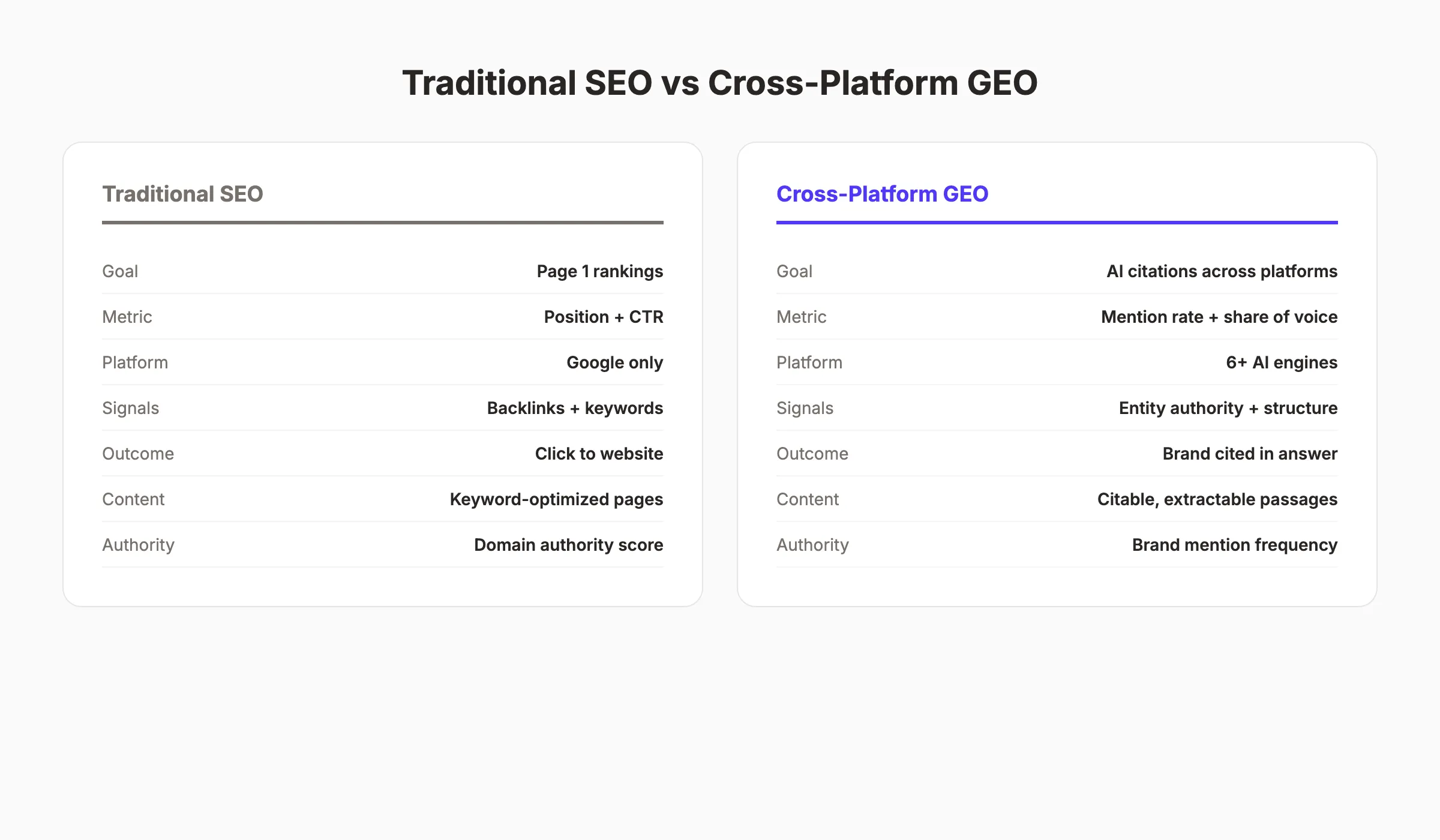
Chapter 2: How Cross-Platform GEO Differs From Traditional SEO {#ch2}
GEO and SEO share a foundation: create useful content that search systems can find and trust. The differences are in the signals, the output, and the measurement.
Different Signals
Traditional SEO depends heavily on backlinks, keyword placement, and domain authority. GEO depends on entity authority, content structure, brand mentions, and freshness.
The Princeton GEO research tested 9 optimization methods across 10,000 queries. Keyword stuffing produced near-zero improvement in AI visibility. But adding statistics, quotations, and authoritative citations boosted visibility by up to 40%.
| Signal | Traditional SEO | Cross-Platform GEO |
|---|---|---|
| Primary ranking factor | Backlinks | Entity authority + mentions |
| Content format | Keyword-optimized | Extractable passages |
| Measurement | Position tracking | Mention rate + citation share |
| Platform count | 1 (Google) | 6+ AI engines |
| Update cadence | Quarterly | Within 90 days or citations drop |
| Third-party value | Link equity | Brand mention frequency |
| User behavior | Click to website | Answer consumed in AI |
Different Output
When you win at SEO, users click your blue link. When you win at cross-platform GEO, your brand gets cited inside the AI answer. 93% of AI search sessions end without a click to any website. The value is in the citation itself. Brand visibility, trust transfer, and the traffic that does come through.
That traffic converts. AI referral visitors convert 4.4x higher than organic search visitors. The volume is smaller. The quality is much higher.
What Stays the Same
Strong E-E-A-T signals still matter. Content depth matters. Technical accessibility matters. Cross-platform GEO does not replace SEO. It adds a new layer on top.
The overlap between top Google links and AI-cited sources has dropped from 70% to below 20%. Ranking on Google no longer guarantees AI visibility. But the foundational work of creating authoritative, well-structured content serves both goals.
Cross-platform GEO compounds with traditional SEO. Every article optimized for AI citability also performs better in organic search. Start for $1 →
Chapter 3: How Each AI Platform Sources and Cites Content {#ch3}
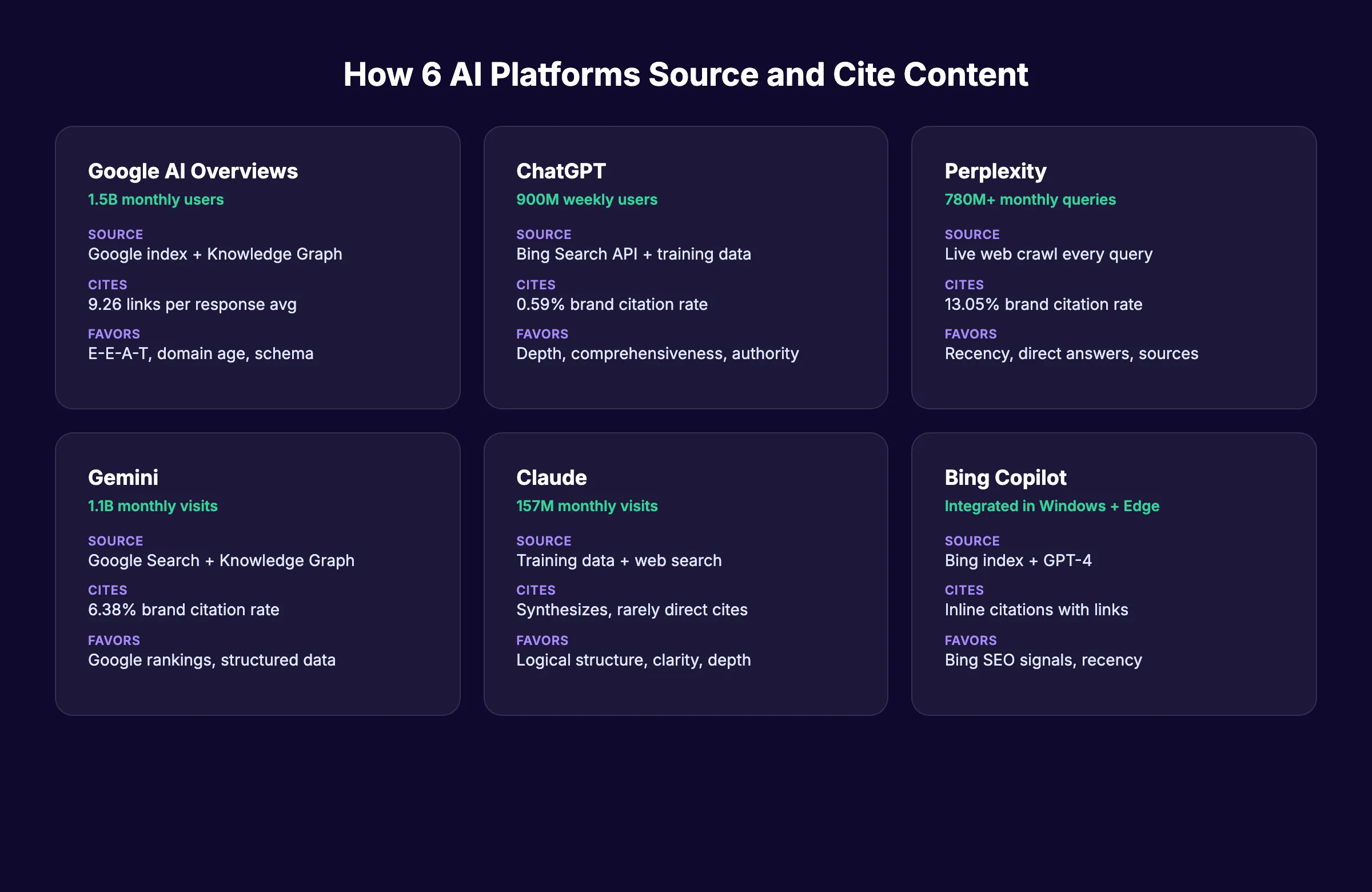
Every AI search engine retrieves content differently. Understanding each pipeline is the foundation of a cross-platform GEO strategy. Here is how the 6 major platforms work.
Google AI Overviews
Google AI Overviews pull from Google’s own search index and Knowledge Graph. They now appear on 25% of all searches and reach 1.5 billion monthly users. The average AI Overview cites 9.26 sources.
Google AI Overviews favor pages with strong organic rankings, but the correlation is weaker than most assume. Only 38% of AI Overview citations come from top-10 ranking pages. Domain age matters , 49.21% of cited domains are over 15 years old.
ChatGPT
ChatGPT uses the Bing Search API for real-time web queries. 92% of ChatGPT agent queries go through Bing. Wikipedia accounts for nearly half of its top-cited sources.
ChatGPT has the lowest brand citation rate of any major platform at 0.59%. It favors complete, well-sourced content with clear expertise signals. Getting cited in ChatGPT requires depth, not keyword optimization.
Perplexity
Perplexity searches the live web for every single query. It does not rely on a cached index. That makes it the most citation-heavy AI platform, with a 13.05% brand citation rate.
Perplexity has a strong recency bias. 46.7% of its top citations come from Reddit. It favors transparent sourcing, direct answers, and content published or updated within the last 90 days.
Gemini
Gemini uses Google Search and the Knowledge Graph. It grew 157% between April and September 2025, reaching 1.1 billion monthly visits. Its citation rate sits at 6.38%.
Gemini benefits from strong Google SEO performance. Pages that rank well in Google organic results have a higher probability of citation in Gemini responses. Structured data and Knowledge Graph entities carry extra weight.
Claude
Claude uses training data and optional web search. It synthesizes information rather than quoting directly. Direct citation rates are near zero in most analyses.
Claude favors well-structured, logical content with clear reasoning. Getting your content into Claude’s training data requires consistent publishing, broad web presence, and content that third-party sources reference.
Bing Copilot
Bing Copilot runs on GPT-4 with access to the Bing index. It provides inline citations with clickable links. Bing SEO signals. Domain authority in Bing, content freshness, structured data. Determine visibility.
| Platform | Source Pipeline | Citation Rate | Key Differentiator |
|---|---|---|---|
| Google AI Overviews | Google index + Knowledge Graph | High volume (9.26 avg) | Organic rank correlation |
| ChatGPT | Bing Search API | 0.59% | Depth and completeness |
| Perplexity | Live web crawl | 13.05% | Recency and source transparency |
| Gemini | Google Search + Knowledge Graph | 6.38% | Google SEO signal carryover |
| Claude | Training data + web search | Near zero direct | Logical structure and synthesis |
| Bing Copilot | Bing index + GPT-4 | Inline citations | Bing SEO signals |
Chapter 4: Platform-Specific Optimization Strategies {#ch4}
A cross-platform GEO strategy starts with universal optimization. Then you add platform-specific adjustments for each AI engine.
Universal Cross-Platform GEO Fundamentals
These tactics improve visibility across all 6 platforms:
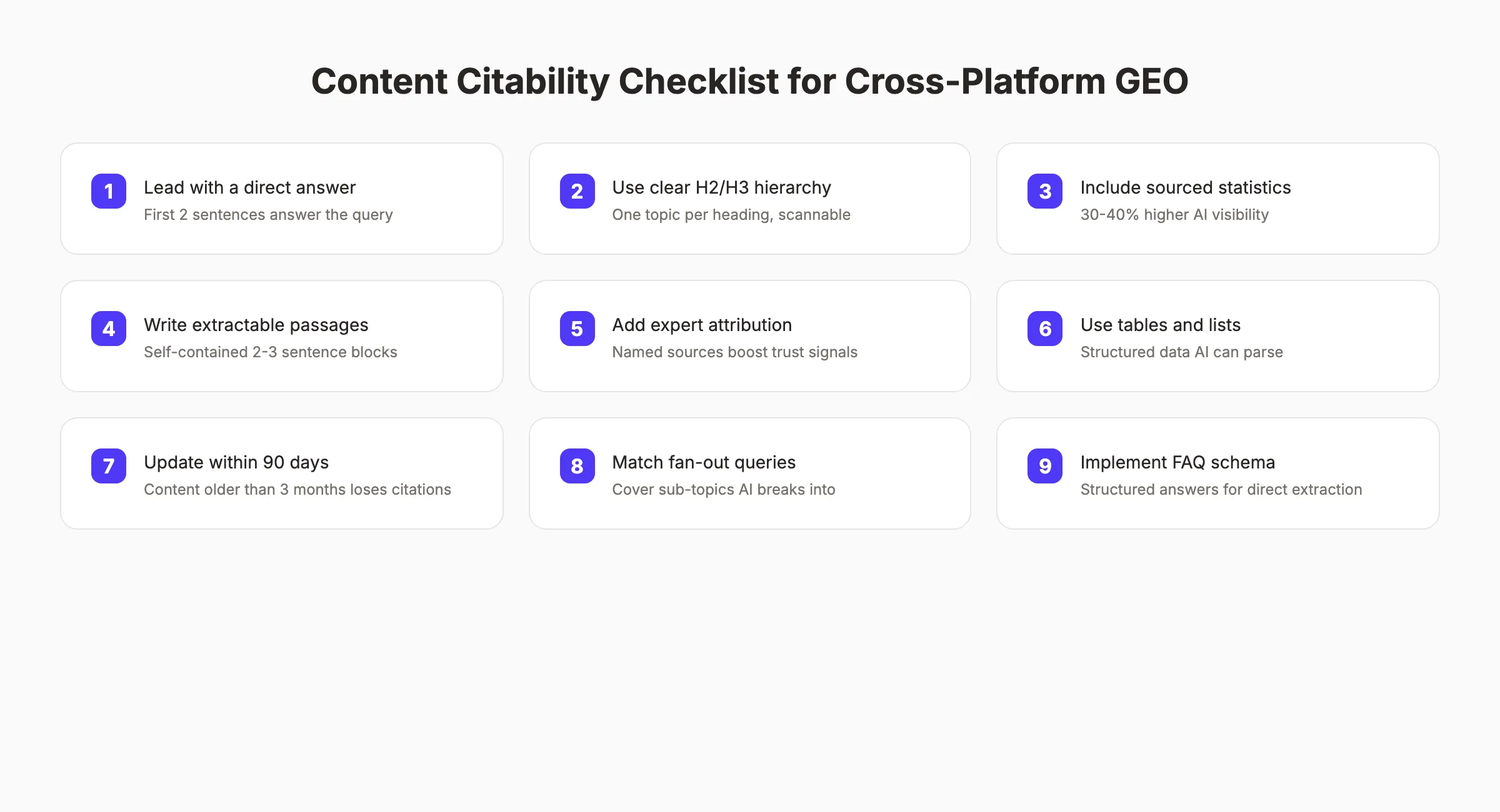
- Lead every major section with a direct, extractable answer
- Use clear H2/H3 heading hierarchy with one topic per heading
- Include sourced statistics with links to original data
- Write self-contained passages that stand alone when extracted
- Update content within 90 days to maintain freshness signals
- Implement FAQ schema for question-answer pairs
Google AI Overviews Strategy
Google AI Overviews correlate more closely with traditional SEO signals than any other platform. Your strategy here reinforces your organic rankings.
Focus on E-E-A-T signals. Add author bios with verifiable credentials. Implement Article, Organization, and FAQ schema. Target featured snippet formats. Definition boxes, numbered lists, and comparison tables. Google AI Overviews pull heavily from pages already earning featured snippets.
ChatGPT Strategy
ChatGPT favors the most complete source on a topic. Pages that answer “what is it,” “who uses it,” “how to choose,” and “pricing” in a single URL earn the most citations.
The top 4.8% of cited URLs in ChatGPT are cited 10+ times. These are deep, authoritative pages. Thin content does not get cited. Build pillar pages that cover a topic exhaustively. Ensure your site is accessible to GPTBot in your robots.txt.
Perplexity Strategy
Perplexity rewards recency above everything. Content updated within the last 2 months earns an average of 5.0 citations versus 3.9 for older content.
Publish “last updated” timestamps. Add PerplexityBot access in your robots.txt. Write direct answers in the first 2 sentences of each section. Perplexity extracts the clearest, most recent answer it can find.
Gemini and Claude Strategy
Gemini follows Google SEO signals closely. If you optimize for Google AI Overviews, Gemini visibility comes with it. The incremental effort is minimal.
Claude optimization is about long-term content quality. Claude synthesizes from its training data. Publish consistently. Get referenced by third-party sources. Build a topical authority footprint that AI training pipelines absorb over time.
We publish 30 to 80 blog posts per month, optimized for both SEO and cross-platform GEO. Every article follows the citability standards in this guide. Start for $1 →
Chapter 5: Content Formatting for Maximum AI Citability {#ch5}
AI search engines do not read content like humans. They break queries into sub-queries, search for matching passages, and extract the best-fit answer. Your content formatting determines whether your passages get selected.
The Extractable Passage Format
Each H2 or H3 section should open with a 2 to 3 sentence passage that directly answers the question implied by the heading. This is the passage AI engines extract.
Bad format: “There are many factors to consider when thinking about this topic. Let us explore them below.”
Good format: “Cross-platform GEO requires content structured for extraction across 6 AI engines. The 3 universal formats are definition blocks, comparison tables, and step-by-step lists.”
The good format works because it is self-contained. An AI engine can pull it directly into a response without losing meaning.
Statistics Boost Citation Rates by 30 to 40%
Pages with structured lists, quotations, and statistics earn 30 to 40% higher visibility in AI responses. Every section of your content should include at least one specific data point.
Do not write “AI search is growing fast.” Write “AI referral traffic grew 527% year-over-year between 2024 and 2025.” The second version is citable. The first is not.
Tables and Lists Win
Tables give AI engines structured data they can parse and reformat. Comparison tables, feature tables, and data tables all perform well.
Numbered lists and bullet lists break information into discrete, extractable chunks. AI engines prefer these formats because they can select individual items without losing context.
Fan-Out Query Matching
AI engines use a technique called fan-out querying. When a user asks “What is the best project management tool?”, the AI breaks it into sub-queries: pricing comparison, feature comparison, user reviews, use cases.
Your content needs to match these sub-queries. Cover price, features, pros, cons, use cases, and alternatives within a single complete page. The pages that cover the most sub-query angles earn the most citations.
Content Length and Depth
Content over 1,500 words earns more AI citations than shorter pages. But length alone does not help. Every section must add substance. Padding with filler text reduces citability because AI engines can detect low-information-density passages.
Chapter 6: Structured Data, Schema, and Entity Optimization {#ch6}
Schema markup is how you translate your content into a format AI engines can read without ambiguity. Structured data does not guarantee citations. But it removes the friction that prevents them.
Schema Types That Matter for Cross-Platform GEO
| Schema Type | What It Tells AI | GEO Impact |
|---|---|---|
| Article | Content type, author, date published, date modified | Freshness and authorship signals |
| Organization | Brand name, logo, social profiles, founding date | Entity recognition across platforms |
| FAQ | Question-answer pairs in structured format | Direct extraction into AI answers |
| HowTo | Step-by-step process with tools and materials | Process query matching |
| Author/Person | Credentials, expertise, affiliated organizations | E-E-A-T signals for trust |
Entity Optimization
AI engines think in entities, not keywords. An entity is a distinct concept that AI can identify. A brand, a person, a product, a topic.
Strong entity signals include: consistent brand name usage across your site, a Wikipedia or Wikidata presence, a Google Knowledge Panel, consistent NAP (name, address, phone) data across the web, and structured Organization schema on every page.
Pages with clear entity signals get cited more accurately. AI engines can confidently attribute information to the correct source instead of creating what researchers call “ghost citations”. Citations that reference content without naming the brand. 73% of AI citations lack brand name mentions.
How Schema Feeds AI Retrieval
When Google AI Overviews or Gemini process a query, they consult the Knowledge Graph alongside the search index. Schema markup feeds the Knowledge Graph. Pages with Article, FAQ, and Organization schema give these platforms pre-structured data they can use directly.
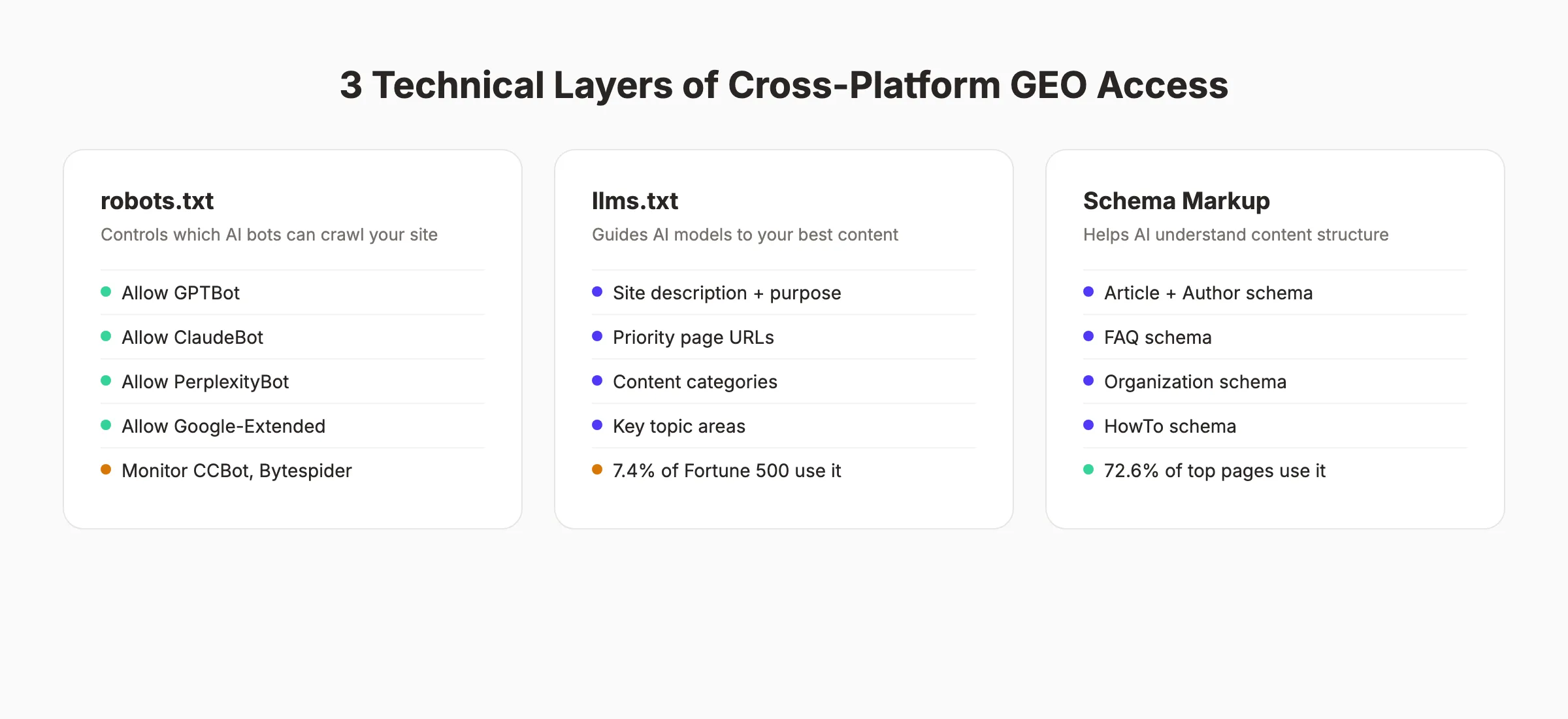
72.6% of top-ranking pages use schema markup. For cross-platform GEO, schema is not optional. It is foundational.
Chapter 7: Technical Access. Llms.txt, AI Crawlers, and robots.txt {#ch7}
Your content cannot get cited if AI bots cannot reach it. Technical access is the most overlooked layer of cross-platform GEO. A single misconfigured robots.txt file can block you from every AI platform that respects crawl directives.
robots.txt for AI Crawlers
21 major AI bots actively crawl the web. The ones that matter most for cross-platform GEO are GPTBot (OpenAI/ChatGPT), ClaudeBot (Anthropic/Claude), PerplexityBot, and Google-Extended (Gemini training).
Only 5.89% of websites block GPTBot. But if your site is in that 5.89%, you are invisible to ChatGPT and Bing Copilot for web-sourced answers.
Review your robots.txt configuration to ensure all 4 key AI bots have access. Block only the bots that provide zero value, such as training-only crawlers that do not power search products.
llms.txt. The AI Content Guide
The llms.txt file sits in your root directory and tells AI models which pages matter most. Think of it as a curated sitemap for AI. It includes your site description, priority URLs, and topic areas.
Adoption is still early. Only 7.4% of the Fortune 500 have implemented llms.txt. No AI crawlers have confirmed they extract information from it. But the cost of implementation is near zero, and it positions your site for future adoption.
Server-Side Rendering
AI bots cannot execute JavaScript. If your site relies on client-side rendering, AI crawlers see empty pages. 63% of ChatGPT agent visits bounce due to HTTP errors, CAPTCHAs, or rendering issues.
Ensure your content renders server-side. Check your pages with JavaScript disabled to see what AI crawlers actually receive. Any content loaded via JavaScript after page load is invisible to AI retrieval.
Every blog post Stacc publishes is built for AI crawlability. Server-rendered, schema-tagged, and accessible to all major AI bots. Start for $1 →
Chapter 8: Brand Authority Signals AI Models Use {#ch8}
AI search is changing SEO by shifting the primary authority signal from backlinks to brand mentions. AI engines systematically prefer earned media over brand-owned content. Understanding these authority signals is critical for cross-platform GEO.
Third-Party Mentions Outweigh Owned Content
Brands are 6.5x more likely to be cited through third-party sources than through their own domains. AI engines treat a mention of your brand on an authoritative third-party site as a stronger signal than your own product page.
This flips the traditional SEO playbook. In SEO, you optimize your own pages. In cross-platform GEO, you need others to mention your brand on their pages.
The Reddit Signal
Reddit is the number 1 most-cited domain across AI search engines, with approximately 5,588 citations across studied prompts. 46.7% of Perplexity’s top citations come from Reddit. Google AI Overviews also pull heavily from Reddit threads.
Authentic Reddit presence. Real participation, not spam. Builds cross-platform GEO visibility. If your brand gets recommended in genuine Reddit discussions, AI engines amplify that signal.
Consistency Across the Web
AI engines build entity profiles from every mention of your brand across the web. Inconsistent information. Different company names, conflicting product descriptions, outdated pricing. Weakens entity confidence.
Audit your brand mentions across directories, review sites, social profiles, and third-party articles. Consistent, accurate information across all sources strengthens the entity signals AI platforms rely on.
Digital PR for GEO
Traditional link building earns backlinks. GEO-focused digital PR earns brand mentions. The tactic shifts from “get a link” to “get mentioned by name in authoritative content.”
Publish original research. Contribute expert quotes to industry publications. Create data-driven studies that journalists and bloggers reference. Each mention builds the brand entity signal that AI engines use to determine citation worthiness.
Chapter 9: Measuring Cross-Platform GEO Success {#ch9}
Traditional SEO measurement is straightforward: track rankings, monitor traffic, measure conversions. Cross-platform GEO measurement is harder because AI platforms do not provide ranking positions or complete analytics.
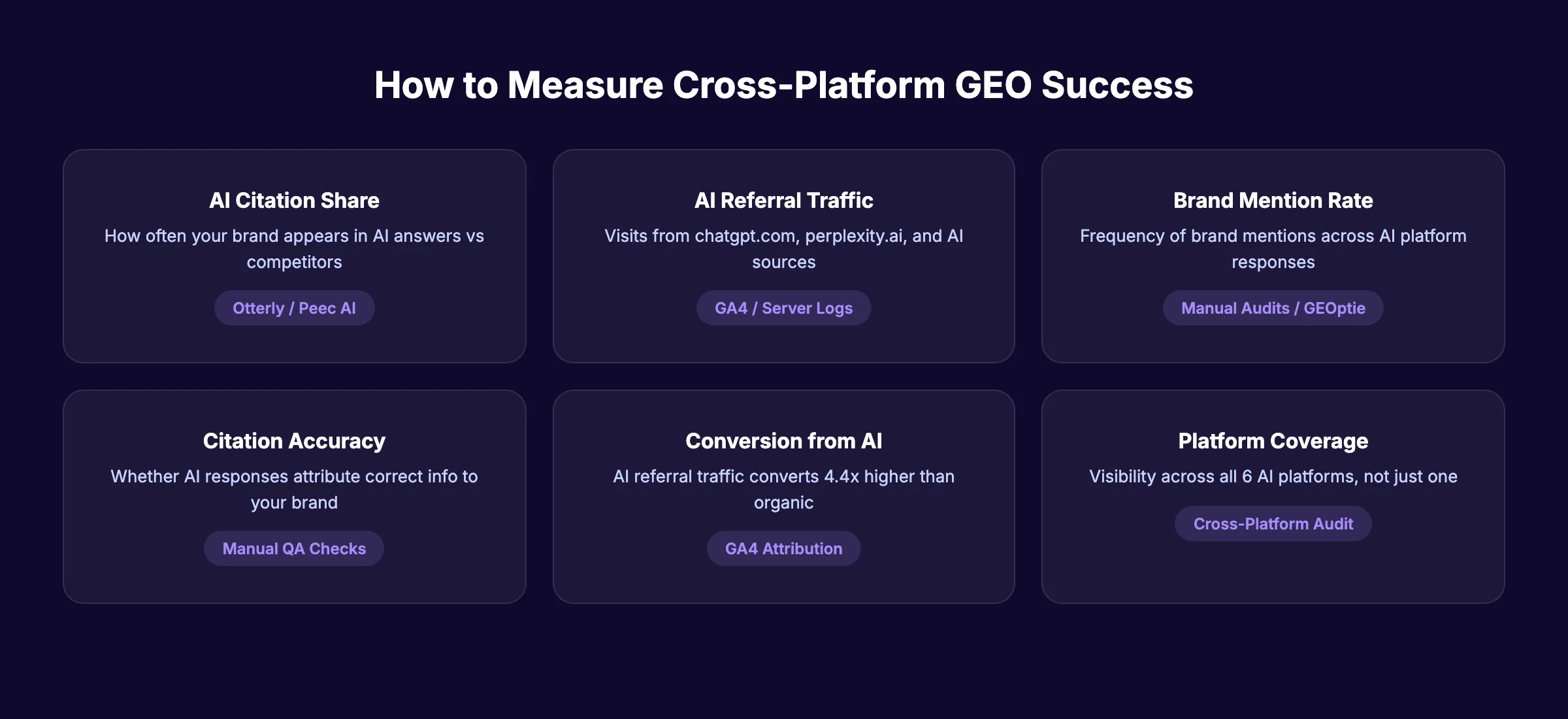
The 5 Metrics That Matter
1. AI Citation Share. How often does your brand appear in AI-generated answers compared to competitors? This is the GEO equivalent of share of voice. Manually test 20 to 30 relevant queries across all 6 platforms monthly.
2. AI Referral Traffic. Monitor visits from chatgpt.com, perplexity.ai, and other AI sources in your analytics. ChatGPT drives 87.4% of all AI referral traffic. Filter your GA4 referral report by these domains.
3. Brand Mention Rate. Track how often your brand name appears in AI responses versus unnamed citations. 73% of AI citations are “ghost citations” without brand names. Reducing that percentage means your entity signals are strengthening.
4. Citation Accuracy. When AI engines cite your brand, is the information correct? Inaccurate citations damage trust. Run monthly accuracy audits across platforms.
5. Conversion from AI Traffic. AI visitors convert at 4.4x the rate of organic visitors. Track this segment separately in your analytics to justify GEO investment.
Tools for Cross-Platform GEO Tracking
Dedicated GEO tracking tools are still emerging. Otterly, Peec AI, and GEOptie offer automated AI visibility monitoring. Manual testing remains essential because automated tools do not yet cover all platforms with full accuracy.
Build a monthly audit routine: enter your target queries into each AI platform, record which brands get cited, and track changes over time. This manual approach catches platform-specific shifts that automated tools miss.
The Volatility Problem
AI search results are volatile. AI Overview content changes approximately 70% of the time for identical queries. Only 30% of brands remain visible between consecutive responses.
Accept that AI visibility fluctuates. Measure trends over 30 to 90 day windows, not daily snapshots. A brand that appears in 60% of responses this month and 55% next month is performing well. Daily measurement creates noise.
Chapter 10: Cross-Platform GEO Mistakes to Avoid {#ch10}
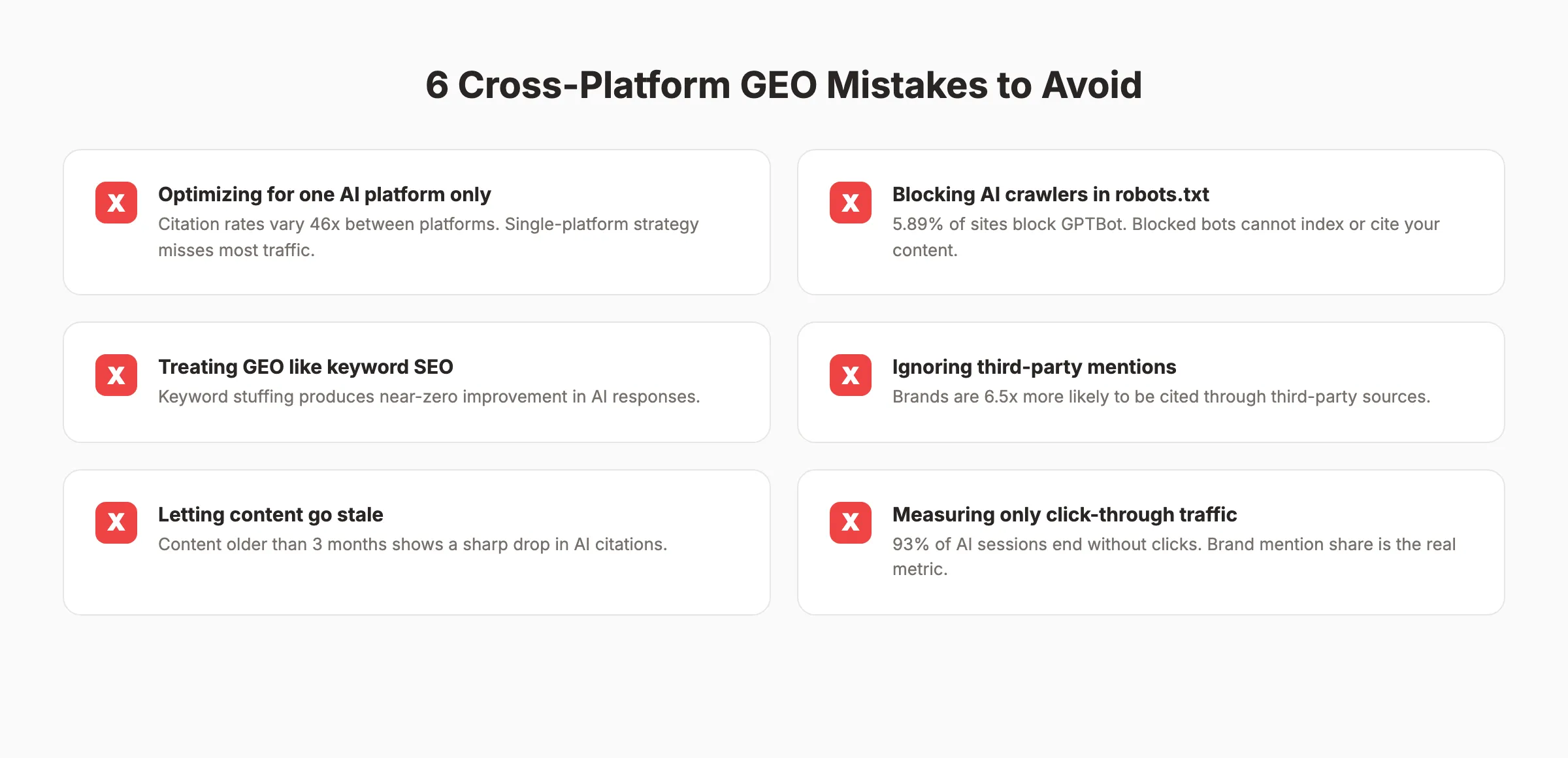
Mistake 1: Optimizing for One Platform Only
The 46x citation rate gap between platforms means single-platform strategies fail. A page optimized only for Perplexity (recency-focused, citation-heavy) may not match what ChatGPT needs (depth, completeness). Build for the universal requirements first. Add platform-specific adjustments second.
Mistake 2: Blocking AI Crawlers
5.89% of websites block GPTBot. Some block all AI bots preemptively. Unless you have a specific legal or business reason, blocking AI crawlers removes your content from AI search entirely.
Review your robots.txt and your CDN settings. Some CDNs and security tools block AI bots by default. Check server logs to confirm AI bots can actually reach your pages.
Mistake 3: Treating GEO Like Keyword SEO
Keyword density is irrelevant in AI search. The Princeton GEO research confirmed that keyword stuffing produces near-zero improvement in AI visibility. AI engines evaluate semantic relevance, not keyword frequency.
Focus on entity clarity, source authority, and passage extractability. These are the signals that move citation rates.
Mistake 4: Ignoring Third-Party Mentions
Your owned content alone will not drive cross-platform GEO success. Brands are 6.5x more likely to be cited through third-party sources. Invest in digital PR, Reddit presence, and industry publication placements. Each third-party mention compounds your AI visibility.
Mistake 5: Letting Content Go Stale
AI engines have a documented recency bias. Content older than 3 months shows a sharp drop in citation frequency. Pages updated within 2 months earn an average of 5.0 citations versus 3.9 for older content.
Set a 90-day content refresh cycle for every page you want cited by AI search engines. Update statistics, add new examples, and refresh the “last updated” timestamp.
Mistake 6: Measuring Only Click-Through Traffic
93% of AI search sessions end without a single click. If you only measure website visits, you miss 93% of the value cross-platform GEO delivers. Brand mention share, citation frequency, and citation accuracy are the metrics that matter.
Cross-platform GEO is not optional for businesses that depend on search visibility. Stacc builds AI-optimized content into every blog post we publish. Start for $1 →
Building a Unified Cross-Platform GEO Strategy {#unified}
A unified cross-platform GEO strategy has 4 layers. Each layer builds on the previous one.
Layer 1: Technical foundation. Ensure all major AI bots can crawl your site. Implement schema markup. Set up llms.txt. Verify server-side rendering.
Layer 2: Content citability. Restructure existing content for extraction. Lead sections with direct answers. Add statistics and sourced data. Build comparison tables. Follow the blog GEO checklist for every new post.
Layer 3: Authority building. Earn third-party brand mentions through digital PR. Participate authentically on Reddit and industry forums. Publish original research. Build entity consistency across the web.
Layer 4: Measurement and iteration. Track citation share monthly across all 6 platforms. Refresh content within 90 days. Expand coverage to new queries where competitors get cited and you do not.
The businesses that build all 4 layers now will own AI search visibility as these platforms continue growing. The gap between brands that invested early and those that waited is already widening.
Frequently Asked Questions {#faq}
What is the difference between GEO and cross-platform GEO?
GEO (generative engine optimization) is the general practice of optimizing content for AI search engines. Cross-platform GEO specifically focuses on optimizing for multiple AI platforms simultaneously. Google AI Overviews, ChatGPT, Perplexity, Claude, Gemini, and Bing Copilot. The distinction matters because each platform uses different source signals and citation patterns.
Does cross-platform GEO replace traditional SEO?
No. Cross-platform GEO builds on top of traditional SEO. Strong organic rankings still help, especially with Google AI Overviews and Gemini. But organic rankings alone no longer guarantee AI visibility. The overlap between top Google results and AI-cited sources has dropped below 20%.
Which AI search platform should I optimize for first?
Start with Google AI Overviews and Perplexity. Google AI Overviews reach 1.5 billion monthly users and correlate most strongly with existing SEO signals. Perplexity has the highest brand citation rate at 13.05% and rewards recency, making results visible faster. Once those 2 are covered, expand to ChatGPT, Gemini, and the rest.
How often do I need to update content for cross-platform GEO?
Every 90 days at minimum. AI engines show a documented recency bias. Pages updated within 2 months earn 28% more citations than older content. Set a quarterly refresh schedule for all priority pages and update statistics, examples, and timestamps.
Can I track which AI platforms are citing my content?
Partially. GA4 tracks referral traffic from chatgpt.com and perplexity.ai. For citation tracking across AI responses, tools like Otterly, Peec AI, and GEOptie offer automated monitoring. Manual audits remain necessary for full cross-platform coverage. See our guide on tracking AI search visibility for the complete setup.
Is llms.txt necessary for cross-platform GEO?
Not yet required, but worth implementing. Only 7.4% of Fortune 500 companies use it, and no AI crawlers have confirmed they extract data from it. The setup takes minutes. It positions your site for future adoption at near-zero cost.
Cross-platform GEO is where search visibility is heading. The brands building this capability now will own AI search results for years. The brands waiting will compete for a shrinking share of traditional clicks.
Stacc publishes 30 to 80 AI-optimized blog posts per month. Every article is built for citations across all 6 AI platforms. Start for $1 →

Written by
Siddharth GangalSiddharth is the founder of theStacc and Arka360, and a graduate of IIT Mandi. He spent years watching great businesses lose organic traffic to competitors who simply published more. So he built a system to fix that. He writes about SEO, content at scale, and the tactics that actually move rankings.
30 SEO blog articles published every month
Keyword-optimized, scheduled, and live on your site. Automatically.
30-day trial · Cancel anytime
theStacc
Stop writing SEO content manually
30 blog articles, 30 GBP posts, and social media content. Published every month. Automatically.
Try for free$1 for 3 days · Cancel anytime