Off-Page SEO: The Complete Guide (2026)
Master off-page SEO with proven techniques. Covers link building, brand mentions, digital PR, AI visibility, cost data, and measurement. Updated 2026.
Siddharth Gangal • 2026-03-30 • SEO Tips
In This Article
95% of all web pages have zero backlinks. The number 1 result on Google has 3.8 times more backlinks than positions 2 through 10. That gap explains why most sites never reach page 1. They ignore off-page SEO entirely.
Off page SEO is everything you do outside your website to improve its search engine rankings. It includes link building, brand mentions, digital PR, social signals, and reputation management. While on-page SEO gives you control over your content, off-page SEO builds the trust and authority that Google uses to decide who deserves to rank.
Most guides on this topic list 10 link building tactics and call it a day. That is incomplete. Off-page SEO in 2026 extends to AI search visibility, brand entity recognition, and co-citation strategies that affect how ChatGPT, Perplexity, and Google AI Overviews cite your content.
We have published 3,500+ blog posts across 70+ industries. The pattern is clear: sites that combine strong on-page content with deliberate off-page authority building rank faster and hold positions longer than sites that focus on content alone.
Here is what you will learn in this guide:
- What off-page SEO is and how it differs from on-page SEO
- The 10 most effective off-page SEO techniques with real data
- How much off-page SEO costs and what to budget
- How off-page signals affect AI search visibility
- Common myths about backlinks and link building
- How to audit and measure your off-page SEO performance
- A timeline for when to expect results
What Is Off-Page SEO
Off-page SEO refers to all optimization activities that happen outside your website to improve its authority, relevance, and trustworthiness in the eyes of search engines. The most recognized off-page signal is backlinks. But off-page SEO also includes brand mentions, reviews, social engagement, digital PR, and entity recognition across the web.
Think of it this way: on-page SEO is your resume. Off-page SEO is your reputation. Google uses both to decide whether to trust your content enough to rank it.
Off-Page SEO vs On-Page SEO
| Factor | On-Page SEO | Off-Page SEO |
|---|---|---|
| Where it happens | On your website | Across the internet |
| Control level | Full control | Requires external cooperation |
| Key signals | Content, HTML tags, structure, speed | Backlinks, mentions, reviews, authority |
| Timeline | Faster impact (days to weeks) | Slower build (weeks to months) |
| Priority | Do first | Build on top of on-page |
| Cost | Primarily time/content investment | Higher cost ($361-$509 per quality link) |
On-page SEO is the foundation. Without quality content, proper title tags, and technical SEO, off-page efforts have nothing to amplify. Always fix on-page issues before investing in off-page campaigns.
Why Off-Page SEO Still Matters in 2026
Google’s Gary Illyes said in September 2023 that links are “not in the top three” ranking factors. John Mueller said in April 2024 that Google needs “very few links to rank pages” (Search Engine Land).
These statements are true. And misleading. Links carry less weight than they did in 2015. But off-page SEO extends far beyond links. Google uses off-page signals to evaluate E-E-A-T: Experience, Expertise, Authoritativeness, and Trustworthiness. Brand mentions, reviews, PR coverage, and third-party citations all feed these trust signals.
Pages with at least 1 backlink are 77% more likely to rank in the top 10. Position 1 averages 220 backlinks. And 92.3% of top-100 ranking pages have at least 1 external link. The data is clear: off-page signals still separate pages that rank from pages that do not.
10 Off-Page SEO Techniques That Work in 2026
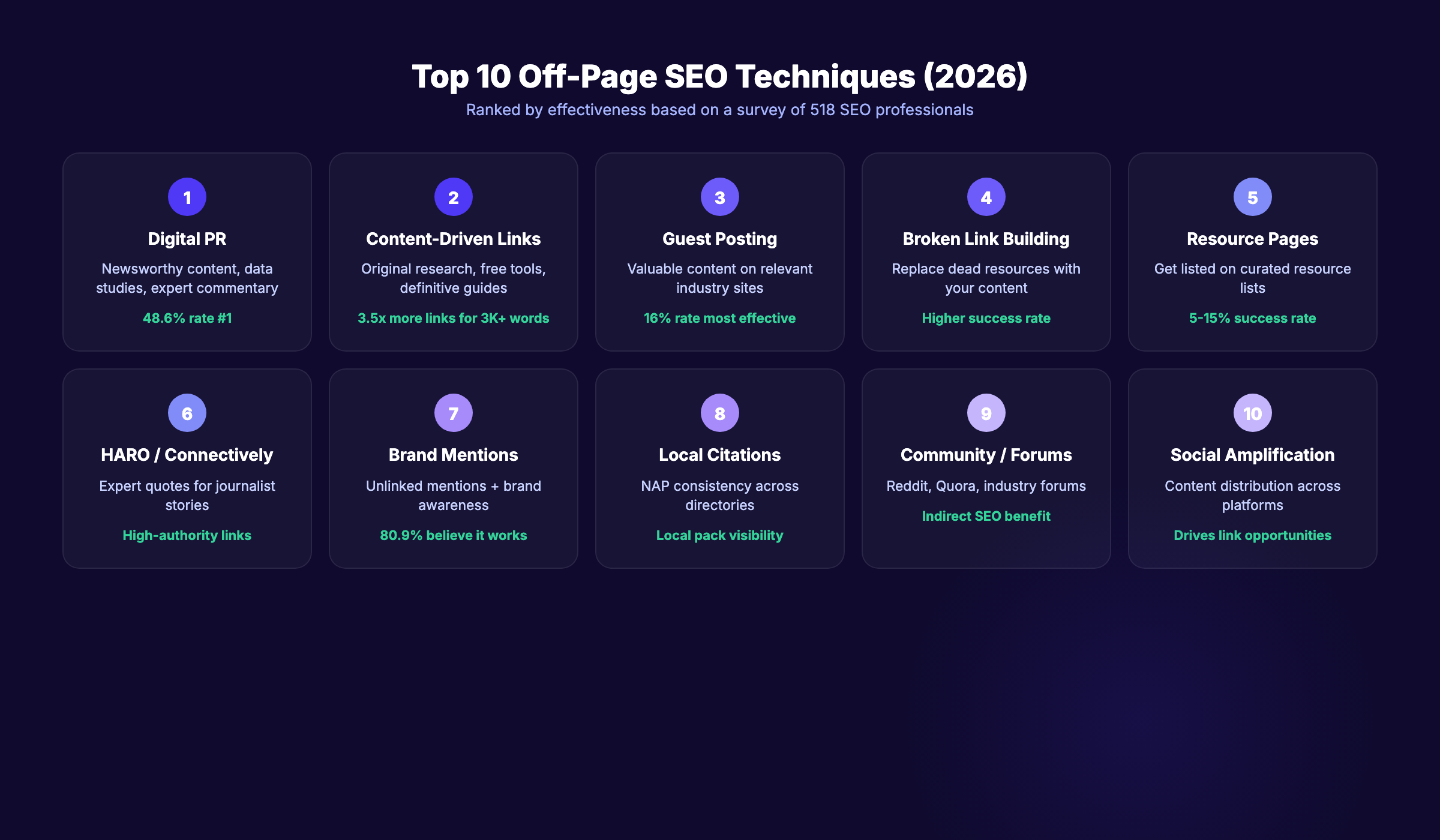
These techniques are ranked by effectiveness based on a survey of 518 SEO professionals.
1. Digital PR (48.6% Rate It Most Effective)
Digital PR earns backlinks by creating newsworthy content that journalists and publishers want to cover. This includes original research, data studies, expert commentary, and industry reports.
Why it works: one digital PR campaign can earn 20 to 100 backlinks from high-authority news sites. These links carry more weight than dozens of directory submissions or guest post links.
How to start:
- Create original data or research in your niche
- Write a press release with a clear news angle
- Pitch to journalists covering your industry (use tools like HARO, Connectively, or Muck Rack)
- Read our digital PR and SEO guide for the full framework
2. Link Building Through Content
Long-form content with original data earns links naturally. Backlinko’s content study found that content over 3,000 words gets 3.5 times more backlinks than average-length posts.
Create linkable assets:
- Original research and data studies
- Free tools and calculators
- Infographics with shareable data
- Definitive guides that become reference resources
Then promote them. Content does not earn links by sitting on your site. Reach out to sites that link to similar content and offer yours as a better resource. The skyscraper technique formalizes this process.
3. Guest Posting
Guest posting remains the most widely used link building tactic. 16% of SEO professionals rate it the single most effective method. Write valuable content for relevant sites in your industry. Include a contextual link back to your site within the article body.
Quality standards for guest posting:
- Target sites with real traffic, not high domain authority alone
- Write content that serves the host site’s audience
- Use natural, descriptive anchor text
- Avoid sites that accept anyone (those are link farms)
- Read our guest posting guide for outreach templates and vetting criteria
Stop writing. Start ranking. Stacc publishes 30 SEO-optimized articles per month for $99. Every post builds the topical authority that earns natural backlinks. Start for $1 →
4. Broken Link Building
Find broken links on relevant sites. Create content that replaces the dead resource. Contact the site owner and suggest your page as the replacement. This works because you are helping the webmaster fix a problem, not asking for a favor.
Our broken link building guide covers the full process including tools, outreach templates, and success rate benchmarks.
5. Resource Page Link Building
Resource pages are curated lists of helpful links on a specific topic. If your content fits a resource page’s theme, contact the curator and suggest your page. Success rates for resource page outreach range from 5 to 15%, which is higher than cold email pitches.
6. HARO and Journalist Queries
Help a Reporter Out (now Connectively) connects experts with journalists who need sources. Respond to relevant queries with expert commentary. If published, you earn a backlink from a high-authority news outlet.
Our HARO link building guide shows how to craft responses that get selected.
7. Brand Mentions and Unlinked Mentions
80.9% of SEO professionals believe unlinked brand mentions affect rankings. Google’s patents reference brand mentions as a trust signal, even without a hyperlink.
Two strategies here:
- Monitor for unlinked mentions of your brand and request a link
- Build brand awareness that generates mentions naturally (PR, speaking, partnerships)
Tools like Ahrefs, Semrush, and Google Alerts can track brand mentions across the web.
8. Local SEO Citations
For local businesses, citations (mentions of your business name, address, and phone number on directories) are a core off-page signal. Consistent NAP data across Google Business Profile, Yelp, industry directories, and local sites builds local authority.
Read our link building for local SEO guide for the directory strategy and citation building process.
9. Community and Forum Participation
Reddit now ranks prominently in Google search results following the $60 million Google-Reddit licensing deal. Active, genuine participation in relevant subreddits, Quora, and industry forums builds visibility and can earn referral traffic and indirect SEO benefits.
The key word is “genuine.” Spamming links in forums is a fast path to account bans and zero SEO benefit. Add value first. Link only when your content directly answers the question.
10. Social Media Amplification
Social signals are not a direct Google ranking factor. Google has confirmed this repeatedly. But social media amplifies content distribution, which indirectly earns links and brand mentions.
A blog post shared across LinkedIn, X, and industry communities reaches audiences who may link to it from their own sites. Social amplification is the bridge between publishing content and earning off-page signals from it.
How Much Off-Page SEO Costs
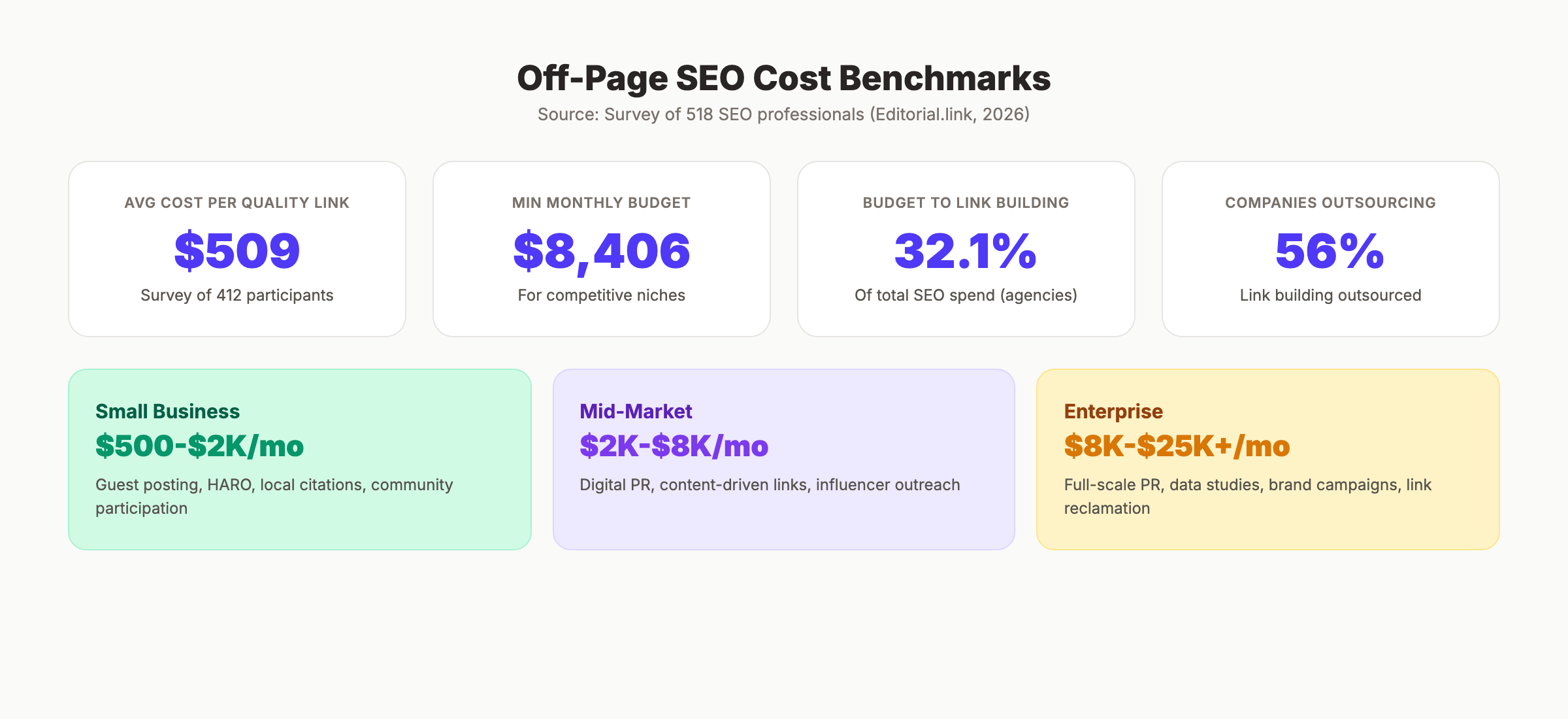
Most off-page SEO guides skip the budget conversation. Here is the real data from a survey of 518 SEO professionals.
| Metric | Average Cost |
|---|---|
| Cost per quality backlink | $361 to $509 |
| Minimum monthly budget (competitive niches) | $8,406 |
| Budget allocation to link building (agencies) | 32.1% of total SEO budget |
| Percentage of companies outsourcing link building | 56% |
Budget Framework by Business Size
| Business Size | Monthly Off-Page Budget | Focus Areas |
|---|---|---|
| Small business / startup | $500 to $2,000 | Guest posting, HARO, local citations, community participation |
| Mid-market | $2,000 to $8,000 | Digital PR, content-driven link building, influencer outreach |
| Enterprise | $8,000 to $25,000+ | Full-scale digital PR, data studies, brand campaigns, link reclamation |
The most cost-effective approach: create linkable content assets that earn links over time. A single data study costing $2,000 to produce can earn 50 to 200 backlinks over 12 months. That is $10 to $40 per link versus $361 to $509 for manual outreach.
Off-Page SEO and AI Search Visibility
Off-page signals now affect more than Google rankings. They influence whether AI search engines cite your content.
Sites with 32,000+ referring domains are 3.5 times more likely to get cited by ChatGPT (SE Ranking). Perplexity, Google AI Overviews, and Gemini also favor sources with strong authority signals when selecting citations.
How Off-Page SEO Feeds AI Citations
AI search engines evaluate source credibility before citing. The signals they use overlap heavily with traditional off-page SEO:
- Backlink profile strength signals domain authority to AI models
- Brand mentions across trusted sites build entity recognition
- Reviews and ratings contribute to trustworthiness evaluation
- Co-citations (being mentioned alongside authoritative sources) build topical association
The Co-Citation Strategy
Co-citation means being mentioned in the same context as established authorities. If your brand appears alongside HubSpot, Ahrefs, and Moz in industry discussions, AI models associate your brand with that level of authority.
Build co-citations by:
- Contributing expert quotes to roundup posts
- Appearing on industry podcasts
- Getting featured in “best of” lists alongside known brands
- Publishing research that authoritative sources reference
Read our generative engine optimization guide for the full AI search visibility framework. And learn specifically how to get cited by AI search engines.
Your SEO team. $99 per month. 30 optimized articles, published automatically. Build the topical authority that earns links and AI citations. Start for $1 →
Off-Page SEO Myths Debunked
These myths waste time and budget. Here is what the data actually shows.
Myth 1: Backlinks Are the Number 1 Ranking Factor
Google’s Gary Illyes said links are “not in the top three” ranking factors (September 2023). Content quality, relevance, and user engagement carry more weight. Backlinks matter. They are not the dominant factor they were in 2015.
Myth 2: More Backlinks Always Means Higher Rankings
Referring domain diversity matters more than raw link count. 100 links from 100 different domains outperform 1,000 links from 1 domain. Quality and relevance outweigh quantity every time. Run a backlink audit to assess your link profile health.
Myth 3: Nofollow Links Are Worthless
Google changed nofollow from a directive to a “hint” in September 2019. 78.8% of SEO professionals believe nofollow links still impact rankings. Nofollow links from high-authority sites (Wikipedia, major news outlets) send traffic and brand signals even if they pass limited link equity.
Myth 4: Social Media Directly Boosts Rankings
Social signals are not a confirmed Google ranking factor. But social amplification drives content visibility, which indirectly earns links and mentions. Treat social media as a distribution channel, not a ranking signal.
Myth 5: Guest Posting Is Dead
Guest posting is the most widely used link building method. 16% of professionals rate it the most effective tactic. The tactic is not dead. Low-quality guest posting on irrelevant sites is dead. Strategic guest posting on authoritative, relevant sites remains highly effective.
Myth 6: You Need Hundreds of Backlinks to Rank
John Mueller (Google, April 2024): “We need very few links to rank pages.” For low-competition keywords, a few high-quality links can be sufficient. For competitive keywords, you need more. But the threshold is lower than most people think.
How to Audit Your Off-Page SEO
A systematic audit reveals your strengths, weaknesses, and opportunities. Run this checklist quarterly.
Backlink Profile Audit
- Total referring domains (benchmark against top 3 competitors)
- Referring domain growth rate (aim for 5 to 15% monthly growth)
- Link quality distribution (DR/DA of linking domains)
- Anchor text diversity (no more than 5% exact-match anchors)
- Toxic backlink percentage (disavow if over 5% of profile)
- Dofollow vs nofollow ratio (70/30 is healthy)
- New vs lost links per month (net positive is the goal)
Brand Authority Audit
- Brand mention volume (track monthly with Google Alerts)
- Unlinked mentions (convert to links with outreach)
- Review profile across Google, Yelp, industry directories
- Social media mention sentiment (positive vs negative)
- Press and media coverage count
Competitor Benchmarking
- Compare referring domain count against top 3 SERP competitors
- Identify linking domains your competitors have that you do not
- Analyze competitor link velocity (how fast they earn new links)
- Find content types earning the most links for competitors
Use tools like Ahrefs, Semrush, or Moz to pull this data. Our link building tools guide reviews the best options for each budget level.
Timeline: When to Expect Off-Page SEO Results
Off-page SEO is not instant. Here is what the data shows about timelines.
57.1% of SEO professionals see ranking improvements within 1 to 3 months of building links. The full impact of an off-page campaign typically plays out over 6 to 12 months as authority compounds.
| Activity | Time to Impact | Expected Result |
|---|---|---|
| Local citations | 2 to 4 weeks | Improved local pack visibility |
| HARO responses | 2 to 6 weeks | Individual high-authority backlinks |
| Guest posting campaign | 1 to 3 months | Steady link flow + referral traffic |
| Digital PR campaign | 1 to 3 months | Burst of high-authority links |
| Content-driven link building | 3 to 6 months | Compounding natural link acquisition |
| Brand authority building | 6 to 12 months | Domain-wide ranking improvements |
The compounding effect matters. Early links build foundation authority. Each additional link adds more value as your domain’s baseline trust grows. Sites that stop building links after an initial campaign often see rankings plateau within 6 to 9 months. Consistency beats intensity.
3,500+ blogs published. 92% average SEO score. See what Stacc can do for your site. Consistent publishing builds the topical authority that earns links naturally. Start for $1 →
FAQ
What is off-page SEO?
Off-page SEO is the practice of building authority, trust, and relevance for your website through activities that happen outside your site. This includes earning backlinks, generating brand mentions, managing reviews, building social visibility, and establishing entity recognition across the web. It complements on-page SEO, which covers optimizations on your own pages.
Is link building the same as off-page SEO?
No. Link building is the most recognized component of off-page SEO, but off-page SEO also includes brand mentions, reviews, social signals, local citations, digital PR, and entity recognition. Focusing only on links misses 40 to 50% of off-page opportunity.
How many backlinks do I need to rank?
It depends on competition. Google has said it needs “very few links to rank pages” for low-competition terms. For competitive keywords, position 1 averages 220 backlinks. Focus on referring domain diversity over raw link count. 100 links from 100 domains outperform 1,000 links from 1 domain.
Does social media help with SEO?
Social signals are not a direct Google ranking factor. But social media amplifies content visibility, drives referral traffic, and indirectly earns backlinks and brand mentions. Treat social as a distribution and amplification channel that supports off-page SEO goals.
How much does off-page SEO cost?
A quality backlink costs $361 to $509 on average. Monthly budgets for competitive niches average $8,406. Small businesses can start with $500 to $2,000 per month focusing on HARO, guest posting, and local citations. The most cost-effective approach is creating linkable content assets that earn links over time.
How long does off-page SEO take to work?
57.1% of SEO professionals see results within 1 to 3 months. Individual tactics like HARO can produce links within weeks. Brand authority and domain-wide ranking improvements take 6 to 12 months. Consistency matters more than intensity. Sites that build links steadily outperform those that run one campaign and stop.
Off-page SEO builds the trust and authority that content alone cannot create. Start with a backlink audit to understand your current position. Then focus your budget on the tactics that match your business size and goals. The sites that win in 2026 are the ones that combine strong content with deliberate authority building across the web.
Written and published by Stacc. We publish 3,500+ articles per month across 70+ industries. All data verified against public sources as of March 2026.