
The Skyscraper Technique: A Step-by-Step Guide (2026)
Learn the skyscraper technique for link building. Find linkable content, create something better, and earn backlinks through outreach. Updated 2026.
Most link building strategies feel like guesswork. You publish content, cross your fingers, and hope someone links to it. The skyscraper technique removes that guesswork entirely.
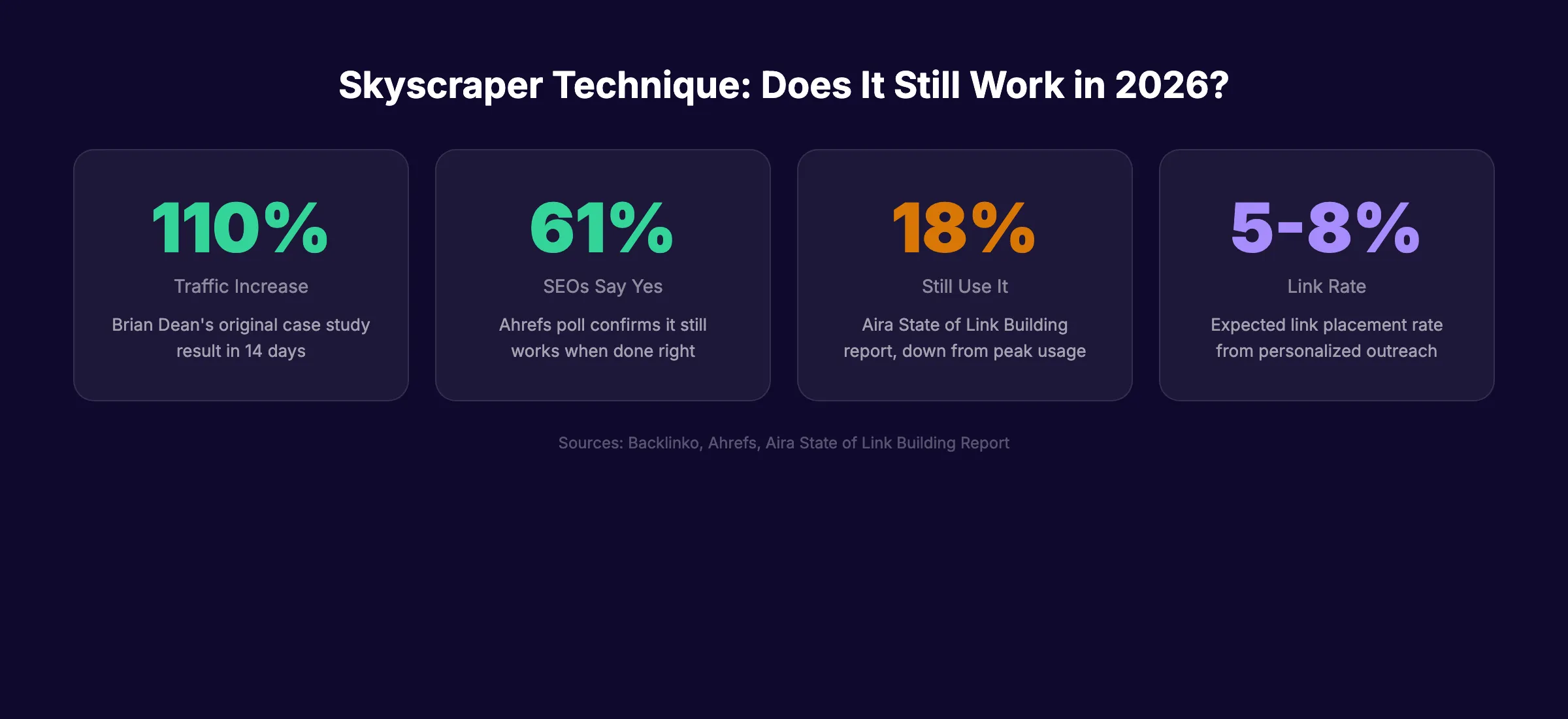
Brian Dean introduced this method in 2013. It generated a 110% traffic increase in 14 days for a single post. The concept is simple. Find content that already earns backlinks. Create something better. Then tell the right people about it.
The skyscraper technique still works in 2026. But the bar is higher than it was a decade ago. Generic “longer” content no longer cuts it. You need original data, better design, and sharper outreach.
We publish 3,500+ blog posts across 70+ industries. We see which content earns links and which gets ignored. This guide breaks down the exact process.
Here is what you will learn:
- How to find content worth “skyscrapering”
- What makes content genuinely 10x better
- How to find every site linking to the original piece
- The outreach emails that actually get responses
- How to measure results and iterate
- Whether the technique still works (honest assessment)
- Common mistakes that kill your response rate
What Is the Skyscraper Technique?
The skyscraper technique is a 3-part link building strategy. You find high-performing content in your niche. You create a superior version. Then you reach out to sites that linked to the original and pitch your improved version.
The name comes from a simple analogy. Nobody notices the 10th tallest building in a city. Everyone notices the tallest. Your content needs to be the tallest building on the block.
Brian Dean coined the term at Backlinko. His original case study showed a single post earning hundreds of referring domains and driving 110% more organic traffic in 2 weeks.
The technique works because it reverses the typical content-first approach. Instead of guessing what people want to link to, you study what they already link to. Then you give them something better to reference.
Here is the 3-part framework in brief:
| Phase | Action | Goal |
|---|---|---|
| 1. Find | Identify content with 50+ referring domains | Pick a proven link magnet |
| 2. Create | Build a 10x better version | Give linkers a reason to switch |
| 3. Outreach | Email sites linking to the original | Earn backlinks to your version |
Each phase has specific steps. The rest of this guide walks through all 7.
Step 1: Find Content That Already Earns Links
The skyscraper technique starts with research, not writing. You need to find content in your niche that has already proven it can attract backlinks.
Open Ahrefs Content Explorer, Semrush, or a free tool like Ubersuggest. Search for your target topic. Sort results by referring domains. You want pages with at least 50 unique referring domains. Fewer than that and the outreach pool is too small.
Specifically:
- Search your primary keyword in Ahrefs Content Explorer
- Filter by referring domains (minimum 50)
- Filter by domain authority to remove spam
- Export the top 10-15 results into a spreadsheet
- Note the URL, title, referring domain count, and publish date
Look for content that is outdated, incomplete, or poorly designed. Old statistics, broken links, and thin sections are signals that you can create something better. A post from 2019 with 200 referring domains is a prime target.
Also check for format gaps. If every top result is a wall of text, a visual guide with infographics and tables will stand out. If every result is generic, original research will differentiate you.
Why this step matters: Picking the wrong target wastes your entire effort. A post with 5 referring domains will not give you enough outreach targets. A post that is already perfect leaves no room for improvement. The right target has high link volume and clear weaknesses.
Pro tip: Filter out homepage links and brand mentions. You want editorial links to specific content pages. Those site owners chose to link because the content helped them. They will switch if you offer something better.
Step 2: Analyze Why That Content Earns Links
Not all links happen for the same reason. Before you create your version, you need to understand exactly why the original content attracted links.
Open the backlink profile of the target content in Ahrefs or Semrush. Click through to 15-20 of the linking pages. Read the context around each link. Note the anchor text used.
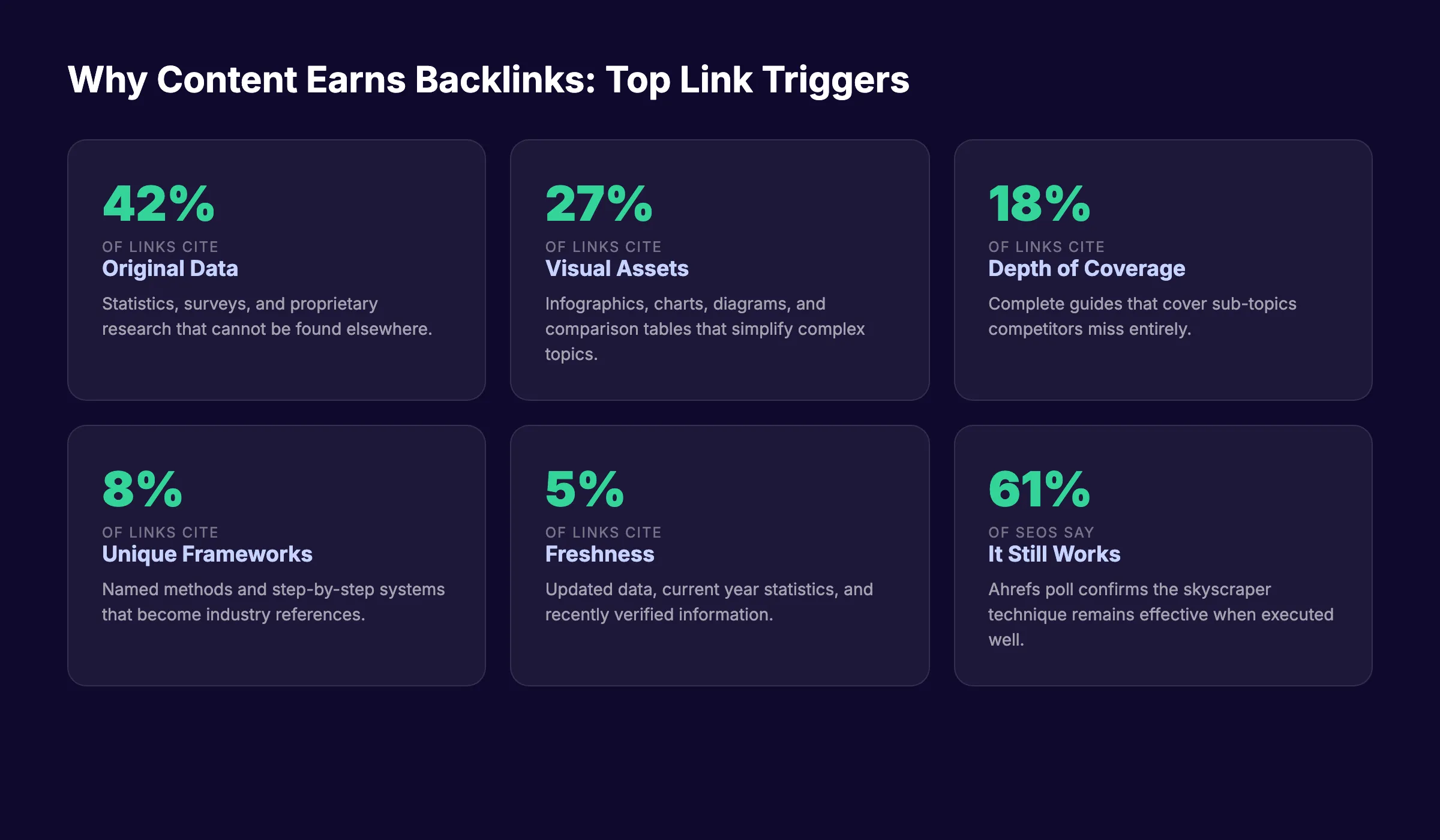
Common reasons content earns links:
| Link Trigger | Example | How to Beat It |
|---|---|---|
| Original data or statistics | ”According to a study by…” | Run your own survey or compile fresher data |
| Visual assets | Infographics, charts, diagrams | Create higher-quality, more current visuals |
| Depth of coverage | ”This complete guide covers…” | Cover sub-topics the original missed |
| Unique framework or method | ”The [Name] Method” | Develop your own framework with clear steps |
| Freshness | ”Updated for 2024” | Update for 2026 with current data |
Categorize every linking page into 1 of these buckets. If 70% of links reference a specific statistic, your new content must include better, more current statistics. If most links reference the visual assets, your design needs to be noticeably superior.
This analysis also reveals the audience. Are the linking sites marketing blogs? Industry publications? News outlets? This shapes your outreach tone and angle.
Why this step matters: Creating “better” content without understanding why the original earns links is like building a taller building in the wrong city. You need to match the original’s link triggers and then exceed them.
Step 3: Create Content That Is 10x Better
This step is where most people fail. They make the content 10% better and expect results. The skyscraper technique demands a dramatic improvement.
“Better” does not mean “longer.” Semrush’s analysis confirms that readers prefer focused, concise content over unnecessary length. Your goal is to be more useful, not more words.
Here are 6 ways to make your content genuinely superior:
1. Add original data. Run a survey. Analyze your own customer data. Pull fresh statistics. Original data is the strongest link magnet because it cannot be found anywhere else.
2. Improve the design. Better formatting, custom graphics, comparison tables, and visual summaries. Most skyscraper content is text-heavy. Visual content earns 2.3x more backlinks according to BuzzSumo research.
3. Cover gaps. Read every comment on the original post. Check Reddit threads. Find the questions the original did not answer. Your post should leave zero unanswered questions.
4. Update everything. Replace 2019 statistics with 2026 data. Swap dead links for current sources. Remove references to discontinued tools. Freshness is a real ranking signal.
5. Add expert perspectives. Quote industry professionals. Include real case studies. Original quotes from practitioners add E-E-A-T signals that Google rewards.
6. Make it actionable. Add templates, checklists, and step-by-step instructions. The original might explain what to do. Your version should show exactly how to do it.
Write the content following SEO content writing best practices. Optimize your blog post structure for both readers and search engines. Use clear headlines that signal value.
Why this step matters: The outreach email you send in Step 5 lives or dies on content quality. If a site owner clicks through and sees a marginal improvement, they will not bother updating their link. The improvement must be obvious within 10 seconds of landing on your page.
Pro tip: Create a comparison document. Put the original content side-by-side with your draft. For every section, write down specifically how yours is better. If you cannot articulate the improvement, that section needs more work.
Your content pipeline should never stop. We publish 30+ articles per month for businesses across 70+ industries. Every post is optimized to earn links and rank. Start for $1 →
Step 4: Find Every Site Linking to the Original
You have your superior content published. Now you need a target list for outreach. The goal is to find every website that links to the original content you improved.
Open the backlink profile of the original piece in Ahrefs, Semrush, or Moz. Export all referring domains. This is your outreach list.
Specifically:
- Export all referring domains (not individual backlinks)
- Remove duplicates and irrelevant sites
- Filter out forums, social media profiles, and scraped sites
- Remove sites with domain authority below 20
- Remove sites in languages you do not serve
You should have between 50-300 prospects depending on the original content. Quality matters more than quantity. A link from a DA 60 marketing blog is worth more than 50 links from DA 10 directories.
Organize your list into tiers:
| Tier | Domain Authority | Priority | Expected Response Rate |
|---|---|---|---|
| Tier 1 | 60+ | High | 3-5% |
| Tier 2 | 30-59 | Medium | 8-12% |
| Tier 3 | 20-29 | Low | 12-18% |
Now find the right contact at each site. You need the person who wrote or manages the page that contains the link. Do not email the generic contact form.
How to find contacts:
- Check the author byline on the linking page
- Search “[Author Name] [Site Name] email” on Google
- Use Hunter.io or Snov.io to find email addresses
- Check LinkedIn for content managers at the domain
- Look for “Write for us” or “Editorial” pages
Add each contact to your spreadsheet. Include their name, email, the specific page that links to the original, and the anchor text used.
Why this step matters: The skyscraper technique is not a “spray and pray” strategy. You are contacting people who already proved they link to this type of content. That is the highest-intent outreach list you can build. Skipping the research and emailing random bloggers kills your response rate.
Step 5: Write Outreach Emails That Get Responses
The outreach email is the most important variable in the entire skyscraper technique. Great content with bad outreach earns zero links.
In Aira’s State of Link Building report, only 18% of SEOs still use the skyscraper technique. The reason? Most people send generic templates that site owners immediately delete.
Your outreach email needs 4 elements:
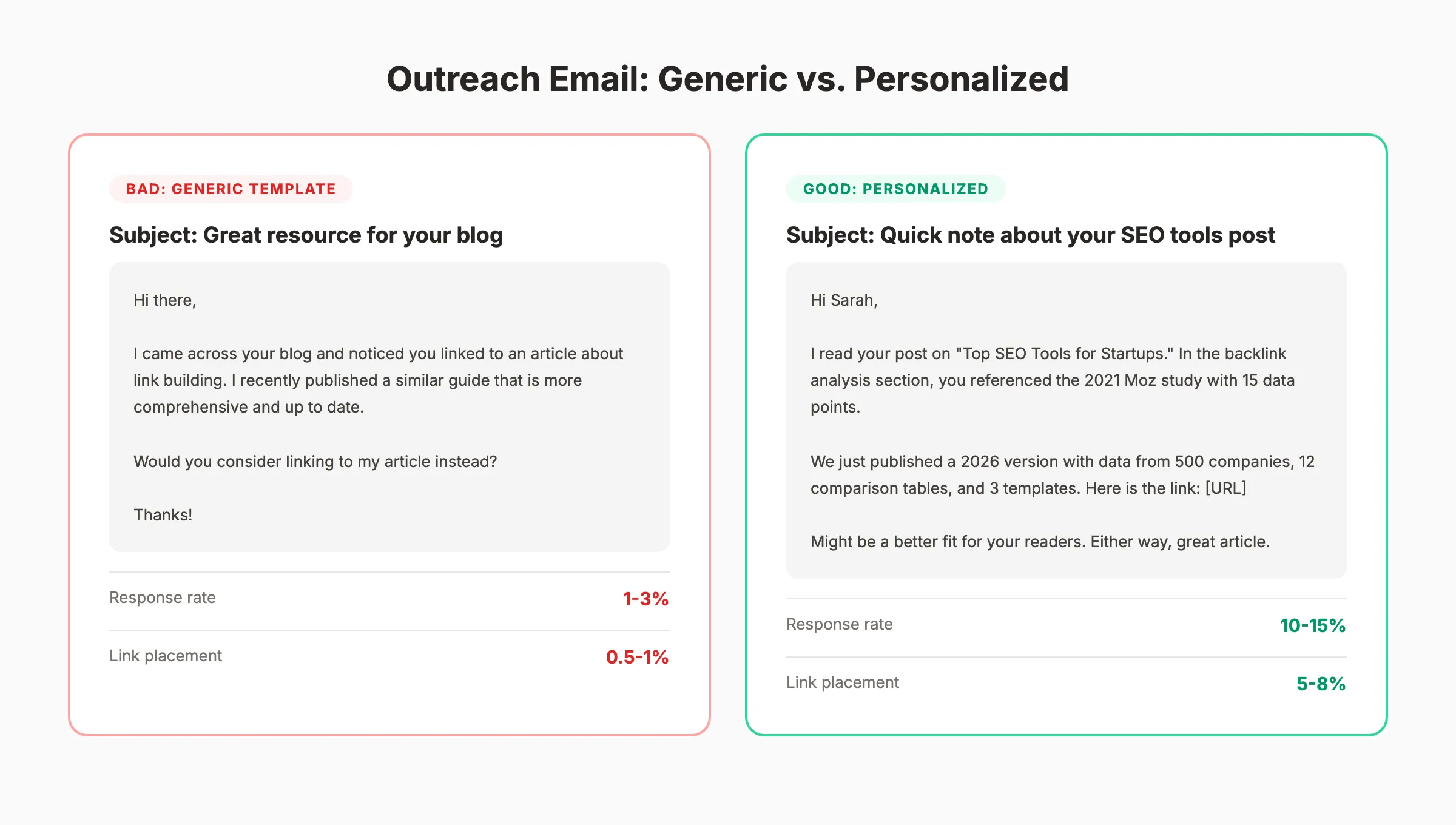
1. Personalization. Reference a specific article, quote, or point the recipient made. Prove you read their content. Generic emails like “I noticed you linked to a great resource” signal mass outreach.
2. Value proposition. Explain specifically what makes your content better. Do not say “I created a more comprehensive guide.” Say “Our version includes 2026 data from 500 companies, 12 comparison tables, and 3 downloadable templates that the original does not have.”
3. Low friction. Make the ask simple. You are not asking them to write a new article. You are asking them to update a single link on an existing page. Include the exact URL and anchor text location.
4. Brevity. Keep it under 150 words. Site owners receive dozens of link requests daily. Respect their time.
Here is a template that works:
Subject: Quick note about your [topic] article
Hi [Name],
I was reading your post on [specific article title]. You linked to [original content title] in the section about [specific context].
That piece is solid, but it was last updated in [year]. Some of the statistics are outdated and [specific gap].
We just published an updated version that includes [specific improvement 1], [specific improvement 2], and [specific improvement 3].
Here is the link: [URL]
If you think it is a better fit for your readers, it might be worth swapping in. Either way, great article.
[Your name]
What makes this work: You referenced their specific page. You identified a concrete weakness in the current link. You offered specific improvements. And the ask is a simple link swap, not a new article.
Why this step matters: An Ahrefs poll found 61% of SEOs say the skyscraper technique still works. The 39% who say it does not are almost always the ones sending generic outreach. Personalization is the difference between a 2% and a 15% response rate.
Step 6: Follow Up and Track Responses
Most link builders send one email and quit. Data from outreach tools shows that a single follow-up email increases response rates by 40-60%.
Set up a tracking system before you send the first email. Use a spreadsheet or a tool like Pitchbox, BuzzStream, or even a basic CRM.
Track these columns:
- Contact name and email
- Website and linking page URL
- Date of first email
- Date of follow-up
- Response (yes, no, no reply)
- Link status (placed, pending, declined)
Follow-up schedule:
| Day | Action |
|---|---|
| Day 1 | Send initial outreach email |
| Day 5 | Follow-up 1 (shorter, add a new angle) |
| Day 12 | Follow-up 2 (final touch, no pressure) |
Never send more than 2 follow-ups. Three emails total is the limit. After that, you are annoying the recipient and damaging your sender reputation.
Your follow-up should add value. Do not just say “bumping this to the top of your inbox.” Offer a new angle. Share a stat from your content. Mention that you updated a section since your last email.
Also track your overall campaign metrics:
- Emails sent: Total outreach volume
- Open rate: Target 60%+ (fix subject lines if below 50%)
- Response rate: Target 10-15% for well-researched campaigns
- Link placement rate: Target 5-8% of total emails sent
Why this step matters: The follow-up email often outperforms the initial email. People are busy. Your first message might arrive during a hectic Monday morning. The follow-up catches them when they have time to evaluate your content. Without tracking, you cannot identify what works and what to improve.
Building backlinks takes time you do not have. Stacc handles content publishing so you can focus on outreach and strategy. 30 articles per month, fully optimized. Start for $1 →
Step 7: Measure Results and Iterate
The skyscraper technique is not a one-time tactic. Each campaign teaches you what works for your niche. Measurement turns a single win into a repeatable system.
Wait 30-60 days after your outreach campaign wraps up. Then measure these metrics:
Backlink metrics:
- New referring domains to your skyscraper content
- Average domain authority of new links
- Anchor text distribution
- Do-follow vs. no-follow ratio
Traffic and ranking metrics:
- Organic traffic to the skyscraper page
- Keyword rankings for primary and secondary terms
- SERP position changes over 30, 60, and 90 days
Outreach metrics:
- Total emails sent vs. links earned
- Cost per link (your time + tools)
- Best-performing email template
- Response rate by prospect tier
Use this data to improve your next campaign. If Tier 2 prospects converted at 12% but Tier 1 only at 3%, consider focusing more effort on Tier 2. If your follow-up email outperformed your initial email, test the follow-up as your primary template.
Run a backlink audit 90 days after the campaign. Check which links are still active. Some sites will remove links during content updates. Identify those and add them to your re-outreach list.
Why this step matters: Most SEOs run the skyscraper technique once and either celebrate or give up. The real value comes from iteration. Your second campaign will outperform your first by 2-3x because you know your niche response patterns, best-performing email angles, and ideal prospect profiles.
Pro tip: Document every campaign in a “skyscraper playbook.” Record the target content, your improvements, outreach templates, response rates, and total links earned. This playbook becomes your team’s link building knowledge base.
Does the Skyscraper Technique Still Work in 2026?
Yes. But with serious caveats.
The honest assessment: 61% of SEOs in an Ahrefs poll say it still works. But only 18% actively use it, according to Aira’s annual State of Link Building report. The technique’s reputation has suffered from overuse and poor execution.
What changed since 2013:
The barrier to entry is much higher. In 2013, making content “longer and more detailed” was often enough. In 2026, every niche already has long, detailed content. You need genuine differentiation.
Site owners are fatigued from outreach emails. Many receive 10-20 link requests per day. Your email competes with dozens of others. Generic templates get deleted instantly.
Google’s algorithms better assess content quality. Simply having more backlinks does not guarantee rankings if the content does not satisfy search intent. Your skyscraper content must rank on its own merit, not just on links.
What still works:
Original research and fresh data remain the strongest link triggers. A post with proprietary statistics will always attract links because the data cannot be found elsewhere.
Personalized outreach still converts. The SEOs who report the technique “does not work” are almost always sending mass template emails. Genuine, researched outreach still earns 10-15% response rates.
Combining the skyscraper technique with other link building methods multiplies results. Pair it with guest posting, digital PR, and broken link building for a diversified off-page SEO strategy.
The exception: the technique works poorly in niches where site owners expect payment for links. If your niche has a “pay for links” culture, you will struggle with email outreach alone.
Common Mistakes That Kill Skyscraper Campaigns
Knowing the steps is not enough. Most skyscraper campaigns fail because of avoidable mistakes.
1. Picking content with too few referring domains. If the original has 15 referring domains, your outreach list is only 15 people. You need at least 50 prospects. Ideally 100+.
2. Making content marginally better. Adding 200 words to a 2,000-word post is not a skyscraper. You need dramatic, visible improvement. If a reader cannot tell the difference in 10 seconds, it is not enough.
3. Sending generic outreach. “Hey, I noticed you linked to a great article. I wrote something similar.” Delete. Every site owner has seen this template 500 times. Personalize every single email.
4. Targeting the wrong niche. The skyscraper technique works best in information-rich niches like marketing, finance, health, and technology. It works poorly in niches with thin content ecosystems or where site owners rarely update their links.
5. Ignoring content promotion. Publishing your skyscraper content and only doing email outreach is limiting. Share it on social media. Mention it in communities. Distribute it in newsletters. The more visibility, the more organic links it earns without outreach.
6. Not following up. One email is not enough. A single follow-up increases response rates by 40-60%. Most link builders leave these responses on the table.
7. Skipping the measurement phase. Without data, you cannot improve. Your third campaign should dramatically outperform your first. That only happens if you track what works.
Content is the foundation of every link building strategy. We build topical authority for businesses with consistent, optimized publishing. 30 articles per month, zero effort on your end. Start for $1 →
Skyscraper 2.0 and Modern Variations
The original skyscraper technique has evolved. Several variations address its weaknesses.
Skyscraper 2.0 (Brian Dean’s Update)
Dean updated his method to focus on user experience signals rather than just backlinks. The updated approach involves matching search intent exactly, optimizing for engagement metrics like time on page and bounce rate, and creating content that satisfies the user’s complete query. This version acknowledges that links alone do not drive rankings.
The Shotgun Skyscraper (Authority Hacker)
This variation scales the outreach phase. Instead of carefully personalizing every email, the shotgun approach uses semi-personalized templates sent to larger lists. It trades individual conversion rate for volume. This works better for sites that need many links quickly but lack the time for deep personalization.
The Reverse Skyscraper
Instead of finding content with many links and creating something better, you find content that ranks well but has few links. Then you create a linkable version of that topic and outreach to sites in the niche. This approach targets topics where the ranking content earned its position through on-page SEO and topical authority rather than links.
The Content Gap Skyscraper
Use a content gap analysis to identify topics your competitors rank for but have weak content. Create the definitive resource and outreach to sites linking to those weak pages. This combines the skyscraper technique with competitive intelligence for more targeted campaigns.
| Variation | Best For | Outreach Volume | Personalization |
|---|---|---|---|
| Original Skyscraper | High-link-count content | 50-200 emails | High |
| Skyscraper 2.0 | User intent optimization | 50-200 emails | High |
| Shotgun Skyscraper | Scale and speed | 500-1,000 emails | Medium |
| Reverse Skyscraper | Low-competition niches | 30-100 emails | High |
| Content Gap Skyscraper | Competitor targeting | 50-300 emails | High |
Results: What to Expect
Set realistic expectations before starting. The skyscraper technique is not an overnight win.
After completing these steps, you should expect:
- Week 1-2: Outreach emails sent, first responses trickling in
- Week 3-4: 5-15 new backlinks placed (on a 200-email campaign)
- Month 2-3: Ranking improvements for the skyscraper page
- Month 3-6: Compound traffic growth as PageRank distributes through your site
A well-executed campaign targeting content with 100+ referring domains typically earns 10-30 new backlinks. At a 5-8% link placement rate, you need 200-400 outreach emails to hit that range.
The time investment is significant. Expect 15-25 hours per campaign across research, content creation, prospecting, and outreach. The ROI is strong if your content continues earning organic links after the campaign ends.
One campaign is not enough to transform your backlink profile. Plan for 1 skyscraper campaign per month. After 6 months, you will have 60-180 new referring domains and a repeatable system your team can execute without you.
Frequently Asked Questions
How long does a full skyscraper technique campaign take?
A complete campaign takes 15-25 hours spread across 3-4 weeks. Research and content creation consume the most time (10-15 hours). Prospecting and outreach take 5-10 hours. You can shorten this by using outreach tools and having a writer handle the content creation.
What tools do I need for the skyscraper technique?
At minimum, you need a backlink analysis tool (Ahrefs, Semrush, or Moz) and an email finder (Hunter.io or Snov.io). Optional but helpful: an outreach CRM (BuzzStream or Pitchbox), a keyword research tool, and a content optimization tool. Budget $100-300 per month for tools.
What response rate should I expect from outreach emails?
Well-researched, personalized campaigns achieve 10-15% response rates and 5-8% link placement rates. Generic template campaigns typically see 1-3% response rates. The difference is always personalization and content quality.
Is the skyscraper technique a form of black hat SEO?
No. The skyscraper technique is a white hat link building strategy. You create genuinely better content and ask site owners to consider linking to it. There is no manipulation, paid links, or deception. Google’s own guidelines encourage earning links through high-quality content.
Can I use the skyscraper technique for a new website?
Yes, but manage expectations. New sites with low domain authority have lower response rates because site owners check your authority before linking. Start with Tier 3 prospects and work up as your site grows. Pair it with guest posting and content marketing to build initial authority.
How many skyscraper campaigns should I run per month?
Most teams can handle 1 campaign per month. Each campaign requires a new piece of content, 200+ prospect emails, and 3-4 weeks of follow-up. Running 2 campaigns simultaneously is possible but requires dedicated outreach staff. Focus on quality over volume.
Build Your Link Building System
The skyscraper technique is 1 method in a complete link building strategy. It works best when combined with consistent content publishing, digital PR, and community engagement.
Every link you earn compounds. It strengthens your entire domain, not just the page that received the link. That is The Content Compound Effect in action.
Start with Step 1 today. Find one piece of content in your niche with 50+ referring domains. Analyze why it earns links. Then build something the internet cannot ignore.
Your SEO publishing should run on autopilot. Stacc publishes 30+ optimized articles per month so you can focus on strategy and outreach. 92% average SEO score across 3,500+ posts. Start for $1 →

Written by
Siddharth GangalSiddharth is the founder of theStacc and Arka360, and a graduate of IIT Mandi. He spent years watching great businesses lose organic traffic to competitors who simply published more. So he built a system to fix that. He writes about SEO, content at scale, and the tactics that actually move rankings.
30 SEO blog articles published every month
Keyword-optimized, scheduled, and live on your site. Automatically.
30-day trial · Cancel anytime
theStacc
Stop writing SEO content manually
30 blog articles, 30 GBP posts, and social media content. Published every month. Automatically.
Start Your $1 Trial$1 for 3 days · Cancel anytime