Salon SEO: The Complete Guide for 2026
Everything you need to know about salon SEO in one 9-chapter guide. Covers keywords, Google Business Profile, local SEO, reviews, and content. Updated for 2026.
Siddharth Gangal • 2026-03-28 • Local SEO
In This Article
Your chairs are empty between 2 pm and 4 pm. Your Instagram looks great. But no one finds your salon on Google when they search “balayage near me.”
That gap between talent and visibility costs the average salon thousands in lost bookings every month. Over 93% of online experiences start with a search engine. If your salon does not rank, your competitor down the street books that client instead.
This guide fixes that. We publish 3,500+ SEO-optimized articles across 70+ industries, and salon SEO is one of the most predictable paths to full appointment books we have seen.
Here is what you will learn:
- How to find the exact keywords salon clients search before they book
- How to optimize your Google Business Profile to dominate the map pack
- How to build service pages that rank and convert walk-ins into regulars
- How to earn reviews that boost your rankings and your reputation
- How to create content that positions you as the go-to stylist in your area
- How to measure what is working and what to fix first
Why SEO Matters for Salons
The U.S. beauty salon market exceeded $60.6 billion in 2024. Over 1 million hair salons compete for the same local clients. Word-of-mouth still works. But Google is where most new clients start their search.
Salon Clients Search Before They Book
A potential client does not flip through a phone book. She types “best hair salon near me” or “keratin treatment downtown Austin” into Google. If your salon does not appear in the first 3 results, you lose that booking to a competitor who does.
According to local SEO statistics, 76% of people who search for a local business visit one within 24 hours. For salons, that visit often means an appointment. Every day your salon is invisible on Google is a day you lose clients you never knew existed.
The Cost of Not Ranking
Salon owners often rely on Instagram and referrals. Both work. Neither scales.
Referrals depend on your current clients remembering to mention you. Instagram depends on an algorithm you do not control. SEO delivers clients who are already searching for your exact services in your exact area. That is the highest-intent traffic a salon can get.
Consider the math. A single new color client is worth $150 to $300 per visit. If she returns 6 times per year, that is $900 to $1,800 in annual revenue. Ranking for “balayage [your city]” could deliver 5 to 15 new clients per month. That is $54,000 to $324,000 in annual lifetime value from one keyword.
SEO Compounds Over Time
A paid ad stops generating leads the moment you stop paying. An optimized Google Business Profile and a well-ranked website generate bookings 24 hours a day, 7 days a week. And the results compound over time.
That is the core advantage. Every blog post, every review, every optimized service page stacks on the last. Six months of consistent salon SEO builds a moat your competitors cannot easily replicate.
Salon Keywords That Book Appointments
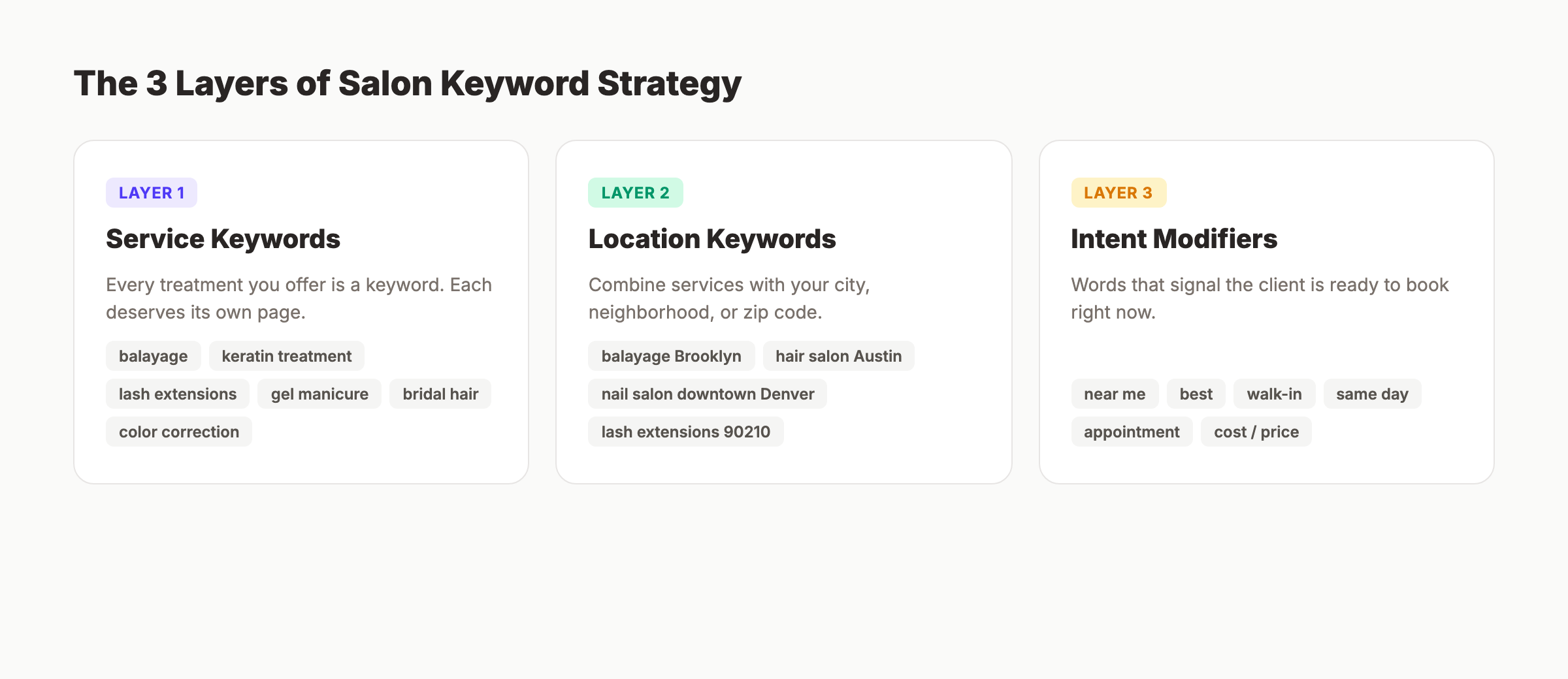
Keyword research for salons is different from other industries. Your clients search by service, by location, and by urgency. Understanding these 3 layers unlocks every page you need to build.
Service Keywords
These are the foundation. Every treatment you offer is a keyword.
| Keyword Type | Examples |
|---|---|
| Hair services | ”haircut,” “balayage,” “highlights,” “keratin treatment,” “blowout” |
| Nail services | ”manicure,” “pedicure,” “gel nails,” “acrylic nails,” “nail art” |
| Spa services | ”facial,” “waxing,” “lash extensions,” “microdermabrasion” |
| Specialty | ”bridal hair,” “hair extensions,” “silk press,” “color correction” |
Each of these services deserves its own page on your website. We cover that in Chapter 4.
Location Keywords
Salon SEO is local. Clients search with geographic intent.
Combine your service keywords with your city, neighborhood, or zip code. “Balayage Brooklyn” is a different keyword than “balayage Manhattan.” Both deserve separate pages if you serve both areas.
Use keyword research tools like Google Keyword Planner or free SEO tools to find exact search volumes. Focus on keywords with clear booking intent.
High-Intent Modifiers
The most profitable keywords include modifiers that signal a client is ready to book.
| Modifier | Example | Intent Level |
|---|---|---|
| ”near me" | "hair salon near me” | Very high |
| ”best" | "best colorist in Denver” | High |
| ”price/cost" | "balayage cost Chicago” | High |
| ”appointment" | "book hair appointment online” | Very high |
| ”walk-in" | "walk-in hair salon open now” | Immediate |
| ”same day" | "same day hair appointment” | Immediate |
Target 10 to 20 primary keywords for your salon. Map each one to a specific page. Do not try to rank one page for everything. That is the most common salon SEO mistake we see.
Your salon deserves full appointment books. Stacc publishes 30 SEO-optimized articles per month so clients find you on Google, not your competitor. Start for $1 →
Google Business Profile for Salons
Your Google Business Profile (GBP) is the single most important ranking factor for salon SEO. It determines whether you appear in the local pack — the map results that show above organic listings.
Claim and Complete Every Field
Start with the basics. Claim your profile at business.google.com if you have not already.
Complete every field Google offers. Your business name, address, phone number (NAP), website URL, hours, and service list all matter. Incomplete profiles rank lower. Google Business Profile optimization is not optional for salons.
Choose the right primary category. “Hair salon” is the most common, but select secondary categories too. If you also offer nail services, add “nail salon.” If you have an esthetician, add “skin care clinic.”
Add Every Service with Descriptions
Google lets you list individual services under your profile. Add every treatment you offer.
- Haircuts (women, men, children)
- Color services (balayage, highlights, single process, color correction)
- Treatments (keratin, deep conditioning, scalp treatments)
- Styling (blowout, updo, bridal party)
- Extensions (tape-in, sew-in, clip-in)
- Nail services (manicure, pedicure, gel, acrylic)
- Spa services (facial, waxing, lash extensions)
Include pricing where possible. Clients trust transparency. Google rewards completeness.
Photos That Convert Browsers to Bookings
Salons with 100+ photos on their GBP get 520% more calls than those with fewer than 10. Upload before-and-after photos of your best work. Show your salon interior, your stylists, and your products.
Post new photos weekly. Google rewards active profiles with better visibility. Tag photos with relevant descriptions like “balayage transformation” or “bridal updo.”
Google Posts for Salons
Use Google Posts to announce promotions, share seasonal specials, or highlight new services. A post about “20% off keratin treatments this month” turns a search into a booking.
Post at least once per week. Each post stays visible for 7 days. This signals to Google that your business is active and engaged.
On-Page SEO for Salon Websites
Your website is your digital salon. If it loads slowly, looks outdated, or fails to mention your services clearly, clients bounce and book elsewhere.
Build Individual Service Pages
This is the highest-impact on-page SEO move for any salon. Do not list all your services on a single page.
Create a dedicated page for each service category:
/services/balayage— targeting “balayage [city]”/services/haircuts— targeting “haircut [city]”/services/keratin-treatment— targeting “keratin treatment [city]”/services/bridal-hair— targeting “bridal hair [city]”/services/lash-extensions— targeting “lash extensions [city]”
Each page should include a description of the service, pricing, duration, what to expect, before-and-after photos, and a booking button. Write meta descriptions that include the service name and your city.
Title Tags and Headers
Your title tag is the first thing Google and clients see. Keep it under 60 characters. Include the service, your salon name, and your city.
| Page | Title Tag Example |
|---|---|
| Balayage | ”Balayage in Austin |
| Haircuts | ”Haircuts for Women & Men |
| Homepage | ”[Salon Name] — Hair Salon in [City]” |
Use H1 tags for your main page title. Use H2 and H3 tags for subsections. Google uses your heading structure to understand your content. Follow the on-page SEO best practices in every page you build.
Mobile Speed Matters
Over 60% of salon searches happen on mobile devices. If your website takes more than 3 seconds to load, you lose 53% of mobile visitors.
Check your Core Web Vitals score. Compress images. Use a fast hosting provider. Your salon software booking widget (Vagaro, Fresha, Booksy, GlossGenius) should load without slowing down the rest of the page.
Schema Markup for Salons
Add schema markup to your website. LocalBusiness schema tells Google your salon name, address, hours, and services in a structured format.
Use the schema markup generator to create the code. Add Service schema for each treatment page. This helps your listings appear with rich results like star ratings, price ranges, and service details in search.
30 SEO blog posts per month. Zero writing required. Stacc handles your salon content strategy so you can focus on your clients. Start for $1 →
Local SEO and the Map Pack
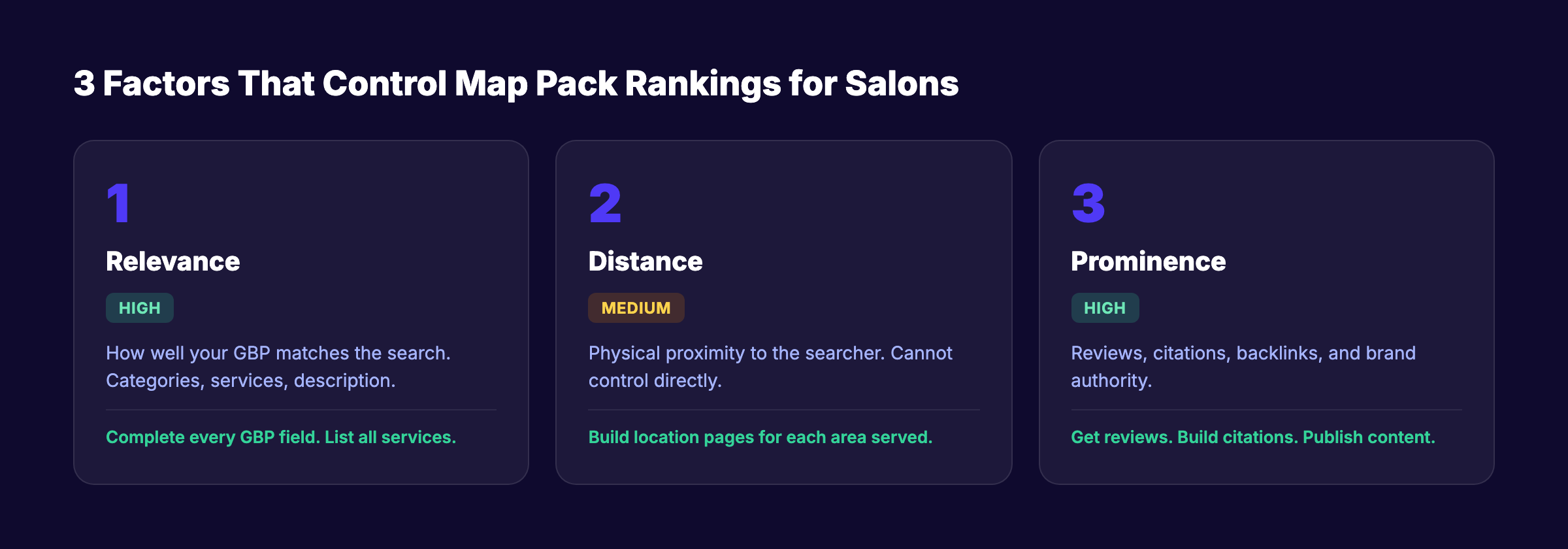
The map pack is the 3-business section that appears at the top of Google for local searches. For salons, ranking in the map pack means you appear above every organic result. That is where most bookings happen.
The 3 Factors That Control Map Rankings
Google ranks map pack results based on 3 factors:
- Relevance — How well your profile matches the search query
- Distance — How close your salon is to the searcher
- Prominence — How well-known and trusted your salon is online
You cannot change your location. But you can control relevance and prominence. That means optimizing your GBP, building citations, earning reviews, and creating local content.
Build Consistent Citations
A citation is any online mention of your salon name, address, and phone number. Consistency across every listing is critical.
Submit your salon to these directories:
- Google Business Profile
- Yelp
- Apple Maps
- Facebook Business
- Bing Places
- Salon-specific directories (StyleSeat, Booksy, Vagaro)
- Local chamber of commerce
- City business directories
Your NAP must be identical everywhere. “123 Main St” and “123 Main Street” count as inconsistent. Use local SEO tools to audit and fix citation inconsistencies.
Location Pages for Multi-Location Salons
If your salon has more than one location, build a dedicated page for each. Include the location address, embedded Google Map, unique content about that specific salon, team photos, and neighborhood-specific keywords.
A salon with 3 locations in Dallas should have /locations/uptown-dallas, /locations/deep-ellum, and /locations/plano. Each page targets that neighborhood. This is standard local SEO practice, and it works.
Earning Local Backlinks
Backlinks from local websites boost your prominence signal. Partner with local wedding planners, photographers, and event venues. Sponsor a local charity event. Get featured in a local lifestyle blog.
Each link from a trusted local website tells Google your salon is a real, respected business in the community. Focus on quality over quantity. One link from your city newspaper is worth more than 50 links from random directories.
Content Marketing for Salons
Blogging is the most underused salon SEO strategy. Most salons have zero blog posts. That is an enormous advantage for the ones that start.
What to Write About
Salon clients search for answers before they book. Blog posts capture that traffic and funnel it toward your booking page.
| Content Type | Topic Examples |
|---|---|
| Service education | ”What is balayage vs highlights?” “How long does a keratin treatment last?” |
| Aftercare guides | ”How to maintain colored hair” “Gel manicure aftercare tips” |
| Seasonal content | ”Best fall hair colors 2026” “Summer hair protection tips” |
| Local guides | ”Best bridal hair salons in [city]” “Where to get lash extensions in [city]“ |
| Trend content | ”Hair trends for 2026” “Most popular nail designs this season” |
Write for search intent. Someone searching “how to maintain balayage” wants education. Someone searching “balayage near me” wants to book. Match your content to the intent.
How Often to Publish
Consistency matters more than volume. But volume helps.
Publishing 1 blog post per month is a start. Publishing 4 per month is better. Publishing 30 per month with a service like Stacc is how salons build topical authority fast.
The Content Compound Effect is real. Your 10th article builds on the authority of your first 9. By month 6, your salon website becomes the local resource Google trusts most.
Internal Linking Strategy
Every blog post should link to your service pages. Every service page should link to related blog posts. This internal linking web helps Google understand your site structure and passes authority between pages.
A blog post about “how to maintain colored hair” should link to your color services page. Your color services page should link back to that blog post. Both pages become stronger.
Reviews and Reputation Management
Reviews are the rocket fuel of salon SEO. Google weighs review quantity, quality, recency, and keywords when ranking local results. Salons with more 5-star reviews rank higher. Period.
How to Get More Reviews
Do not wait for clients to leave reviews on their own. Less than 10% will. You need a system.
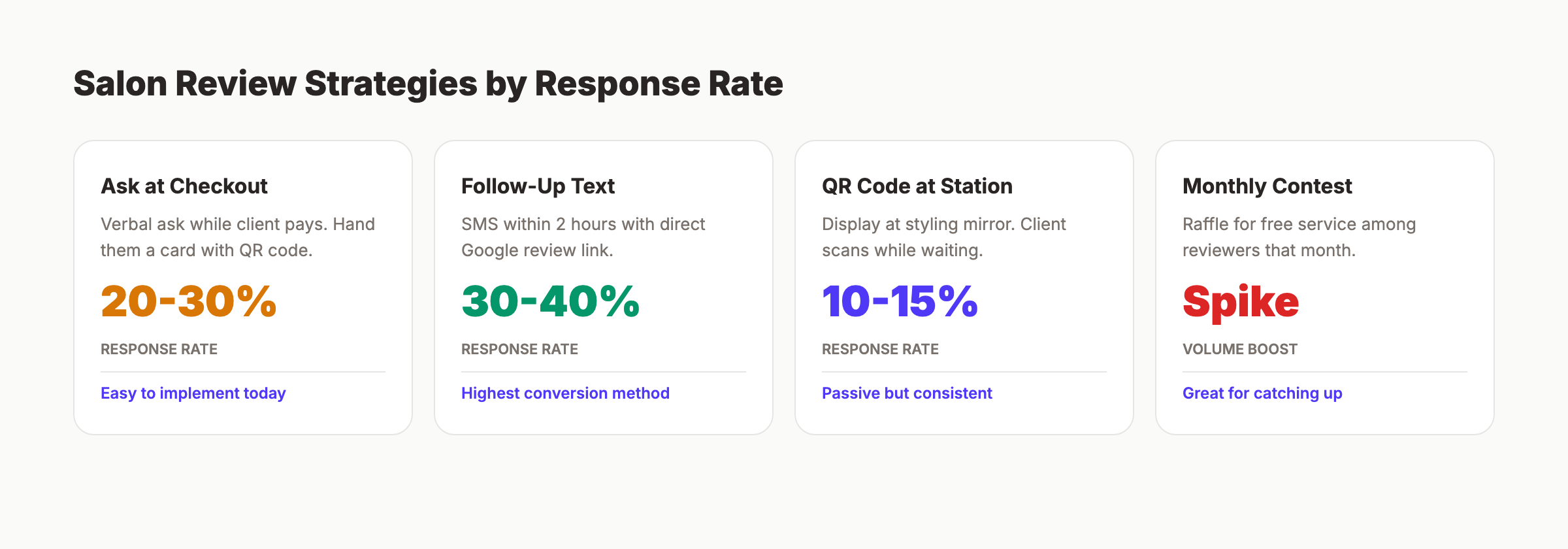
Ask every client at checkout. Send a follow-up text or email with a direct link to your Google review page. Use the review request generator to create templates that work.
Timing matters. Ask within 2 hours of the appointment while the client still feels great about her fresh color or blowout.
| Review Strategy | Expected Impact |
|---|---|
| Ask at checkout | 20-30% response rate |
| Follow-up text within 2 hours | 30-40% response rate |
| QR code at styling station | 10-15% response rate |
| Monthly review contest | Spikes in volume |
Respond to Every Review
Google confirms that responding to reviews improves your local ranking. Respond to every review — positive and negative.
For positive reviews, thank the client by name and mention the service. “Thank you Sarah! We loved doing your balayage. See you in 8 weeks!”
For negative reviews, stay professional. Acknowledge the concern. Offer to make it right offline. Never argue. Use the review response generator for templates.
Reviews with Keywords Rank Better
A review that says “Best balayage in Austin, love this salon!” helps you rank for “balayage Austin.” You cannot tell clients what to write. But you can guide them.
Ask specific questions in your review request. “What service did you love most?” or “How was your experience with [stylist name]?” Specific prompts generate reviews with natural keyword mentions.
Read our full guide on how to get more Google reviews for a step-by-step system.
Rank in your city. Book more clients. Stacc combines blog SEO and local SEO so your salon shows up everywhere clients search. Start for $1 →
Social Media and SEO for Salons
Social media does not directly improve your Google rankings. But it supports your salon SEO strategy in 3 indirect and powerful ways.
Social Profiles Rank for Your Brand Name
When someone searches your salon name, your Instagram, Facebook, and TikTok profiles often appear on page 1. Optimized social profiles with your salon name, address, services, and booking link create a wall of branded results.
This builds trust. A client who sees your website, Google profile, Instagram, and Facebook all appearing for your salon name is more likely to book.
Before-and-After Content Drives Branded Searches
Salon content thrives on visual platforms. A viral before-and-after balayage transformation can drive hundreds of people to Google your salon name.
Those branded searches (people searching “[your salon name]”) are a strong ranking signal. Google sees demand for your brand and rewards you with better visibility for non-branded searches too.
Post your best transformations on Instagram Reels and TikTok. Tag your location. Use service-specific hashtags. Then repurpose that content for social media across all your platforms.
Social Proof Supports Conversion
A strong social media presence does not replace SEO. But it supports the conversion that SEO drives.
A client finds you on Google. She clicks through to your website. She checks your Instagram. She sees 500 before-and-after photos, active engagement, and happy clients. She books.
Without that social proof, she might hesitate. With it, the booking feels like a safe choice. Use social media automation tools to stay consistent without spending hours on content every week.
Measuring Results and ROI
Salon SEO is not a guessing game. Every strategy in this guide is measurable. Track the right numbers and you will know exactly what is working.
Set Up Google Analytics and Search Console
Install Google Analytics 4 on your salon website. Set up Google Search Console to track your keyword rankings and click-through rates.
Both tools are free. Both are essential. Without them, you are optimizing blind.
Key Metrics for Salon SEO
| Metric | What It Tells You | Tool |
|---|---|---|
| Organic traffic | How many people find you via Google | Google Analytics |
| Keyword rankings | Where you rank for target keywords | Search Console |
| GBP views | How many people see your profile | GBP Insights |
| GBP actions | Calls, directions, website clicks | GBP Insights |
| Booking conversions | How many visitors become clients | Salon software (Vagaro, Fresha) |
| Review count/rating | Reputation strength | GBP Dashboard |
How Long Does Salon SEO Take?
Most salons see measurable ranking improvements within 3 to 6 months. Google Business Profile changes can show results within weeks. Blog content typically takes 60 to 90 days to index and rank.
Read our guide on how long SEO takes for realistic timelines.
The key is consistency. Salons that publish content every week, earn reviews every month, and keep their GBP updated see the fastest results. The ones that optimize once and stop see their rankings decay.
Calculating Your SEO ROI
Use the SEO ROI calculator to estimate the return on your SEO investment.
A simple formula: multiply your monthly organic bookings by your average service value. If SEO drives 20 new bookings per month at an average of $120 each, that is $2,400 per month in revenue from SEO alone.
Compare that to what you spend. A done-for-you SEO service at $99 per month that generates $2,400 in bookings delivers a 24x return. That math is hard to argue with.
Use our full framework for measuring content marketing ROI to build your tracking dashboard.
FAQ
How much does salon SEO cost?
DIY salon SEO costs nothing but your time. Professional SEO services for salons range from $99 to $500 per month for content and local SEO. Traditional agencies charge $1,000 to $5,000 per month. A service like Stacc publishes 30 SEO articles per month for $99, making it one of the most affordable options for salon owners who do not want to write content themselves.
What are the best keywords for a hair salon?
The best salon keywords combine your services with your location. Examples include “hair salon [city],” “balayage [city],” “keratin treatment near me,” “bridal hair [city],” and “best colorist [city].” Long-tail keywords like “walk-in haircut [city]” and “same-day hair appointment [city]” capture clients ready to book immediately.
How long does it take for salon SEO to work?
Google Business Profile optimizations can show results within 2 to 4 weeks. On-page SEO improvements typically take 60 to 90 days. A full content strategy takes 3 to 6 months to build meaningful organic traffic. Consistency is the variable that separates salons that rank from those that do not.
Do I need a blog for my salon website?
Yes. A blog is the fastest way to rank for informational keywords your clients search. Topics like “how to maintain colored hair,” “balayage vs highlights,” and “best hair products for extensions” drive traffic to your website. That traffic converts into bookings. Salons without blogs compete on GBP and service pages alone, which limits their keyword reach.
Can I do salon SEO myself?
You can. Start with your Google Business Profile, build service pages, and ask every client for a review. Those 3 actions alone will improve your visibility. For content marketing, keyword research, and ongoing optimization, most salon owners either hire help or use a service. Running a salon and running an SEO strategy at the same time is difficult. That is why done-for-you options exist.
Is Instagram better than SEO for salons?
They serve different purposes. Instagram is great for showcasing your work and building a brand. SEO captures clients who are actively searching for a salon right now. The highest-performing salons use both. Instagram builds awareness. SEO captures demand. Together, they fill your appointment book from both directions.
Your Next Move
Salon SEO is not complicated. It requires consistency, not expertise.
Start with your Google Business Profile. Build service pages for your top 5 treatments. Ask every client for a review this week. Those 3 steps alone will move the needle within 30 days.
If you want the content, the blog posts, and the local SEO handled for you, Stacc publishes 30 articles per month starting at $99. Your salon shows up on Google. You focus on your clients.
Rank everywhere your clients search. Blog SEO and local SEO, done for you, every month. Start for $1 →
Written and published by Stacc. We publish 3,500+ articles per month across 70+ industries. All data verified against public sources as of March 2026.