The complete SEO action plan template for 2026. Month-by-month 90-day roadmap with specific tasks, milestones, and realistic timelines. Free to use.
An SEO action plan fails when tasks have no sequence and no owner. This 90-day template sets the order: audit and technical fixes first, keyword and content mapping next, then link building and reporting, with a named owner and an expected milestone at each stage.
Most SEO plans fail before day 30. Not because the strategy was wrong. Because the plan had no sequence. Every task felt equally important, nothing had a clear owner, and the site stagnated.
A real SEO action plan tells you exactly what to do, in what order, and what to expect at each milestone. This template covers the full 90-day roadmap. From the first audit on day 1 to compounding content authority by day 90.
The 90-day window is not arbitrary. According to Semrush's ranking timeline data, most established websites see initial keyword movement within 30-90 days when technical issues are resolved early. New sites and domains take longer, but the sequence is the same.
In this guide, you will get:
- A week-by-week SEO action plan for months 1, 2, and 3
- Specific tasks for each phase with time estimates
- The metrics to track at day 30, 60, and 90
- The 5 biggest mistakes that destroy results in the first 90 days
- A printable week-by-week template you can copy and use today
We have published 3,500+ SEO articles across 70+ industries. The roadmap below reflects what actually moves rankings. Not what looks good in a strategy deck.
Table of Contents
- Chapter 1: Why Most 90-Day SEO Plans Fail
- Chapter 2: Before Day 1. Pre-Launch Setup
- Chapter 3: Month 1 (Days 1-30). Fix the Foundation
- Chapter 4: Month 2 (Days 31-60). Content and Trust
- Chapter 5: Month 3 (Days 61-90). Scale and Compound
- Chapter 6: What NOT to Do in Your First 90 Days
- Chapter 7: Week-by-Week Action Template
- Chapter 8: What to Expect at Day 30, 60, and 90
Chapter 1: Why Most 90-Day SEO Plans Fail
The most common 90-day SEO plan looks like this: audit in week 1, publish content in weeks 2-4, build links in month 2, "optimize" in month 3. The problem is that none of these phases are sequenced correctly.
You cannot effectively publish content on a site with uncrawled pages. You cannot build links worth keeping if the page they point to has a thin content problem. Order matters more than effort.
Three real SEO shifts in 2026 make sequence even more critical:
Change #1: Google's Content Quality Threshold Rose Google's March 2026 Core Update penalized 55% of monitored sites for thin AI content, weak E-E-A-T, and pages with no verifiable author credentials. Publishing content before your site has proper author attribution and a credible about page now actively hurts rankings. What to do: Set up author pages and site authority signals before any content goes live.
Change #2: Technical Issues Compound Faster Google's indexing pipeline now processes content faster. But also applies quality signals earlier. A page with a Core Web Vitals failure, a missing canonical, or a crawl error gets suppressed before it ever earns a ranking. What to do: Clear all technical issues in month 1, before writing a single new piece of content.
Change #3: AI Search Signals Matter for Discoverability Pages cited by AI Overviews, Perplexity, and ChatGPT web search share specific structural traits. FAQ schema, semantic HTML, author credentials. These signals are built in, not added later. What to do: Build AI visibility into every page from the start, not as a retrofit.
Chapter 2: Before Day 1. Pre-Launch Setup
Running an SEO plan without a measurement system is like driving without a speedometer. You might be going the right direction, but you have no idea how fast or slow.
Set these up before anything else:
Measurement and Tracking
- ✓ Google Search Console verified and all properties connected
- ✓ Google Analytics 4 installed with organic source/medium filter saved
- ✓ Baseline pulled: current organic impressions, clicks, and average position from GSC
- ✓ Top 20 target keywords recorded with current rankings (screenshot or spreadsheet)
- ✓ Core Web Vitals scores recorded for homepage, top category page, and a content page
Benchmark Documentation
Record today's numbers. Every decision in months 2 and 3 depends on knowing what month 1 looked like. A 15% traffic increase from 200 to 230 monthly sessions is invisible without the baseline.
Baseline Template:
| Metric | Today | Day 30 | Day 60 | Day 90 |
|---|---|---|---|---|
| Organic sessions/month | __ | __ | __ | __ |
| GSC total impressions | __ | __ | __ | __ |
| Total pages indexed | __ | __ | __ | __ |
| Average GSC position | __ | __ | __ | __ |
| Domain rating / authority | __ | __ | __ | __ |
| Number of ranking keywords | __ | __ | __ | __ |
Copy this into a Google Sheet. Update it at the end of each month. Use the SEO ROI calculator to convert ranking improvements into revenue estimates when reporting to clients or stakeholders.
Chapter 3: Month 1 (Days 1-30). Fix the Foundation
Month 1 is not about traffic. It is about removing every technical and structural barrier that prevents Google from finding, understanding, and trusting your content.
Every hour spent publishing new content on a broken technical foundation is wasted. Fix the foundation first.
Week 1: The Technical Audit
Run a complete SEO audit using the SEO audit template and checklist. Every Tier 1 issue found must be fixed this week.
Tier 1 issues to resolve in week 1:
- ✓ Pages incorrectly set to
noindex - ✓ Key pages blocked in
robots.txt - ✓ SSL certificate errors or HTTP not redirecting to HTTPS
- ✓ Broken internal links on top-traffic pages
- ✓ Duplicate title tags and missing meta descriptions on main pages
- ✓ Core Web Vitals failures on homepage and key landing pages
The technical SEO checklist covers every item with specific tools and fix instructions. Budget approximately 8-12 hours for a site with 50-200 pages.
Week 2: Keyword Architecture
Before publishing any content, map your keyword targets. Every page needs a primary keyword, a clear intent match, and no internal competition from other pages targeting the same term.
Run keyword research to build a master list organized by:
- Search intent (informational / commercial / transactional)
- Competition level (low / medium / high)
- Topical cluster (group related keywords under a hub page)
Focus month 1 on low-competition informational keywords. These rank fastest and build topical authority that helps your commercial pages later.
Week 3: On-Page Optimization of Existing Content
Before publishing a single new page, optimize your 10 most important existing pages:
- ✓ Title tags updated to include primary keyword in first 4 words
- ✓ Meta descriptions rewritten to 145-155 characters with a benefit hook
- ✓ H1 includes exact or close variant of the primary keyword
- ✓ One strong internal link added from each page to the next-most-relevant page
- ✓ Images updated with descriptive alt text
The on-page SEO guide covers the exact optimization sequence. Improving 10 existing pages takes less time than writing 3 new ones. And generates faster results if those pages already have impressions in Google Search Console.
Week 4: Site Authority Setup
- ✓ About page updated with real team members, credentials, and company history
- ✓ Author bio pages created for every content author on the site
- ✓ Contact page includes phone, address (if local), and response time
- ✓ Privacy policy and terms updated with current date
- ✓ Schema markup implemented on homepage (
OrganizationorLocalBusiness)
Stop writing. Start ranking. theStacc handles 30 SEO articles per month automatically. So your content month starts from day 1 without a writing team.
Chapter 4: Month 2 (Days 31-60). Content and Trust
Month 2 is where most plans either gain momentum or die. The sites that start ranking in month 2 are the ones that fixed their foundations in month 1 and now have a clear, executable content plan.
Week 5-6: Content Production
Launch the content plan built in week 2. The formula for month 2 content:
- 4-8 new informational articles targeting low-competition keywords in your topical cluster
- Each article: 1,500-3,000 words, clear keyword focus, internal links to related hub pages
- Structure every post with FAQ schema, clear H2 sections, and an author byline
Do not write generic content. Every article should address a specific query with a specific audience. Read the blog SEO guide for the exact optimization process for each post.
Month 2 content calendar template:
| Week | Article Topic | Target Keyword | Intent | Word Count |
|---|---|---|---|---|
| Week 5 | [Your topic] | [keyword] | Informational | 2,000 |
| Week 5 | [Your topic] | [keyword] | Informational | 2,000 |
| Week 6 | [Your topic] | [keyword] | Informational | 2,500 |
| Week 6 | [Your topic] | [keyword] | Informational | 1,800 |
| Week 7 | [Your topic] | [keyword] | Commercial | 2,200 |
| Week 7 | [Your topic] | [keyword] | Informational | 2,000 |
| Week 8 | [Your topic] | [keyword] | Commercial | 3,000 |
| Week 8 | [Your topic] | [keyword] | Informational | 1,500 |
Week 7: Backlink Outreach
Link building in month 2 focuses on low-effort, high-relevance opportunities:
- ✓ Identify 10-15 broken links on competitor or resource pages pointing to dead content you can replace
- ✓ Find 5-10 unlinked brand or product mentions using Google (
"[your brand]" -site:yourdomain.com) - ✓ Reach out to 3-5 industry blogs for guest post opportunities
- ✓ Submit your site to 3-5 high-quality industry directories
Run a backlink audit to understand your current link profile before building new ones.
Week 8: Topical Authority Building
The most underrated tactic in month 2 is internal linking architecture. Pages that link to each other within a topic cluster rank faster than orphan pages publishing standalone content.
- ✓ Every article published in weeks 5-6 links to at least 2 related articles
- ✓ Hub/category page links to all cluster content
- ✓ Each new article includes an internal link to a commercial/product page (when relevant)
The topical authority guide covers the full cluster architecture approach.
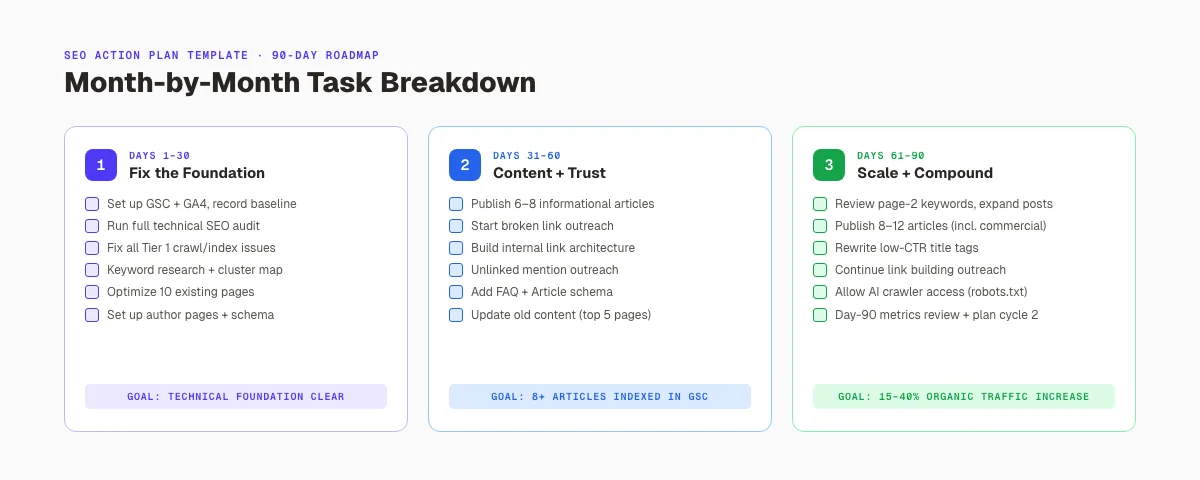
Chapter 5: Month 3 (Days 61-90). Scale and Compound
Month 3 is where the compounding starts. Technical issues are resolved. Content is indexed. Early ranking signals are visible in Search Console.
Month 3 focuses on amplifying what is working and cutting what is not.
Week 9-10: Performance Review and Doubling Down
Pull your month 2 data:
- ✓ Which keywords moved from page 3+ to page 2 in GSC?
- ✓ Which articles have impressions but low CTR (under 3%)?
- ✓ Which pages are indexed but not appearing for any query?
For keywords on page 2: add more depth to the corresponding article. Expand by 500-1,000 words, add a table or checklist, and add 2 more internal links from other relevant pages.
For articles with impressions but low CTR: rewrite the title tag and meta description as ad copy. The website SEO score checker identifies CTR optimization opportunities automatically.
Week 11: Scale Content Production
If month 2 content is generating impressions (visible in GSC within 14-21 days of publishing), month 3 is the time to double output:
- Target 8-12 articles in weeks 11-12 if resources allow
- Focus on commercial-intent keywords now that informational authority is building
- Publish at least 2 long-form pillar pieces (3,000+ words) targeting high-volume keywords in your cluster
For agencies and businesses publishing at scale, automating the SEO workflow covers the systems that sustain month 3+ publishing cadence without burning out.
Week 12: Link Authority and AI Visibility
- ✓ Submit top 5 new articles to relevant industry newsletters or communities
- ✓ Add
FAQPageschema to every article containing a FAQ section - ✓ Add
Articleschema with author entity to all new posts - ✓ Verify
robots.txtallows GPTBot and PerplexityBot (for AI citation potential) - ✓ Check that all new content uses semantic HTML5 elements (
<article>,<section>)
3,500+ blogs published. Every article is SEO-scored before publish. theStacc delivers the content velocity that month 3 requires: 30 articles per month, fully optimized, automatically published. See what theStacc does →
Chapter 6: What NOT to Do in Your First 90 Days
Every experienced SEO professional has a list of mistakes they made before learning these the hard way. Skip the hard part.
Stop doing this: Publishing content before fixing technical issues Content published on a site with crawl errors, noindex problems, or Core Web Vitals failures does not rank. Fix technical issues in week 1, then publish. Sequence matters. Do this instead: Run the full SEO audit checklist before publishing anything new.
Stop doing this: Targeting high-competition keywords in month 1 A domain with a low authority score has zero chance of ranking page 1 for "best CRM software." Competing on high-volume terms before building authority is wasted effort. Do this instead: Target keywords with under 20 keyword difficulty in your topical cluster. Build authority first, compete on high-volume terms in months 4-6.
Stop doing this: Publishing thin content to hit a volume target Google's March 2026 Core Update specifically penalized sites that published high volumes of short, low-value AI-generated content. 30 thin articles hurt more than 8 strong ones. Do this instead: Set a word count floor of 1,500 words minimum. Every article must answer the query more completely than the current page-1 result.
Stop doing this: Building links before content is indexed A backlink to a page that is not indexed is a wasted resource. Worse, aggressive link building to very new content can trigger spam filters. Do this instead: Wait until week 6-7 (after technical issues are resolved and content has had 2-3 weeks to index) before starting any link building outreach.
Stop doing this: Reporting on traffic before day 60 Organic traffic in the first 60 days is not a reliable success signal. Impression and indexation growth are the right metrics for months 1-2. Do this instead: Track GSC impressions and indexed page count in months 1-2. Traffic tracking only becomes meaningful in month 3.
Chapter 7: Week-by-Week Action Template
Copy this template into a Google Sheet or Notion and assign owners and due dates for each task.
Month 1: Foundation
| Week | Task | Owner | Hours | Status |
|---|---|---|---|---|
| Week 1 | Set up Google Search Console + GA4 | , | 2 | , |
| Week 1 | Record baseline metrics | , | 1 | , |
| Week 1 | Run full technical SEO audit | , | 6-10 | , |
| Week 1 | Fix all Tier 1 technical issues | , | 4-8 | , |
| Week 2 | Build keyword research spreadsheet | , | 4-6 | , |
| Week 2 | Map keyword clusters + hub pages | , | 2-3 | , |
| Week 3 | Optimize top 10 existing pages | , | 4-6 | , |
| Week 3 | Update internal linking on existing posts | , | 2-3 | , |
| Week 4 | Update About page + author pages | , | 2 | , |
| Week 4 | Add homepage schema markup | , | 1 | , |
Month 2: Content and Trust
| Week | Task | Owner | Hours | Status |
|---|---|---|---|---|
| Week 5 | Publish 2 new informational articles | , | 6-10 | , |
| Week 6 | Publish 2 new informational articles | , | 6-10 | , |
| Week 7 | Start backlink outreach (broken links) | , | 3-4 | , |
| Week 7 | Publish 2 new articles | , | 6-10 | , |
| Week 8 | Build internal link architecture | , | 2-3 | , |
| Week 8 | Publish 2 new articles + 1 pillar | , | 8-12 | , |
Month 3: Scale and Compound
| Week | Task | Owner | Hours | Status |
|---|---|---|---|---|
| Week 9 | Pull GSC data, identify page-2 keywords | , | 2 | , |
| Week 9 | Expand 2-3 articles with low CTR | , | 4-6 | , |
| Week 10 | Publish 4 new articles | , | 10-16 | , |
| Week 10 | Continue backlink outreach | , | 3-4 | , |
| Week 11 | Publish 4-6 articles | , | 12-18 | , |
| Week 11 | Add FAQ + Article schema to all new posts | , | 2 | , |
| Week 12 | Final metrics review + month 4 planning | , | 3-4 | , |
| Week 12 | Submit content to communities/newsletters | , | 2 | , |
Total estimated hours: 85-130 hours over 90 days (roughly 1-1.5 full work days per week)
Chapter 8: What to Expect at Day 30, 60, and 90
Setting realistic expectations at each milestone prevents the common outcome of abandoning a plan at day 45 because "SEO is not working."
Day 30 Checkpoint
You should see:
- All Tier 1 technical issues resolved
- GSC showing increased crawl activity (more URLs in coverage report)
- 10+ existing pages with updated title tags and on-page optimization
- Keyword tracking spreadsheet baseline established
You should NOT expect:
- Traffic increases
- New keyword rankings
- Any measurable organic growth
Day 30 is not a traffic milestone. It is a foundation milestone.
Day 60 Checkpoint
You should see:
- 8-12 new articles indexed in Google
- GSC impressions trending upward (even if clicks are flat)
- 2-5 target keywords moving from page 3+ to page 2
- Domain authority metric starting to increase (slowly)
Realistic traffic change: 0-15% increase from month 1 baseline. Early movers (technical fixes that resolved crawl blocks) may show larger gains.
Day 90 Checkpoint
You should see:
- 15-25 new articles indexed and generating impressions
- 3-8 target keywords appearing on page 1 or page 2
- Organic traffic up 15-40% from day 1 baseline (for established sites)
- Clear pattern of which content types perform best for your audience
According to Backlinko's ranking data, the average first-page result contains 1,447 words. Sites publishing consistently above that threshold rank faster in competitive clusters.
New websites (under 6 months old) should expect more modest results. Initial keyword movement is slower on new domains. The 15-40% traffic improvement benchmark applies to established sites with existing traffic. New sites may see their first meaningful organic traffic closer to day 90-120.
Your SEO team. $99/month. theStacc handles the ongoing publishing and optimization that months 2 and 3 require: 30 articles per month, automatically delivered.
What practitioners are saying on X
AI search advice ages quickly. Here is high-signal public discussion from SEO and growth operators — context for your roadmap, not a substitute for primary data.
- @hridoyreh (Mar 2026): Widely shared SEO skill tree: foundations, research, technical, on-page, content, links, AI SEO/GEO, analytics, UX, brand, programmatic — useful map for stats and how-to posts. See the post on X.
- @jakezward (Feb 2026): 2026 SEO predictions emphasize AI Overview share-of-SERP, schema for LLM token efficiency, brand mentions in AI answers as a KPI, proprietary data as a moat, and content refresh beating net-new AI slop. See the post on X.
Grok, AI Overviews, and multi-engine visibility
For “seo action plan template”, multi-engine visibility still starts with clear definitions, sourced numbers, and extractable section answers. Grok additionally factors live X discussion — keep public claims consistent with this page.
- Google AI Overviews: Use passage-ready answers, tables, and FAQ schema where relevant.
- ChatGPT / Perplexity: Cite named sources next to key claims.
- Grok: Maintain accurate entity facts on-site and in high-signal X posts.
Publish content built for Google and AI citations. theStacc’s Content SEO module ships SEO-scored articles structured for rankings and generative engines — including clearer entity pages models like Grok can quote.
FAQ
Initial keyword movement (page 3 → page 2) is visible within 30-60 days on established sites. Organic traffic growth typically starts at day 60-90, with 15-40% improvements common by the end of 90 days. New websites see earlier indexation but slower ranking movement. Meaningful traffic growth for new sites is more typically a 4-6 month process.
An SEO strategy defines the direction. Which keywords to target, which audience to reach, which content types to publish. An SEO action plan translates that strategy into specific tasks, sequences, and timelines. A strategy without an action plan stays theoretical. This template is the action plan layer. Plug your strategy into the task framework and execute.
Month 1: 0 new articles (focus on technical fixes and optimizing existing content). Month 2: 6-8 articles targeting informational keywords. Month 3: 8-12 articles mixing informational and commercial intent. Quality matters more than volume. A 2,000-word article that ranks on page 1 outperforms 10 thin posts that never get indexed.
No. This template is designed for in-house marketing teams, business owners, and solo operators. The technical audit requires some familiarity with Google Search Console. The content production can be handled with a white label content service if writing capacity is limited. See the white label SEO content guide for how agencies and businesses automate the production layer without hiring.
Free tools cover most of the plan: Google Search Console (crawl data, rankings, indexation), Google Analytics 4 (traffic), Google PageSpeed Insights (Core Web Vitals), and the free website SEO score checker. A paid keyword research tool (Ahrefs, Semrush) is useful for week 2 keyword mapping but not required. Total tool cost for the full 90 days can be $0.
Day 90 is a checkpoint, not a finish line. Use the day 90 data to plan months 4-6: double down on the content types with the best impression-to-click ratios, accelerate link building on pages now ranking page 2, and expand into adjacent keyword clusters. The compounding effect of SEO means months 4-6 typically generate 2-3× the ranking movement of months 1-3.
A 90-day SEO plan works when every action happens in the right order. Fix the foundation before publishing. Publish before link building. Measure before scaling.
The sites that compound search traffic over time are not doing anything exotic. They are executing this sequence consistently, updating their content regularly, and building links to pages that deserve to rank.
The content production piece: 30 articles per month in months 2 and 3. Is where most plans stall. theStacc handles that layer automatically, so the plan keeps moving even when internal capacity runs low.
Related Tools & Resources
Free SEO Tools:
Best Lists:
Sources & references
- [1] Princeton / Georgia Tech et al. — GEO research (arXiv:2311.09735)
- [2] @hridoyreh on X — Widely shared SEO skill tree: foundations, research, technical, on-page, content, links, AI SEO/GEO, analytics, UX, bran
- [3] @jakezward on X — 2026 SEO predictions emphasize AI Overview share-of-SERP, schema for LLM token efficiency, brand mentions in AI answers
- [4] Referenced source — www.semrush.com

Plan topics, review article drafts, and publish to a connected CMS.
Weekly local SEO teardowns
One practical email a week. Map Pack, GBP, AI Overviews — no fluff. Unsubscribe anytime.