An SEO content template for writers in 7 chapters: keyword mapping, heading structure, EEAT signals, schema, and a reusable content brief.
Most writers know SEO matters. Few have a consistent template that turns that knowledge into repeatable, rankable content.
An SEO content template is a documented structure writers follow on every article: keyword placement, heading hierarchy, a content brief, EEAT signals, schema markup, and a pre-publish checklist. 94% of SEO content gets zero organic traffic from Google, and the gap is usually structure rather than quality.
94% of SEO content gets zero organic traffic from Google. The gap between content that ranks and content that disappears is not quality. It is structure. Writers who follow a documented SEO content template outperform those who improvise every article, every time.
This guide walks through every element of a working SEO content template for writers: from keyword placement to heading hierarchy, content briefs, EEAT signals, schema markup, and a pre-publish checklist you can use on every piece.
We have published 3,500+ SEO articles across 70+ industries. This guide covers what actually works.
Here is what you will learn:
- The 9 essential elements every SEO template must include
- How to write content briefs that eliminate revision cycles
- Templates by page type. Blog, product, location, guide
- How to integrate EEAT and schema markup from the start
- A pre-publish SEO checklist writers can use without SEO expertise
Chapter 1: What Is an SEO Content Template. And Why Writers Need One
An SEO content template is a documented structure that guides a writer through every element required for a piece to rank. It specifies the keyword targets, heading hierarchy, word count, internal links, meta fields, tone, and quality standards before a single word of body copy is written.
The alternative is guessing. Writers who receive only a title and a keyword produce content that is either too thin, structured incorrectly, misses secondary keywords, or lacks the signals Google uses to assess quality and relevance.
Why Templates Outperform Ad Hoc Briefs
Templates force decisions upfront. Instead of discovering mid-draft that the target keyword changes the entire angle, the template locks in the keyword, the intent, the structure, and the format before writing begins.
According to Semrush research, 82.7% of content teams rely on content briefs to guide their writers. The teams that skip this step spend more time on revisions and produce less consistent output.
A good template also creates institutional knowledge. When a new writer joins, the template teaches the standard. When an experienced writer drifts, the template pulls them back. Build it once. Use it for every piece.
What a Template Is Not
A template is not a rigid script. It defines the structure, not the sentences. The writer's voice, the specific examples, and the quality of reasoning are all still human work. The template ensures that human work lands in the right format for Google to interpret and rank it correctly.
Chapter 2: The 9 Core Elements of Every SEO Content Template
Every SEO content template. Regardless of page type. Must include these 9 elements. Skip any one of them and the content is incomplete before it is published.
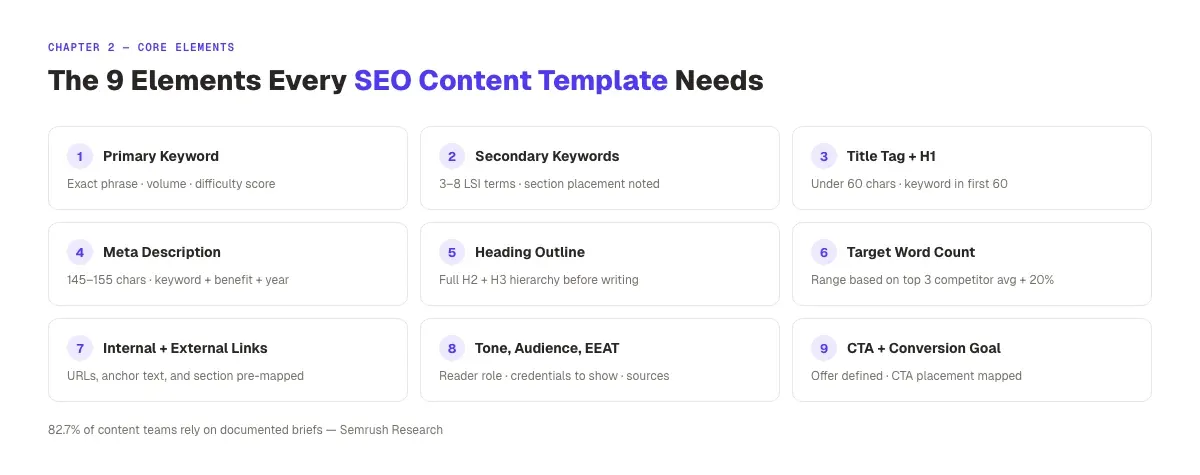
Element 1: Primary Keyword
The one keyword the page is being built to rank for. Include the exact phrase, its monthly search volume, and the keyword difficulty score. Writers need this to know where the term must appear: title, H1, first 100 words, at least one H2, and meta description.
Document it as: Primary keyword: [exact phrase] | Volume: [X] | Difficulty: [X/100]
Element 2: Secondary Keywords and LSI Terms
3-8 related keywords that support the primary term. These appear naturally in the body. Writers do not force them, but they know to include them. Include the rough section where each secondary keyword fits best.
Use the keyword research for blog posts framework to build a complete keyword map before writing.
Element 3: Title Tag and H1
The title tag (under 60 characters) appears in Google search results. The H1 appears on the page. They can differ. But both must contain the primary keyword within the first 60 characters.
Document the target: Title tag: [under 60 chars] | H1: [on-page variant]
Use the headline analyzer tool to score headline strength before finalizing.
Element 4: Meta Description
145-155 characters. Include the primary keyword, a clear benefit statement, and a freshness signal (year or "Updated [Month]"). This field does not directly affect rankings. But it directly affects click-through rate, which does.
Element 5: Heading Structure (H2 and H3 Outline)
The full heading hierarchy before writing begins. Each H2 should represent a major section. Each H3 should represent a subsection under its parent H2. Writers should never need to decide the heading structure. The template decides it.
Document as a nested list: H2: [section title] → H3: [subsection] → H3: [subsection]
A strong blog post structure for SEO maps every heading before writing starts.
Element 6: Target Word Count
Include a range, not a single number. Base it on competitor analysis: the average word count of the top 3 ranking pages for the target keyword, plus 20-30%. Include the minimum and maximum.
Document as: Word count: [minimum] to [maximum] | Competitor avg: [X]
See our guide on blog post length for SEO to understand how word count affects rankings by content type.
Element 7: Internal and External Links
Pre-identify every internal link the writer should include. Include the exact URL, the anchor text, and the section where it belongs. Do the same for 2-3 external authority sources.
Writers should not hunt for links mid-draft. Links identified in the template are links that actually get placed. See the internal linking strategy guide for how to build a complete link map.
Element 8: Tone, Audience, and EEAT Signals
Define the reader: experience level, role, primary question they are trying to answer. Define the tone: practical, expert, conversational, formal. Define the EEAT signals the writer should demonstrate. Specific credentials to mention, data to cite, or experiences to reference.
Element 9: CTA and Conversion Goals
What action should the reader take at the end? Where do CTAs appear in the body? What is the offer? Writers who do not know the conversion goal write conclusions that stop short of driving action.
Chapter 3: How to Write a Content Brief That Writers Actually Follow
The template is the document. The content brief is the communication layer. How the template gets transmitted to the writer. A brief that writers actually follow is clear, specific, and removes every decision that could cause a revision request.
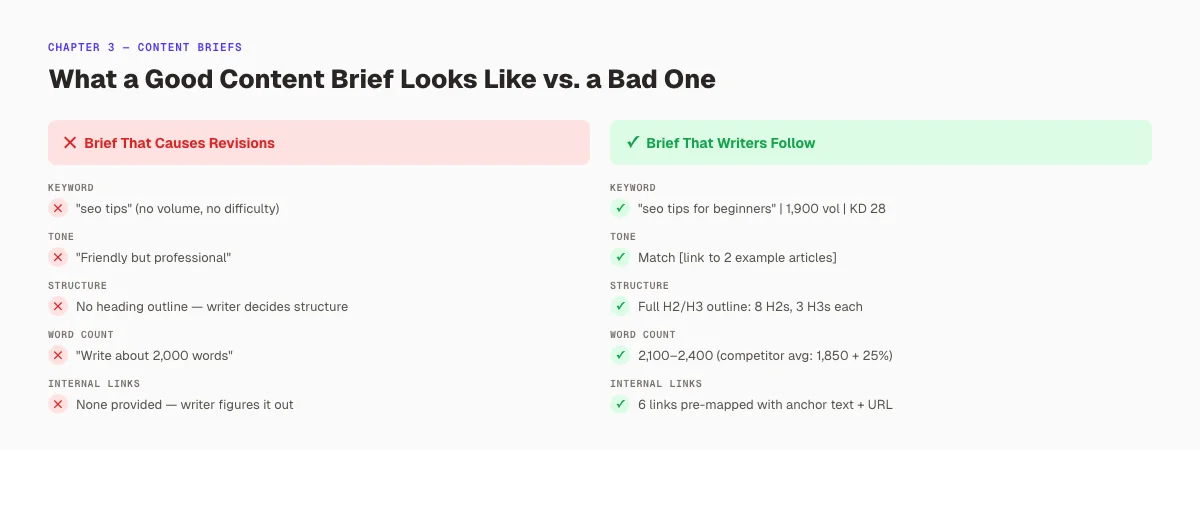
The 5 Most Common Brief Mistakes
Mistake 1: Giving only a title and keyword. Writers cannot determine content angle, word count, heading structure, or tone from a title alone. They fill the gaps with assumptions. Which produce revisions.
Mistake 2: Vague tone descriptions. "Friendly but professional" means nothing. Reference 2-3 published articles that demonstrate the target tone. Writers match examples faster than they decode adjectives.
Mistake 3: No outline. Providing a keyword without a heading structure forces the writer to structure the content from scratch. Two writers given the same keyword will produce two different structures. Neither may be the one that ranks. The template specifies the structure.
Mistake 4: Missing internal links. Writers do not know your full site architecture. They cannot identify internal linking opportunities mid-draft if they have not been given the map. Pre-identify every internal link in the brief.
Mistake 5: No word count rationale. Saying "write 2,000 words" without explaining why produces padding. Saying "the top 3 competitors average 1,900 words. Target 2,200 to beat them" tells the writer exactly how much depth is needed and why.
What Writers Actually Want from a Brief
- The exact keyword and where it must appear
- The full heading outline (not just the title)
- Sample articles that show the target quality and tone
- Internal links pre-identified with anchor text
- A clear word count range with context
- The primary conversion goal (what should the reader do after reading?)
A well-documented brief reduces revision cycles by eliminating ambiguity before the first draft. The blog post outline guide shows how to structure the heading hierarchy for any article type.
Chapter 4: SEO Content Templates by Page Type
One template does not serve every page type. Blog posts, product pages, location pages, and pillar guides each have different ranking signals, different intent patterns, and different structural requirements.
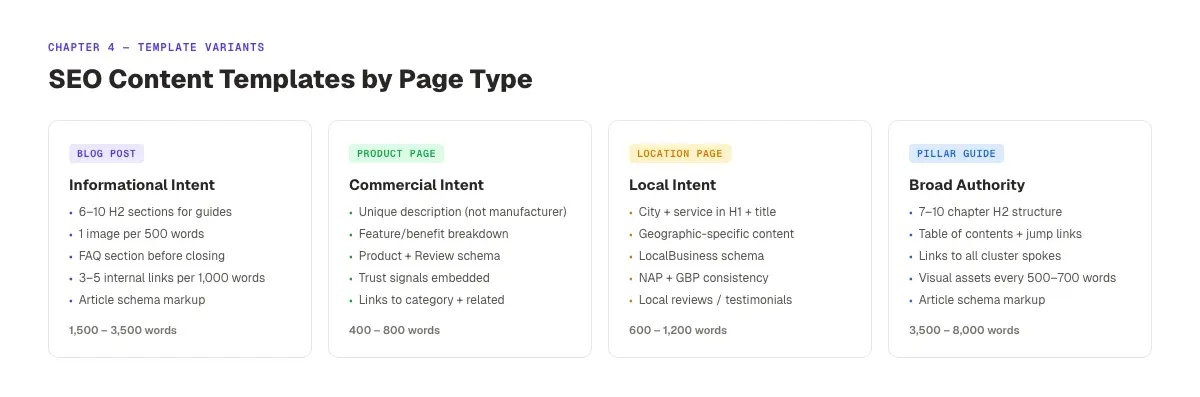
Blog Post Template
Blog posts target informational intent. Readers want answers, not sales pitches. The structure prioritizes clarity, depth, and internal link placement to other relevant content.
Required elements:
- Primary keyword in title, H1, first 100 words, one H2, meta description
- Intro: problem → solution preview → benefit list
- H2 sections: 6-10 for guides, 4-6 for standard posts
- 1 image per 500 words minimum
- 2-3 CTAs distributed through body
- FAQ section before closing
- Internal links: 3-5 per 1,000 words
See the full SEO content writing guide for the complete blog post framework.
Product Page Template
Product pages target commercial intent. The structure balances keyword optimization with conversion architecture.
Required elements:
- Primary keyword in H1, title tag, first paragraph, image alt text
- Unique product description (not manufacturer copy)
- Structured feature/benefit breakdown
- Customer review schema markup
- Product schema (name, price, availability, rating)
- Internal links to category and related products
- Trust signals: guarantees, return policy, certifications
Location Page Template
Location pages target local intent. They must signal geographic relevance while maintaining unique content that avoids thin-page penalties.
Required elements:
- City + service keyword in H1 and title tag
- Geographic-specific content (local references, not just city name inserted)
- Local business schema markup
- NAP consistency with Google Business Profile
- Embedded Google Map or location reference
- Local customer reviews or testimonials
- Internal links to service pages and parent location index
Pillar / Long-Form Guide Template
Pillar pages target broad, high-volume keywords. They serve as the hub for an entire content cluster.
Required elements:
- Primary keyword covers a broad topic ("SEO guide", "content marketing")
- Table of contents with jump links
- Chapter-style H2 structure (7-10 chapters)
- Internal links to all spoke content in the cluster
- Visual assets every 500-700 words
- Article schema markup
- Minimum 3,500 words for competitive topics
Build the full cluster around any pillar using the topical authority template.
Stop writing. Start ranking. theStacc publishes SEO articles per month for $99. Fully templated, optimized, and published automatically.
Chapter 5: Advanced Template Elements. EEAT, Schema, and Internal Links
Google's quality rater guidelines use EEAT. Experience, Expertise, Authoritativeness, and Trustworthiness. To evaluate content quality. Writers who build EEAT signals into every piece produce content that performs better in competitive niches and holds its rankings through algorithm updates.
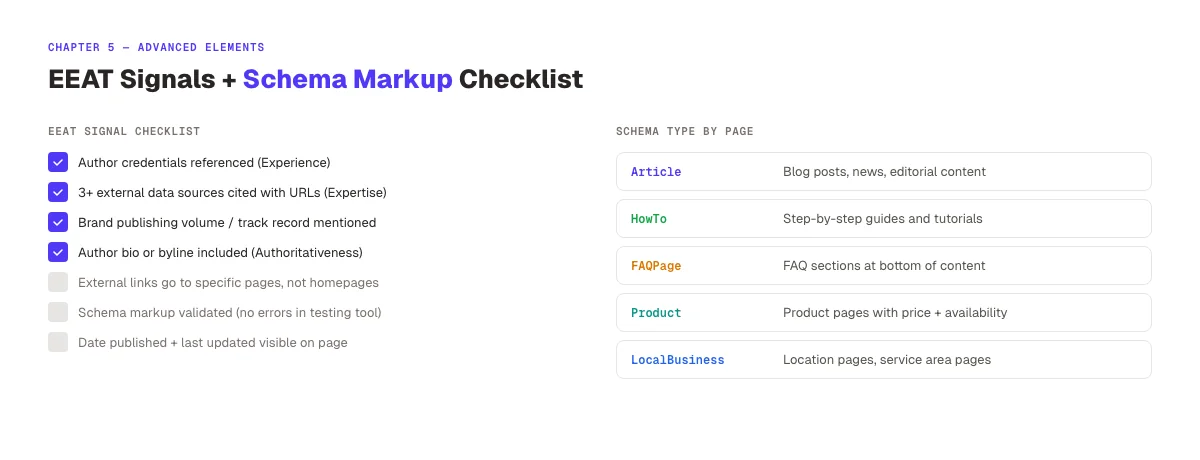
Building EEAT Into Your Template
Experience: Include first-person observations, tested examples, or specific results. "We published 3,500 articles across 70 industries" is an experience signal. Generic advice is not.
Expertise: Cite authoritative sources. Reference specific data. Name the methodology. Writers who demonstrate how they know what they know rank better than writers who simply state conclusions.
Authoritativeness: Include author credentials or brand credentials in the brief. Schema markup that identifies the author helps Google attribute expertise.
Trustworthiness: Link to authoritative external sources. Include schema markup for Article or FAQPage types. Cite data with source URLs. According to Google's Search Central documentation, trustworthiness is the most important EEAT dimension.
Schema Markup in Your Template
Every content type has a corresponding schema type. Specify it in the template. Do not leave schema decisions to the writer.
| Page Type | Schema Type | Key Fields |
|---|---|---|
| Blog post / Article | Article | headline, author, datePublished, image |
| How-to guide | HowTo | steps, totalTime, tool, supply |
| FAQ section | FAQPage | mainEntity, Question, acceptedAnswer |
| Product page | Product | name, price, availability, aggregateRating |
| Location page | LocalBusiness | name, address, telephone, geo |
Use the schema markup for blog posts guide to implement the correct type for each content piece. The schema markup generator tool produces valid JSON-LD in seconds.
Internal Linking Architecture
Internal links do two things: they pass link equity between pages, and they signal to Google how content on your site relates to each other.
The template should specify every internal link with:
- Destination URL (verified as live)
- Anchor text (descriptive, keyword-relevant, not generic)
- Placement section (where in the body it appears naturally)
Avoid clustering all internal links in one section. Distribute them across H2 sections at natural transition points. The internal linking for blog posts guide covers placement patterns that preserve flow while maximizing SEO value.
For anchor text, never use "click here" or "read more." Use anchor text that describes the destination page: "blog post structure for SEO" rather than "this guide." See the anchor text optimization guide for the full framework.
Chapter 6: AI and Automation in Your SEO Content Workflow
AI tools do not replace the SEO content template. They work inside it. The template defines the structure and requirements. AI handles the output speed. Writers who use AI without a template produce fast, structurally weak content. Writers who use AI with a template produce fast, structurally sound content that still requires human editing.
Where AI Fits in the Template Workflow
Keyword and outline research: AI tools accelerate competitive analysis and heading structure generation. The template records the output. A human validates it before sending to the writer.
First draft production: AI can generate a first draft from a fully completed template. The draft requires human editing for accuracy, voice, and EEAT signal injection. Do not publish AI drafts without editing.
Content brief formatting: AI formats a raw list of requirements into a clean, structured brief. The content remains human-defined; the formatting is automated.
See AI prompts for SEO articles for prompts that work inside a documented template structure. For team workflows, ChatGPT for SEO content covers how to integrate AI into a multi-writer publishing process.
What AI Cannot Replace in a Template
AI does not know your site's internal link structure. It cannot verify which internal pages exist or which anchor text is appropriate. It cannot check whether the heading structure matches what already ranks for a specific keyword. These decisions stay in the template. Filled by a human before the writer (human or AI) touches the brief.
The AI content strategy guide covers how to build a hybrid workflow that uses AI speed without sacrificing SEO quality.
Chapter 7: The Pre-Publish SEO Checklist for Writers
This checklist runs in under 10 minutes. Use it before every publish to catch the issues that automated tools miss.
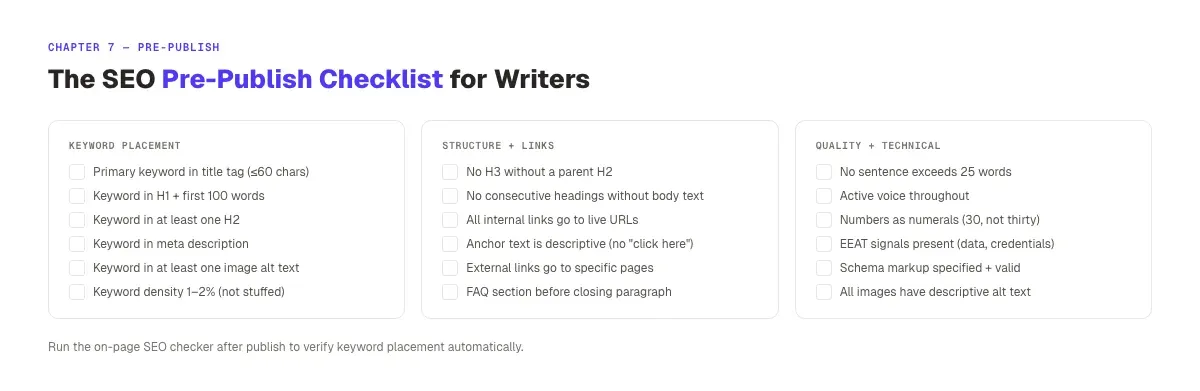
Keyword Placement
- ✓ Primary keyword appears in the title tag (under 60 chars)
- ✓ Primary keyword appears in the H1
- ✓ Primary keyword appears in the first 100 words of body copy
- ✓ Primary keyword appears in at least one H2
- ✓ Primary keyword appears in the meta description
- ✓ Primary keyword appears in at least one image alt text
- ✓ Keyword density is 1-2% (not stuffed)
Structure
- ✓ No H3 appears without a parent H2
- ✓ No consecutive headings without body text between them
- ✓ Every table has a header row and at least 2 data rows
- ✓ Every image has descriptive alt text (under 125 characters)
- ✓ FAQ section appears before the closing paragraph
Links
- ✓ Every internal link goes to a live URL (no 404s)
- ✓ Every external link goes to the specific page cited (not a homepage)
- ✓ Internal links are distributed. Not clustered in one section
- ✓ Anchor text is descriptive. No "click here" or "read more"
- ✓ No internal link uses the full domain URL (use
/blog/slugnothttps://domain.com/blog/slug)
Content Quality
- ✓ No sentence exceeds 25 words
- ✓ No paragraph exceeds 3 sentences
- ✓ Active voice throughout (check for "was," "were," "been" + past participle)
- ✓ Numbers appear as numerals ("30 articles" not "thirty articles")
- ✓ EEAT signals are present: experience, expertise, data citations, source links
Technical
- ✓ Title tag is under 60 characters
- ✓ Meta description is 145-155 characters
- ✓ Schema markup is specified and valid (use the schema markup generator)
- ✓ All images are optimized (WebP format preferred, under 200KB)
- ✓ All images reference existing files (no broken paths)
Run the on-page SEO checker on the published URL to verify keyword placement, meta fields, and heading structure automatically.
Your SEO team. $99/month. Fully templated SEO articles, written, optimized, and published automatically every month.
What practitioners are saying on X
Systems and fundamentals still compound; AI search adds new KPIs.
- @jakezward (Feb 2026): 2026 SEO predictions emphasize AI Overview share-of-SERP, schema for LLM token efficiency, brand mentions in AI answers as a KPI, proprietary data as a moat, and content refresh beating net-new AI slop. See the post on X.
- @hridoyreh (Mar 2026): Widely shared SEO skill tree: foundations, research, technical, on-page, content, links, AI SEO/GEO, analytics, UX, brand, programmatic — useful map for stats and how-to posts. See the post on X.
- @HlynurStefDev (Jul 2026): Public case: niche site traffic jumped from ~18 to 4,162 Google visits/month after focused technical/on-page SEO work (GSC screenshots claimed) — reminds that fundamentals still move numbers. See the post on X.
Grok, AI Overviews, and multi-engine visibility
Content topics like “seo content template” get AI citations when process steps, quality bars, and examples are concrete. Operator consensus on X is clear: research-backed pages beat unedited bulk generation — reflect that honestly.
- Google AI Overviews: Use passage-ready answers, tables, and FAQ schema where relevant.
- ChatGPT / Perplexity: Cite named sources next to key claims.
- Grok: Maintain accurate entity facts on-site and in high-signal X posts.
FAQ
Every template needs: a primary keyword with volume and difficulty data, secondary keywords, a title tag under 60 characters, a meta description of 145-155 characters, a full heading outline (H2 and H3 levels), a target word count range based on competitor analysis, pre-identified internal and external links with anchor text, tone and audience definition, EEAT signal requirements, and a CTA with conversion goal. Skip any one of these and writers make decisions the template should have made.
Word count depends on competitive analysis, not on a universal standard. Check the average word count of the top 3 ranking pages for your target keyword. Target 20-30% longer than that average. For informational keywords in competitive niches, that typically means 2,000-3,500 words. For low-competition informational queries, 1,200-1,800 words often ranks well. For product pages, 400-800 words is usually sufficient. See the blog post length for SEO guide for benchmarks by content type.
An SEO content template is the master framework. The full set of requirements for a content type. A content brief is a single instance of that template, filled in for a specific article or page. The template is the structure; the brief is the execution document. Well-run content teams maintain 3-6 templates (one per content type) and generate a new brief from the appropriate template for each piece.
EEAT signals are concrete, not abstract. In the brief, specify: what experience or credentials the author should reference, which data sources must be cited (with source URLs), how many external authority links to include, and whether an author bio or byline is required. Writers who receive vague "demonstrate expertise" instructions produce vague content. Writers who receive "cite 3 external stats with source links, reference the company's publishing volume, and include an author bio" know exactly what to do.
Review your template quarterly. Google's quality rater guidelines update regularly, schema types evolve, and EEAT requirements shift. The specific elements that matter (meta description length, schema types, heading depth) remain stable. But the nuances change. When a major algorithm update lands, audit your template against current ranking pages for your target keywords before the next content cycle.
The SEO content template is the difference between a content program and a content lottery. Writers who follow a structured template produce content that Google can assess, categorize, and rank. Writers who improvise produce content that is impossible to evaluate consistently.
Build your template from the 9 core elements in Chapter 2. Use it to generate briefs that writers can follow without revision cycles. Test it against the pre-publish checklist in Chapter 7 before every publish.
If you want SEO content produced at scale without building and maintaining a template system yourself, theStacc handles the whole template system for $99 a month. Fully templated, optimized, and published automatically.
Related Tools & Resources
Free SEO Tools:
Best Lists:
Sources & references
- [1] Princeton / Georgia Tech et al. — GEO research (arXiv:2311.09735)
- [2] @varunram on X — Critique of GEO slopfarm products that combine SEO clickbait with unresearched content marketing — quality and research
- [3] @jakezward on X — 2026 SEO predictions emphasize AI Overview share-of-SERP, schema for LLM token efficiency, brand mentions in AI answers
- [4] @HlynurStefDev on X — Public case: niche site traffic jumped from ~18 to 4,162 Google visits/month after focused technical/on-page SEO work (G
- [5] Referenced source — www.semrush.com

Researched, written, and published articles that compound organic traffic.
Weekly local SEO teardowns
One practical email a week. Map Pack, GBP, AI Overviews — no fluff. Unsubscribe anytime.