SEO Reputation Management: The Complete Guide
Everything you need to know about SEO reputation management. Covers branded SERPs, negative suppression, review strategy, and crisis response. Updated 2026.
Stacc Editorial • 2026-04-04 • SEO Tips
In This Article
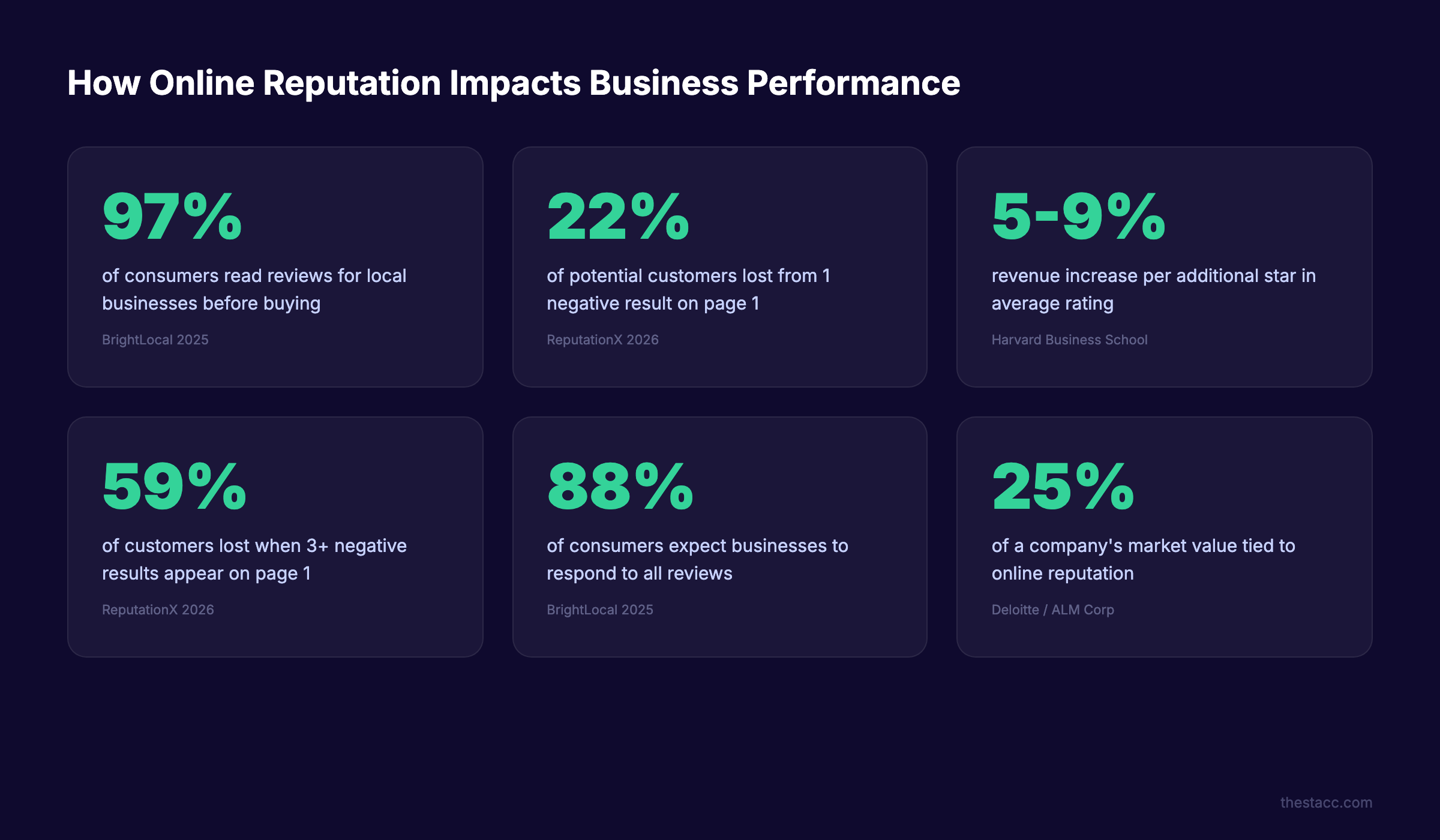
A single negative search result on page 1 costs businesses 22% of potential customers. Three negative results push that number to 59%. Your brand name is a keyword. If you do not control what ranks for it, someone else will.
SEO reputation management is the practice of shaping branded search results through content, optimization, and review strategy. It sits at the intersection of SEO and brand protection. Most businesses ignore it until a crisis hits. By then, the damage is already compounding.
We publish 3,500+ articles across 70+ industries. We have seen how branded search results make or break trust before a prospect ever visits a website. This guide covers everything we know about controlling your search reputation.
Here is what you will learn:
- How search results shape buyer perception before your website loads
- The exact process for auditing your branded SERPs
- 5 content types that dominate branded search results
- How to suppress negative content without black-hat tactics
- Review management strategies that double as SEO signals
- A 48-hour crisis response playbook for reputation emergencies
Table of Contents
- Chapter 1: What Is SEO Reputation Management
- Chapter 2: How Search Results Shape Brand Perception
- Chapter 3: How to Audit Your Branded SERPs
- Chapter 4: 5 Content Types That Dominate Branded Search
- Chapter 5: How to Suppress Negative Search Results
- Chapter 6: Review Management as an SEO Reputation Strategy
- Chapter 7: Crisis Response SEO — The 48-Hour Playbook
- FAQ: SEO Reputation Management
Chapter 1: What Is SEO Reputation Management {#ch1}
SEO reputation management combines search engine optimization with brand protection. The goal is to control what appears when someone searches your brand name, your products, or your leadership team.
Traditional reputation management focused on PR and damage control. SEO reputation management focuses on search results. The distinction matters because 97% of consumers read reviews for local businesses. Search results are the first impression for most buyers.
How It Differs from Traditional ORM
Traditional online reputation management monitors social media, responds to press coverage, and manages crisis communication. SEO reputation management specifically targets search engine results pages.
The overlap is growing. Google now pulls reviews, social profiles, news articles, and People Also Ask results into branded SERPs. A strong E-E-A-T signal across all these channels reinforces your search reputation.
The Three Pillars of Search Reputation
Every SEO reputation strategy rests on 3 pillars:
| Pillar | What It Covers | Control Level |
|---|---|---|
| Owned content | Website, blog, social profiles | High |
| Earned content | Reviews, press, guest posts | Medium |
| Third-party content | Forums, complaint sites, Wikipedia | Low |
Your job is to maximize the owned and earned content on page 1 while minimizing the negative third-party results. This guide walks through each step of that process.
Why Most Businesses Get It Wrong
Most companies only think about reputation after something goes wrong. A bad review goes viral. A complaint site ranks for their brand name. A disgruntled employee posts on Glassdoor.
Reactive reputation management costs 3-5x more than proactive management. Building positive search assets before a crisis hits gives you a defensive moat. The businesses with the strongest branded SERPs are the ones publishing consistent content month after month.
Chapter 2: How Search Results Shape Brand Perception {#ch2}
Google controls 89.8% of the global search market. Your branded SERP is your digital storefront. Most buyers see it before they see your homepage.
The First-Page Trust Effect
The top 10 results for your brand name form an instant credibility check. Buyers scan these results in under 10 seconds. One negative headline among 9 positive results still causes doubt.
Research from ReputationX shows that each additional star in your average rating increases revenue by 5-9%. The opposite is true for negative signals. A single negative article on page 1 changes the entire tone of the SERP.
What Buyers Search Before They Buy
Branded searches go beyond your company name. Buyers also search:
- [Brand] reviews — The most common pre-purchase search
- [Brand] complaints — Risk-assessment behavior
- [Brand] vs [competitor] — Comparison shopping
- [Brand] pricing — Qualification behavior
- [CEO name] — Trust verification
Each of these queries produces a different SERP. You need positive content ranking for all of them. A strong SEO competitor analysis reveals what competitors own in their branded SERPs that you do not.
The People Also Ask Problem
Google generates People Also Ask boxes in 52% of searches. For branded queries, PAA results can surface questions like “Is [brand] legit?” or “Why is [brand] so bad?”
You cannot directly control PAA results. But you can influence them by publishing FAQ content, blog posts, and help articles that answer these questions with positive framing. Schema markup helps Google understand your FAQ content and pull it into PAA results.
Your branded SERP is your most valuable digital asset. Stacc publishes 30 SEO-optimized articles per month to help you own page 1. Start for $1 →
Chapter 3: How to Audit Your Branded SERPs {#ch3}
Before building a reputation strategy, you need a baseline. A branded SERP audit tells you exactly what buyers see when they search your name.
The 8-Point Branded SERP Audit
Open an incognito browser window. Search each of these queries and record every result on page 1:
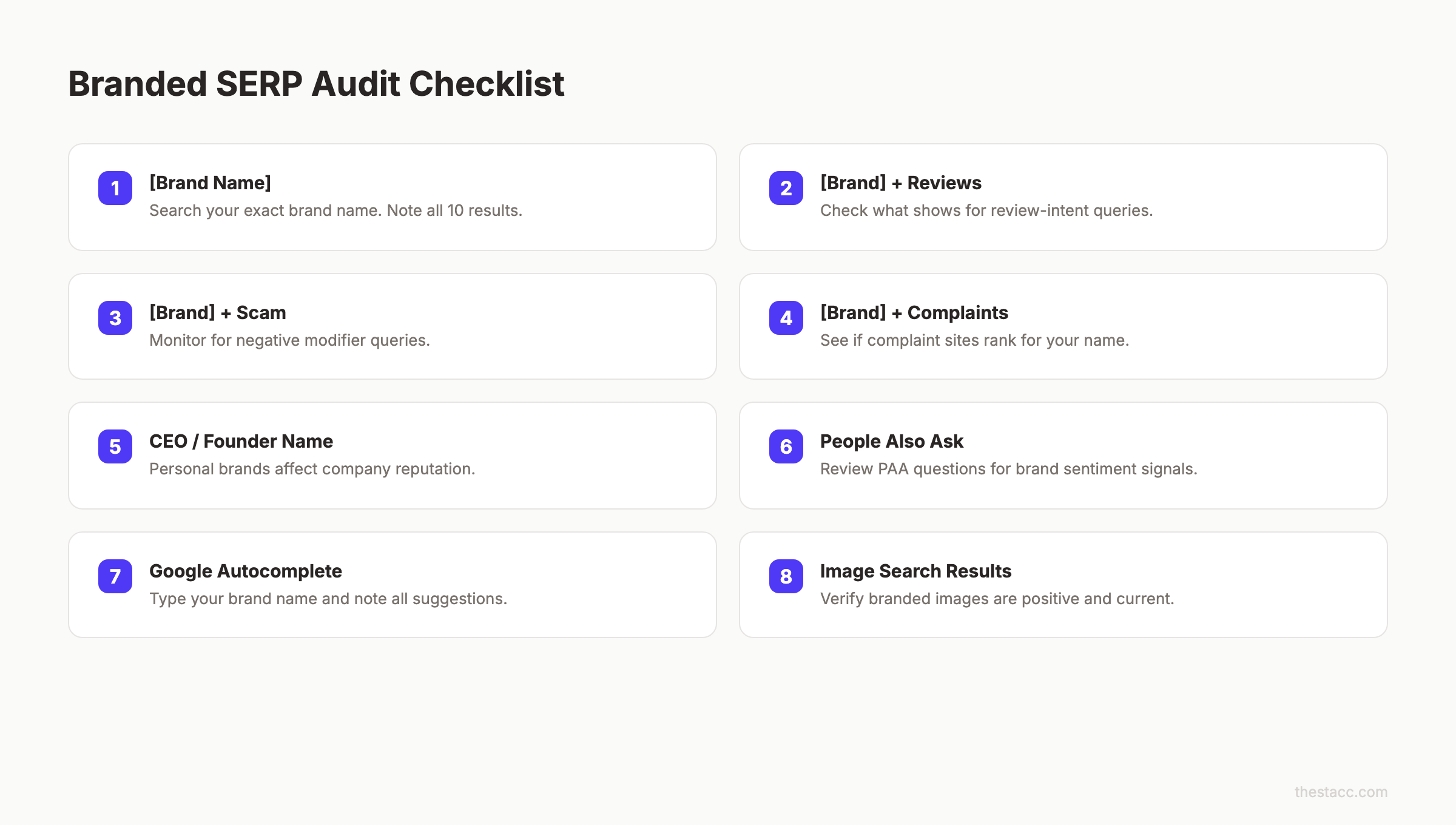
- [Brand name] — Your primary branded SERP
- [Brand] reviews — Review-intent results
- [Brand] scam — Negative modifier check
- [Brand] complaints — Complaint site presence
- [CEO/founder name] — Personal reputation
- [Brand] vs [competitor] — Comparison SERPs
- People Also Ask — Question sentiment
- Google Autocomplete — Suggested search modifiers
How to Score Your Results
For each of the 10 organic results on page 1, categorize them:
| Category | Score | Description |
|---|---|---|
| Owned positive | +2 | Your website, blog, or official profiles |
| Earned positive | +1 | Positive reviews, press, guest content |
| Neutral | 0 | Wikipedia, directories, generic mentions |
| Negative | -3 | Complaints, bad reviews, negative press |
A healthy branded SERP scores 12+ out of a possible 20. Anything below 8 requires immediate action. Write meta descriptions that reinforce positive messaging for every owned result.
Tools for Ongoing Monitoring
Manual audits work for a baseline. Ongoing monitoring requires automation:
- Google Alerts — Free. Set alerts for your brand name and key modifiers.
- Ahrefs or Semrush — Track branded keyword rankings over time. See our SEO statistics for benchmark data.
- Review monitoring — Review management tools track reviews across platforms automatically.
Run a full branded SERP audit monthly. Track changes over time. A single result moving from position 8 to position 3 can shift perception overnight.
Chapter 4: 5 Content Types That Dominate Branded Search {#ch4}
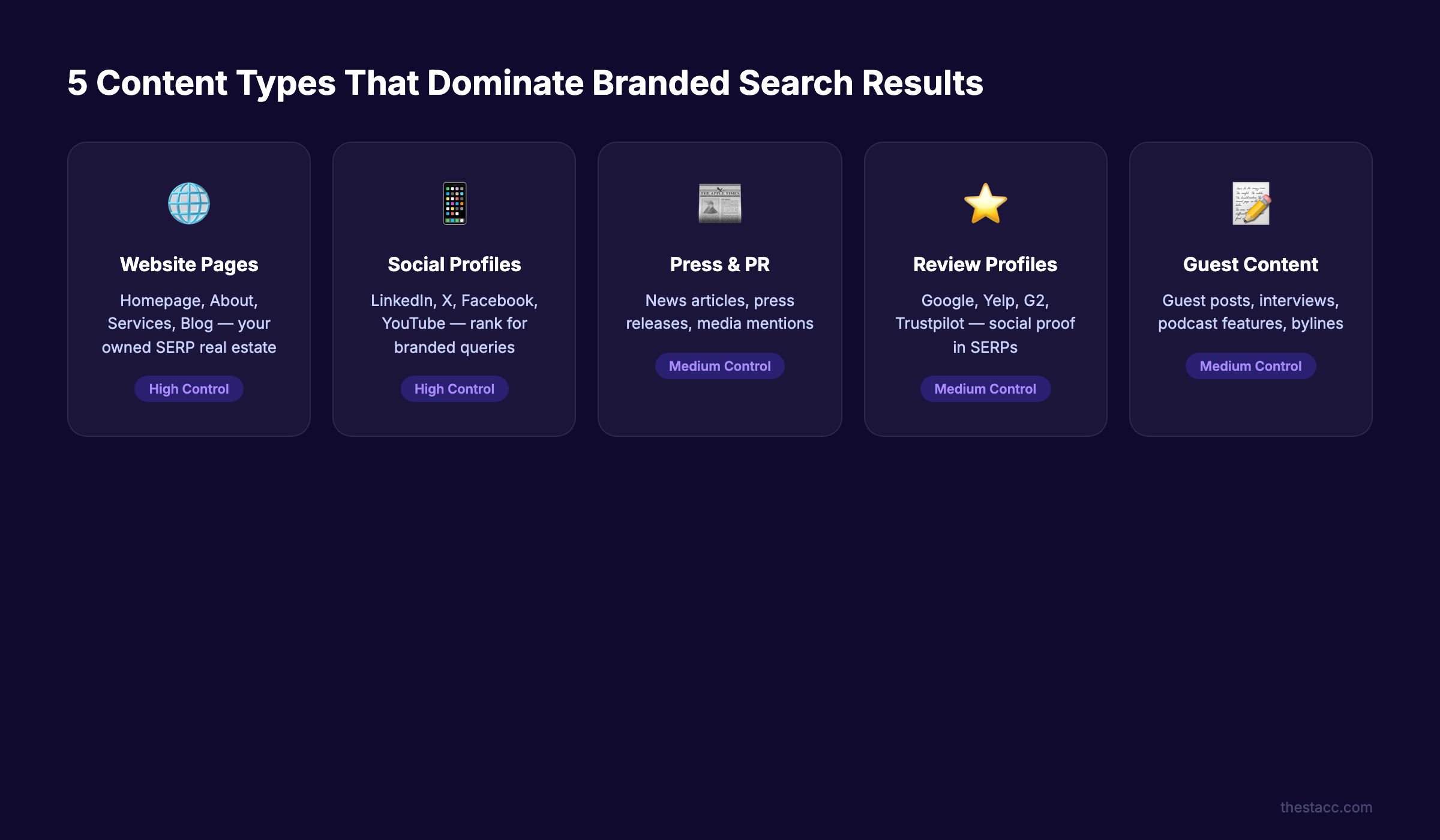
Page 1 has 10 organic slots. Your goal is to fill as many as possible with content you control or influence. These 5 content types rank most consistently for branded queries.
1. Your Website Pages
Your homepage, about page, services pages, and blog posts should occupy multiple page 1 positions. Most businesses only rank their homepage for branded searches.
Fix this by optimizing secondary pages with branded title tags. Your about page should target “[brand name] company.” Your blog should target “[brand name] blog.” Build internal links between these pages to distribute authority.
2. Social Media Profiles
LinkedIn, X (Twitter), Facebook, YouTube, and Instagram profiles rank for branded queries. They rank because these platforms have extremely high domain authority.
Claim your brand name on every major platform. Post regularly. An active LinkedIn profile with weekly posts will outrank a dormant one. Our guide on social media marketing for local businesses covers platform selection and posting frequency.
3. Review Platform Profiles
Google Business Profile, Yelp, G2, Trustpilot, and industry-specific review sites rank for branded searches. A fully optimized Google Business Profile dominates the right sidebar of branded SERPs.
Businesses with 100+ reviews are 54% more likely to appear in the top 3 results. Our review statistics break down exactly how review volume and rating impact rankings.
4. Press Coverage and Digital PR
News articles from high-authority publications rank fast for branded queries. One feature in a regional news outlet or industry publication can occupy a page 1 spot for years.
Press releases distributed through PR Newswire or Business Wire also rank. They are especially effective for controlling the narrative during product launches or company milestones.
5. Guest Content and Thought Leadership
Guest posts on industry blogs, podcast appearances, and bylined articles on platforms like Medium or LinkedIn create additional branded results. Each guest post builds a new URL that can rank for your brand name.
Target publications with domain authority above 50. One guest post on a DR 70+ site will outperform 10 posts on low-authority blogs. Our guide on link building outreach includes templates for pitching guest content.
Consistent publishing fills your branded SERP with positive content. Stacc handles 30 articles per month so you focus on running your business. Start for $1 →
Chapter 5: How to Suppress Negative Search Results {#ch5}
Suppression means pushing negative results off page 1 by outranking them with stronger positive content. Removal is preferred when possible. Suppression is the fallback for content you cannot take down.
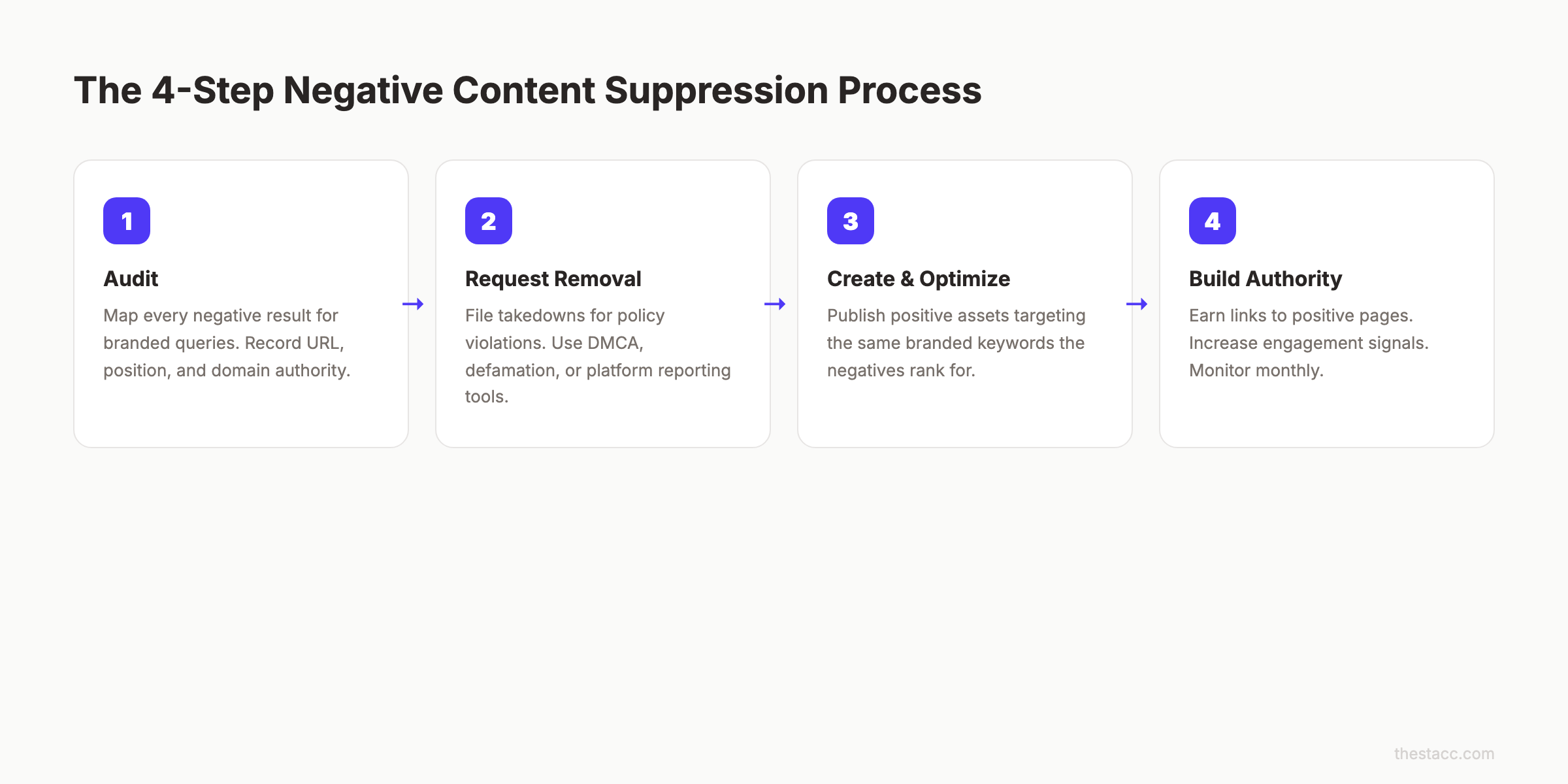
Step 1: Classify the Negative Result
Not all negative results require the same response. Classify each one:
- Policy violation — Fake reviews, defamatory content, or content that violates platform terms of service. File a removal request directly with the platform.
- Legitimate criticism — Real customer complaints or factual negative coverage. Address the underlying issue first. Then suppress with positive content.
- Competitor attack — Negative SEO or planted content. Document everything. Consider legal counsel for defamation.
Our guide on handling fake Google reviews covers the removal process for review-based attacks.
Step 2: Request Removal Where Possible
Google offers legal removal requests for content that violates policies. Platforms like Yelp, Glassdoor, and Trustpilot have their own reporting processes.
Removal success rates vary. Google removes content for legal violations, personal information exposure, and policy breaches. They do not remove content simply because it is negative. Budget 2-6 weeks for removal requests.
Step 3: Create Suppression Assets
For content that cannot be removed, build competing pages that target the same branded keywords:
- Publish a blog post answering the specific complaint
- Optimize your about page for the branded modifier
- Create a case study proving the opposite of the negative claim
- Post a detailed response on social profiles
- Pitch a guest post to a high-authority publication
Each asset needs its own on-page SEO optimization, backlink support, and promotion plan. One asset alone will not suppress a strong negative result.
Step 4: Build Links to Positive Assets
Suppression works through authority. The pages with the most backlinks and engagement signals rank highest. Direct link building efforts toward your positive branded content.
Use content clusters to build topical authority around your brand. A cluster of 10 articles linking to your about page sends strong authority signals. This method is not fast. Budget 2-4 months to push a negative result from position 5 to page 2.
Suppression Timeline Expectations
| Negative Result Strength | Estimated Suppression Time | Assets Required |
|---|---|---|
| Low authority (forum post, blog comment) | 4-8 weeks | 2-3 new pages |
| Medium authority (review site, niche blog) | 2-4 months | 5-8 new pages |
| High authority (major news outlet) | 6-12 months | 10+ new pages + PR |
Chapter 6: Review Management as an SEO Reputation Strategy {#ch6}
Reviews serve double duty. They build trust with potential customers and send ranking signals to Google. A strong review profile is the most efficient form of SEO reputation management for local businesses.
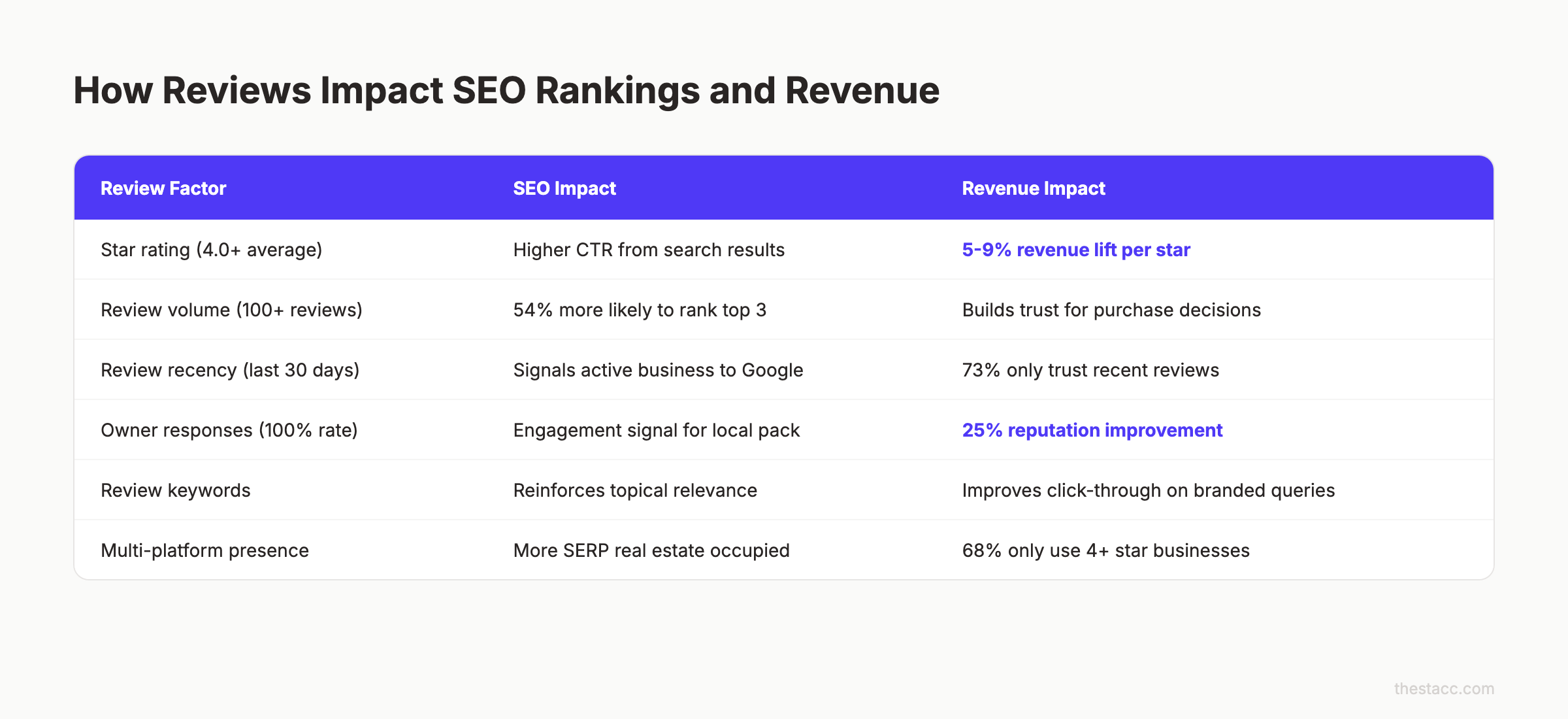
Reviews as a Local Ranking Factor
Google uses review signals as a major local ranking factor. Review volume, velocity, rating, keywords, and owner responses all influence Google Maps rankings.
Businesses with 100+ reviews are 54% more likely to rank in the local pack top 3. Review recency matters too. A business with 10 new reviews in the past month outranks one with 200 reviews from 2 years ago.
The Review Response Framework
88% of consumers expect businesses to respond to all reviews. Response strategy differs by review type:
Positive reviews (4-5 stars): Thank the customer by name. Reference the specific service or product. Include a natural keyword mention. Our positive review response guide includes 15 copy-paste templates.
Negative reviews (1-2 stars): Respond within 24 hours. Acknowledge the issue. Offer a resolution offline. Never argue publicly. The response is not for the unhappy customer. It is for every future customer who reads it.
Fake reviews: Flag and report immediately. Respond publicly noting that you have no record of the transaction. Follow the steps in our fake review handling guide.
Building a Review Generation Engine
The best defense is a steady flow of positive reviews. Do not wait for customers to leave reviews organically. Build a system:
- Send a review request within 24 hours of service completion
- Use our review request generator for personalized messages
- Make the review link one click (use your GBP short link)
- Follow up once if no review is left within 3 days
- Train staff to mention reviews during service delivery
Aim for 10+ new reviews per month. This volume maintains a fresh review profile. It also steadily improves your average rating as new positive reviews dilute older negative ones.
Use review management software to automate monitoring and response across platforms. The time savings alone justify the cost.
Reviews are the fastest path to a stronger branded SERP. Let Stacc handle your content strategy while you focus on review generation. Start for $1 →
Chapter 7: Crisis Response SEO — The 48-Hour Playbook {#ch7}
A reputation crisis hits fast. A viral complaint, a negative news story, or a wave of bad reviews can reshape your branded SERP within days. The first 48 hours determine whether the crisis fades or compounds.
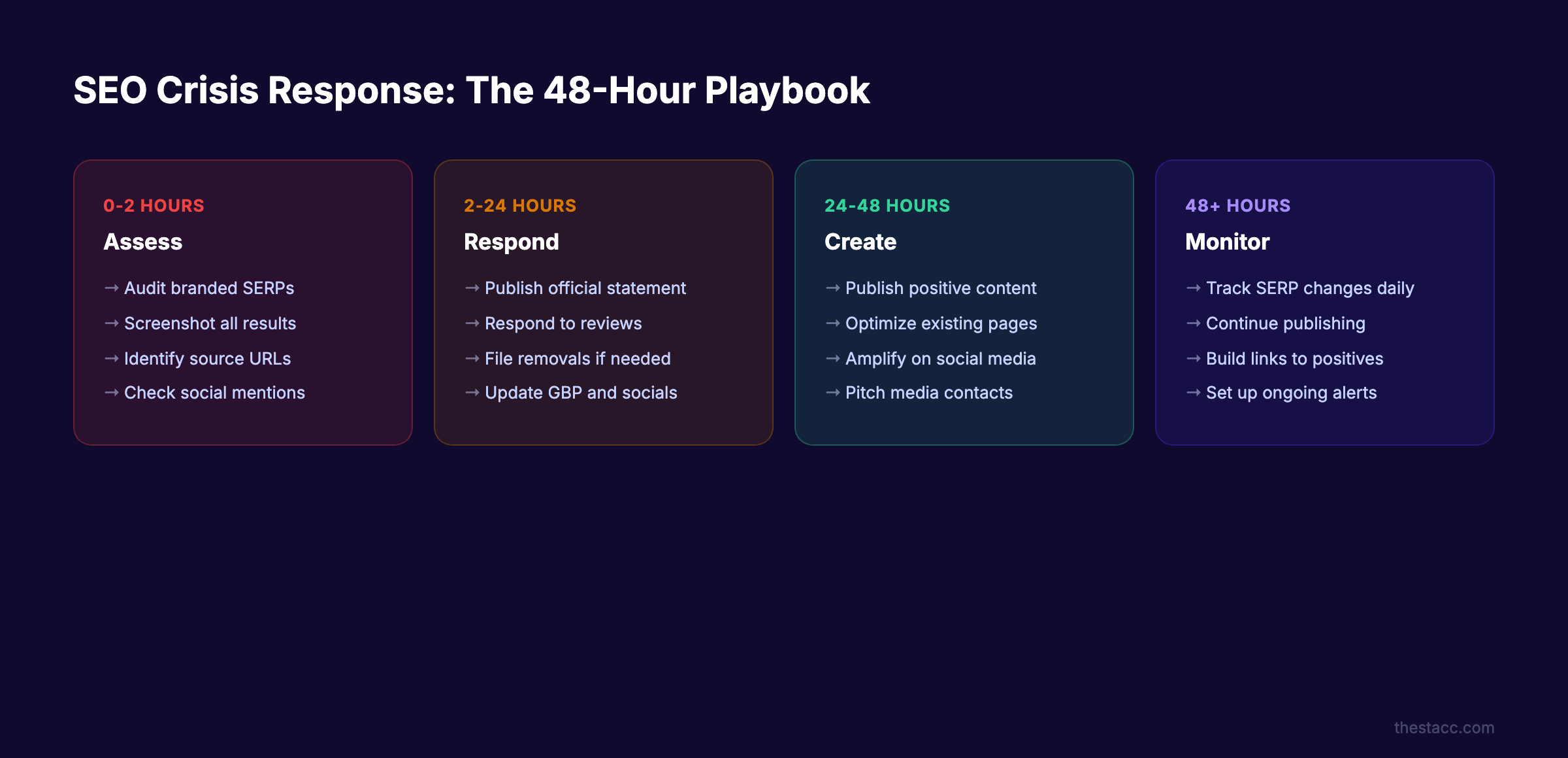
Hours 0-2: Assess the Damage
Stop everything and audit your branded SERPs. Screenshot every result. Document the source, current ranking position, and estimated domain authority of each negative result.
Check Google Autocomplete for your brand name. Look at People Also Ask results. Monitor social media for real-time mentions. This assessment determines your response plan.
Hours 2-24: Respond Directly
Publish an official statement on your website. This page should target “[brand name] [crisis topic]” as its primary keyword. Optimize the title tag, meta description, and headers for this exact query.
Respond to every review and social comment within this window. Use your review response generator for consistent messaging. Update your Google Business Profile with a relevant post.
If the negative content violates platform policies, file removal requests immediately. The faster you file, the faster the review process begins.
Hours 24-48: Create Counter-Content
Publish 2-3 pieces of positive content targeting the crisis keywords. Blog posts, press releases, and social media content all help. Pitch media contacts for coverage of your response.
Optimize existing pages that rank for your brand name. Update title tags, add fresh content, and improve internal linking. Every on-page SEO improvement to your owned pages helps them hold their positions against the negative content.
48+ Hours: Long-Term Recovery
Continue publishing at an elevated pace. Businesses that maintain a consistent content calendar recover faster because they already have a publishing rhythm.
The Content Compound Effect applies here. Every positive article you publish stacks on the last one. Over 60-90 days, a steady stream of content pushes negative results further down. Track your organic traffic alongside branded SERP positions to measure recovery progress.
Brands that respond proactively see a 40% higher likelihood of restoring their reputation compared to brands that wait for backlash to subside.
Proactive Reputation Building: The Long Game
The best SEO reputation management strategy is one you start before you need it. Reactive management is expensive and stressful. Proactive building is steady and compounding.
The Content Compound Effect
Every article, social post, and review response builds your branded SERP moat. Businesses that publish 20-30 articles per month fill page 1 with owned and earned content. This leaves no room for negative results to surface.
The math is straightforward. Your website can rank multiple pages for branded queries. Add social profiles, review platforms, and guest posts. A business publishing consistently can own 7-8 of the 10 organic results for their brand name.
NAP Consistency Across the Web
Your business name, address, and phone number must be identical everywhere. Inconsistent NAP citations confuse search engines and weaken your branded SERP presence. Audit your listings quarterly.
Monthly Reputation Maintenance Checklist
- Run a branded SERP audit for all key queries
- Respond to every new review within 48 hours
- Publish at least 4 blog posts targeting branded and industry keywords
- Share content across all social platforms weekly
- Monitor Google Alerts for new brand mentions
- Check Google Autocomplete for negative suggestions
- Update your Google Business Profile with new posts and photos
Consistency beats intensity. A business that publishes 30 articles per month for 12 months owns its branded SERP. A business that scrambles to publish 30 articles after a crisis does not recover as fast.
SEO reputation management runs on autopilot with Stacc. We publish, optimize, and distribute content every month while you run your business. Start for $1 →
FAQ: SEO Reputation Management {#faq}
What is SEO reputation management?
SEO reputation management is the practice of using search engine optimization to control what appears in search results for your brand name, products, and leadership team. It combines content creation, review management, social media optimization, and link building to push positive results higher and negative results lower.
How long does it take to suppress a negative search result?
Timeline depends on the authority of the negative result. A low-authority forum post can be suppressed in 4-8 weeks. A negative article from a major news outlet may take 6-12 months. The average suppression campaign requires 2-4 months and 5-8 new content assets targeting the same branded keywords.
Can I remove negative Google search results?
Google removes content that violates its policies. This includes personal information exposure, defamation, and certain legal violations. You can file a request through Google’s legal troubleshooter. Google does not remove content simply because it is negative or unflattering. For non-removable content, suppression through positive content creation is the standard approach.
Do reviews affect SEO rankings?
Yes. Google uses review signals as a ranking factor, especially for local search. Review volume, velocity, star rating, keyword content, and owner responses all influence local pack and Maps rankings. Businesses with 100+ reviews are 54% more likely to rank in the top 3. See our complete review statistics breakdown for more data.
How many articles do I need to control my branded SERP?
There is no fixed number. The goal is to own as many page 1 positions as possible. Start with your core website pages, social profiles, and review platforms. Then publish blog content, guest posts, and press coverage to fill remaining spots. Most businesses need 10-20 branded content assets to dominate page 1 for their primary brand query.
What is the difference between ORM and SEO reputation management?
Online reputation management (ORM) is the broader discipline that includes PR, social media monitoring, and crisis communication. SEO reputation management is the subset focused specifically on search engine results. The two overlap significantly. Modern ORM without an SEO component is incomplete because search results are the primary trust signal for most buyers.
Your branded SERP tells buyers what to think about your business before you get a chance to speak. Start building your search reputation now. Every article, every review response, and every optimized page compounds into a stronger first impression.
Written and published by Stacc. We publish 3,500+ articles per month across 70+ industries. All data verified against public sources as of March 2026.