Tutoring SEO: The Complete Guide for 2026
Everything you need to know about tutoring SEO in one 10-chapter guide. Covers keywords, Google Business Profile, local rankings, and reviews. Updated for 2026.
Siddharth Gangal • 2026-03-29 • Local SEO
In This Article
Parents search Google before they search anywhere else. 98% of consumers look online to find local businesses, and tutoring centers are no exception. Yet most tutoring companies — from solo math tutors to multi-location learning centers — have zero SEO strategy.
The result? Kumon, Sylvan, and Mathnasium dominate page 1 while independent tutors pay for ads that stop working the moment the budget runs out.
This guide fixes that. We publish 3,500+ blog posts across 70+ industries, and education is one of the fastest-growing categories we serve.
Here is what you will learn:
- How to find the exact tutoring keywords parents type into Google
- How to set up your Google Business Profile so you rank in the map pack
- The on-page SEO changes that move tutoring websites from page 3 to page 1
- How to build local authority that outranks franchise competitors
- The content strategy that brings in students during back-to-school season, exam season, and summer programs
- How to turn parent reviews into ranking signals
- How to measure tutoring SEO results in dollars, not just clicks
Why SEO Matters for Tutoring Businesses
The private tutoring market hit $66.96 billion in 2025. It is projected to reach $160.50 billion by 2034. That growth means more competition for every “math tutor near me” search.
Tutoring SEO is how your learning center, test prep service, or private tutoring business appears at the top of Google when parents and students search for help. Without it, you are invisible during the exact moments families make enrollment decisions.
Parents Search Before They Call
46% of all Google searches have local intent. A parent looking for “SAT tutor in Austin” or “reading tutor near me” has high purchase intent. They are not browsing. They are ready to book a session.
76% of people who search “near me” visit a business within 24 hours. For a tutoring center, that visit is a phone call, a form submission, or a walk-in consultation.
Paid Ads Stop. SEO Compounds.
Google Ads work until you stop paying. A tutoring center spending $500 per month on ads gets zero leads the day the budget pauses.
SEO works differently. A blog post about “how to improve ACT scores” can rank for 2 to 3 years and bring in student inquiries every month. One well-optimized service page for “elementary math tutoring in [city]” generates leads while you sleep.
This is the Content Compound Effect — every piece of content stacks on the last and builds authority over time.
Independent Tutors Can Outrank Franchises
Kumon has 26,000 locations. Mathnasium has 1,100. Sylvan has 750. These franchises have massive domain authority.
But local SEO levels the playing field. Google prioritizes proximity and relevance for local searches. A solo tutor with a well-optimized Google Business Profile and 40 parent reviews can outrank Sylvan in their zip code.
The key is consistency. Tutoring businesses that publish content regularly and maintain their local listings rank higher than those with bigger budgets but stale profiles.
Tutoring Keywords That Bring Students
Keyword research is where every tutoring SEO strategy starts. The wrong keywords bring traffic that never converts. The right ones bring parents ready to book a session.
Three Keyword Categories for Tutors
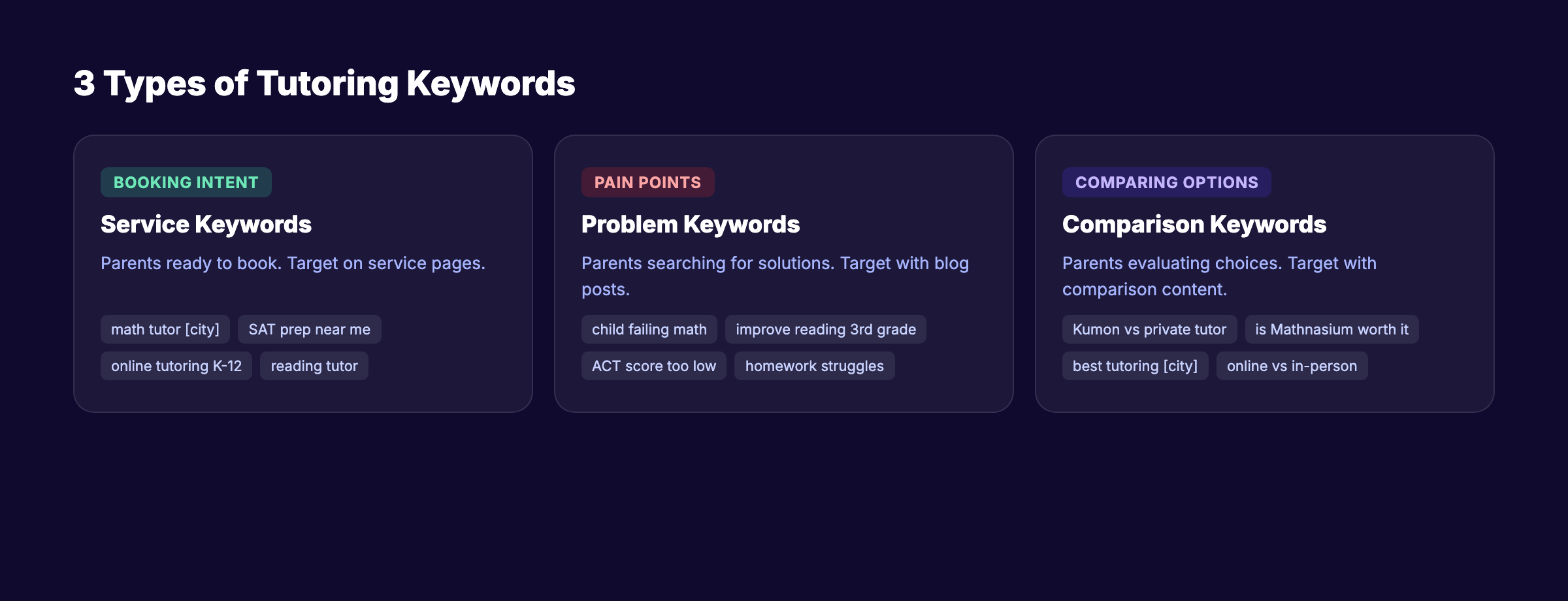
Tutoring keywords fall into 3 groups. Each serves a different purpose.
Service keywords describe what you offer. These are your highest-intent terms:
| Keyword Type | Examples | Intent |
|---|---|---|
| Subject + location | ”math tutor in Denver,” “science tutoring Chicago” | Ready to book |
| Grade level + service | ”high school chemistry tutor,” “K-12 reading help” | Comparing options |
| Test prep | ”SAT prep tutor near me,” “GMAT tutoring online” | Urgent, high value |
| Format | ”one-on-one tutoring,” “online tutoring for kids” | Evaluating fit |
Problem keywords describe the challenge a parent or student faces:
- “my child is failing math”
- “how to improve reading comprehension 3rd grade”
- “ACT score too low for college”
These searches show pain. A blog post that addresses the problem and presents your tutoring service as the answer converts well.
Comparison keywords show a parent evaluating options:
- “Kumon vs private tutor”
- “is Mathnasium worth it”
- “best tutoring centers in [city]”
Target these with comparison pages and honest reviews. Parents trust businesses that help them decide rather than just sell.
How to Find Tutoring Keywords
Start with free tools. Type “tutoring” into Google and note the autocomplete suggestions. Check “People Also Ask” for question-based keywords. Use Google Search Console to see what queries already bring impressions.
For deeper research, use a dedicated keyword research tool. Look for keywords with monthly search volume above 50, local intent, and low to medium difficulty.
Build a spreadsheet with 30 to 50 target keywords. Group them by topic: subject tutoring, test prep, grade levels, and tutoring formats. Each group becomes a page or blog post on your site.
Long-Tail Keywords Win for Tutors
“Tutor” has massive competition. “Algebra 2 tutor for high school students in Plano TX” has almost none.
Long-tail keywords are 4+ word phrases with specific search intent. They get less volume but convert at higher rates because the searcher knows exactly what they need.
Build service pages around long-tail terms. One page for “online SAT prep tutoring.” Another for “in-person elementary reading tutor in [city].” Google rewards specificity.
Your tutoring website should rank for the keywords parents actually search. We publish 30 SEO-optimized articles per month that target the exact terms your students use. Start for $1 →
Google Business Profile for Tutors
Your Google Business Profile (GBP) is the single most important local ranking factor for a tutoring business. It determines whether you appear in the map pack — the 3 business listings that show above organic results for local searches.
Set Up Your Profile Correctly
Claim your profile at business.google.com. If your tutoring center has a physical location where students visit, use that address. If you are a mobile tutor or online-only, set a service area instead.
Choose the right primary category. For most tutoring businesses, select “Tutoring Service.” Add secondary categories like “Test Preparation Center,” “Academic Camp,” “Education Center,” or “After School Program.”
Fill in every field. Businesses with complete profiles get 7 times more clicks than incomplete ones. That includes:
- Business hours (update for summer programs and exam season)
- Phone number and website URL
- Services offered with descriptions
- Business description (use all 750 characters)
Optimize Your Business Description
Your GBP description should include your primary keyword, location, and services. Here is a template:
“[Business Name] provides one-on-one and group tutoring for K-12 students in [City]. We specialize in math tutoring, reading comprehension, SAT/ACT test prep, and homework help. Our certified tutors create personalized learning plans for every student.”
Do not stuff keywords. Write for parents, not algorithms.
Add Photos and Updates Weekly
Upload photos of your tutoring space, whiteboards with lesson examples, and your team. Google rewards active profiles. Post weekly updates about enrollment openings, test prep workshops, and student success stories.
GBP posts expire after 7 days in search. A consistent posting schedule signals to Google that your business is active and relevant. Use a GBP management tool to schedule posts in advance.
Services and Products Section
Most tutoring centers skip the Services section. Do not make that mistake. Add every service you offer with a description and price range:
- One-on-one math tutoring ($40-60/hour)
- SAT prep package (10 sessions)
- Group study sessions (middle school)
- Online tutoring (all subjects)
- Summer enrichment programs
This section gives Google more data to match your profile with relevant searches.
On-Page SEO for Tutoring Websites
On-page SEO is the optimization you control on your own website. For tutoring businesses, it means structuring every page so Google understands what you offer, where you offer it, and who you serve.
Title Tags and Meta Descriptions
Every page on your tutoring website needs a unique title tag under 60 characters. Include your primary keyword and location.
| Page | Title Tag Example |
|---|---|
| Homepage | Math & Reading Tutoring in Denver |
| SAT Prep | SAT Prep Tutoring in Denver |
| Math Tutoring | Math Tutor for K-12 Students |
| Blog Post | 7 Ways to Improve Your ACT Score Fast |
Write meta descriptions between 145 and 155 characters. Include a benefit and a call to action: “Expert math tutoring for K-12 students in Denver. Personalized learning plans and proven results. Book a free assessment today.”
Create Dedicated Service Pages
Do not list all your services on one page. Build separate pages for each:
- Subject pages: Math tutoring, reading tutoring, science tutoring, writing tutoring
- Test prep pages: SAT prep, ACT prep, GRE tutoring, GMAT tutoring
- Grade level pages: Elementary tutoring, middle school tutoring, high school tutoring
- Format pages: Online tutoring, in-person tutoring, group sessions, one-on-one tutoring
Each page should have 500+ words, a unique title tag, 2 to 3 internal links, and a clear call to action (book a session, request an assessment, call now).
Internal Linking
Connect your pages together with internal links. Link from your math tutoring page to your SAT prep page. Link blog posts to service pages. Link your FAQ to relevant service pages.
Aim for 3 to 5 internal links per page. Use descriptive anchor text — “our SAT prep program” is better than “click here.”
On-page SEO takes hours when you do it manually. Stacc handles content creation, optimization, and publishing for tutoring businesses — 30 posts per month, fully optimized. Start for $1 →
Local SEO — Ranking in the Map Pack
Local SEO determines whether your tutoring center shows up when a parent searches “tutoring near me” or “math tutor in [city].” According to local SEO statistics, 76% of “near me” searchers visit a business within a day.
For tutoring companies, the map pack is prime real estate. The 3 listings that appear with a map get the majority of clicks for local searches.
The 3 Local Ranking Factors
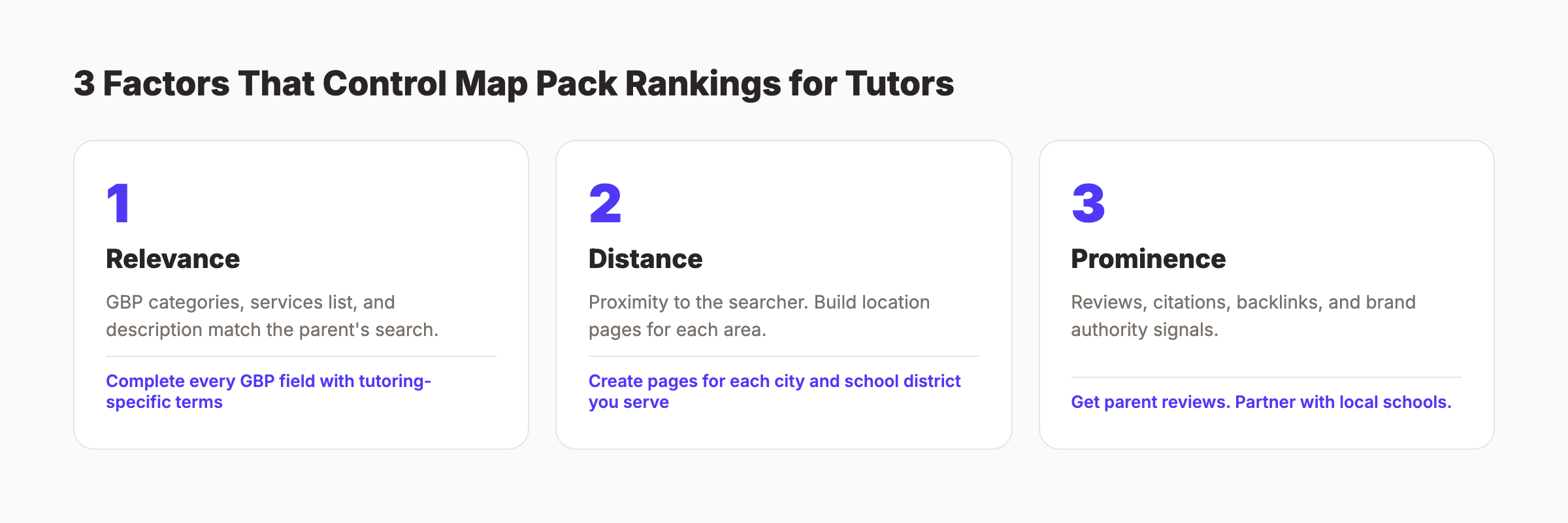
Google ranks local results based on 3 factors:
- Relevance — Does your listing match the search? A complete GBP with accurate categories and services boosts relevance.
- Distance — How close is the searcher to your location? You cannot change this, but you can expand your reach with service area settings.
- Prominence — How well-known and trusted is your business? Reviews, citations, and backlinks all build prominence.
Build Local Citations
A citation is any online mention of your tutoring business name, address, and phone number (NAP). Consistent citations across directories tell Google your business is legitimate.
Submit your tutoring center to these directories:
- Google Business Profile
- Yelp
- Facebook Business
- Apple Maps
- Bing Places
- Thumbtack
- Care.com (for tutoring)
- Wyzant (tutoring directory)
- Tutors.com
- Local Chamber of Commerce
Keep your NAP identical everywhere. Use local SEO tools to audit your listings.
Create Location-Specific Content
If you serve multiple cities or neighborhoods, create a page for each. A tutoring center in the Dallas area might have pages for:
- Math Tutoring in Plano
- SAT Prep in Frisco
- Reading Tutoring in McKinney
- Online Tutoring in Dallas-Fort Worth
Each page should include local landmarks, school district names, and specific details that prove you serve that area. Mention local schools: “We help students from Plano ISD, including Jasper High School and Rice Middle School.”
Earn Local Backlinks
Backlinks from local websites signal trust to Google. Tutoring businesses have unique opportunities:
- School partnerships: Sponsor a math competition or reading challenge. The school links to your website.
- Local news: Offer free test prep workshops before SAT season. Pitch the story to local media.
- Education blogs: Write guest posts about study techniques for local parenting blogs.
- Community events: Host a homework help night at the local library. Get listed on their events page.
Even 5 to 10 quality local backlinks can dramatically improve your domain authority and map pack rankings.
Content Marketing for Tutoring Companies
Content marketing is how tutoring businesses build topical authority and attract organic traffic from parents and students searching for help. A tutoring website with 5 pages cannot compete against one with 50.
Blog Topics That Attract Students
The best tutoring blog content answers questions parents and students already ask.
| Category | Blog Post Examples |
|---|---|
| Study tips | ”7 Study Techniques for Middle School Math,” “How to Study for the SAT in 30 Days” |
| Subject guides | ”Algebra 1 Explained for Parents,” “How to Help Your Child With Reading Comprehension” |
| Test prep | ”ACT vs SAT: Which Test Should Your Student Take?” “GRE Score Guide for 2026” |
| Parent resources | ”Signs Your Child Needs a Tutor,” “How to Choose Between Kumon and a Private Tutor” |
| Seasonal content | ”Back-to-School Study Checklist,” “Summer Learning Loss: What Parents Should Know” |
| Local content | ”Best Study Spots in [City],” “Top-Rated Schools in [District] and How to Get In” |
Publish at least 4 blog posts per month. Each post should target a specific keyword and link to a relevant service page. Over 12 months, that is 48 pieces of content working for you around the clock.
Content Calendar for Tutoring
Align your publishing with the academic calendar. Here is a year-round content calendar framework:
August-September (Back to School): Study habits, grade-specific guides, homework help tips.
October-November (Midterm Season): Test preparation, study schedules, subject-specific review guides.
December-January (SAT/ACT Registration): Test prep content, score improvement guides, “SAT vs ACT” comparisons.
March-April (Exam Season): Final exam prep, AP exam guides, spring SAT/ACT content.
May-June (Summer Planning): Summer learning loss prevention, enrichment program promotion, summer reading lists.
July (Enrollment Push): Back-to-school preparation, assessment offers, “get ahead before school starts.”
The Content Compound Effect
Publishing 1 blog post does almost nothing. Publishing 30 over 6 months creates a network of content that Google sees as authoritative.
Each post links to other posts. Each post links to service pages. Search intent guides the reader from informational content (“how to improve SAT scores”) to your transactional page (“SAT prep tutoring in [city]”).
This compounding effect is why SEO takes time but delivers the highest ROI of any marketing channel for tutoring businesses.
Most tutoring centers publish 0 blog posts per month. Stacc publishes 30 — targeting the keywords parents search every day. That is the difference between page 5 and page 1. Start for $1 →
Reviews and Parent Trust Signals
Parent trust determines whether a tutoring business gets the enrollment. 62% of customers leave a review when asked. Yet most tutoring centers never ask.
Reviews are also a ranking factor. Google uses review quantity, quality, and recency to determine local pack placement. A tutoring center with 80 reviews outranks one with 12 — assuming similar relevance and distance.
How to Get More Parent Reviews
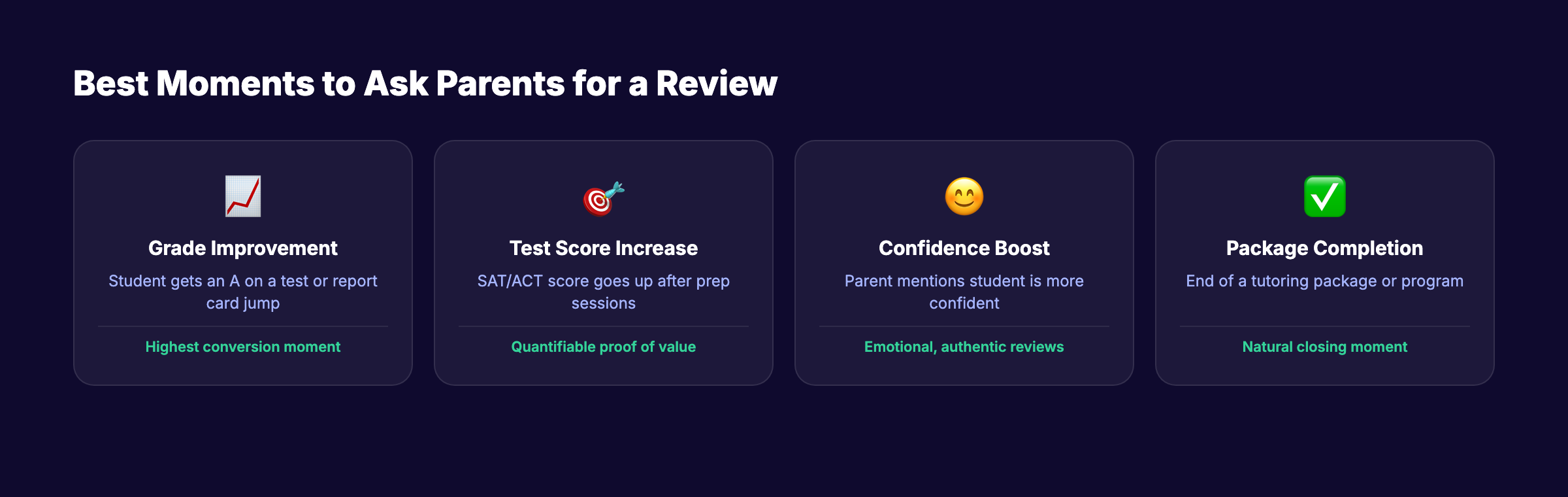
Parents are willing to leave reviews. They just need a prompt at the right moment. The best time to ask is after a measurable student win:
- Student’s grade improves (A on a test, report card jump)
- SAT/ACT score increases
- Student gains confidence (parent mentions it)
- End of a successful tutoring package
Use a review request generator to create personalized ask templates. Send the request via text or email within 24 hours of the positive moment.
Respond to Every Review
Responding to reviews signals engagement to both Google and parents browsing your profile. Use a review response generator to maintain consistency.
For positive reviews, thank the parent and mention the specific service: “Thank you, Sarah. We are glad to see Jake’s algebra grade improve from a C to an A. Our one-on-one math tutoring program made the difference.”
For negative reviews, respond professionally. Acknowledge the concern. Offer to resolve it offline. Never argue.
Trust Signals Beyond Reviews
Reviews are one piece of the trust puzzle. Tutoring businesses should also display:
- Tutor credentials — Degrees, certifications, teaching experience on your website
- Student outcomes — “Average 150-point SAT score increase” with data to back it up
- Parent testimonials — Video testimonials outperform text
- Affiliations — National Tutoring Association membership, local education partnerships
- Background checks — Parents need to know tutors are vetted
Google evaluates E-E-A-T (Experience, Expertise, Authoritativeness, Trustworthiness) for all content. A tutoring website that showcases tutor qualifications and student results ranks higher than one with generic claims.
Technical SEO for Tutoring Sites
Technical SEO ensures Google can find, crawl, and index your tutoring website. Many tutoring businesses build a website and never touch the technical foundation. That is a mistake.
Mobile-First Design
Over 60% of searches happen on mobile. Parents search for tutors from their phones — during soccer practice, at the grocery store, after a parent-teacher conference.
Your tutoring website must load fast and display correctly on mobile. Check your site with Google’s PageSpeed Insights. Aim for a performance score above 80.
Schema Markup
Schema markup tells Google exactly what your business is. For tutoring businesses, implement these schema types:
- LocalBusiness schema — Your NAP, hours, service area, and payment methods. Use the schema markup generator to create the code.
- EducationalOrganization schema — Specific to learning centers. Includes fields for educational programs and course offerings.
- FAQPage schema — Add to pages with FAQ sections. This can earn rich snippets in search results.
- Review schema — Display star ratings in search results. Boosts click-through rates by up to 35%.
Site Speed and Core Web Vitals
Google uses Core Web Vitals as ranking signals. For tutoring websites, focus on:
| Metric | Target | Common Fix |
|---|---|---|
| Largest Contentful Paint (LCP) | Under 2.5 seconds | Compress hero images, use WebP |
| Interaction to Next Paint (INP) | Under 200ms | Remove heavy JavaScript |
| Cumulative Layout Shift (CLS) | Under 0.1 | Set image dimensions |
Most tutoring websites run on WordPress, Wix, or Squarespace. Run a free SEO audit to identify technical issues.
XML Sitemap and Search Console
Submit an XML sitemap to Google Search Console. This tells Google every page on your site. Update it whenever you add new service pages or blog posts.
Measuring Results and ROI
Tutoring SEO only matters if it brings students through the door. Tracking the right metrics tells you what is working and where to invest more.
Set Up Tracking
Install Google Analytics 4 and connect Google Search Console. These are free tools that show exactly how parents find your tutoring website.
Metrics That Matter for Tutoring Businesses
| Metric | What It Tells You | Target |
|---|---|---|
| Organic traffic | How many people find you through Google | Growing month over month |
| Keyword rankings | Where you rank for target terms | Top 10 for service keywords |
| GBP views and actions | How many parents see and interact with your profile | 500+ views/month |
| Conversion rate | Percentage of visitors who contact you | 3-5% for service pages |
| Cost per lead | What each student inquiry costs | Under $20 for organic leads |
Calculate Your SEO ROI
Use this formula to measure content marketing ROI:
Monthly SEO value = (Monthly organic leads) x (Close rate) x (Average student lifetime value)
Example: A tutoring center gets 40 organic leads per month. They close 25% (10 students). Each student pays $200 per month for 6 months ($1,200 lifetime value). Monthly SEO value = 10 x $1,200 = $12,000.
Use the SEO ROI calculator to model your specific numbers.
How Long Before You See Results
- Month 1-2: Technical fixes, GBP optimization, initial content. Minimal ranking changes.
- Month 3-4: Blog posts start indexing. Long-tail keywords begin ranking. GBP visibility increases.
- Month 5-6: Service pages climb in rankings. Organic traffic grows 30-50%. First student inquiries from SEO.
- Month 7-12: Compounding effect kicks in. Multiple pages ranking on page 1. Consistent lead flow.
The tutoring businesses that commit to SEO for the long term see the biggest returns.
Tutoring SEO does not have to take your entire week. Stacc handles keyword research, content creation, and publishing. 30 articles per month. Zero effort from your team. Start for $1 →
FAQ
How much does SEO cost for a tutoring business?
A tutoring center can start SEO for under $200 per month with a service like Stacc that publishes 30 articles monthly. DIY approaches cost nothing but time — expect 10 to 15 hours per week. Agencies charge $1,000 to $5,000 per month. Most independent tutors get the best ROI from done-for-you SEO services.
What keywords should a tutoring business target first?
Start with service + location keywords: “math tutor in [city],” “SAT prep [city],” “reading tutoring near me.” These carry the highest intent. Once those pages rank, expand to informational keywords like “how to improve SAT scores” and “study tips for middle schoolers.”
How do I rank higher than Kumon or Sylvan in my area?
Focus on local signals. Optimize your Google Business Profile completely. Collect parent reviews consistently. Build local citations in every relevant directory. Publish location-specific content mentioning local schools and districts. Franchise websites often have generic content that does not mention local details. That is your advantage.
Is blogging worth it for a small tutoring company?
Yes. A tutoring blog with 30 to 50 posts targeting parent and student questions can generate 500 to 2,000 monthly visitors within 6 months. Each visitor is a potential student inquiry. Blog SEO is the highest-ROI channel for tutoring businesses that cannot afford ongoing ad spend.
Should I focus on SEO or Google Ads for my tutoring center?
Both serve different purposes. Google Ads provide immediate visibility — useful for back-to-school season or a new location launch. SEO builds long-term traffic that costs nothing per click. The best strategy combines a small ad budget for peak seasons with consistent SEO year-round.
How important are reviews for tutoring SEO?
Reviews are a top 3 local ranking factor. Google uses review count, average rating, and recency to rank businesses in the map pack. A tutoring center with 50+ reviews at 4.5 stars outranks competitors with fewer reviews in most local searches. Ask every satisfied parent for a review. Make it easy with a direct Google review link.
Tutoring SEO is not optional in 2026. Parents search Google to find help for their children, and the tutoring businesses that show up first get the students. Start with your Google Business Profile, build service pages for every subject and location, publish content consistently, and collect reviews from every happy family.
The tutoring centers ranking on page 1 today started 6 to 12 months ago. The best time to start is now.
See how Stacc publishes 30 SEO articles per month for tutoring businesses →
Written and published by Stacc. We publish 3,500+ articles per month across 70+ industries. All data verified against public sources as of March 2026.