
Yelp for Business (2026): Setup, Reviews, Ads & Is It Worth It?
Yelp for business guide: page setup, review management, ad costs, the filter algorithm explained, and data on whether Yelp advertising delivers ROI for local businesses.
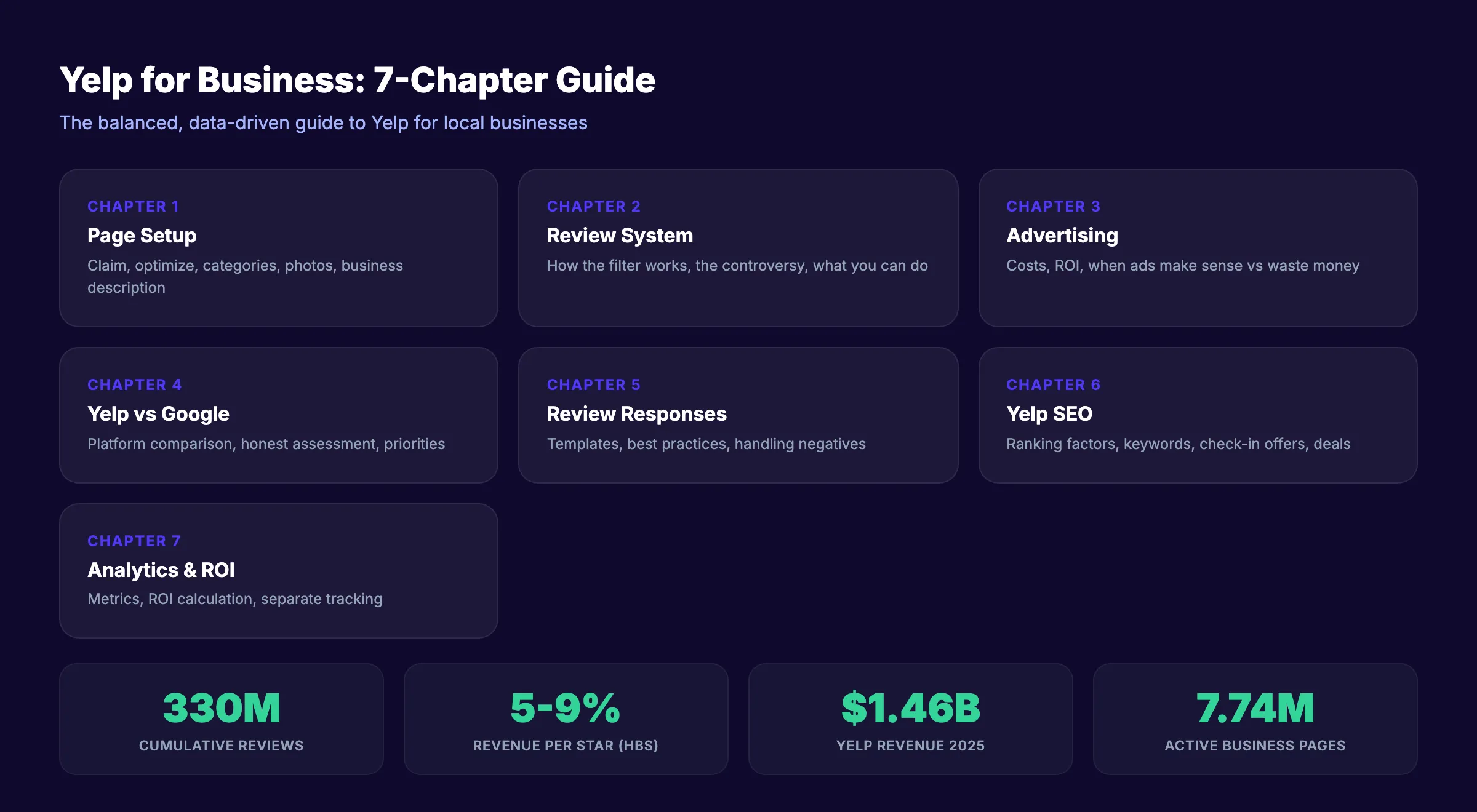
Yelp hosts 330 million cumulative reviews across 7.74 million active business pages. About 50% of Americans consult Yelp before making a purchase decision. And a Harvard Business School study found that a 1-star increase in a Yelp rating leads to a 5 to 9% increase in revenue.
But Yelp for business is also one of the most controversial platforms in local marketing. Business owners complain about filtered positive reviews, aggressive sales calls, and a system that feels designed to push them toward paid advertising.
This guide covers both sides. How to set up and optimize your Yelp business page. How reviews actually work (including the filter). Whether Yelp ads are worth the money. And how Yelp fits alongside Google Business Profile in your local marketing strategy.
We have published 3,500+ SEO articles across 70+ industries. This guide gives you the facts, the data, and the honest assessment.
Here is what you will learn:
- How to claim and optimize your Yelp business page for free
- How the Yelp review filter works and why it hides legitimate reviews
- Whether Yelp advertising is worth the cost for your business
- How Yelp compares to Google Business Profile for local visibility
- The optimization checklist that maximizes your free Yelp presence
Chapter 1: Setting Up Your Yelp Business Page
Every business already has a Yelp page whether you created one or not. Yelp auto-generates listings based on public data. If you have not claimed yours, someone else’s review could be the first impression customers see with no business response attached.
How to Claim Your Page
- Go to biz.yelp.com/claim
- Search for your business name and location
- Verify ownership through phone, email, or documentation
- Complete your business information
Claiming is free. It gives you control over your listing, the ability to respond to reviews, and access to Yelp analytics.
Optimization Checklist
- Enter your exact business name (matching your signage and other listings)
- Add your full street address and local area code phone number
- Set accurate business hours including holiday hours
- Select up to 3 business categories from Yelp’s 1,500+ options
- Add specific services under each category
- Write a 1,500-character description in the “Specialties” section with local keywords
- Complete the “From the Business” section with your brand story
- Add your website URL
- Upload 10+ high-quality photos with keyword-rich filenames (e.g., “italian-restaurant-downtown-seattle.jpg”)
- Turn on all notification types for quick response times
Photos Matter More Than You Think
Users spend 2x longer on business profiles that have photos. Upload images of your storefront, interior, products, team, and finished work. Name each file with descriptive keywords before uploading. Yelp indexes filenames.
For restaurants: food photos, dining area, menu items, team. For service businesses: before-and-after projects, team in uniform, branded vehicles, equipment.
Our NAP consistency guide covers how to keep your business information identical across Yelp, Google, and every other directory.
Chapter 2: How Yelp Reviews Work
Yelp reviews operate differently from Google reviews. Understanding the system is critical before investing time or money in the platform.
The Review Filter
Yelp uses an automated “recommendation software” that classifies every review as either “Recommended” (visible) or “Not Recommended” (hidden). Only Recommended reviews count toward your star rating.
What triggers the filter:
| Factor | How It Affects Reviews | |---|---|---| | Reviewer activity | Infrequent or first-time reviewers are filtered more often | | Profile completeness | Reviewers with no photo, no friends, and no other reviews get filtered | | Review patterns | A sudden surge of reviews triggers filtering | | Sentiment extremes | Extremely positive or negative reviews face more scrutiny | | IP and location signals | Reviews from unusual locations relative to the business get flagged |
The filter is not manually controlled by Yelp employees. It is an algorithm. But the outcomes create predictable frustration for business owners.
The Controversy
Business owners report that positive reviews get filtered at higher rates than negative ones. The most common complaint: a loyal customer leaves a glowing 5-star review, and Yelp hides it because the customer rarely uses Yelp.
Thousands of FTC complaints have been filed. A legal analysis from jlegal.org concluded that “the combination of visibility control and monetization creates predictable economic pressure” on businesses.
Yelp denies any connection between advertising spend and review visibility. Courts have sided with Yelp in multiple lawsuits, ruling that the recommendation algorithm is protected editorial discretion.
What You Can Actually Do
You cannot control the filter. But you can improve your odds:
- Encourage reviews from active Yelp users. Reviews from people who regularly review on Yelp are far less likely to be filtered. A customer who has reviewed 20 businesses will have their review stick. A first-timer will likely get filtered.
- Never ask for reviews directly. Yelp’s terms of service prohibit soliciting reviews. This is the opposite of Google, where asking for reviews is standard practice. Instead, add a “Find us on Yelp” badge to your website and receipts. Let customers find the page themselves.
- Respond to every review. Consistent owner responses signal an active page. Yelp rewards engagement.
- Report clearly fake or policy-violating reviews. Yelp will remove reviews that contain hate speech, conflicts of interest, or irrelevant content. Use the “Report Review” flag on the review itself.
For a broader review management strategy, our respond to Google reviews guide covers templates that work across platforms.
Stop writing. Start ranking. Stacc publishes 30 SEO-optimized articles per month for $99. Built for local businesses. Start for $1 →
Chapter 3: Yelp Advertising. Is It Worth It?
Yelp generated $1.46 billion in revenue in 2025. Most of that comes from advertising. 515,000 business locations pay for ads. The question every business owner asks: should you be one of them?
What Yelp Ads Cost
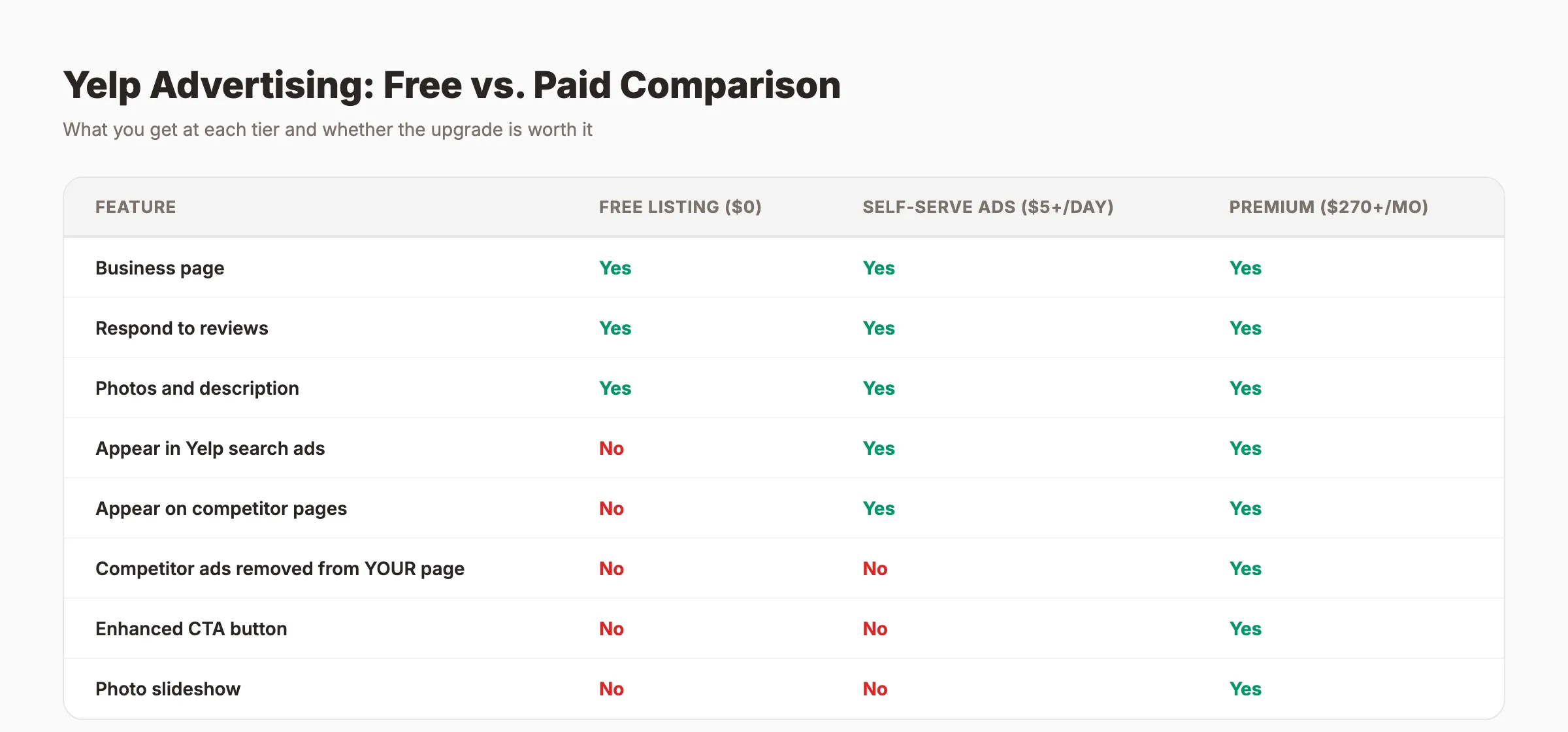
| Feature | Cost | What You Get |
|---|---|---|
| Free listing | $0 | Basic page, reviews, photos, messaging |
| Self-serve ads | $5/day minimum | Appear in search results and competitor pages |
| Typical small biz spend | $300-$500/month | Restaurants, salons, low-competition markets |
| Premium page upgrade | From $270/month | No competitor ads on your page, enhanced CTA, slideshow |
| High-competition CPC | $2-$5+ per click | Legal, dental, home services, major cities |
The Free Listing Problem
On a free Yelp listing, competitor ads appear directly on your business page. A customer finds your restaurant on Yelp, scrolls down, and sees ads for 3 competing restaurants. This is by design. Yelp sells premium page upgrades that remove competitor ads from your page.
When Yelp Ads Make Sense
Yelp claims that advertisers get 2.5x more leads than free listings. The ROI depends on your industry and location.
Yelp ads work well for:
- Restaurants and food service (Yelp’s strongest category)
- Home services (plumbing, HVAC, roofing, cleaning)
- Salons and spas
- Auto repair shops
- Any business in a city where Yelp has strong user adoption
Yelp ads are risky for:
- Businesses in small towns with low Yelp usage
- Industries where Yelp is not a primary discovery channel
- Businesses with fewer than 10 reviews (low credibility)
- Businesses already getting strong results from Google Ads
The Sales Call Experience
Yelp’s sales team is aggressive. Business owners report multiple calls per day, high-pressure tactics, and difficulty canceling. If you decide to advertise, use the self-serve dashboard at biz.yelp.com rather than signing up through a sales representative. Self-serve gives you full control over budget and cancellation.
For a comparison of paid advertising options, our Google Ads vs SEO guide covers when paid search makes sense relative to organic strategies.
Chapter 4: Yelp vs. Google Business Profile
Most local businesses have limited marketing time. Should you invest in Yelp, Google Business Profile, or both?
Platform Comparison
| Factor | Yelp | Google Business Profile |
|---|---|---|
| Monthly reach | ~97 million devices quarterly | 1B+ Google Maps downloads |
| Review solicitation | Prohibited | Allowed and encouraged |
| Free visibility in search | Only within Yelp search | Google Map Pack, Knowledge Panel, organic |
| Competitor ads on your page | Yes (free listings) | No |
| Cost to remove competitor ads | From $270/month | Free (no competitor ads ever) |
| Best industries | Restaurants, home services, salons | All industries |
| Mobile search share | N/A (Yelp app only) | 89.57% (all Google searches) |
| Review trust | High among Yelp users (44% check Yelp) | Highest overall (83% check Google) |
| Ad model | CPC starting $0.50/click | Optional, free organic visibility |
The Honest Assessment
Google Business Profile reaches more people, allows you to ask for reviews, costs nothing, and appears in the search results where 89% of mobile searches happen. For most local businesses, GBP should be the priority.
Yelp remains valuable for restaurants, salons, and home service businesses in metro areas where Yelp usage is high. It is a supplementary channel, not a primary one.
The exception: if your business already has a strong Yelp presence with 50+ reviews and a high rating, maintaining and optimizing that page is worth the effort. That existing social proof drives real decisions.
Our GBP categories guide covers how to optimize your Google Business Profile for local search.
For understanding how reviews impact local rankings, our GBP statistics guide covers the data.
Your SEO team. $99 per month. 30 optimized articles, published automatically. Blog SEO, Local SEO, and Social on autopilot. Start for $1 →
Chapter 5: Responding to Yelp Reviews
Every Yelp review deserves a response. Responding shows potential customers that you care about feedback. It also signals to Yelp that your page is actively managed.
Response Templates
For positive reviews (4-5 stars):
“Thank you, [Name]. We are glad you had a great experience with [specific thing they mentioned]. We look forward to seeing you again.”
Keep it short, personal, and specific. Reference something from their review so it does not read like a copy-paste template.
For negative reviews (1-2 stars):
“[Name], thank you for sharing your experience. We are sorry to hear about [specific issue]. We take this seriously and would like to make it right. Please reach out to us at [phone/email] so we can resolve this.”
Never argue. Never get defensive. Never accuse the reviewer of lying. Other potential customers are reading your response to judge how you handle problems.
For filtered reviews you disagree with:
You cannot respond to Not Recommended reviews. If you believe a review violates Yelp’s content guidelines (fake review, conflict of interest, hate speech), use the “Report Review” function. Yelp will evaluate it within 7 to 14 days.
Response Best Practices
- Respond within 24 hours
- Keep responses under 100 words
- Never offer compensation publicly (it encourages fake negative reviews)
- Thank the reviewer by name
- Address the specific feedback, not generic platitudes
Our respond to Google reviews guide covers response strategies that apply across all review platforms.
Chapter 6: Yelp SEO. Ranking Higher in Yelp Search
Yelp has its own search algorithm. Optimizing for it works similarly to Google local SEO but with Yelp-specific factors.
Yelp Ranking Factors
| Factor | Impact | How to Optimize |
|---|---|---|
| Review count and rating | High | More Recommended reviews with higher stars |
| Review recency | High | Consistent new reviews over time |
| Category match | High | Select the most specific categories |
| Business description keywords | Medium | Include service and location keywords in Specialties |
| Photo count and quality | Medium | Upload 10+ photos with keyword filenames |
| Owner response rate | Medium | Respond to every review |
| Profile completeness | Medium | Fill every available field |
| Check-ins | Low-Medium | Encourage customers to check in on Yelp |
Keywords in Your Yelp Profile
Yelp’s search algorithm indexes the text in your Specialties section, business description, and photo captions. Include your primary services and location naturally.
Example for a plumber in Austin: “Austin emergency plumbing, drain cleaning, water heater repair, sewer line replacement. Serving Austin, Round Rock, Cedar Park, and Georgetown.”
Do not keyword-stuff. Write naturally but include the terms customers actually search for.
Check-in Offers and Yelp Deals
Yelp allows businesses to create Check-in Offers (a free perk for customers who check in on the app) and Yelp Deals (discounted prepaid offers). Both drive engagement signals that help your ranking.
A restaurant might offer “Free appetizer with Yelp Check-in.” A salon might offer “10% off your first visit when you check in on Yelp.” These cost you a small discount but generate the engagement that boosts your visibility.
Our local SEO checklist covers the full setup for ranking across all local platforms.
For broader local search strategy, our Google Maps SEO guide covers how to dominate the Map Pack.
3,500+ blogs published. 92% average SEO score. See what Stacc can do for your business. Start for $1 →
Chapter 7: Yelp Analytics and Tracking ROI
Yelp provides a free analytics dashboard for claimed business pages. Use it to determine whether Yelp is actually sending you customers or just consuming your attention.
Key Metrics in Yelp Analytics
| Metric | What It Tells You | Where to Find It |
|---|---|---|
| Page visits | How many people viewed your listing | Yelp for Business dashboard |
| Customer leads | Calls, directions, website clicks, messages | Yelp for Business dashboard |
| Audience demographics | Age, gender, and location of viewers | Yelp for Business dashboard |
| Revenue per action | How much each lead is worth | Calculate: revenue / customer leads |
| Review velocity | How many new reviews you get per month | Manual tracking |
Calculating Yelp ROI
If you spend $300/month on Yelp ads and receive 15 customer leads, your cost per lead is $20. If your average customer value is $200 and your close rate from Yelp leads is 40%, each $20 lead generates $80 in revenue on average. That is a 4x return.
If your numbers do not show a positive return after 3 months, reduce or stop ad spend. Maintain the free listing regardless.
Tracking Yelp Separately
Use a unique phone number or UTM parameters on your Yelp website link to track Yelp traffic separately from Google and other sources. Without separate tracking, you cannot measure what Yelp actually contributes.
For a full approach to marketing analytics, our SEO reporting guide covers metrics, dashboards, and attribution.
Common Yelp Mistakes
Asking customers for Yelp reviews. This violates Yelp’s terms of service. Unlike Google, Yelp prohibits direct review solicitation. Instead, display a “Find us on Yelp” badge and let customers discover the page organically.
Ignoring your Yelp page. Even if you do not advertise on Yelp, your page exists. Customers are reading it. An unclaimed page with unanswered negative reviews is worse than no page at all.
Arguing with reviewers publicly. A defensive response to a negative review looks worse than the review itself. Acknowledge, apologize, and move the conversation offline.
Paying for ads before optimizing your free listing. A business with 3 reviews and no photos will waste every dollar spent on Yelp ads. Complete your profile, build your review base, and then consider advertising.
Treating Yelp as your primary marketing channel. Yelp is a supplementary platform. Google Business Profile, your website, and SEO should come first. Yelp supports those efforts. It does not replace them.
Not uploading photos. Profiles with photos get 2x more time on page. An empty profile with just text suggests the business is closed or inactive.
For a broader view of how reputation fits into local marketing, our SEO small business guide covers the full local marketing stack.
FAQ
Is Yelp free for business owners?
Yes. Claiming and managing a Yelp business page is free. You can add photos, respond to reviews, update your information, and access basic analytics at no cost. Paid advertising and premium page features are optional.
How much does Yelp advertising cost?
Self-serve ads start at $5 per day. Most small businesses spend $300 to $500 per month. Premium page upgrades that remove competitor ads from your listing start at $270 per month. Cost per click varies by industry and location, from $0.50 to $5+.
Why does Yelp filter my positive reviews?
Yelp’s recommendation algorithm filters reviews based on reviewer behavior, not review content. Reviews from first-time or infrequent Yelp users are most likely filtered. The system is automated and cannot be overridden by business owners or Yelp sales representatives.
Should I use Yelp or Google Business Profile?
Google Business Profile should be your priority. It reaches more people, appears in Google search results, and allows you to ask for reviews. Yelp is worth maintaining as a supplementary platform, especially for restaurants, home services, and salons in metro areas.
Can I remove my business from Yelp?
No. Once a Yelp listing exists, it cannot be deleted. You can claim the page and manage it, but you cannot remove it entirely. This is why claiming and optimizing your page is important even if you do not plan to advertise.
Is Yelp advertising worth it for small businesses?
It depends on your industry and location. Yelp ads work well for restaurants, home services, and salons in cities with strong Yelp adoption. They are less effective for businesses in small towns or industries where Yelp usage is low. Start with the self-serve $5/day option and track results before committing to larger budgets.
Rank everywhere. Do nothing. Blog SEO, Local SEO, and Social on autopilot. Stacc starts at $99/mo with a $1 trial. Start for $1 →
Yelp is not the most important platform for local businesses. Google is. But Yelp still influences buying decisions for millions of consumers. Claim your page, optimize it, respond to every review, and use it as one piece of a broader local marketing strategy. The businesses that win are the ones visible on every platform their customers check.

Written by
Siddharth GangalSiddharth is the founder of theStacc and Arka360, and a graduate of IIT Mandi. He spent years watching great businesses lose organic traffic to competitors who simply published more. So he built a system to fix that. He writes about SEO, content at scale, and the tactics that actually move rankings.
Automate your Google Business Profile content
30 GBP posts, local SEO articles, and review responses. Published every month automatically.
30-day trial · Cancel anytime
theStacc
Stop writing SEO content manually
30 blog articles, 30 GBP posts, and social media content. Published every month. Automatically.
Try for free$1 for 3 days · Cancel anytime