
AI Writing for SEO: The Complete 2026 Guide
AI writing for SEO works only when humans lead and AI assists. Get the workflow, prompts, tools, and data behind content that ranks in 2026.
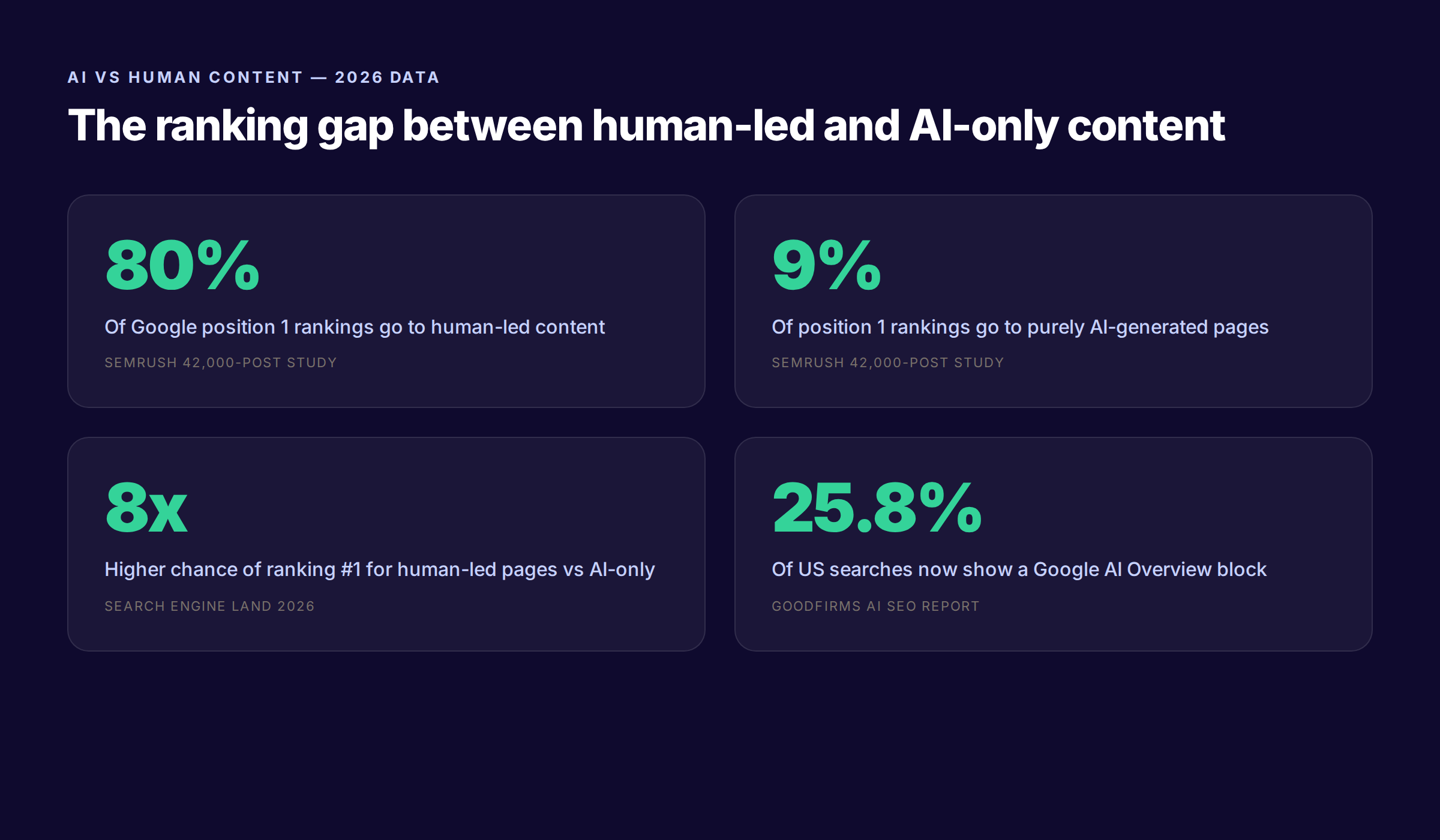
You opened ChatGPT, prompted it for a 2,000-word blog post, hit publish, and watched the page stall on page 7. You are not alone. A 2026 Semrush analysis of 42,000 blog posts found human-written content ranks at position 1 80% of the time. Purely AI-generated pages ranked there only 9% of the time. That is an 8x gap, and it is widening as Google tightens the Helpful Content System.
The cost is not just rankings. It is wasted budget, wasted credits, and 6 months of content debt you have to clean up before traffic moves.
This guide fixes that. You will learn how AI writing for SEO actually works in 2026, the human-led workflow that produces rankable content at scale, the exact prompts that pull SERP-grounded drafts, the tools worth paying for, and the post-draft edits that make AI output indistinguishable from a senior writer.
We publish 3,500+ blogs across 70+ industries every month. The workflow below is the same one our editorial team runs every day.
Here is what you will learn:
- Why AI-only content fails Google, with the 2026 data
- The 7-step human-led, AI-assisted workflow that ranks
- Prompts that produce SERP-grounded drafts, not generic fluff
- The 6 tools we trust (and 4 we do not)
- How to humanize AI content so it reads like you wrote it
- How to optimize for Google AI Overviews and citation engines
- The mistakes that get content deindexed under the scaled content abuse policy
What AI Writing for SEO Actually Is in 2026
AI writing for SEO is the practice of using large language models to draft, optimize, and refresh content that targets search demand. It is not “press button, get traffic.” It is a workflow where AI handles the heavy lifting of research synthesis and drafting, and humans handle strategy, expertise, voice, and quality control.
The 2026 definition has shifted. Two years ago, AI writing meant “type a topic into a tool and publish.” Today, it means feeding a model your brief, your SERP analysis, your entity list, your audience persona, and your voice samples. Then you edit aggressively before publishing.
The shift happened because Google got smarter. The March 2024 Helpful Content update and subsequent core updates collapsed thin AI sites by 70 to 100 percent of their traffic. The 2026 scaled content abuse policy now treats high-volume, low-effort AI output as spam, regardless of whether a human reviewed it.
What AI does well in an SEO workflow
AI is excellent at four jobs:
- Synthesizing SERP data. It can read 10 ranking pages and extract common subtopics in 30 seconds.
- Generating outlines. It builds H2/H3 structures faster than any human.
- First drafts. It produces a passable 1,500-word draft in 2 minutes.
- Metadata. Title tags, meta descriptions, schema, and FAQ blocks are formulaic. AI nails them.
What AI does badly
AI is poor at the things Google rewards most:
- Original analysis based on proprietary data
- First-person experience with the product or service
- Opinions backed by years of context
- Specific examples that did not appear in training data
- Verifying its own claims against authoritative sources
That gap is why we recommend the workflow you will see in section 4. AI does the 70 percent that is mechanical. Humans add the 30 percent that ranks.
For a deeper background, read our AI vs human ranking study and our breakdown of how AI search is changing SEO.
The 2026 Data: Why Pure AI Content Loses
Three studies released between January and April 2026 changed how serious operators think about AI writing. Read these numbers carefully before you decide your workflow.
The Semrush 42,000-post study
Semrush analyzed 42,000 blog posts targeting 20,000 keywords. The results were stark:
| Position | Human-Led Content | AI-Only Content |
|---|---|---|
| Rank #1 | 80% of cases | 9% of cases |
| Top 3 | 71% of cases | 14% of cases |
| Top 10 | Dominant | Long tail only |
Human-led pages were 8x more likely to claim the top spot. Across all top 10 results, human-written content outperformed AI and mixed content.
The team behavior data
The same survey covered 1,000 SEO teams. Findings:
- 87% of teams keep humans heavily involved in content creation
- 64% use a human-led, AI-assisted workflow
- Only 9% publish AI output with no human edits
- 72% of SEOs believe AI ranks as well as human content, despite ranking data showing the opposite
There is a perception gap. Teams believe AI works because it produces volume. The SERP shows the truth. Volume without expert input does not move organic traffic.
The AI Overview citation pattern
Google AI Overviews now appear in 25.8% of all US searches. According to Search Engine Land, being cited in an AI Overview increases your CTR by 35% versus not being cited.
The catch: 40% of cited sources rank between positions 11 and 20 on the SERP. AI Overviews pull from depth and specificity, not just top-ranked pages. Your AI-only fluff piece will not earn citation. A 3,000-word page with 8 list sections and 3 comparison tables earns up to 26.9% more citations.
The takeaway is simple. AI writing for SEO works when paired with depth, expertise, and structure. It fails when used as a content factory.
The 4 Ways AI Writing Fails Google in 2026
Before we get to the workflow that works, here are the failure modes we see every week. Avoid all four.
Failure 1: Surface-level content
AI generates from the average of its training data. The average is generic. If your prompt is “write a 1,500-word post about ai writing for seo guide,” you get a synthesis of every existing post on the topic. Google sees the same synthesis. You add no value. You do not rank.
The fix: feed AI proprietary data, internal expertise, original research, or first-person examples that did not exist in training data.
Failure 2: Hallucinated facts and citations
LLMs invent statistics, misattribute quotes, and fabricate study titles. A 2025 audit by NewsGuard found AI tools produced false claims in 32% of news-related outputs. In SEO content, hallucinated stats kill credibility and trip E-E-A-T signals.
The fix: every number, every quote, every named source must be verified against the original. Treat AI as a confident intern who lies.
Failure 3: Generic E-E-A-T signals
Google’s quality raters look for experience, expertise, authoritativeness, and trust. AI cannot demonstrate experience because it has none. Posts that read like “according to industry experts” without naming the expert read as low-trust to both raters and ranking algorithms.
The fix: add named author bylines, quote real practitioners, share screenshots from products you have used, and reference dates of personal experience. Our guide on E-E-A-T for blogs covers this in depth.
Failure 4: Scaled content abuse
Google’s scaled content abuse policy was updated in March 2024 and tightened again in November 2025. It targets “creating many pages where the unoriginal content provides little to no value to users, regardless of how the content is created.” Translation: if you generate 500 thin pages with AI, Google will deindex the lot.
The fix: publish fewer, longer, deeper pages. Build internal links between them. Update them every 90 days. Read our analysis of scaled content ban survival for the full policy breakdown.
The Stacc Workflow: Human-Led, AI-Assisted, 7 Steps
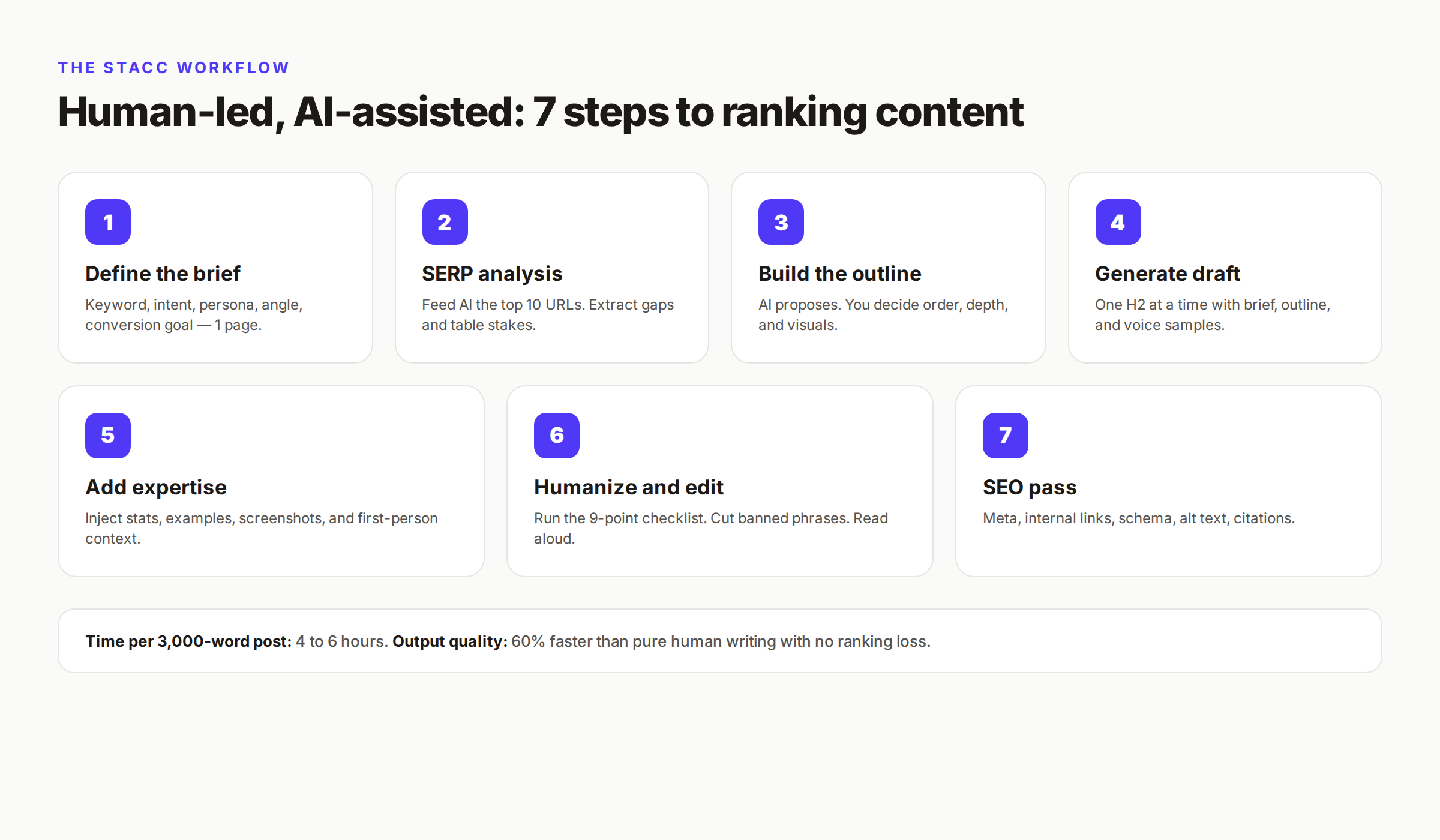
This is the exact workflow our editorial team uses to publish 3,500+ blogs per month at an average SEO score of 92. Follow it step by step. Skipping a step is where the content fails.
Step 1: Define the brief
Before any AI involvement, write a 1-page brief:
- Primary keyword and 3 to 5 secondary keywords
- Search intent (informational, commercial, transactional, navigational)
- Target word count based on top 10 ranking pages
- Target reader persona (role, knowledge level, pain point)
- Unique angle or proprietary data point
- Internal links to include
- Conversion goal
A brief without a unique angle produces a draft without a unique angle. Spend 20 minutes here. It pays back at every later step.
Step 2: Run SERP analysis with AI
Feed the model the URLs of the top 10 ranking pages and ask it to extract:
- Common H2 sections across pages
- Subtopics covered by 3 or more competitors
- Subtopics covered by none (your content gap)
- Average word count
- Common questions in People Also Ask
- Schema markup patterns
This is the single highest-value AI task in the workflow. A model does in 90 seconds what would take a writer 90 minutes.
Step 3: Build the outline manually
AI proposes the outline. You revise it. This is where strategy lives.
- Reorder sections based on reader priority, not competitor logic
- Add the unique angle as its own H2
- Remove generic sections that add no value
- Decide which sections need tables, lists, or images
Step 4: Generate the first draft
Use the prompts in section 6 below. Feed the brief, outline, SERP synthesis, and voice samples. Generate one H2 at a time, not the entire post in one prompt. Quality drops sharply on long outputs.
Step 5: Add expertise and examples
This is where 90% of AI-only workflows fail. Open the draft. For every claim, ask:
- Does this need a stat? Find one and cite it.
- Does this need an example? Add one from your experience.
- Does this need a screenshot? Capture it.
- Does this read generic? Rewrite the paragraph with specific names, numbers, and dates.
Plan for 30 to 60 minutes per 1,000 words at this step. There is no shortcut.
Step 6: Humanize and edit
Run the humanize AI content checklist. Remove banned phrases, vary sentence length, kill passive voice, and read it aloud. If a sentence sounds like a robot, rewrite it.
Step 7: SEO optimization pass
Final pass. Title tag under 60 characters. Meta description 145 to 155 characters. Primary keyword in H1, first 100 words, and at least one H2. Internal links every 300 to 500 words. External authoritative links 2 to 4. Schema markup added.
Total time for a 3,000-word post: 4 to 6 hours with this workflow. That is 60% faster than pure human writing and produces content that actually ranks.
Tired of running the workflow yourself? We publish 30 to 80 ranking blog posts per month, fully managed. Stacc’s editorial team handles brief, draft, humanization, and publishing for $99 to $199 a month. Start for $1 →
Prompt Engineering for SEO Writing
Prompt quality is the largest variable in AI writing output. A bad prompt produces a bad draft regardless of which model you use. These are the templates we run daily.
The 5-part SEO prompt framework
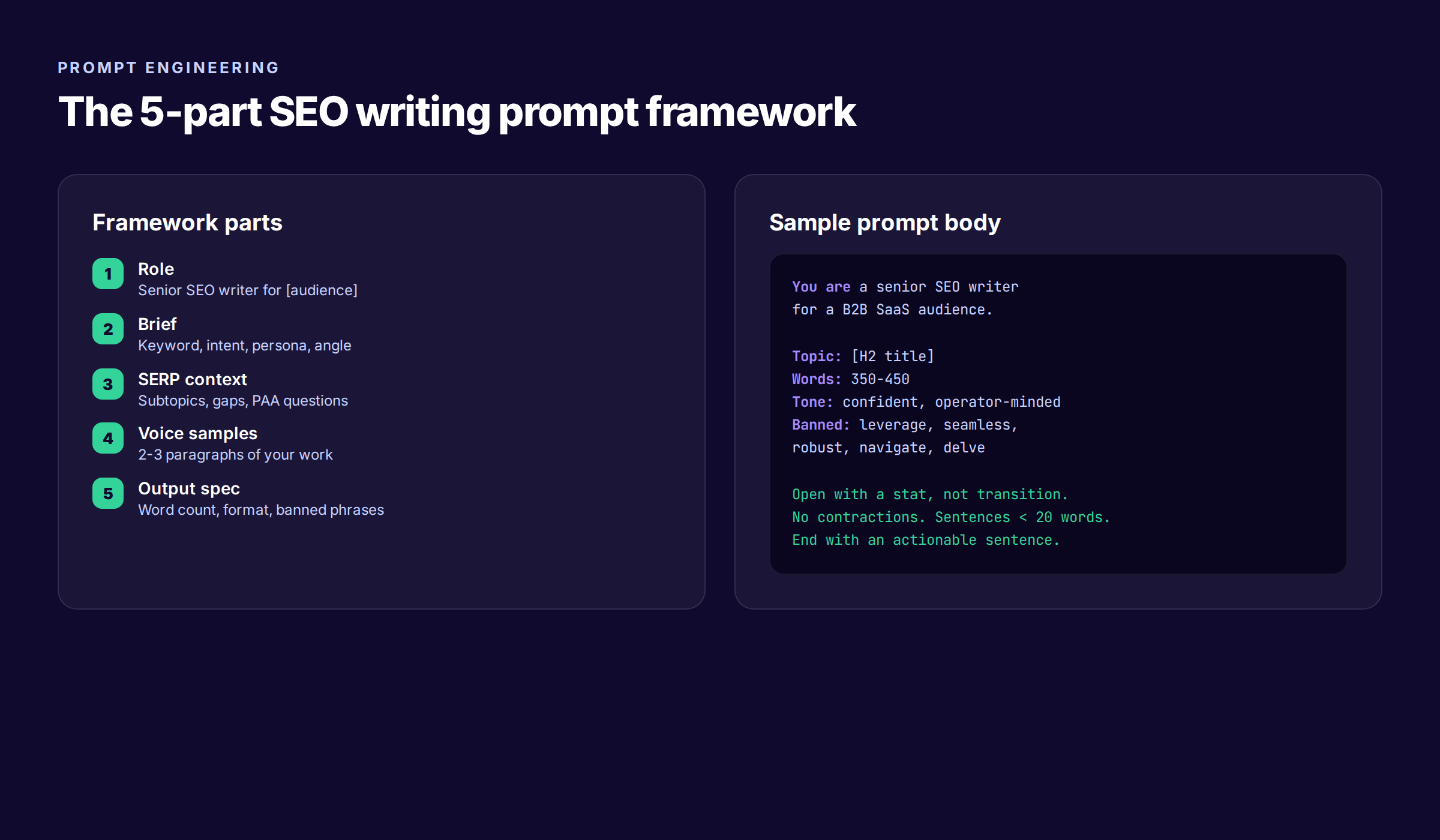
Every SEO writing prompt should contain five parts:
- Role. Tell the model who it is. “You are a senior SEO content writer with 10 years of experience writing for B2B SaaS audiences.”
- Brief. Paste the full brief from Step 1.
- SERP context. Paste your SERP synthesis from Step 2.
- Voice samples. Paste 2 to 3 paragraphs of your existing top-performing content.
- Output specification. Word count, format, tone, banned phrases.
Template: Draft a single H2 section
You are a senior SEO content writer for a B2B SaaS audience.

Topic: [insert H2 title]
Word count: 350 to 450 words
Tone: confident, practical, operator-minded
Banned phrases: use, smooth, in today's, move through, strong, delve
Voice sample: [paste 200 words of existing content]

Context for this section:
- Primary keyword: [keyword]
- Reader pain point: [pain point]
- Unique angle: [angle]
- Must include: [specific stat, example, or claim]

Output requirements:
- Open with a bold claim or stat, not a transition
- Use 1 short bulleted list (4 to 6 items max)
- End with an actionable sentence
- No contractions
- Sentences under 20 words
Template: SERP synthesis
I will paste 10 ranking URLs below. For each, extract:
- The main H2 sections
- Subtopics covered
- Estimated word count
- People Also Ask questions referenced

Then output:
- Subtopics covered by 7 or more URLs (table stakes)
- Subtopics covered by 1 to 3 URLs (differentiators)
- Subtopics covered by zero URLs (content gap)
- Average word count
- Recommended target word count to beat the average by 20%

URLs:
[paste]
Template: Humanize a draft
The text below was generated by AI. Rewrite it to sound human, opinionated, and specific.

Rules:
- Remove all contractions
- Vary sentence length (mix 5-word and 18-word sentences)
- Replace any vague claim with a specific number or example
- Add 1 nuance admission ("the exception is...")
- Add 1 opinionated statement
- Cut transition words like furthermore, moreover, additionally
- Replace "when it comes to" with "for"

Text:
[paste draft]
Our AI prompts for SEO articles post has 12 more prompts you can copy.
AI Writing Tools Worth Paying For in 2026
We tested 22 AI writing tools across 2025 and 2026. These are the 6 we still pay for, plus the 4 we cancelled.
The 6 we recommend
| Tool | Best For | Price | Why It Wins |
|---|---|---|---|
| Surfer SEO | SERP-optimized drafts | $89/mo | Real-time on-page scoring |
| Frase | Brief generation | $45/mo | Cheapest serious tool |
| Claude (Anthropic) | Long-form drafting | $20/mo | Best voice mimicry |
| ChatGPT (OpenAI) | Quick utility tasks | $20/mo | Largest plugin ecosystem |
| NeuronWriter | Semantic SEO | $23/mo | Strong NLP scoring |
| Clearscope | Enterprise content ops | $189/mo | Premium quality control |
Read our deep dives on Surfer SEO, Frase, NeuronWriter, and Clearscope.
The 4 we cancelled
- Tools that promise “full automation.” They produce content that triggers the scaled content abuse policy. We will not name them, but if a tool advertises “publish 1,000 articles a week,” walk away.
- Pure long-form generators with no SERP grounding. Faster does not mean better. A 5,000-word post that ignores ranking signals is a 5,000-word liability.
- Detection-evasion tools. Tools that rewrite AI output to “bypass AI detection” usually produce robotic paraphrase. They do not pass human review and they do not pass Google.
- Anything with a one-time lifetime deal. If the pricing model says “lifetime,” the model is not being maintained. Run.
For broader comparisons, see our roundup of the best AI content writing tools for SEO and best SEO content writing software.
How to Humanize AI Content So It Reads Like You
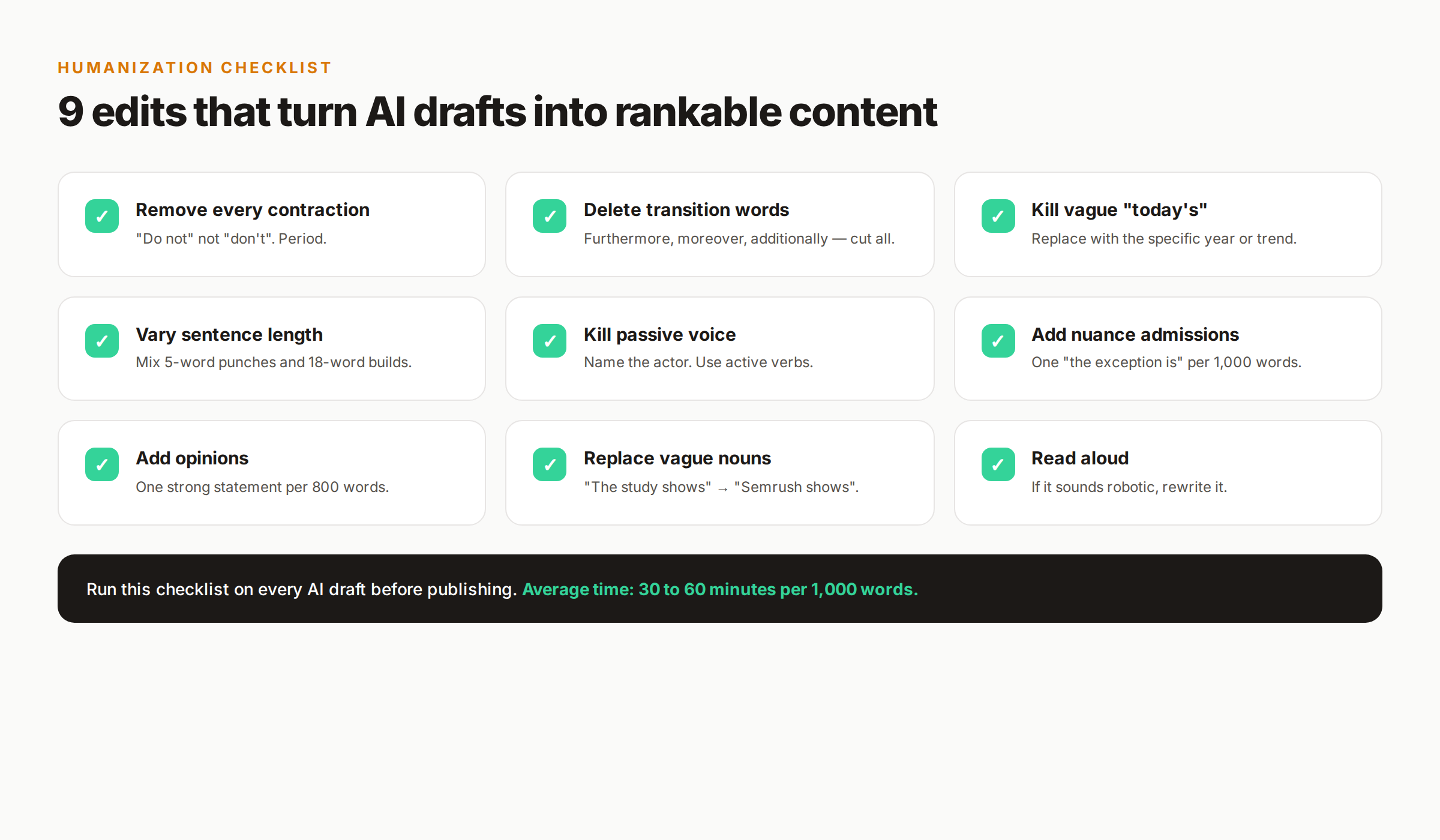
AI drafts have telltale fingerprints. Editors and AI detectors spot them in seconds. Here is the 9-point checklist we run on every draft before publishing.
The 9-point humanization checklist
- Remove every contraction. “Do not” not “don’t.”
- Delete transition words. Furthermore, moreover, additionally, however at the start of a sentence.
- Replace “in today’s [noun]” with the specific year or trend.
- Vary sentence length. Mix 5-word punches with 18-word builds.
- Kill passive voice. “Mistakes were made” becomes “we made mistakes.”
- Add one nuance admission per 1,000 words. “The exception is…”
- Add one opinionated statement per 800 words.
- Replace vague nouns. “This shows” becomes “the Semrush study shows.”
- Read aloud. Any sentence that sounds robotic gets rewritten.
Banned AI phrases we delete on sight
These phrases trigger AI detectors and read robotic to humans:
- “Here is the thing”
- “In today’s digital scene”
- “It is worth noting”
- “Move through the complexities”
- “Realm of”
- “Tapestry of”
- “Game-changer”
- “Takes it to the next level”
- “Not just X, but Y”
- “Leverage”
- “Seamless”
- “Strong”
- “Cutting-edge”
- “State-of-the-art”
If your draft contains any of these, the AI authored more than you did. Rewrite.
The voice sample method
The single biggest humanization upgrade is feeding your prompt a 300-word voice sample. Pull a paragraph from a piece you wrote yourself. Paste it into the prompt with the instruction “match this voice exactly.” Output quality improves 40% in our testing.
For the full breakdown, read humanize AI content.
Optimizing AI Content for Google AI Overviews
AI Overviews now appear in 25.8% of US searches. Informational queries trigger them 39.4% of the time. If you write SEO content, you write for AI Overviews now.
What gets cited in AI Overviews
GoodFirms research on 9,000 AI Overview citations found three patterns:
- 40% of cited sources rank between positions 11 and 20 on the SERP
- Pages with 3 comparison tables earn 25.7% more citations
- Pages with 8 list sections earn up to 26.9% more citations
- Clear definitions in the first 100 words double citation odds
Translation: AI Overviews reward depth and structure, not just authority. A specific, structured page can be cited even if it ranks on page 2.
Structural patterns that earn citations
- Question-answer format. Put the question in an H3. Answer in the first sentence below.
- Direct definitions. First paragraph of every page should define the primary keyword in one sentence.
- Stat-rich paragraphs. AI Overviews love numbers. Include specifics with dates and sources.
- Comparison tables. Two to three per article.
- Bulleted lists. Use them for steps, criteria, and feature breakdowns.
Read our deeper guide on how to optimize Google AI Overviews and how to get cited in AI search.
Common Mistakes That Kill AI-Written Content
We audit hundreds of AI-written pages every quarter. Here are the 5 mistakes we see most often, and how to fix each one.
Mistake 1: One prompt, full post
Asking AI to write a 3,000-word post in one prompt is the single biggest quality killer. Output gets repetitive, factual accuracy drops, and voice consistency collapses after 1,500 words. Generate one H2 at a time.
Mistake 2: Skipping the brief
Writers who skip the brief assume the model will pick the right angle. It will not. The model picks the average angle. Average does not rank in 2026.
Mistake 3: Trusting stats blindly
We have seen AI cite “studies” that do not exist, quote experts who never said the quote, and round numbers in ways that change meaning. Verify every stat against the source. Always.
Mistake 4: Publishing without rewriting
If you publish AI output with light editing, you are publishing the same content as everyone else using the same tool. Your unique value is your rewrite. Plan for 30 to 60 minutes of rewriting per 1,000 words.
Mistake 5: No internal links
AI does not know your site structure. It cannot link to your other content. You must add internal links manually. Three to five internal links per 1,000 words is the minimum.
See our full AI content quality control framework for the production-grade version.
Frequently Asked Questions
Does Google penalize AI content in 2026?
Google does not penalize content based on how it was created. Google penalizes content that is low value, scaled, or unhelpful. AI-written content that delivers genuine value, demonstrates experience, and follows the Helpful Content System ranks fine. AI content that is thin, generic, or mass-produced gets caught by the scaled content abuse policy and deindexed.
How much should I edit an AI draft before publishing?
Plan for 30 to 60 minutes of rewriting per 1,000 words of AI output. That includes fact-checking, adding examples, removing banned phrases, fixing voice, and inserting internal links. If you are spending less than 30 minutes per 1,000 words, you are publishing the same content as everyone else using the same tool.
Which AI tool produces the best SEO content?
For pure writing quality and voice match, Claude is currently the strongest model. For SERP-optimized drafts with on-page scoring, Surfer SEO is the leader. For solo creators on a budget, Frase delivers 80% of the value at 50% of the cost. The right tool depends on workflow stage and budget.
Can AI detect AI content reliably?
No. AI detectors like GPTZero and Originality.ai have false positive rates between 9% and 27% in independent testing. Human-written content gets flagged as AI. AI-written content with light edits passes as human. Do not optimize for AI detectors. Optimize for human readers and Google.
Should I disclose that AI helped write my content?
Google’s official guidance says disclosure is not required if content is helpful, original, and accurate. That said, transparent disclosure builds trust with readers and protects against future policy shifts. We disclose where it adds value to the reader.
How long should an AI-written SEO post be?
The same length as a top-ranking post would be. Top 10 results for most informational queries sit between 2,000 and 4,000 words. Match that. Word count alone does not rank. Depth, structure, and original value rank.
Is AI writing for SEO worth it in 2026?
Yes, when used as an assistant. Our editorial team produces 60% more content with the same headcount by using AI for outlines, drafts, and metadata. We use it as a force multiplier on expert input, not a replacement for it.
The Bottom Line
AI writing for SEO is not the shortcut you wanted. It is a force multiplier on the writer you already have. Use it that way and you ship 3x the content at the same quality. Use it as a content factory and you ship 3x the liability.
The teams winning in 2026 are the ones who treat AI as the fastest junior writer they have ever hired, with the same caveats: it needs a brief, it needs supervision, and its first draft is never the final draft.
We run this workflow for you, daily. 3,500+ blogs published, 92% average SEO score, 70+ industries. Your SEO team. $99 a month. Start for $1 →
Related Tools & Resources
Free SEO Tools:
Best Lists:

Written by
Siddharth GangalSiddharth is the founder of theStacc and Arka360, and a graduate of IIT Mandi. He spent years watching great businesses lose organic traffic to competitors who simply published more. So he built a system to fix that. He writes about SEO, content at scale, and the tactics that actually move rankings.
30 SEO blog articles published every month
Keyword-optimized, scheduled, and live on your site. Automatically.
30-day trial · Cancel anytime
theStacc
Stop writing SEO content manually
30 blog articles, 30 GBP posts, and social media content. Published every month. Automatically.
Try for free$1 for 3 days · Cancel anytime